
Quick Look: The Danger of Loving Minecraft

Slate author Lisa Guernsey loves all the great things Minecraft has taught her girls, but also laments the day it entered her house. “I love that they are creating things, talking about their creations, and planning ahead for new projects. But I hate that the real thing—their Legos, the cardboard boxes saved for building forts—can’t … Continue reading Quick Look: The Danger of Loving Minecraft

Can Kids Be Taught Persistence?

Flickr:Miish

By Jennie Rose

In his new book How Children Succeed: Grit, Curiosity, and the Hidden Power of Character, author Paul Tough makes the case that persistence and grit are the biggest indicators of student success. Being resilient against failure, he says, is the fundamental quality we should be teaching kids, and he gives examples of where that’s being done.

Dominic Randolph, the headmaster at the elite Riverdale Country School in the Bronx, New York, who believes students don’t know how to fail, is one of the sources in Tough’s book who has set out on a road to change an “impoverished view” of learning. Rather than producing students adept at “gaming” the system, “we have got to change the educational system to think about different outcomes and different capacities,” he says.

Another primary source in the book is David Levin, co-founder of the charter KIPP Academy, who developed a student character report card to cultivate this resilience and self control in his students. With Levin’s KIPP Academy as a case study, Tough tracks persistence among low-income kids who aim to go to college, taking special note of those who have the skill in

engaging with people who are different from them, or what educators refer to as “code switching.” Tough’s research indicates that students who possess this “code switching” ability, as well as self control, optimism, and curiosity, also show an ability to recover from setbacks.

At KIPP Academy, kids wear school spirit sweatshirts with pro self-control slogans like “Don’t Eat the Marshmallow!”– a nod to Walter Mischel’s renowned cognitive psychology study on self Continue reading Can Kids Be Taught Persistence?

Letting Fourth Graders Solve the World’s Problems

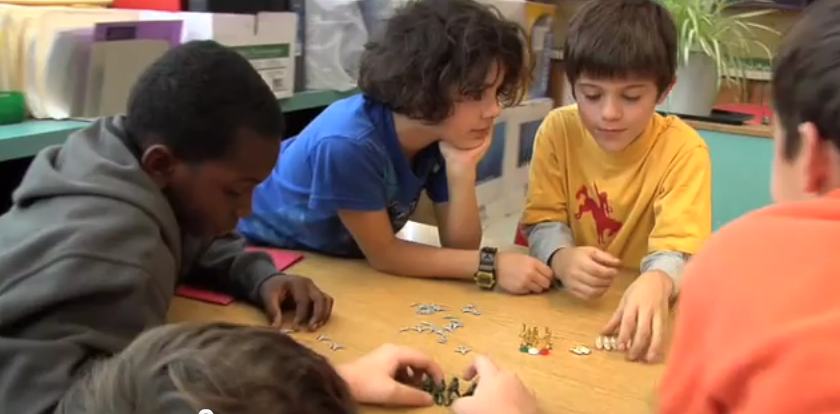
John Hunter puts all the problems of the world on a 4’x5′ plywood board and lets his 4th-graders solve them. In this TED Talk, Hunter, who’s been named one of Time Magazine’s education activists for 2012, explains how his World Peace Game engages schoolkids, and why the complex lessons it teaches — spontaneous, and always surprising — go further than classroom lectures can.

Students must deconstruct a 13-page crisis document with interlocking problems like ethnic and Continue reading Letting Fourth Graders Solve the World’s Problems

74 Creative Ways to Stop Summer Brain Drain

[/caption]

Keep kids’ brain muscles flexed with fun learning exercises. This year’s Summer Learning Series features 10 Awesome Outdoor Learning Ideas, 10 Fun Indoor Learning Projects, Four Ways to Prepare for College This Summer, and to round out the numbered lists, this collection from Accredited Online Colleges.

READING AND WRITING

  1. Keeping up with reading and writing skills over the summer is key to maintaining learning throughout the year — so pay special attention to these creative learning activities.
  2. Create a book club: Make reading social with a summer book club for kids
  3. Keep a journal: Encourage kids to stay sharp in their writing by keeping a journal, discussing summer activities and more.
  4. Find summer writing camps: Older kids can check out summer writing camps, often available through local newspapers.
  5. Read throughout the day: Offer reading opportunities morning, noon, and night, with the newspaper, websites, books, magazines, and more.
  6. Write a comic strip: Develop creativity, writing, and humor with a fun comic strip.
  7. Read books about summer activities: Before heading to the beach or a baseball game, pick Continue reading 74 Creative Ways to Stop Summer Brain Drain

Good Read: Want To Fix the Tech Gender Gap? Make Girls Play Video Games

Interesting premise: getting girls interested in video games will also lead them to learn how to they’re made. “The leap toward more advanced computing comes not only from playing games—today, 94 percent of girls are gaming, compared with 99 percent of boys—but in becoming curious about how they work and then beginning to tinker with … Continue reading Good Read: Want To Fix the Tech Gender Gap? Make Girls Play Video Games

Quick Look: Video Games to Train Middle-Schoolers’ Mindfulness, Empathy

If it’s true that by the time Americans turn 21, they will have spent 10,000 hours playing online video games, then this news should be welcome. Researchers at the University of Wisconsin-Madison will design two educational games aimed at helping eighth-graders develop the opposite of what video games are criticized of developing: empathy, cooperation, mental … Continue reading Quick Look: Video Games to Train Middle-Schoolers’ Mindfulness, Empathy

Augmented Reality: Coming Soon to a School Near You?

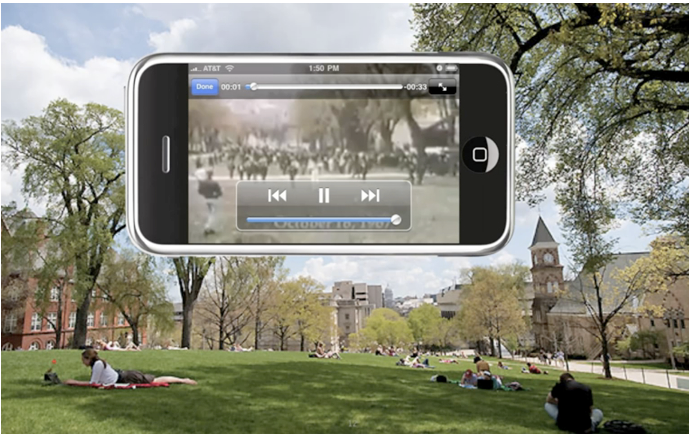
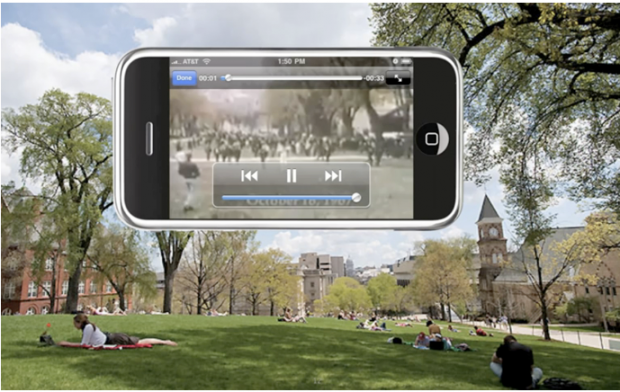
In “Dow Day,” an augmented reality game, middle school students walk the University of Wisconsin-Madison campus using mobile phones to view footage of Vietnam war protests that occurred in the same campus locations.
By Sarah Jackson

David Gagnon is talking to a group of educators about how to use mobile devices for learning. In his work as an instructional designer with the University of Wisconsin’s ENGAGE program, Gagnon has given this workshop many times. But these days, he says, things are starting to change.

“How many of you are currently using an iPhone, iPad, or iPod touch?” Gagnon asks the teachers, who are participating in a webinar through ISTE, the International Society for Technology in Education.

What happens next demonstrates how the availability of communications technology has grown exponentially in recent years: 89 percent of this group owns a mobile device, and they want to know how to use it in their classrooms.

“Two years ago, when we would do a workshop with 20 people, we would have to bring 10 devices. Now,” Gagnon says, “the 10 devices sit in the front of the room, and everyone pulls out their own. It’s just amazing.”

As schools’ acceptance of mobile tools such as smartphones and tablets becomes more widespread, educators are struggling with how to incorporate them into current teaching models. Experts say schools need to get beyond the technology cart—treating these tools as accessories that get wheeled in and wheeled out an hour later—and educators need guidance on how to change their teaching practices to take advantage of what mobile learning has to offer. Yet examples of what these new pedagogical models might look like are hard to come by.

Gagnon and his team may be able to help. As the minds behind Augmented Reality and Interactive Storytelling (ARIS), they’ve developed an open-source mobile learning platform educators can download onto an iPhone, iPad or iPod Touch to create place-based and narrative gaming activities that can be incorporated into classroom curriculum.

For example, Chris Holden, an assistant professor in the University Honors Program at the University of New Mexico, and Julie Sykes, an assistant professor of Hispanic linguistics, used ARIS to create the game “Mentira.” Designed to help Spanish-language students learn in a real-world context, players talk with real people and virtual characters while visiting the Los Continue reading Augmented Reality: Coming Soon to a School Near You?

Fun Failure: How to Make Learning Irresistible

Bao Tri Photography

By Anne Collier

Failure is a positive act of creativity,” Katie Salen said. Scientists, artists, engineers, and even entrepreneurs know this as adults. But in schools, the notion of failure is complicated.

Salen, executive director of the Institute of Play and founder of Quest to Learn, the first public school based on the principles of game design in the U.S., explained how failure can be a motivating agent for learning in her presentation at SXSW.

Any practice – athletic, artistic, even social – involves repeatedly failing till one gets the experience or activity right. We need to “keep the challenge constant so players are able to fail and try again,” she said. “It’s hard and it leads to something rewarding.”

Game designer Jane McGonigal makes a similar point. She dedicates an entire chapter in her book Reality Is Broken to “fun failure” and why it makes us happy. When we’re playing a well-designed game, failure doesn’t disappoint us. It makes us happy in a very particular way; excited, interested, and most of all optimistic, Salen said. “Fun failure” even makes us more resilient, which keeps us emotionally safe.

But the opposite is true in school, Salen said. School usually gives students one chance to get something right; failing grades work against practice, mastery, and creativity. To keep kids Continue reading Fun Failure: How to Make Learning Irresistible

Quick Look: Why Children Should Play More Video Games

Lots of interesting quotes in this piece, including the following: “Video games can be a wonderful pastime for children — one that families should embrace. As with more traditional aspects of parenting, though, finding success with the high-tech hobby requires leading by example. Teach kids safe, healthy, and positive computing habits, and the virtual world … Continue reading Quick Look: Why Children Should Play More Video Games

Game-Based Learning – Starring Homer

Roger Travis's course on Homer includes using Lord of the Rings Online.
By Nathan Maton

Remember Math Blaster? Careening through space, shooting apple cores to learn about multiplication? That’s the most common correlation to the idea of “educational games.” But there’s a completely different way of using games for learning.

Roger Travis, a professor at University of Connecticut who teaches classics and researches gaming describes it this way: “When the learning objectives are the same as the play objectives of the game, that’s game-based learning.”

Travis has created a game to teach Homer texts he calls “Operation ΚΛΕΟΣ.” The objective of the game is for students to develop an analytic sense of both ancient and modern epic narratives and to perform as modern bards with a sense of ancient tradition.

There are no video game controllers in this class. Playing the game requires students to become bards and discuss epic narratives. Students perform bardic rituals on online games like Lord of The Rings Online. They form teams at the beginning of the course, and each team represents a separate character who they learn about and attempt to role-play in their game performances.

Travis uses game play to structure rules that require deeper interrogation of the subject, and he believes any subject below graduate-level studies can be taught this way. But creating a game-based learning experience is not easy. Travis has been teaching this course for six years, but it’s only his second year trying to make it a game. Last year he created a narrative that spoke to Continue reading Game-Based Learning – Starring Homer

Doomed or Lucky? Predicting the Future of the Internet Generation

Looking into the proverbial crystal ball, a slew of technology experts weighed in on the Future of the Internet V survey conducted by Pew Research and Elon University, and came up with a predictably mixed scenario: It’s complicated.

Asked to consider the future of the Internet-connected world between now and 2020 and to choose from two statements, of the total 1,021 responses, 55% agreed with this optimistic view:

“In 2020 the brains of multitasking teens and young adults are “wired” differently from those over age 35 and overall it yields helpful results. They do not suffer notable cognitive shortcomings as they multitask and cycle quickly through personal- and work-related tasks. Rather, they are learning more and they are more adept at finding answers to deep questions, in part because they can search effectively and access collective intelligence via the Internet. In sum, the changes in learning behavior and cognition among the young generally produce positive outcomes.”

But 42% were less enthusiastic about the impact of wired life:

“In 2020, the brains of multitasking teens and young adults are “wired” differently from those over age 35 and overall it yields baleful results. They do not retain information; they spend most of their energy sharing short social messages, being entertained, and being distracted away from deep engagement with people and knowledge. They lack deep-thinking Continue reading Doomed or Lucky? Predicting the Future of the Internet Generation

What’s On the Horizon in Higher Education

Flickr: Dexterwas

How will college life be different in five years than it is today? In its recently released 2012 NMC Horizon Report on Higher Education, New Media Consortium predicts there may be more gesture-based computing, and lots of inter-connected (and Internet-connected) objects packed with useful information.

Video games will become more commonplace in classrooms, and Big Data will drive big decisions on the part of students, faculty, and the foundations and companies in the education sphere.

The Horizon Report crystallizes a lot of what we’re witnessing in education. But one notable category isn’t addressed in this otherwise comprehensive report: how open education resources — mostly free, customizable, content — is disrupting higher ed, allowing teachers to create their own textbooks, and changing state policy on using print books (more on this later.) And in that vein, the legacy of Stanford’s free online classes, which attracted tens of thousands of learner, and the evolution of MIT’s certification of its free online classes, which leads us to question how “informal learning” will affect the value of the traditional college degree.

What the report does focus on are six technologies to watch, categorized in the near, middle, and foreseeable future. The report’s Key Trends enumerates this in its summary:

1. People expect to be able to work, learn, and study whenever and wherever they want to.

2. The technologies we use are increasingly cloud-based, and our notions of IT support are decentralized.

3. The world of work is increasingly collaborative, driving changes in the way student projects Continue reading What’s On the Horizon in Higher Education

Beyond the Transcript: Digital Portfolios Paint a Complete Picture

By Jennifer Roland

As digital portfolios become more commonly used for students to showcase their work and projects, more companies are offering their services in this realm. One of the newest onto the scene is CollegeOnTrack, which joins Zinch and College Bound — as well as the tried-and-true personal blog — in the world of online portfolio tools.

Zinch, which is free for students, is designed like a social networking tool. Educational portfolio researcher, author and consultant Helen Barrett believes the lines are blurring between social networking tools and digital portfolios. In fact, she says, social networking sites help prepare students for the technical work involved in creating and maintaining a strong digital portfolio. (Educator Lisa Nielsen goes so far as to recommend using Facebook Timeline to showcase student achievement.)

With the digital portfolio sites, students can compile the list of colleges they want to apply to, upload their work for college admissions officers to see, and apply for scholarships. They can connect with admissions officers at participating schools so their application will be more than just a name and a set of scores when it arrives in the admissions office.

College Bound Designs actually creates digital portfolios for students to submit as part of their application package. They offer a range of packages ranging from $500 to $1800, with a special focus on portfolios for artists and athletes. The packages can be targeted for specific schools.

CollegeOnTrack’s service focuses more on the process and less on the finished works than the other two companies, with a journal that allows students to reflect on their learning process in addition to the presentation of finished works that show the breadth of a student’s growth as a learner throughout high school. It also allows parents and counselors, when invited by the student, Continue reading Beyond the Transcript: Digital Portfolios Paint a Complete Picture

Creating Students’ Survival Guide to the Web

Getty

By Ann Michaelson

Infotention is a word I came up with to describe the psycho-social-techno skill/tools we all need to find our way online today, a mind-machine combination of brain-powered attention skills with computer-powered information filters. Howard Rheingold

Author and educator Howard Rheingold discusses the importance of teaching students how to search the Web skillfully and how to find trustworthy Web sites. (See this YouTube video with advice to students and read “Crap Detection 101“). Rheingold’s online course Social Media Classroom points to many directions and provides a long reading list that includes books by intelligent authors who examine the potentially detrimental effects of the Internet on human cognition and relationships; books like Alone Together by Sherry Turkle and The Shallows by Nicholas Carr.

If highly educated professionals are having problems staying focused on long pieces of writing, what about students? More and more schools are going 1:1, equipping students with personal computing devices without equipping their teachers with research-based pedagogy to support its use.

It’s like Clayton M. Christensen says in his book Disrupting Class: We can’t go on teaching, assuming all students should be taught the same things on the same day in the same way. When teachers are lecturing, using a PowerPoint for more than 15 minutes, students’ attention most certainly will be on content they find online! I think it is rather unfair to assume that all teachers Continue reading Creating Students’ Survival Guide to the Web