How to Judge if Research is Trustworthy

B. Gilliard

[UPDATE Feb. 3, 2012: Please see additional clarification from both of the researchers of the studies cited in this article below.]

Scientists are notorious for questioning the veracity of publicized research — and with good reason. They want to know: Who conducted the research? Where was it published? What were the survey questions?

It’s that much more important when it comes to evaluating research in education that will affect the investment decisions of teachers, parents, and administrators.

Case in point: does the iPad boost student learning? Is it a solid educational tool, as the headline from a recent article in Wired magazine says, maintaining that the devices are improving student engagement and assessment.

The article draws on two recent studies conducted on iPad apps: one on Houghton Mifflin Harcourt’s Fuse Algebra I app (see MindShift’s coverage here) and one on Motion Math’s fraction app (see MindShift’s coverage here). Both of these studies tout positive results for the apps in question: In the case of the former, state standardized test scores jumped by 20%; in the case of the latter, students’ scores improved an average of 15%.

Both studies were commissioned by the companies in question; Motion Math hired an independent researcher and Houghton used both the research firm Empirical Education and its own staff to Continue reading How to Judge if Research is Trustworthy

What Does Your School Know About You?

In the information age, data will follow us from the time we first walk into kindergarten to well past retirement. As data is used to guide us in making all kinds of decisions, from what we consume to what health plan we follow, it’s also becoming a powerful tool in education.

As more schools and colleges use algorithms to determine a student’s path, the Amazon- and Netflix-style practice of data mining will soon be the norm in how schools and students operate.

But that might not be such a bad thing. Just as the two online behemoths — Amazon and Netflix — are able to use software to predict books, music, and movies you might like based on your past preferences, schools are using data to place students not only in their appropriate learning level, but even to recommend what subject to major in.

In K-12 education, it’s happening in classrooms and computer labs in both rich and blue-collar schools. In Covington Elementary, for example, the affluent Silicon Valley community where each fifth-grade student has a laptop and is learning math using Khan Academy videos and quizzes, teachers can track each student’s progress in real time on their iPads. When a student is stuck in one subject area, teachers can help the student one-on-one.

Likewise, at Rocketship’s Los Suenos Elementary school in a working class neighborhood in San Jose, teacher Alana Mednick can track her students’ progress based on how they score on their online computer games in their Learning Lab. And these examples are hardly rare these days.

On the college level, student data is being used for everything from recommending courses to picking majors. Austin Peay State University in Clarksville, Tenn., rolled out a program last year Continue reading What Does Your School Know About You?

With Media, Parents and Kids Learn More Together

Kids learn with each other while playing games on the iPad.

Most of what we read about kids and screen time revolves around whether or not it’s good for them. But one aspect of media use with kids that’s worth examining closer is how co-viewing affects their experience. Whether kids are watching TV, creating digital media, reading, searching, or playing video games with parents, siblings or friends, consuming media becomes a different kind of experience than when it’s done alone.

Though TV is still the dominant media in most homes, other forms are quickly permeating daily life: video games, apps, and exploring the Internet are woven into most families’ activities. The Joan Ganz Cooney Center calls it joint media engagement (JME), and they’ve just released one of their comprehensive reports, The New CoViewing: Designing for Learning Through Joint Media Engagement, about the phenomenon and its effects. The theory goes that the better we understand how kids use media together, the better designed the media can be, to take the most advantage of how kids work, learn, think, and make things together.

HOW PARENTS RELATE

Perhaps the activity that parents love most to do with their kids — reading — has been vastly transformed by digital media. E-books can be read on Web sites, computer software, products like LeapFrog, and of course tablets and e-readers. And depending on whom you ask, e-books (or print books) are the medium of choice for reading together. The typically tech-cautious New York Times decided that “for their children, many e-book fans insist on paper.”

But the Cooney Center’s own “quick study,” which followed 24 families with kids three- to six-years old reading both print and e-books, showed that most kids preferred reading an e-book to a print book, according to Digital Book World. And maybe just as importantly, “comprehension between the two formats were the same,” though the enhanced e-readers with all the bells and whistles were distracting to young readers.

Still, “If we can encourage kids to engage in books through an iPad, that’s a win already,” said the Cooney Center’s Carly Shuler.

Plenty of studies have shown that kids learn more when they’re consuming media alongside their parents — parents typically chime in and explain what’s going on or answer questions or share their opinions about what they’re seeing, hearing, and doing. In turn, parents can have a better understanding of what their kids are doing and learning and what they’re involved with during their kids’ media use.

And for a lot of parents, this kind of interaction is important. A recent national survey showed that two-thirds of nearly 1,000 parents of 12- to 17-year-olds said they talked regularly with their kids Continue reading With Media, Parents and Kids Learn More Together

12 Education Tech Trends to Watch in 2012

Getty

Looking ahead at some of the education technology trends we’ll likely see in 2012, many are already underway.

But here are 12 areas where we believe we’ll see significant adoption and innovation in the coming months.

MOBILE PHONES: Mobile learning is hardly a new trend, but we have now reached the point with near ubiquitous cellphone ownership among adults, and growing ownership among children. More than three-quarters of teens own a cellphone, and about 40% own a smartphone. As such, these mobile devices will help unlock some of the promise of “anytime, anywhere” learning opportunities.

BYOD (BRING YOUR OWN DEVICE): A related trend to mobile learning. More schools will grapple with their policies surrounding students bringing their own devices to school. They do so already, of course, although cellphones in particular are often required to be turned off or stowed in backpacks or lockers. It isn’t just cellphones that are brought from home now either. There are iPod Touches, tablets, laptops, e-readers, and netbooks, and schools will weigh whether or not students will be permitted or even encouraged to bring their own devices to school.

BANDWIDTH ISSUES: The FCC has made broadband access the focus of some of its efforts over the last few years, arguing for its importance to the U.S. economy and education. It’s pushing for better access across the board, but also recognizing the importance of high-speed Internet specifically at schools and libraries. Even those schools with broadband access may find their Continue reading 12 Education Tech Trends to Watch in 2012

Books and Band Saws: the Future of Libraries

Flickr:Toolstop

By Jon Kalish, NPR

As information becomes more digital, public libraries are striving to redefine their roles. A small number are working to create “hackerspaces,” where do-it-yourselfers share sophisticated tools and their expertise.

The Allen County Public Library, which serves the city of Fort Wayne, Ind., has a modest hackerspace inside a trailer in its parking lot. Library director Jeff Krull says hosting it is consistent with the library’s mission.

“We see the library as not being in the book business, but being in the learning business and the exploration business and the expand-your-mind business,” he says. “We feel this is really in that spirit, that we provide a resource to the community that individuals would not be able to have access to on their own.”

The 50-foot trailer is known as the Maker Station and belongs to TekVenture, an educational nonprofit that had struggled to find a building it could afford before it was approached by the library. TekVenture signed an agreement with the library to operate in its parking lot for a year. TekVenture President Greg Jacobs says this partnership made sense.

“The library is a well-established, respectable institution in the area. The library is used by everybody,” he says. “Regardless of your stripe in society, you’re going to use library facilities.”

The Allen County facility includes a CNC router, a computer-controlled power tool that cuts wood, plastic and some metals. The Maker Station also has a lathe, scroll and band saws, an electronics Continue reading Books and Band Saws: the Future of Libraries

Great New Apps for Music, Middle School, Math, And More

Continuing our monthly Educational Apps series, here are some of the new iOS, Android, and Web-based educational apps that caught our eye this month:

THE WORMWORLD SAGA

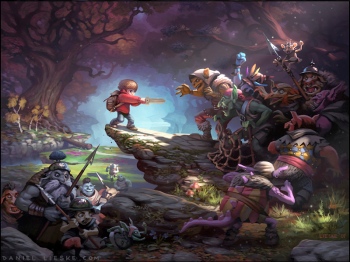
The Wormworld Saga is an online graphic novel about Jonas Berg, a young boy who enters an alternative fantasy world through a magical painting. Author and artist Dan Lieske held a successful Kickstarter campaign to fund the graphic novel’s creation, and the response was overwhelming — almost doubling Lieske’s original funding request and enabling him to focus fulltime on the project. The Wormworld Saga has been available on the Web for a while, but it entered the iTunes store (link) this month with an iPad app that’s perfect for its vision of a continuous-scrolling story. (iOS, free with in-app purchases for additional chapters)

KILL MATH

Bret Victor has collected his ideas about making math more meaningful to learners and designed Kill Math around the idea. “We are no longer constrained by pencil and paper,” he writes. “The symbolic shuffle should no longer be taken for granted as the fundamental mechanism for understanding quantity and change. Math needs a new interface.” In thinking what this new Continue reading Great New Apps for Music, Middle School, Math, And More

What’s Behind the Culture of Academic Dishonesty

B. Gilliard

You’ve heard the stories: Cheating in Atlanta, Georgia. Cheating in Washington, DC. Cheating in Long Island, New York.

Academic dishonesty, plagiarism, and cheating are hardly new. And as the history of the banking industry and baseball demonstrate, cheating scandals aren’t just limited to schools. With numerous incidents making headlines in recent months, however, questions are being raised about the validity and the pressures of standardized testing, as well as the security of testing practices. And some are asking if it’s time to scrutinize the underlying behaviors and motivation for all this cheating.

Is the pressure to score high — not just on standardized tests, but in all facets of school life — leading to a rampant culture of academic dishonesty? Or is it simply that technology is making it easier to cheat?

Some studies indicate that cheating is at an all time high — or at least, students’ willingness to admit they’ve cheated. Some 75% of college students admit that they’ve cheated at one point Continue reading What’s Behind the Culture of Academic Dishonesty

Quick Look: Foldit Game Leads to AIDS Research Breakthrough

Incredible news from the gaming world: “video gamers were able to do what biochemists have been trying to do for a decade: decipher the structure of a protein called retroviral protease, an enzyme that is key to the way HIV multiplies. Being able to see how this protein builds will likely help scientists develop drugs … Continue reading Quick Look: Foldit Game Leads to AIDS Research Breakthrough

With Pictures, Puzzles and Games, Students Create Transmedia Stories

A scene from the transmedia storytelling site Inanimate Alice
By Laura Fleming and John Connell

Until just a few years ago, stories we were told mostly through  a single medium – it might be a book, a movie, a radio program, a cartoon.

Today, we can tell stories across a wide variety of media, all at the same time. That’s the premise behind the term “transmedia.”

Transmedia is a new way of thinking about how stories are told: creating and consuming stories simultaneously through text, images, the spoken word, music, video, animation. We can even bring computer games into our stories, allowing the reader to solve puzzles or choose alternative routes through the tale. Rather than just retelling the story, the different media help to extend the story. At the same time, today’s ever-expanding social networks are creating opportunities for us to interact with a story, and this, combined with all the digital tools at our disposal, enable us to play our own part in deciding how a story unfolds.


Take Inanimate Alice, for example. Created as digital text, the transmedia story allows learners, fourth grade and up, to interact with the central character, Alice, and to help her advance her story. Text, audio, video, special effects and gaming are all used to deliver the narrative in a compelling way. Inanimate Alice one of five resources in the National Writing Project’s “Digital Is” website, which is a repository of ideas about how educators use transmedia to teach writing.

With Inanimate Alice, the complexity and interactivity increases with each episode, directly correlating with Alice’s personal growth as the games designer she is set to become. Through embedded puzzles and games, Inanimate Alice makes the reader a direct participant in telling the story. Kids connect intimately with the story as they walk in the shoes of the main character. Continue reading With Pictures, Puzzles and Games, Students Create Transmedia Stories

New Educational Apps of the Month

At the end of month, we review some of our favorite educational apps that have been released or updated over the last thirty days. (Read our previous months’ reviews.) Below you’ll find a mixture of iOS, Android, and Web-based apps.

  • NASA VISUALIZATION EXPLORER

NASA’s latest iPad app, the NASA Visualization Explorer (iTunes, free) brings some of NASA’s research to the tablet. Developed in conjunction with NASA’s Goddard Space Flight Center, the app includes visuals straight from NASA’s satellites. The app includes high-resolution movies and still, as well as short stories and interviews helping to explain the material and the steps NASA takes in its research. NASA says it plans to update the app with two new science features per week.

  • WRECK THIS APP

Wreck This App (iTunes, $4.99) takes Keri Smith’s bestselling Wreck This Journal and turns it into an iPad app. For those unfamiliar with the title, Wreck This Journal encourages creativity through destruction, if you will, by encouraging people to paint, tear, poke holes, and scribble, challenging what it means to be creative within the pages of a journal. Wreck This App takes this concept and digitizes it, so users can doodle, scribble and deface the app.

Of course, you’re not really wrecking the app the same way you wreck a printed journal, as you can erase your digital marks and tears and then wreck the app again and again.

  • KONA’S CRATE

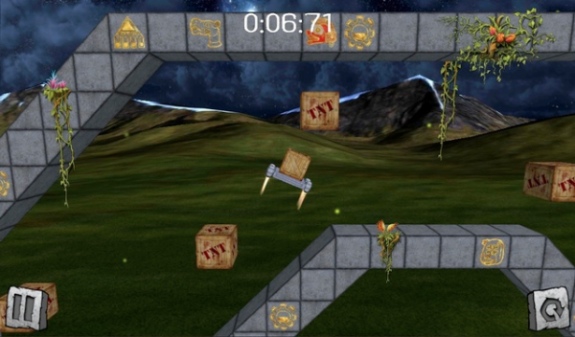
Kona’s Crate (iTunes and Android Market, $.99) is an incredibly fun puzzle game available for iOS and Android devices. The game requires you maneuver a jetpack in order to deliver crates to Chief Kona.

How is this educational you ask? Well, recently Angry Birds has received a lot of attention for its use of physics and for its educational potential, and while I haven’t seen physics teachers rush to use Kona’s Crate in the classroom in the same way, I’d contend it offers a similar sort of physic-oriented play, forcing users to think carefully (and move quickly) about motion and thrust.
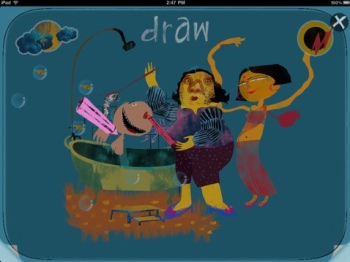
  • POP-IT

The creation of the artist Raghava KK, Pop-It is an interactive children’s book that aims to teach teach open-mindedness while exploring the relationships between kids and their parents (iTunes, $1.99).

The parents in the book are gay, but when you shake the app, the parents become lesbians or straight couples. In an interview with Mashable, Raghava said that “It’s a metaphor for shaking from one perspective to another. The relationship between parent and child does not change if they have two moms, two dads. I’m challenging the concept of family.”
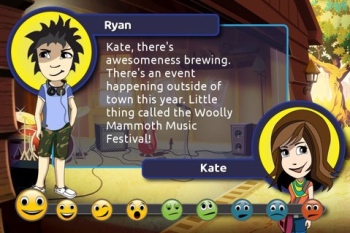
  • SUMMER OF SECRETS

We’ve covered the gaming studio Silicon Sisters before here on MindShift, with its work building video games for girls. The studio has just released its second title, School 26: Summer of Secrets (iTunes, $2.99). The theme of “social mastery” continues in this game, as the main character Kate and her friends navigate the social pitfalls of tween and teen life.

“Our first School 26 game was about fitting in at a new school. Now that Kate has a network of friends, Summer of Secrets is more about being yourself and seeing the impact of your choices,” says Silicon Sisters co-founder Kirsten Forbes. “As you play, the game tracks your decisions and presents you with a personality profile based on your playing style. So while you’re helping Kate sort out all of these secrets, you’ll also learn something about yourself.”

Have any favorites that we missed? Let us know in the comments.

Computer Science With a Twist: Students Hack into Kinect

Within the first 60 days of its release, Microsoft sold some eight million Kinects, making it the fastest selling consumer electronics device in history (beating out the iPad and the VCR).

For those who aren’t familiar with it yet, Kinect is a sensor input device for the popular Xbox gaming console that allows gamers to play without any controllers.

It’s been less than a year since the Kinect has been available to the public, and while the rapid uptake by consumers has broken records, it still feels as though the full potential has yet to be unleashed — particularly in the classroom.

We’re probably just beginning to explore the possibilities for building and using video games for learning. Now, the Kinect adds even more dimensions to gaming, least of which is the physical and the auditory, bringing “the real world” to gaming.

The Kinect sensors include a RGB camera, a depth sensor, and a microphone — all meaning that the physical actions taken by gamers can be captured by the Kinect and used in turn to control simulations. “You are the controller,” as some of the early marketing for the device contends. Continue reading Computer Science With a Twist: Students Hack into Kinect

50 Creative Ways to Prevent Summer Brain Drain

Reading prevents the dreaded "summer slide" - even if it's at the beach.

The Fourth of July weekend is a great opportunity to take a break, but during the rest of the summer, it’s important to keep those brain muscles flexed with fun learning exercises. We’ve written about math games, ideas for reading exercises, and technology and science projects, and of course, MindShift’s own 50 fantastic educational apps, games, and toys.

Similarly, Accredited Online Colleges has created this comprehensive list of 50 creative ways to fight the summer slide, a collection of ideas from all across the Web (including MindShift). Goes to show that ordinary summer activities like opening up a lemonade stand or going to a baseball game can be turned into learning opportunities. They asked me to repost, and I do so with pleasure. Enjoy!

READING AND WRITING

  1. Keeping up with reading and writing skills over the summer is key to maintaining learning throughout the year — so pay special attention to these creative learning activities.
  2. Create a book club: Make reading social with a summer book club for kids
  3. Keep a journal: Encourage kids to stay sharp in their writing by keeping a journal, discussing summer activities and more.
  4. Find summer writing camps: Older kids can check out summer writing camps, often available through local newspapers.
  5. Read throughout the day: Offer reading opportunities morning, noon, and night, with the newspaper, websites, books, magazines, and more.
  6. Write a comic strip: Develop creativity, writing, and humor with a fun comic strip.
  7. Read books about summer activities: Before heading to the beach or a baseball game, pick out a book that discusses the activity.
  8. Email friends and family: Have kids write to friends and family over email to keep in touch while also keeping up with their writing practice.
  9. Encourage reading in bed, even if it pushes bedtimes: Allow your children to read in bed, even allowing them to stay up later as long as they are reading.
  10. Start a blog: Create a blog for your child to update over the summer, and share it with family and friends. Continue reading 50 Creative Ways to Prevent Summer Brain Drain

What Kids Can Learn from Playing in Virtual Worlds

There are over 1 billion users of virtual worlds, online communities where users have avatars and participate in various simulated environments. Even more impressive than that number: roughly half of those virtual world users are under age 15.

With a number of news stories lately about kids under 13 on Facebook (violating the social network’s terms of service), you’d think there weren’t any other social networking sites that were geared for kids or where kids wanted to be. But clearly that’s hardly the case, and there are many social networks, gaming sites and virtual worlds aimed at the under 13 set: Club Penguin, Whyville, and Webkinz to name just a few. (Here’s a list of eight social media sites just for kids.)

Allowing children under age 13 to participate in online communities often raises questions about security and safety, and many parents fear predators and cyberbullies. Kid-oriented websites have a number of measures to prevent these dangers for their members, including logging chats and flagging questionable content and suspicious accounts.

But there may be other problems with these sites too, including the intense commercialization of many of them. Often virtual worlds (for children as for adults) encourage not just game-play but consumption, and kids need to buy virtual goods (sometimes with real money) in order to dress their avatars and decorate their virtual homes. Purchasing in-game items often gives users more status, and that’s a lesson in itself that parents may or may not wish to have imparted to their kids. Continue reading What Kids Can Learn from Playing in Virtual Worlds

Video Games Built Just for Girls

The stereotypical video game player is a young male under age 18, but study after study has shown that majority of the game-playing population does not fall into that demographic. Only 18% of gamers are under age 18, and women over 18 represent a significantly greater proportion of this population (37%) than do boys age 17 or younger (13%).

With the explosive growth in social gaming, particularly on Facebook, more games are being targeted at women. Games like Farmville and Pet Society, while not explicitly aimed at women, have been embraced by an older and female gaming population.

But what about girls? As we have written about often here at MindShift, video games are increasingly considered an important tool for learning. And even though plenty of women do play video games, there is still a sense — particularly among girls — that games are a “boy thing.”

That girl-gamer audience is the focus of the Vancouver, B.C.-based gaming studio Silicon Sisters. The first female-owned and run video game studio in Canada, Silicon Sisters is committed to building games for women and girls by women and girls. Founded by former Radical Entertainment executive producer Kristen Forbes and former Deep Fried Entertainment COO Brenda Bailey Gershkovitch, the studio released their very first game, School 26, to critical acclaim back in April. (We featured the game in our April round-up of the best new educational apps of the month.) The studio plans to release their next School 26 game — “Summer of Secrets” — next month.

The School 26 games are geared towards tweens and teens, and the storyline is built around the very complicated social hierarchy of high school. You play the game as a young girl who’s a newcomer to a school. She comes from a nomadic family, which has made it difficult for her to maintain long-term friendships. As she enrolls in this, her 26th school, she strikes a bargain with her parents: If she can make friends, they’ll stay put. Continue reading Video Games Built Just for Girls