
Future School Day Encourages Exploration

A NASA photo of Olympus Mons, the tallest known mountain in the solar system, using wide-angle imagery from NASA’s Viking orbiters and the Mars Orbiter Camera.

A vision of the school day of the future from Curtis Wong, principal researcher at Microsoft focusing on interaction, media, and visualization technologies. Wong has authored more than 45 patents pending in areas such as interactive television, media browsing, visualization, search, gaming and learning. Wong worked on Project Tuva, which links the lectures of Nobel Prize winning Physicist Richard Feynman with interactive simulations and related content and the WorldWide Telescope, which essentially turns a computer into a telescope and features the largest collection of ground and space-based imagery that can be accessed online.

Whenever I think about what a school of the future would be like, I remember the first time I visited the Vivarium Project Open School in Los Angeles over 20 years ago. It was conceived by Alan Kay and was exploring some new ideas around the classroom, the role of teachers and the potential impact of networked computers among other ideas in the ecosystem of learning.

My first impression in talking to the students in the classroom was that they were responsible for their own exploration and they worked in teams. The teacher spoke with the whole class for a few minutes about the broader goals of the exploration, but most of his time was spent with each of the small teams of students that were working on researching and exploring problems in the context of the larger goals. The teacher was more of a coach and provided suggestions for areas to explore rather than giving answers to questions. Students were challenged and sought out resources to help themselves to understand and build the solutions that helped them make progress to understanding the bigger problems.

To that end I can imagine the classroom of the future being organized loosely like the Vivarium Open School, but this time having much richer online resources that provide the full spectrum of  instruction, exploration and assets and tools  to allow students to research and construct their own learning experience and synthesize their learning, which can then be shared with others for further exploration by other students. Continue reading Future School Day Encourages Exploration →

“Gamified” Textbooks? It’s on the Horizon

From Mashable:

A prediction about gaming in education, by Gabe Zicherman author of the upcoming book Gamification by Design (O’Reilly, 2011).

I believe we’ll see the first “trans-institution” apps that connect students across different schools. We’ll see the first “gamified” textbooks from publishers while federal and state governments will continue to innovate and support initiatives in education. For adults, applications like MindSnacks, an iPhone app that makes learning languages more fun, will transform how we engage with continuing education. Expect an explosion in apps and services for language, food, finance and geo-location that manipulate game mechanics.

Mobile Phones Open Up a Word of Learning

By Leslie Rule

Leslie Rule is studying at the Harvard Graduate School of Education in the Technology, Innovation, and Education (TIE) program. She specializes in project-based workshops using geo-apps, mobile devices, and storytelling techniques to explore place and community.

The statistics on cellphone adoption and usage are staggering, not just for their sheer numbers, but for the depth to which they have penetrated our day-to-day life. According to a recent Pew Report, they are our favorite devices, beating out desktops, laptops, gaming consoles, MP3 players, and tablet/readers.

Consider the recent stats:

– 75% of 12-17 year-olds use own cell phones, and of those

– 88% of kids with cellphones use them to text

-83% use them to take pictures and 64% to exchange pictures

-54% to record and 32% to exchange video

– 27% to trawl the web

-23% to post to social networking sites Continue reading Mobile Phones Open Up a Word of Learning →

(Video) Game on? Yes and No.

Leslie Rule is studying at the Harvard Graduate School of Education in the Technology, Innovation, and Education (TIE) program. She specializes in hands-on, in-depth, project-based workshops using geo-apps, mobile devices, and storytelling techniques to explore place and community.

By Leslie Rule

I am not a gamer. Never liked board games. Pre-date the video game revolution. I have played many games of tennis, have on occasion gamed the system, even been bested by the game of life…but video games, not so much.

But one part of the video game I love: the world created, otherwise known by the rather antiseptic term “virtual environment.” My son will often call me over to watch the opening “cinematic” of a video game, where the virtual environment (the amazing fantasy world) is introduced. Think Oz or Dune, Narnia, Middle-Earth, or Rivendell…or my son’s favorite, Spira of FFX.

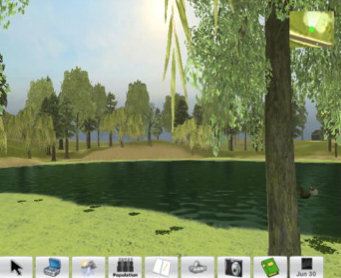
What affordances (roughly defined “action possibilities” or learning tools) does a virtual world offer that the real world doesn’t? For the concerned environmentalist in all of us, researchers at the Harvard Graduate School of Education are investigating just that question. Chris Dede, Tina Grotzer and team have built a virtual ecosystem/world of EcoMUVE: Advancing Ecosystems Science Education via Situated Collaborative Learning in a Multi-User Virtual Environments. Continue reading (Video) Game on? Yes and No. →

College Credit for Video Games

Video games are not just rich school curriculum for sixth graders, as I posted yesterday.

As U.C. Berkeley did last year, the University of Florida is offering a two-credit class called “21st Century Skills in StarCraft” to teach resource-management and decision-making skills, as well as critical thinking and adaptive decision-making.

As an ecampus news article points out, these types of courses are not commonly seen on college syllabi, but there’s potential to create a useful prototype for similar classes in the future. Continue reading College Credit for Video Games →