The stereotypical video game player is a young male under age 18, but study after study has shown that majority of the game-playing population does not fall into that demographic. Only 18% of gamers are under age 18, and women over 18 represent a significantly greater proportion of this population (37%) than do boys age 17 or younger (13%).
With the explosive growth in social gaming, particularly on Facebook, more games are being targeted at women. Games like Farmville and Pet Society, while not explicitly aimed at women, have been embraced by an older and female gaming population.
But what about girls? As we have written about often here at MindShift, video games are increasingly considered an important tool for learning. And even though plenty of women do play video games, there is still a sense — particularly among girls — that games are a “boy thing.”
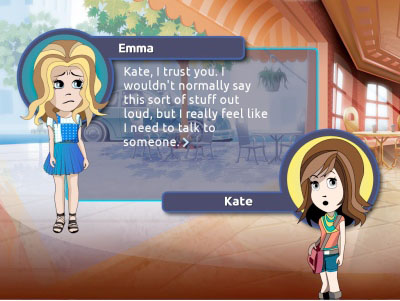
That girl-gamer audience is the focus of the Vancouver, B.C.-based gaming studio Silicon Sisters. The first female-owned and run video game studio in Canada, Silicon Sisters is committed to building games for women and girls by women and girls. Founded by former Radical Entertainment executive producer Kristen Forbes and former Deep Fried Entertainment COO Brenda Bailey Gershkovitch, the studio released their very first game, School 26, to critical acclaim back in April. (We featured the game in our April round-up of the best new educational apps of the month.) The studio plans to release their next School 26 game — “Summer of Secrets” — next month.
The School 26 games are geared towards tweens and teens, and the storyline is built around the very complicated social hierarchy of high school. You play the game as a young girl who’s a newcomer to a school. She comes from a nomadic family, which has made it difficult for her to maintain long-term friendships. As she enrolls in this, her 26th school, she strikes a bargain with her parents: If she can make friends, they’ll stay put. Continue reading Video Games Built Just for Girls→
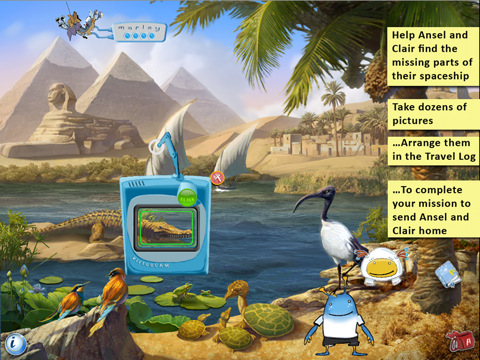
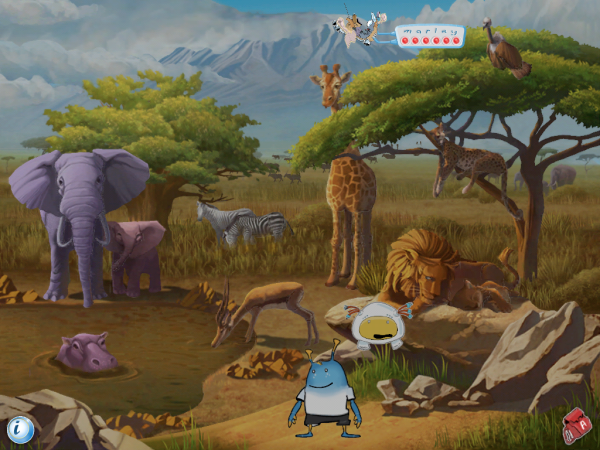
Ansel & Clair's Adventure app features animations, quests, puzzles and games in scenic African locations.
School or no school, there’s a world of learning opportunities for kids. When they’re not exploring outdoors, keep kids engaged in learning throughout the summer months with these enjoyable and educational apps and websites. For kids, playing these games is a cool pastime; for parents, it’s another way to get kids to exercise their thinking muscles.
VIRTUAL WORLDS
MINECRAFT. This online game lets you build entire worlds out of blocks. Minecraft’s visual simplicity belies what is a completely open-ended and therefore terrifically complex world. And the best of that world: it’s up to the player to design. Minecraft is what’s known as a “sandbox” game, giving players almost complete freedom to build within it.
CAESAR III. In this simulation, you begin as a lowly citizen trying to eke out an existence in a virgin landscape. The student begins by learning about the basic needs for survival and graduates to increasingly demanding scenarios. By the end, students will have gained a very sophisticated understanding of the influence played by the environment on the development of a civilization.
ANSEL & CLAIR’S ADVENTURES IN AFRICA. Ansel and Clair are aliens who must recover their lost spaceship parts, and as they travel the continent (the Serengheti, the Nile River Valley, and the Sahara Desert) they not only work on that mission but learn about the geography and history of the area as well. The app takes full advantage of iPad technology — audio, video, the touchscreen, “tilt the iPad” games, and so on.
THINKING WORLDS. Kids enter a virtual world that resides on their personal computer. Their avatar can be somewhat modified, and engage in a wide variety of explorations. In the unit dealing with volcanoes and earthquakes, they not only learn about the details, they visit places such as Herculaneum, subterraneous faults, and the ruins of Kobe in Japan. Continue reading Boredom Busters: 50 Fantastic Play-and-Learn Apps, Sites, and Toys→
The famous videogame designer, Shigeru Miyamoto, known for creating some of the most iconic and successful videogames in history, such as Donkey Kong, Mario Brothers and Legend of Zelda, once said, “Videogames are bad for you? That’s what they said about rock n’ roll.”
In retrospect, we know rock ‘n roll’s influence has gone beyond creating a new kind of music, shaping many other aspects of culture: lifestyles, fashion, attitudes and language. And there is compelling evidence that rock ‘n roll may have even helped the civil rights movement.
In a similar fashion, videogames have been stigmatized by an older generation (that has largely never played them) as corrupting the moral and cognitive fiber of a generation. At best they can help develop some hand-eye coordination. At worst videogames can turn you into a sociopath.
Continuing our Apps of the Month Feature, here’s a round-up of some of our favorite educational apps released or updated over the course of the month, which includes Android, iPhone, and Web applications. If you want to let readers know about your favorite educational app, tell us in the comments.
ANSEL & CLAIR’S ADVENTURES IN AFRICA
Ansel & Clair’s Adventures in Africa is one of those rare joys that combines beautiful graphics and engaging gameplay with educational content. Ansel and Clair are aliens who must recover their lost spaceship parts, and as they travel the continent (the Serengheti, the Nile River Valley, and the Sahara Desert) they not only work on that mission but learn about the geography and history of the area as well. The app takes full advantage of iPad technology — audio, video, the touchscreen, “tilt the iPad” games, and so on.You can have separate accounts, so different users can move through the the story at their own pace and it’s suitable for a wide age range (the iTunes lists the app as 4 and up). Kids have have ample instructions on how to proceed, but it’s open-ended enough for them to have their own way of interacting with the content. Lots to explore here.
I’MOK
Both parents and children say that having cellphones makes them feel safer and helps maintain communication channels. But often just texting to let parents where a child is isn’t enough. So I’mOK has created an app that rewards children for doing more than just sending a text message. The app lets kids flag their location, tag the friends they’re with, and upload pictures — all in the service of helping give parents a better idea where they are (and hopefully decrease the need for nagging or spying). In exchange for being forthcoming with their data, the app lets kids earn points, which in turn parents can use to reward kids. The app is still in private beta, but should be available for wider use this summer. Continue reading New Educational Apps of the Month→
Salman Khan's library of free instructional videos has reached millions of people, and now his videos are reaching into classrooms.
If you’re curious at all about the future of education, you should know about Salman Khan. He’s the charismatic brainiac who’s created more than 2,000 instructional videos about everything from photosynthesis to the Bay of Pigs invasion. As former New York City schools chancellor Joel Klein recently noted, “Sal Khan has 50 million people on a site that doesn’t sell sex.”
Self-effacing (“Any joker in his closet can reach millions of people”), fast-talking, and pragmatic, Khan spins his big-picture views about education in the same way he describes subjects like valence electrons or mortgage-backed securities: as a bemused observer pointing out the obvious. “If Isaac Newton had made YouTube videos about gravity, I wouldn’t have to!” Khan said at a recent TED Talk.
But rather than quarterbacking from the sidelines, Khan is intentionally getting in the game. Some, including Bill Gates (who’s donated millions of dollars into Khan’s vision), believe his free YouTube videos, the full collection of which are called The Khan Academy, will profoundly change what we know as classroom instruction.
In Silicon Valley, at least, it’s already in the works. What began as a series of helpful videos for his cousins is being piloted in the Los Altos School District in two fifth-grade and two seventh-grade math classes, and will likely expand to other grades and possibly even schools in the district next year. Continue reading Meet Sal Khan: the Seinfeld of the Education Revolution→
Professional development and networking are vital in any field, and that’s especially true for educators.
Whether it’s coming up with fresh ideas for lesson plans and classroom activities, seeking mentorship and support from veteran educators, or cultivating resources for technology integration or for meeting state standards, teachers need one another’s expertise.
That’s why working with other educators in personal learning networks (PLNs) has become as important in an educator’s day as the time he or she spends teaching in class.
Below is a short list of PLNs that already exist, followed by some resources to help teachers build their own
The Educator’s PLN is a Ning site (or online platform for creating your own social network) that facilitates connections between educators. It features a slew of resources such as downloadable podcasts with education leaders as guest speakers, discussion groups with specific purposes like exploring the iPad’s use in the classroom, and links to relevant blogs, videos, resource lists, and events.
Powerful Learning Practiceis a professional development program for progressive-minded educators. Its year-long curriculum provides cohorts of teachers with new ideas and hands-on practice in order to bolster their tech knowledge and aptitudes, rethink classroom activities to make them relevant for today’s students, find other teachers with similar goals, and build their own tech-rich learning tools. It isn’t free ($1,500 per person for a year of professional development in a school or district team or $1,000 as an individual), but teachers can usually earn education credits for their participation. Continue reading 5 Personal Learning Networks (PLNs) for Educators→
Florida Virtual School (FLVS) students Christianne and Carylanne Joubert are pretty advanced for their age. Christianne, at 13, is already a published novelist; Carylanne, 14, is about to start 11th grade. The Jouberts would probably succeed at any school they attended, but they attribute a large part of their progress to online learning. (And for Carlyanne, who has diabetes, the convenience of doing school work at home is a big advantage.)
The Jouberts, whose father is in the military, requiring the family to travel a great deal, were homeschooled by their mother until recently.
“Online classes are easy to understand. You can move onto the next thing much faster,” Christianne says. “I have a friend in regular public school who says that they like FLVS courses better because they don’t have to wait around for the other students to get it — or get frustrated when they don’t get it themselves. But it’s not easier because it’s of a lower quality. The better quality makes it easier.”
I chatted with both girls and got a good glimpse into their academic life is like — flexible, varied, and personalized. It’s not the best fit for every kid, of course, but for these students, it works.
Q: Is going to school at FLVS different from being homeschooled?
A:Carylanne: The assignments are different. The courses I took when my mom was teaching me were mostly reading the lessons, getting the information, doing worksheets and exams and that kind of stuff. At FLVS, I write essays, I do PowerPoint presentations and brochures. In my Latin course, I had to pretend I lived in 100 B.C. and write up an invitation and a menu. There are different assignments for those who are more creative. The lessons also show the information in different ways; sometimes there’s a visual representation, like a diagram or a video, to help remember it. Continue reading A Day in the Life of a Virtual School Student→
Microsoft announced this week that it has agreed to acquire the popular VOIP service Skype for $8.5 billion. Skype has become an important tool for educators bridging classrooms around the world, and the acquisition may boost Microsoft’s status in the education sector (provided, of course, Skype still works on Apple computers).
According to the June issue of Consumer Reports, Facebook has about 7.5 million users below the required minimum age of 13. And 5 million of those users are ten or younger.
While teens and pre-teens may love Facebook, they’re less than enthralled with Foursquare and other location-based check-ins. That’s the findings of a recent survey by Dubit, a youth communications agency, reports Business Insider. According to the survey, 48% of teens have not heard of Foursquare, Facebook Places, or other location services, and 67% of teens who have heard of the services don’t use any of them.
The Department of Education in New South Wales, Australia announced this week that it officially supports its teachers’ use of Facebook, Twitter, and other social media sites, noting that this will “help improve communication between schools and their communities
John Resig, the creator of JQuery, announced this week that he was leaving the Mozilla Foundation and joining Khan Academy — a move that’s sure to have a huge impact on education technology.
The 40 regional finalists for the Doodle 4 Google competition have been announced. The public can vote on these through May 13. This vote will help determine the four national finalist, one per grade group (K-3, 4-6, 7-9, 10-12). On May 19, Google will announce the national winner, whose doodle will appear on Google.
Amazon is suing the National Association of College Bookstores (NACB), arguing that the the latter constitutes a monopoly. The lawsuit follows claims by the NACB that Amazon is falsely advertising that students can save up to 60 – 90% on textbooks by shopping with the online bookseller. Continue reading Weekly News Roundup→
Gamification is one of the new buzzwords in social media circles. It’s the idea that by making non-gaming applications more game-like — by adding points, badges, levels, titles and other game mechanics — these apps become more fun and engaging.
We see gamification at work in apps like Foursquare, where “checking in” and giving your location via the app earns you points and potentially the “mayorship” of venues. Even though the term may be new to some, gamification has been used for years for offline services too, such as earning points and unlocking special deals via frequent flyer programs. Continue reading Can Gamification Boost Independent Learning?→
The spotlight has been shining on media and gaming in the education innovation scene in recent years. And while many tout the virtues of what games and media can teach kids, we know it’s just as important to give kids enough time to play outside.
In this essay, Andy Russell, co-founder of Launchpad Toys, which created Toontastic (I reviewed the digital storytelling app recently) talks about how the two worlds don’t have to be mutually exclusive. Ideally, inside and outside play build on each other.
By Andy Russell
This past weekend I had the pleasure of helping to organize TEDxSFED and participating in a number of post-conference roundtables about “Re-Imagining Education.” One session on Educational Gaming posed the question: “How would you create a game to teach Natural Selection?” The group tossed out several ideas and seemed quite happy until one insightful teacher dropped the Josh Baskin question of the day: “But why do I need a computer for that? Why not just go outside and play tag?” Eyes averted, crickets chirped… it was beautiful.
For years, educational software developers have digitized and embedded worksheets and problem sets into interactive games. The practice has known many names — Edutainment, Serious Gaming, and most recently “Gamification” – but all share the common premise (misconception) that learning by itself isn’t fun, that kids need a spoonful of sugar (game mechanics, rewards, etc.) to make the medicine (curriculum) go down.
As several of the roundtable participants struggled to answer this million-dollar question, I found myself thinking about the many kindergartners I’ve had the chance to play with over the years – and the endless barrage of questions that I’ve had to field on topics ranging from weather to ticklishness to the flavor of boogers. Looking back, I don’t think I’ve ever met a 4- or 5-year-old who isn’t naturally curious, who isn’t excited to learn. So why is it that so many 10-year-olds cringe at the sight or sound of the word “education”?
I found myself comparing the questions that kindergarteners ask to the questions/answers often seen in traditional educational media. I noticed a theme: most educational games deal a lot in the “Who?, What?, When?, and Where?” while the questions I hear from young kids are more of the “How?” and “Why?” variety. Not once has a child ever asked me to fill in a blank or select from multiple choices. Like many adults, they’re less interested in facts and figures and more intrigued by opportunities to investigate, create, and share their voice with the world.
What’s the difference between a computer simulation and a backyard game of tag? Quite honestly, not much – which is exactly why we, as educational media designers, have failed three decades of curious kids (with some notable exceptions). Interactive quizzes and digital flash cards may make content more exciting than their analog counterparts, but that’s a short-sighted approach that fails to get at the root problem, an extrinsic motivation when kids are already intrinsically motivated to learn. The fundamental problem is not that learning isn’t fun, it’s that we’re answering questions that kids aren’t asking (Who?, What?, When?, Where?) instead of giving them tools to experiment, build on, and share their own ideas. The problem is that we’re trying to replace teachers and parents with software rather than giving them complementary tools to help them become facilitators and coaches instead of test administrators.
A backyard game of tag is an excellent way to demonstrate natural selection. Sure, one might replicate that with a computer game, but why? As educational media designers, our role shouldn’t be to demonstrate these phenomena in action (there are plenty of tools for that), but instead to leverage the incredible power of modern technology to help kids answer the bigger questions: HOW and WHY are these phenomena happening? Our role should be to guide them up Bloom’s Taxonomy to not just memorize and regurgitate, but to synthesize, analyze, and create. To do this, we need to dive deeper – to help kids learn not just by “doing,” but by designing (please see: John Maeda, Laura Seargent Richardson). We need to stop thinking of educational media as fancy content delivery mechanisms (interactive videos and electronic books) and start building tools that help kids design and develop their own understandings of the world through iterative content creation.
Constructionist learning tools like Scratch, NetLogo, and LEGO Mindstorms, empower kids as self-motivated learners to program, build, animate, and design their own creations. NetLogo, for example, would be a perfect tool for the natural selection question. With NetLogo, kids can easily program their own natural selection simulation with millions of independent characters operating in a virtual biosphere under the rules and guidelines they assign – almost like a digital petri dish, but with the ability to scale and fast-forward in real-time and iteratively test many different variables and hypotheses. These tools are the modern equivalent of the five-paragraph-essay: templates for inventing, testing, and sharing new ideas while developing higher-level critical thinking and analytical skills.
So my answer to the teacher is: We SHOULD go outside and play tag! Then let’s go back into the house or classroom and talk about what just happened and see if we can break those big ideas apart while building, testing, and iterating on our model. Then let’s upload our model to the Web, compare it to others’ ideas, and maybe even collaborate with other kids/students around the world. As educational media designers, let’s re-imagine edutainment as empowerment. Let’s empower children as designers by making concepts and tools accessible to learners and then, above all, let’s give kids megaphones to share their ideas with friends, family, and peers around the world.
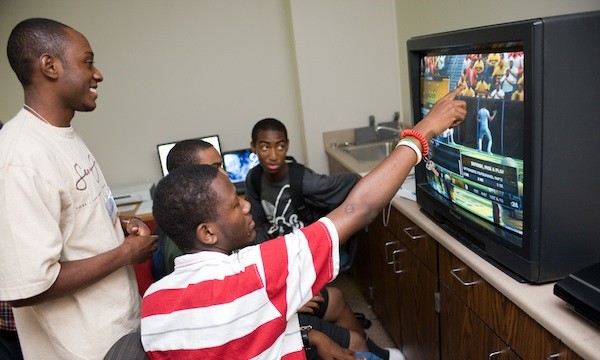
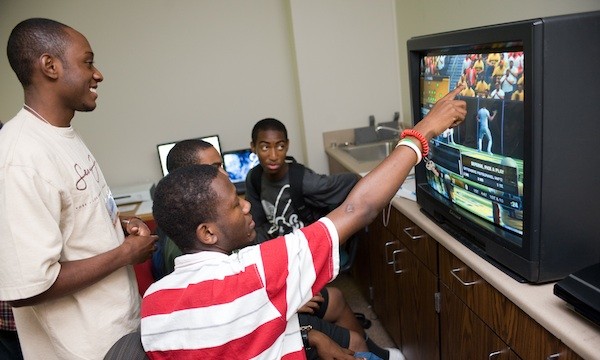
Applying African-American boys’ passion for sports video games toward building confidence in a learning environment.
This fascinating article by Liz Losh on Digital Media & Learning looks at how video games as learning motivator can be a completely different experience for different cultures.
While the Obama White House has become known for promoting video games as a way to teach science, technology, engineering, math, and as a method to promote healthier eating and exercise among kids with sedentary lifestyles and pop culture habits, often the Presidential message targeted to African-American urban youth emphasizes traditional print culture literacies in reading and writing. Researcher Betsy James DiSalvo from the Georgia Institute of Technology is taking a different approach to the achievement gap. Her work is focused on understanding the role that video games play in urban African-American youth culture.
DiSalvo engages African-American teenage boys with video game design and seeks to provide them intensive college and career counseling that “A Call for Change” argues they might not be getting in school despite a desperate need for intervention. She also takes advantage of the fact that video games can bridge the digital divide in African-American homes, because “game consoles often are the most powerful computational devices and the only Internet-enabled devices in our participants’ homes.”
UNUSUAL APPROACH
Unlike other after-school programs with technology labs, DiSalvo’s “Glitch Game Testers” treats students as paid employees rather than charity cases. Participants have part-time jobs during the school year and full-time jobs during the summer that provide economic as well as educational incentives to pursue careers in computer science and other STEM-related fields. The program makes a long-term commitment to mentoring and economic support and tries to tailor services around stated needs. According to DiSalvo, other programs “parachute-in” with a rescue mentality that shows little respect for existing attitudes in African-American communities.
DiSalvo has come up with a pragmatic series of solutions designed around symbiotic relationships between corporate products and consumer populations to foster STEM learning around sports video games that are usually not seen as particularly educational. She recruits Atlanta-area youth attending schools that are 99% African-American and where most students are well below the poverty line as play testers for commercial video game companies to search for bugs in new video games. Local mentors from Georgia Tech and historically black Morehouse College are also part of the Glitch Game Testers team and serve as both coaches and role models.
In her work, DiSalvo finds that video game play practices such as “hacking, cheating, and modding,” which provide powerful informal learning practices among self-described “geeks” destined for careers in technology, are often treated with disdain by African-American teenagers. For many black urban youth, DiSalvo says, their notions of masculinity are defined by codes of idealized sportsmanship and pure physical embodiment, rather than the so-called “hacker ethic” that emphasizes subverting systems and authority.
GENDER, IDENTITY AND TECHNOLOGY
DiSalvo’s advisor, Professor Amy Bruckman, has been known for her research on gender and computer gaming that stretches back for more than a decade. (Bruckman also wrote seminal essays questioning cyber-utopianism that were written in the nineties, such as “Finding One’s Own in Cyberspace” and “Cyberspace is Not Disneyland“).
In an interview for DML Central, Bruckman praises DiSalvo’s work because it is “specifically targeting African-American teenage boys” in a larger research environment in which the discussion about gender and technology has often been focused on “women and this, and women and that” without enough serious research on masculinity and how “cultural groups have unique challenges.” Continue reading Can Video Games Help Close the Digital Divide?→
Context is as important as content. Time, place and purpose matter.
Pushing forward our discussion about the value of games and apps, David Kleeman wrote in response to the article: “Every screen has benefits and cautions, quality content and junk.” In this essay on the Huffington Post, Kleeman, who’s the president of the American Center for Children and Media elaborates further.
By David Kleeman
“A Screen is a Screen is a Meme”
Children’s television has been a playground for memes for as long as it’s existed (much longer than “meme” has been a word!). Most are light and from pop culture — from Davy Crockett coonskin caps to rumors of gay Teletubbies. Others grow from more dire murmurs about media’s effects on children — sit too close and you’ll ruin your vision, short segments decrease attention span, digital kids can’t write standard English.
Recently, I’ve noticed an emerging meme — “a screen is a screen is a screen.” This or similar phrases suggest that only total time matters in children’s relationship with media, not what’s being viewed or used by whom, nor how and why. As used, it’s a facile way to tar all media and absolve parents or activists from doing the hard work of addressing specific content or context.
For example, last month the American Academy of Pediatrics released its updated policy on children and media. Not surprisingly, the AAP’s new guidelines reiterate its “no screen time for under twos” position; dismayingly, they also treat enormous technology evolution almost coincidentally and entirely negatively (the “new technology” section addresses only sexting, porn and pro-anorexia websites). In a New York Timesarticle on young children and mobile media, a member of the AAP’s Council on Communications suggests the current landscape was just too difficult to parse in its revisions, saying “at the moment, we seem to feel it’s the same as TV.” Continue reading Defining the Differences in Screen Time→
When it comes to video games and apps, what’s a parent to do? On one hand, we’re bombarded with messages about the perils of letting kids play with computer games and gadgets. On the other, we’re seduced by games and apps marketed to us as “educational.”
It’s a tricky line to navigate. The spectrum of kids’ apps ranges from “baking” cupcakes to crushing war demons. Most of them have some educational aspect — at the very least kids learn what ingredients are used in cupcake baking, and the physics of launching Angry Birds at just the right angle to kill the piggies. That’s learning, isn’t it?
Therein lie the vague boundaries. Not all games are educational, and not all are shallow forms of entertainment. Many are marketed as educational tools, but in fact, most have some elements of both. The trick is to figure out what we want kids to learn and to experience. To clump them all into one category is to miss out on a huge treasure trove of learning opportunities. Real learning apps have a set of criteria that qualifies them as educational, so rather than writing them all off as a waste of time, parents can figure out what their kids are exposed to.
“We don’t ever want to separate engagement from the purposes of learning,” said Daniel Edelson, Executive Directorand Vice President of Education and Children’s Programs at the National Geographic Society at a cyberlearning conference last week. “When you’re engaged with activities that have learning goals, you can connect the dots between engagement and learning. If you use engagement in its broadest possible sense when people are paying attention because of bright lights and activity, then you don’t find that connection.”
Enter the parent. A young child is not necessarily going to figure out if she’s learning or having fun. And in the best cases, that line is blurred without the child even knowing it. She’s collecting information about bugs and plantlife with apps like Project NOAH. She’s creating original stories — complete with exposition and denouement and background music — with digital storytelling apps like Toontastic.
So should parents feel guilty allowing their kids to play games on mobile gadgets?
Simply put: “No,” says Dr. Michael Levine of the Joan Ganz Cooney Center, which recently released a study called Learning: Is There an App For That. “Kids see their parents using mobile phones all the time. It’s only natural for them to want to use them too. And from the data in our study it looks like many parents are letting their children use them responsibly – with restrictions and in moderation. We recommend a balanced media diet that consists of content that is fun, educational, and doesn’t take up too much time in a given day.”
That said, Levine cautioned parents to stay vigilant about screen time. “We would be quite concerned if young children, especially preschoolers, began to dramatically increase their mobile screen time,” he said.
A screen is not just a screen, though. The one-way interaction between TV and the couch potato is far different than an absorbing Scrabble play-off with a friend on a mobile phone.
“Nobody’s saying, ‘Give your kid a Gameboy, so he can be quiet and go sit in the corner,” said Andy Russell, co-creator of Toontastic at a digital media and learning conference. “We’re giving them tools to actually help them create content. The new devices allow us to do new things that we haven’t ever been able to do. But the world of ‘edutainment’ has dug us into a hole where most people think games only create a solitary experience.”
In fact, many apps invite multiple players, social interaction with peers, and a call to go outdoors, either with specific instructions or with the child’s own imagination. When my daughter and her friend were deciding how to spend their Saturday afternoon last week, their indoor play turned into an outdoor movie that they scripted, and that I filmed and edited for them with my iPhone.
“Most parents don’t understand the need for their participation,” said Dr. Gwenn O’Keeffe, a pediatrician who says she specializes in children’s media use. “It’s a small population who gets it.”
Russell says game designers should also take responsibility in guiding parents on how to interact with the games and their kids. “The failure is not the technology, but how we communicate to parents,” he said.
BEYOND SCREENS
Regardless of how educational or engaging a screen can be, O’Keeffe says emotional connections are lost without face-to-face contact. “If they’re looking at a screen, they can’t see the emotional response,” said O’Keeffe, who believes screens should be kept out of the hands of kids under five years old. “It’s about empathy and they’re having trouble learning that. Do you really need to turn on the DVD in the car? Do kids really need the Gameboy in the grocery store? We all have to use the screen as babysitter sometimes. But to always use a screen that often is a problem.”
But gaming advocates argue that social connections are built into most games. That sharing tactics and strategies help cement the learning experience — and connect players to each other in ways that haven’t been done before.