
Let the Games Begin: Students and Teachers Dive Into SimCityEDU

photo(1)

“What do you think is causing pollution in the city?”
“Factories.”
“Which factories are causing pollution?”
“Coal Factories.”
“So to reduce pollution, what would you do?”
“Close ‘em down.”
“But then you have to think about, how are you going to get energy?”

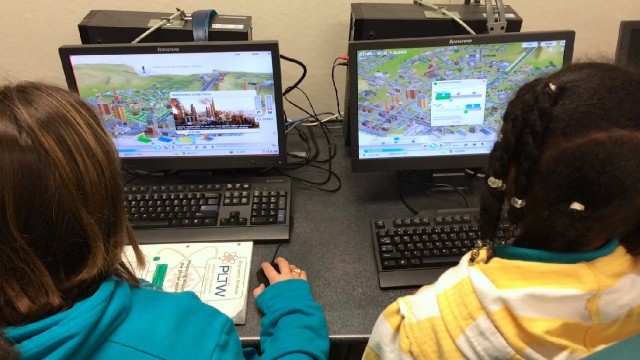
Seventh grade engineering teacher Petrut Ababei is helping his student Danny Jimenez think his way through an early attempt to figure out SimCityEDU, an educational video game designed by the non-profit GlassLab. Ababei is beta testing the game at Lazear Charter Academy in Oakland, California.

SimCityEDU is built on the code for the popular city building game SimCity and has the same graphics. The difference is that SimCityEDU asks players to accomplish environmental science missions that are based on the Common Core State Standards.

GlassLab developed the game as a progression of six distinct missions that correlate with one another, scaffolding the player’s understanding of both the game and science topics. The first level is fairly simple, but new tools are added at each progressing level, as well as more complicated concepts, such as where energy comes from and how it relates to pollution. Originally, developers expected teachers to assign missions in the order they were created — from one to six — but after observing several beta-testers, they’ve seen that educators are picking and choosing parts of the game that fit with their curriculum.

Ababei, for example, had his class skip from level one to level six with only a short introduction before they jumped into playing the game. “My approach was based on not underestimating their ability to explore and click around on their own because I think kids are pretty good at that,” Ababei said. He wants his students to explore and build the problem as they go along.

“They were able to be very quick and very responsive to the feedback they were getting in the game based on their actions,” Ababei said. “That was pretty impressive and I get excited. I think those are the good moments in teaching, when you’re like, ‘I didn’t teach you that, but you figured it out on your own.’”

[RELATED: SimCityEDU: Using Games For Formative Assessment ]

Ababei chose to jump ahead to the most complex mission in SimCityEDU because it directly relates to an ongoing project the class is doing on green energy. Students are learning how different types of energy are generated and how that affects pollution levels. Those concepts help provide real-world context for their culminating project — building a wind turbine and measuring its energy output.

But jumping ahead to level six, which is called “It’s Complicated,” left many kids puzzled, not sure what tools were available to them for solving the mission. So they just clicked around trying to figure it out. Some students immediately picked up on a few simple ways to reduce pollution while making sure that residents of their city had enough power to operate businesses and electricity at home. One student even discovered the “zoning tool” which allowed him to rezone areas for industrial or residential use, although he wasn’t really sure what that meant. Other students appeared to be clicking around aimlessly, but kept trying different tactics that would help them complete the mission after being prompted to go back and try again. Many students tried to help one another understand the game, but at the end of 30 minutes, a good portion of the class had checked out.

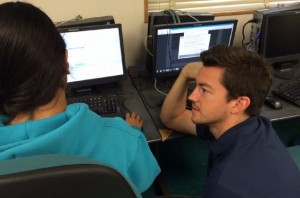
Meanwhile, Ababei and another science coach walked through the class, asking questions that would help students answer their own questions, and offering help to students as they needed it.

photo

After the class’s experiment with level six, Ababei found out that level three mission in SimCityEDU also deals with the concept of energy, but on a much simpler level. For the game developer, this was useful knowledge during the beta phase.

“What it’s telling me as a developer, is I need to improve the visibility of the professional development and the lesson plans so you don’t have to spend more than two minutes to figure out: ‘OK here’s where I want to focus on,’” said Jessica Lindl, GlassLab’s general manager. She was observing how Lazear students played the game to improve on the product before it goes to market in early November. “I need a much easier view of quick scaffolding of what’s in each mission,” she said.

Lindl also decided to keep the game “unlocked,” meaning teachers can move around between missions and levels in a way that suits their instruction goals, rather than keeping them at specific levels. Lindl says as she’s observed teachers she’s been impressed at the creative ways they’re using the game and she doesn’t want to limit that freedom by prescribing the order of missions.

That said, the scaffolding embedded in the game is an important element of the formative assessment tool that GlassLab has been testing with SimCityEDU. “We actually do have as part of our formative assessment their ability to discover and understand the tools informing us on their ability to apply problem solving,” Lindl said. Every click and hover that a student makes in the game is a data point towards assessing how well she is using critical thinking and problem solving skills to gather information. “It’s almost like learning the game is part of the experience,” Lindl said.

“Not only are we teaching them about systems in a very fun way, but we’re also teaching them about perseverance and that failure isn’t necessarily a bad thing,” said Francis Abbatantuono, the Science, Technology, Engineering and Math (STEM) coach for Lazear’s parent charter company Education for Change. “The point for me is they’re trying something, they’re seeing themselves fail, and they’re going back and trying something different. And hopefully that transitions to the game, the class, their life,” he said.

Whether or not students have played video games before could make a big difference in how well they play this game. Some kids have extensive experience playing complicated games like SimCity that have narratives, multiplayer options and lots of tools. Others have only played simple mobile games. And still others don’t play video games, which could affect how intuitive the game feels.

At Lazear, 95 percent of the students are low-income, receiving free or reduced price lunch. Student access to technology and gaming outside of school is varied. Lindl said she’d like to develop a way to identify each player at the beginning with a “gaming persona,” that could help inform assessment.

GlassLab will make the game available to the public on November 7, distributing it through established vendors  SMS Tech Solutions and Houghton Mifflin Harcourt. At the same time, the organization is awaiting an SRI study to be released next spring evaluating how effective the game’s formative assessment tools really are.


Kids’ Video Games: Source of Fun, Pain, and Profit

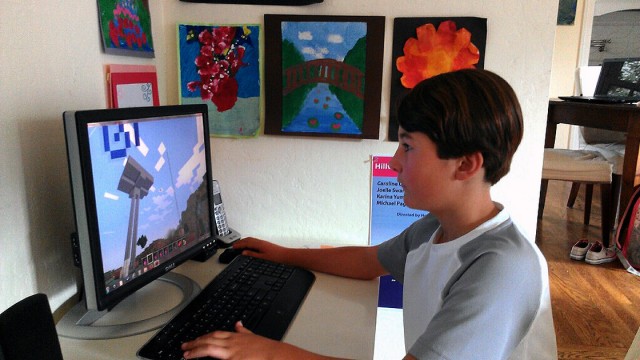
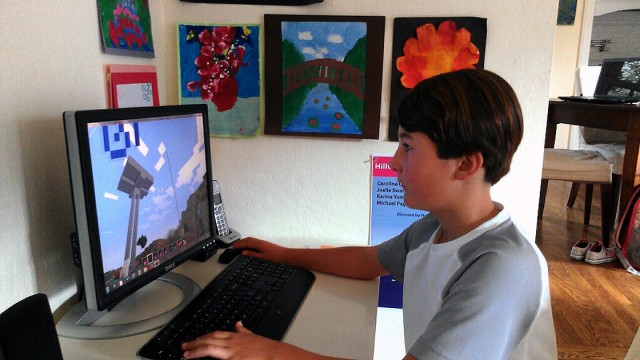
Austin Newman, 10, of Menlo Park, Calif., is not allowed to play video games during the school week. His mother, Michelle DeWolf, said she had to take that step to keep her son focused on his homework during the week.

By Scott Henn

This week on All Tech, we’re exploring kids and technology with posts and radio pieces about raising digital natives. Share your thoughts and ideas in the comments, by email or tweet.

Max Kelmon, 13, has his own little version of a man cave in Palo Alto, Calif. Behind the family kitchen in a converted garage, he has an Xbox, a big-screen TV, headphones and a microphone. There’s an old couch covered in a sheet. And that couch where he parks himself, surrounded by boxes and Christmas lights, is one of Max’s favorite places on the planet.

From that couch, he connects to friends all over the globe — and he spends hours, pretty much every day, honing his skills in Call of Duty.

The first commercially successfully video game, Pong, invaded Americans’ living rooms 38 years ago. Since then, the industry has evolved from a simple bouncing ball in the Atari original to games with astounding graphics and sound, most of them connected to the Internet.

That means that kids like Max can play with people spread across the globe. It also means that gaming companies can analyze how gamers play — each and every decision they make.

So when kids sit down with a game, they are actually sitting across a screen from adults who are studying them — and, in some cases, trying to influence their behavior in powerful ways.

Researchers in game companies tweak games to get players to stay on longer, or to encourage them to spend money on digital goods. They study gamers’ reactions. It’s become a science.

And parents like Max’s mom, Vanessa Kelmon, often feel outgunned.

“I hate it. I really do,” she says. “He could play Xbox for 12 straight hours. [He has] friends in Mexico City and friends in England.”

Vanessa says Max is addicted to video games. “When I took it away, he started to cry,” she says. “My God, I am offering you to go play tennis or go play golf … and I am making you shut this down, and you’re crying about it.”

Tracking Clicks And Purchases

In millions of families, video games are a source of intense love and intense hate because they can be so incredibly compelling. You might not believe that if you don’t play them, but you can get lost in a great game. They make you feel good.

And it’s no accident, says Ramin Shokrizade, the game economist for Wargaming America.

“The technology for this has gotten quite sophisticated,” says Shokrizade, who began his career in neuroscience and behavioral economics. “At this point, every major gaming company worldwide either has in place a fully developed business intelligence unit, or they’re in the process of building one.”

Today’s game design is dominated by research, he says. As we play games, game developers are tracking every click, running tests and analyzing data.

They are trying to find out: What can they tweak to make us play just a bit longer? What would make the game more fun? What can get us to spend some money inside a game and buy something?

So as millions of people play, designers introduce little changes and get answers to all of these questions in real time. And games evolve.

For example, most games today sell virtual goods right inside the game — like a new gun in Call of Duty or a cow in FarmVille. Shokrizade’s job is to get people to buy them.

One of the tricks of the trade is something developers at Zynga — which created FarmVille — used to call “fun pain” or “the pinch.” The idea is to make gamers uncomfortable, frustrate them, take away their powers, crush their forts — and then, at the last second, offer them a way out for a price.

John Davison, who works at video game company Red Robot Labs, says free-to-play smartphone games like Candy Crush Saga and Puzzle & Dragons have become brilliant at using these tests to figure out how to get people to spend money.

And the research is working. Davison says those games are making millions of dollars — every day.

Kids Who Cash In

When adults play games, they consent to share that personal information about how they play. But Shokrizade worries about the millions of kids who play. “If it’s a child, how do you even get consent for something like that?” he says.

Many of the people spending cash are kids, including Davison’s children. Game consoles sell gift cards at convenience stores that allow kids to make purchases on video games, even if they don’t have a credit card.

Davison’s kids started playing Clash of Clans this year. In the game, developed by Supercell, you get to run your own little Viking village and team up with friends. To protect your clan, you can spend money on forts and weapons.

It’s free to download — but because of these virtual goods, it’s one of the highest-grossing apps in Apple’s store.

Davison’s two boys loved it. “They were clearly getting a lot of enjoyment out of it,” he says. “But it did get to the point where my wife and I were like, ‘Do you really want to be spending everything on this?’ ”

And this is coming from a man who has devoted his life to video games.

“I was trying to sort of total up in my head how much the kids had spent on this game,” he says. “But there was also a degree of admiration for the team at Supercell, that they had managed to get under my 10-year-old’s skin to this degree.”

Apple recently settled a class-action lawsuit about kids making in-app purchases like this without their parents’ permission, and the European Union is considering new regulations on games.

Some regulations are taking place on a smaller scale. In Menlo Park, Calif., Michelle DeWolf banned her 10-year-old son, Austin Newman, from playing games during the school week.

Originally, she gave him 30 minutes a day, but that didn’t work.

“He couldn’t think about doing his homework. He couldn’t think about walking the dog or helping in any other way, because he couldn’t get his mind off the idea that he had 30 minutes coming,” she says.

“Once he knew there was nothing, he didn’t think about it during the week, and he almost — maybe I’m not objective — but he almost seemed relieved.”

Copyright 2013 NPR. To see more, visit http://www.npr.org/.

Tech Disaster Torments College Applicants

computerstress300

By Eric Westervelt, NPR

For many high school students this year, the already stressful process of applying to college has been made far worse by major technical malfunctions with the Common Application, an online application portal used by hundreds of colleges and universities.

“It’s been stressful, to be honest,” says Freya James, a senior in Atlanta applying to five schools — all early admissions. The Common App has been a nightmare, the 17-year-old says.

“No one likes applying to college anyway, and this is supposed to help and it’s made it worse,” she says. “I have spent a good number of hours just sitting there refreshing the page, doing nothing terribly productive except for trying to get this thing to work. … It’s not useful; it’s not doing what it’s meant to do.”

The Common Application has been around for more than 30 years and has long made the application process easier for students and schools. With one common form, students are able to apply to dozens of schools at once.

But the number of schools using the form has more than doubled over the past decade. What was once used mainly by small liberal arts schools is now accepted by more than 500 institutions.

The nonprofit that runs the form, also called Common Application, had touted a major upgrade of software and applications as a way to streamline the process even more. Instead, the digital makeover has been a bust and a big mess for many students and higher education officials.

“Application Armageddon”

“There have been issues with being able to import the application itself, with receiving the supplemental materials like the transcripts or letters of recommendations, those kinds of things,” says Lisa Meyer, dean for enrollment at Lewis and Clark College in Portland, Ore.

“Those are very big things. It’s very hard to read an application when you don’t have a transcript to look at. … So I think the colleges have been scrambling a bit,” she says.

[RELATED READING: ‘Gaming’ the College Admissions Process]

Other serious technical problems include payments that take days to register or registering duplicate payments. Other students complain they simply couldn’t log in, while others were repeatedly logged off for inactivity after waiting hours to submit their applications.

Then there’s the personal essay, a key part of the admissions process. A formatting glitch left many students’ essays looking like a giant stream-of-consciousness blur with no spaces, paragraphs or indentations.

Many high-schoolers are ranting against the Common App on Twitter. Some of the kinder comments: “I’m freaking out, the common app isn’t working”; “The common app is kind of the worst thing ever”; “The common app is broken … so we’re all just not gonna go to college, ok.”

Irena Smith, a college admissions consultant based in the San Francisco area, says the problems are adding more stress for her student clients. “It’s starting to look like application Armageddon,” she says. And an official with the National Association for College Admission Counseling says, “There is a bit of panic in the community.”

Schools Look For Backup Plans

A growing number of colleges and universities are now rolling back early admissions deadlines or trying to reassure students that they won’t be penalized for technical failures of the Common App. As Columbia University, which has extended its early admission deadline, put it on its website, “We hope this announcement helps to relieve some of the stress and anxiety you might be feeling as the application deadline approaches.”

In a statement, Common Application says it’s “committed to resolving these issues promptly.” Scott Anderson, the company’s senior director for policy, says some of the problems have been resolved, but he concedes that others persist.

“We did test the system. But what we couldn’t test was tens of thousands of people hitting the system at the same time using multiple kinds of browsers,” Anderson says.

[RELATED READING: Facebook Meets College Apps With Mission Admission]

Many parents and school administrators, however, are frustrated and angry. “I think this has been a debacle, and the Common App board and leadership should be ashamed,” says Valerie Weber, chairwoman of the Department of Clinical Sciences at the Commonwealth Medical College in Pennsylvania — and mother of a high school senior currently applying to college.

“How they have handled the mess will be a case study in business schools for years to come about how not to handle a PR catastrophe — hunker down, ignore and refuse to answer questions,” Weber says.

A Lesson For Procrastinators?

Some in higher education are cautiously hopeful that the technical problems will be resolved by Nov. 1, the early admissions deadline for many schools, but others are getting nervous. Some schools are starting to make backup plans that include email, snail mail — even dusting off the fax machine. “That is certainly one of the things we are considering doing,” says Meyer of Lewis and Clark College.

Mary Beth Fry, director of college counseling at Savannah Country Day School in Georgia, cautions students and parents to take a deep breath. “Everyone at the Common App and the colleges is doing his best, and — as some colleges’ extensions of early action or early decision deadlines will attest — colleges are going to do what’s best for everyone.”

Admissions consultant Smith sees a “teaching moment” in all this: Some teenagers prone to procrastination may now be prodded into getting their applications done — early.

“In some ways it’s nice to learn, as we do as adults, that you can’t always anticipate that everything will go smoothly,” she says. “It’s nice to plan for contingencies and to get things done a little bit ahead of time.”

But when that lesson comes with potentially crippling anxiety, she adds, maybe it’s not such a great way to teach it.

Tablets for Learning: Emphasis on Capturing Students’ Voices

As more schools across the country begin to use tablets in classrooms, it’s worth taking the time to note how other countries are incorporating tablets for learning. In this Slate article, Lisa Guernsey points out that the emphasis is less on games and interactive content and more on the iPad as a tool for capturing experiences.

“The school has an unconventional take on the iPad’s purpose. The devices are not really valued as portable screens or mobile gaming devices. Teachers I talked to seemed uninterested, almost dismissive, of animations and gamelike apps. Instead, the tablets were intended to be used as video cameras, audio recorders, and multimedia notebooks of individual students’ creations. The teachers cared most about how the devices could capture moments that told stories about their students’ experiences in school. Instead of focusing on what was coming out of the iPad, they were focused on what was going into it.” [Also read The Future of Tablets in Education: Potential Vs. Reality of Consuming Media]

The Smart Way to Use iPads in the ClassroomTouch-screen tablets for young students have become all the rage. Some districts are even buying iPads for every kindergartner, a move sparking both celebration and consternation. Do we really want to give $500 devices to kids who can’t even tie their shoes? What are these schools doing with these devices,…

Embedly Powered

via Slate

How to Grab and Keep Girls’ Interest in Computer Coding

black-girls-code640x300

There’s growing and well-founded concern about the gender gap in science, technology, engineering and math fields, particularly when it comes to women of color. Women’s participation in computer science careers has actually decreased since the 1980s. Right now, about 20 percent of all programmers are women and while women make up 57 percent of undergraduates they represent only 18 percent of the computer science majors.

Meanwhile, a STEM Connector report from 2012-2013 predicts that 8.65 million jobs in 2018 will be in STEM fields. That growth makes the gender disparity numbers especially troubling.

Why is there a gender gap in computer science?

There are a lot of reasons, but EJ Jung, associate professor of computer science at the University of San Francisco says two of the biggest are social pressure and a misconceptions about what computer science jobs are like. “Girls are not very cool if they want to program — if they are interested in computer games — and that social pressure definitely affects their major choices,” Jung said on KQED’s Forum program.

Girls often hold the misperception that programming jobs aren’t social or collaborative and that they will be stuck in front of a computer alone if they go into computer science. There are especially few women programmers of color, a fact Kimberly Bryant, founder of Black Girls Code, partially attributes to the high costs of extracurricular coding camps. “Over half of our students don’t have laptops or computers at home,” Bryan said. Her work illustrates the very real digital divide that still exists in the U.S. and which prevents less affluent families from taking advantage of free online coding resources as well. “There is still a very real barrier that we are working against.” She added that many girls of color don’t have clear role models or mentors within their community to encourage them along the computer science path.

[RELATED READING: Coding, Making and the Arts: Essential Tools for Students]

Yet another problem is the “elbowing out” that boys do in computer science classes. Jung said that because boys are often exposed to computers and coding earlier than girls, they like to show off what they know in college computer science classes. That can make girls in the class feel like they are so far behind it isn’t worth trying to catch up, but Jung said that’s almost never true.

HOW TO GRAB GIRLS’ INTEREST

Introduce girls to coding in middle school or grade school. “By high school it’s almost impossible for us to recruit girls of color into computer coding,” said Bryant. Social pressures on girls increase in high school and they have often already made up their minds about their interests and direction. Many organizations working with youth focus on middle school aged girls.

It’s also important to begin creating a community of women coders. “What I’ve realized in doing Girl Develop It is we’re creating a community of people,” said Pamela Fox, co-organizer of the San Francisco Chapter of Girl Develop It, a series of workshops to teach women about web development. She says the workshops offer education, but also a community of people to continue collaborating with, to draw inspiration and support from and to have as friends. She even recommended that women already working as programmers might seek out such a community to help provide support if they have no other female mentors.

[RELATED READING: Should Kids Learn to Code in Grade School?]

Girls should understand that coding is creative. Fox likes to emphasis the incredible power of creation that coding can put in the hands of young women. “All you need is a computer and your head and in two hours you can come up with something that no one has ever thought of and post it to the internet,” she said. She and other coding mentors have also found that girls often like story-based games and role play, which can all be incorporated into the gaming and coding world.

Women programmers become mentors for girls. Girls need to see that there are cool, smart women in these jobs and they’re enjoying them. Women of color especially have power to inspire girls who might not otherwise see someone that looks like them in STEM fields. “In the back tech community we joke about the unicorn effect, something that’s very rare,” Bryant said. “A black programmer becomes the unicorn because it’s something you don’t see often.”

Women can start to feel isolated in the workplace fairly easily and without a mentor to talk with they might leave the field. “We need women throughout the whole pipeline, to mentor back for young women today,” Bryant said. Women should also recognize that programming can be a very flexible job, making it ideal for driven intellectuals who want families too.

KEEPING WOMEN IN COMPUTER SCIENCE

A lot of energy is going into recruiting girls to become coders because of the expected growth in the industry going forward. But women already working in computer science are leaving. “We call it leaky pipe,” Jung said. She said in academia, 20 percent of associate computer science professors are women, but only 10 percent make it to become full professors. A woman programmer who called into the talk show explained that she gave up working at a start-up because she wanted to have a family and couldn’t sustain the hours. Another said she left because she had no support dealing with issues that arose around gender in the workplace.

Women can start to feel isolated in the workplace fairly easily and without a mentor to talk, with they might leave the field. “We need women throughout the whole pipeline, to mentor back for young women today,” Bryant said. Women should also recognize that programming can be a very flexible job since programmers only need their computers. That can make it ideal for driven intellectuals who want families too.

The Maker Movement Finds Its Way Into Urban Classrooms

Pitt-kid300

By Kathleen Costanza, Remake Learning

A school library might not be the most obvious place to find kids building robots. But this year, Miriam Klein, a librarian and English teacher in the Cornell School District outside of Pittsburgh, is planning to use her district’s brand new Hummingbird robotics kits in the classroom to build characters from stories her students read. Using cardboard, pipe cleaners, and whatever else they come up with, along with the equipment in the kit (motors, LED lights, digital sensors), created by Carnegie Mellon’s CREATE lab, the kids will bring their characters to life.

The infectious enthusiasm Klein and hordes of teachers around the country have for hands-on projects echoes that of the maker movement, a growing network of DIY and making enthusiasts building everything from marshmallow cannons to hovercrafts in garages, at Maker Faires, and state-of-the-art makeshops. Leveraging kids’ natural inclination to tinker, the maker movement has found its way into classrooms. In Pittsburgh and around the country, educators are encouraging kids to experiment, building imperative skills in STEAM subjects and spurring lifelong interests that will hopefully one day lead to careers.

Further encouraging Klein’s plans for this year is a two-week professional development camp she attended in July, MobileQuest CoLab, organized by the Institute of Play. The program taught educators and students the basics of game design. But the games weren’t necessarily played on devices—many were hands-on, puzzle-like games such as tossing a ping-pong ball down a flight of stairs into cups. They then often incorporated an element of technology like a stopwatch or QR code scanner.

During MobileQuest, Klein saw students owning their ideas in a way she’d only seen in her creative writing classes. Witnessing that ownership, she says, is what excites her most about the hands-on projects and game design she’s envisioning for her classroom this year.

[RELATED READING: Why We Need to Value Students’ Spatial Creativity]

“My idea of hands-on learning is sort of controlled chaos and then learning to accept chaos,” Klein says. Like proponents of the maker movement, she believes that in an environment conducive to hands-on learning a teacher acts as a facilitator rather than instructor, encouraging collaboration and ensuring everyone’s voices are heard.

Chris Foster, a Business, Computer and Information Technology teacher at Elizabeth Forward Middle School in Elizabeth, Pennsylvania, is also looking ahead and developing ideas for hands-on learning this year. As part of his school’s new program called the Dream Factory, students will have access to a 3D printer. The students get to experiment with digital and physical materials to create the inventions of their dreams. Foster is planning ways to encourage them to think creatively about what they create, for example by having students wear blindfolds while they hold objects in order to use all their senses in brainstorming possible iterations.

“If they don’t reach the goal the first time, after taking suggestions, they try again. I think that’s a change,” Foster says of the difference he’s seen between project-based learning and more traditional pedagogy. He’s seen students dread revising assignments, but an environment and culture embracing hands-on learning and making alters the meaning of “revisions” altogether. “If you build this kind of atmosphere and environment in a class from the very beginning, I think students are more apt to take suggestions from their classmates and teachers and go back to create a better product.”

As maker-expert and educator Gary Stager explains in his new book with co-author Sylvia Libow Martinez, “Invent to Learn: Making, Tinkering, and Engineering in the Classroom,” learning through making and inventing isn’t new. But its use is gaining renewed emphasis among educators, fueled by the tools and technology we can now put into kids’ hands.

Stager and Libow Martinez call these technologies—specifically fabrication, computing and computer science—“game changers.”

[RELATED READING: Before Reading or Watching Videos, Students Should Experiment]

“The excitement about these new technologies will reanimate the best traditions of progressive education in classrooms, of learning by doing, of working on meaningful projects, of developing agency and becoming lost in the flow of something you care about,” Stager writes.

He points to a student in Australia who wrote a computer program that drew complex, geometric shapes and then sporadically teleported them into a black hole. Letting students follow their own interests and creative urges encourages them to be self-directed, Stager says, and prepares them for an outside world where problems are not multiple choice.

“At the core, I think the goal of teachers and schooling in general is to prepare kids to solve problems that teachers and the curriculum never even anticipated,” Stager says.

“[Making] is intrinsic, whereas a lot of traditional, formal school is motivated by extrinsic measures, such as grades,” Dale Dougherty, founder of MAKE Magazine, says in the short documentary “We Are Makers.” “Shifting that control from the teacher or the expert to the participant to the non-expert, the student, that’s the real big difference here.”

Teachers and makers have seen firsthand how kids develop agency by making. Now, researchers are heading out into makerspaces and classrooms to delve into how and why making fosters this kind of agency and excitement.

With support from the National Science Foundation, Erica Halverson, an education professor at the University of Wisconsin-Madison, is embarking on a study of environments that foster creativity and learning. The goal is to understand the difference, if there is any, between the culture of makerspaces and the act of making. What exactly fosters learning? Is the making itself enough to drive learning, or does the culture of a makerspace impart a sense of agency in kids, empowering them to explore and tinker? What Halverson and her team find will have implications for how to further move making into classrooms.

To answer their questions, Halverson’s team is using the Makeshop at the Children’s Museum of Pittsburgh as their laboratory. The Makeshop includes woodworking tools, circuitry, sewing materials, and animation tools, plus experts who can help kids and their families out with projects.

“More than any other children’s museum, they’re committed to the maker culture as a part of their mission,” Halverson said. “I didn’t know much about children’s museums before I started this project, but [Museum Director] Jane Werner is the queen of children’s museums. She’s forward-thinking and has invested so much time in the development of Makeshop as something distinct from the typical arts/crafts space in their museum—it’s an amazing place.”

[RELATED READING: Want to Start a Maker Space at School? Tips to Get Started]

Kylie Peppler, an assistant professor of learning sciences at Indiana University, Bloomington, and the head of the Make to Learn Initiative, is developing a white paper on making and its guiding learning theories.

Peppler said making is so exciting because “the act of construction externalizes what kids know, and allows them to reflect on the designing and action. The externalizing of your ideas is really productive for learning and connecting with other people.”

The interests hands-on learning sparks are sometimes a beeline to a career.

Peppler points out that “Ninety percent of the time you talk to an engineer, the experience of making a boat in eighth grade was what sparked their interest in engineering.”

“We as educators try to make our lectures engaging, but when we allow people to make something, it’s completely transformative. You don’t have to fight for kids’ attention when making,” Peppler said.

Stager echoed Peppler’s belief that making is intrinsically motivating for kids. He recalled a group of three 10-year-old girls who, after Stager charged their fifth grade class with the challenge, came back two days later with a computer program they wrote that drew any fraction as pieces of a circle.

“I’m not surprised when kids do extraordinary things,” Stager said. “I’m surprised when adults are surprised at kids doing extraordinary things.”

How Schools Design Classroom Games for Learning

Caterpillar640x300

Game-based learning has become synonymous with educational video games in some circles, but low-tech games have been used with great success in classrooms for a while. In fact, games that don’t require costly technology have a lot to offer the intrepid educator both as a learning tool and an education mindset, according to game-based learning advocates.

Quest to Learn schools in New York and Chicago are based entirely on game principles, but 90% of the games used in those classrooms are board-games or physical games, according to school officials. If classes do use video games, they almost always use existing commercial games like Minecraft or Portal paired with a specific query or learning goal directive designed by the teacher. The drawback of many video games is that they are single-player and isolated. The benefit can be a self-directed and personalized experience with a lot of data to help assess if a student is learning.

“Kids can sit for hours on end playing games because games drop players into spaces that force them to face complex problems,” said Eliza Spang, Institute of Play learning director in an edWeb presentation. “Then players get immediate and ongoing feedback about their choices.” Gaming can be especially useful in middle and high school grades when school traditionally moves away from play, she added.

LEARN THROUGH PLAY

There are seven components to game-play that aptly fit curriculum design.

  1. Challenge is constant
  2. Everything is interconnected
  3. Failure is reframed as iteration
  4. Learning happens by doing
  5. Feedback is immediate and ongoing
  6. Everyone is a participant
  7. It feels like play

“These characteristics are very hard to untangle,” Spang said. “You need to use them all together to make them feel the most powerful.” Like a game, students won’t understand a new unit of study all at once. It should be designed around a difficult concept that students reach by doing exercises and projects – leveling up – to the point when they understand how to “win” the game or unit.

Thinking of the seven components of game-play as integral parts of classroom pedagogy allows the teacher to learn more from gaming than any one design offers, she said.

VARIED ASSESSMENT TOOL

Games can also be great tools for both gauging existing knowledge and for formative assessment. As students are playing a game, a teacher can walk around and listen to the conversations students are having with one another. Through observation, teachers can tell if students understand the material or if they’re struggling. The group environment allows students to work on teamwork, problem solving and leadership, and game-play can also facilitate peer-to-peer instruction as students help each other learn the game and the concepts.

[RELATED READING: MIT Unleashes New Online Game For Math and Science]

One way to assess learning at the end of a unit is to ask students to make a strategy guide written to help a classmate win the game. By documenting the choices they made in the game they’re showing their knowledge. Another way to assess them could be to have students design their own game. And if students don’t know how to play or win the game at first, one of the curriculum goals is to see failure as iteration and to improve.

“Generally when you play you won’t get it right the first time,” said Brendan Trombley, a game designer at Institute of Play. “You’ll have to change your strategy or technique to overcome that challenge.”

GETTING STARTED WITH GAME DESIGN

At Quest to Learn schools teachers have a robust team of game and curriculum designers to work with as they develop new games for their classrooms. Most schools won’t have those kinds of resources, but games can still be a part of the classrooms, the speakers said. One easy way to get started designing games is to modify an existing game by breaking it down into its parts and tweaking one aspect to target a learning outcome.

[RELATED READING: Why Competition Can Be Helpful to Kids]

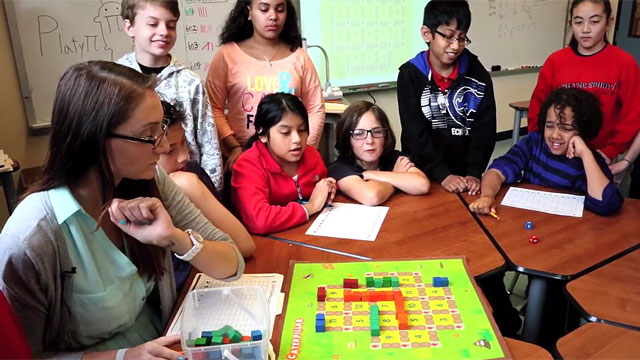
The parts of a game are: goal, challenge, core mechanics, components, rules and space. Change any one element and it’s a very different game. For example, Quest to Learn developed a game called “Caterpillar” focused on 6th grade math concepts of probability and frequency. Caterpillar is a modified version of Settlers of Catan. The goal is to create the longest continuous chain of blocks by the end of the game. The challenge is that to get more blocks students have to build around the most frequently rolled numbers, that’s how they get more blocks. But at the end of the game those numbers become “bombs” and everything built around them blows up. It’s a mixture of skill and chance, but students get a good understanding of what numbers are rolled most frequently by playing and how to calculate probability.

It’s also not hard to test out a game once it’s been designed. The targeted users are students, so ask them to play and give feedback. One of the biggest complaints teachers have about classroom games is the amount of time it takes students to learn how to play. Making sure the game is simple and elegant with clear rules helps maximize classroom learning time. One good question to ask the play-testers: “What would your classmate learn from this game?” That helps determine if students understand what they’re supposed to be learning. It’s also a good idea to ask about the level of difficulty, because while answers vary among students if all say it’s too easy or too hard it should be modified.

“Game design is collaborative,” said Spang. “It’s really hard to do it with just one person. It’s great to have more than one head working together.” That goes for the process of picking a targeted standard, designing a game and tinkering to get it right. But it also means that once the game is deployed in the classroom, it may need further modification to meet all learners.
Quest to Learn will be putting the games it has designed online this fall so other educators can download blueprints for the games they’ve had four years to perfect.

10 Ideas to Get Those Back-to-School Juices Flowing

back-to-school

Educators are getting prepared to welcome students back to school this month. Many have spent the summer reading up on new teaching strategies or getting inspired by colleagues across the country. To help get those idea juices flowing, here are some MindShift articles that delve into creative work, tools, and methodologies. Happy back to school!

  • FOR STORYTELLING PROJECTS, COOL NEW MULTIMEDIA TOOLS: Writing will always be important, but weaving text, images, sound, and presentation together can give students more and different ways to express themselves. Easy-to-use online tools allow students the opportunity to create multimedia projects that demonstrate knowledge and develop useful skills. Check out three tools on the scene.
  • 13 FREE WEB TOOLS STUDENTS AND TEACHERS SHOULD KNOW ABOUT: Web-based tools continue to proliferate, giving teachers more to add to their arsenal, but it can be hard to determine which resources are worth spending time exploring. Here are some tried-and-true favorites of ed-tech veterans Adam Bellow and Steve Dembo.
  • 5 WAYS TO INSPIRE STUDENTS THROUGH GLOBAL COLLABORATION: The Internet has made the world smaller. Teachers can now collaborate with classrooms around the world to expose students to different cultures. Some advantages of investing in a globally connected classroom include motivating students through international friendships and inspiring independent learning as students become curious about different cultures.
  • HOW TO APPLY DESIGN THINKING IN CLASS, STEP-BY-STEP: Adding elements of design thinking to the classroom doesn’t necessarily require a huge classroom redesign or an expensive 3D printer. There are plenty of ways to bring the creativity and energy of designing thinking into class, helping to inspire students and teachers alike. Here are some ideas for integrating different components of a design learning experience into familiar, pre-existing scenarios that play out in every school.
  • HOW TO TRIGGER STUDENTS’ INQUIRY THROUGH PROJECTS: Project-based learning has got a lot of educators excited about the future of education. It’s easy to get excited about what students could make without thinking through the learning outcomes that are the ultimate goal. In this article a project-based learning experts Suzie Boss and Jane Krauss walk through simple steps to set up effective projects.
  • WHY SLEEPING MAY BE MORE IMPORTANT THAN STUDYING: Part of the excitement of going back to school is imagining all the ways to stimulate student curiosity and passion through classroom work. But it’s also important to keep in mind how overwhelmed students can be with homework, extracurricular activities and other commitments. Sleep is a huge part of the learning process and both parents and teachers should keep it in mind as kids move through the school year.
  • TO GET STUDENTS INVESTED, INVOLVE THEM IN DECISIONS BIG AND SMALL: Technology is becoming an inherent part of many classrooms, but that doesn’t mean educators can stop thinking about how to integrate it effectively into learning goals. A big challenge can be how to frame curriculum design using the technology so that it moves beyond novelty and engagement into deep learning. One way to get students engaged is to involve them in designing their own learning. It can be eye-opening to see how students understand learning and engagement.
  • WHY READING ALOUD TO OLDER CHILDREN IS VALUABLE: Storytime often disappears in school after first or second grade. But some teachers are finding that reading aloud to older children can help them understand literary devices and nuance that they might otherwise miss. And research shows that it can enhance interest in and attention to reading.
  • WHY CODING TEACHES SO MUCH MORE THAN TECHNICAL SKILLS: Computer programming is often seen as a technical skill, but at its heart, learning to code is just like learning another language. And, once kids speak the language, their power to create expands. Learn about some of the specific benefits coding offers.
  • IS GAMING THE NEW ESSENTIAL LITERACY? Game-based learning has taken off in the last several years, often offering students fun ways to problem solve and achieve mastery in a subject. Educators are finding value not only in the game, but also in the meta-cultures that surround games, inspiring fan-fiction, collaboration and peer-editing from a diverse set of students. Gaming has become so popular that some big names in education are even hoping to assess learning through games.

Can Playing Video Games Give Girls an Edge In Math?

81754633 2

Girls should play more video games. That’s one of the unexpected lessons I take away from a rash of recent studies on the importance of—and the malleability of—spatial skills.

First, why spatial skills matter: The ability to mentally manipulate shapes and otherwise understand how the three-dimensional world works turns out to be an important predictor of creative and scholarly achievements, according to research published this month in the journal Psychological Science. The long-term study found that 13-year-olds’ scores on traditional measures of mathematical and verbal reasoning predicted the number of scholarly papers and patents these individuals produced three decades later.

But high scores on tests of spatial ability taken at age 13 predicted something more surprising: the likelihood that the individual would develop new knowledge and produce innovation in science, technology, engineering and mathematics, the domains collectively known as STEM.

The good news is that spatial abilities can get better with practice. A meta-analysis of 217 research studies, published in the journal Psychological Science last year, concluded that “spatial skills are malleable, durable and transferable”: that is, spatial skills can be improved by training; these improvements persist over time; and they “transfer” to tasks that are different from the tasks used in the training.

This last point is supported by a study published just last month in the Journal of Cognition and Development, which reported that training children in spatial reasoning can improve their performance in math. A single twenty-minute training session in spatial skills enhanced participants’ ability to solve math problems, suggesting that the training “primes” the brain to tackle arithmetic, says study author and Michigan State University education professor Kelly Mix.

Findings like these have led some researchers to advocate for the addition of spatial-skills training to the school curriculum. That’s not a bad idea, but here’s another way to think about it: the informal education children receive can be just as important as what they learn in the classroom. We need to think more carefully about how kids’ formal and informal educational experiences fit together, and how one can fill gaps left by the other.

If traditional math and reading skills are emphasized at school, for example, parents can make sure that spatial skills are accentuated at home—starting early on, with activities as simple as talking about the spatial properties of the world around us. A 2011 study from researchers at the University of Chicago reported that the number of spatial terms (like “circle,” “curvy,” and “edge”) parents used while interacting with their toddlers predicted how many of these kinds of words children themselves produced, and how well they performed on spatial problem-solving tasks at a later age.

[RELATED: How Thinking in 3D Can Improve Math and Science Skills]

As kids grow older, much of the experience they get in manipulating three-dimensional objects comes from playing video games—which brings us back to the contention at the start of this article. Males have historically held the advantage over females in spatial ability, and this advantage has often been attributed to genetic differences. But males’ spatial edge may also reflect, in part, differences in the leisure-time activities of boys and girls, activities that add up to a kind of daily drill in spatial skills for boys.

If that’s the case, then offering girls more opportunities to practice their spatial skills may begin to close the spatial-skills gender gap—and produce more female scientists, engineers and mathematicians in the bargain. So suggests a study by University of Toronto researchers, published in the journal Psychological Science. They found that playing an action video game “can virtually eliminate” the gender difference in a basic capacity they call spatial attention, while at the same time reducing the gender difference in the ability to mentally rotate objects, a higher-level spatial skill.

Exposure to video games, the authors conclude, “could play a significant role as part of a larger strategy designed to interest women in science and engineering careers.” Participants with little prior video-game exposure “realized large gains after only ten hours of training,” they note, adding that “we can only imagine the benefits that might be realized after weeks, months, or even years of action-video-gaming experience.”

Parents of daughters may blanch at the idea of actually encouraging “years” of action video game play. These moms and dads should tell themselves that their daughters aren’t wasting their time—they’re readying themselves for brilliant careers as scientists and engineers.

Can Digital Games Boost Students’ Test Scores?

ipadgame

In the past few years, educators have been closely watching the evolution of digital games used for learning. With a huge influx of products — whether they’re individual apps for tablets or an entire suite of software — the market is already big and continues to grow, with entire game-based schools cropping up across the country.

There’s no question students are interested in digital games — 97 percent of kids play them — but what educators and industry watchers want to know is whether playing those games can actually improve student achievement.

A new SRI study released today suggests they do — at least in the subjects of science, math, engineering, and technology. According to the report, which is an analysis of 77 peer-reviewed journal articles of students K-16 studying STEM subjects, “when digital games were compared to other instruction conditions without digital games, there was a moderate to strong effect in favor of digital games in terms of broad cognitive competencies.”

More specifically, “students at the median in the control group (no games) could have been raised 12 percent in cognitive learning outcomes if they had received the digital game.”

Another way to explain it: “For a student sitting in the median who doesn’t have a game, his or her learning achievement would have increased by 12 percent if he or she had that game,” said Ed Dieterle,  Senior Program Officer for Research, Measurement, and Evaluation for the Bill and Melinda Gates Foundation, which funded the SRI report.

Simulations have an even bigger impact, according to this analysis. When considering simulations — taking a phenomena, process, or behavior and coding it into something that can be manipulated and studied — improvement index jumped to 25 percent, meaning students who used simulations could have increased their learning outcomes by that amount.

Which begs the question, how do we define learning outcomes? According to Stacey Childress, deputy director of education at the Gates Foundation, learning outcomes can be defined in a few ways: progress toward mastery of a particular set of content and skill objectives in areas such as math and literacy; demonstration of complex skills like collaboration and critical thinking; and improvement in what researchers call “non-cognitive” skills such as persistence and grit.

“With learning games, it’s important to understand which kinds of outcomes they are designed to improve and whether or not students are actually making progress on those dimensions,” Childress said.

[RELATED: Teachers, Students, Digital Games: What’s the Right Mix?]

The Gates Foundation has made huge investments in the educational gaming world. Last year, the foundation launched the Games Learning and Assessment Lab (GlassLab), which was tasked with prototyping and developing games and formative assessments. The work is being conducted by the Institute of Play, the Educational Testing Service (ETS), Pearson, Inc., Electronic Arts (EA), and the Entertainment Software Association (ESA). GlassLab recently released, SimCityEdu, which integrates assessments aligned with Common Core State Standards. The educational version uses the same code as the commercial game, but with the addition of using students’ choices during challenges as a method of assessment, though not all education experts agree that assessment should be built into games.

The foundation has also invested in The Center for Game Science and the Radix Endeavor at MIT with the intent to develop games that embed valid assessment measures.

For this analysis, SRI considered reports from a gamut of sources in those 77 studies — going as far back as a 1992 study from The Journal of Educational Research looking at the effects of computer simulations and problem-solving approaches on high school students, to a 2006 study in the journal Interactive Learning Environments using just-in-time information to support scientific discovery learning in a computer-based simulation.

Other studies examined include one from 2011 that compares different versions of a game in terms of the degree to which the learning mechanics and goals are integrated directly into the central game mechanics (intrinsic design) versus separating the learning mechanics and goals from the central game mechanic (extrinsic design); and another from 2012 that compares different approaches to socially organizing players within a game in terms of collaboration and competition to maximize learning. The games within each study were developed specifically for research purposes, and thus are not as elaborate as some commercial titles like SimCity, but are solid examples of learning games, according to Dieterle.*

“This is the first big study to hit the pause button for a second and reach back in time and extract everything we could from what previous researchers have done with the intent of using that information to inform us about the field going forward,” Dieterle said.

FUTURE OF GAMES IN CLASSROOMS IS NOW

If digital games were rare in the past, that’s no longer the case. According to a recent teacher survey conducted by PBS, 43 percent of classroom computing goes to playing educational digital games. And in one study undertaken last year by the Joan Ganz Cooney Center, surveying 505 teachers, the majority of teachers reported that games increase motivation and make it easier to personalize learning.

But experiences and perceptions around games are still very much a mixed bag, depending on whom you ask. Some educators are skeptical that digital games are the answer. They question whether games provide enough context and depth that come from hands-on experiences.

“Imagine the difference between a student who’s playing an online math video game and a student who’s sitting in a small group with a teacher, working out problems and receiving immediate, individualized feedback and guidance,” said St. Louis-based fifth-grade teacher Jenny Kavanaugh in a recent interview. “There is no comparison.”

But Childress points out that the issue is more nuanced.

“The games and learning space is still in an exploratory, R&D phase. We shouldn’t frame games, or any other instructional support, as ‘the answer,'” she said. “All of us working in education should be skeptical about any innovation that doesn’t aim to produce evidence of its effectiveness. The SRI results are a strong start in the direction of solid evidence.”

And Childress does not see the use of digital games as an either/or scenario — either teachers or digital games.

“We should be careful not to view learning technologies as a replacement for deep teacher and student interactions. We see effective technology supports as enabling the opposite,” she said.

Digital games can be a part of a holistic plan that challenges students with things like “quests” and “missions,” when paired with tactics like spending targeted time with students in small groups or individually to help them address areas where they need help, she said.

[RELATED: Money, Time and Tactics: Can Games Be Effective in School?]

For educators who aren’t sure where to start, or how to find ways to integrate digital games into the current model, Childress said teachers’ own network can be a great resource.  For instance, one of the Gates-funded organizations, Playful Learning, focuses on creating a national network that offers teachers workshops on using games in the classroom.

For their part, game developers should incorporate ways to help educators do their jobs better, as is the case with other industries that have embraced technologies. “The best product developers deeply understand who they are designing for and the use case they are targeting, and offer the kind of implementation supports professionals need to integrate new tools into their daily work,” Childress said.

If Quest to Learn, the entirely game-based schools in New York and Chicago, are any indication of whether games can be successful learning tools, the potential seems bright. According to CNN, the school’s New York test scores, “an admittedly conventional metric, show the Quest kids have outperformed peers in the New York City school system in each of the last three years, in both English Language Arts and Math, according to data provided by the school,” with the only exception being the 2010 math scores.

But not every school can be a Quest to Learn, with dedicated funding for games. Finding the funds to finance digital games is one of the main obstacles, in fact. In the Cooney Center survey, 51 percent of teachers said that cost of digital games was the primary obstacle to integrating them into class, and only 17 percent of those surveyed said the school spent $100 or more on games.

To that end, Childress said there are a number of free resources available on the web, and that the foundation has funded 17 game development projects over the last three years, a number of which are free or available at reduced cost to districts serving students in low-income neighborhoods.

*The updated version of the article includes information about the studies from 2011 and 2012.

Inquiry Learning Vs. Standardized Content: Can They Coexist?

497411105_60c65df8ba_z
By Thom Markham

As Common Core State Standards are incorporated from school to school across the country, educators are discussing their value. It may seem that educators are arguing over whether the CCSS will roll out as a substitute No Child Left Behind curriculum or as an innovative guide to encourage inquiry rather than rote learning. In reality, as time will prove, we’re arguing over whether content standards are still appropriate.

Everyday there is less standardization of information, making it nearly impossible to decide what a tenth-grader should know. Beyond the core literacies of reading, writing, computation, and research, the world-wide culture of innovation, discovery, multi-polarity, interdisciplinary thinking, and rapid change depends on the explosive potential of the human mind, not entombed truths from the past. Increasingly, any standards-based curriculum is at odds with the outside world.

There is only one resolution to the debate. Sooner or later, inquiry-standards will take precedence over content-based standards. Education’s core task is to prepare young people to generate new ideas, filter them through a net of critical analysis and reflection, and move the ideas through a design process to create a quality product, either as an idea or a material object. Students need information, facts, and specific knowledge for a successful outcome. But that information must be gathered during the process of creation, in a usable, just-in-time format not found in “subjects.”

If you’re a teacher in tune with the needs of your students, you sense the disconnect between the curriculum and reality. You’d like the freedom to respond more directly to student needs, but standardized information and testing remains a barrier to innovative teaching.

So how can you, as a teacher, help move the dialogue forward? First, you can focus on becoming a highly-effective project based learning (PBL) teacher. When done well, PBL is the most effective method education has at the moment to introduce and practice inquiry-based education. Continue reading Inquiry Learning Vs. Standardized Content: Can They Coexist?

Teachers, Students, Digital Games: What’s the Right Mix?

6660140011_60f066dd02_z
By Holly Korbey

When St. Louis fifth-grade teacher Jenny Kavanaugh teaches history, she uses her laptop to look at a map, or to give kids a virtual tour of the historical landmarks they’re studying. “Students can interact with history in very cool ways online,” she said.

But when it’s time for math, she puts the computer away. Even though Kavanaugh thinks technology is a great tool to enhance and deepen certain lessons, for drill and practice of key concepts in class, she finds one-on-one practice to be much more effective than its technological equivalent – digital practice games.

“The goal is that a student can do division problems with speed and accuracy, and can also describe to me exactly what division is,” she said. “I have found that my advanced students can move past division of fractions in the online game, indicating mastery, but when I ask for a verbal description of what it is they are really doing – what is the division of fractions, or when would you use that in the real world? – they have no idea. I think that the rote practice is wasted time if the student does not have that conceptual understanding first. Many online games do not teach that part of math as well.”

While experts like Gary Stager, founder of the Constructing Modern Knowledge Summer Institute, recommend that computers be used to add “deep and meaningful experiences” to teachers’ lessons, much of what the 91percent of teachers with access to computers are doing may be just the opposite.

According to a recent teacher survey conducted by PBS, 43 percent of classroom computing goes to playing educational digital games, while a Joan Ganz Cooney study showed that nearly 50 percent of teachers use digital games in class. But with nearly half of all classroom computer time dedicated to games — many of which are played to reinforce basic skills like phonics, spelling or multiplication Continue reading Teachers, Students, Digital Games: What’s the Right Mix?

SimCityEDU: Using Games for Formative Assessment

SimCityEDU

SimCity

As game-based learning gains momentum in education circles, teachers increasingly want substantive proof that games are helpful for learning. The game-makers at the non-profit GlassLab are hoping to do this with the popular video game SimCity.

GlassLab is working with commercial game companies, assessment experts, and those versed in digital classrooms to build SimCityEDU, a downloadable game designed for sixth graders. Scheduled to be be released in the fall of 2013, it builds on SimCity’s city management theme, but provides specific challenges to players in the subject of STEM.

“The big pain point we’ve heard from teachers is that they cannot entertain their kids to the level that they are being entertained outside of the classroom,” said Jessica Lindl, general manager of GlassLab. “They want to be able to create meaningful learning experiences and they just can’t compete with the digital tools their kids are accessing all the time.”

Teachers have been using the commercial version of SimCity as a classroom tool for a long time, but with the newest version recently released and the EDU version soon to follow, GlassLab is trying to convene an online community of educators already working in the space, asking them to Continue reading SimCityEDU: Using Games for Formative Assessment

World of Warcraft Finds Its Way Into Class

Wow

World of Warcraft

Students’ passions can be a powerful driver for deeper and more creative learning. With this knowledge, some educators are using popular commercial games like World of Warcraft (WoW) to create curriculum around the game. And they say they’re seeing success, especially with learners who have had trouble in traditional classrooms.

World of Warcraft is a Massively Multiplayer Online Roleplay (MMOR) game, where players take on the identity of characters in a narrative-rich plot, working together to overcome challenges.

“In my estimation, a well-designed video game is pure, scaffolded, constructivist learning at its best,” said Peggy Sheehy, one of the designers of WoW in Schools, an elective English Language Arts curriculum built around the game. “Mastery of content opens up new content and offers unlimited opportunity for success.” And that’s what learning should be like, she says: interesting, engaging and collaborative. Research on gaming in an educational context corroborates Sheehy’s viewpoint that games demonstrate mastery learning because a player cannot move on until he or she has completed a set of tasks.

Sheehy designs “quests” with particular learning objectives in mind that the students or — “heroes” as they’re called in class — must complete. Quests might include components of comparative writing or characterization exercises. For example, Sheehy had her students read J.R.R. Tolkien’s The Hobbit as they progressed through the course, and for one assignment, they had to pick a character from the book and categorize that character within World of Warcraft. They were asked to defend their choices in writing, supporting their argument with the text. Continue reading World of Warcraft Finds Its Way Into Class