Tag Archives: Water

Paddling to the Sea

Jessie Raeder is Bay Area Organizer for the Tuolumne River Trust. More than 200 paddlers are expected to take to the river between now and June 7, for this river awareness relay. Raeder offers this dispatch from the starting line, near the headwaters in Yosemite National Park.

By Jessie Raeder

Paddle to the Sea got off to a roaring start over the weekend.  Melting snow caused by an early heat wave in the Sierras had the river pumping at much higher flows than rafters typically face. The Tuolumne is usually rated Class 4–but goes to Class 5 when flows get over 4000 cubic feet per second.   This weekend saw the river flowing at 7000 cfs! For a while it looked like we might have to cancel all the whitewater trips due to safety concerns, but in the end one trip did go on and needless to say it was an epic journey for our Paddle-to-the-Sea team.
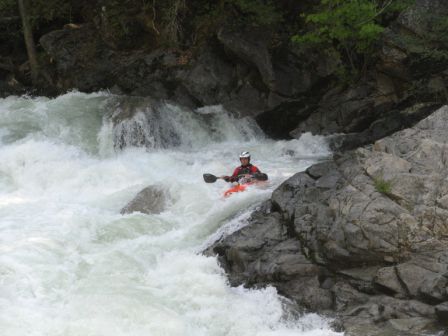
A paddler takes on the Clavey. Photo:
A paddler takes on the Clavey. Photo: Patrick Koepele, Tuolumne River Trust

Meanwhile, an international team of 12 hotshot kayakers ran the Clavey River, a tributary of the Tuolumne and one of only three remaining free-flowing rivers in the Sierra.  The Clavey is a class 5+ river that’s rarely run and only by experts.

Paddle to the Sea is a three-week festival to foster stewardship of the Tuolumne River. Hundreds are joining in this epic journey from the Sierra to the Sea. Kayakers and rafters will begin on the upper stretches of the Clavey and Tuolumne Rivers, travel through the Central Valley where canoers take the lead, pass through the confluence of the Tuolumne and San Joaquin Rivers, and sea kayakers will finish the trip in San Francisco Bay.

A changing and increasingly unpredictable water supply will be the first way that most people in California experience climate change affecting their own lives.  Here in the Bay Area, tap water for 2.5 million people comes from the Tuolumne River, whose headwaters start with melting snow from the Lyell Glacier (picture attached).  That glacier is on the retreat, and more frequent droughts are expected throughout the Sierra.

Paddle to the Sea is meant to demonstrate that issues that affect one section of the river ripple up and down the watershed.   Bay Area water users share this resource with farmers in Modesto, anglers in Yosemite, the commercial salmon industry on the Pacific, and a host of native fish, plant, and wildlife species, many of which are endangered.

As population and demand for water continues to grow, California will be faced with many questions about how we use water, and where it will come from.  The Tuolumne River Trust is working to ensure that we turn to water efficiency and water recycling as much as possible–alternatives which are far more sustainable and renewable than continuing to take additional water from the Tuolumne River, which has been the solution most turned to in the past.
 

California’s Water Meter Rebellion Withers

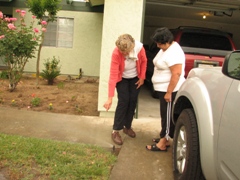
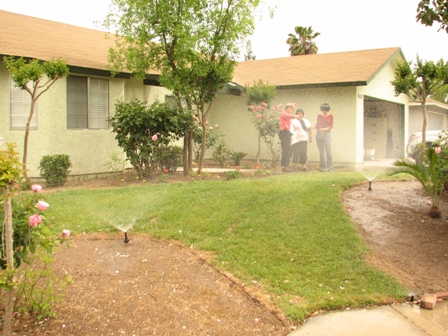
City water conservation specialist Marilyn Creel shows Fresno resident Mary Ann Evans how to adjust her sprinklers to point them away from the sidewalk.

Monday on The California Report, Central Valley Bureau Chief Sasha Khokha tracks one city’s longstanding rebellion against water meters–and says the day of reckoning is nearly at hand. Listen to Sasha’s story here.

I admit it. I wanted to do this story because I saw so many of my neighbors watering their driveways. What I learned is that unmetered cities are a long and slow-dying tradition in the Central Valley.

Martin McIntyre, who used to head Fresno’s water agency, explained how vehement anti-metering forces swayed voters and banned meters in the city charter:

“They were really false arguments. The simple phraseology was ‘meters are taxing machines,’ and they’re going to use meters to fund city hall activities. And, in fact, as is the case for all municipal water supply systems, the funds collected from ratepayers by law can only be used for the operation and improvement of the water supply system. Nonetheless, that resonated with some of the public and it was very easy for a handful of people to get prominent headlines above the fold simply by saying city hall is taxing us to death.”

State lawmakers overrode Fresno’s rule, because they understood that cities with meters use less water.

Ellen Hanak, a water researcher with the Public Policy Institute of California, has found that metered cities use about 15 percent less water than unmetered cities. And cities with a tiered rate system save an additional ten percent on top of that. In addition to usage, her report compares different cities’ water rates. Of course, San Franciscans get away with using less water because–guess what? Many of them don’t have front yards.

Hanak crunched statewide residential water rate numbers and determined that more than half of San Joaquin Valley residents don’t have water meters. (For further details, read the survey disclaimer.)

But meters are coming, one way or another.

There are basically three laws that will eventually require the entire state to install water meters. One says that all homes built after 1992 must have meters. Another dictates that cities that get federal water (like Fresno) have to install meters by 2013. And yet another law says that all California cities (including holdouts like Sacramento) have to be metered by 2025.

Fresno is gearing up to install its first meters this year. They’ve even created a handy Q&A for skittish customers.

And if you thought Central California was the only laggard, this might make you feel better: many Chicago residents don’t have meters, either.

But they probably don’t have the sprinkler ladies–who can fix any leaky, squeaky, spritzy sprinkler, and make sure it’s pointing away from the sidewalk.

KQED’s Sasha Khokha braves sprinkler spray to record Fresno’s city water conservation team at work.

“The Australian Reality”

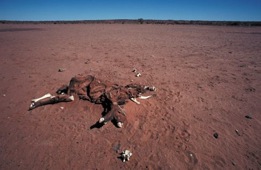
Australia's Simpson Desert. Photo: Mike Gillam

Referring to Australia’s seven-year drought, that’s how the state’s top water manager describes the new paradigm for water planning at the Dept. of Water Resources.

Speaking to a packed house at the annual forum of the Sacramento River Watershed Program yesterday, DWR Director Lester Snow said his staff is assuming that 2010 will be another dry year. Snow warned about “loss of resilience” in the state’s water system, calling it “completely unsustainable” in it’s present form, given predictions for population growth, coupled with anticipated effects of climate change.

All speakers at the forum seemed to agree that a paradigm shift is in order. Thomas Philps, a strategist at SoCal’s Metropolitan Water District, pointed out that in Victoria’s capital city of Melbourne (Australia), per capita water consumption runs about 40 gallons per day, while in California’s capital, it’s 280 gallons. As Sasha Khoka will report Monday morning on The California Report, Sacramento is just one of several cities in the Central Valley that still doesn’t meter its water use. Philps added that the Sacramento region is “on a trajectory” to use the same volume of water as Los Angeles, though he did not say by when.

UC Davis geologist Jeff Mount cautioned against relying on additional surface storage to secure California’s water future. Not only does storing water become “very expensive” year over year, but dams and reservoirs “don’t create any new water,” he said. (If some think Mount is taking a “jaundiced view” of the situation, it might be because he braved a bout of hepatitis to deliver his morning talk)

In a panel discussion on resource planning, moderator Greg Zlotnick of the Santa Clara Valley Water District asked panelists to respond with “true” or “false” to a quote from the Pacific Institute’s Peter Gleick in a story aired on NPR last week. The quote, as given by Zlotnick, was: “Government has built infrastructure and made promises that can’t be kept.” Here are the panelists’ responses:

Tina Swanson, The Bay Institute: “True.”

Philps: “True, but…” (Generally true but MWD doesn’t really expect to get its full contractual allocation of water anymore, anyway)

Don Glaser, US Bureau of Reclamation: “False, but…” (Water allotments from his agency’s Central Valley Project are intended to be “supplemental contracts,” to augment use of groundwater and other sources, but Glaser sees the statement becoming “more and more true in the future.”)

Snow: “Hell, no.”

NPR Spotlights California Water Issues

farm_0799_blog1

NPR’s Morning Edition launched an “occasional series” on California’s water woes this morning. Veteran correspondent John McChesney begins with the impact on agriculture in the Central Valley’s Westlands Water District, the nation’s “biggest irrigated region.”

KQED’s Central Valley Bureau Chief and Climate Watch contributor Sasha Khokha will have three stories in the series, two of which will debut on The California Report in the weeks ahead:

WATER METERS: Many California cities are preparing for or implementing mandatory water rationing this summer. But there are still cities and towns, particularly in California’s Central Valley, where water can’t be rationed because residents don’t even have water meters.  Residents are charged a flat rate for any amount of water they use. Khokha looks at the city of Fresno, where water meters will be phased in, but not until 2013.

MENDOTA PROFILE: The town of Mendota in California’s Central Valley is at the heart of the economic crisis spawned by drought and the loss of farm jobs.  Sam Rubio grew up here, the son of a Mexican farmworker.  He went off to college, and was planning to become a doctor, but instead has returned to this town to teach biology, mentor local kids, and run a café that’s become a haven for the farmworker youth.

AG ADAPTING TO DROUGHT: California farmers are facing an increasingly uncertain water supply, brought about by drought, environmental restrictions on pumping, and climate change. How will farmers adapt? Some of them are yanking out water-intensive crops and replacing them with more drought-tolerant ones. But others are trying to keep growing the same crops with improved technology. We’ll follow a new tech start-up that’s helping farmers use water more efficiently by tracking how much moisture reaches each plant in their fields–and sending a satellite message to their cell phones. We’ll also talk with a researcher who says there are ways California can grow some key crops, like oranges and nuts, using less water.


Decoding California’s Drought History

Abbie Tingstad is a paleoclimatologist at UCLA. She specializes in reconstructing drought records in the western United States, and takes us along on some of her field research in this guest post:

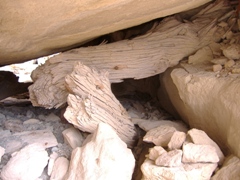
Part of a Piñon pine beam under the collapsed rock shelter. This beam was one of several sampled for tree ring analysis. Photo by Abbie Tingstad.
Part of a Piñon pine beam under a collapsed rock shelter. This beam was one of several sampled for tree ring analysis. Photo by Abbie Tingstad.

By Abbie Tingstad

The site was so remote we needed a team of archaeologists and a couple of heavy-duty 4x4s to get us there.

Deep within the rocky piñon-juniper cliffs of northwestern Colorado was a secret so well hidden I didn’t see it until I was physically inside, face-to-face with a series of hand prints made over a thousand years ago. This rock shelter was occupied during Medieval times by Fremont Indians, contemporaries of the Anasazi whose cultural center was further south in the Four Corners Region. The site had already been excavated, but our interest as dendroclimatologists was not in artifacts. We had come to take samples from the ancient piñon and juniper beams that once supported this structure for the valuable paleoclimate information contained within their annual growth rings.

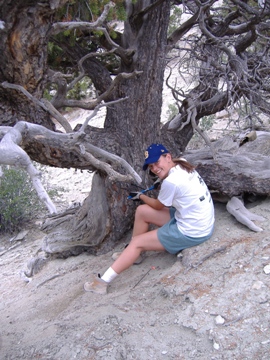
Tingstad sampling a live Piñon pine tree in northeastern Utah. This tree is about 550 years old. Photo by Glen MacDonald.

Gathering Medieval climate information from tree rings, lake sediments, and other natural climate archives in the Western US is critically important for understanding the implications of increasing temperatures in this region, particularly when it comes to future water supply and demand.

Research has confirmed that temperatures rose in the Western U.S. from about A.D. 800-1300, which translated into a series of droughts. The most devastating of these occurred in the mid-11th and 12th Centuries, when dry conditions persisted for several decades and may have contributed to the collapse of the Anasazi and Fremont cultures.

Paleoclimate data from tree rings and other sources also suggest that the mechanism driving drought during the “Medieval Warm Period” was eastern Pacific Ocean cooling. Like a widespread, extended La Niña event, cool sea surface temperatures may have strengthened the persistent moisture-blocking system of high-pressure off the West coast, nudging storm tracks north.

While the Medieval period is an instructive analogue for the warming we are beginning to experience, it is an imperfect one. Two major factors separate the episode the Fremont and Anasazi experienced a thousand years ago from what we are just beginning to undergo today. First, Medieval warming appears to have been fostered by a combination of increased solar irradiance and decreased volcanic activity, rather than anthropogenic greenhouse gas emissions. Secondly, Medieval times were characterized mainly by summer warming, while winter and spring temperatures are expected to increase most dramatically in the future. These differences manifest themselves in many ways, but notable for the water-starved West are the implications for decreased winter snowpack and earlier spring river discharge.

The Medieval Warm Period may not offer a precise preview of our future, but it serves as a valuable warning about the tenuous balance of water supply and demand in California and the Western US, something the occupants of the Fremont rock shelter we visited were likely aware of.

Since the turn of the new Millennium, drought has been the norm rather than the exception in this region and the end is not in sight: As of May 1, 2009 surveys suggest that the Sierra Nevada snowpack is two-thirds of normal. What we can learn from Medieval times is not to expect “normally” moist conditions to return any time soon, and to plan accordingly.

Sierra Snow Season Ends with a Whimper

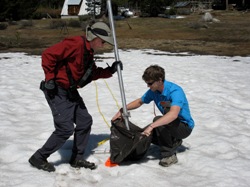
Surveyor Frank Gehrke takes on last poke at the season's shrinking snow pack. Photo by Craig Miller.
Surveyor Frank Gehrke takes one last poke at the season's shrinking snow pack. Photo by Craig Miller.

When veteran snow surveyor Frank Gehrke stuck his aluminum tube into the thinning snow course at Phillips Station this morning, the “Mount Rose” snow gauge stopped dead a few inches in. He then withdrew a sad little cylinder of corn snow, about the size of a flashlight battery. There was barely a foot of snow left at this measuring station, 6,900 feet above sea level. Water content: 35% of normal. Yikes. Of course, that’s just one station among many surveyed on a monthly basis to help handicap the coming summer’s water supply.

The numbers are in for the season’s last snow survey: On average throughout the Sierra Nevada, water content clocks in at 66% of normal for this date. Last year at this time it was 72% of normal. The southern third of the Sierra came in at 61%.

So even with that hope-lifting late-season burst of precipitation that started in mid-February, we ended up even worse than last year–at least in terms of the snowpack. Some local reservoirs filled up nicely with the soggy spring. The trouble, says Gehrke, is that “The big ones didn’t.”

Some municipal water districts have vacillated on rationing plans for the summer. But the big state and federal systems that supply irrigation water to farms have largely stuck with their drastic cuts in allocations this year.

The bottom line, according to state water director Lester Snow:  “When combined with extremely dry years in 2007 and 2008, low storage in the state’s major reservoirs, restrictions on Delta pumping, a growing population and prediction of increasingly unpredictable weather patterns due to climate change, it is clear the problems facing California will persist beyond this year and this drought.”

Official drought proclamations have been a source of some controversy since the rain finally began falling in February. The Department of Water Resources has produced a statewide water plan and put it up for comment until June.

Congressman: Delta Fish a “Worthless Little Worm”

Peter Johnsen, U.S. Fish & Wildlife Service
Photo: Peter Johnsen, U.S. Fish & Wildlife Service

In hearings by the House Energy & Commerce Subcommitee today, Rep. George Radanovich (R-Fresno) called the Delta smelt “a worthless little worm that needs to go the way of the dinosaur.” He made the remark as part of a five-minute attack on “environmental alarmism,” in response to testimony from former vice-president Al Gore, founder of the Alliance for Climate Protection.

The tiny fish, recently listed by the state Fish & Game Commission as “endangered,” came up in remarks by Radanovich about the current drought conditions in the Central Valley. He blamed the lack of water on lawsuits that have restricted water supplies to farms, “for a Delta smelt–a worthless little worm that needs to go the way of the dinosaur. They’ve shut pumps down and restricted water deliveries to California over that thing, when what’s eating it is a striped bass, a non-native species in the Delta.”

Radanovich rejected the possibility that climate change might be a player in the current drought. Instead he took aim at what he described as “collaboration between environmentalists and sport fishermen,” blaming that for slashed water allocations to farms, as many as 60,000 job losses and “a $6 billion-dollar hit to our economy.”

“That is not global warming,” he said. ” “It’s the result of bad policy caused by environmental alarmism.”

Joining Gore among the 21 witnesses before the subcommittee on Day 4 of the climate bill hearings was UC Davis professor Dan Sperling (.pdf link), who had just come from a marathon hearing before the California Air Resources Board. Last evening the Air Board approved the first-ever Low-Carbon Fuel Standard, as part of it’s plan to reduce greenhouse gases.

Early Runoff More than Theory

This post has been modified based on clarifications by the study’s lead author, which are outlined in her comment, below.

A recent study seems to confirm what many have already surmised: The spring melt from the Sierra snowpack is happening sooner.

To get a handle on the timing of mountain runoff, a team led by Iris Stewart of Santa Clara University pulled together data from 52 stream gauges up and down California. For her study, Stewart says she chose only water courses unaffected by dams and diversions, with at least 20 years of continuous data.

Stewart’s data shows that over the 60 years spanning 1948-2008; 80% of the gauges show the “stream pulse” that accompanies peak runoff, coming consistently sooner in the season–an average of about 10 days sooner, though at least one location had shifted up by more than a month. In fact, combining all of the metrics in the study, Stewart says only one gauge showed a later trend.

The trend seems remarkably consistent. Stewart says that despite a warming trend over the past ten years, she has not seen any acceleration of the trend within that period.

Stewart cautions that there’s more work to do on this and was reluctant to draw broad inferences from the study. Runoff in a particular stream is affected by many factors, including the elevation, slope, aspect (which direction it’s facing), vegetation cover and soil composition. Stewart says further study of these variables will better help identify the most vulnerable streams. But the latest results seem consistent with an earlier study in which Stewart found “earlier runoff on a continental scale.”

Scientists are concerned that as average temperatures rise, California’s mountains will see more rain, less snow–and what snow there is will melt off sooner. Reservoirs can only retain so much runoff at once, so if more of the “frozen reservoir” dissipates earlier in the season, farms and cities stand to be caught short of water before the rains return.

Stewart, an assistant professor at SCU’s Environmental Studies Institute, presented her findings this morning to researchers at the Pacific Climate Workshop (known as PACLIM, the conference does not have a website), a semi-annual gathering of climate scientists doing front-line research around North America. The conference in Pacific Grove is organized by the USGS office in Menlo Park.

Over the course of four days, about 60 researchers will hear findings on the climatic implications for fire, fog, glaciers, the ocean and wildlife, among other topics.

Survey Says: Drought Still On

It’s still “cause for concern.” That’s how California’s water chief summed up the water outlook for this summer, based on the latest survey. The Sierra snowpack stands at 81% of normal for this date, according to today’s measurements by the state Department of Water Resources.

Chopping up the Sierra Nevada into segments, Northern California fared a little better at 87%. The situation deteriorates as you move southward, with Southern Sierra stations clocking in at 77% of normal.

In most years, the April survey marks the peak of the season’s snow water content.

Ultimately what matters is runoff, or the total amount of water that actually comes off the mountains with the spring melt. And snowpack isn’t necessarily a good predictor of that, as we heard in David Gorn’s story on The California Report and in his blog notes from today.

Just yesterday the Governor’s Climate Action Team released its 2009 assessment of likely climate change effects in California. One  predicted outcome is that ripple effects from water shortages could run up a tab of $3 billion per year. And that’s the rosy scenario, based on being able to quickly move 5 million acre-feet of water to where it’s needed. Eileen Tutt of Cal-EPA cautions that the actual capacity of the current system to quickly redistribute water is closer to 1 million acre-feet. An acre-foot is about the amount of water that a typical household uses in one year.

Fire and (Less) Ice: California’s Climate Future

firesign_blogThere was little “news” in this week’s report from California’s inter-agency Climate Action Team. The distillation of 37 academic studies mostly affirmed what we’ve been hearing from multiple sources lately; that “severe and costly impacts” likely lie ahead as the state’s climate changes.

The report’s findings are aligned with two of the scenarios modeled by the U.N.’s climate panel; the “B1” outlook for moderate emissions of CO2, and the higher-emissions “A2” scenario. While California has ambitious plans to curb carbon emissions, many recent reports agree that the world is presently on a path toward emissions even higher than the worst IPCC scenario.

Under that more severe tableau, says report co-author Dan Cayan of the Scripps Institution of Oceanography in San Diego, the number of wildfires in the state could double by 2085. Cayan said that “by every model,” the state is warming and in some areas, drying. One regional model sees precipitation in Southern California tailing off by 10% in years to come.

There’s more coverage of the report in Jane Kay’s article for the San Francisco Chronicle and Bettina Boxall’s story in the L.A. Times.

The Times article points to some relatively “good” news in the report; a UCLA study that the strength of fire-fanning Santa Ana winds may be subsiding. But there is also research out of Lawrence Berkeley National Laboratory that points to a longer Santa Ana season, so it’s unclear what the net effect might be in the long run.

In a media conference call attended by report authors and state officials, I asked about murmurings that the Western Climate Initiative may be unraveling. Eileen Tutt of Cal-EPA denied that the planned regional cap & trade program for cutting carbon emissions is in trouble. She said that in working with people from California’s six potential partner states, it’s her view that they “aren’t backing off at all.” She admitted that “rumors abound,” however.

Climate Watch has dispatched freelance correspondent Tom Banse to look further into those rumors. He’ll be reporting in from Washington and Oregon in the weeks to come.