The California Air Resources Board (CARB) announced Thursday that the state has fulfilled its part of the May 2009 agreement set between auto manufacturers and two federal agencies that will establish the nation’s first greenhouse gas emissions standard for cars.
The new regulation adopted Thursday contains what CARB spokesman Stanley Young called “largely technical fixes,” including a change that will allow cars that meet the federal standard in the years 2012 to 2016 to be counted as compliant with the stricter California standard. (The federal standard goes into effect in 2012. It differs from the California standard until the two reach the same levels in 2016.)
The California law mandating rules to cut greenhouse gas emissions from cars, AB 1493, was passed in 2002. Between 2005 and 2009, the state fought for an EPA waiver that would allow it to implement a standard tougher than existing federal rules. Last May, President Obama announced a national standard for tailpipe emissions of greenhouse gases modeled on California’s rules. In June, the U.S. EPA granted the waiver the state had long sought. See the CARB website for a history of the struggles over the regulations.
CARB says that national implementation of the standard will cut 941 million tons of CO2 by 2020, compared to 793 million tons had the standard been limited to California and the thirteen states that had adopted California’s rules.
AB 1493 would not be affected by a suspension of AB 32, an issue Californians may be voting on soon.
Five years ago, the notion of measuring your company’s carbon footprint might have seemed quaint, or foolish, or just plain impossible. And not too many large companies were interested. But a recent report from the consulting firm Groom Energy Solutions finds that corporate emissions reporting is fast becoming big business (Groom describes itself as a “provider of renewable and energy efficiency systems to commercial and industrial companies.”)
The Groom analysis focuses on “enterprise carbon accounting” software, or, in plain language, technology that helps companies track their emissions. According to the report, venture capitalists invested $46 million in enterprise carbon accounting (ECA) software in 2009, and it predicts that purchases of the technology will increase 600% by next year.
According to Paul Baier, VP of consulting services for Groom, 60% of Fortune 500 companies currently report their carbon emissions, and that number is growing rapidly.
“By the end of 2010, if a company is not reporting, it will be seen as a laggard in the industry,” said Baier. “It’s increasingly mainstream for corporations to be doing this now.
Ninety percent of reporting companies are using “spreadsheets and consultants” to determine their footprints, said Baier, and the rest are using ECA software. Three years from now he expects that 80% will be using the software, which helps companies track hundreds of different data points related to operational emissions.
“They don’t keep track of their financial information with spreadsheets anymore, and they won’t be using them for carbon reporting much longer,” he said.
In general, corporate carbon accounting is limited to what the Greenhouse Gas Protocol Initiative (which sets the widely accepted standards) refers to as Scope 1 and Scope 2. These include the direct emissions of company operations such as on-site fuel combustion and electricity use. Significantly, Scopes 1 and 2 leave out the potentially enormous, yet elusive footprint of a company’s suppliers and the myriad of other associated carbon sources. In the works are standards for measuring Scope 3, which Baier calls “everything else,” but for now, there is no generally agreed-upon template for measuring this wider footprint.
Which leaves room for debate, such as when The Wall Street Journal raised questions about the 2008 pronouncement by Dell Inc. that it had achieved carbon neutrality. The Journal article reported that Dell was measuring only a small fraction of total emissions associated with the company. Dell had taken into account employee air travel and building electricity use, but not emissions produced from transporting products or the footprints of the factories around that world that supply it with computer parts.
Given the inconsistencies and uncertainties of corporate carbon accounting, not to mention the cost in employee time and technology investments, why are companies flocking to do it?
According to the Groom Energy report, the three main drivers, in order, are:
Increased pressure from customers and investors for companies to create a “greener” public image
NASA's "Dynamic Planet" exhibit at the San Diego Convention Center. Photo: Craig Miller
SAN DIEGO –The annual meeting of the American Association for the Advancement of Science (AAAS) draws “thousands” of scientists in virtually every endeavor, from astrophysics to zoology. In climate science circles there was no lack of topics to choose from this year. Among them:
Geo-Engineering
Several sessions were devoted to the notion of fending off climate change by tinkering with earth systems. In technical sessions and news briefings, there was a range of opinion on display, from “Let’s try it” to “Let’s look at it,” to “Don’t even think about it.” There seems to be general agreement that techniques like seeding the atmosphere with particulates could yield rapid results–but the idea is fraught with political controversy and legal pitfalls. Stanford’s Ken Caldeira likened the idea to a cancer patient who accepts the risks of chemotherapy, in order to avoid worse consequences. Philosophy professor (and Caldeira’s former teacher) Martin Bunzl, firmly rejected that analogy, saying that unlike cancer therapy, the risks are not well known and “You can’t just turn it off.” Bunzl directs the Climate and Social Policy Initiative at Rutgers University.
At Climate Watch, we’re preparing an explanatory radio feature on geo-engineering, for broadcast in the coming weeks.
Oceans
The plight of the planet’s oceans was a focus of the conference, with numerous discussions of acidification, marine reserves and the newly implemented concept of “marine spatial planning,” an effort to map the oceans’ topography, biota and habitat, then translate that into a kind of zoning plan for human use (an approach specifically mandated by the Obama administration last year).
In October, researchers will formally conclude the Census of Marine Life, a 10-year collaboration among scientists in 80 countries, to “assess and explain the diversity, distribution and abundance of life in the ocean.” During a media briefing at AAAS, census Co-Chief Scientist Ron O’Dor estimated that the final tally would include 5,000 newly discovered species (“not counting the microbials”), from flying sea cucumbers to the “Rasta sponge,” which, according to O’Dor’s colleague, Shirley Pomponi, appears to sport dreadlocks and also “produces an anti-cancer compound.” O’Dor said one general conclusion from the census would be that while it is “large and resilient, we can’t keep insulting the ocean forever.”
Science & Policy
In keeping with the meeting’s theme of “Bridging Science and Society,” and reflecting the current angst over credibility in science, there were overflow sessions with titles such as “A Wobbly Three-Legged Stool: Science, Politics and the Public.” While people spilled out the door of that room, hard-science lectures in adjacent rooms drew just a smattering of people. In an interview with Climate Watch, Brad Allenby, a professor of engineering and ethics at Arizona State University, lamented that “the climate change discussion has become so polarized, even among scientists, that it’s difficult to present the public with factual information that is credible.”
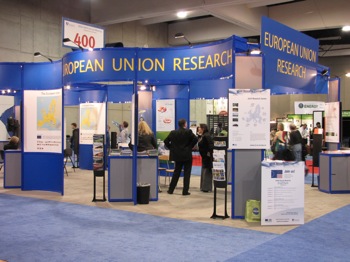
European Union exhibit at AAAS. Some attendees commented that the exhibit hall seemed sparse this year. Photo: Craig Miller
National Climate Service
NOAA chief Jane Lubchenko used the occasion of the conference to talk up her agency’s new National Climate Service, funded by legislation last year. The new branch will provide one-stop shopping for climate research and tools for policymakers, including those at the state and local level. Lubchenko says she hopes to have the new unit operational by October, when the federal fiscal year turns over.
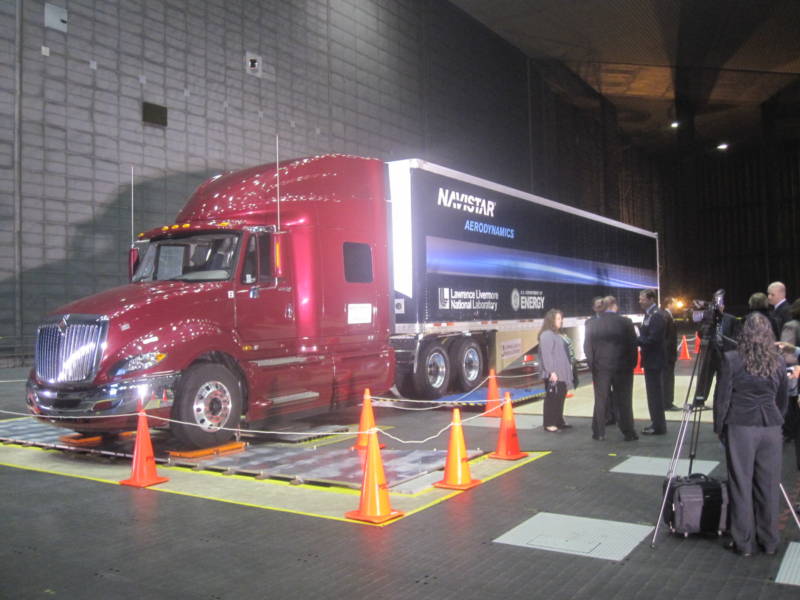
The wind tunnel at NASA’s Ames Research Center in Mountain View is the largest in the world. According to Ames deputy director Lou Braxton, at various times it has housed a Boeing 747 and an America’s Cup racing yacht. But parked inside this week was a relatively diminutive semi-truck with a 53-foot trailer. The truck is called the ProStar, and according to its manufacturer, Navistar, it’s the most aerodynamic truck on the road.
The wind tunnel was open to the media because Ames, Lawrence Livermore National Lab (LLNL), Navistar, and the Air Force (which manages the tunnel) were showcasing their ongoing project designed to identify, develop, and test devices that reduce the aerodynamic drag of “big rigs.” The wind tunnel wasn’t activated for the press event but the media gathered inside the cavernous space could envision how the tests might work.
At highway speeds, more than 50 percent of the energy produced by a truck’s engine is used to overcome aerodynamic drag. Therefore, reducing that drag can produce significant fuel savings. In fact, testing thus far has determined that existing aerodynamic design adjustments and attachments can increase fuel efficiency by 12 percent, which, when applied to the US trucking fleet, could save more than three billion gallons of diesel fuel per year, a cost savings of more than $10 billion at current prices. This savings in diesel translates to a reduction of 36 million metric tons of CO2 per year.
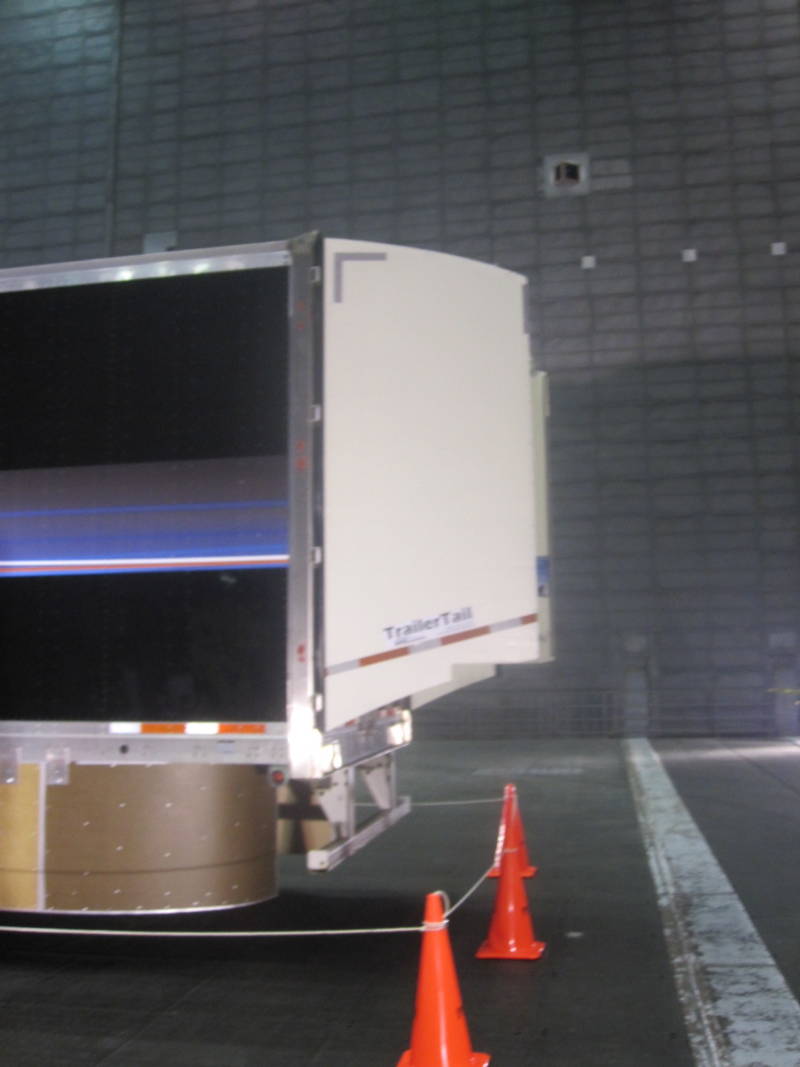
Inside the wind tunnel, the truck’s trailer was outfitted with various attachments designed to reduce drag at critical points such as the trailer base, the under body, and the gap between the tractor and trailer. Some, such as the TrailerTail, are already commercially available, while others are still in development. For the next three weeks, scientists will test various devices and combinations. The best ones will be track tested and then road tested over the next year.
Currently, semi-trucks make up about 12 percent of US petroleum consumption; about 21 million barrels a day, according to LLNL.
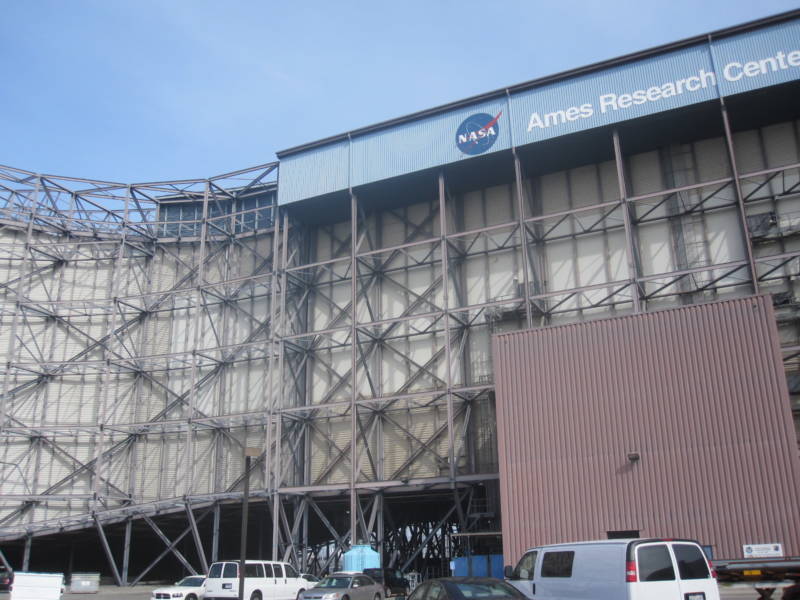
The TrailerTail (Photo: Gretchen Weber)Outside the National Full-Scale Aerodynamics Complex (NFAC) at Ames, where the wind tunnel is located (Photo: Gretchen Weber)
In April of last year, Climate Watch first called attention to the apparent lack of momentum within the WCI, an agreement among 11 US states and Canadian provinces, in which Arizona was a founding partner.
In her order, Governor Brewer wrote that imposing cap-and-trade at this time would “cost investment and jobs in Arizona” and put the state at a “competitive disadvantage,” as industry would be forced to pay fees for their carbon emissions.
Arizona relies on coal for about a third of its electricity production (36% as of 2007, according to the US Energy Information Administration’s tally) and its renewable energy goals (15% by 2025) are less ambitious than California’s (30% by 2020). But Arizona also has a larger nuclear power component. Governor Brewer cited this in last week’s executive order, as part of the reason why Arizona’s per capita greenhouse gas emissions are “about one third less than the national average.” The Governor’s order affirms that Arizona seeks “pragmatic” approaches to climate change mitigation and implies that Arizona officials would rather wait and see what carbon regulation develops at the national level, than proceed with a regional plan.
The state’s move comes as several energy companies mount an eleventh-hour push for a national cap-and-trade program, which has languished in the Senate.
The WCI comprises both “partner” and “observer” states. The Brewer order says that Arizona will “continue to be a member of the WCI to ensure that Arizona’s unique perspective will be advanced,” but that the state will not implement regional cap and trade. As of this morning, Arizona was still listed on the WCI website as a “partner” and there was no mention of the action.
California officials have long said that while a regional carbon trading pact would be preferable, California could “go it alone” if necessary.
A couple of months ago, nearly lost amid the “Hopenhagen” hype, the University of California, Davis (UCD) put out a press release with an admonition: “Don’t Blame Cows for Climate Change.” The release was a first look at some work conducted by UCD Associate Professor and Air Quality Specialist Frank Mitloehner. His study examines the greenhouse gases, or GHGs, emitted by the livestock sector. As California’s air regulators turn more attention toward methane in particular, the report remains timely.
Mitloehner’s paper is entitled: “Clearing the Air: Livestock’s Contributions to Climate Change,” and was published in the peer-reviewed journal Advances in Agronomy. The paper is a synthesis of current science on the cattle-climate connection. Mitloehner has been updating some of that science in recent years.
In 2008, I stopped by his cluster of “bio bubbles;” airtight domes that serve as high-tech stables for cows. Inside, Mitloehner had set up simulated dairy operations, measuring GHGs emitted by the cows’ digestive process and decomposition of the manure. The numbers then in common use had been generated in the 1930s.
Research "bio-bubbles" at UC Davis. Photo: Cody Sheehy
Mitloehner says cattle gets a bum rap in the media, and points to some examples, including a 2007 story in Time magazine, which included assertions like: “Which is responsible for more global warming: your BMW or your Big Mac? Believe it or not, it’s your Big Mac,” and “A 16-oz T-bone is like a hummer on a plate . . ”
In many cases, Mitloehner says the statements are crafted from an influnencial 2006 United Nations report entitled: “Livestock’s Long Shadow.” According to the executive summary, “The livestock sector is a major player, responsible for 18 percent of greenhouse gas emissions measured in CO2 equivalent. This is a higher share than transport.”
But Mitloehner points to a quote deeper in the report:
“The respiration of livestock makes up only a very small part of the net release of carbon that can be attributed to the livestock sector. Much more is released indirectly by other channels, including: the burning of fossil fuel to produce mineral fertilizers used in feed production, methane release from the breakdown of fertilizers and from animal manure, land-use changes for feed production and for grazing, land degradation, fossil fuel use during feed and animal production and fossil fuel use in production and transport of processed and refrigerated animal products.”
Mitloehner cautions that the transportation number they use only accounts for tailpipe emissions. To be even-handed, he says, the authors should’ve incorporated emissions from the entire oil industry, including refinement of the oil and production of cars. In the UCD release, Mitloehner calls it a “lopsided ‘analysis” and “a classical apples-and-oranges analogy that truly confused the issue.”
Meanwhile, the Bio-bubbles have been generating some interesting numbers. Mitloehner found that the amount of methane the cows respire (belch) and how much is released in the breakdown of animal manure is quite different from what previous research had calculated. In combination, these two sources represent the most direct GHGs from the livestock industry, even if they’re not the largest GHG emitter associated with the industry. They’re also the most out of date.
Emission factors used in “Livestock’s Long Shadow” provide an estimate of methane respiration of about 86 million tonnes (metric tons) of methane (CH4) and 17.5 million tonnes of CH4 annually from manure decomposition. In the annex of the UN report, the authors write: “Obviously, great improvements to the estimates of emission factors could be made if more data on nutrition and production were available.” And so it is that inside his bio-bubbles, Mitloehner has come up with numbers much lower than those that represented the conventional wisdom since 1938.
All in all, we’ve got a discussion about comparing apples and oranges (more appealing than manure, granted) and some updated numbers that lower the emissions of livestock in one category. As with any scientific paper, there will probably be debate on both of these points and new ones, but let’s look at the broader consequences. Will industry look at this study and see an incentive to update and revise carbon emission numbers all across the board?
According to Emilo Laca, an agricultural ecologist at U. C. Davis, some of these questions will be fodder for policy debates that lie outside the realm of science. He says “The real question is, ‘How are we going to split this up?'” Laca used a hypothetical problem to explain: Let’s say that a certain livestock industry consumed 30% of soybean production as a food source. Livestock producers might concede that they should be accountable for 30% of carbon emissions related to soybeans. It makes sense. It’s what the numbers say. Others might counter that without this certain livestock industry, the soybean market would behave differently and some amount–lets guess 70%–wouldn’t need to be planted. Therefore, the livestock industry in this example is responsible for 70% of the emissions, not 30%. Science can support both interpretations. As Laca says, the decision is how to “split” things up. And ultimately, those decisions may fall to policy wonks.
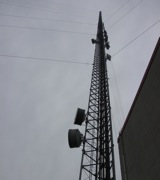
Scientists in California have begun setting up a statewide network of monitors to track California’s greenhouse gas emissions. Similar equipment has been in place for years as part of a continental network established by the National Oceanic & Atmospheric Administration (NOAA). But officials at the California Air Resources Board (CARB) say this new system will be the first of its kind.
“The unique thing about this is that we’re actually looking at the local emissions, rather than the global average, says Jorn Herner, who heads the Greenhouse Gas Technology & Field Testing Section of CARB’s research arm. “Nobody has done that before.”
Scientists have been systematically tracking atmospheric CO2 on a broad scale since 1958. California’s network of GHG sniffers will be capable of tracking CO2, nitrous oxides and other known greenhouse gases, and will initially focus on methane.
But CARB officials say the network is not part of a “Big Brother” strategy for emissions compliance. “This is initially a research project,” said Herner. He says the new network will provide a “second data point” to augment the state’s current method of estimating GHG emissions. Currently California’s current climate law, AB-32, relies on a “bottom-up” system of estimating emissions from individual sources, then adding them up to arrive at total emissions for the state.
“The modeling won’t tell you each individual source but what you’d be able to do is develop a gridded inventory. So you’ll be able to say in this square mile of land over here, it looks like emissions are much higher than in this square mile next to it.”
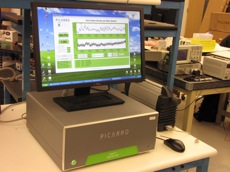
The greenhouse gas analyzers are about the size of a desktop computer. Photo: Craig Miller
The Air Board has purchased seven “next-generation” analyzers from Picarro Instruments in Sunnyvale. Five will go to fixed locations, such as a tower on Mt. Wilson, above the Los Angeles Basin. The two others will be on “mobile platforms;” electric vehicles that can roam the state taking ground-level readings. The units cost about $50,000 apiece but Picarro executives say they are self-adjusting and require far less human intervention than previous models, which will ultimately make them more cost-effective.
Picarro’s CEO, Michael Woelk, says a nationwide network of 500-to-700 detectors could yield a comprehensive GHG map of the US with resolution down to ten kilometers (a little more than six miles).
If California regulators are successful at putting in place a statewide or regional cap-and-trade system for greenhouse gases, industrial emitters will have to pay fees for the carbon they pump into the air. Horn agrees that at that point, some kind of check on the current system of self-reporting will “probably” be needed, but, he says, “that’s not the goal of this monitoring network at this time.”
“The science is really young,” he explained. “We’re really just trying to find out the potential of what we can do with this network. How it’s used in the future is still up in the air.”
…so to speak.
This animation below shows the methane levels detected by a Picarro analyzer as it is driven from Livermore, CA, to Sacramento.
California’s cap-and-trade program took another baby step toward fruition on Monday, with the release of the state-appointed Economic and Allocation Advisory Committee’s final report on implementing carbon regulation.
Stopping just short of recommending a 100% auction of emission credits, the report, which is non-binding and was written to help the California Air Resources Board develop an economically sound cap-and-trade program, advises the state to sell off the majority of its carbon permits to emitters — with a few exceptions. Industries that “rely heavily” on carbon-based energy or compete directly with firms that do not face carbon regulation, the report says, should be “provided with assistance” or given funds earned from the auction.
The report pointedly advises against handing out free permits to utilities. Although the state’s utilities will almost certainly pass increased costs onto customers, the committee predicts that the price spike will provide an incentive for Californians to start saving energy. The committee’s press release says the report takes a “household friendly” approach to cap-and-trade, recommending that at least 75% of the proceeds from selling carbon permits be returned to households through either tax cuts or direct financial transfers.
Even before the report was released on Monday, the looming possibility of a carbon permit auction was causing anxiety in industrial circles. The AB-32 Implementation Group, an organization that aims to protect California business interests, claimed last week that if the price of carbon is set to $60 per ton, “large employers could be subject to an ‘Auction Tax’ of up to $143 billion by 2020.” Environmental groups have been urging the Air Board to auction off all the carbon permits initially offered.
In a written statement, Governor Arnold Schwarzenegger responded to the committee’s report, saying “the best program will be one that returns value to the people through tax cuts, rebates or dividends, and I applaud the Committee for recognizing those options.”
Here’s a quick run down of the rest of the report’s key recommendations:
Protect Low Income Households
The report recommends returning some of the auction’s profits to low income households, since such households tend to spend a greater percentage of their income on energy.
Invest in a Low Carbon Economy
The committee recommends that the state create an independent Investment Advisory Board to help make it reach its low carbon targets.
Simple Auctions
The state’s carbon permit auctions should simple and allow the public to sell permits in the auctions along with the state.
Here’s my “highlights reel” from the panel of experts who testified, in order of appearance:
Mary Nichols, Chair, California Air Resources Board
– On carbon pricing: “There is no approach that does not involve administrative costs & headaches” but cap-and-trade “seems like a pretty good mix” of certainty provided by an enforced cap and market flexibility (versus an outright carbon tax of some sort).
– On California going “solo” with carbon trading (i.e. without the other states and provinces currently signed to the Western Carbon Initiative): The larger the territory, the more potential for “bad actors” but the greater the potential for meaningful savings & benefits to the economy.
Michael Wara, Stanford Law Professor
– On carbon offsets: “…difficult to administer;” to ensure real reductions, changes in behavior, has proven to be “a significant and ongoing challenge, in practice.”
– California appears to be “opting for prudent limits” on allowable offsets, at an anticipated 4%, versus more than 30% in the Waxman-Markey bill that has cleared the US House of Representatives.
– “Very few [offset] programs have been run without controversy.”
Ken Alex, California Attorney General’s Office
– On enforcement: “Every system has cheaters, especially where billions of dollars are involved.”
– Cap-and-trade provides “a permanent incentive for cheaters.” Unassailable data is essential for regulators.
– Regulators “must have sufficient authority” to assess meaningful penalties. Alex, who was involved in sorting out the state’s energy crisis of 2000-2001, recalled that “million-dollar penalties were irrelevant.”
Dallas Butraw, Economist, Resources for the Future
– Warned against a “phone book-sized” regulation.
– Cost of carbon emissions permits will be passed along to consumers but could be offset by tax breaks or a dividend system similar to what oil & gas companies pay to residents of Alaska.
David Harrison, Economist, NERA Economic Consulting
– On lessons from Europe: Despite a rocky start for the EU’s “pilot” program, the system for carbon trading in 27 countries has “evolved over time” to become “very successful.”
– The EU experience “really does show that cap & trade works. Emissions have been reduced.”
– There is “no silver bullet” for determining allocations; that in Europe has been a “messy” and “contentious” process.
– In spite of it all, the EU experience demonstrates that cap-and-trade is “not perfect but it really is better than the alternatives,” and provides a good laboratory for California.
The committee, chaired by Fran Pavley (D-L.A.), also heard from several business and environmental groups. At one point a speaker from the Natural Resources Defense Council (NRDC) argued briefly with a utility representative about whether electric rates are actually higher or lower in California, compared to the nation as a whole (apparent compromise: rates may be higher but average bills are lower).
Utilities complained that the system, as proposed, forces power companies to bear the brunt of the burden. Business interests warned that unbridled implementation of AB-32 “could add to an already alarming increase in job losses,” claimed that the state has no authority to hold carbon permit auctions under AB-32, and asked for initial permits to be given away to industry. Environmentalists asked for the opposite, urging that 100% of initial permits be auctioned off, i.e. that emitters be made to pay for them.
Numerous speakers expressed nervousness over validity of carbon offset programs. Regarding the various schemes for carbon storage in forests or soil, Assemblyman Jared Huffman (D-San Rafael) said “This one makes my head hurt.” There’ll be a lot of Excedrin passed around before this is through.
Almost lost amid the Copenhagen media clutter was last week’s meeting of the American Geophysical Union in San Francisco. So this week we’re playing a little catch-up. Climate Watch contributor Molly Samuel has the last of three posts on some things that caught our attention at AGU.
The UN’s Collaborative Programme on Reducing Emissions from Deforestation and Forest Degradation in Developing Countries, or REDD, was a big topic the past two weeks at the climate conference in Copenhagen. Wealthy countries, including the United States, have put billions of dollars on the table to help developing countries use sustainable forestry practices.
Back here on the California climate beat, there’s forestry-related news, too. Scientists at the NASA Ames Research Center in Mountain View (see map, below) have been working with the California Energy Commission and the Air Resources Board to measure California’s greenhouse gas emissions for the state’s mandated greenhouse gas inventory under AB-32 (the Global Warming Solutions Act of 2006).
Carbon-mapping California by satellite. Image: NASA
At the American Geophysical Union conference in San Francisco, NASA’s Christopher Potter shared information he’s gathered using MODIS, an imaging instrument that’s hitching a ride on NASA’s Terra satellite. Potter’s data shows that California’s ecosystems–forests, grasslands, croplands, wetlands, etc.–emit about the same amount of carbon that they absorb each year. And in wet years, they absorb considerably more. In an email Potter says, “the natural ecosystem sources can decrease or increase the net emissions of CO2 in the state by about 15%, depending on whether it is a normal precipitation year or a below-normal precipitation year, respectively.”
MODIS isn’t NASA’s only tool aimed at California as it circles the earth. AIRS, or Atmospheric Infrared Sounder, collects data from the troposphere (the layer of the atmosphere closest to the earth). NASA designed it to improve weather forecasting—the troposphere is where our weather happens–but it’s turned out to be an effective instrument for measuring carbons as they bubble up from the earth and circulate in the atmosphere.
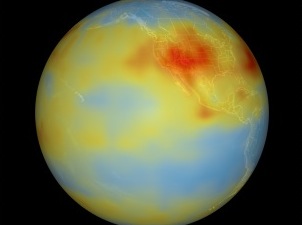
Having collected seven years of data on carbon dioxide, carbon monoxide, and methane, scientists (and now you) can actually see where the carbons are coming from and where they go. NASA has posted animations showing the methane emitted by wildfires in California, and maps of carbon dioxide concentrations around the world.


 Five years ago, the notion of measuring your company’s carbon footprint might have seemed quaint, or foolish, or just plain impossible. And not too many large companies were interested. But a recent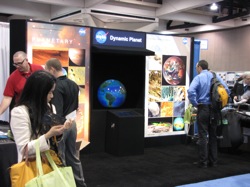
 On Ground Hog Day, Arizona saw the shadow of regional carbon trading looming over it…and retreated.
 By Cody Sheehy