Tag Archives: Emissions

Creating Carbon Sponges

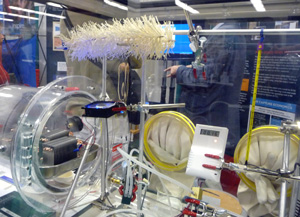
Carbon capture demo at the annual American Geophysical Union meeting. Credit: Molly Samual.
Carbon capture demo at the annual American Geophysical Union meeting. Photo: Molly Samuel

Almost lost amid the Copenhagen media clutter was last week’s meeting of the American Geophysical Union in San Francisco. So this week we’re playing a little catch-up. Lauren Sommer has the second of three posts on things that caught our attention at AGU.

Carbon capture technology has largely focused on the most convenient emissions sources–namely the stacks at large power plants. But as Columbia University’s Allen Wright showed at the American Geophysical Union conference in San Francisco last week, there are other ways to do it.

Wright and colleagues demonstrated their “air capture” technology, where carbon dioxide is absorbed straight from the air by something that looks a lot like a gadget for cleaning Venetian blinds. It’s a special plastic material with a sponge-like consistency. Once the carbon is absorbed, the material is exposed to water or water vapor which causes the carbon to be released. It can then be captured. Wright says it captures CO2 three to five times better than a leaf in full sunlight.

On a large scale, this technology might be built into “artificial trees” that could be stationed anywhere around the globe. The prototype, designed by Wright’s Global Research Technologies, doesn’t look much like a tree. It’s a shipping container with a circular, rotating basket on top where the air capture units are exposed to the air. After one rotation, the baskets would be brought “downstairs” where the carbon is captured. From there, the carbon could be geologically sequestered or even used to make beverages bubbly.

Of course, the main criticism of this approach is efficiency. Carbon dioxide is only about 0.04% of the atmosphere, which is why more concentrated sources like power plant stacks get more attention. Wright says capturing carbon from power generation will be important, “but capture at the stack isn’t enough. It won’t do what has to be done. Air capture has the advantage of being able to deal with emissions from anywhere on the planet from any source.”

Cars are one of the sources he’s talking about. Their prototype unit is designed to capture a ton of carbon a day, which would neutralize the emissions from about 20 cars. They hope to get the cost of each carbon-capturing unit down to the price of car, so the cost of reducing a ton of carbon could one day be similar to other technologies.

Still, to make an impact on global emissions, millions of these units would need to dot the landscape. And just as with renewable energy, NIMBY issues are a potential roadblock. But as is a common refrain these days, Wright says if we’re serious about cutting emissions, we’ll need every technology that shows promise.

After All That, Disappointment in “Hopenhagen”

Delegates to the UN climate conference in Copenhagen have officially “taken note” of the deal squeezed out on Friday by major carbon-emitting nations, an action that seems to fall short of a ringing endorsement.

President Obama’s own summary of the climate deal reached at–almost literally–the eleventh hour in Copenhagen, was laden with the language of muted disappointment. While describing the arrangement hammered out by the US, China, India and Brazil as “meaningful and unprecedented” and stressing that for the first time, “All major economies have come together,” he also used terms like “first step” and “not enough.”

Some bullet points from the President’s news conference, right before be bolted for the airport:

– Accord contains the three key elements: transparency, mitigation and finance

– Mitigation goal to stop warming at 2 degrees (C) “…by action consistent with science.”

– Nations have “much farther to go.”

– Accord is “not legally binding” and sets no deadline to achieve one that is*

– A legally binding pact was “not achievable at this conference.”

– Getting to a legally binding agreement will be “very hard and is going to take some time.”

– “This is hard within countries. It’s going to be even harder between countries.”

And here’s one to set a cheery tone for the coming year:

– “Kyoto was legally binding but everybody fell short, anyway.”

*Earlier drafts of the agreement reportedly set the end of 2010 as a deadline for signing something binding.

The US President and other heads of state left the Bella conference center before the agreement was actually signed. He said negotiators will remain in Copenhagen and attach many of the details to the deal in an “appendix,” before signing. President Obama said he was confident that as he departed, delegates were “moving in the direction of a significant accord.”

Here’s an early reaction from a major environmental group, in this case Friends of the Earth:

– “Sham Deal Requires Nothing, Accomplishes Nothing.”

Prepare for more of that.

The outcome of the fifteenth “Conference of Parties” in Copenhagen would seem to lend prescience to the speech given there by California Governor Arnold Schwarzenegger on Tuesday, the theme of which was: Don’t wait for national and international bodies to solve this problem. They haven’t–and may not.

Schwarzenegger’s Speech in Copenhagen

Here is a transcript of Governor Schwarzenegger’s speech to the UN climate conference in Copenhagen. It’s provided by his media relations staff, as insertion of the “laugh track” and applause notations may suggest.

Thank you so much for this great introduction, Governor Campbell, or Premier Campbell. It’s exactly the way I wrote it. That’s right. (Laughter) Just joking. He has been a terrific partner and a great, great friend and of course we will see each other up there at the Olympics, which is going to be probably the best-organized Olympics, knowing you. So thank you very much also for your invitation.

I also want to thank Governor Jose Serra for the wonderful speech and the very profound things that he said. And you have been also an extraordinary leader, so thank you very much. Let’s give him also again another big hand for the great work. (Applause)

And then Ivo de Bóer from the U.N., we want to thank him for organizing this and being a great leader and believing in the subnational governments.

And also we have from California here some people like Linda Adams, who is in charge of the EPA. Where’s Linda Adams? Stand up, Linda. Let’s give her a big hand. (Applause) Then Senator Fran Pavley, who is a great, great leader. Where is she? Can you get up? OK, right there. (Applause) Extraordinary leader in California. Without her we wouldn’t have been able to go as far as we did with the reduction of greenhouse gases and so on. And then we have Assemblywoman Nancy Skinner. Where is she? She is also here. Let’s give her also a big hand.

I love giving this speech here just simply because I’m not the only one that has an accent. It’s a good place to come. (Laughter)

But anyway, it is wonderful to be back here again. So before I say anything and do anything, let me just thank the U.N. and the people who have worked very hard on this to make this whole meeting happen. Let’s give them a big hand for their great, great organization. (Applause)

I especially want to thank Secretary General Ban Ki-moon for his early attention to the threat of global climate change and I want to congratulate him on his great, great leadership on the issue that has brought us all together.

I am delighted and honored to be with you in Copenhagen. This is not the first time I’ve been here; I’ve been here many, many times before, if it is for my movie promotions or for coming here for bodybuilding and weightlifting seminars, or just on vacation and so on. But I never thought then that one day I will get here as the governor of the great state and talk about climate change, so this is really terrific. So it’s great.

And this city, of course, distinguishes itself by being so clean you can actually swim in its harbor, even though I wouldn’t recommend it right now because it’s a little cold, of course. But how happy we would be if all the world’s harbors would be as clean.

As everyone knows, also in the harbor there is the “Little Mermaid,” the statue based on the Hans Christian Andersen fairy tale. When I was a boy in Austria, the Andersen fairy tale that I always liked best was “The Ugly Duckling.” And looking back, I think the reason that I liked it was because it was a tale of transformation and that spoke to me inside. I have always believed in the tremendous power of personal transformation.

The desire, the hope, the desperate need for planetary transformation is what brought us together here. And the question is: is this also a fairy tale? Is it a dream? Is it a false hope? And if it is not, how do we make it real? Is that something that we ought to discuss? And this is something that I do want to discuss here while I’m here with you. Look around this carbon-conscious city and you should feel hope. Copenhagen is often voted as one of the most livable cities in the world.

So the question really is, how do we make the world itself livable and sustainable? Certainly, it would be terrific if the world’s governments reached an agreement and put hard caps on greenhouse gases while generously helping poor nations, who are least responsible for and least able to respond to climate change. Attempting to reach such an agreement is good and is actually very, very important.

But why do we put so many hopes and eggs into the big international agreement basket when, according to the UN itself, up to 80 percent of greenhouse gas mitigation will be done at the subnational level?

In recent weeks, the prospects for this gathering here have gone up and down, up and own, like a roller-coaster ride. And everyone was in fear, of like what will the U.S. do? What will China do, or not do? Is it going to be 20 percent reductions or a 17 percent reductions? Is the base 1990 or 2005? Should it be 350 parts per million or 450 parts per million?

But what if I said that international agreements, as critical as they are, will never do enough? What if we took that as a given? Wouldn’t that expand the possibilities and approaches for progress we would consider?

I mean, my late mother-in-law, Eunice Kennedy Shriver, the remarkable woman who started Special Olympics, an organization that dedicates itself to people with intellectual disabilities, gave me an insight on this. She was the sister of John F. Kennedy and Robert Kennedy and Teddy Kennedy and she knew everyone in American power and politics.

But she once told me that while the federal government was important for policies related to Special Olympics — such as health care, equal rights, job creation, dental care and so on — but she never would have relied on the federal government to build Special Olympics. She said you need all kinds of different elements and entities like local government, state government, volunteers, corporate sponsors, coaches, celebrities and, of course, the families.

She said that no one from government is going to be there at the sports events and hug those kids when they come through the finish line, or organize the competition so there is a finish line in the first place. No one from government trains those kids so they don’t hurt themselves or so they know how to perform those sports. She said, no, that is up to many of us, many different entities. And she built a movement, a worldwide movement that has spread to 180-plus countries.

So history tells us that movements began with the people, not with government and then, when they became powerful enough, government responds. In the U.S. the labor movement, the women’s suffrage movement, the civil rights movement, the Vietnam anti-war movement — they did not begin in the corridors of power in Washington.

So there’s a lesson in this for our cause. While national governments have been fighting over emission targets, subnational governments have been adopting their own targets and laws and policies. While national governments have been trying for years to define what Kyoto means, businesses are pursuing cutting-edge technologies to solve energy and environmental problems. While national governments debate how carbon caps will affect their economies compared to others, many of their citizens are seeking greener lifestyles on their own.

Government clearly has a major role, there are no two ways about that. But I also believe in the power of the iconoclast and the entrepreneur and the individualist. I believe in the power of the scientists, the capitalists and the activists. I believe in the power of the cities and the states and the provinces to be laboratories for new ideas, which the national governments then can go and study and adopt.

I mean, too often, I think, we fail to see the potential and the progress that is being made on all those different levels. By putting all of our eggs in one basket, we fail to see the eggs in the other baskets.

Let me give you a few quick examples.

Dr. Rajendra Pachuari, who came to our environmental summit in California just recently, he has his own target. He is replacing kerosene and paraffin lanterns with solar light for 400 million rural people in India — 400 million people in India. Think about that. So if the nations of the world do not sign a carbon agreement, does that mean the doctor’s transformative work in India doesn’t count?

In the U.S., in the small town of Roscoe, Texas, a German company has completed the world’s largest wind farm. If we don’t reach a major carbon agreement, does that mean the Texas wind farm doesn’t really count?

With the assistance of Greenpeace, four of the world’s largest meat producers agreed not to buy cattle from newly deforested areas of the Amazon. That doesn’t count?

The head of an energy company in China recently said of renewable and efficient energy, “We think that this is a new business for us, not a burden.” And China now is becoming the leader in developing and manufacturing renewable energy equipment. That doesn’t count?

Yes, sure, they all count. And they reveal that something is happening, something that is happening below the national level.

California, for instance, is working with cities and with states and provinces and regions and nations, including Mexican states, Canadian and Chinese provinces and European nations. We’re even working with the U.N. to assist developing countries, especially in Africa. We are trying to foment change and collaboration and movement. We’re doing everything we can to change the balance of power on the environment.

And of course when I talk about California, I realize that while we may lead America and many other countries environmentally, Denmark here is already one-third more energy efficient. Isn’t that fantastic? And Europe is a great leader in this whole thing.

But the reason for discussing my adopted home state of California is because, first of all, I’m the governor of the great state of California and I have a little right to brag about our state, right? And also, California is the seventh largest economy in the world and also America’s trendsetter, so what we do has consequences. Now, maybe when you look at the globe it is just a little dot, or maybe you cannot even find California. But the power of influence we have is equivalent to a continent. And we in California do not believe and we do not behave, as if progress has to wait for Washington or Beijing or Kyoto.

In California, we are proceeding on renewable energy requirements and a cap and trade system for greenhouse gases. We are moving forward. As a matter of fact, we are making great progress. If hydro is included, we will get 45 percent of our energy from renewables in ten years from now and we are already at 27 percent.

We are proceeding on the world’s first low carbon fuel standards and limiting greenhouse gas emissions from cars which, by the way, the Obama Administration has now just adopted. We are proceeding in a major way on green tech, no matter what happens in Washington or in Copenhagen. Billions of dollars, nearly 60 percent of all venture capital in America, flows to California and this is creating the critical mass of money and intellect to develop new green technologies.

Leaders from around the world are coming to California to see what we’re doing. I took the French Foreign Trade Minister to a business in San Francisco called Solazyme, which was just recently named the most innovative bio-energy company. They have come up with a way to convert algae into a fuel that is 90 percent cleaner than petroleum-based fuels. The U.S. Navy has just signed an agreement with them and is going to use that fuel to power some of its ships.

So from what I see in the research labs and venture capital start-ups around the globe, I believe that the world’s businesses will move to solar and to wind and alternatives much faster than the people expect.

Kenya, for instance. Kenya already gets nearly three-quarters of its power from hydroelectric and from geothermal — three-quarters. And next month it will begin work on a $760 million wind farm that by 2012 will increase Kenya’s power supply by about 30 percent.

Now, the uplifting thing is that the developing nations will be able to leapfrog into the green economy and skip the fossil-fueled industrial revolution. Isn’t that wonderful?

I believe that we have economics on our side. Since the supply of wind and sun and algae is unlimited, their prices will not jump. That cannot be said of oil, the supply of which is limited and declining. That cannot be said of coal, whose costs of extraction and labor and transportation are bound to rise.

So I believe technological and economic forces will overtake the political and the regulatory efforts of national governments. We are beginning one of history’s great transitions – the transition to a new economic foundation for the 21st century and beyond.

Shouldn’t we organize to encourage this transition even as we continue to work toward international compacts? Of course we should. Now, if this conference does not get a strong agreement, some will say that Copenhagen has failed, that we talk grandly but we are fooling ourselves, much like the fairy tale, “The Emperor Has No Clothes.”

And others will say that any agreement that is being reached isn’t enough because the world is going to melt and we’re going to die anyway.

Others will say, “Look at those crazy people trying to wreck the global economy.”

No, ladies and gentlemen, this conference is automatically and already a success.

Kyoto brought the world’s focus to what must be done. It brought the focus to that whole subject. We didn’t know then what we know now. We didn’t have as much experience with the science that we would research or the hurdles we would face. But Kyoto made us think differently about the world.

And perhaps the real success of Copenhagen is to give us the opportunity to think differently again. Perhaps the success comes in realizing that something different needs to be done and in fact is already being done. It’s being done at the sub-national level.

And I would ask the U.N. to convene a climate summit like Copenhagen but for cities, for states, for provinces and for regions. And I will be more than happy to host such a summit in California or anywhere else the U.N. wants to hold it but I recommend strongly in California. (Applause) People like coming to California. They love our state.

So ladies and gentlemen, the world’s governments alone cannot make progress, the kind of progress that is needed on global climate change. They alone cannot do it. They need everyone coming together, everyone working together. They need the cities, they need the states, they need the provinces and the regions. They need the corporations, the activists, the scientists and the universities. They need the individuals whose vision and determination create movements. They need everybody out there.

So ladies and gentlemen, let us regain our momentum, let us regain our purpose, let us regain our hope by liberating the transformative power beneath the national level.
That can be the great contribution of Copenhagen — that could be the great contribution of Copenhagen.

So thank you for inviting me. Thank you for your kind attention and warm hospitality. And thank you for the great passion and for the hard work that you all do. And it is very important that we continue with this work.

So thank you very much and I’ll be back. Thank you.

The Schwarzenegger Solution: R20

Drawing on the G(X) model of international cooperation (as in the G-20 group of nations), California Governor Arnold Schwarzenegger is proposing that subnational governments band together to advance climate policy, in their own “R20,” or “Club of 20 Regions.” According to the Governor’s office, officials from four other nations have already signed on to the idea of  “a new regional coalition to fast-track the results of the Copenhagen Climate Change Conference and push their respective national governments into more rapid actions and stronger commitments to fight climate change.”

According to a concept document released on Monday, the group aspires to “demonstrate the feasibility” of the arrangement by 2012, which coincides with some key international conferences and is also when California’s climate legislation is scheduled to take full effect.

Founding members of the group include provincial officials from Canada, Nigeria, France and Algeria, including Premier Jean Charest of Quebec, who said the arrangement would, among other things, “allow for the transfer of expertise and green technologies to developing countries.”

Quebec is one of four Canadian provinces participating in the embryonic regional carbon trading cooperative known as the Western Climate Initiative.  The Governor’s announcement provided no indication that the other Canadian provinces or the half-dozen other US states in the WCI had signed on to R20, as of Monday (the “20” is apparently “symbolic” thus far).

Following his speech to the climate conference on Tuesday, Governor Schwarzenegger is scheduled to meet with the governors of some WCI partners in Copenhagen.

Schwarzenegger to Rally Subnationals

Meanwhile Rob Schmitz, our reporter in Copenhagen, sets the scene with a look at how the state’s anchor climate legislation is playing here at home, three years after its passage. That report airs Monday morning on The California Report.

Governor Arnold Schwarzenegger is expected to arrive in Copenhagen on Monday, ready to rally the world’s “subnationals” in the fight against global warming. This is the first time that UN climate talks have created a formal role for states, provinces, cities and the like, and California’s governor will be loaded for bear.

In the weeks leading up to Copenhagen, the Governor turned up the heat on climate rhetoric, with a series of related media events. On Treasure Island, a low-lying man-made rectangle on San Francisco Bay that he said “could be under water” by the end of the century, Schwarzenegger unveiled the state’s climate adaptation strategy with a video tour of California’s climate vulnerabilities, powered by graphics from Google Earth (if you just want the gist, there’s a shorter version available).

The Governor also seized the occasion to preview his trip to Copenhagen, saying we “can’t wait” for national and multi-national efforts to save us from the potentially catastrophic effects of climate change; that “subnational” actors like California–perhaps led by California–should stay focused on their own efforts to both reduce greenhouse gas emissions and prepare for the changes already on the way. The Governor’s speech to COP 15 delegates on Tuesday will be a chance to do some crowing about California’s climate leadership, on an international stage, before a media gallery that’s been estimated at somewhere between 3,500 and 5,000 members.

Delegate’s Dispatch No. 2

Louis Blumberg directs the California climate programs for The Nature Conservancy. He’s also been keeping us posted as an official observer to the UN climate conference. And yes, views expressed in his guest posts are his and not necessarily those of KQED or the Climate Watch staff.

Things Heat Up Copenhagen
By Louis Blumberg

Emotions erupted at the Bella Center today during the United Nations climate change conference in Copenhagen, Denmark. Demonstrations, street theater, leaked documents, heated words, threats of walkouts and huge crowds all collided to increase the energy level throughout the massive hall. Frustration was driven in part, according to one of the key treaty negotiators, by the fact that little progress has been made.

At this point in the process, the open meetings have stopped and negotiators are meeting in private to work out their differences. This loss of transparency was exacerbated when demonstrators disrupted one of the last public plenary sessions of the week and the organizers threw out representatives from all non-governmental organizations–including me.*

As discouraging as this emerging gridlock is, my optimism remains because I see that three key pieces, which are falling into place, can produce a real deal:

– First, for the first time ever, key countries, including the U.S., China, India, Brazil and Korea, have all put numerical proposals on the table to reduce emissions.

– Second, as I reported before, the U.S. is providing real leadership, in part by proposing a $10 billion annual fund to help developing countries reduce emissions and adapt to climate change while continuing to grow their economies.

– Third, President Obama and 110 other heads of state will arrive next week for the final negotiation.

In the meantime, the process of creating a new international treaty amps up…

Yesterday I joined 200 activists in a standing ovation for EPA Director Lisa Jackson as she confirmed U.S. leadership by listing the administration’s actions to fight climate change, including this week’s official finding that greenhouse gas endangers human health. [Ed. Note: This creates authority for the EPA to regulate greenhouse gases on its own, with or without enabling legislation].

African countries called for more forest protection. Delegates from one island nation faced with imminent destruction by flooding due to sea-level rise, threatened to walk out on the talks unless the developed countries exhort to cut emissions by 95 percent.

I, alongside a coalition of forest activists, struggled (in what may be a futile attempt) to close a new loophole in emissions reporting rules proposed by some European countries.

And finally, the energy, passion and idealism of demonstrators in costume–walking trees, polluters dressed in red, vegans for climate, and Mr. Green (you can figure that one out on your own)–were both captivating and inspiring.

The frenetic pace is both tiring and energizing and will only increase as we move toward the conference closing on December 18. But there is much more to come before then. Stay tuned.

*Ed. Note: We’re using the term “delegate” somewhat loosely here. Blumberg is a member of The Nature Conservancy “delegation” in Copenhagen but technically he’s an official observer, as are all NGO reps. That’s why he can be tossed out of sessions.

Capturing Carbon in California

CoalPlantLauren Sommer’s two-part radio series on carbon capture in California airs this week on The California Report. You can also view her slide show at the end of this post.

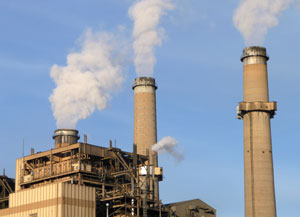
The idea seems simple enough: In order to get energy, we burn carbon. In most cases, that carbon comes out of the ground in the form of natural gas or coal. So instead of releasing the resulting carbon dioxide emissions into the atmosphere, why not put it back into the ground?

Of course, carbon capture and storage/sequestration (CCS) is much more complicated than that. Nonetheless it’s a strategy that’s being pursued aggressively by both international leaders and US Energy Secretary Steven Chu, who would like to see it deployed in ten years.

There are obstacles on both the “capture” and “storage” side of the equation. In terms of technology, however, “storage” is much further along, thanks to the oil and gas industry, which is already using CO2 in oil recovery. Injecting compressed CO2 into oil fields forces more oil to the surface in a process known as enhanced oil recovery. As many in the industry will remind you, they have three decades of experience doing this.

Keeping it underground is another matter. In the western US, the West Coast Regional Carbon Sequestration Partnership (WestCarb) is setting up a number of pilot projects to study how CO2 can be safely stored underground. As Technical Director Larry Myer explained to me, one of the primary goals is to simply work out the regulatory, siting, and liability issues.

As with any waste issue, choosing the site is the most important–and often most difficult–issue. California’s Central Valley has plenty of underground saline aquifers and depleted oil and gas fields that could hold CO2. But the trick is finding a site where the geology can securely store it and where there’s little risk of groundwater contamination. On the plus side, scientists know that CO2 is slowly immobilized underground, which lessens the risk over time. But how long that takes is still under study.

As for the “capture” issue, there are three ways to separate CO2 from power plant emissions.

  • In today’s Climate Watch story, I describe Oxyfuel technology, in which natural gas is burned in pure oxygen. Since the outputs are steam and carbon dioxide, the CO2 can be easily siphoned off. But that requires building new power plants from scratch.
  • The second option seeks to deal with the carbon dioxide before the fuel is burned; a “pre-combustion” approach. Or for all you wonks out there: Integrated Gasification Combined Cycle (IGCC). The downside to this process is that it requires gobs of energy, which makes it expensive.
  • Finally, there’s the “post-combustion” approach. That’s where the CO2 is “scrubbed” from flue gas after the fuel is burned. Existing plants can be retrofitted with this technology, but it also comes with large energy penalty, just like IGCC.

A price on carbon, through either a cap-and-trade system or carbon tax, would change the economic case for CCS, but there are a lot of strikes against the technology. So why pursue it?

The argument goes like this: In order to achieve steep emissions cuts–say an 80% reduction worldwide by 2050–it may be an important tool (or stabilization wedge).  The world will continue to use fossil fuels in the near term and despite the enormous growth of renewable energy, it’s still a drop in the bucket. That’s why many believe that CCS is a crutch the world needs to wean ourselves from fossil fuels.

Hopenhagen II: A Delegate’s View

Louis Blumberg is a COP 15 delegate and Director of Climate and Forest Policy for the Nature
Conservancy in California.

Update from Hopenhagen

By Louis Blumberg

The sense of possibility pervaded the halls Monday, infusing energy and 
optimism into the delegates at the UN climate change conference in
 Copenhagen, Denmark. As in prior years, the sheer magnitude of the event 
was inspiring. More than 10,000 participants attended today, thousands 
of whom (including this participant) waited patiently in line for hours
 to get inside.

In one room, representatives from 192 nations sat shoulder-to-shoulder
 in the discussions, and each country was given an equal voice. Two seats
 were allocated to Gabon and two for the U.S., two for China and two for
 Monaco, and so on.

At home in San Francisco, much of my work is focused on addressing
 climate change in California, and we have made great progress as a
 state. Now, seeing the whole world gathered in one room (figuratively
 speaking), it is a powerful reminder that the work we are doing in 
California can be applied anywhere, whether in Australia, Peru or China.
 We are all in this together and can learn so much from one another.

This is the 15th meeting for the “Conference of Parties” (hence “COP 15”), a follow-up to 
the 1992 UN Framework Convention on Climate Change, which resulted in the first global climate agreement ratified by 192 nations, including the U.S. Each year preceding that conference, global delegations have 
met to discuss how to address climate change. The most notable agreement
 happened in 1997 in Kyoto, Japan. Dubbed the Kyoto Protocol, it 
ordered 37 industrialized nations to cut greenhouse gas emissions. The
 U.S. rejected that pact, and since then our federal government has shown little-to-no leadership on the issue.

But what a difference a year makes. In its first public statement at the 
conference, the United States addressed two key issues head-on with commitments for action: First, a pledge to reduce emissions of
 greenhouse gases by 17% by 2020; and second, a $10 billion pledge with
 other nations intended to help developing countries grow their economies
 while cutting emissions. U.S. envoy Jonathan Pershing spoke forcefully,
 signaling that a new regime in Washington meant real leadership on
 climate change for the world.

Despite public skepticism, it has become clear that something is going
 to happen here. People from all over the world have come together to solve the most serious problem of our lifetime. Nothing less than the 
future of nature and humanity is at stake. I just hope the agreement is
 sufficiently strong and that action happens quickly.

Hopenhagen: A Reporter’s View

Hope for an international deal on climate change abounds on the streets and metro stations throughout Copenhagen. But does it among U.N. delegates?

The capital city of this bone-chilling European country is dressed to the nines in global warming, from Coca-Cola ‘Hopenhagen‘ ads overlooking its quaint canals, to huge globes pasted with polar bears and receding glaciers. All this advertising makes all the lovely Scandinavian Christmas decorations look dim in comparison. This is, of course, COP 15– the most anticipated UN climate change convention since Kyoto twelve years ago. Despite the pessimism that pervaded the run-up to this conference, hope was the buzzword on the first day of the conference. In an afternoon news briefing, Yvo de Boer, ever the optimist about these meetings, stayed on message, telling reporters that it wasn’t for nothing that major heads of state like President Obama were changing their schedules to arrive at the end of the conference. They want to see a deal, de Boer said, and news from across the Atlantic that was first reported during the midday hours here in Copenhagen, may very well increase the odds.

As news started to trickle in that the US Environmental Protection Agency had determined that greenhouse gases are a threat to human health and the environment (thus opening carbon dioxide and equivalent greenhouse gases to government regulation with or without the blessing of Congress),* the excitement in the halls of the Bella Center rose. High fives were exchanged among American observers, and Rajendra Pachauri, chair of the Intergovernmental Panel on Climate Change told my office mate, Sam Eaton of Marketplace, that it was high time that Obama flexed his muscle on climate change. EPA’s move had been in the works for a while.

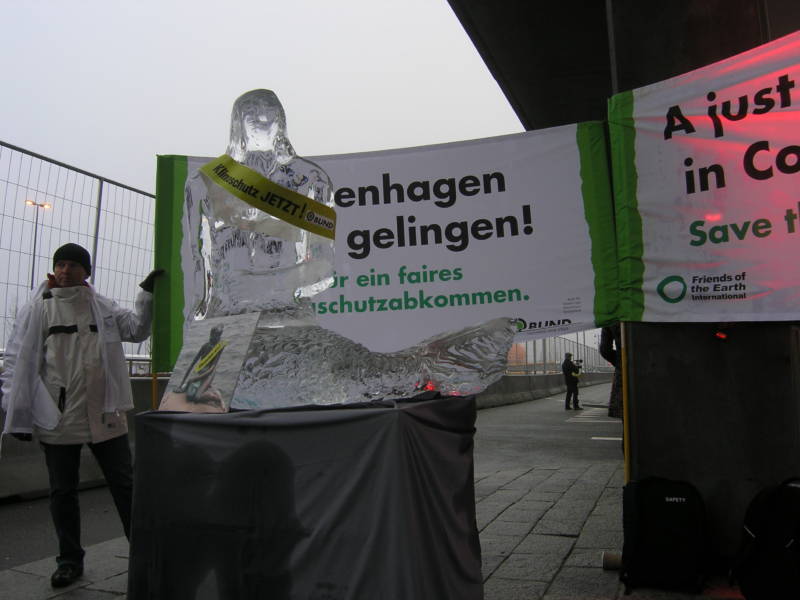
An ice replica of Copenhagen’s famous mermaid, melting in the dead of winter, conveniently placed in front of the Bella Center.

Back in September when I attended a climate change conference in Tokyo, UNFCCC head Yvo de Boer hinted it would happen. But it’ll take a lot more than an EPA announcement to move delegates toward a final deal at this conference. One of the biggest issues they face is how to finance emissions reductions throughout the developing world. Poor countries say they need rich countries to help them build a clean energy infrastructure if they are to agree to any binding deal. Rich countries are scratching their heads trying to figure out how to finance this (de Boer says it’ll cost around $10 billion a year) and, more importantly, how to divvy up the cost, especially in the throes of a global recession.

What does this mean for California? It’s one of the few states that have passed carbon dioxide reducing legislation. It behooves us to have neighbors, both domestically and internationally, who have similar laws, so that employers don’t flee the state to escape environmental regulations–a very real scenario in this economy. Whether or not Hopenhagen lives up its nickname, it’s already turning into an interesting event.

*Ed. Note: Back in Washington, at an afternoon news conference, EPA Administrator Lisa Jackson explained that today’s “finalizing” of the previously announced endangerment finding now “obligates” the agency to regulate carbon dioxide under the Clean Air Act. But she hastily added that it’s not a replacement for Congressional action. “Legislation is still the best way,” said Jackson. “It’s not an either-or proposition.”

Climate Watch in Copenhagen

Earthshine_NASAClimate Watch begins it’s coverage of the UN’s COP 15 climate talks in Copenhagen this evening, when KQED’s This Week in Northern California airs my recently taped interview with former Vice President and Nobel Laureate Al Gore. The original 20-minute interview has been “edited for TV,” down to about nine minutes. The full interview is to be posted on This Week’s website.

The interview begins with Gore’s assessment of the upcoming climate conference and then moves on to California’s role, the hype surrounding “green jobs,” controversy over climate science, his new book, and other topics. Regrettably, the interview was recorded before the eruption of the email scandal now known as “Climategate,” so I wasn’t able to get his take on that.

It’s pretty hard to spring anything on Gore. He’s heard every question there is to be asked about a thousand times and has carefully crafted, well-rehearsed answers to all of them. He did seem slightly off-balance when I asked him about FactCheck.org’s conclusions about some of the green job creation hype.

On Monday, our radio and online coverage begins in earnest when the first of Rob Schmitz’ reports from Copenhagen airs on The California Report. Schmitz, KQED’s Los Angeles Bureau Chief, arrives there on Saturday and will be there for the entire two weeks of events and negotiations. He’ll provide radio reports and frequent blog posts, covering–among other things–the appearance of California Governor Arnold Schwarzenegger on “Subnational Day.” In a climate-related media event on Treasure Island this week, Schwarzenegger said his mission in Copenhagen would be to rally governors, mayors, provincial leaders and other subnational players, to continue their own progress toward greenhouse gas emissions and not wait for national governments and international bodies to take action.

Also on Monday, Rob and I will join host Michael Krasny and NASA climatologist James Hansen on KQED’s Forum program. Hansen was the original climate whistle-blower, complaining that the Bush administration was muzzling climate scientists. Hansen has since taken a hard line against the upcoming efforts in Copenhagen, saying that cap & trade is the wrong path to climate intervention (both Gore and Hansen are promoting new books of theirs).