Tag Archives: Emissions

Invasion of the Electrics

If the electric car was indeed “killed,” as a popular documentary suggested not long ago, the floor at the Los Angeles Auto Show this week would suggest a mass resurrection not seen since Night of the Living Dead. Climate Watch contributor Alison Hawkes reports on some implications for the power grid. Her radio report airs Friday on The California Report.

By Alison Hawkes

Electric vehicles may be few in number over the next few years, despite the hype around the release of off-the-assembly line EV models in 2010. It takes several decades to flip the American vehicle fleet.
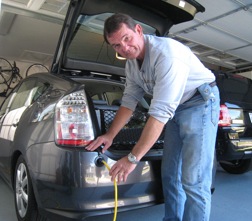
Robert Susich offsets his charging with rooftop solar.  "This is the way of the future," he says. Photo: Alison Hawkes
Robert Susich offsets his charging with rooftop solar. "This is the way of the future," he says. Photo: Alison Hawkes

But there’s little doubt that EVs are coming, pushed on by anxiety over foreign oil and unexpected spikes in gas prices, growing environmental awareness, and government incentives. Starting at the end of December, EV buyers get a federal tax credit of between $2,500-to-$7,500 per vehicle, depending on the battery size. There are other tax credits for plug-in conversions and even electric motorcycles and electric three-wheelers. Now who doesn’t like a tax credit?

All this may sound promising but energy planners have some serious head-scratching to do as Americans begin switching their transportation fuel from gasoline to electricity.

For starters, how do you avoid building extra power plants? Who pays for infrastructure upgrades to electrical substations and transformers? How do you get EV drivers to charge during off-peak hours when the energy supply is now wasted?

Pacific Gas & Electric’s smart grid director Andrew Tang says utilities have faced similar problems before with the advent of air conditioners in the 1970s and plasma screen TVs in the 1990s. New technologies add to the demand on an already tight energy market. “It’s a form of load growth and we’ve managed to deal with it without having sudden power outages,” says Tang.

But, Tang admits, EVs could bring a heavier strain on the grid than any seen before. One EV can draw as much energy as a house. Put another way, that’s doubling a household’s demand for power. Fortunately, it sounds like the utilities have some time, and capacity, to see how the EV market develops.

PG&E is expecting to support some 250,000 vehicles by 2020, which may not seem like much for a 70,000 square-mile service territory. But they won’t be spread out evenly. The northern California utility is expecting EV drivers to congregate in certain neighborhoods, potentially sending substations and transformers into overload (read: blackouts) if not properly managed. Tang said PG&E did a study of hybrid electric vehicle registration over the last four years and found that Fresno’s portion of hybrids was 2.4 percent, while Berkeley’s was 18 percent. “That’s much more concentration,” says Tang. “We think that’s a fair proxy of what we could have with electric vehicles.”

So the California Public Utilities Commission is now exploring ways to regulate EV’s. The basic question is how to influence consumer behavior so EVs do not add to peak energy demand. No one wants blackouts, and no one wants to build more power plants. One idea bandied about is a differentiated rate system that encourages EV drivers to charge during off-peak hours at deeply discounted prices, called a “time of use rate.” Another idea promoted by the PUC’s independent Division of Ratepayer Advocates is a five-dollar monthly fee on EV drivers that would go into upgrading grid infrastructure, like adding or upgrading local transformers, as needed.

“If electric vehicles need (additional) infrastructure, they should pay for it and not spread the cost across all ratepayers,” says DRA’s deputy director Dave Ashuckian.

EV drivers may bristle at being treated differently than other power users, especially when they feel they’re doing society a favor by switching to a cleaner fuel source. Early adopters may be happy to help optimize the grid. But if EVs go mainstream, energy planners know the public is going to want a more convenient system.

Automated smart metering (you’re not in charge of your charging) may help. The hybrid plug-in Chevy Volt coming next year is supposed to come with a smart meter.  But planners eventually foresee public charging stations that will allow EV drivers to juice up quickly (through high-wattage charging equipment) and when they need to, during daytime peak hours. Already some California companies that want in on the emerging charging station business are fighting the idea of PUC regulation of their potential market.

A California PUC staff white paper reported that the benefits of lowered greenhouse gas emissions with an electrified transportation system are realized only when some 76 percent of EV drivers charge off-peak. And only if any extra power demand is met by renewable energy sources – not coal or oil. That’s a tall order.

Ed. Note: One thing EV’s already have going for them: a lobby. This week it was announced that after 16 years, deputy director Eileen Tutt is leaving CalEPA to become executive director of the California Electric Transportation Coalition.
Sketchy First Look at California Cap & Trade

On Tuesday the California Air Resources Board put out a sneak preview of the carbon cap & trade system mandated by the Global Warming Solutions Act of 2006 (AB 32). Couched as a “preliminary draft,” the 132-page plan is intended as a broad outline for a final Cap-and-Trade regulation scheduled to go before the board late next year.

As such, the draft lacks a few key components, such as how many allowances the state plans to auction off to industry, versus give away. Air Board chief Mary Nichols says her agency is still waiting on recommendations from an expert committee on how to best handle allowances.

Environmentalists have been pushing for polluters to pay for allowances up front. In an email to me on Tuesday, in anticipation of the draft, Bernadette del Chiaro of Environment California wrote that her group is “slightly disappointed that ARB staff are punting on the issue of auctions. ARB in the scoping plan said they are committed to getting to 100% auctions. I hope the draft rules at least repeat this commitment.”

The draft appears to stop short of an outright commitment, reiterating that “transition to a 100 percent auction was a worthwhile goal.” In a conference call with reporters, Nichols said she anticipates at least a partial auction. Also undetermined is how to deploy the funds that emitters may pay for allowances. Nichols said a $10 per ton price for carbon could produce a two-to-four-billion-dollar pool of money, which could be used for such things as “buying down” utility costs for low-income families or creating incentives for development of renewable energy technology. Nichols declined to project what a cap & trade system would end up costing households in California.

You can download a PDF file of the complete report at the CARB website (under “What’s New). A public meeting is scheduled for December 14 in Sacramento, to get feedback on the Preliminary Draft Regulation released this week.

Also on Tuesday, the Governor’s Office announced that Quebec, one of California’s partners in the Western Climate Initiative for regional carbon trading, has set a target “to reduce its greenhouse gas emissions 20 percent below 1990 levels by 2020 and the introduction of a clean-car emissions standard equivalent to California’s Vehicle Tailpipe Emissions Standards.”

The WCI includes seven western states and four Canadian provinces. Any progress from the state’s WCI partners is welcome at this point, as most have been reluctant to set their intentions into law.

Check out our interactive map of California’s largest industrial emitters of greenhouse gases.

California’s Biggest Carbon Emitters

Carbon addiction is the same as any other in at least one respect: the first step to recovery is admitting you have a problem. For greenhouse gases, reducing emissions requires knowing what you’re putting out to begin with.

The Conoco Phillips refinery in Rodeo, north of Oakland, is a relatively small player at 1.9 million metric tons of CO2 per year. Photo: Craig Miller
The Conoco Phillips refinery in Rodeo is a relatively small player, as refineries go, at 1.9 million metric tons of CO2 per year. Photo: Craig Miller

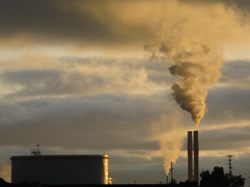
It was toward this end that this week the California Air Resources Board released the first comprehensive data on large-scale industrial carbon emissions in the state. Not surprisingly, the top emitters tend to fall into two categories: power plants and oil refineries, with cement manufacturers not far behind.

Individually, major oil refineries have the largest carbon footprint. Two of Chevron’s refineries–in Richmond and El Segundo, BP’s Carson refinery and the Shell refinery in Martinez, all clocked in at more than three million metric tons (tonnes), CO2-equivalent, for 2008.

Use the interactive map below, prepared by Climate Watch intern David Ferry, to locate the largest industrial emitters and see how they sort out by industry (We’ve been having difficulty with embedded maps vanishing from the blog, so if you don’t see the map below, just click on the link to it).

(Click here for a larger map and a list of all the largest emitters.)

View KQED: California’s Biggest Industrial CO2 Emitters of 2008 in a larger map

Cumulatively, electric power generation is California’s biggest emitter, despite the virtual absence of coal-powered plants in the state. The ARB report lists nearly 20 utility or industrial cogeneration plants in the million-plus club. Several plants put out more than two million tonnes, including Dynegy’s gas-fired plant at Moss Landing, the LaPaloma McKittrick plant, Southern California Edison’s Mountainview plant in Redlands, and the L.A. Department of Water & Power’s Haynes Generating Plant.

The federal EPA considers anything above 25,000 tonnes to be a large emitter. But with carbon emissions, “large” is a relative concept. California imports power from other states and we can get a clue to “large” from the carbon output numbers on some of the mostly coal-fired plants feeding the California grid from states like Utah and Wyoming. Some fossil fuel plants in those states weigh in at a hefty six, ten–even 15 million metric tons. Los Angeles still depends on out-of-state fossil plants for roughly half of its electric power.

A few large cement plants are also in the million-plus column. To find out why, listen to Amy Standen’s report for Quest.

Of course, all this careful accounting leaves aside the elephant in the room: transportation, which has a bigger footprint in California than all electrical generation combined, including imports from other states–and is about equal to total industrial emissions.

The industrial tally released this week is subject to revision and will be used to set caps and allowances for the carbon trading (cap & trade) system mandated by the state’s 2006 Global Warming Solutions Act, commonly known as AB-32. There’s more on the emissions report and what it means in Paul Rogers’ story for the San Jose Mercury News.

Marketplace Parses Climate Questions

The public radio program Marketplace continues its ambitious series on climate change, later this month. New reports will air November 16-20 as part of “The Climate Race”, a multidimensional look at “how global warming is already affecting us and the tough choices we have to make.” While the geographic scope of the series ranges well beyond California’s borders, it underscores that much of the nation grapples with the same issues that confront us here in the West. The first four reports, aired last week, are worth catching up with online.

Part 1: “Climate Change in Our Own Backyards” is a snapshot of how climate change is already affecting residents of Helena, MT.  Fewer cold snaps have allowed the mountain pine beetle to run rampant, devastating the area’s surrounding pine forests, and leaving a tinderbox of dead trees for miles across the landscape.  Reporters Sam Eaton and Sarah Gardner talk to residents about how this reality has changed the way people think about climate change and what challenges lie ahead.

Part 2: “The Planet Will Survive, But Will We?” explores episodes of severe climate change in the Earth’s distant past, and explains what ancient tree stumps can tell us about climate past, present, and future

Part 3: Is There Energy to Slow Climate Change?” focuses on energy and the political, social, technological, and economic challenges we face as we consider moving from fossil fuels to renewable energy supplies.  This report zeroes in on West Virgina and the debate between the coal industry and wind power advocates.  In Part 4;  “How Do We Live With a Warmer Planet?”, Eaton and Gardener look at what lies ahead for business, agriculture, and society, as temperatures continue to rise.

Photographs and audio slide shows related to the radio stories are available on the series web page:  “Futuristic Farming” offers a look at a farm that takes water efficiency to new heights, and “Climate Past” features stunning shots of Mono Lake and an interview with paleoclimatologist and geomorphologist, Scott Stein. The “Climate Race” page also includes links to resources, an interactive map of the United States with statistics about how climate change is affecting regions and what changes are expected by the end of the century, and audio clips from experts on topics such as how climate change is expected to affect health and agriculture.

Climate Watch will be sharing resources with Markeplace to cover the U.N. climate talks in Copenhagen, next month. KQED’s L.A. Bureau Chief Rob Schmitz will team up with Eaton for coverage of the two-week conference. Schmitz, who recently reported a series of Climate Watch stories from Japan, speaks Chinese and has extensive experience in international reporting.

An Hour with Amory Lovins

In case you missed it amid the flurry of climate-related news last week: On September 30, Amory Lovins, founder and chief scientist of the Rocky Mountain Institute, and an honest-to-goodness energy guru to many, spent an hour in conversation with Michael Krasny and callers to KQED’s Forum program. You can listen to the entire archived broadcast or scan some of the highlights here, compiled by Climate Watch intern David Ferry.

On China:

“We can count on China to lead the world out of the climate mess…Even though the U.S. has led the world in wind installations the past three years, this year China’s going to pass us so fast we won’t even hear them go by. China’s doubled its wind installation each of the past four years, and there’s a new paper in Science from Harvard and Tsinghua in September saying that China can meet all its electric needs–not the growth but the total–till at least 2030, cost effectively, from its wind resources.”

On Nuclear Power:

“Basically nuclear and coal plants are getting walloped in the global marketplace by efficiency and renewables and cogeneration because they’re a lot cheaper and they have less financial risk so they can attract private investment.”

Grading the Obama Administration on Renewables:

“Greatly improved and I think on the whole doing very well.”

On the Upcoming UN Climate Talks in Copenhagen:

“I’m cautiously optimistic…But remember that governments are usually the last to figure these things out. Most governments still think climate protection is costly. They haven’t figured out yet that economic theorists got the sign wrong and actually climate protection is profitable. Once you change the conversation from cost, burden and sacrifice to profit, jobs and competitive advantage it makes the politics a whole lot easier.”

On Energy Efficiency & Steve Chu’s “Low-Hanging Fruit” metaphor:

“The technologies keep improving faster than we use them, so efficiency is an ever bigger and cheaper source–it’s as if the ‘low hanging fruit’ had fallen on the ground; it’s mushing up around the ankles, it’s spilling in over the tops of our boots and the efficiency tree keeps dumping more fruit on our heads.”

On Large-Scale Solar Farms v. “Distributed” Power Generation:

“The sun is distributed for free. Why gather it in one place and then pay to spread it out again? The National Renewable Energy Lab says if we put solar cells on seven percent of the structures in this country it would run all our electric needs without using any land. And for that matter, the wind potential on available windy land in this country is several times our total electric need and the footprint is actually very small.”

On Whether Climate Change is Irreversible:

“There are a half-dozen known mechanisms of rapid climate change. Several of them show like they may be starting up, so it’s urgent to reverse that…we have plenty of technology already available to stabilize climate to the extent that irreversible changes have not already started. We don’t know what that extent is, so we ought to go full bore on best buys first and hope that we’re in time.”

You can also take a virtual tour of Lovins’ home in Colorado, which doubles as a laboratory for energy innovation.

UN Climate Chief: 2014 “Will Alarm the World”

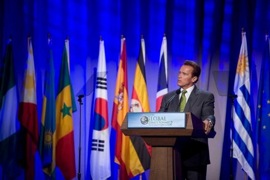
As Governor Arnold Schwarzenegger wrapped up his three-day Global Climate Summit today, with signatures and ceremony, the U.N.’s top climate official set a sobering tone with his own parting shot.

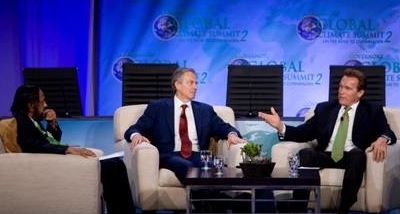
In a final panel this afternoon, the Governor was joined by former Prime Minister Tony Blair and Rajendra Pachauri, who chairs the U.N.’s Intergovernmental Panel on Climate Change (IPCC). Pachauri said the worst-case scenarios from previous climate modeling appear to be coming true, and warned that the next climate change assessment from the IPCC, due out in 2014, “will alarm the world.”

Then he went on to reiterate a prediction he made before the U.N. earlier this month; that based on the science he’s seen, 12 countries are in danger of becoming failed states due to the impacts of climate change. And while he stopped short of listing the nations, previous statements appear to imply that several of the states on his list are in Africa.

Elsewhere at the summit, 30 delegates from state and local governments around the world signed a final agreement to collaborate on climate change. If they follow through with some muscle on the partnership, they’ll be collaborating on clean transportation and on climate adaptation strategies.

Governors from Brazil, Indonesia and U.S.also called on their national governments to address deforestation at the UN climate treaty talks in Copenhagen. Forest loss accounts for 20% of climate emissions globally. California also signed its agreement with the Jiangsu Province of China.

The three-day summit’s title was “On the Road to Copenhagen” and the international talks have been front and center in the discussions here. The governors attending would like their role in combating climate change formally recognized there. They see themselves on the front lines of climate change, as evidenced by this much cited statistic: 50-80% of the emissions cuts needed to reach the UN’s goals will be implemented by states and cities.

But despite the Copenhagen-mania, Schwarzenegger stuck with his subnational message, saying: “Climate change isn’t all about this one treaty.” Even if the talks at Copenhagen fail, he says states and provinces should keep forging ahead.

Photo: Office of the Governor.

A Bottom-Up Climate Approach

Governor's Office
Photo: Governor's Office

The second Governors’ Climate Summit kicked off yesterday with a plenary on adaptation to climate change. Most of the climate policy we hear about has to do with mitigation; cutting emissions to reduce the rate of climate warming. Increasingly, though, policy makers are looking at ways to adapt to the effects that are already palpable.

Several international leaders had stories to tell:

– Premier Gordon Campbell of British Columbia said that due to warming winters, pine beetles will kill 80% of the mature pine forests in his province by 2013.

– Dr. Dessima Williams of the Alliance of Small Island States said rising sea levels make climate change “a case of life and death” for island nations.

According to a World Bank analysis cited by Michele De Nevers of the Bank’s Environment Department, adapting to climate change will cost $75-100 billion dollars a year for developing countries–and that’s with only 2 degrees (Celsius) of warming by 2050. That seems like a big number, but De Nevers reminded the crowd that it’s on par with the recent financial bailout.

I also spoke with Margret Kim, China Program Director for the California Air Resources Board and EPA, who has been working with the government of the Jiangsu Province in China.  She filled me in on the agreement that Governor Schwarzenegger is expected to sign today with leaders from the province to help them reduce greenhouse gas emissions.  Based on this framework, California would develop an action plan to share expertise and research with the province.

This partnership is built on a 2005 agreement that California signed with the province, which was focused on energy efficiency. Barbara Finamore of the Natural Resources Defense Council says real progress was made on the first agreement with Jiangsu, which set several efficiency incentives and programs in motion. But they have more to do.  Ninety-five percent of the province’s electricity comes from coal.

The announcement comes on the heels of President Hu Jintao’s declaration less than two weeks ago that China would make notable reductions in its carbon intensity by 2020.  Carbon intensity isn’t quite as simple as a straight emissions cut. It measures the amount of carbon dioxide produced for each dollar of economic output.  And fixed targets aren’t part of the expected Jiangsu agreement either. But Finamore says this is a landmark agreement since it shows an important shift in China’s willingness to tackle climate change. As she said, “I’ve been working in China on energy issues for more than 20 years, and there has been a tremendous amount of recent progress.” And a bottom-up approach–with states piloting environmental policies before national governments adopt them–is certainly something we’re familiar with in California.

Provincial Climate Summitry: Day One

Governor Schwarzenegger kicked off his second Global Climate Summit Wednesday in Los Angeles–and “global” is certainly the emphasis.  The three-day conference features panelists from more than 70 states, provinces and countries who are discussing “subnational” strategies to cut carbon emissions.  (That’s the policy wonk term for regional, state and provincial governments).

Events like these are at risk of being feel-good political meet-and-greets, but I spoke with Louis Blumberg of The Nature Conservancy, who believes that the partnerships created at the last climate summit have borne fruit in the past year. Blumberg is part of a deforestation working group made up of five Brazilian states, two provinces in Indonesia and three states in the U.S. They’re working on carbon accounting techniques for forestry projects–or in carbon parlance, REDD (Reduced Emissions from Deforestation and Degradation).

Expect more partnership announcements from the rest of the summit.  The first signed this week came from California and Mexico, who announced a partnership to protect Monarch Butterfly habitat in Mexico through reforestation.  California forests are also getting some attention.  The Governor also announced a deal with the largest private forest owner in California, Sierra Pacific Industries, to produce carbon credits from its forestry projects.

Still, for all the state-level dialogue, national climate news stole the show.  EPA Administrator Lisa Jackson appeared just after the Governor to announce  a proposed rule to use the Clean Air Act to regulate greenhouse gas emissions from large power plants and refineries. And in Washington, Senators Barbara Boxer and John Kerry released a national climate bill in the Senate (see Craig Miller’s post for more on that).

The Governor took it all in stride, reminding the audience that California piloted many of the policies the national government is now considering. “That’s how powerful states and regions are,” said Schwarzenegger. “We really are the laboratories for the national governments. That’s where the action is.”

And Now, the Senate Show Begins

Senators Barbara Boxer (D-CA) and John Kerry (D-MA) have released their climate bill into the maw of Senate committees. Their Clean Energy Jobs and American Power Act is designed to cut greenhouse gas emissions by 20% from 2005 levels by 2020, with a long-range goal of 80% by 2050.

Sen. Boxer told me in an interview today that five committees have jurisdiction over various pieces of the legislation, which runs about 800 pages at this point (versus 1,400 for the version that narrowly passed the House). She conceded that it’s unlikely to clear the committee gantlet and get to the Senate floor in time for the next major round of U.N. climate talks, set for December 7 in Copenhagen.

Given multiple major distractions such as economic recovery, health care reform, and two ongoing wars, Boxer predicted that it would likely be late December before a version of the climate bill could come to the floor. She said “I have a hunch we’re going to be in until Christmas Eve, frankly.”

Box says she and her colleagues have “broadened the coalition” since a House version of national carbon legislation squeaked through by nine votes over the summer. “We think at the end of the day, they (skeptics) will realize that this is the most flexible way to stand up and fight this challenge called global warming.”

Boxer counterposed this “flexibility” with what some consider the likely alternative; non-legislated regulation of greenhouse gases by the Environmental Protection Agency, under the decades-old Clean Air Act. Coincidentally or not, EPA took a step in that direction today by announcing proposed new requirements for large industrial emitters of carbon dioxide.

EPA’s proposed “tailoring rule” covers six known greenhouse gases produced by power plants, oil & chemical refineries and other large-scale operations. Boxer says she doesn’t see the announcement as competing with Congress. “I think this is a very important signal to my colleagues that the EPA wants to work with us. They’re just going after the biggest polluters and that’s following our lead.”

As for “subnational” initiatives like the Governors’ Climate Summit, going on this week in L.A. (and where EPA chief Lisa Jackson chose to announce the new rules), Boxer said her bill “should encourage the Governors to keep on going. Keep on keepin’ on because the more we all do, the easier it will be in the end.”

Boxer said “We have to step up here or we’re going to see the terrible results of unchecked global warming. This is the moment,” she said. “We’re losing the window.”

Lauren Sommer is covering the L.A. summit for Climate Watch. Watch for her daily posts.

Japan’s Zero Emissions Fever

Sekisui House’s Green First Home-It looks like a normal house, but take a closer look at those roof tiles…yup. PV.

Since arriving in Japan almost a month ago, I’ve visited a “zero-emissions house,” a house that claims to be zero emissions but really isn’t (more on that later), and an “EcoHouse.” It’s fair to say the housing industry in Japan is going ga-ga over reducing carbon emissions. The obsession began a little over a year ago, when Japan’s largest companies (collectively known as “keiretsu“) came together to build the zero-emissions house.

The home, which purportedly produces zero or negative emissions over the course of its lifetime, was built especially for the 2008 G8 Summit in Toyako, on Japan’s northern island of Hokkaido (you can see my video tour of the home at KQED’s YouTube site). Originally nestled on a hillside overlooking a lovely lake during the G8 summit, the home has moved to more modest surroundings: It now sits in a drab parking lot outside Sekisui House‘s noisy prefabricated homes factory in Koga, 40 miles north of Tokyo. The home’s greenhouse gas-reducing technology includes:

– A 14-kilowatt solar array on the roof

– A hydrogen fuel cell which generates energy by taking hydrogen from natural gas and using the byproduct, heat, for the home’s hot water supply and space heating during the winter

– A window with photovoltaic (PV) film inside of it

– A ‘waterless’ washer/dryer, and of course, every energy-efficient appliance you can think of.

Kimikazu Kondo, spokesman for Sekisui House, tells me that nobody’s offered to buy the home yet. Until they do, it’ll be sitting in that parking lot, looking a little lonely.

The interior of the Green First Home. If this is prefab, sign me up.

Kondo also showed me Sekisui’s Green First home, the company’s newest prefab. Sekisui estimates that the average Japanese household spends around the equivalent of  $3,000 on energy per year. Kondo told me that if you buy the Green First home, you’ll spend around five hundred. The home’s roof tiles are made of PV thin film. The house has a hydrogen fuel cell, LED lights, etc. When I first toured the home, Kondo told me it was a zero-emissions home, too. But when I asked specific, pointed questions at how they arrived at that determination, he backed down and told me that over the life of the house, it would reduce 70% of greenhouse gas emissions over an average home in Japan. Not a true zero emitter, but not bad.

But I started to wonder how Sekisui House was marketing this home to Japanese buyers. Were they touting it as a “zero-emissions” house, despite the fact that it isn’t? Hmm. Sekisui’s Kondo did take me on a very interesting tour of his prefabricated home factory. I shot a short video there of a machine that punches holes through steel beams.

A control panel inside the Green First home which gives the homeowner information on how much electricity is being generated from the solar panels on the roof. On this day, it was only 340 watts. It was cloudy.

Each prefabricated home that Sekisui builds has more than a hundred thousand parts built for it in a factory. They’re actually more durable than your average site-built Japanese home. Prefab homes make up about 15% of the housing stock in Japan. Kondo told me Sekisui has no plans to bring its homes to the American market, but it is now starting to sell them in Australia.