Tag Archives: Emissions

Copenhagen Sans Congress

KQED’s Los Angeles Bureau Chief and frequent Climate Watch contributor Rob Schmitz is spending six weeks in Japan, as part of  the Abe Fellowship Program. He’s filing a series of blog posts and radio reports on Japan’s extraordinary strides in energy efficiency–and what we might learn from them.
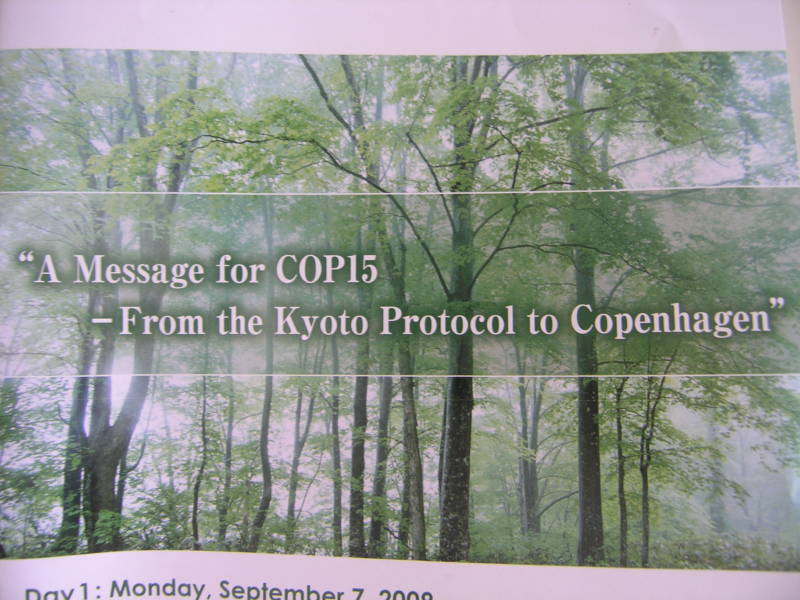
…And a message for the US from Yvo de Boer–An official program from last week’s Asahi World Environment Forum in Tokyo.

With the United Nations Climate Change Conference in Copenhagen two and a half months away, it’s becoming increasingly likely that lawmakers on Capitol Hill will not pass legislation on greenhouse gas reductions in time. A commonly accepted premise seems to be that without domestic climate legislation enacted at home, the U.S. won’t be able to sign a global deal on climate change in Copenhagen, either.

Not true, said UN Climate chief Yvo de Boer last week at the Asahi World Environment Forum here in Tokyo. de Boer told a packed house that in recent conversations he’s had with Senator John Kerry (chairman of the Senate Foreign Relations Committee) and senior advisors to President Obama, it was clear to him that the United States doesn’t need Congress to act in order to sign a deal in Copenhagen. (Listen to an audio clip of his remarks using the player below.)

[audio:http://kqed03.streamguys.us/anon.kqed/climatewatch/YvodeBoer.mp3]

This isn’t the first time de Boer has said this, nor is it the first time this notion has been floated. Last year, Marc Ambiner, political editor for The Atlantic, wrote in his blog about how the administration could bypass Congress for comprehensive energy reform by using the Clean Air Act as a platform. It seems that some of Obama’s environmental advisors believe that the act not only gives the Environmental Protection Agency the power to regulate greenhouse gases but also to institute a cap-and-trade regime on its own. Going around Congress for such an important policy shift would no doubt be a controversial step, but if such powerful and influential figures are hinting at it to de Boer, maybe we’ll see a little Copenhagen surprise on the part of the American delegation.

Scotland Rising to Carbon Challenge

This dispatch came in from Alison van Diggelen after a recent visit to her home country. Van Diggelen is a freelance writer and interviewer and founder of the Fresh Dialogues website and podcast. Originally from Glasgow, she now makes her home in Silicon Valley.

Scotland Aims to Beat California on Climate Change Action

By Alison van Diggelen

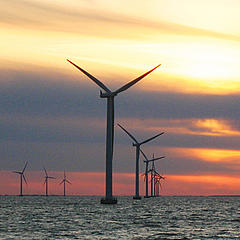
Wind turbines off Scottish coast. Photo: World Wildlife Fund

It’s not often that Scotland is ahead of the game compared to California, but on the issue of climate change, this small northern country has taken a legislative lead that has put it on the green map of the world.

As the California Legislature this week grapples with new laws* requiring utilities to get 33% of their energy from renewable sources by 2020, Scotland is sitting pretty. It is already close to its 31% target of energy from renewables by 2011 and has an even bolder target of 50% by 2020.

On a trip to Scotland this summer, I met with Lena Wilson, CEO of Scottish Enterprise, a government-funded organization that promotes Scottish interests both at home and abroad. She told me that the fight against global warming is a crucial part of the government’s strategy because ultimately a low carbon future is an economic stimulus and job creator for the country.

But how did Scotland muster the political will to set such ambitious targets? Scotland’s First Minister, Alex Salmond is passionate about renewable energy, Wilson told me; and establishing Scotland as a hub of green energy and green-tech is key to his strategy. Part of the plan is to harness its natural resources – powerful wind and wave power, estimated to account for a quarter of Europe’s potential. Salmond recently opened the largest wind farm in Europe to drive home that point. It’s on the outskirts of my home town of Glasgow and makes me rather proud.

Yet, making bold targets isn’t the end of the story. Scotland must create a whole ecosystem to make green growth attractive in Scotland. It launched the Saltire Prize last year to stimulate innovation in wave and tidal power; but still has ground to cover. As well as the financial, administrative and logistical challenges, there’s the issue of NIMBY-ism. Although Wilson insisted they’re pursing a popular green agenda, some of the locals I talked to in Scotland were less enthusiastic about the aesthetics of wind turbines.
And then there’s the “nuclear option.” Just as in California, the issue is red hot. Salmond is publically against it, but if he wants to keep shining his low carbon credentials, he may be forced to rethink his position.

One final note: When I asked Wilson, is your boss, Alex Salmond the Al Gore of Scotland? Her response was enlightening. She almost choked. Being a staunch nationalist, union man and former socialist, she doubted he’d enjoy the comparison. On my next trip, I hope to discuss this with the man himself and find out exactly how his passion for green took root. Stay tuned.

*State legislators passed two bills during their overnight session on Friday. Here’s a summary provided by the advocacy group Environment California:

AB 64 (Krekorian) & SB 14 (Simitian): AB 64 and SB 14 are companion bills that together set California on the path toward producing 33% of its electricity from renewable resources like solar and wind power. While there was much controversy over amendments to the bill that add in language for PG&E to potentially build large hydroelectric dams in British Columbia and call it renewable energy as well as amendments pushed by British Petroleum and Chevron that put 7,000 MW of fossil fuel burning combined heat and power plants ahead of renewable energy, the two bills still stand to become the biggest renewable energy mandate in the country”

Few Surprises as Climate Symposium Opens

A broad spectrum of scientists, entrepreneurs and public officials are meeting in Sacramento this week for the sixth annual Climate Change Research Symposium, sponsored by the California Energy Commission (CEC).

Today and tomorrow are packed with technical lectures on topics ranging from “Decadal Changes in the El Nino Pattern and Impact on the Hydroclimate…” to “Climate and Wine Grape Phenology in Napa Valley.” But yesterday it was up to the policy honchos to set the scene.

There was little in that preamble that hasn’t been heard before. When asked about recently expressed doubts that the state’s utilities can attain a one-third proportion of renewable energy within the next decade, air board chief Mary Nichols said “Not only can we do it, we have to do it.” Nichols, probably the state’s highest-profile point-person on climate policy,  said the the state’s broader, longer-range goal for cutting greenhouse gas emissions simply can’t be achieved without it.

Just as if they’d heard her, legislators tonight passed SB 14 out of committee. The bill requires utilities to meet the 33% renewable portfolio standard (RPS) by 2020 (in other words, to derive a third of their power from low-carbon sources). Green energy activists lamented language in the current version that allows utilities to slip that deadline, if there are delays in bringing new renewable energy sources online.

There was a clear signal from yesterday’s symposium speakers that, as we’ve previously discussed in this space, adaptation is taking center stage on the policy front. California has set targets for “mitigation” of global warming and put some of the wheels in motion. Now attention has turned to preparing for inevitable climate change effects, already in the pipeline.

The CEC’s newest Commissioner, Julia Levin, warned against the onset of “NIMBY” syndrome as measures are implemented across the state, such as the build-out of solar and wind “farms.”

And Stanford scientist Chris Field, who heads the IPCC’s Working Group II, noted that while growing interest in the “other” greenhouse gases (methane, nitrous oxides, etc.) is justified, the focus should remain on controlling carbon dioxide.  “As long as the world maintains an aggressive focus on economic growth,” said Field, “It’s the economic growth that’s the driver of future emissions and that’s why strategies to find ways to grow the economy without increasing carbon emissions are so important.” While some of the other gases are more potent greenhouse gases, Field says they’ll see little or no growth in volume in coming years.

Field previewed some of what he sees as the focal points of the next major IPCC climate report, known as AR5. Field predicted that we’ll see a shift in focus from making the case that global warming is real and human-induced, to providing more and better information that “stakeholders” can act upon. Field cited a recent study projecting that corn yields in Africa could fall 30% by 2040, due to climate forces.

Japan’s Climate Plan: Too Ambitious?

KQED’s Los Angeles Bureau Chief and frequent Climate Watch contributor Rob Schmitz is spending six weeks in Japan, as part of  the Abe Fellowship for Journalists. In the weeks to come he’ll file a series of special reports on Japan’s extraordinary strides in energy efficiency–and what we might learn from them.

Saturday night, on my way home from an interview, I witnessed one of the more interesting orchestrated movements of humanity the world has to offer. I shot this video when I was changing trains at Shibuya station, one of Tokyo’s busiest. The intersection shows how well Japan engineers pedestrian movement–but how well will it engineer its residents’ greenhouse gas emissions?

On Monday, I attended the Asahi World Environment Forum, where all the bigwigs on climate change were in attendance (including Yvo de Boer and Rajendra Pachauri, among others). The surprise visitor was Japan’s Prime Minister-elect Yukio Hatoyama.

Hatoyama makes his climate change pledge.

He told a packed house that Japan will aim to reduce its greenhouse gases by 25% from 1990 levels by 2020.

“In my personal opinion, that’s impossible,” Hidetoshi Nakagami told me last week. Nakagami is President of the Jyukankyo Research Institute and holds a coveted seat on the advisory committee to Japan’s powerful Ministry of Economy, Trade, and Industry, or METI. “Hatoyama’s pledge is pure politics,” he said. “It’s not practical, it’s not possible, and there’s not enough time.”

Nakagami is not a pessimist. He played a large role in creating Japan’s very successful Top Runner program, a 1997 policy that searches for the most efficient model of any given electrical appliance and then makes that model the industry standard, requiring other companies to adhere to it when making new models of the same appliance. The program was one of Japan’s most ambitious energy efficiency measures, and Nakagami had to fight against Japan’s largest companies in order to help craft the policy into law.

While Nakagami would like to see a one-quarter reduction in greenhouse gases from 1990 levels in the next decade, he says it’ll cost the average Japanese dearly. When former Prime Minister Taro Aso pledged to cut Japan’s greenhouse gases by 15% of 2005 levels, Nakagami’s institute estimated that the effort would cost each Japanese household, on average, 70,000 yen–a little over USD $700–a year. Even that, says Nakagami, would be a tall order in this economy.

In the end, Hatoyama may not fill this order. His historic pledge, which during his campaign, seemed to have no strings attached to it, now has an important caveat. At Monday’s forum, he told the audience that Japan will embark on this journey as long as other major countries also set similar ambitious targets.

Japan’s future hanging in the balance.

After the forum concluded, I walked outside into Tokyo’s rush hour: pedestrians everywhere, taxis speeding by me. I stopped at a Shinto shrine built among enormous glass skyscrapers. In front stood an Omikuji shrine, where believers tie a paper copy of their fortune, with hopes that it’ll come true. Hundreds of paper fortunes rattled in the hot, summer wind. I wondered if one of them was Hatoyama’s.

Where There’s Smoke—And Where Isn’t There?

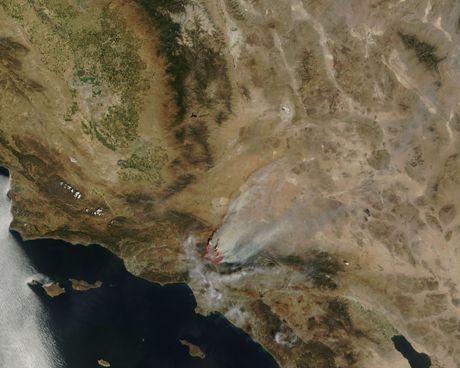
Earlier this week I got an email from a colleague in Boulder, Colorado, remarking on the crimson sunsets and brown haze that had settled across the Front Range, apparently caused by drifting smoke from California’s wildfires. At that point the Station Fire complex in Los Angeles County had already charred nearly 150,000 acres.

Smoke fans out from L.A. fires this week. Image: NASA
Smoke fans out from L.A. fires this week. Clickable image: NASA

My colleague Dan Brekke, an ardent watcher of elemental stuff like water and fire, featured a map of the spreading haze in his personal blog.

By Wednesday evening Brekke relayed that flames had consumed an area about the size of Chicago (and no, he couldn’t resist the low-hanging Mrs. O’Leary reference). With less than 30% containment, smoke had spread over about three-quarters of the state. Beyond California, NOAA had tracked the plumes “northward and eastward…across southern Nevada, Utah, Colorado, and Kansas.”

Front page of Wednesday's Denver Post

From The Denver Post:

“Joe Ramey, a meteorologist with the National Weather Service in Grand Junction, said that a high-pressure system is continuing to pump smoke from several California fires and 17 fires currently burning in Utah into the state. He said a fire near Nucla in south-central Colorado also may be contributing to the haze…Most of the smoke, however, is being generated by the 190-square-mile fire burning near Los Angeles, he said.”

While the current pall is not entirely California-born, it does make the point that large wildfires cast a surprisingly long shadow.

Atmospheric scientists classify smoke as an “aerosol” (any airborne particulate matter), which has a complicated set of feedbacks on the climate. For instance, aerosols encourage cloud formation and clouds have both positive and negative feedback effects on global warming. But it’s clear that smoke plumes generate greenhouse gases and also carry toxic air pollutants such as carbon monoxide.

Briefing journalists last month at the National Center for Atmospheric Research (NCAR)–in Boulder, no less–atmospheric chemist Gabriele Pfister said that wildfires have multiple effects on the atmosphere. They “disturb the carbon cycle,” interfering with energy exchanges and generating greenhouse gases. Itinerant smoke can generate ozone pollution far from the initial fires. This presents a challenge for local regulation of “ground-level” ozone, since it’s often likely an import from distant fires.

Stanford Studies Clean Coal Tech for China

coal_blogChina, the world’s largest emitter of CO2, is the focus of a new $2 million investment in clean coal technology research by  Stanford’s Global Climate and Energy Project (GCEP).
The project will fund research into large-scale carbon sequestration in underground geological formations. China relies heavily on coal for electricity generation and in 2006 was reported to be building the equivalent of one new coal-fired power plant every week.

“China is growing so rapidly, and if they’re going to be able to lower their emissions, they are going to need a whole suite of technologies,” said Sally Benson, director of GCEP.  “They are doing a lot with solar technologies and energy efficiency but China is not abandoning coal.  So, we’re looking for ways they can reduce their emissions from coal.”

The three-year project is an international collaboration among the University of Southern California (USC), Peking University (PKU) and China University of Geosciences at Wuhan (CUG). It will focus on the technical aspects of stashing carbon in saline aquifers, such as chemical reactions between the rock and carbon and understanding what portions of the aquifers can actually be filled up.  The research will involve 39 scientists and students, and will integrate geological modeling, reservoir simulation and laboratory experiments.   The results may shed needed light on China’s overall carbon storage potential.

“Saline aquifers have been shown to have the biggest storage capacity across the world,” said Benson, “and China has a tremendous need.”

China’s not the only country with a tremendous need.  As the second largest emitter of CO2 (and still bigger than China per capita), the United States has yet to deploy large-scale CCS. Yesterday, the U.S. Department of Energy announced $27.6 million in new funding for 19 projects exploring potential carbon storage technologies.

A Climate Reporter’s Candy Store

I’m spending the week in Boulder, CO, attending a series of lectures and discussions at the National Center for Atmospheric Research (NCAR). The center is a hub for climate modeling using some of the world’s most advanced computers–but scientists here are working on a dizzying array of projects, from “wind prospecting” models for siting utility-scale wind farms in Colorado, to tracking the ozone drift from California wildfires, to studying the relationship between weather and meningitis in Sub-Saharan Africa.

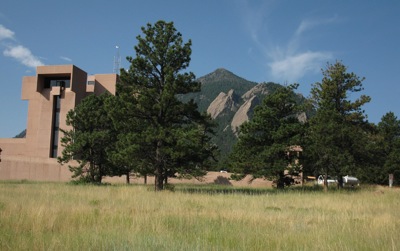
With the Flatiron Mountains as a backdrop, architect I. M. Pei used the Mesa Verde cliff dwellings as inspiration for the NCAR headquarters building, in Boulder. Photo: Craig Miller

While NCAR works closely with NOAA (which also has a major research center in town), it is not part of it. NCAR is funded by the National Science Foundation and managed by something called the University Corporation for Atmospheric Research (UCAR), a consortium of about 75 North American universities, as well as major institutions abroad.

About 400 scientists work under the NCAR umbrella, including Kevin Trenberth, a leading authority on the link between El Nino and global climate. Right before hopping a plane for Australia this week, Trenberth, head of NCAR’s Climate Analysis Section, reaffirmed what NOAA and others have been saying; that we may be in for a significant El Nino event this fall and winter.

“There are good signs below the surface of the ocean in the tropical Pacific that this is the real deal,” said Trenberth. He echoed some of the optimism expressed by many Californians that the result could be an overdue dousing after three years of accumulating drought conditions. “The odds are, if it’s a good El Nino,” said Trenberth, “that there is more likelihood of a southerly storm track that’ll bring a lot of weather systems into southern California in particular. It’s not always clear what happens in northern California but the odds are that there’s a much more active southern storm track right across the U.S. and in particular in California.”

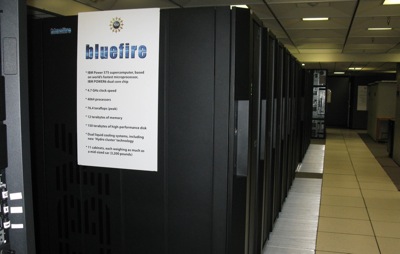
The IBM Bluefire 76-teraflop computer, centerpiece of NCAR's supercomputing center. Photo: Craig Miller

NCAR scientists continue to refine their climate models, which have been downloaded by more than 10,000 scientists around the world. UCAR invests $20-to-$30 million every four years in it’s Computational & Information Systems Lab (CISL), to maintain it’s state-of-the-art status. CISL chief Rich Loft says it’s probably the most advanced supercomputing center devoted largely to climate analysis.

Even so, NCAR is busy building a bigger, faster one–but not here. The new supercomputer, which may be ready by 2012, will be sited near Cheyenne, Wyoming, mostly to take advantage of the cheap, abundant electric power in that area. Loft and NCAR Director Eric Barron both concede the paradox that the most advanced computer assault on global warming is itself a huge gobbler of electricity, much of which comes from coal-fired power plants. The Wyoming facility will suck down 4.5 megawatts of power. Barron says at least there’s a major wind farm “right next door.”

The center’s carbon footprint is probably also swollen slightly by its own air force. NCAR operates two aircraft packed with advanced instrumentation; a hulking C-130 Hercules and a sleek, high-altitude Gulfstream V. Sadly, no rides were offered this week.

Plugged In, in Long Beach

Rob Schmitz heads KQED’s Los Angeles Bureau and is a frequent contributor to Climate Watch.

A Chevy that gets 230 miles to the gallon. A Hummer that gets 100.

Plug-in 2009, the 2nd annual industry conference in Long Beach, was wall-to-wall with such apparent oxymora. Just roving around the exhibition floor on Tuesday, I got the sense that our electric vehicle future is closer than I had originally suspected. I spoke to conference-goers who are already investing millions in what is assured to be an enormous infrastructure that’ll be built around these new cars.

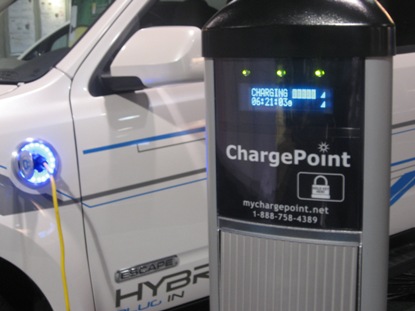
Electric Vehicle Charging Stations that are sold by Coulomb Technologies out of the Silicon Valley. Photo: Rob Schmitz
Electric vehicle charging stations from Campbell-based Coulomb Technologies. Photo: Rob Schmitz

I met Tom Tormey, Vice President of Technology at the Silicon Valley-based Coulomb Technologies. He raised a lot of important questions about where we’d charge these vehicles when we’re not at home. Of course, the answer came in the form of something he could sell you: car-charging stations. His company manufactures automated posts where you can use a credit card to charge up your car when you’re away from home or at work. He’s already sold dozens of these to cities across Europe. The stations will even help calculate taxes for the government through a network that hooks up to Coulomb’s servers here in California: a potentially big business for an electric future.

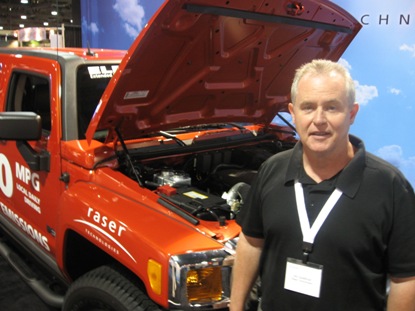
Speaking of big, check out the electric Hummer. If you thought this beast was nearing extinction (with the sale of Hummer to the Chinese and all), think again. With a new electric version that allegedly gets a 100 miles to the gallon, you may continue to see this American icon on our freeways.

Jim Spellman of Raser Technologies, standing in front of the 100-mpg Electric Hummer. Photo: Rob Schmitz
Jim Spellman of Raser Technologies, standing in front of the 100-mpg electric Hummer. Photo: Rob Schmitz

Jim Spellman of Raser Technologies showed off the Hummer to me, complete with his company’s power train and electric generation system. He says they took it out for a test drive a few weeks ago and it ran 50 miles on electric power with 30% of the battery left to go.

With momentum building among the plug-in players, it’s not surprising that Mike Howard of the Electric Power Research Institute predicts there will be 16 million electric vehicles on the nation’s roads by 2030.

Not With a Bang, But…

This is the way the world ends. Not with a bang but with a whimper. –T.S. Eliot

With the President headed for Mexico for a two-day summit, I was struck last week by the juxtaposition of two headlines that jumped out of a daily environmental news digest.

One headline read: “MEXICO AIMS TO BRING CO2 CUT PLAN TO CLIMATE TALKS.” The other, just above it, referring to similar efforts in this country, read: “CLIMATE BILL MAY FALL BY THE WAYSIDE.”

“With the fight over health care reform absorbing all the bandwidth on Capitol Hill,” Lisa Lerer wrote for Politico, “Democrats fear a major climate change bill may be left on the cutting-room floor this year.”

Granted, Mexico’s contribution to global greenhouse gas emissions is reportedly about 2%, or a tenth of the U.S. contribution, so one might argue that there’s a lesser job to do there. But with less than four months remaining before the next major U.N. climate conference, it raises the grim prospect that while other nations press on, the U.S. could arrive in Copenhagen empty-handed, which is to say without meaningful carbon legislation to show.

At the same time last week, the 16-nation Pacific Islands Forum called for a 50/50 commitment from developed nations; a 50% reduction in greenhouse gas emissions by 2050. Many of those island nations are on the hot seat as rising seas levels could make them among the first to lose substantial real estate before the end of this century.

At his first climate summit for governors last fall, Governor Arnold Schwarzenegger introduced a video from then President-elect Obama, in which he promised that his presidency would “mark a new chapter in America’s leadership on climate change.”

Praising the governors in attendance for their own climate initiatives, the newly elected President declared that “Too often Washington has failed to show the same kind of leadership. That will change when I take office.”

Of course “Washington” includes Congress, which is still dithering over the major carbon emissions bill championed by the new President. It squeaked through the House by nine votes and now looms as a 1,400-page pig that the Senate python will attempt to digest or regurgitate. Either way, what comes out is unlikely to closely resemble what went in.

Meanwhile the whole cap-and-trade concept has been coming under increasing scrutiny and skepticism. Last month, when the non-partisan Public Policy Institute of California polled Californians on the subject, more respondents favored an out-and-out carbon tax than cap-and-trade (56% to 49%). The Western Climate Initiative, a regional cap-and-trade pact that is a keystone of California’s climate strategy, AB 32, remains in limbo while western legislatures wait on Congress.

So when the Governor convenes his second climate summit in L.A. next month, billed optimistically as “The Road to Copenhagen,” he and his fellow “subnational leaders” (Wisconsin, Michigan & Connecticut governors are currently signed up) may find that the ball is still in their court. According to a news release from the Governor’s office, “climate leaders from around the world will come together and collaborate on efforts to further the global fight against climate change.”

They’ll do it with the same question on the table as last year: Can they count on Washington to take up the reins?