Tag Archives: Emissions

Poll: Support for Climate Action More Contentious

New polling suggests that Californians may be wavering slightly in their support of climate response policies. The survey, just released by the non-partisan Public Policy Institute of California (PPIC), also shows a growing rift along party lines, when it comes to climate policy.

Nearly nine in ten Democrats surveyed (86%) said the government should regulate greenhouse gas emissions, while just 54% of Republicans agreed. Among all adults, including “independent” voters, 76% of Californians favored regulation of emissions, similar to a nationwide poll conducted in June by ABC News and the Washington Post.

PPIC chief Mark Baldassare says he thinks that the high-profile debate over national carbon legislation is “splitting Democrats and Republicans in California in a way that they weren’t a couple of years ago, when they saw a Republican governor and a Democratic legislature finding common ground on climate issues.”

Baldassare also observed that the relentless recession and state budget crisis have distracted both voters and their political leaders from environmental concerns.

There was a spike in water concerns compared to last year’s poll, with 18% naming water supply and drought as the state’s most important environmental issue, up 13 points from a year ago, virtually tying air pollution and vehicle emissions (20%) as the top concern. The poll’s margin of error is 2%. The telephone survey was conducted in mid-July.

The PPIC poll also appeared to pick up a groundswell among climate action naysayers. The percentage of respondents saying there’s no need for immediate action was up six points from a year ago, to 23%. Baldassare chalks this up partly to the complex nature of climate science. “People become skeptical when they don’t understand things,” he said.

Overall respondents showed the most concern (59%) over the likelihood of more wildfires, followed by more severe droughts (55%). People seemed less concerned about flooding and coastal erosion brought about by rising sea levels, possibly because they see that as a longer-term threat. Concern over wildfire was strongest in the Inland Empire and L.A. Basin. Interestingly, Angelinos also expressed more intense drought fears (61%) than respondents in the ag-intensive Central Valley, where just 21% described themselves as “very concerned” about the drought threat from climate change. Note that this is not an expression of drought fears in general, just those driven by climate change.

When it came down to the question of what to do about global warming, more Californians favored a “carbon tax” than a cap-and-trade system, by 56% to 49%. California and the nation are currently on a path toward cap-and-trade, at least partly (and paradoxically) because it’s considered more politically palatable than a straightforward carbon tax.
California Climate Champions: Project Carpool

Patrick Ouziel
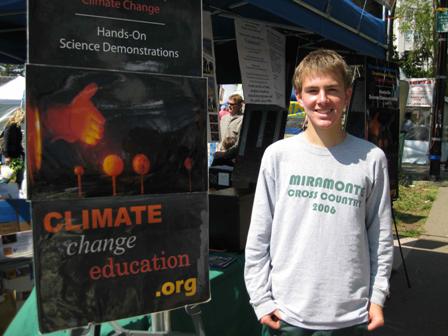
Photo by: Patrick Ouziel

Devin Finzer is a 2008 California Climate Champion from Orinda who graduated from Miramonte High School in June. In this guest post for the Climate Watch blog, he describes how he and fellow Champion Patrick Ouziel were able to start a carpooling program at his school.

Walking to my high school each morning, I trekked past long lines of backed-up traffic. Driver after driver waited anxiously for his or her chance to round the corner into the Miramonte High School lot and hunt for a coveted parking spot. For the most part, each car contained just one person. The passenger seats of large SUVs and mini-vans were often left completely empty. The early-morning situation involved stress, traffic congestion, and unnecessary pollution. Fellow student Patrick Ouziel and I decided we could do something about it.

As California Climate Champions sponsored by the California Air Resources Board and the British Council, Patrick and I are engaged in local and international efforts to take action and spread awareness about climate change. One of the main environmental issues we noticed at our high school was the way students get around. With after-school sports and club activities, juniors and seniors take advantage of their newly earned driver’s license, but by driving only themselves, they often missed out on easy, cost-beneficial, and eco-friendly ways to group together with other students traveling their same route.

Patrick and I are proud to have lobbied for the expansion of our school’s carpool system, which provides carpoolers with designated parking spots each morning. During the school year, we produced several videos promoting eco-friendly transportation and climate awareness, and linked these videos to a web site where students could demonstrate their support for increasing the percentage of carpool spots at our school. We also provided an option where students could sign up as “potential carpoolers” in order to find other ride-sharers who lived close by.

The result?  With the support of students and the administration, we transformed our parking lot reserved for high school seniors into a lot exclusively for carpoolers. Now 80 spots, about 30% of our entire lot, are reserved exclusively for carpoolers.

What are the environmental benefits for the new program? While differing gas mileages and travel distances make exact calculations difficult, we do know that carpooling with just one other person already cuts per-person emissions, as well as gas costs, in half, and we can estimate that our carpool system inspired about 40 additional carpool groups.

While deciding to carpool almost seems almost like a no-brainer, Patrick and I did face significant barriers when we emphasized the importance of ridesharing. From the get-go, one of the main obstacles we had to address was the relationship between driving and teenage independence. Every sixteen-year-old remembers the day he earns his license: the fresh feeling of the driver’s seat and the thrill of taking the wheel, free from parental supervision. Americans clearly love to drive, and apparently, many of us love to do it by ourselves — a 2005 U.S. Census Bureau survey says 77 percent of American workers drive to and from work alone.

In our awareness videos, Patrick and I emphasized that carpooling doesn’t have to be a sacrifice of this independence. Rather, it can be an effective symbol of collaboration: sharing a ride is an opportunity to spend time with friends, or to get to know new people. Teenagers are social beings who feel most content when they are connected with their peers. That’s why we emphasized the importance of a collective carpool movement built on the strong sense of community at our school.

Advocating carpooling can be a great way to start a green movement at your own school or workplace. There are a number of web sites that match potential carpoolers and make ridesharing easy. I’ve reviewed a few of the better-known ride-matching sites on my blog.

Patrick and I will both be going to school on the East Coast next year, Patrick at Yale and myself at Brown. We plan to continue our climate change activism. In particular, I’d like to encourage the installation of solar panels on the roofs of high schools and universities. Our continued environmental efforts will be documented on my blog.

Special thanks to Climate Watch intern Kristine Wong for help with this post.

Long, Hot Summer for Climate Bill

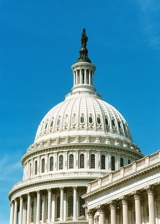
capitoldome_hr_blogAs California’s Barbara Boxer opened Senate hearings on the Waxman-Markey climate bill today, her committee was urged by Republicans not to “rush through this thing.” At this point there seems to be little danger of that.
Having squeaked through the House by the thinnest of margins, the American Clean Energy and Security Act is facing a gantlet of Senate committees that will likely spend most of the summer dissecting the 1400-page beast.

Boxer’s Environmental and Public Woks Committee heard testimony today, with Finance and Foreign Relations scheduled to have their whack at it tomorrow. During the latter, expect to hear gruesome details about Europe’s experiment with cap & trade, which has been fraught with problems. Peter Fairley recently provided an excellent overview of those pitfalls in MIT’s Technology Review. Fairley writes that in its current form, the Waxman bill is destined to hit many of the same potholes.

During today’s morning session, members of the Energy committee heard from several cabinet-level officials, including Department of Energy Secretary Steve Chu, who fielded numerous questions on the role of nuclear power in the nation’s energy future. While California still has in place a legislated moratorium on new nuclear plants, Chu assured committee members that restarting the nuclear industry is a “very important factor” in the low-carbon future and that faces “no reluctance” from him.
Chu said his department is “pushing as hard as we can” to provide loan guarantees for new plant construction (most of which is planned for the southeastern U.S.). The former head of Lawrence Berkeley National Lab said that the U.S. has lost the lead on nuclear technology and “should get it back.”

(We’ll look at the prospects for that in a Climate Watch radio feature, scheduled to air on the August 24th broadcast of KQED’s Quest radio series.)

Committee Republicans repeated concerns about potential job losses and the danger of “carbon leakage,” wonk-speak for when production moves overseas to countries where it creates more greenhouse gas emissions than it would here.

As in the House floor debate, Republicans recalled a comment made by then-candidate Barack Obama to the San Francisco Chronicle in January of last year, that electricity rates would “necessarily skyrocket” under cap-and-trade. David Hawkins of the Natural Resources Defense Council countered that the act would also offer some savings; that households could see “up to $14 per month” in savings from transportation efficiencies.

California’s EPA Waiver: Does it Still Matter?

Deja vu all over again. Photo: Craig Miller

Today the federal Environmental Protection Agency formally granted the waiver that California has sought since 2002, allowing the state to set its own standards for greenhouse gas emissions from cars.

But wait–didn’t this already happen for practical purposes, last month? That’s when the Obama administration announced its intent to essentially put California’s proposed standards in place nationwide.

Well, yes–and no. Bernadette Del Chiaro, who represents the group Environment California, says that having the waiver is more than a legal technicality. She says it means that the state can get started sooner, cleaning up tailpipe emissions. Del Chiaro explains that: “California’s standards kick in now, through 2016. The federal program that President Obama has extended throughout the entire country, starts in 2013 (also through 2016).”

That gives the states, in effect, a three-year jump-start. In 2013, everybody should be on the same page.

California’s chief air regulator,  Mary Nichols said, in a written statement:
“The waiver affirms California’s authority to set the standards for the cleanest cars in the nation and recognizes the ability of forward-thinking states to continue to adopt them. Now we can begin to work with the manufacturers to make a new generation of cars that deliver all the comfort and power we have come to expect but with improved efficiency and far fewer greenhouse gas emissions. ”

Thirteen other states had also pursued the waiver and can now proceed with their own programs.

While automakers have long argued that the tighter regs will make cars more expensive, Environment California calculates that they’ll “save consumers $36 billion at the pump by 2020.” That projection assumed that gasoline would would average about $2 per gallon over that period. Higher pump prices (which seem a lot more likely) would in turn, increase expected savings, as the underlying premise is that we’ll be driving cars that get better gas mileage.

But of course those cars will cost more than the clunkers we’re wheeling around in now. The state Air Resources Board estimates that the clean car regulations will tack an average of $1,000 onto the price of a new car by 2016. Obviously that would offset some of the pump savings.

Down to the Wire: House Passes Climate Bill

After a long day of debate, the U.S. House of Representatives approved the Waxman-Markey climate bill, by a narrow vote of 219-212. The bill now goes to the Senate.

President Obama reportedly changed the topic of his weekly address, in order to respond to the landmark bill’s passage.

Toward the end of the day-long floor debate, Ohio Republican John Boehner railed against a “manager’s amendment” that was “dropped at 3:09 a.m.,” as he reminded members numerous times. The 309-page amendment spelled out some of the regulatory architecture of the proposed law, and Boehner spent more than an hour going through it nearly page-by-page, detailing how the law would reach into local governments, private homes, homeowners’ associations and mortgage markets.

In urging her Democratic colleagues to vote in favor of the measure, House Speaker Nancy Pelosi promised that passage would mean “four things: jobs, jobs, jobs and jobs.” But Republicans repeatedly warned that the law would cost “2.5 million jobs” every year, for the next decade and highlighted conflicting estimates of the cost per household (Projections by the EPA and Congressional Budget Office put the number at between $140 and $175 per year, while House Republicans insisted that the real price would be many times that).

At times the House floor sounded more like the British Parliament in decorum. A Republican amendment known as the “New Manhattan Project” alternative to the bill was defeated 256-172. That proposal would have largely substituted the Waxman bill’s web of regulation with incentives for development of new energy sources.

One thing that both parties seemed to agree on was that the American Clean Energy and Security Act of 2009 is one of the most sweeping pieces of legislation ever to come before Congress. The Waxman bill ballooned to more than 1200 pages by the final vote.

Speed Bumps on the “Hydrogen Highway”

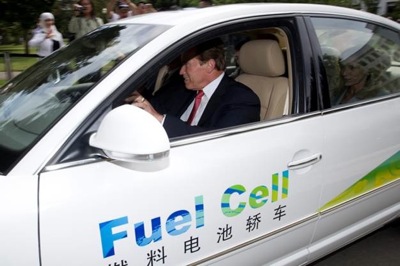
Seems like the Governor is spending a lot of time looking at cars lately. If the rest of us spent as much time cruising Auto Row, the recession might already be fading in the rear-view mirror.

Governor Schwarzenegger tries out the Volkswagen Passat Lingyu. Photo: Governor's Office
Governor Schwarzenegger at the wheel of a Volkswagen Passat Lingyu. Photo: Governor's Office

But California’s chief executive isn’t interested in run-of-the-mill rolling stock (he will, of course, happily take credit for inventing the Hummer). He’s into exotics: the alternative-fuel cars of the future–and in some cases, present.

At least five times in the last three weeks, the Governor’s Office has created photo ops with alt-fuel autos, prototypes or refueling stations; from a fuel-cell Volkswagen (June 3) to the Mutt-&-Jeff of electrics, Hummer and Peapod (May 28 & June 10, respectively), he’s kicked the tires on a whole generation of not-widely-available wheels–not to mention the home ethanol refinery (June 4) or the hydrogen refueling station in Santa Monica (May 27).

All of which got us to wondering: “Dude, where’s our Hydrogen Highway?” You may recall the Governor’s promise five years ago, that California would by now be coming down the home stretch on a whole new infrastructure for the coming swarm of cars powered by hydrogen fuel cells.

Monday morning on KQED’s weekly Quest radio feature, David Gorn reports that we’ve apparently hit a few speed bumps:

“The technology clearly has promise, but it’s behind schedule. Schwarzenegger’s original plan called for 100 to 150 hydrogen fuel stations by next year, and so far there are only about two dozen. He also wanted 2,000 hydrogen-powered cars on the road, yet fewer than 200 are being road-tested today. The lack of progress has prompted California’s non-partisan state legislative analyst to recommend scrapping state funding for the hydrogen program. And on the federal level, Energy Secretary Steven Chu has asked Congress to cut about half of the national hydrogen-research budget. Chu said hydrogen technology is too far from fruition.”

None of these details stopped Governor  Schwarzenegger from hyping the 2009 Hydrogen Road Tour, a recently concluded San Diego-to-Vancouver rally, designed to highlight fuel-cell technology:

“We will keep pushing, and thanks to our public-private partnerships and the commitment of these automakers and energy companies, the era of pollution-free transportation is dawning.”

The Governor’s statement went on to say that “Auto manufacturers expect the number of hydrogen vehicles to increase to 4,300 by 2014 and more than 40,000 vehicles by 2017.” Of course, that was before Energy Secretary Steve Chu announced that R&D funding for hydrogen fuel cells on the road didn’t quite make the cut for the next DOE budget. Plug-in hydrid, anyone?

Transportation’s Tricky Carbon Footprint

Kristine Wong is our Climate Watch intern for the current term. She’s a student at UC Berkeley’s Graduate School of Journalism.

interchange_0145_blogStudy comparing environmental impact of transportation modes yields surprising results

By Kristine Wong

You may not believe that during peak commute hours, Boston’s light rail system generates more greenhouse gases (GHGs) per person than a gas-powered, fully occupied SUV–or a commercial airliner filled to capacity, traveling the same distance.

Yet this is what UC Berkeley researchers found in a study released this week. Mikhail Chester and Arpad Horvath compared the environmental impacts of cars, buses, planes, and rail after adding up all the energy costs and emissions (both GHGs and local air pollutants) over their entire life cycle–not just by what came out of the tailpipe. The authors say no such comprehensive study had been done before.

The researchers developed a method that evaluated each transportation mode based on the energy inputs needed for production and maintenance of the vehicle itself. They also looked at the infrastructure for each mode, such as construction of supporting components like rail station platforms and airport runways, bus and rail station lighting and parking, and the source of  power for each mode (e.g. gasoline, jet fuel, diesel or electric–and the costs of distributing and producing these inputs).

In total, Chester and Horvath compared 79 components across all transportation modes. Within each they also selected a few variations to represent differences, depending on factors such as vehicle make and mileage, passenger occupancy, and size.

The results were both logical and surprising. Most of the energy consumed and GHG emissions from auto, bus and air travel originated from the operational period, not from the materials needed to produce and maintain the vehicles. Rail produced the greatest amount of GHGs compared to all other modes over their life cycle. But Chester and Horvath point out that there is a big difference in GHG emissions from light rail systems in the Bay Area versus, say, Boston due to the portion of fossil fuel-based electricity used. Boston’s fuel mix is 82% fossil, while the Bay Area’s BART system clocks in at just 49% fossil fuel–a major factor in efficiency and GHG emission rates.

Finally, passenger occupancy was a key factor influencing efficiency. Not surprisingly, each mode was most efficient when used to capacity. But the researchers caution that boosting passenger occupancy is not a magic bullet. They say minimizing fossil fuel inputs and adding pollution filters and controls would have a greater effect on efficiency.

Chester and Horvath say that they hope their results will provide a framework for more comprehensive analysis of the environmental impacts of transportation, and to assess the impact of hybrid or electric vehicles and alternative energy sources such as biofuels, solar power, and wind power, none of which were included in the study.

There are more details of the study posted at the websites for Green Car Congress and Sustainable Transportation.

Head-to-Head: Chevron and The Sierra Club

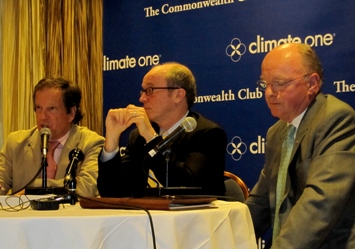
Two giants of California’s energy debate squared off at a Commonwealth Club forum in San Francisco last night.

Chevron CEO Dave O’Reilly and Sierra Club Executive Director Carl Pope fielded questions from moderator Alan Murray of The Wall Street Journal and a sometimes impassioned audience, about renewable energy opportunities, reducing greenhouse gas emissions, and predictions for the future of the United States’ energy economy. Several questions also concerned Chevron’s high profile court battle in Ecuador and the oil company’s presence in Richmond, the Bay Area city where a major Chevron refinery dominates the skyline–and some say, local governance

Carl Pope, ED of Sierra Club Alan Murray, Executive Editor of WSJ Online Dave O'Reilly, CEO of Chevron. Photo: Gretchen Weber
From left to right: Sierra Club chief Carl Pope; WSJ Online Executive Editor Alan Murray; Dave O'Reilly, CEO of Chevron. Photo: Gretchen Weber

In what was less of a debate than a discussion, Pope and O’Reilly agreed that the United States needs to make major changes towards greater energy efficiency and that the country must begin to rely more on renewable energy sources.

Their views diverged significantly, however, on the timeline for such changes. While Pope supports a 90% reduction of greenhouse gas emissions from today’s levels by 2050 and says he believes this goal possible, O’Reilly projected that by 2050, the United States will have reduced its GHG emissions by no more than 20-25% from today’s levels.

O’Reilly said that even if the U.S. replaced the entire transportation system with a zero-emissions system, the country would reduce GHG emissions by just 34%–and that doing likewise with the nation’s power generation would reduce GHGs by another 40%.

“So we have to ask ourselves, can we replace our entire energy system–transportation and power–in just a few short decades?” said O’Reilly. “I think the transition is going to take some time.”

According to O’Reilly, his company is already the largest provider of geothermal energy in the world and yet only 2% of Chevron’s income currently comes from renewable energy.

“The challenge of scale demands that we acknowledge that conventional energy sources will remain indispensable for decades,” said O’Reilly. “We must be realistic. For the foreseeable future we need to develop it all: conventional as well as non-conventional energy, as well as renewables and alternatives.”

When asked what his prediction was for how much of Chevron’s income would come from renewable energy sources by 2050, O’Reilly said he thought the number would be about 10-15%.

Pope responded, “The world will have room in 2050 for a very small company, 90% of whose energy comes from fossils [fuels]. The world will not have room, or tolerance, in 2050 for a big energy company [that does], so if Chevron wants to be successful, I think Chevron’s going to need to change those numbers.

Pope also called on Chevron to “come to the table” with local communities in which Chevron operates, such as Richmond, CA, and he proposed that all oil companies donate 10% of their profits to a global fund to clean up areas of the world damaged by the petroleum industry.

Not surprisingly, Pope and O’Reilly agreed that the highest priority for reducing GHG emissions is to replace coal with natural gas or another less carbon-intensive energy source, and while on stage, the men shook hands on an agreement to lobby the issue together in Washington.

KQED will broadcast the entire Commonwealth Club event at 8 p.m. on Friday, June 19, with a rebroadcast at 2 a.m. the following morning.

Carbon Offsets in the Air

Friday on The California Report’s weekly magazine, Rori Gallagher reports on ways to assuage your carbon guilt with a quick stop at an airport kiosk.

By Rori Gallagher

Reed Galin
Photo: Reed Galin

I first got the idea to do a story on carbon offsets back in December, when San Francisco International Airport announced it was partnering with a private company called 3Degrees to install carbon offset kiosks.

Originally, the kiosks were supposed to be installed sometime “in the spring.” But there seems to be a delay with the contract negotiations. I kept checking in with 3Degrees about a launch date. At first they were saying Earth Day–then it was pushed to May, and now “by the end of June.”

But there are already other options out there. I found that Virgin America, the only major airline based in California, was the first to offer carbon offsets in the sky. Other airlines do offer customers the chance to purchase offsets but Virgin allows you to do it during the flight through the in-flight entertainment system.

Carbon offsets are supposed to stop carbon emissions that would have otherwise taken place. That’s really difficult to substantiate. Projects like wind farms for example, certainly seem good for the environment but likely most of them would be built anyway and produce power without this type of third-party incentive.

Virgin’s program managers say they stringently vetted carbon offset programs, and that theirs are among the most credible out there. But as I point out in my radio story, there is very little regulation of the voluntary carbon offset industry and it’s difficult to know if they’ll do what they say they will.

There are some independent efforts to separate the sheep from the goats, for example the Natural Resources Defense Council has produced a buyer’s guide for carbon offsets.

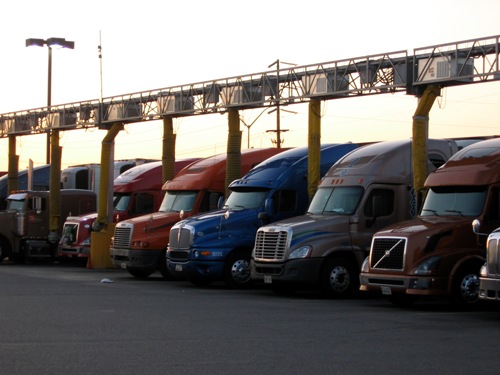
Trucks line up at an IdleAire terminal, which provides "carbon offsets" for airlines. Photo: Rori Gallagher

New Tailpipe Regs are an “Alternate Reality”

Amy Standen specializes in science and environmental reporting for Quest. She’s among the guests today on KQED’s Forum program. Listen to the archived program here.

Hazy day in L.A. Photo: Craig Miller

Yesterday afternoon, as I started working on my news spot about the new federal standard for tailpipe emissions, I dug up my notes from over a year ago, the last time I covered this story in any depth.

The contrast in tone between then and now amazed me. Back then, I was describing accusations of outright lying, government actions that California enviros called “completely illegal,” and California officials “sharpening their knives” as they marched into battle with EPA former Administrator Stephen Johnson. It was September, 2007, and Democratic lawmakers, led by Henry Waxman (D-CA), were accusing the White House of strong-arming the EPA into denying California its “waiver,” or permission to regulate auto tailpipe emissions. The mood between California environmentalists, many of the state’s elected officials, and the Bush administration couldn’t have been more hostile.

Today, it’s as if we’ve landed in an alternate reality.  Not only has California been given its more fuel-efficient cars, but those same laws are taking effect nationwide. The new rules actually exceed anything that California–traditionally the most ambitious state in the union, when it comes to greenhouse gas regulation–could have asked for.

Instead of knives being sharpened, California enviros are singing the praises of “an historic blueprint to carry out rigorous greenhouse gas emission standards,” to quote one email I received today. Another group told the New York Times: “This is the single biggest step the American government has ever taken to cut greenhouse gas emissions.” Compared to the fall of ’07–actually make that since ’05, when California first asked for the waiver and the EPA first started stalling–it’s like night and day.

Still, listening in to the White House background press briefing on Monday afternoon, you could hear the seeds of criticism taking root in a few reporters’ questions.

Sure, American automakers will be making more fuel-efficient cars, one reporter asked, but what is the White House doing to encourage consumers to buy them? (in addition to restricting tailpipe emissions, the new rules also substantially increase fuel efficiency standards for manufacturers’ fleets–SUVs and trucks will still be available; they’ll be more fuel efficient than before, but less efficient than smaller cars.) The question takes on new relevance as the federal government finds itself a major stockholder in auto companies.

President Obama says the new regs will have the equivalent impact of taking 177 million cars off the road.