Tag Archives: Emissions

Change Your Diet, Change the Climate?

salinas-007_blog

Climate Watch contributor David Gorn has been looking at the link between climate and the food we eat. His latest report aired recently on NPR’s All Things Considered.

So I have to admit, when I first got this story assignment from National Public Radio, my reaction was mixed. You want to reduce global carbon emissions by changing your personal DIET? Oh, come on. I mean, how much of an impact could diet change have on climate change?

Quite a bit, apparently.

A United Nations report says livestock accounts for 18 percent of the world’s greenhouse gasses, much of it from the methane produced by cows, as well as goats and sheep.

Shipping beef and dairy products across the country and around the globe also contributes heavily to that carbon footprint, in the form of emissions from trains, planes and trucks.

So the idea is that by cutting out beef and cheese from your personal diet, you can significantly reduce your personal carbon footprint. Chris Jones, a staff researcher at UC Berkeley’s Institute of the Environment, says the production and distribution of beef, pork, lamb and cheese are particularly high offenders on the greenhouse gas emissions chart.

In my story for All Things Considered, I focused on an Earth Day event where the University of San Francisco cafeteria and about 400 other food service outlets across the country, managed by Palo Alto-based Bon Appetit, were cutting all beef and cheese out of the menu for one day. Yes, no cheeseburgers in a university cafeteria. Scary thought, eh? The students didn’t seem to flinch, though.

It looks like this approach to the low-carbon diet it may be catching on among Bay Area hospital cafeterias, as well.

It’s unclear what effect the current efforts might have on climate patterns but it’s a familiar pattern to Americans; using personal buying power to influence public policy decisions.

Low-Carbon Fuels in Your Future

After years of study and a day of marathon testimony in Sacramento, state regulators have adopted the world’s first low-carbon standard (LCFS) for transportation fuels. Only one member of the California Air Resources Board, John Telles, voted against adoption.

During nearly six hours of testimony by almost 100 speakers, businesses lined up both for and against the new rules. As Marjorie Sun reported for us this week, some claimed that calculations for the carbon footprints of different fuels–especially ethanol–were not even-handed. Speaker after speaker assailed the LCFS as being the product of “incomplete analysis” or just bad math (public testimony begins about an hour into the webcast).

But Daniel Sperling, a UC Davis professor and member of the Air Board, calls it “government at its best.”

“There’s been a huge amount of effort,” he said, ” in working with the oil companies, working with the electricity companies, working with the environmental community, working with the biofuels companies, to try to get this really done right.”

Though numerous speakers challenged the view that it was done right, both Sperling and Air Board head Mary Nichols seemed to leave the door open to additional tweakage of the regulations. “In the end, it’s a science-based policy,” said Sterling. “There are a lot of pieces of this that we’re not certain exactly the best way to do it but we’ve got the framework of a really outstanding policy and an important policy. And we’ve made the commitment to work with all the different stakeholders in refining it, to make sure that it really works best.”

Small-business and environmental justice groups locked arms to decry the cost of the new rules. Some cited a report from Sacramento-based Sierra Research estimating $3.8 billion in increased fuel costs by 2020, if the LCFS takes effect.

An “expert working group” is due to report back on January 1, with possible suggestions for fine-tuning the plan.

Board member Ron Roberts summed up the proposed regulation by paraphrasing Winston Churchill: “It may not be the end or even the beginning of the end, but it’s the end of the start,” said Roberts (falling somewhat short of Churchillian eloquence but point taken).

The new rules are designed to cut greenhouse gas emissions from transportation 10 percent by 20-20.  Sperling is now headed to Capitol Hill, to testify before Congress on national legislation. California’s process is being closely watched in Washington, where pending federal carbon legislation is widely seen to be modeled after California’s plan.

The Battle Over Biomass

This week, the California Air Resources Board is expected to pass a controversial new standard that measures the carbon footprint of transportation fuels. Reporter Marjorie Sun filed a story for Climate Watch on the measure and why the ethanol industry is fighting it. She provides some additional insights here:

The proposed low carbon fuel standard is part of a broad effort by the California regulators to roll greenhouse gas emissions back to 1990 levels by 2020.

biofuel pumpSlashing carbon emissions from cars and trucks is a big part of the state’s game plan. That’s because transportation accounts for 40 percent of the state’s greenhouse gas emissions. A whopping 96 percent of the fuel sources that power our cars and trucks is petroleum-based. Right now, the bulk of ethanol sold in California–and the rest of the United States for that matter—is corn-based. (Brazil makes its ethanol fuel from sugar cane, which has a smaller carbon footprint.) U.S. producers argue that the proposed Low-Carbon Fuel Standard (LCFS) would make corn-based ethanol less competitive in the marketplace because of the way it calculates emissions. Pacific Ethanol was the biggest ethanol producer and marketer in California– until recently. With the drop in gasoline prices over the past year, demand for ethanol has plummeted. Over the past several months the company suspended operations at its two production plants in California and stopped construction of a third facility. In March, it filed for loan extensions with its creditors. So the new fuel standard could deliver yet another blow to the company. Hence, ethanol interests have been putting up a fight. But the Air Resources Board is counting on the proposed standard to spur innovation in the alternative fuels market, to reduce carbon emissions. The state says it’s hoping to “expand the size of the current renewable fuels market in California (already the largest in the nation) by three-to-five times. Instead of today’s corn, over half of the ethanol is likely to be made from extremely low-carbon, cellulosic feedstocks such as agricultural waste and switchgrass. There are numerous startups in California working on cellulosic ethanol. They’re experimenting with a wide range of plants, from switchgrass to algae, as potential sources of ethanol. Getting a new fuel to market, however, requires enormous capital costs. The state is projecting that by 2020, Californians will have bought more than 7 million alternative-fuel and hybrid vehicles. That’s about 20 times greater than today. But in these tight economic times, folks are hanging onto their old cars. So it’s not clear how fast Priuses and plug-ins will replace the carbon-spewing cars on the road today.

Sun’s radio story aired Wednesday on The California Report.

Green Response to EPA’s CO2 Finding: “Duh.”

Reactions are coming in to The EPA’s long-awaited finding today that carbon dioxide and five other greenhouse gases pose a threat to “the public health and welfare.” One California environmental group actually used the word “Duh” in its official response.

After two years of study, prodded by a Supreme Court decision, the federal agency finds that CO2, methane, oxides of nitrogen and two other industrial gases should be regulated as pollutants under the Clean Air Act. A sampling of reactions:

Environment California:

“‘Duh’ may not be a scientific term, but it applies here.  Today, common sense prevailed over pressure from Big Oil and other big polluters to deny the obvious in order to maintain the status quo on energy.  EPA has embraced the basic facts on global warming that scientists around the world have acknowledged for years.”

Governor Schwarzenegger:

“While the federal government was asleep at the wheel for years, we in California have known greenhouse gases are a threat to our health and to our environment – that’s why we have taken such aggressive action to reduce harmful emissions and move toward a greener economy. Two years after the Supreme Court declared greenhouse gas emissions a pollutant, it’s promising to see the new administration in Washington showing signs that it will take an aggressive leadership role in fighting climate change that will lead to reduced emissions, thousands of new green jobs and a healthier future for our children and our planet.”

Senator James Inhofe (R-Oklahoma–boldface is his):

“Today’s action by the EPA is the beginning of a regulatory barrage that will destroy jobs, raise energy prices for consumers, and undermine America’s global competitiveness,” Senator Inhofe said. “It now appears EPA’s regulatory reach will find its way into schools, hospitals, assisted living facilities, and just about any activity that meets minimum thresholds in the Clean Air Act.  Rep. John Dingell was right: the endangerment finding will produce a ‘glorious mess.’

The Wilderness Society:

“This finding was expected, but long overdue because the previous administration respected neither the science nor the law. The consequence of this finding is that EPA will now begin the task of reducing these emissions through the permitting process provided by the Clean Air Act. One way or the other, the clear and present danger of endlessly dumping pollutants into the atmosphere must be confronted.  We will either find a way to build a future for our children based on clean energy and sustainable jobs, or we will face a very unsentimental foe unarmed – a climate that makes life unsustainable. The choice is clear, and the new Administration is following the wisest path forward.”

California moved to regulate carbon emissions three years ago, when state lawmakers passed the Global Warming Solutions Act of 2006, also known as AB 32. But many specific regulations required by that law have yet to take effect.

One More Reason to Hate Spam

As if we didn’t have enough already. We’re talking about the Internet kind, of course, not the canned variety.

Drawing on a study from protective software maker McAfee, ABC News has posted an interesting take on Internet junk mail and the carbon emissions associated with it. The upshot is that the energy used in spewing out 62 trillion (yes, with a “t”) individual pieces of spam last year could power all Bay Area homes or some entire states.

But beyond just another villification of uninvited come-ons for “male enhancement” or Nigerian money schemes, it sort of drives home the point that everything seems to have some kind of carbon footprint–even activities that take place entirely in the “digishpere.”

Here’s another take on the report from The Tech Herald.

China: Have a Carb and a Smile

carb_stockWhat does coal power have to do with popping a can of soda? This morning, NPR’s Anthony Kuhn reported on a power plant in China that is successfully capturing some of the carbon dioxide it releases. They extract it, liquefy it, and send it off to companies that use it in dry ice, fire extinguishers, and even carbonated beverages. A handful of power plants in U.S. are already doing the same.
Of course, when it comes to reducing carbon emissions, capture is only half the battle. The carbon snared from these plants is only temporarily stored – it gets released eventually–like when someone pops the top of the soda can.  It’s more like carbon recycling. The greater hurdle is in “sequestering” part of it.  In order to make a lasting difference in cutting emissions, that carbon has to be stored permanently.

President Obama has signaled that developing carbon sequestration technology is a key part of his energy plan, and is handing out billions in stimulus dollars.  But the U.S. is already behind the curve.  While there are several ways to store carbon, the main focus has been on storing carbon underground in geologic formations. There are several power plants in Europe that are already capturing and sequestering carbon emissions underground.  The Bush Administration backed off its first attempt at carbon capture and sequestration (CCS), the FutureGen project, in 2008 after the costs became too high. The name of game now is to simply get a demonstration plant working. Anywhere.

Here in California, CCS is an option, thanks to the underground geologic formations throughout the Central Valley that could be ideal sites. A western consortium known as WESTCARB is leading the charge with backing from the California Energy Commission and the Department of Energy.  They’ve announced a pilot project in Bakersfield where carbon will be captured from a 50-megawatt power plant. But construction is described as still “months away.”

As with any new technology, cost is the make-or-break issue.  Capturing and stashing carbon is prohibitively expensive–at least until there’s a price on carbon or the technology improves. This week, Energy Secretary Steven Chu said he doesn’t expect to see cost-effective technology for at least eight years. And he raised another point. “Even if the United States or Europe turns its back on coal, India and China will not,” Chu said.  At last fall’s climate summit in Los Angeles, members of the Chinese delegation told Climate Watch that they were looking to the U.S. to provide key technology. But as Anthony Kuhn reported, the Chinese went to Australia to get technical advice.

It’s commonly forecast that coal will remain a central power source in the U.S. for decades to come. But as critics of carbon sequestration have stated, it’s really a question of whether cost-effective technology will arrive in time to slow down climate change.

Lauren Sommer is an associate producer with Quest at KQED, and a self-described “carbon geek.” Her story on plans for a “smart” electrical grid is Monday’s Quest Radio feature.

California’s Climate Partners Get Cold Feet

On Wednesday’s edition of The California Report, correspondent Tom Banse takes the pulse of a vital organ in California’s climate strategy; the regional carbon trading market. The upshot: Reports of its well-being may be greatly exaggerated.

Are they with us?  It’s hard to tell looking at some of California’s supposed partners in the Western Climate Initiative.

WCI includes six states besides California and four Canadian provinces.  Last year the group agreed on a regional “cap-and-trade” plan to reduce greenhouse gas emissions (and not coincidentally to show the federal government how it’s done).  Governors and environmental agencies in the participating states continue to voice support for moving ahead with a regional initiative.  The rub is that the executive branch cannot just snap its fingers and will the plan into being.  A major policy change like this requires state legislatures to adopt the cap-and-trade rules.  And some of those lawmakers definitely have other ideas.

Utah offers the most dramatic example.  Before adjourning for the year, the state House of Representatives voted 52-19 in favor of a non-binding resolution directed at Utah Governor Jon Huntsman:

    “…WHEREAS, experts, including the Congressional Budget Office, warn against cap and trade policies, especially regional programs like the seven-member WCI;WHEREAS, experts also point out that the costs of such programming will be borne by consumers, placing a disproportionately high burden on poorer households; andWHEREAS, no state or nation has enhanced economic opportunities for its citizens or increased real GDP through cap and trade or other carbon reduction policies:NOW, THEREFORE, BE IT RESOLVED that the House of Representatives urges the Governor to withdraw Utah from the Western Climate Initiative.”

Huntsman, a Republican, is apparently ignoring the legislative shot across his bow.

Skepticism is also alive and well in the Arizona Legislature, where this preemptive strike skips the whereases and gets right to the job of handcuffing the executive branch.

    “The [Arizona Department of Environmental Quality] shall not participate in the Western climate initiative that is organized and operated by an affiliation of state governors and one or more provinces of Canada.”

The succinct bill has passed out of state House committee and awaits a floor vote.

Meanwhile in New Mexico, the legislature is done for the year.  Legislation to authorize a greenhouse gas emissions cap was not even broached.  Montana’s legislature is still in session, but all lawmakers in Helena have the stomach to tackle is preparatory measures.  They would set up the regulatory framework for underground carbon storage (aka, sequestration) and require large companies to track and report their carbon emissions.

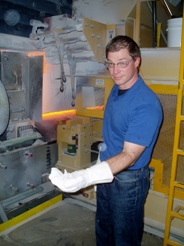
At his glassmaking plant in southwestern Washington, Steve Smith worries that a regional cap on carbon emissions will render his business unable to compete with suppliers outside the region. Photo by Tom Banse.
At his glass making plant in southwestern Washington, Steve Smith worries that a regional cap on carbon emissions will render his business unable to compete with suppliers outside the region. Photo by Tom Banse.

The governors of Oregon and Washington State served up the full climate enchilada to their legislatures this January only to see it picked apart.

That leaves California as the sole state in the Western Climate Initiative that has so far adopted cap-and-trade as the law of the land.  California’s partners have consistently told us that a national program is the preferable way to regulate greenhouse gases.  Now the “preferable” way is starting to look like the only way.

Fire and (Less) Ice: California’s Climate Future

firesign_blogThere was little “news” in this week’s report from California’s inter-agency Climate Action Team. The distillation of 37 academic studies mostly affirmed what we’ve been hearing from multiple sources lately; that “severe and costly impacts” likely lie ahead as the state’s climate changes.

The report’s findings are aligned with two of the scenarios modeled by the U.N.’s climate panel; the “B1” outlook for moderate emissions of CO2, and the higher-emissions “A2” scenario. While California has ambitious plans to curb carbon emissions, many recent reports agree that the world is presently on a path toward emissions even higher than the worst IPCC scenario.

Under that more severe tableau, says report co-author Dan Cayan of the Scripps Institution of Oceanography in San Diego, the number of wildfires in the state could double by 2085. Cayan said that “by every model,” the state is warming and in some areas, drying. One regional model sees precipitation in Southern California tailing off by 10% in years to come.

There’s more coverage of the report in Jane Kay’s article for the San Francisco Chronicle and Bettina Boxall’s story in the L.A. Times.

The Times article points to some relatively “good” news in the report; a UCLA study that the strength of fire-fanning Santa Ana winds may be subsiding. But there is also research out of Lawrence Berkeley National Laboratory that points to a longer Santa Ana season, so it’s unclear what the net effect might be in the long run.

In a media conference call attended by report authors and state officials, I asked about murmurings that the Western Climate Initiative may be unraveling. Eileen Tutt of Cal-EPA denied that the planned regional cap & trade program for cutting carbon emissions is in trouble. She said that in working with people from California’s six potential partner states, it’s her view that they “aren’t backing off at all.” She admitted that “rumors abound,” however.

Climate Watch has dispatched freelance correspondent Tom Banse to look further into those rumors. He’ll be reporting in from Washington and Oregon in the weeks to come.

A Billion People in the Dark?

Where will you be when the hour arrives? Wherever it is, you might want to take a flashlight–LED, of course. In it’s third year, the organizers of Earth Hour are shooting for one billion people to turn out the lights in this global demonstration in support of decarbonization.

It’s being promoted as a kind of switchplate referendum. Begun in Sydney, Australia, in 2007, it’s a simple concept, which may be part of its appeal: Wherever you are, at 8:30 local time tomorrow (Saturday) evening, turn off the lights for one hour.

Last year organizers estimated that 50 million people complied. California icons like the Golden Gate Bridge went dark. This year, about two dozen California cities and counties have signed up to participate, as well as the State of California.

They’re not telling you to turn off your computer or iPhone, however. Electrons we save at the light switch might be made up for on the Internet, which will likely be abuzz with a worldwide conversation documenting the event on blogs and social networks like Twitter (tag your updates with #earthour and #location). Photo sites will be bombarded with picture uploads.

Personally, I’ll be in the high desert of New Mexico, beyond the sight of any town or even neighbors, so the event won’t make for much of a snaphot.

It might also be a bit anticlimactic for the folks who run California’s power grid. I asked Gregg Fishman at the California ISO (Independent System Operator) if they’d be able to see a dip in the load at 8:30 p.m. tomorrow. He’s not counting on it: “It will probably have some impact but it’s really hard to measure,” he told me.

This time of year, the state is usually pulling about 27-28,000 megawatts at that hour on a Saturday evening. In fact, if you look at the ISO’s grid status graph, you can see a little spike around 8 p.m., as people normally start turning lights on. But Fishman says that even though “most of the load is lighting” at that hour, it may be hard, even for grid technicians, to measure the actual effect of Earth Hour.

But of course, that’s kind of beside the point. The event isn’t designed to achieve palpable energy savings for one hour. It’s supposed to be a visual show of support for policies designed to reduce energy consumption and the global carbon footprint. Recent surveys have shown that economic woes have pushed concerns about global warming and the environment to their predictable recessionary lows, at least in this country. Tomorrow night we’ll find out how the rest of the world feels about it.

Western Cap-and-Trade Plan Taking Heat

Proponents of the Western Climate Initiative’s (WCI) climate action plan encountered some vocal critics on Tuesday as nineteen U.S. Senators and House members from 10 states challenged western governors to rethink the plan’s approach to cutting carbon emissions.

In a letter to the governors, members of the Congressional Western Caucus, including three from California, expressed particular concern about capping carbon during the most severe economic slump in the post-war period.

WCI is a cooperative plan by 11 western U.S. states and Canadian provinces to create a regional cap-and-trade system for greenhouse gases.  Craig Miller reported on the plan in September for KQED’s The California Report.

The critics’ letter takes issue specifically with what it says are the WCI’s plans to rely on “renewable technologies and demand destruction” and to allow “for virtually no new baseload power plants deployed in the West through 2020 that are powered by natural gas, clean-coal-with-carbon-capture, renewable hydropower or nuclear energy”.  They say the region will lose billions of dollars in investments in green technology due to a plan that prevents new fossil-fuel power plants, even those with CO2 capture and sequestration technology.

At issue seems to be the WCI’s plan for the emissions caps, which are slated to be a “flat line” from either 2012 or 2015, depending on the source.  According to the WCI’s recommendations, the line would be set using “the best estimate of expected emissions for sources covered in the cap and trade program” in 2012.  Under this system, there would be very little room for increased emissions from any new power source covered by the program (i.e. electricity generation, combustion at industrial and commercial facilities,  and oil and gas processing).

The letter refers to a recent economic analysis commissioned by the Western Business Roundtable that found that the WCI would be expensive, cause job losses, and would not affect global climate.

California congressmen Dan Lungren, Elton Gallegly and George Radanovich were among the signers.