Tag Archives: Emissions

EPA Waiver Still Not “In the Can”

Now the waiting begins–or resumes. After nearly seven hours watching opposing sides duke it out in a Beltway hearing room this week, the EPA will settle down to deciding (again) if California should be allowed to set its own standards for auto emissions.

During the hearing, one group was using Twitter to pass around an online petition supporting the required EPA waiver. They weren’t too late. EPA will continue accepting public comment until April 6. EPA spokesman Cathy Milbourn says “We will review all of the comments, with a decision to follow.” No further timeline for that decision has been made public, however.

Meanwhile, the Detroit News is reporting today that California’s top air regulator may be ready to compromise on a new national standard that would obviate the need for a special waiver.

In case you need a quick review, the issue is whether the tailpipe emissions standards passed into law by California several years ago–the so-called Pavley regulations–can actually be enforced. The Pavley standards are more stringent than the current federal standard and the state is leaning heavily on them to attain its greenhouse gas targets under the Global Warming Solutions Act of 2006 (AB 32). But the waiver was denied under the Bush administration.

Thirteen other states are lined up to enact the California standard if they get a green light from EPA. The auto industry has long argued that this will create a “patchwork” of regulations across the nation, and the ensuing complications of compliance would place an onerous burden on the industry and push up prices for car buyers.

Supporters of the California standard, like Jim Kliesch of the Union of Concerned Scientists, say that automakers already have the technology and can easily comply. Kliesch conceded that consolidating the most efficient technology into one car would add–he figures–about $700 to the cost. But he says the same technology would recoup $1,800 in fuel savings over the life of the car.

Mark Cooper of the Consumer Federation of America pointed to an apparent disconnect in the car maket. He referred to a survey in which half the respondents said they wanted their next car to get at least 30 MPG–but Cooper said only 2% of models currently on the market deliver that.

And so, the argument goes, that if car makers would just follow the market toward cleaner, more fuel-efficient cars, it would actually help them recover from a financial abyss that threatens to topple them.

At the end of the day, the EPA has to make its decision based on three criteria, says David Doniger of the NRDC. To be valid, the California standard must be:

1. Equally strict or more stringent than the federal standard,

2. Needed to meet “compelling and extraordinary conditions,” and

3. Technologically and economically feasible.

Hmm. It seems like you could make a solid case for checking off numbers 1 and 2 but what’s “economically feasible” is a potential tripwire, especially with General Motors teetering on the brink of bankruptcy. Much of it will come down to whether the Obama administration buys into the “patchwork” argument. It’ll be at least another month before we know.

Can There Be This Much Climate News?

"Reports to the Contrary" by Chester Arnold

Some weeks it seems like KQED could fill up its entire “news hole” with climate-related stories (thank goodness we don’t). Last week was a prime example.

Monday: A keynote speaker at U.C. Berkeley’s annual Energy Symposium said that we need a “Fed” for energy policy. John Hofmeister, a former executive at Shell Oil and founder of Citizens for Affordable Energy, told the lunch crowd that the only way to overcome the current two-year “policy cycle” (the length of a congressional term) is with an autonomous policy group like the Federal Reserve Board, which can take a longer view.

Tuesday: PG&E announced a massive new solar power initiative (it was brought to my attention this week that no news story is complete these days without the word “massive”–at least when there’s no opportunity to use “deadly”). If approved by state regulators, the project will provide 500 megawatts of photovoltaic energy by 2015. Perhaps the most interesting aspect of the plan is that instead of, say, taking over huge tracts of the Mojave, the project will rely heavily on “solar infill;” making use of property already owned by the company, where they can conveniently access the grid.

Wednesday: Senator Barbara Boxer chaired a hearing of the Energy and Public Works Committee to update members on the latest climate science. They heard testimony from four experts, including Christopher Field of Stanford, who essentially said things are worse than you think. Ranking minority member James Inhofe of Oklahoma seized the moment to decry a $6.7 trillion “climate bailout,” a reference to upcoming federal climate legislation and costs associated with an aggressive plan to fight global warming. You can watch the entire two-and-a-half hour webcast for the gory details.

And of course also on Wednesday, the Coen Brothers rolled out their TV ad for The Reality Coalition, assailing the concept of “clean coal.”

Thursday: The California Air Resources Control Board rolled out new regulations to control some of the lesser known (but highly potent) greenhouse gases, including sulfur hexaflouride, used in the manufacture of computer chips. CARB says a pound of it has the same atmospheric warming potential as ten metric tons of CO2. The board also unveiled a new drought page on its website.

Friday: The Governor issued the latest in a series of drought declarations, this one proclaiming a state of emergency and called on cities to reduce their water use by 20%.

And this week wasn’t all that unusual.

Monday, another week begins with the winter’s third survey of the Sierra snowpack. While recent storms will no doubt have raised the water content from last month’s 61% of normal, it should be something of an anticlimax, especially given that the Governor didn’t wait for the numbers to make his drought declaration last week.

No Country for “Clean Coal?”

An activist group led by the Alliance for Climate Protection has crafted another national TV ad aimed at debunking “the clean coal myth,” this one directed by Hollywood legends Joel & Ethan Coen (directors of No Country for Old Men, in case you’re still puzzling over my obscure headline).

Produced by The Reality Coalition, the ad depicts a pitchman touting a fictional product called “Clean Coal” air freshener. He’s inter-cut with shots of a family spraying what looks like coal dust out of an aerosol can and coughing. The spot ends with the coalition’s stock text message: “In reality, there is no such thing as ‘clean coal.'” The best line in the mock ad, though, is when the pitchman explains that the product “harnesses the awesome power of the word ‘clean,'” the implication being that saying something is clean doesn’t make it so.

Former Vice President Al Gore has been on the stump for some time, carrying the same message; that clean-coal technology “doesn’t exist.” Reality Coalition spokesman Brian Hardwick goes farther than that. He claims that not only does it not exist but the industry isn’t doing much to make it reality. A separate analysis by the Center for American Progress pegged the research commitment by U.S. coal companies to carbon capture technology at about $3.5 billion “over several years,” compared to combined profits of $57 billion in just one year (2007).

The clean-coal debate is relevant to Californians. Mostly through imported power, coal provides more than 16% of the electricity we use. And as I mentioned in my radio segment for The California Report, China is counting on the U-S to develop technology to allow them to burn coal “cleanly.”

While clever, the ad does kind of miss the climate connection. It seems to be aimed at particulate pollution rather than the unseen emissions of carbon dioxide and other greenhouse gases blamed for global warming. Hardwick responded to that critique by saying that “Truly clean coal would have to mitigate all the (environmental) issues” involved in burning the fuel. Still, it’s a source of potential confusion for viewers unclear about the distinctions among greenhouse gases, ozone-depleting gases and local air quality issues.

The Cost of Ignoring Climate Change

sunheat_smMuch of the debate over addressing climate change hinges on the cost of proposed mitigation efforts.  Some say we can’t afford the extraordinary measures required to cut greenhouses gases, particularly in the current economic train wreck.  What gets less attention is the cost of doing nothing.
This has been a controversial idea since the Stern Review called attention to the issue in 2006. That report concluded that unless one percent of global GDP was diverted to mitigate the worst effects of climate change, the world could lose up to 5% of  global GDP each year and the total damage could claim as much as 20%.

A set of new reports out of the University of Oregon inserts fresh numbers into the debate. According to researchers, three western states are each likely to lose more than $3 billion a year in climate change-related costs by 2020, if nothing is done to reduce greenhouse gas emissions.  By 2080, the projected annual costs range from $9-to-$18 billion for each state.

The reports, which focus on Washington, Oregon, and New Mexico, assume a business-as-usual scenario where both carbon emissions and temperature continue to rise at rates similar to those seen in recent years. Under these conditions, these states (and California, according to the prevalent research) can expect more severe droughts and floods, less snowfall,  more wildfires and habitat loss, and a higher incidence of climate-associated health problems and deaths.

In New Mexico, the study’s authors expect summer temperatures to climb 12.6 degrees above current averages by 2080,  spiking air-conditioning costs, health-care complications, and the state’s death rate.  By 2020, annual climate-related health care costs in New Mexico alone are expected to top $1.3 billion.

California’s temperatures, under business-as-usual scenarios, are widely expected rise between six and ten degrees by the end of century.  Even in a relatively cool state like Washington, health care impacts would make up $421 million, or 32%, of total annual climate-related costs, under this pr0jection.

The study attributed the largest costs (more than $1 billion annually in each state) to inefficient consumption of energy, a projection that might not pan out, given the Obama Adminstration’s focus on green technology and clean energy efforts.

Other costs cited by the study include reduced salmon populations and food production, lost recreational opportunities (sell your snowboard now), and more intense and frequent wildfires and storms.

IPCC Scientist: A “Vicious Cycle” of Carbon Spikes

For a while now, we’ve been hearing that greenhouse gas emissions are still off the charts, which is to say increasing beyond the U.N.’s worst-case scenario for global warming. Now a Stanford researcher has laid out some specific scenarios–and they’re not pretty.

Chris Field, who is working on the next IPCC report, said “There is a real risk that human-caused climate change will accelerate the release of carbon dioxide from forest and tundra ecosystems, which have been storing a lot of carbon for thousands of years.”

Field, a professor of biology and of environmental Earth system science at Stanford, and a senior fellow at the Woods Institute for the Environment, issued a warning for members of the American Association for the Advancement of Science (AAAS) in Chicago today: “We don’t want to cross a critical threshold where this massive release of carbon starts to run on autopilot.”

And yet, that would appear to be path that we’re on. As Field told the AAAS symposium, “We now have data showing that from 2000 to 2007, greenhouse gas emissions increased far more rapidly than we expected, primarily because developing countries, like China and India, saw a huge upsurge in electric power generation, almost all of it based on coal.”

So what would some of the consequences be? “Tropical forests are essentially inflammable,” Field said. “You couldn’t get a fire to burn there if you tried. But if they dry out just a little bit, the result can be very large and destructive wildfires. It is increasingly clear that as you produce a warmer world, lots of forested areas that had been acting as carbon sinks could be converted to carbon sources. Essentially we could see a forest-carbon feedback that acts like a foot on the accelerator pedal for atmospheric CO2.”

The loss of functioning forests worldwide is already estimated to account for about 20% of carbon emissions. But field also warns of another carbon burst from decomposed plants that have been locked in permafrost for tens of thousands of years. As if all that weren’t plenty, Field says the accelerated forest destruction and melting permafrost could combine to create a “vicious cycle” of accelerated carbon emissions.

Field sums up by saying: “We now know that, without effective action, climate change is going to be larger and more difficult to deal with than we thought.”

The Chicago symposium is being held to address new developments since the last IPCC interim report, in 2007. A formal update is due out next year. Field is co-chair of the IPCC’s Working Group 2, which is assessing the impacts of climate change on social, economic and natural systems.

Cow Power Takes to the Highway

biogas1If the program for the World Ag Expo in Tulare had a centerfold, it might well be a gleaming red and silver tank truck, powered by pure Holstein hydrocarbons.

A Tulare County dairyman is using cow “emissions” to fuel two delivery trucks. Instead of a sleeper compartment, the cab of the truck holds six lightweight tanks for compressed bio-methane.

Western United Dairymen have produced a video about the project and its benefits to the environment. That’s an interesting twist because the dairy lobbying group and air quality regulators haven’t always seen eye to eye on the question of bovine gas.

Emissions from livestock have their own load of air quality issues, especially in Tulare County, where there are more cows than people. When cows burp or emit gas, it produces ozone, a key component of smog. Dairy owners have also wrangled with air regulators over emissions from some methane digesters that convert manure to electricity on dairies. For a refresher (poor word choice, perhaps), check out our recent radio/web series on methane.

But the California Air Resources Board stands behind the cow-power project (though perhaps not the manure spreaders–okay, old joke). In fact, CARB staked the dairy to a $600,000 grant, under legislation passed in June 2006 to encourage the introduction of alternative fuels into the California market. Hilarides Dairy and Cheese company used the money to help build a methane digester and figure out how to convert the diesel trucks.

How exactly does cow poop become something that can power a vehicle? It isn’t pretty, according to the group Sustainable Conservation, which put out a report on the subject. It goes something like this:

Manure is flushed from the cows’ stalls into a covered lagoon where bacteria convert the manure to biogas. The trapped gas is sent from the lagoon to a biogas upgrading system which removes impurities. Pressurized bio-methane is put into the truck’s fuel tank. The truck is then ready for the road.

The report estimates that cows could eventually power a million cars nationwide. But unless you live near a dairy farm or have your own personal cow to hook up to your fuel tank, don’t expect this will save you a trip to the gas station anytime soon.

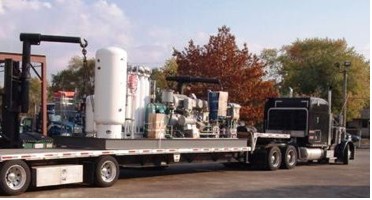
Photo courtesy of Hilarides Dairy: The biogas upgrading system arrives by truck from Michigan (but transported with conventional diesel).

Thin Climate Strategy in Bay Area Transit Plan

3273414070_fd61bfa09a_mThe new Draft Transportation 2035 Plan released Wednesday by the Bay Area’s Metropolitan Transportation Commission calls for $226 billion in spending over the next 25 years to “confront global warming and traffic congestion.”  But close up, the plans seems more like a sorely needed band-aid to patch up the region’s ailing transit infrastructure.  Fully 82% of the plan’s funding is designated for upgrading and maintaining the existing system, with 13% allotted for transit expansions.

The plan includes $400 million (0.2%) for a “Transportation Climate Action Campaign”  to raise public awareness about climate change and individual actions that residents can take to reduce the region’s carbon footprint. The campaign will also include a grants program to subsidize demonstration projects  for reducing auto emissions with alternative fuels or car-sharing projects.  An additional $1 billion is set aside for bicycle facilities and programs.

But when, by the MTC’s own numbers, 40% of the Bay Area’s emissions come from the transportation sector, $1.4 billion to fight greenhouse gas emissions seems paltry given that this is the plan to carry us through to 2035. By law, California’s greenhouse gas emissions need to be reduced approximately 30% by 2020.

MTC Executive Director Steve Heminger said the plan “tees up two strategies that we have consistently indentified as the most important in making progress in reducing environmental emissions like CO2, in reducing vehicle miles of travel, and those are road pricing, and a better link to land use without transportation investment.”

The idea is that reducing traffic congestion by increasing the cost of driving, be it with higher bridge tolls or charging drivers to use HOV lanes,  greenhouse gas emissions will decrease.  And by upgrading aspects of the region’s transit system, more people will choose to forgo the car and opt for public transit.

“From an infrastructure perspective, I think this plan is about as climate positive as it could be,” said Heminger.

Use the audio players to hear Heminger explain how the plan attacks climate change:


Leveraging Disaster: Australia’s Fires and Climate Policy

Environmentalists in Australia are seizing on the recent catastrophic fires there to press for more aggressive action on climate change.

Reuters news service reports that the drought-driven fires, which killed at least 130 people in the nation’s Victoria province, have become a fulcrum in arguments to intensify Australia’s relatively modest targets for reducing greenhouse gas emissions.

Here in California, we can only hope that the Australia fires aren’t a preview of the summer ahead. Last year’s fire season set records, with more than 2,000 fires burning at one point. This year, conditions will likely be even drier.

GHG Targets: Compared to What?

cooling-tower-small.jpgSetting targets for greenhouse gas reductions has turned into a house of mirrors. It’s hard to know what anyone means when they talk about an “80% reduction” in emissions. Reader Steve Bloom raised this point in response to my January 15 post. It’s an important one.

Most of California’s targets are based on 1990 levels (also 80% by 2050). On the other hand, The USCAP plan announced last month by a national coalition of business & environmental groups, also aims for an 80% reduction by 2050–but from 2005 levels. That 15 years between 1990 and 2005 is hardly trivial. Much of the explosive development in China and India occurred during this time, as U.S. emissions were also rising.

The number that will matter the most is the one that comes out in the federal legislation, which is still being drafted. In his video address to the Governor’s Climate Summit in November, President (then-elect) Obama appeared to be using California’s aggressive goal as a benchmark when he promised to “set us on a course to reduce emissions to their 1990 levels by 2020, and reduce them an additional 80% by 2050.”

We’re hearing more voices saying that California’s 2020 target (about 15% from today’s level) is unobtainable, Stanford researcher Steve Schneider being a recent example (see Gretchen Weber’s post from 1/30). As a practical matter, this would mean cutting California’s per capita carbon footprint from 14 tons per year, down to about ten.

Lately more people seem to be looking toward the 2050 target of an 80% reduction. But for national policy, the question is still sort of hanging out there: 80% of what? It’s one that will have to be answered soon, as congressional leaders press to have a climate bill ready by Memorial Day.

Photo by Reed Galin

Methane Epilogue: Power from Cows and Castoffs

dig_3944-web.jpgWe have updates from some of the places we visited in our methane series, heard on The California Report. For Part 1 of the series, click here. For Part 2 of the series, click here.

At Fiscalini Farms near Modesto, John Fiscalini says he finally worked out a deal with air regulators that allows him to convert his manure into methane for electric power. His permit from the San Joaquin Valley Air Pollution Control District allows him to run the engine while he makes adjustments to minimize particulate and nitrous oxide pollutants.

He hopes to be making power by the middle of this month–more than 13 months behind schedule. Capturing the methane, of course, will make a significant dent in the carbon footprint of the farm, which has 3,000 cows (1,500 producing and 1,500 “replacements”).

He also has a grant from the U.S. Dept. of Energy, under which university researchers will install equipment to monitor the methane operation. Fiscalini says they’ll “monitor everything we can possibly monitor” and gather data to make better judgments about the efficiency and economic feasibility of methane digesters. He’s having some doubts about the economic feasibility of his own. Now, he says, water quality regulators want him to do $40,000 worth of environmental assessments, including a hydro-geologic survey and a study of his waste stream (he uses leftovers from the methane digester for fertilizer).

You may recall that we started Part One at an unidentified landfill, to explain how methane is produced and captured, and why flaring it off is better than letting the methane escape into the atmosphere. I later heard from Jessica Jones, district manager for Waste Management, which runs the Redwood Landfill and Recycling Center in Marin County, the location where I did the recording. While the landfill currently flares off its collected methane, Jones wanted us to know about some of the company’s efforts to harness that gas–potentially enough to power 4,000-5,000 homes. In an email to KQED, she wrote:

“Redwood Landfill is currently working to permit a landfill gas to energy facility which will become Marin County’s largest source of green power.  Altamont Landfill in Alameda County currently has landfill gas to energy production through the use of internal combustion engines and turbines, and is beginning construction of a liquefied natural gas facility which will convert landfill gas into a clean burning fuel which can be used to power Waste Management’s refuse collection fleet.  This type of fuel is estimated to be potentially the closest to carbon neutral of any fuel being developed today.”

There’s more about Redwood’s landfill-gas-to-energy (LFGTE) project at the company’s website. In echoes from our conversations with John Fiscalini, Jones writes on the site that there are “regulatory hurdles” to be cleared before this can happen. Sound familiar?

Photo: Stinky silage; Methane digester tanks will soon power the Fiscalini dairy farm.