Tag Archives: Ecosystems

Nature Always Bats Last

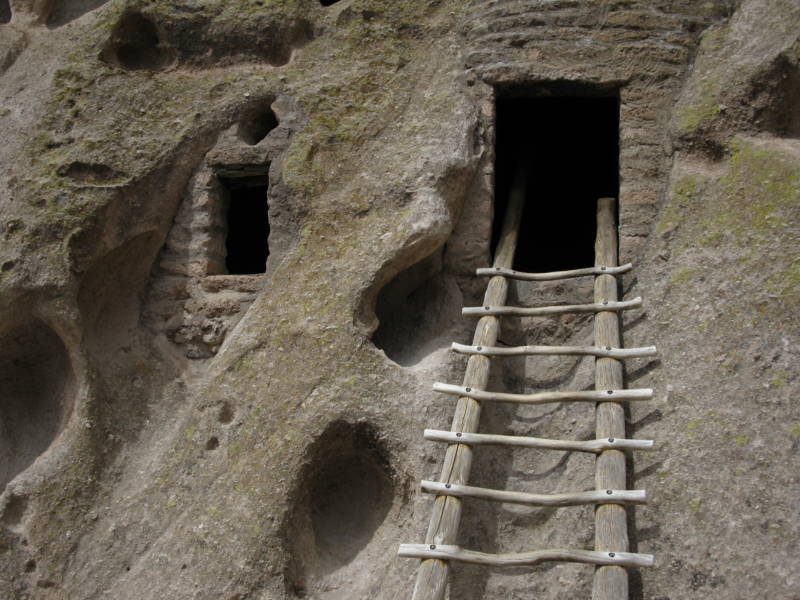
Cliff dwellings at Bandelier National Monument, New Mexico Photo: Craig Miller

Mike Newland is an archeologist at Sonoma State University’s Anthropological Studies Center. A version of this essay was originally broadcast as part of KQED’s Perspectives series.

Nature Always Bats Last

By Mike Newland

I’ve been pondering a 3,000 year old mystery that makes me uneasy about our current plight. Starting around 2,000 B.C., people in the Great Basin and Mojave Desert really got into big-game hunting.  We see this in the archaeological record—all of this big-horn sheep and antelope bone shows up in larger quantities.  Up in the mountains, great panels of rock art are chock full of hunters chasing sheep, and evidence of their hunting camps is tucked in shelters and around springs.

Big-game hunting isn’t that efficient.  You’re better off going for a wide range of edibles close by.  You get more food for less work.  This is an important point, because after 3,000 years of this big game hunting, this culture died out, and was replaced by folks that hunted and collected a broader range of food.

Bill Hildebrandt and Kelly McGuire, two archaeologists from Far Western Anthropological Research Group in Davis, have made a compelling argument about why people were so obsessed with hunting—they did it for status.

Good hunters were revered for their abilities to provide food and hunting trips could serve political and social functions.  But big game hunting was eventually done at the expense of the rest of the population: archaeologists still discuss whether the bow and arrow, probably introduced to California by groups coming out of Oregon, was such an effective hunting tool that the hunters wiped-out most of the big game, or whether the devastating effects of the Medieval Climatic Anomaly, which caused major droughts throughout the Great Basin and desert areas, pushed these people over the edge.  But it is clear that serious changes took place, and big game hunting became unsustainable.  By the time the next group of folks came along, the big-game hunters were on the verge of collapse.

This is one of the reasons why archaeology is important—we can look at past cultures and see how we, as a species, have dealt with big problems.

This research makes me uneasy because archaeology has shown repeatedly that cultures not in balance with nature die out.  For millennia, people have sat around campfires debating whether to make the changes necessary to adapt to a shifting climate or depleted resource base, and invariably they said no. As a result, the graveyards of history are full of the corpses of cultures that failed to change when they needed to.

Now it’s our turn. History shows that nature won’t hesitate to take us out.  We’re lucky in that we have probably one of the most adaptive cultures in history: we’ve made major changes—abolition of slavery, passing of environmental legislation, the Equal Rights Amendment—when we thought it was in our collective best interest. Even still, these landmark changes required decades of hard work and dedication to educate the broader population.  We have our work cut out for us.  We can either rise to the occasion, and make the investments necessary to stem climate change, or we can take our place with the rest of the dead in the graveyard.
Climate and Development Affecting CA’s Butterflies

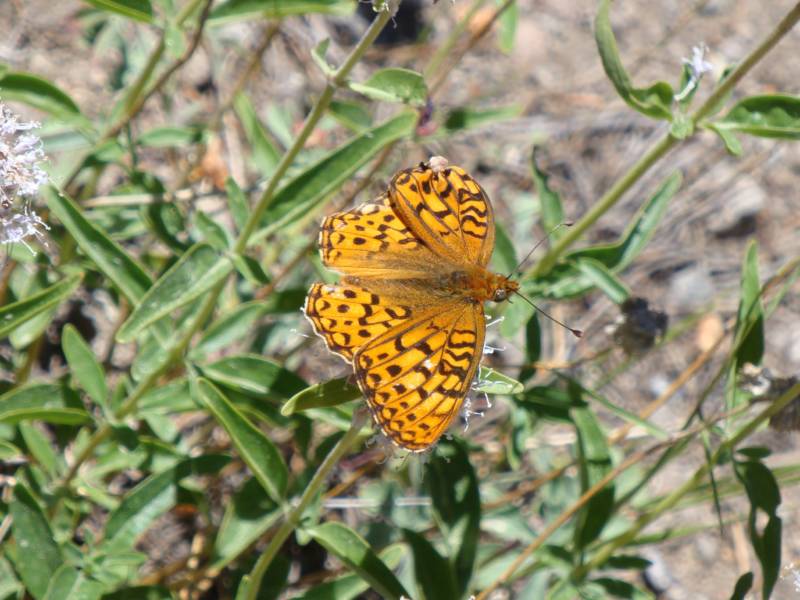
Atlantis Fritillary butterfly at Sierraville, CA Photo: Jennifer Wolf

California’s butterfly populations are suffering from the combination of a warming climate and increased land development, according to a new analysis from scientists at UC Davis.

The study, scheduled to be published online this week in the journal Proceedings of the National Academy of Sciences, draws from butterfly expert Arthur Shapiro’s database of more than three decades of observations of 159 species from 10 sites in the Sierra Nevada at varying elevations, from sea level to tree line.

The data shows that over the last three decades butterfly species diversity declined at half of the sites, with the most severe reductions occurring at the lowest elevations, where habitat destruction is greatest.  The sites in the middle range showed evidence of habitats shifting upslope, as lower elevation butterflies began appearing at higher elevations.  The only site studied where butterfly biodiversity and abundance has increased is at the highest elevation site, at 2,400-2,775 meters.

“These patterns are quite consistent with other studies on a variety of organisms,” said Shapiro.  “The trend is for organisms to seek the climate to which they are adapted. So if it’s getting warmer, that means you go north, or you go up.”

While the population shifts appear consistent with warming temperatures (Both average maximum temperatures and average daily minimum temperatures increased across the majority of the sites), the study finds that warming alone is not enough to account for the loss of biodiversity at low and middle elevations.  Researchers analyzed county land use data at the sites, and found that it correlates with the butterfly population data.  The authors propose that habitat destruction due to urban and suburban development is most likely the leading cause of butterfly population deterioration at the lower elevation sites.

Citing pressures from human development as the main cause for species loss, the United Nations declared 2010 to be the International Year of Biodiversity.  At the Johannesburg summit of 2002,  governments agreed to achieve “significant reduction” in the rate of biological diversity loss by 2010, but according to the BBC, conservation organizations are acknowledging that this target is not going to be met, and that, in fact, the problem may be worsening.

Western Lakes Warming Up Rapidly

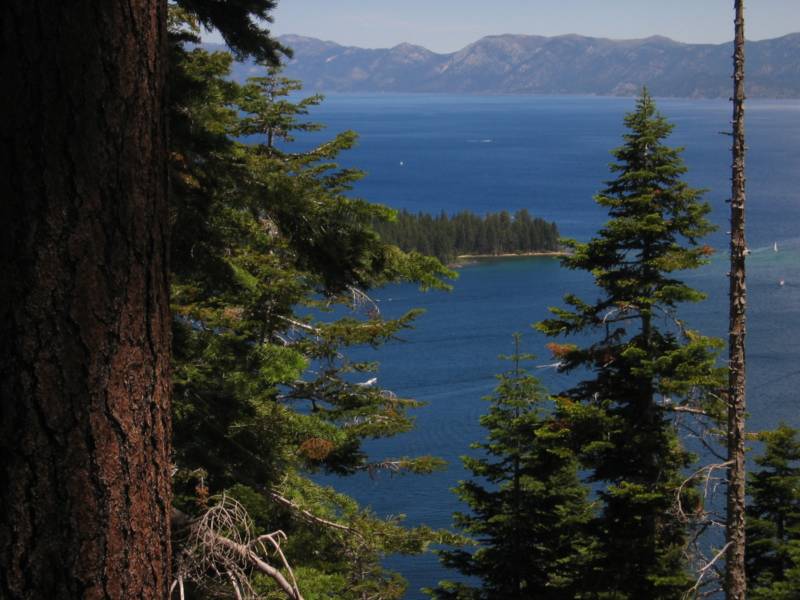
Photo: Craig Miller

Some lakes in Northern California and Nevada are warming twice as fast as the surrounding air temperature, raising concerns that climate change may be affecting aquatic ecosystems more rapidly than terrestrial ones, according to a recently published study.

Researchers from the Tahoe Environmental Research Center, UC Davis and NASA’s Jet Propulsion Laboratory in Pasadena, studied Lake Tahoe, Lake Almanor, Clear Lake, and Mono Lake in California, and Nevada’s Pyramid and Walker Lakes, by analyzing 18 years of temperature data from satellite sensors.

Long-established instrument buoys provided a flow of temperature data for Tahoe, dating back to 1968, which allowed the team to calibrate satellite readings, raising confidence in data gathered from the other lakes. Previous studies have documented the warming of Lake Tahoe but John Reuter, associate director of the Tahoe Environmental Research Center (TERC), says the new study takes that information one step further.

“This study really shows that this phenomenon is happening on a much larger scale than just Lake Tahoe,” said Reuter.

All of the lakes studied showed a strong warming trend among summer nighttime temperatures between 1992 and 2008.  The two lakes that warmed the most during that time, Almanor and Mono, warmed 4.3 degrees (F).  During that time Lake Tahoe’s surface waters warmed 3.7 degrees, averaging .23 degrees annually.  In contrast, Tahoe City’s air temperature increased just .1 degree each year.

TERC director Geoffrey Schladow, who co-authored the study, said there is no doubt in his mind that rising lake temperatures are related to climate change, and he expects that it’s happening across the world, not just in Northern California and Nevada.

“The significance of this study is that across the western United States these very different lakes are displaying signs of warming.  It’s not just a Tahoe issue, it’s a regional issue.  And in all likelihood, it’s a global issue,”said Schladow.

Over the next six months, researchers will be using the remote sensors to extend the study to 50 lakes across the world to evaluate whether or not large lakes everywhere are warming at similar rates.

Warmer temperatures can affect water circulation, which influences the amount of oxygen and nutrients available throughout the lake.  A 2008 study from TERC predicts that warming due to climate change could dramatically affect the amount of mixing in Lake Tahoe, which would deplete the bottom water of oxygen and drastically disrupt the food web.

“Temperature is one of the conditions that dictates who lives in the lakes,” said Schladow. “Warmer temperatures may make the lakes more hospitable to invasive species and put native species under stress.  I’m not saying this is happening yet, but it could.”

In his article about the study, Matt Weiser of the Sacramento Bee has some examples of how warmer temperatures can affect lake ecosystems. And KQED news editor Dan Brekke has assembled an interactive map (below), showing the locations and some temperature data for lakes in the study.


View California’s Warming Lakes in a larger map

NASA’s Carbon Trackers Yield New Maps

Almost lost amid the Copenhagen media clutter was last week’s meeting of the American Geophysical Union in San Francisco. So this week we’re playing a little catch-up. Climate Watch contributor Molly Samuel has the last of three posts on some things that caught our attention at AGU.

The UN’s Collaborative Programme on Reducing Emissions from Deforestation and Forest Degradation in Developing Countries, or REDD, was a big topic the past two weeks at the climate conference in Copenhagen. Wealthy countries, including the United States, have put billions of dollars on the table to help developing countries use sustainable forestry practices.

Back here on the California climate beat, there’s forestry-related news, too. Scientists at the NASA Ames Research Center in Mountain View (see map, below) have been working with the California Energy Commission and the Air Resources Board to measure California’s greenhouse gas emissions for the state’s mandated greenhouse gas inventory under AB-32 (the Global Warming Solutions Act of 2006).

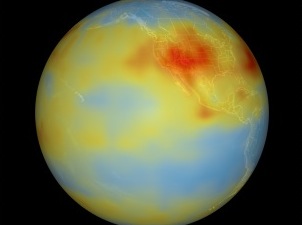
Carbon mapping by satellite. Image: NASA
Carbon-mapping California by satellite. Image: NASA

At the American Geophysical Union conference in San Francisco, NASA’s Christopher Potter shared information he’s gathered using MODIS, an imaging instrument that’s hitching a ride on NASA’s Terra satellite. Potter’s data shows that California’s ecosystems–forests, grasslands, croplands, wetlands, etc.–emit about the same amount of carbon that they absorb each year. And in wet years, they absorb considerably more. In an email Potter says, “the natural ecosystem sources can decrease or increase the net emissions of CO2 in the state by about 15%, depending on whether it is a normal precipitation year or a below-normal precipitation year, respectively.”

MODIS isn’t NASA’s only tool aimed at California as it circles the earth. AIRS, or Atmospheric Infrared Sounder, collects data from the troposphere (the layer of the atmosphere closest to the earth). NASA designed it to improve weather forecasting—the troposphere is where our weather happens–but it’s turned out to be an effective instrument for measuring carbons as they bubble up from the earth and circulate in the atmosphere.

Having collected seven years of data on carbon dioxide, carbon monoxide, and methane, scientists (and now you) can actually see where the carbons are coming from and where they go. NASA has posted animations showing the methane emitted by wildfires in California, and maps of carbon dioxide concentrations around the world.

Polar Bears and Sea Ice: Sorting it Out

87514496A recent post I wrote to highlight a radio discussion of the current plight of polar bears, drew a challenge from Russell Steele, one of our regular readers. Steele questioned some of the scientific conclusions underlying dire predictions for the bears.

To help sort some of this out, I asked for responses from two highly regarded scientists in the field. Here’s a response to the specific reader challenge from Mark Serreze, Director of the National Snow & Ice Data Center, in Boulder, CO:

It is unclear what Mr. Steele is trying to get at with reference to the seasonal cycles in sea ice extent from the AMSR-E data. The AMSR-E data, while valuable, only go back to 2002. Through combining SSM/I and SMMR satellite data with other information sources for earlier years, we have a decent record of Arctic sea ice extent going back to the early 1950s. The relevant issue is the long-term decline in end-of-summer (September) ice extent evident in this record, with the extreme September minima of recent years (represented in the short AMSR-E record) serving as exclamation points. The observed rate of September ice loss exceeds expectations from nearly all climate models.

I also turned to Waleed Abdalati. Now director of the Earth Sciences Observation Center at the University of Colorado, Abdalati is a veteran of the Cryospheric Sciences and Terrestrial Hydrology programs at NASA, and one of the most articulate people I’ve heard speak on the subject of polar ice. He offers the following:

I am not an expert on polar bears, but I do think it is safe to say that
 their primary habitat, the Arctic sea ice, is severely threatened.  I, and 
most of my colleagues believe we are well on our way to an ice-free Arctic
 in summer any time between this decade and the next 40 years.

This
 is because of two things:  1) it will be decades before the ocean has 
finished its response to present-day greenhouse forcing, so the impacts of 
what we’ve done already have not been fully realized; and 2) the loss of
 sea ice is self-compounding: when it starts to shrink, exposing a 
darker more (heat) absorbing ocean underneath, the likelihood of its continued
 shrinking is greater (ice melts, exposes darker ocean, absorbs more heat, 
melts more ice, exposes darker ocean, and so-on).

Of course the flipside
 of this is that as ice starts to grow, it is more inclined to grow, but
 against the backdrop of the increased warming, the former is far more likely 
than the latter. Finally, as thick multi-year ice disappears, it is
 replaced with thinner and younger ice that is more vulnerable to surface 
melt from the atmosphere, bottom melting from sea water, and being carried
 away to lower, warmer latitudes by ocean current and wind.

So back to the polar bears: If their habitat disappears and they are unable 
to hunt seals, their main source of food, they seem to stand little or no
 chance of survival. I am not a wildlife biologist but its hard for me to 
believe they as a population can sustain themselves on land and with only a
 seasonally-present ice cover. In some cases, the fact that they face more
 challenges on sea ice than in the past, has driven them to forage inland,
 creating the illusion in some people’s minds that their populations are 
increasing, because there are more sightings on land. Who knows? Maybe 
they’ll evolve to hibernate in late summer, when there is no ice, and hunt
 the rest of the year.

There is an added effect that doesn’t get much attention.  There was a 
fascinating study by a Canadian Biologist (Ian Stirling) and a sea ice
 expert (Claire Parkinson) [Stirling, I., and C.L. Parkinson. 2006. Possible 
Effects of Climate Warming on Selected Populations of Polar Bears (Ursus
maritimus) in the Canadian Arctic. Arctic 59(3): 261-275.], which suggested 
that the bears are also losing weight, and approaching the weights at which 
they have historically not been able to bear cubs.  So not only is the
population threatened by starvation, the ability to replenish the population
 seems diminished.

I don’t believe we can say anything with absolute certainty,
 so I, myself would not make the statement that the polar bears are doomed–but I will say that the outlook for them, in my view, looks very, very bad.

Author: Polar Bears Doomed No Matter What We Do

US Fish & Wildlife Service
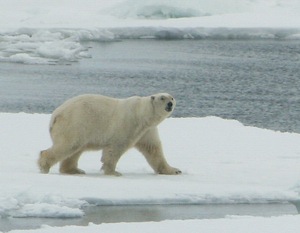
Photo: US Fish & Wildlife Service

Because our charter at Climate Watch is to examine climate change from the California perspective, you don’t see a lot here about melting ice caps and imperiled polar bears. But Michael Krasny’s interview with Richard Ellis on KQED’s Forum program is well worth an hour of your time.

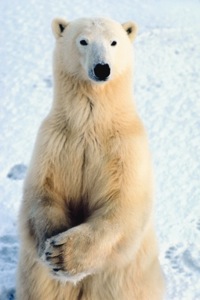
Ellis is the author of On Thin Ice: The Changing World of the Polar Bear (Random House, 2009) and it’s fair to say that he managed to stun Krasny with a declaration that the species is “doomed,” no matter what we might try to do to save it at this point. Ellis says there is already too much warming in the pipeline (what scientists call “committed” warming) to reverse the disintegration of the bears’ arctic habitat.

Polar bear populations have been a topic of persistent confusion, recently amplified in an op-ed piece written by former Alaska governor Sarah Palin for The Washington Post.

According to the advocacy group Polar Bears International, there is little room for doubt about the animal’s decline. The organization’s website breaks down the numbers, which point to a “scientifically documented decline in the best-studied population, Western Hudson Bay, and predictions of decline in the second best-studied population, the Southern Beaufort Sea.”

The PBI analysis goes on to explain that:

The Western Hudson Bay population has dropped by 22% since 1987. The Southern Beaufort Sea bears are showing the same signs of stress the Western Hudson Bay bears did before they crashed, including smaller adults and fewer yearling bears.

At the most recent meeting of the IUCN Polar Bear Specialist Group (Copenhagen, 2009), scientists reported that of the 19 sub-populations of polar bears, eight are declining, three are stable, one is increasing, and seven have insufficient data on which to base a decision. (The number of declining populations has increased from five at the group’s 2005 meeting.)

Regardless of whether you share the conclusions of Ellis and PBI about the future of the “poster child for global warming,” the Forum interview is a fascinating hour.

Marketplace Parses Climate Questions

The public radio program Marketplace continues its ambitious series on climate change, later this month. New reports will air November 16-20 as part of “The Climate Race”, a multidimensional look at “how global warming is already affecting us and the tough choices we have to make.” While the geographic scope of the series ranges well beyond California’s borders, it underscores that much of the nation grapples with the same issues that confront us here in the West. The first four reports, aired last week, are worth catching up with online.

Part 1: “Climate Change in Our Own Backyards” is a snapshot of how climate change is already affecting residents of Helena, MT.  Fewer cold snaps have allowed the mountain pine beetle to run rampant, devastating the area’s surrounding pine forests, and leaving a tinderbox of dead trees for miles across the landscape.  Reporters Sam Eaton and Sarah Gardner talk to residents about how this reality has changed the way people think about climate change and what challenges lie ahead.

Part 2: “The Planet Will Survive, But Will We?” explores episodes of severe climate change in the Earth’s distant past, and explains what ancient tree stumps can tell us about climate past, present, and future

Part 3: Is There Energy to Slow Climate Change?” focuses on energy and the political, social, technological, and economic challenges we face as we consider moving from fossil fuels to renewable energy supplies.  This report zeroes in on West Virgina and the debate between the coal industry and wind power advocates.  In Part 4;  “How Do We Live With a Warmer Planet?”, Eaton and Gardener look at what lies ahead for business, agriculture, and society, as temperatures continue to rise.

Photographs and audio slide shows related to the radio stories are available on the series web page:  “Futuristic Farming” offers a look at a farm that takes water efficiency to new heights, and “Climate Past” features stunning shots of Mono Lake and an interview with paleoclimatologist and geomorphologist, Scott Stein. The “Climate Race” page also includes links to resources, an interactive map of the United States with statistics about how climate change is affecting regions and what changes are expected by the end of the century, and audio clips from experts on topics such as how climate change is expected to affect health and agriculture.

Climate Watch will be sharing resources with Markeplace to cover the U.N. climate talks in Copenhagen, next month. KQED’s L.A. Bureau Chief Rob Schmitz will team up with Eaton for coverage of the two-week conference. Schmitz, who recently reported a series of Climate Watch stories from Japan, speaks Chinese and has extensive experience in international reporting.

An Hour with Stewart Brand

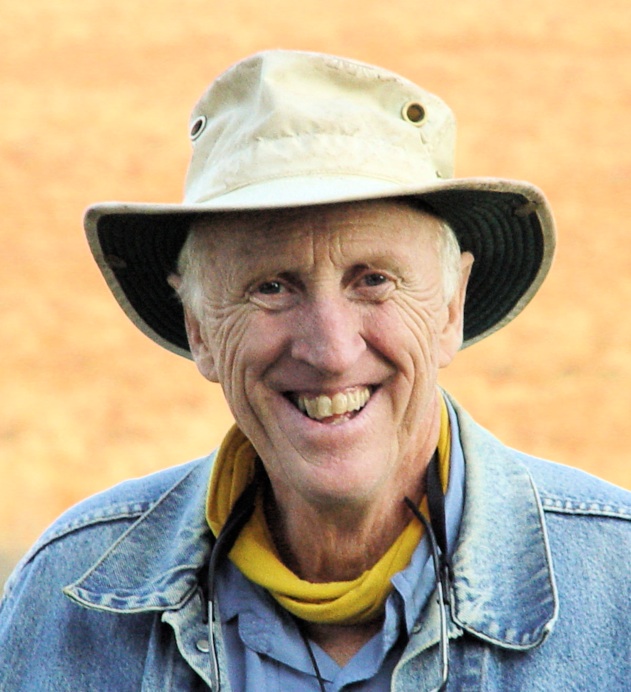
Photo by Ryan Phelan

Climate Watch sat down with ecologist and futurist Stewart Brand to talk about the rethinking of “traditional green pieties” that he says environmentalists will have to confront, in order to address climate change. In his new book, Whole Earth Discipline, he argues for a major change in the way “greens” have traditionally thought about stewarding the planet — one that calls for managing the earth’s natural infrastructure “with as light a touch as possible and with as much intervention as necessary.”

What do you think the world is facing in terms of climate change?

“I pretty much buy James Lovelock‘s approach that we’re warming toward an equilibrium of maybe five degrees warmer than now, which doesn’t sound like much, but the last time we were that was 55 million years ago and crocodiles were swimming around in the polar oceans. [Lovelock] thinks the carrying capacity for humans in a world that’s five degrees warmer would be about a billion to a billion-and-a-half people. And it could happen fairly quickly because there are various positive feedbacks that are self-reinforcing, amplification of change going on. A four-or-five-billion person die-back is horrible to contemplate. Nothing like it has ever happened in human history, and it does get your attention.

“I am persuaded by a number of data points he looks at and climatologists he listens to and the system dynamics of climate, which is tremendously non-linear. It has lots of these positive feedbacks in it and various thresholds. Sometimes we know where the threshold is, and sometimes we find out after we’ve passed it. Abrupt climate change, it turns out, is pretty common in the historical record and that’s what we could be looking at this century, maybe even in the first half of this century.”

You write in your book: “Accustomed to saving natural systems from civilization, Greens now have the unfamiliar task of saving civilization from a natural system: climate change.” Can you talk more about this?

“I wonder if there will be people turning up soon saying, “Let the climate do what it wants. Gaia’s just having her usual carryings-on and we must not stand in her way.” [Ed. Note: There are people already saying this] I think when it cuts this close to home, environmentalists do realize that when humans are an endangered species we’ve got to rise to the occasion and be green to protect this species and its habitat as well.

“There’s a shift that goes on because the standard, deep, ideological, emotional stance of environmentalists is that nature is always right and humans are always wrong, and this is a case when actually, nature is up to something we really, really don’t like and we have to do, as humans, something that’s right to head that off. That’s a switch. And it’s my point of leverage in the book which is to say, okay, bear that switch in mind, now think through all the things you’ve had opinions about for 20 or 30 years and revisit them.

“The climate crunch gives us permission, indeed encouragement, to rethink nuclear power, to rethink genetically-engineered food crops, to rethink how we feel about cities, and to start thinking in a serious way and an encouraging way about geo-engineering, which is direct intervention in the climate.”

The idea of “playing God” with nature can raise a lot of emotion and controversy…

“The thing is, we’ve been having god-like power in nature for a very long time, probably at least 10,000 years, maybe 55,000 years when we started doing massive burning to change the landscape in a way that we liked. In ecology, the current term is “niche construction” or “ecological engineering.” We don’t have a choice not to do it because it’s what we are doing. One of the terms for our era geologically is the ‘Anthropocene;’ the human-dominated era of geology. And so we’re already terraforming the Earth, and we’re doing it badly. So, is the choice to stop terraforming the Earth? No. Actually that’s no longer an option. The only choice is to stop doing it badly and start doing it well.”

It’s a large laboratory that we’re talking about in terms of learning from our mistakes, because we’ll be conducting our experiments (geo-engineering, bio-engineering, etc) in the world.

“We’re running an experiment in the world anyway by raising the greenhouse gas percentage in the atmosphere, and we’re starting to get results from that experiment, and we don’t like them, so we’re already doing interventionist science outside the lab in the laboratory of the world. If we don’t like what’s happening so far, we have no choice but to do better experimentation and better science and start getting the results that are better.”

How do you respond to Amory Lovins’ recent article on Grist, criticizing your position on nuclear power?

“I think it’s great that Amory Lovins, who is an old friend, has put up a rebuttal to my chapter on nuclear in the book. I think that’s absolutely fair and right since my whole chapter is basically a rebuttal of his anti-nuclear arguments.* I respect him enormously for most of the things I think he’s right about. I think he’s wrong about nuclear. He thinks I’m right about most things, and that I’m wrong about nuclear, so that’s the debate.”

*Last week we posted highlights from a conversation with Amory Lovins, aired originally on KQED’s Forum program. Brand’s name was not evoked in those excerpts but Lovins was critical of the idea of a nuclear power revival, dismissing it as financially unsupportable.

A Sea Change in Ocean Policy Promised

Reed Galin
Photo: Reed Galin

A phalanx of high-level federal officials marched into San Francisco today to announce a major shift in the way the federal government oversees the oceans.

The top-level administrators from the White House and several agencies held a public meeting to launch efforts toward a first-ever National Ocean Policy, in which they say restoring a healthy ecosystem will be a top priority.

The newly formed Interagency Ocean Policy Task Force is led by Nancy Sutley, chair of the White House Council on Environmental Quality and one of President Obama’s top advisors on the environment. She arrived surrounded by representatives from the National Oceanic and Atmospheric Administration (NOAA), EPA, Navy, Coast Guard and Dept. of Interior (which, odd as it sounds, is responsible for vast tracts on the outer continental shelf).

Asked why we’re just getting around to a unified national ocean policy, Sutley said that “Too often the federal government sits in its stovepipes,” with each agency taking a narrow view. This effort is an attempt to break through traditional parochialism in favor of a more holistic approach to the challenges.

Task force member Jane Lubchenco, who heads NOAA, said that for the first time, policy makers are saying loudly that “healthy oceans matter.” And right now, she says, they’re not real healthy.

“At a global scale, I would say that oceans are in critical condition,” said Lubchenco. ” Most people are unaware of how much disruption and depletion has occurred within the oceans. We’re seeing the symptoms of much of that. It’s time to get on with the solutions.”

The task force will address a growing array of concerns, from shrinking fisheries to higher acid levels in the ocean—many of which are likely related to climate change.

Lubchenco, who is also an Undersecretary of Commerce, told me that “Climate change is exacerbating many of the existing challenges for ocean uses. There’s very good evidence that climate change is already having very significant impacts on oceans.” Lubchenco also cited “the related problem of ocean acidification,” and reeled off a laundry list of  climate impacts, including “loss of biological diversity, increasing transport of invasive species, nutrient pollution, habitat loss, and over-fishing.”

Lubchenco added “That sum total of stresses on ocean ecosystems means that we need to be taking new approaches.” The most sweeping of those “new approaches” will be “ecosystem-based management,” a term used repeatedly in the Interim Report issued by the task force this month.

According to the report:

“The implementation of ecosystem-based management embodies a fundamental shift in how the United States manages these resources, and provides a foundation for how the remaining objectives would be implemented…It would provide the opportunity to ensure proactive and holistic approaches to balance the use and conservation of these valuable resources. This broad-based application of ecosystem-based management would provide a framework for the management of our resources, and allow for such benefits as helping to restore fish populations, control invasive species, support healthy coastal communities and ecosystems, restore sensitive species and habitats, protect human health, and rationally allow for emerging uses of the ocean, including new energy production.”

The task force will also be taking its own stab at some long-term solutions for the troubled Sacramento River Delta. The interim report is open for public comment until October 10.

Major Shifts in California Bird Movements

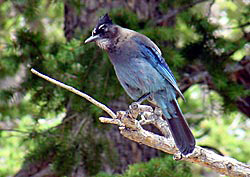
Stellar's Jay,  Photo: National Park Service
Stellar's Jay. Photo: National Park Service

Climate change has California’s birds on the move, but not in the usual direction or at the same pace, a new study has found.  Research suggests that warming temperatures and changing precipitation patterns will cause bird species distributions to shift independently, resulting in new bird “communities” appearing in up to half the state.

In some cases, these new communities will create combinations of birds that have never existed before, a situation that could disrupt the delicate balance of species interactions with potentially unanticipated consequences for whole ecosystems, the report authors concluded.

One of the co-authors, Stanford biologist Terry Root, told Climate Watch: “This will not be just a few species in a few locations–this tearing apart of communities could be quite extensive across California.”

Root was among  researchers from Stanford’s Woods Institute for the Environment, PRBO Conservation Science, the University of California-Santa Cruz, and the Klamath Bird Observatory, who collaborated on the study.  They used bird survey data and climate model projections for California to map current and future bird distributions for 70 species.  Many species often found together, such as acorn woodpeckers and western bluebirds, are projected to shift and adapt in different ways, resulting in these new assemblages.

PBRO has posted interactive maps of the future projections for individual species distributions on its Climate Change, Birds, and Conservation website, in the section called “Where will the birds be?“.

The study authors, including Terry Root of Stanford and Diana Stralberg and John Wiens of PRBO, write that the emergence of new bird communities in the coming decades present enormous conservation and management challenges.  They assert that rapidly changing habitats and ecological communities are going to require new approaches to conservation and management. “As new combinations of species interact, some species will face new competition and/or predation pressures, while others may be released from previous biotic interactions,” they wrote. “Managers and conservationists will be faced with difficult choices about how, where, and on which species to prioritize their efforts and investments.”

Root pointed to experience with wolves, coyotes and foxes, in which wildlife managers tried to control one,  only to see unexpected spikes in the population of another: “Here is a community of only 3 canines to which we purposely forced changes, and we had two big surprises.  Now we are talking about 70 species of birds shifting without any control of the force or the species being changed.  I guarantee there will be a lot of surprises.”