Tag Archives: Ecosystems

How a Data-Gathering Ocean Robot was Born

Thayer Walker is a San Francisco-based freelance writer, who first reported on development of the Wave Glider for The New York Times. His radio segment for Climate Watch, was produced by Nathanael Johnson and is scheduled to air Monday, 8/31 on KQED’s The California Report.

Red Flash in the Sunset

By Thayer Walker

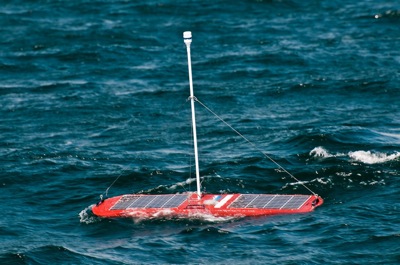
A Silicon Valley engineering firm called Liquid Robotics recently launched a new device called a Wave Glider off the California coast. It’s the latest and perhaps, the most ingenious design in the growing network of “autonomous ocean samplers,” which is to say sea-going science robots. The glider is a sensor-carrying platform powered entirely by wave energy and it has the potential to collect an enormous amount of data about the ocean, which in turn will give scientists a better understanding of climate change.

"Red Flash" at sea. Photo: Liquid Robotics

Jim Bellingham, Chief Technologist at the Monterey Bay Aquarium Research Institute, calls the device a “transformational development” in the field of ocean science and technology, but when the inventors came up with the idea they weren’t trying to revolutionize marine studies, they were trying to eavesdrop on humpback whales.

In 2005, Joe Rizzi, the chairman of Liquid Robotics, wanted to listen to the song of humpback whales off the coast of his home in Puako, Hawaii. He anchored a hydrophone near the shore, but instead of picking up whale song he heard the sound of frying bacon. Snapping shrimp, a small crustacean that uses its powerful claw to generate sound blasts that stuns its prey, had drowned out the call of the whales.

When Rizzi moved the hydrophones into deeper water he captured clear whale sounds, but kept losing the moored devices to rough seas. “The difficulty,” says Rizzi “was holding a hydrophone anchored in 600 feet of water during winter storms.” Rizzi realized that to keep a hydrophone stationary, he would need a powered device. “You’re not going to do that with a battery and a motor and a solar panel,” he explains. “The amount of power to hold station in a 60 mile per hour wind and 10 foot waves is thousands of watts. We recognized that it’s an energy problem.”

Rizzi presented the problem to Liquid Robotics CEO Roger Hine, who quickly came up with a design, and the Wave Glider was born.  “We weren’t sitting around thinking this thing would have a lot of scientific uses,” says Rizzi, “but as it turns out, there are a lot more uses for this device than just listening to whales.”

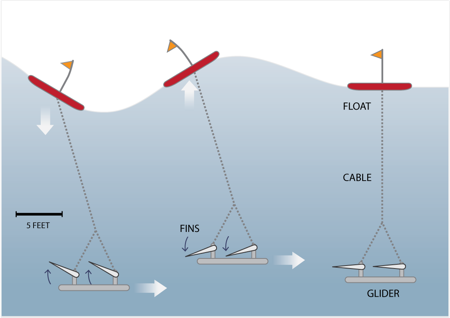
The Wave Glider's passive propulsion system harnesses the up-and-down motion of sea swells for locomotion. Diagram: Liquid Robotics

Delta Dawn

Scientists and policy wonks seem to be in general agreement on this: that it’s time to close out the current management epoch on the Sacramento-San Joaquin Delta and begin anew. There’s less accord on how to proceed.

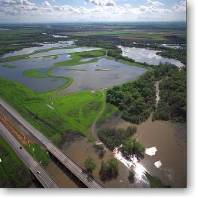
U.S. Fish & Wildlife Service
Photo: U.S. Fish & Wildlife Service

Policy makers have assembled “blue ribbon” panels to study the options and make recommendations. Volumes of studies and proposals line the shelves in Sacramento and elsewhere.

Last week a new idea surfaced for moving water through the Delta: Instead of channeling around it, tunnel under it.

This week the non-partisan Public Policy Institute of California released its recommendations for a mechanism to fund the enormous fixes that will be required: Those who benefit pay (ecologists use the term “ecosystem services” for all those bennies we get from natural resources and tend to take for granted).

Whatever the outcome, one thing seems inevitable, with or without human intervention. Driven by warming ocean temperatures, rising sea levels will continue to push saltwater farther upstream, changing the Delta’s character and the “services” it provides.

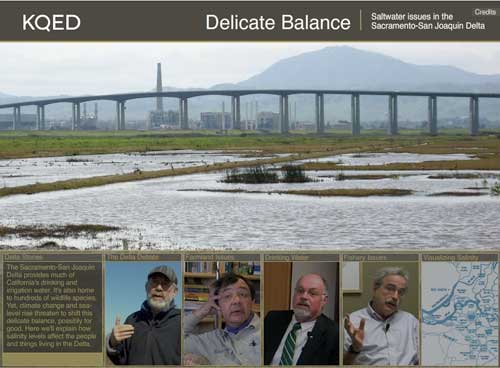
Recently a team of students at U.C. Berkeley’s Graduate School of Journalism produced a Flash presentation on some of the issues raised by advancing salt in the Delta. The multimedia report: Delicate Balance was produced for Climate Watch by Amanda Dyer, Martin Ricard and Jeremy Whitaker. We’re grateful to them for their time and creativity.

delicatebalance

Plan Moves Climate Adaptation to Front Burner

A one-fifth reduction in per capita water use by 2020 is among the goals outlined in a new state report on adapting to climate change.

Released by the California Natural Resources Agency (CNRA) as a “discussion draft,”  the 2009 California Climate Adaptation Strategy is being billed as the nation’s first comprehensive game plan for adaptation to climate change.

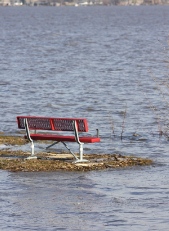
Reed Galin
Photo: Reed Galin

Most of the state’s high-profile climate initiatives (and battles) have been about mitigation; how to reduce greenhouse gas emissions to slow down warming. This report swings the spotlight over to adaptation; what needs to be done to accommodate the climate change effects that are already “in the pipeline.”

While the California’s centerpiece climate law was passed three years ago, this week’s CNRA report concedes that “adaptation is a relatively new concept in California policy.” The 161-page white paper comes in response to an executive order from the Governor last fall, calling for a statewide adaptation strategy.

The draft divides the strategy into seven “sectors:” Public health, biodiversity and habitat, ocean and coastal resources, water, agriculture, and forestry.

Tony Brunello, Deputy Secretary for Climate Change and Energy at CNRA, says “This is the first report that really looks at how climate change is going to impact the state and what we need to do about it.”

But Brunello stopped short of conceding that mitigation is a lost cause. “You only have half a deck if you’re only focused on mitigation,” he said. “You need to focus on both mitigation and adaptation to truly be prepared.”

Some strategies attack both. Brunello points to water conservation measures, which save both water and energy (20% of the energy used in the state is deployed moving water around).

The plan is designed to work in consort with the California Air Resources Board’s implementation plan for AB-32, the state’s multifaceted attack on greenhouse gas emissions. CNRA says one of its goals is to “enhance” existing efforts, rather than create new programs and offices that need funding.

CNRA also promises to use the “best available science in identifying climate change risks and adaptation strategies.” Andrew Revkin has a useful overview of the mounting challenges to climate scientists, published this week in the New York Times.

One planned product from the adaptation plan is an interactive website devoted to climate adaptation, with maps and data to assist local planners. CNRA hopes to have that in place by early next year. The draft plan now enters a 45-day period for public comment.

NOAA Confirms El Nino

Image from NASA
Warm water patterns in the Pacific during normal (upper) and El Nino (lower) years. The lower image is from 1995-96. Image from NASA

Scientists with the National Oceanic and Atmospheric Administration today confirmed what many had pretty much surmised: El Nino is back.

Officially the El Nino Southern Oscillation (ENSO), the cyclical pattern of ocean conditions has broad implications for weather and the Pacific food chain.

According to the NOAA news release:

“NOAA expects this El Niño to continue developing during the next several months, with further strengthening possible. The event is expected to last through winter 2009-10.”

NOAA’s Climate Prediction Center suggested about a month ago that conditions were right for the return of El Nino.

More recently, the high incidence of underweight sea lion pups turning up along the California coast was taken by some as a harbinger of ENSO. During El Nino cycles, normal upwelling of deep, cold water slows down, essentially shutting down the “food elevator” for many species.

Of course, there can be an upside. According to NOAA:

“El Niño’s impacts depend on a variety of factors, such as intensity and extent of ocean warming, and the time of year. Contrary to popular belief, not all effects are negative. On the positive side, El Niño can help to suppress Atlantic hurricane activity. In the United States, it typically brings beneficial winter precipitation to the arid Southwest, less wintry weather across the North, and a reduced risk of Florida wildfires.”

Links to climate change are less clear. Some scientists have suggested that warming air and sea temperatures might bring about more and longer El Nino events.

Starving Sea Lions: A Climate Connection?

Photos by Victoria Carpenter

I thought the highlight of my trip to Point Reyes last week would be the cows grazing on spectacular cliffs covered with yellow lupine. I was visiting a historic dairy there for an upcoming story on crashing milk prices.

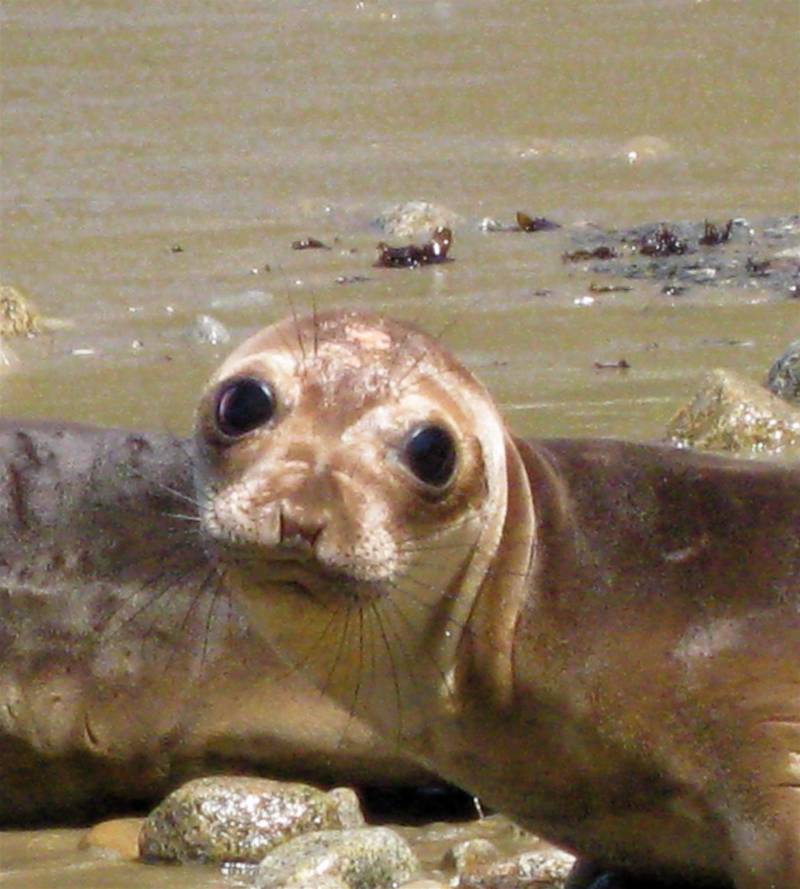
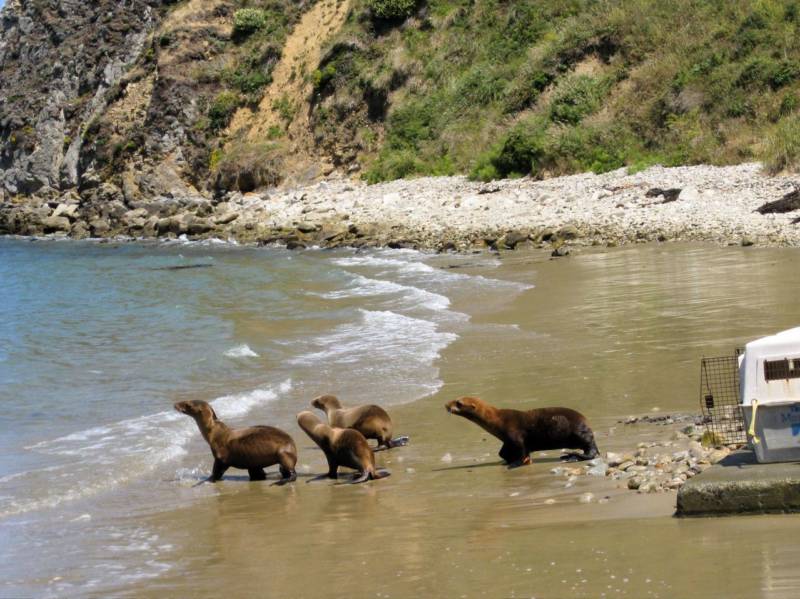
But then I noticed a white van marked “rescue” driving down to a dock near the Pt. Reyes lighthouse, and decided to follow it. Turns out, I stumbled upon an incredible scene: rescue workers releasing baby sea lions and elephant seal pups back into the waves.

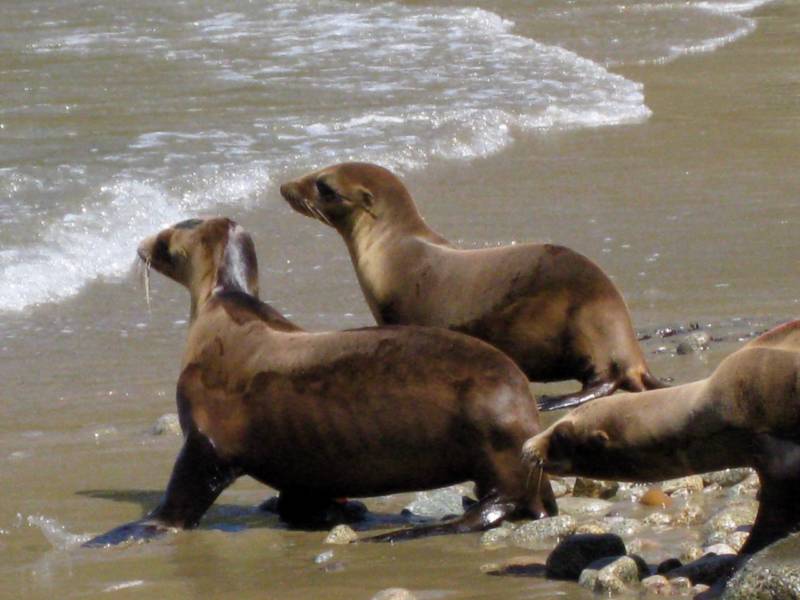
Volunteers lugged what looked like over-sized pet carriers out of the van and slid them onto a cement boat dock. Then a trio of sea lion pups poked their heads out, sniffed the salt air, and flippered their way across the cement and into the water, playfully nuzzling each other.

They seemed exhilarated–but thin. These pups had been rescued near Monterey, revived in the Marine Mammal Center’s Sausalito hospital, and were now healthy enough to return to the ocean, though you could still see their rib cages poking through their fur.

The sea lions swam out quickly but the elephant seals were a little more sluggish. One pup kept swimming back toward the humans, begging for fish. Then a giant female came out of the waves, perhaps offering herself as an adoptive mom, nudging the baby into the water.

Jim Oswald of the Marine Mammal Center (MMC) says the staff is seeing an unprecedented spike in rescue calls. In just the first two weeks of June, nearly 1,300 people phoned in, worried about stranded sea lions and other mammals. Most of them are malnourished sea lions who can’t seem to find enough anchovies, herring, or sardines to snack on.

Researchers aren’t quite sure why–but haven’t ruled out some kind of climate connection. The MMC is reporting its findings to the National Oceanic and Atmospheric Administration (NOAA) to try and figure out the cause. Possible El Nino Conditions? Warming oceans sending schools of smaller fish northwards? No one quite knows at this point.

“If it’s a climate change variable, that’s going to affect the fish the animals feed on,” says NOAA Wildlife Biologist  Joe Cordaro. “That could be a very long temporary shift in the bait fish distribution, or it could be long-term depending on how severely climate change affects the surface temperature of the ocean.”

But Cordaro says at this point, the sea lion strandings are “one big puzzle,” with climate change as just one possible factor. We could simply be witnessing a high-birth year for sea lions, with  a lot more pups than usual, or early signs of a returning El Nino weather pattern. Meteorologists won’t know until the fall whether California actually meets the criteria for a strong El Nino year. If so, Cordaro predicts “things are going to get a lot worse for the sea lions this fall and next spring.”

[Editor’s Note: The case for a return to El Nino was advanced on Wednesday, when the Australian Bureau of Meteorology reported that indications are almost certain at this point]

Regardless of the cause, the MMC’s Oswald says it’s cause for concern.

“These young sea lion pups get to the point where they’re so weak, they end up on the land and they’re too weak to go back,” Oswald explains. “It’s easier for them to waddle along, hoping they’ll find another waterway where they can find some food. They’re using up all their reserves if they stay out in the ocean.”

Stranded sea lion pups have even turned up on Bay Area freeways. Last week, rescuers found one on the 880 freeway in Oakland.

“His name is Fruitvale,” reports Oswald, “for the district in Oakland he was rescued from. He seems to be doing okay. He’s still being tube fed. I’m told from veterinarians that he’s feisty, moving around, and nippy, which is a good sign.”

The Marine Mammal Center’s Sausalito headquarters lets visitors watch volunteers in action. There’s an interactive exhibit with a sea lion on a gurney, where you can see its x-rays and test results. You can watch volunteers prepare fish meal, or even witness a post-mortem in the necropsy room.

Sounds grim, but until sea lion pups start finding more fish to eat–and humans start to figure out what’s causing the food chain to collapse, the Marine Mammal Rescue Squad plans on a very busy summer.

Sasha Khokha is chief of KQED’s Central Valley Bureau and a frequent contributor to Climate Watch.

And for more about the Marine Mammal Center’s sea lion rescue efforts, listen to Amy Standen’s recent radio report on KQED’s Quest. You can also view her slideshow and read her Reporter’s Notes on the Quest blog.

Parsing the White House Climate Report

At least one researcher cited in the 196-page climate impacts report issued this week by the Obama administration is not impressed with the final product. Roger Pielke of the University of Colorado’s Center for Science & Technology Research has written a blog post critical of the report and in particular, the way in which his work was interpreted. If you’d rather not plow through the entire post, John Tierney has an overview of Pielke’s critique on his blog for the New York Times.

California heat wave, from the Aqua satellite. Image: NASA
2004 California heat wave, from the Aqua satellite. Image: NASA

The report was arguably the first to break down both observed and projected effects of climate change into coherent regional summaries. For the purposes of the report, California was considered part of the Southwest region, which included states as far east as Colorado and New Mexico.

Not surprisingly, many of the points raised in the Southwest section (beginning on p. 129) have to do with water supply. Most have been reported or discussed in our Climate Watch coverage, either here or in our radio reports. Selected “highlights” include:

– Past climate records based on changes in Colorado River flows indicate that drought is a frequent feature of the Southwest, with some of the longest documented “megadroughts” on Earth.

– The prospect of future droughts becoming more severe as a result of global warming is a significant concern, especially because the Southwest continues to lead the nation in population growth.

– Human-induced climate change appears to be well underway in the Southwest. Recent warming is among the most rapid in the nation, significantly more than the global average in some areas.

– Projections suggest continued strong warming, with much larger increases under higher emissions scenarios compared to lower emissions scenarios. Projected summertime temperature increases are greater than the annual average increases in some parts of the region, and are likely to be exacerbated locally by expanding urban
heat island effects.

– Water supplies in some areas of the Southwest are already becoming limited, and this trend toward scarcity is likely to be a harbinger of future water shortages. Groundwater pumping is lowering water tables, while rising temperatures reduce river flows in vital rivers including the Colorado.

– Projected temperature increases, combined with river-flow reductions, will increase the risk of water conflicts between sectors, states, and even nations.

– Increasing temperature, drought, wildfire, and invasive species will accelerate transformation of the landscape.

– Under higher emissions scenarios, high-elevation forests in California, for example, are projected to decline by 60 to 90 percent before the end of the century.

– In California, two-thirds of the more than 5,500 native plant species are projected to experience range reductions up to 80 percent before the end of this century under projected warming.

– Projected changes in the timing and amount of river flow, particularly in winter and spring, is estimated to more than double the risk of Delta flooding events by mid-century, and result in an eight-fold increase before the end of the century.

– A steady reduction in winter chilling could have serious economic impacts on fruit and nut production in the region. California’s losses due to future climate change are estimated between zero and 40 percent for wine and table grapes, almonds, oranges, walnuts, and avocados, varying significantly by location.

By the way, Pielke’s critique does not directly address anything in this list, though his work does involve weather-related disasters, which would include floods. Asked by a commentator on his blog if he thinks the entire report should be dismissed based on the flawed interpretation of his research, Pielke replied: “I wouldn’t think so and would certainly hope not. At the same time the section which covers my research does not give me a lot of confidence in the process that led to the report.”

No Shockers in White House Climate Report

The Obama Administration released a much-vaunted update on climate change today. In its nearly 200 pages, the report contains no new data and few new conclusions on the pace and impact of climate change across the U.S. Rather it affirms the core findings of recent research and sounds the alarm for rapid, definitive action to reduce carbon emissions and prepare for changes already on the way.

In a statement from Lawrence Berkeley National Lab, Evan Mills, one of the report’s 28 co-authors, calls it “the most thorough and up-to-date review ever assembled of climate-change impacts observed to date as well as those anticipated in the future across the United States.” Mills is one of two northern California scientists listed in the report’s credits, along with Ben Santer of Lawrence Livermore National Lab.

One clear signal from the report is that it’s time to move adaptation strategies to the front burner; preparing for climate effects already in the pipeline.

Louis Blumberg directs the California climate change team for The Nature Conservancy, and told me in a telephone interview this morning, “I would say it’s a very clear signal that even if we dramatically reduce emissions immediately, which we need to do as soon as possible, we’ve already put enough CO2 into the atmosphere where we’re going to have have significant changes to our way of life. And we need to begin now and plan to adapt to these unavoidable impacts and I think this report underscores that urgency.”

But neither Blumberg nor Mills have given up on the mitigation side. Mills says “the good news is that the harshest impacts of future climate change can be avoided if the nation takes deliberate action soon.”

Here is a summary of  “key findings,” taken directly from the report:

1. Global warming is unequivocal and primarily human-induced.

Global temperature has increased over the past 50 years. This observed increase is due primarily to human-induced emissions of heat-trapping gases.

2. Climate changes are underway in the United States and are projected to grow.

Climate-related changes are already observed in the United States and its coastal waters. These include increases in heavy downpours, rising temperature and sea level, rapidly retreating glaciers, thawing permafrost, lengthening growing seasons, lengthening ice-free seasons in the ocean and on lakes and rivers, earlier snowmelt, and alterations in river flows. These changes are projected to grow.

3. Widespread climate-related impacts are occurring now and are expected to increase.

Climate changes are already affecting water, energy, transportation, agriculture, ecosystems, and health. These impacts are different from region to region and will grow under projected climate change.

4. Climate change will stress water resources.

Water is an issue in every region, but the nature of the potential impacts varies. Drought, related to reduced precipitation, increased evaporation, and increased water loss from plants, is an important issue in many regions, especially in the West. Floods and water quality problems are likely to be amplified by climate change in most regions. Declines in mountain snowpack are important in the West and Alaska where snowpack provides vital natural water storage.

5. Crop and livestock production will be increasingly challenged.

Agriculture is considered one of the sectors most adaptable to changes in climate. However, increased heat, pests, water stress, diseases, and weather extremes will pose adaptation challenges for crop and livestock production.

6. Coastal areas are at increasing risk from sea-level rise and storm surge.

Sea-level rise and storm surge place many U.S. coastal areas at increasing risk of erosion and flooding, especially along the Atlantic and Gulf Coasts, Pacific Islands, and parts of Alaska. Energy and transportation infrastructure and other property in coastal areas are very likely to be adversely affected.

7. Threats to human health will increase.

Health impacts of climate change are related to heat stress, waterborne diseases, poor air quality, extreme weather events, and diseases transmitted by insects and rodents. Robust public health infrastructure can reduce the potential for negative impacts.

8. Climate change will interact with many social and environmental stresses.

Climate change will combine with pollution, population growth, overuse of resources, urbanization, and other social, economic, and environmental stresses to create larger impacts than from any of these factors alone.

9. Thresholds will be crossed, leading to large changes in climate and ecosystems.

There are a variety of thresholds in the climate system and ecosystems. These thresholds determine, for example, the presence of sea ice and permafrost, and the survival of species, from fish to insect pests, with implications for society. With further climate change, the crossing of additional thresholds is expected.

10. Future climate change and its impacts depend on choices made today.

The amount and rate of future climate change depend primarily on current and future human-caused emissions of heat-trapping gases and airborne particles. Responses involve reducing emissions to limit future warming, and adapting to the changes that are unavoidable.

On KQED Public Radio’s Forum for Wednesday, 6/17

9am Forum with Michael Krasny
White House Climate Report
We discuss the report, as well as federal climate change legislation from Congressmen Henry Waxman and Ed Markey. Guests include Dan Kammen, professor of energy at UC Berkeley and co-director of the Berkeley Institute of the Environment; and Katharine Hayhoe, professor of geophysics at Texas Tech University and a lead author of the climate study.

River Diaries, Part 4: Homecoming

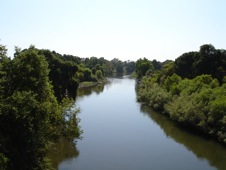
Tuolumne River, near Modesto. Photo: National Weather Service

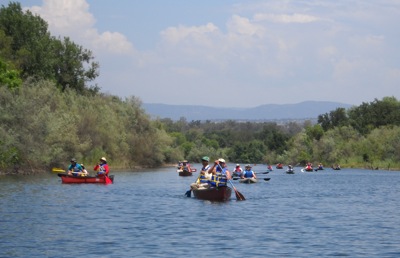
The Tuolumne River Trust’s Paddle to the Sea project concludes today on the San Francisco waterfront. This is another journal entry from Emilio Martinez, one of two paddlers who traveled the entire route, from Yosemite to the Golden Gate.

Emilio Martinez: Return to the Valley

The surprise for the day was that my old stomps look completely different from the vantage point of a kayak on the River’s surface. Some visuals betokened our peculiar Central Valley “look:” the sudden appearance of palm trees behind the oaks and willows; the five bright yellow shopping carts submerged or waiting on the banks for their shiftless owners; and the three homeless sleeping bag spots.

All told, for the first time in my life, the exposed flanks of the Tuolumne were a genuine joy to behold.

A few more things of note, some nice, some just off-putting: the clarity of the water disappeared as we progressed from Fox Grove (Hughson) toward Modesto, going from a fairly deep green of decent transparency to the opaque silt-colored, pale oil-green that we Modestans are quite used to. Not only that, the counter breezes and slowing current acted like a turgid brake on our once swift progression on the water; and of course the air became redolent with–something–either fermenting processed vegetable matter (from where?) or the fertilizer smells wafting over the River from the nearby farm fields. I don’t know.

Besides, the obvious enjoyment of seeing your familiar haunts appear new, fresh, and full of the variety and appeal that Nature’s fecund imagination can contrive, was just sublime. And the River yielded some surreal grace notes, too, specifically in the form of an exquisitely colored horse, sporting every imaginable shade of black and white, lounging serenely underneath the Mitchell Bridge, a place I usually associate with graffiti, industrial consumer detritus, and shiftless “recreational” types: this image shall always remain in my conscious as almost mystical, an ancient ancestral avatar.

Modesto

If the Tuolumne may be considered an emerald queen in its Sierra manifestations, imprisoned and ghostly nobility during its Don Pedro phase, and a country beauty during its descent from La Grange to Waterford, then perhaps the best description of Her Majesty in Her Legion Park – to – Big Bend garb is that of Cinderella. What I mean is that after the Tuolumne’s creep through the homeless camps, fishing holes, arson-burned river banks, defunct Dennet Dam, past sunken fishing boats (five at least), felled floodplain almond trees, topped with a good dousing of cow muffin-perfumed swamp gases, even a queen emerges covered in the cinders and muck of real life as we know it in these troubled regions.

Nonetheless, the “Paddling to the Sea” company was fine and filled with story, song, and revelation; their faces fair and wise; their hearts still courageous enough to brave possible death by choosing life; and their eyes and ears eager to identify the symphony of wildlife that still calls the Tuolumne its home (today’s additions: dogs, crows, palm trees).

Our crew of Tuolumne River Trust personnel and their Grateful Rowers have been at it at least five-days-straight on the River (not counting at least three months of advance preparation on the part of TRT) and we are battered and bruised but still strong and excited by the new face that the River presents every day with each new bend.

So, perhaps fittingly, we began today’s ten-mile row on the nascent topology of the future “Gateway Park” beneath the 7th St. “Lions’ Bridge,” a place where ornate four-foot-high crucifixes memorialized the tragic death of 14-year-old Jeremy Wilson, a drowning victim of the ancient, defunct, and evil Dennett Dam, and ended it at the current “Big Bend” renovation site, where thousands of newly planted trees no higher than year-old-babies dotted the landscape in their blue and red ribbons–all a product of the indefatigable efforts of the TRT’s committed humanity.

I leave you with one image that marks the end of today’s trip in memory: the pale blue gauze of the Coastal Ranges slowly emerging from the horizon to steadfastly gaze back at us from beyond Westley, the small migrant town of my childhood days, the place where the River first entered my consciousness as something to be feared and revered: to many a theologian these are the two faces of the sacred.

Amen.

I want to end on the positive note here. I want to give credit where credit (and kudos) must be given: every one of the human representatives involved in this venture have displayed nothing but stellar professionalism, humanity, and good cheer: from the Hispanic Leadership Youth Council teens to the TRT (Tuolumne River Trust) people–especially the latter, who’ve had the huge task of dealing with boats, people, hunger, and rallies. I cannot imagine an undertaking of this scope being carried out in a better manner by better people, under more challenging conditions, or for a greater cause.

River Diaries, Part 3: Encounters with Civilization

Here are some more journal entries from participants in the Paddle to the Sea project, to raise awareness of river and water supply issues. Two paddlers have pledged to go all the way, from the Sierra to San Francisco Bay. At this point, they’ve descended from the high country and are preparing to traverse California’s Great Valley.

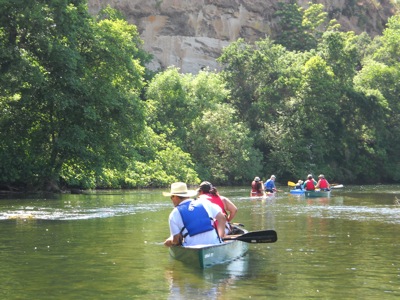
On the tamed lower Tuolumne. Photo: Jesse Raeder

Emilio Martinez: Don Pedro Reservoir & Turlock Lake

After the whitewater thrills of the upper Tuolumne, Don Pedro Reservoir was exciting in the same way that a putting green is exciting: smooth and well-groomed, and so accommodating to the well-mannered sportsman. With the whine of the fishing engine accompanying a distinct lack of visual variety in the blond hills, we boated for two hours towards the Dam, then hiked Bonds Flat Road, then J59 for 2 more hours in the near hundred degree heat, examining road kill for diversion.  Besides the houseboats and odd floating trash, there was not a whole lot to feed the river-bound soul.

So it was with a complete sense that all the excitement that the River Tuolumne had to offer had been expended during the upper portion that I stepped awkwardly into my canoe on the 27th of May. I had already complacently decided that the River was something of a “has been” and would be nothing now but a gentle, rolling presence.

What a complete and arrogant assumption of what the River is, without any knowledge of the true meaning of that word as Nature herself uses it.

The River, in short, thrashed both my thesis–and companion Tim and I like the inconsequential beings that we are before the River’s sublime power and majesty: it slapped us upside the head with willow branches drenched in chilling waters, banged our thighs and knees with the fiberglass canoe we haughtily thought we’d master it with: instead, it made us respect it and fear it: precisely because we are mere visitors to its emerald green kingdom, our canoes so much jetsam and flotsam in its consciousness: in short,  the Tuolumne did everything it needed to do to show us how we must not underestimate Nature, but rather, protect one’s reverence and humility before it so that one can live and be nurtured by it.

Long live the River!

Looking for fish. Photo: Jesse Raeder

Owen Segerstrom: Don Pedro Reservoir

Today’s crossing of Don Pedro was an instructive microcosm of the damage that dams cause. While the former Tuolumne River Canyon rests under hundreds of feet of water, the remaining habitat is a virtual biological desert. Turkey vultures, mallards, and hatchery-raised fish are a far cry from the wildlife of an intact river system. What was once a salmon-bearing, thriving ecosystem sequestering untold millions of metric tons of carbon is now a layer of anaerobic matter at the bottom of the reservoir, the decomposition of which releases methane (a greenhouse gas that is orders of magnitude more potent that carbon dioxide) into the atmosphere.  [Editor’s note: The figure most quoted by scientists is that methane is about 20 times more potent than CO2 as a greenhouse gas. In California, however, livestock and leakage from oil & gas operations are much bigger emitters of methane than natural decomposition from lakebeds].

Upon arrival at the dam, Emilio, Mason (a friend of mine from Kentucky who accompanied us) and I were presented with an interesting conundrum.  Despite indications to the contrary from National Geographic’s mapping database, there is no trail from the dam to the Old La Grange bridge.  After consulting a local ranger, we determined that the only way to walk this leg of our journey was on the side of Bonds Flat road and eventually J59 (approximately 7 miles).  The partially decomposed remains of a fox, whose life was ostensibly claimed by a motorist on the highway, were yet another sobering reminder of the human-caused chasm between a Mt. Lyell-to-the-Pacific river system and the Tuolumne’s current state.  We maintained morale by nicknaming this stretch of our sojourn the “great asphalt eddy of the T,” but the experience was nonetheless jarring.

After the experience at Don Pedro, the first section of the Lower Tuolumne was quite literally a breath of fresh air.  Heritage oaks, the call of an osprey from its nest along the river bank, and the water’s peaceful meander were a feast for the senses.  The integration of community advocacy groups throughout the valley is a hopeful sign for the future of freshwater consciousness, and the results of their efforts are evident.

Though anadromous fish passage beyond the Old La Grange Dam is still impossible, the efforts to address disastrous impacts on salmon populations (an unparalleled gauge of the health of a river ecosystem) between this impasse and the ocean are inspiring.  Salmon have been described as the conscience of a watershed, as they represent the lone upstream vector for ocean nutrients that have historically fertilized inland ecosystems.  The conscientious cooperation of central valley communities along the Tuolumne represents the utterly necessary prevention of local extinction of Chinook salmon.

[Editor’s Note: Here’s the latest biological opinion on California’s Chinook salmon and how it stands to affect water supplies.]

Turlock Lake to Waterford Park

Today’s paddle began with a conversation about the history of California river advocacy. As our group went through individual introductions, many of the participants recalled the (ultimately unsuccessful) efforts to prevent the damming of the Stanislaus River in the late 1970’s, including Mark DuBois chaining himself to a riverside boulder in protest.  While the beauty and avian abundance of yesterday’s journey punctuated the beginning of our day, reminders of the need to rekindle Mark’s passion quickly confronted us.  The soundscape for our lunch break was provided by an industrial gravel pit, the footprint of which has massively diverted the river channel.  As one volunteer pointed out, the beautiful hyacinth blooming in the pond adjacent to the pit were nonetheless a dubious indicator of the river’s ecological health.  The day culminated in a rousing gathering of Waterford’s riverfront restoration community at the local park,  A group of children enjoying a game based on answering questions about salmon presented hope that somewhere there is a young person who will carry Mark’s torch in defense of the Tuolumne’s continuity.

Our posts are running a bit behind the paddlers’ progress. In real time, they are set to cross San Francisco Bay today and conclude their journey tomorrow, with a celebration at Aquatic Park in San Francisco.

Decoding California’s Drought History

Abbie Tingstad is a paleoclimatologist at UCLA. She specializes in reconstructing drought records in the western United States, and takes us along on some of her field research in this guest post:

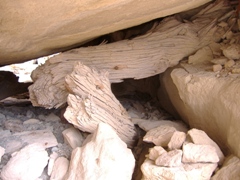
Part of a Piñon pine beam under the collapsed rock shelter. This beam was one of several sampled for tree ring analysis. Photo by Abbie Tingstad.
Part of a Piñon pine beam under a collapsed rock shelter. This beam was one of several sampled for tree ring analysis. Photo by Abbie Tingstad.

By Abbie Tingstad

The site was so remote we needed a team of archaeologists and a couple of heavy-duty 4x4s to get us there.

Deep within the rocky piñon-juniper cliffs of northwestern Colorado was a secret so well hidden I didn’t see it until I was physically inside, face-to-face with a series of hand prints made over a thousand years ago. This rock shelter was occupied during Medieval times by Fremont Indians, contemporaries of the Anasazi whose cultural center was further south in the Four Corners Region. The site had already been excavated, but our interest as dendroclimatologists was not in artifacts. We had come to take samples from the ancient piñon and juniper beams that once supported this structure for the valuable paleoclimate information contained within their annual growth rings.

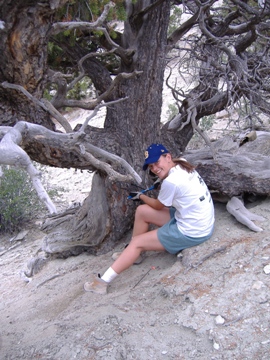
Tingstad sampling a live Piñon pine tree in northeastern Utah. This tree is about 550 years old. Photo by Glen MacDonald.

Gathering Medieval climate information from tree rings, lake sediments, and other natural climate archives in the Western US is critically important for understanding the implications of increasing temperatures in this region, particularly when it comes to future water supply and demand.

Research has confirmed that temperatures rose in the Western U.S. from about A.D. 800-1300, which translated into a series of droughts. The most devastating of these occurred in the mid-11th and 12th Centuries, when dry conditions persisted for several decades and may have contributed to the collapse of the Anasazi and Fremont cultures.

Paleoclimate data from tree rings and other sources also suggest that the mechanism driving drought during the “Medieval Warm Period” was eastern Pacific Ocean cooling. Like a widespread, extended La Niña event, cool sea surface temperatures may have strengthened the persistent moisture-blocking system of high-pressure off the West coast, nudging storm tracks north.

While the Medieval period is an instructive analogue for the warming we are beginning to experience, it is an imperfect one. Two major factors separate the episode the Fremont and Anasazi experienced a thousand years ago from what we are just beginning to undergo today. First, Medieval warming appears to have been fostered by a combination of increased solar irradiance and decreased volcanic activity, rather than anthropogenic greenhouse gas emissions. Secondly, Medieval times were characterized mainly by summer warming, while winter and spring temperatures are expected to increase most dramatically in the future. These differences manifest themselves in many ways, but notable for the water-starved West are the implications for decreased winter snowpack and earlier spring river discharge.

The Medieval Warm Period may not offer a precise preview of our future, but it serves as a valuable warning about the tenuous balance of water supply and demand in California and the Western US, something the occupants of the Fremont rock shelter we visited were likely aware of.

Since the turn of the new Millennium, drought has been the norm rather than the exception in this region and the end is not in sight: As of May 1, 2009 surveys suggest that the Sierra Nevada snowpack is two-thirds of normal. What we can learn from Medieval times is not to expect “normally” moist conditions to return any time soon, and to plan accordingly.