Tag Archives: Ecosystems

Pika One Step Closer to ESA Listing


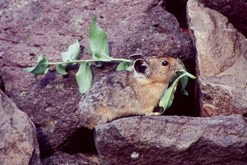
American pika. Photo by Chris Ray.

UPDATE: Federal fish & wildlife authorities have decided to proceed with a full review of the American pika, for potential listing under the Endangered Species Act. The US Fish & Wildlife Service will formally publish its decision this week, including this summary:

“We, the U.S. Fish and Wildlife Service, announce a 90-day finding on a petition to list the American pika (Ochotona princeps) as threatened or endangered under the Endangered Species Act of 1973, as amended. We find that the petition presents substantial scientific or commercial information indicating that listing of the American pika may be warranted. Therefore, with the publication of this notice, we are initiating a status review of the species, and we will issue a 12-month finding to determine if the petitioned action is warranted. To ensure that the status review is comprehensive, we are soliciting scientific and commercial data regarding this species. We will make a determination on critical habitat for this species if, and when, we initiate a listing action.”

The Center for Biological Diversity (CBD) first petitioned for listing in 2007, and then followed with a lawsuit a year later, when federal authorities shelved the request.

The significance of this week’s decision, according to a CBD news release, is that “the pika will become the first mammal considered for protection under the Act due to global warming in the continental United States outside of Alaska.”

Last month a San Francisco court ruled that state wildlife officials wrongly denied the CBD’s petition for listing under California’s ESA. So it looks like the little critter will get a fresh review at both the state and federal levels.

Pivotal Week for Pika Protection

American pika. Photo by Chris Ray.

Note that an update to this story was posted on May 6.

The hamster-sized, high-elevation haymaker known as the American Pika has had its “day” in court–and then some. Now it may be making inroads toward listing as a threatened species, while questions persist over whether that would be premature.

Friday was the deadline for officials at the U.S. Fish & Wildlife Service to decide whether to further consider the pika for listing under the federal Endangered Species Act.

The San Francisco-based Center for Biological Diversity (CBD) has been pursuing listing for the pika under both the state and federal Endangered Species Acts. On April 16, a Superior Court judge in San Francisco ruled that the California Fish and Game Commission applied too stringent a standard, when it voted last year to reject the CBD’s petition to list the pika under the California law. The CBD says it expects the court to formally order the state to go back and take a second look at whether the critter deserves protection.

Meanwhile federal wildlife officials had until May 1 to decide whether to formally review the pika’s plight and consider listing it under federal law. A response is expected to be published in the Federal Register this week.

Complicating the case is an apparent difference between the fate of pika populations in the Great Basin, where field research clearly shows pika colonies in trouble, and colonies in the Sierra Nevada range, which may be faring better.

Pika thrive only at high elevations, in the rocky conditions known as talus. Their band of tolerance for temperature is very narrow, so some biologists see them as an indicator species for global warming. Temperatures that humans may consider merely balmy, can be fatal for pika.


Chris Ray, an ecologist at the University of Colorado, has studied pika in the mountain ranges of the Great Basin. She’s identified and ranked several stress factors that pose threats to the animals, including habitat shrinkage and exposure to both heat and cold.

Ray, who presented her latest research at the USGS-sponsored Pacific Climate Workshop last month, is cautious about endorsing an ESA listing just yet, saying: “I do not think there are data indicating that the species as a whole is in danger of extinction, however the loss of isolated populations from the Great Basin has me concerned.”

“I think it’s very reasonable to consider potentially listing some sub-populations of pika.” Ray says that in order to do that, a case would have to be made that there are genetically distinct sub-species of pika. In its petition, CBD claims that five sub-species have been identified in California. But scientists at UC Berkeley and the U.S. Forest Service who have done field research in the Sierra, have said it’s less clear that those colonies are in trouble.

CBD staff biologist Shaye Wolf says a 1995 study found “evidence for four genetic units across the pika range, roughly grouped as Sierra Nevada, Cascades, Southern Rockies, and Northern Rockies. However, better genetic analyses using more sensitive genetic markers (like microsatellites) are necessary to understand pika population structure.”

Wolf says that for its ESA petition, the CBD drew on a 1981 study that used population distribution to break out 36 “subspecies” of pika.

Congressman: Delta Fish a “Worthless Little Worm”

Peter Johnsen, U.S. Fish & Wildlife Service
Photo: Peter Johnsen, U.S. Fish & Wildlife Service

In hearings by the House Energy & Commerce Subcommitee today, Rep. George Radanovich (R-Fresno) called the Delta smelt “a worthless little worm that needs to go the way of the dinosaur.” He made the remark as part of a five-minute attack on “environmental alarmism,” in response to testimony from former vice-president Al Gore, founder of the Alliance for Climate Protection.

The tiny fish, recently listed by the state Fish & Game Commission as “endangered,” came up in remarks by Radanovich about the current drought conditions in the Central Valley. He blamed the lack of water on lawsuits that have restricted water supplies to farms, “for a Delta smelt–a worthless little worm that needs to go the way of the dinosaur. They’ve shut pumps down and restricted water deliveries to California over that thing, when what’s eating it is a striped bass, a non-native species in the Delta.”

Radanovich rejected the possibility that climate change might be a player in the current drought. Instead he took aim at what he described as “collaboration between environmentalists and sport fishermen,” blaming that for slashed water allocations to farms, as many as 60,000 job losses and “a $6 billion-dollar hit to our economy.”

“That is not global warming,” he said. ” “It’s the result of bad policy caused by environmental alarmism.”

Joining Gore among the 21 witnesses before the subcommittee on Day 4 of the climate bill hearings was UC Davis professor Dan Sperling (.pdf link), who had just come from a marathon hearing before the California Air Resources Board. Last evening the Air Board approved the first-ever Low-Carbon Fuel Standard, as part of it’s plan to reduce greenhouse gases.

The Insidious Side of Climate Change

If you think climate change just means hotter summers in California, think again. The writer of this week’s guest post argues that we’ll all “feel the heat” in myriad ways, both obvious and subtle.

Climate and Nature
by Anthony Barnosky

Some impacts of climate change in California are pretty obvious, things like rising sea level submerging large parts of the San Francisco Bay region, or drought cutting into our water supplies.  Less obvious, but every bit as important, are impacts on something you probably don’t even know you have: your relationship with nature.

One part of that relationship is the concept of “ecosystem services;” the direct benefits you get from nature.  California’s Climate Action Team highlighted some of the state’s ecosystem services in their recent report.  Examples include the ski trip you may have taken this winter, the salmon fillet you may have bought at the grocery store, or surprisingly, even your hamburger.
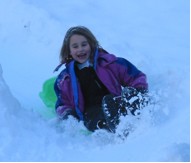
barnosky_snowfunSnow will be less, soggier, at higher elevations, and on the ground for fewer days of the winter, melting some of the $500 million-per-year revenues of the ski industry–not to mention melting your favorite ski run.  Altered river dynamics and temperatures will almost certainly cut into the state’s $33-million-per-year salmon industry. Climate-caused loss of forage means that in 2070 California’s cattle ranchers will be losing up to $92 million in comparison to today’s markets, which means higher beef prices at the grocery store.  Combined, the losses in these ecosystem services likely will cost the state’s already suffering economy well over a hundred million dollars per year as we move into the next few decades. And those are just three of many ecosystem services that will be affected.

A second part of your relationship to nature is the species around you, that is to say, biodiversity. Simply put, biodiversity is which species live in a place, and the extent to which those species are rare or common.  In general, biodiversity means more productive and healthier ecosystems, which translates as more benefits to humans that inhabit those areas.  As it turns out, California is a globally recognized biodiversity hotspot, unique in the world.  But biodiversity losses from global warming promise to be severe: one study predicts that two-thirds of the 2387 plant species found only in the state will lose 80% of their range within the century.

barnosky_icylakeThe third part of your relationship to nature is how it makes you feel.  There’s no question: you can’t get the same feeling you get looking at a giant redwood anywhere but in a redwood forest.   Among species that may have little or no suitable climate left in California, however, are its coastal redwoods and sequoias.

Such impacts of climate change on nature are not confined to California.   Many other reports indicate that global warming is redefining our relationship to nature worldwide.  As with other impacts, this one can be partially mitigated by reducing greenhouse gas emissions immediately, but also will require some new management strategies for preserving nature in the age of global warming.  California, in particular, has a lot to lose.

Anthony D. Barnosky is a Professor of Integrative Biology at the University of California, Berkeley and author of the recently published Heatstroke: Nature in an Age of Global Warming. You can read more on this topic in his blog. Photos by the author.

Barnosky is scheduled to appear Saturday as part of Berkeley’s “Cal Day” activities. His talk is scheduled for noon at the Valley Life Sciences Bldg, Room 2060, followed by a book-signing at the T-Rex (which is hard to miss).
Some Surprises in Fire-Climate Connection

Tonight, San Francisco’s KQED Public Television (HD 9) will air the first collaboration between Climate Watch and Quest, its weekly series on science & environmental topics. “California at the Tipping Point” is a half-hour special that explores the likely affects of climate change on the state. One of those anticipated effects is greater risk of wildfire. This post expands on the program with some of the recent science in that arena.

The conventional wisdom is that a warming planet means more wildfires–and in many cases the conventional wisdom is right. But globally it’s a more complex question.

Just last week, Max Moritz and his team at UC Berkeley’s Center for Fire Research & Outreach published a study that shows widely varied fire response to climate changes around the world. Post-doctoral fellow Meg Krawchuk was the lead data cruncher in the effort, with contributions from researchers at Texas Tech University.

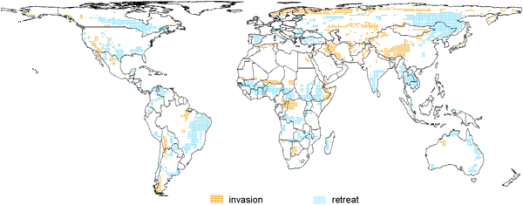
What they found were suggestions of rapid changes in fire regimes, and not all in the same direction. Some places (like most of California) will likely see a spike in the fire hazard, while other regions (like the Pacific Northwest) could see a retreat of wildfire frequency and intensity:

“In contrast to any expectation that global warming should necessarily result in more fire, we find that regional increases in fire probabilities may be counter-balanced by decreases at other locations, due to the interplay of temperature and precipitation variables. Despite this net balance, our models predict substantial invasion and retreat of fire across large portions of the globe.”

Moritz has been stumping for new approaches to fire-climate analysis. He says rather than treat fire strictly as the product of other climate change variables, we should think of it also as a climate driver.

Map shows areas of potential fire advance (orange) and reatreat (blue) by 2010-2039 (medium-high emissions scenario)
Map shows areas of potential fire advance (orange) and retreat (blue) by 2010-2039 (medium-high emissions scenario)

You can use the player below to hear an excerpt from my interview with Moritz, in which he explains the new perspective that he thinks his team’s study brings to the fire-climate connection.

[audio:http://ww2.kqed.org/climatewatch/wp-content/uploads/sites/54/2009/04/moritz_web.mp3]

The Other “Earth Day”

Photo by Reed Galin
Photo by Reed Galin

There is another “Earth Day” that’s been around for, oh, about a hundred years longer than the one we mark on April 22. It’s Arbor Day, though few people can tell you when it is. In fact, nowadays few seem to even know what it is.

Julius Sterling Morton would be crestfallen that the tradition he started shortly after the Civil War is so little remembered. The soon-to-be Secretary of Agriculture under President Grover Cleveland was a big believer in the trans formative power of trees. He reckoned that what his Nebraska farm needed were trees, to gird against both the relentless winter wind and intense summer sun. The idea caught on. When the state marked its first official Arbor Day in 1872, Cornhuskers are said to have planted a million trees (I’ve driven through Nebraska and I’m not sure where they all went).

During the Nixon administration, Arbor Day was designated as the last Friday in April, another reason why it languishes in the shadow of Earth Day. Adding to the confusion is that different states celebrate it at different times, depending on the local climate. In Florida, it’s the third Friday in January. Here in California, it’s not even a “day.” It’s a week. The calendar maintained by the Arbor Day Foundation gives the date of California’s Arbor Day as “March 7-14,” which happens to be right now.

The Arbor Day spirit endures at places like the Sacramento Tree Foundation, which has been using funds from the local utility, SMUD, to fill out the urban canopy and reduce the effect of urban heat islands. Over the past 25 years, the Foundation has orchestrated the planting of 1.25 million trees. The goal is five million. That’s a lot of trees but then it takes a lot of trees to cool down a metro area the size of Sacramento. The shade freaks at SMUD have done the math and say that to make any measurable difference in temperature, you have to add about 10% to the urban canopy.

It’s doubtful that Julius Sterling Morton had urban heat islands or carbon sequestration in mind, back in 19th century Nebraska. He was probably just trying to get out of the damn wind. But given the crucial role of trees in storing carbon and recent reports documenting trees dying off at an alarming rate throughout the West, now seems like a terrific time to exhume Arbor Day from the Tomb of the Unknown Occasion.

Stop and Count The Poppies

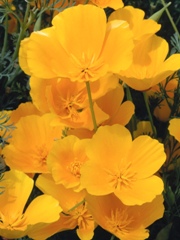
ca_poppy2Here’s a new reason to take time to stop and smell the roses. Or at least count them.
A consortium of scientists called the USA-National Phenology Network (USA-NPN) is recruiting volunteers from across the country to help track the effects of climate change on ecosystems.

Described by executive director Jake Weltzin as a project “for people interested in participating in climate change science, not just reading about it,” the network will collect data from government, academic, and “citizen” scientists to track the life-cycles of more than 200 plants, including California Poppies and Ponderosa Pines.  The project will begin tracking animals next year.

Phenology is the study of the seasonal cycles of plants and animals, such as plants sprouting, flowering and fruiting.   Abrupt changes in these patterns, due to climate change or other reasons, can be extremely disruptive to ecosystems.

USA-NPN hopes that the data collected will help scientists and resource managers “predict wildfires and pollen production, detect and control invasive species, monitor droughts, and assess the vulnerability of various plant and animal species to climate change. ”

Weltzin said that he hopes 100,000 citizen scientists will volunteer to help with the project.   Detailed information on how to participate is located at www.usanpn.org.

Listen here to an interview with Weltzin about the project on the U.S. Geological Survey’s website. Look for episode #85.

The Cost of Ignoring Climate Change

sunheat_smMuch of the debate over addressing climate change hinges on the cost of proposed mitigation efforts.  Some say we can’t afford the extraordinary measures required to cut greenhouses gases, particularly in the current economic train wreck.  What gets less attention is the cost of doing nothing.
This has been a controversial idea since the Stern Review called attention to the issue in 2006. That report concluded that unless one percent of global GDP was diverted to mitigate the worst effects of climate change, the world could lose up to 5% of  global GDP each year and the total damage could claim as much as 20%.

A set of new reports out of the University of Oregon inserts fresh numbers into the debate. According to researchers, three western states are each likely to lose more than $3 billion a year in climate change-related costs by 2020, if nothing is done to reduce greenhouse gas emissions.  By 2080, the projected annual costs range from $9-to-$18 billion for each state.

The reports, which focus on Washington, Oregon, and New Mexico, assume a business-as-usual scenario where both carbon emissions and temperature continue to rise at rates similar to those seen in recent years. Under these conditions, these states (and California, according to the prevalent research) can expect more severe droughts and floods, less snowfall,  more wildfires and habitat loss, and a higher incidence of climate-associated health problems and deaths.

In New Mexico, the study’s authors expect summer temperatures to climb 12.6 degrees above current averages by 2080,  spiking air-conditioning costs, health-care complications, and the state’s death rate.  By 2020, annual climate-related health care costs in New Mexico alone are expected to top $1.3 billion.

California’s temperatures, under business-as-usual scenarios, are widely expected rise between six and ten degrees by the end of century.  Even in a relatively cool state like Washington, health care impacts would make up $421 million, or 32%, of total annual climate-related costs, under this pr0jection.

The study attributed the largest costs (more than $1 billion annually in each state) to inefficient consumption of energy, a projection that might not pan out, given the Obama Adminstration’s focus on green technology and clean energy efforts.

Other costs cited by the study include reduced salmon populations and food production, lost recreational opportunities (sell your snowboard now), and more intense and frequent wildfires and storms.

Amateur Bird Counts Really Do Count

Photo by 10,000 Birds contributor Mike
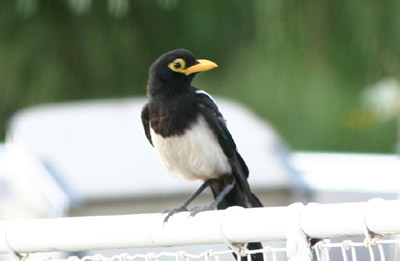
The yellow-billed magpie could lose 75% of its range. Photo by Mike Bergin

The hardiest of volunteers are winding up the Audubon Society’s Great Backyard Bird Count today. Consistent rain has made it a challenge throughout much of California (don’t get me wrong–you won’t see me complaining about rain at this point).

These bird counts are more than just feel-good exercises in pubic education. The data is useful in serious research,  like the Society’s recent stunning report on the likely effects of climate change on bird populations. The study, released last week, combined climate models with 40 years of data from Aububon’s Christmas Bird Count, to paint a grim picture for California’s birds.

The part of the study that focused on California warned that a third of the state’s native bird populations could see their ranges shrink substantially as the planet warms. According to the report:

“These reductions will be part of massive range shifts to all of the state’s bird species caused wholly or in part by the effects of climate change.”

Gary Langham, who co-authored the California study, says it should provide a wake-up call, and not just for those crafting policy to cut greenhouse gas emissions: “It’s also a tool for land managers and conservation groups and others to look at the landscape and understand where their conservation investments would be most wisely spent.”

Langham and his co-author, William B. Monahan note that this is more than a projection:

“Climate change is already pushing species globally poleward and higher in  elevation. In California, directional changes in climate during the 20th century were substantial.”

That squares with the observations of local birdwatchers. Tom Rusert, who founded the non-profit Sonoma Birding, says he’s seen a huge influx of American robins (something that might be a welcome sight in my hometown of Syracuse, NY, right about now). Rusert says his Sonoma Valley Christmas Bird Count drew 150 volunteers last year.

Thanks to nature sound recordists Martyn Stewart of Naturesound and Bernie Krause of Wild Sanctuary for providing bird calls for last week’s radio story. The magpie photo comes to us by way of 10,000 Birds.

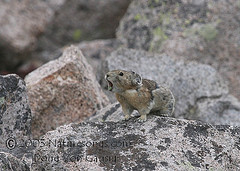
Boulder Bunnies May Break Ground with ESA

Copyright 2006, Doug Von Gausig
Photo: Copyright 2006, Doug Von Gausig

The American pika has begun a long-delayed journey toward possible listing under the Endangered Species Act.  It could become the first mammal in the Lower 48, let alone California, to be listed as specifically threatened by global warming.

The U.S. Fish & Wildlife Service agreed today to review the petition, as part of a court settlement with San Francisco’s Center for Biological Diversity.

Under the settlement, negotiated by lawyers with Earthjustice, the agency commits to a May deadline for determining whether the cartoon-cute alpine critter merits consideration for federal protection.

Pika live in rock colonies only at high elevation (usually above 9,000 feet, though some have been documented lower). They’re well insulated against the harsh mountain environment but can suffer heat stroke at temperatures approaching 80 F.

As alpine temperatures increase with global warming, conservationists worry that the pika will be driven further upslope and eventually out of existence.

Back in the fall of 2007, CBD petitioned for listing under both the federal and California ESA’s. The feds more or less ignored the request. California turned it down flat, saying there was insufficient data to warrant a review. There was also some sentiment on the commission that using global warming as a basis for listing any species would be setting an uncomfortable precedent. CBD sued both agencies and the California case is still in court.

Not all scientists are convinced that the pika’s in trouble. Find out why in our Climate Watch radio feature, Monday morning on The California Report. Listen to the story here.

By the way, “boulder bunny” is a fairly accurate description. They may look like rodents but pika are actually relatives of rabbits and hares.

Use the audio player below to hear Doug Von Gausig’s recording of pika vocalizing.
[audio:http://www.kqed.org/.stream/anon/climatewatch/pika1.mp3]

Audio recording provided by Doug Von Gausig and NatureSongs.com