Tag Archives: Conservation

Not Connecting the Dots

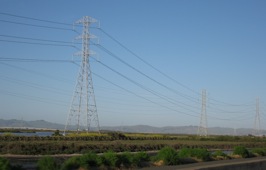
grid_0295Two developments this week would seem to validate concerns that things aren’t quite lining up for the vaunted new age of renewable energy.

While the Secretaries of Energy and Interior were offering confident assurances to a Senate panel about the future of renewables, a consortium of environmental groups was suing them over a plan for major new transmission lines for the western electrical grid.

The groups, represented by lawyers at Oakland-based EarthJustice, produced their own maps to show that the proposed routes appear to miss many areas with the most potential for solar, wind and geothermal resources. Instead, environmentalists say the West-wide Energy Transmission Corridors approved under the Bush administration would seem to line up just about perfectly with major existing and proposed coal-fired power plants (note that the maps themselves are PDF downloads).

According to EarthJustice:

“The Bush corridors plan ignores the Renewable Portfolio Standards (RPS) adopted by nine of the eleven western states to increase use of the region’s vast wind, solar, and other forms of renewable energy. The approximately 6,000 miles and 3.2 million acres of federal land in eleven western states designated as energy corridors puts imperiled wildlife at risk and slices or brushes against the borders of iconic public lands. Among these are Utah’s Grand Staircase-Escalante National Monument, Arches National Park, and New Mexico’s Sevilleta National Wildlife Refuge.”

I asked Katie Renshaw, a Washington-based lawyer for EarthJustice, if Energy and Interior wouldn’t have updated their plans since the Bush-era maps were approved. “As far as we’ve seen, they haven’t,” said Renshaw.  “An analysis was never really completed.”

The lawsuit comes just days after energy entrepreneur T. Boone Pickens revealed that he’s having to reconsider his plans for a major network of wind turbines through Texas. The reason: no transmission lines.

In California and elsewhere, proposed transmission lines have run afoul of environmental interests, as Rob Schmitz reported in his New Gridlock series for Climate Watch.

Update: Scott Streater has more on the controversy over siting renewables in a New York Times Greenwire post.

Navigating the Urban Water Jungle

Follow Gretchen’s radio journey to cut her own water use by 20%. Her story aired May 29 on The California Report weekly magazine.


Gretchen Weber
Photo: Gretchen Weber
Saving water when you live in an apartment isn’t as hard as it might seem.

I know the motivation might not be there to take shorter showers when you see your neighbors watering their lawns in the middle of the day or local restaurants hosing down the sidewalks, but cutting back on your water use (or at least feeling less guilty about those long showers) can be as simple as swapping out your old shower head for a lower-flow model, screwing some aerators onto your faucets, and, for the sufficiently motivated, talking to your landlord about installing higher-efficiency toilets.

For me, the first and last stop was calling my utility company, San Francisco Public Utilities.  They sent out a water expert armed with free devices for my flat, and in less than an hour we’d outfitted the kitchen and bathroom to be much more water efficient.   Save our H2O, a website sponsored by the California Department of Water Resources, has tons of conservation resources including a rebate finder and a list of the state’s local water agencies.

But since I know not every utility offers free devices to customers, last night I dropped by The Home Depot in Daly City, to see what’s available.  I have been inside one of these orange megabox retailers exactly three times in my life and it’s always a bit of sensory overload.  There must have been close to 100 shower heads to choose from, but it wasn’t easy finding one with a low-flow (1.5 gallons per minute) rating.  No matter the price or the size, every model I picked up was either 2.5 gpm, or I couldn’t find the flow rate on the packaging.

Gretchen Weber

Faucet aerators at The Home Depot

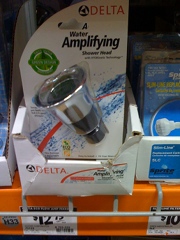
I finally asked a salesman who at first couldn’t find one either.  But eventually, he found one tucked in among the others: the Delta Water Amplifying Shower Head, for $12.75.  It’s actually 1.6 gpm, and it looked kind of  small and cheap,  although it may work fine.  I felt a little disappointed that this was my only option.

Hoping for better luck, I wandered over to the aerator section one aisle over.  There I found aerator aficionado heaven.  Once again, the selection was a little overwhelming.  There were probably 40 aerators to choose from–aerators, no less.  Low-flow, 1.5-gpm models like the kind the SFPU gave me ranged in price from $2.99 to $17.39 for the upscale brushed-nickel variety.

Across from the aerators were the toilets.  I scanned the high shelf and saw several low-flow models (1.6 and 1.28 gallons per flush) that were priced between $90 and $128.  Taped to the toilet shelf was a sign reading that San Francisco residents may be eligible for a $125 rebate on a low-flow model, which could basically mean a free toilet.  Other cities and counties in California have similar rebates.

As I turned to leave the toilet/aerator aisle, I bumped into a large box sitting on the floor.  There, far from all the others, was the shower head I’d been looking for:  a 1.5 gallon-per-minute WaterPik EcoFlow with five different pressures, including something called “Powerspray.”  Touting a 40% water savings, these puppies were on sale for $44.95.

Gretchen Weber
Water Pik Eco Flow Shower Head Photo: Gretchen Weber

Rick Soerhen, the Deputy Director of Water Use Efficiency for the California Department of Water Resources told me that people living in apartments most likely already get “gold stars” for water conservation because they probably aren’t watering lawns and gardens.

So, flat-dwellers, be proud. But if you really want to be as water efficient as possible, devices like these can make a big difference on your total usage — without requiring three-minute showers.

Paddling to the Sea

Jessie Raeder is Bay Area Organizer for the Tuolumne River Trust. More than 200 paddlers are expected to take to the river between now and June 7, for this river awareness relay. Raeder offers this dispatch from the starting line, near the headwaters in Yosemite National Park.

By Jessie Raeder

Paddle to the Sea got off to a roaring start over the weekend.  Melting snow caused by an early heat wave in the Sierras had the river pumping at much higher flows than rafters typically face. The Tuolumne is usually rated Class 4–but goes to Class 5 when flows get over 4000 cubic feet per second.   This weekend saw the river flowing at 7000 cfs! For a while it looked like we might have to cancel all the whitewater trips due to safety concerns, but in the end one trip did go on and needless to say it was an epic journey for our Paddle-to-the-Sea team.

A paddler takes on the Clavey. Photo:
A paddler takes on the Clavey. Photo: Patrick Koepele, Tuolumne River Trust

Meanwhile, an international team of 12 hotshot kayakers ran the Clavey River, a tributary of the Tuolumne and one of only three remaining free-flowing rivers in the Sierra.  The Clavey is a class 5+ river that’s rarely run and only by experts.

Paddle to the Sea is a three-week festival to foster stewardship of the Tuolumne River. Hundreds are joining in this epic journey from the Sierra to the Sea. Kayakers and rafters will begin on the upper stretches of the Clavey and Tuolumne Rivers, travel through the Central Valley where canoers take the lead, pass through the confluence of the Tuolumne and San Joaquin Rivers, and sea kayakers will finish the trip in San Francisco Bay.

A changing and increasingly unpredictable water supply will be the first way that most people in California experience climate change affecting their own lives.  Here in the Bay Area, tap water for 2.5 million people comes from the Tuolumne River, whose headwaters start with melting snow from the Lyell Glacier (picture attached).  That glacier is on the retreat, and more frequent droughts are expected throughout the Sierra.

Paddle to the Sea is meant to demonstrate that issues that affect one section of the river ripple up and down the watershed.   Bay Area water users share this resource with farmers in Modesto, anglers in Yosemite, the commercial salmon industry on the Pacific, and a host of native fish, plant, and wildlife species, many of which are endangered.

As population and demand for water continues to grow, California will be faced with many questions about how we use water, and where it will come from.  The Tuolumne River Trust is working to ensure that we turn to water efficiency and water recycling as much as possible–alternatives which are far more sustainable and renewable than continuing to take additional water from the Tuolumne River, which has been the solution most turned to in the past.


Pika One Step Closer to ESA Listing


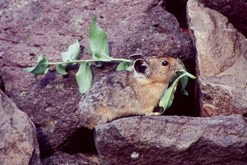
American pika. Photo by Chris Ray.

UPDATE: Federal fish & wildlife authorities have decided to proceed with a full review of the American pika, for potential listing under the Endangered Species Act. The US Fish & Wildlife Service will formally publish its decision this week, including this summary:

“We, the U.S. Fish and Wildlife Service, announce a 90-day finding on a petition to list the American pika (Ochotona princeps) as threatened or endangered under the Endangered Species Act of 1973, as amended. We find that the petition presents substantial scientific or commercial information indicating that listing of the American pika may be warranted. Therefore, with the publication of this notice, we are initiating a status review of the species, and we will issue a 12-month finding to determine if the petitioned action is warranted. To ensure that the status review is comprehensive, we are soliciting scientific and commercial data regarding this species. We will make a determination on critical habitat for this species if, and when, we initiate a listing action.”

The Center for Biological Diversity (CBD) first petitioned for listing in 2007, and then followed with a lawsuit a year later, when federal authorities shelved the request.

The significance of this week’s decision, according to a CBD news release, is that “the pika will become the first mammal considered for protection under the Act due to global warming in the continental United States outside of Alaska.”

Last month a San Francisco court ruled that state wildlife officials wrongly denied the CBD’s petition for listing under California’s ESA. So it looks like the little critter will get a fresh review at both the state and federal levels.

Pivotal Week for Pika Protection

American pika. Photo by Chris Ray.

Note that an update to this story was posted on May 6.

The hamster-sized, high-elevation haymaker known as the American Pika has had its “day” in court–and then some. Now it may be making inroads toward listing as a threatened species, while questions persist over whether that would be premature.

Friday was the deadline for officials at the U.S. Fish & Wildlife Service to decide whether to further consider the pika for listing under the federal Endangered Species Act.

The San Francisco-based Center for Biological Diversity (CBD) has been pursuing listing for the pika under both the state and federal Endangered Species Acts. On April 16, a Superior Court judge in San Francisco ruled that the California Fish and Game Commission applied too stringent a standard, when it voted last year to reject the CBD’s petition to list the pika under the California law. The CBD says it expects the court to formally order the state to go back and take a second look at whether the critter deserves protection.

Meanwhile federal wildlife officials had until May 1 to decide whether to formally review the pika’s plight and consider listing it under federal law. A response is expected to be published in the Federal Register this week.

Complicating the case is an apparent difference between the fate of pika populations in the Great Basin, where field research clearly shows pika colonies in trouble, and colonies in the Sierra Nevada range, which may be faring better.

Pika thrive only at high elevations, in the rocky conditions known as talus. Their band of tolerance for temperature is very narrow, so some biologists see them as an indicator species for global warming. Temperatures that humans may consider merely balmy, can be fatal for pika.


Chris Ray, an ecologist at the University of Colorado, has studied pika in the mountain ranges of the Great Basin. She’s identified and ranked several stress factors that pose threats to the animals, including habitat shrinkage and exposure to both heat and cold.

Ray, who presented her latest research at the USGS-sponsored Pacific Climate Workshop last month, is cautious about endorsing an ESA listing just yet, saying: “I do not think there are data indicating that the species as a whole is in danger of extinction, however the loss of isolated populations from the Great Basin has me concerned.”

“I think it’s very reasonable to consider potentially listing some sub-populations of pika.” Ray says that in order to do that, a case would have to be made that there are genetically distinct sub-species of pika. In its petition, CBD claims that five sub-species have been identified in California. But scientists at UC Berkeley and the U.S. Forest Service who have done field research in the Sierra, have said it’s less clear that those colonies are in trouble.

CBD staff biologist Shaye Wolf says a 1995 study found “evidence for four genetic units across the pika range, roughly grouped as Sierra Nevada, Cascades, Southern Rockies, and Northern Rockies. However, better genetic analyses using more sensitive genetic markers (like microsatellites) are necessary to understand pika population structure.”

Wolf says that for its ESA petition, the CBD drew on a 1981 study that used population distribution to break out 36 “subspecies” of pika.

Congressman: Delta Fish a “Worthless Little Worm”

Peter Johnsen, U.S. Fish & Wildlife Service
Photo: Peter Johnsen, U.S. Fish & Wildlife Service

In hearings by the House Energy & Commerce Subcommitee today, Rep. George Radanovich (R-Fresno) called the Delta smelt “a worthless little worm that needs to go the way of the dinosaur.” He made the remark as part of a five-minute attack on “environmental alarmism,” in response to testimony from former vice-president Al Gore, founder of the Alliance for Climate Protection.

The tiny fish, recently listed by the state Fish & Game Commission as “endangered,” came up in remarks by Radanovich about the current drought conditions in the Central Valley. He blamed the lack of water on lawsuits that have restricted water supplies to farms, “for a Delta smelt–a worthless little worm that needs to go the way of the dinosaur. They’ve shut pumps down and restricted water deliveries to California over that thing, when what’s eating it is a striped bass, a non-native species in the Delta.”

Radanovich rejected the possibility that climate change might be a player in the current drought. Instead he took aim at what he described as “collaboration between environmentalists and sport fishermen,” blaming that for slashed water allocations to farms, as many as 60,000 job losses and “a $6 billion-dollar hit to our economy.”

“That is not global warming,” he said. ” “It’s the result of bad policy caused by environmental alarmism.”

Joining Gore among the 21 witnesses before the subcommittee on Day 4 of the climate bill hearings was UC Davis professor Dan Sperling (.pdf link), who had just come from a marathon hearing before the California Air Resources Board. Last evening the Air Board approved the first-ever Low-Carbon Fuel Standard, as part of it’s plan to reduce greenhouse gases.

Delta Smelt Listed as Endangered

The California Fish and Game Commission today officially qualified two species of freshwater fish for special protection under the California Endangered Species Act.

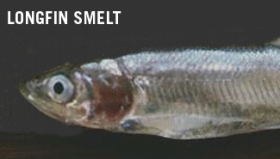
Longfin smelt. Photo: NOAA
Photo: NOAA

The Commission listed the delta smelt as “endangered” and the longfin smelt as “threatened,” a lesser classification. Both are denizens of the Sacramento-San Joaquin Delta and have long been at the center of controversy over water diversions from the Delta. According to the San Francisco-based Center for Biological Diversity:

“The San Francisco Bay-Delta Estuary is home to the largest and southernmost self-sustaining population of longfin smelt. Longfin smelt populations that inhabit the estuaries and lower reaches of Humboldt Bay and the Klamath River have also declined and may now be extinct. Since 2000, the Bay-Delta longfin smelt population has fallen to unprecedented low numbers. Since 2002, the delta smelt has plummeted to its lowest population levels ever recorded.”

CBD was among the environmental groups that petitioned the state for listing of the longfin in 2007. Delta smelt have been protected as a “threatened” species since last year but today that designation was escalated to “endangered.” The Center has also petitioned for–but has yet to attain–federal listing for both species by the U.S. Fish & Wildlife Service.

The listing could have major implications for water supplies this year. Court decisions in favor of the fishes have already forced reductions in water pumped out of the Delta for diversion to the San Joaquin Valley and Southern California. The rulings have prompted some to characterize subsequent reduced water deliveries as a “regulatory drought.”

Boulder Bunnies May Break Ground with ESA

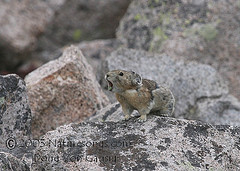
Copyright 2006, Doug Von Gausig
Photo: Copyright 2006, Doug Von Gausig

The American pika has begun a long-delayed journey toward possible listing under the Endangered Species Act.  It could become the first mammal in the Lower 48, let alone California, to be listed as specifically threatened by global warming.

The U.S. Fish & Wildlife Service agreed today to review the petition, as part of a court settlement with San Francisco’s Center for Biological Diversity.

Under the settlement, negotiated by lawyers with Earthjustice, the agency commits to a May deadline for determining whether the cartoon-cute alpine critter merits consideration for federal protection.

Pika live in rock colonies only at high elevation (usually above 9,000 feet, though some have been documented lower). They’re well insulated against the harsh mountain environment but can suffer heat stroke at temperatures approaching 80 F.

As alpine temperatures increase with global warming, conservationists worry that the pika will be driven further upslope and eventually out of existence.

Back in the fall of 2007, CBD petitioned for listing under both the federal and California ESA’s. The feds more or less ignored the request. California turned it down flat, saying there was insufficient data to warrant a review. There was also some sentiment on the commission that using global warming as a basis for listing any species would be setting an uncomfortable precedent. CBD sued both agencies and the California case is still in court.

Not all scientists are convinced that the pika’s in trouble. Find out why in our Climate Watch radio feature, Monday morning on The California Report. Listen to the story here.

By the way, “boulder bunny” is a fairly accurate description. They may look like rodents but pika are actually relatives of rabbits and hares.

Use the audio player below to hear Doug Von Gausig’s recording of pika vocalizing.
[audio:http://www.kqed.org/.stream/anon/climatewatch/pika1.mp3]

Audio recording provided by Doug Von Gausig and NatureSongs.com

California Lobbies for Early Action on EPA Waiver

cars.jpgWasting no time, California officials sent letters to the Obama Administration on its first day, asking that the EPA approve the state’s request for a Clean Air Act waiver, which would allow California to set stricter standards for passenger vehicle greenhouse gas emissions.

As Sasha Khokha recently reported for The California Report, Sacramento requested the waiver from the EPA in 2005, only to see it denied in March 2008, a move that has blocked the state from enforcing its own laws designed to reduce tailpipe emissions.  The state has been fighting for the waiver for the last year along with several other states that have adopted the same regulations.

If granted, the waiver would allow California to take steps to reduce emissions from passenger cars 30 percent by 2016.

In his written appeal, Gov. Schwarzenegger asked that President Obama “direct the EPA to act promptly and favorably on California’s reconsideration request so that we may continue the critical work of reducing greenhouse gas emissions and their impact on global climate change.”

California Air Resources Board chair Mary Nichols also spoke out Wednesday, in a letter to the new designated EPA head Lisa Jackson, stating that “the decision made by the former adminstrator to deny  California the waiver to enforce our clean air car laws was flawed, factually and legally, in fundamental ways.”

At her confirmation hearing, Jackson said only that she promised a “speedy review” of California’s waiver issue.

This fact sheet from CARB explains more about California’s emissions standards for cars and the agency’s take on the waiver controversy.