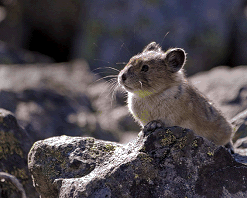
American Pika are living at lower elevations and surviving warmer temperatures than previously thought, according to a paper in the journal Arctic, Antarctic, and Alpine Research (available for download at the US Forest Service Pacific Southwest Research Station’s site).
One of the authors, Connie Millar, said she saw pika far more often and in a broader elevation range than she had expected she would. Millar, a Forest Service ecologist, found all those pika using a method she developed to quickly determine if pika are living in places where one would expect to find them.
Pika, cute little rabbit relatives that live in high elevations throughout the West, have been in the news lately. The Center for Biological Diversity (CBD) petitioned for the pika to be listed under the federal Endangered Species Act in 2007, citing climate change as a threat to survival of the cold-adapted species. Last month, under a new administration, the U.S. Fish and Wildlife Service decided not to protect the pika, explaining that though some populations do seem to be in trouble, most are doing fine so far. (Climate Watch has followed the pika story; see previous posts here, here, and here).
This newest study would seem to support the federal decision. But Shaye Wolf, staff biologist with the CBD, says that though the study “provides a snapshot of where pika are now, long-term in-depth studies have found that pika populations are declining.”
The majority of those declining populations are in Nevada’s Great Basin, at relatively low elevations for pika colonies. One paper Wolf cites was recently published in Ecological Applications. Authors Erik Beever and Chris Ray concluded that shrinking pika populations in the Great Basin could be partially attributed to climate change. Pika have an extremely narrow band of temperature tolerance and can suffer heat stroke in temperatures comfortable to humans.
Wolf and Millar are both members of the California Pika Consortium, a newly formed research group. Millar plans to distribute her pika survey to colleagues in the consortium in order to continue gathering data on locations of pika colonies.
Meanwhile, even though the Fish and Wildlife Service has denied federal protection to the pika, CBD is still working on gaining state-level protection in California. CBD biologists consider the pika to be a bellwether species for climate change.
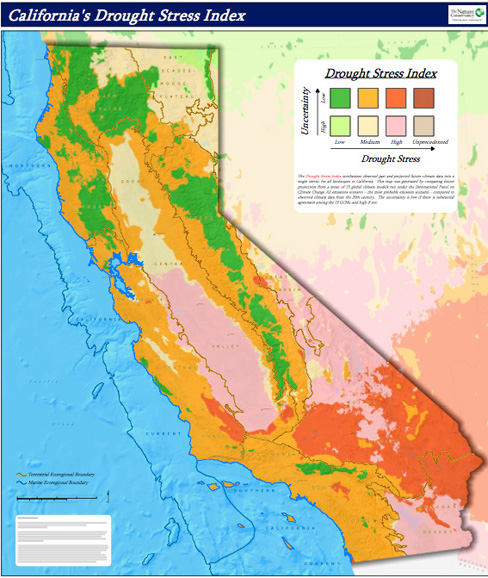
Projected drought conditions for 2070-2100 (Map: The Nature Conservancy)
Climate change is causing conservationists to rethink traditional methods of protecting lands and ecosystems. The conventional strategy of setting aside a specific parcel of land (and increasingly, ocean) to protect a particular community of organisms may no longer be sufficient in a rapidly changing climate. While greenhouse gas reduction and climate change mitigation remains a top priority for most conservationists, land managers have begun developing adaptation strategies that take the effects of a warming planet into account.
“We have a fantastic conservation success story in having conserved a huge network of protected areas,” says Healy Hamilton, director of the Center for Applied Biodiversity Informatics at the California Academy of Sciences. “The issue with those protected areas is that they all have static boundaries around them and they work to protect what lies within them, So the plants and animals that are there are well-protected, as long as they stay there.” Trouble is, the habitat isn’t staying put.
Climate has “Velocity”
The world’s ecosystems will need to move about a quarter of a mile each year to keep up with climate change, according to a recent study published in Nature (link is to the first paragraph of the paper; the full article is only available to subscribers, but you can read a press release about the about the study).
Researchers from the Carnegie Institution, Stanford, the California Academy of Sciences, and UC Berkeley collaborated on the paper, which describes climate belts sweeping north and south from the equator–and also moving uphill–as the world warms.
Hamilton, who co-authored the study, told a packed house at the Center for Biological Diversity in January, that “Climates are on the move. It’s not just a slow unfolding, it’s a radical, abnormal process. Everywhere we look, shifts are already occurring.”
And under these changing conditions, she said, plants and animals have three choices: “They can stay and adapt, they can shift with their climate, or they can go locally extinct if they can’t move fast enough.”
The study’s lead author, Scott Loarie, a fellow at the Carnegie Institution, explains that climate change forecasts are commonly measured in degrees per year, but the authors of this study wanted to know how those temperature changes would affect what can live where. So they used temperature “velocity” (in kilometers per year) to measure how fast regional climate conditions are moving as the planet heats up.
It turns out that the belts move at different rates, depending on the landscape. In the Amazon Basin, velocity is relatively high. It’s a large and homogeneous ecosystem, so as the temperature changes there, plants and animals will have to travel a long way to keep up with the climate in which they’ve evolved to thrive. In a place like California, with its microclimates and variable topography, the velocity is lower. Some species may need merely to migrate to a nearby north-facing–and therefore cooler–slope. Others will have to head north and toward the coast. Climate models forecast that eventually the Bay Area will look more like Southern California, and the Bay Area’s current climate will be located somewhere north of us.
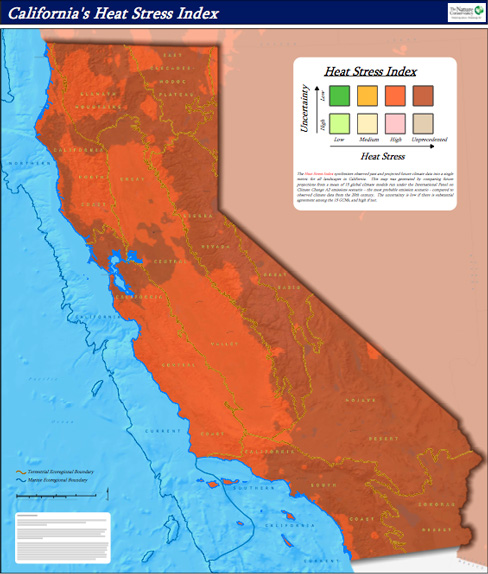
Projected Heat Stress in California for 2070-2100 (Map: The Nature Conservancy)
Mapping a Moving Climate
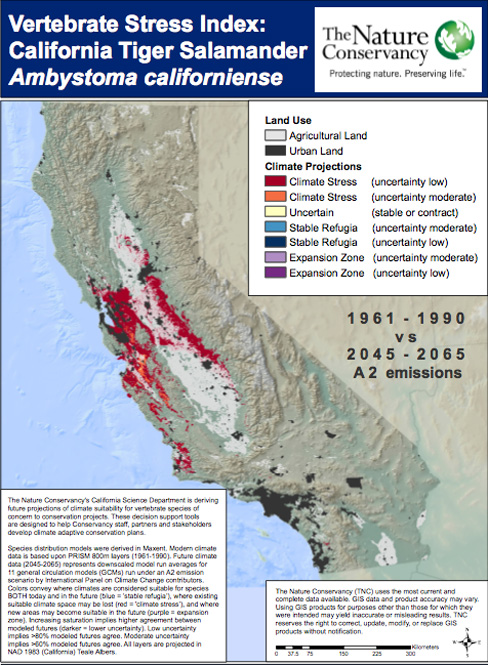
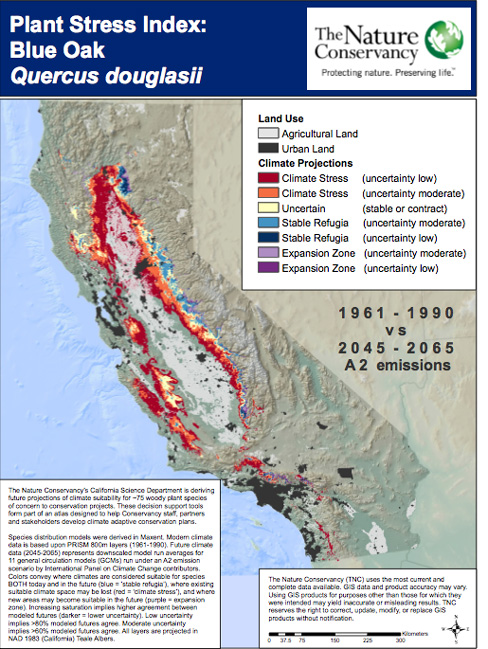
The Nature Conservancy of California has attempted to map some of these trends (see above and below). Scientists averaged together several different climate models to create a picture of California’s future in terms of temperature and precipitation. They then applied that projection to habitats for specific species, to make predictions about how ranges may shift. The maps show both how much areas are likely to change, as well as how certain the predictions are.
“What we’re trying to understand is how does the way we protect species in the future need to change with a changing climate,” says Rebecca Shaw, Director of Conservation for the Nature Conservancy of California. “The kind of strategies you employ and how much you spend is really going to be dependent on how certain you are about change in the future.”
For example, she says some parts of the Sierra are not likely to change very much over the next century, but some places like the Mojave Desert are expected to change a great deal. That kind of information could be useful for land managers trying to plan for the future. For example, in areas that are expected to undergo great change, it might be more important to preserve corridors, or connecting stretches of protected lands, so that populations can move as the climate changes, if they are unable to adapt where they are.
Loarie says “assisted migration”–helping specific species move to new locations–is expensive, unpredictable, and unrealistic. Instead, he, too, corridors for plants and animals to safely follow their climate–if they can keep up. Species like the American pika, already living on mountaintops, can’t go any farther uphill. Their habitats could disappear completely, or, as Loarie says, “they’ll pop off the top.”
There are limitations to the predictions one can make with temperature velocity measurements. What temperature changes will do to fog, for instance, is still unknown, so it’s not clear yet where the redwoods will need to move in the next 100 or so years.
To enable the second option, Hamilton agrees with Loarie. she says the conservation community needs to rethink its traditional strategy of protecting lands. Instead of protecting specific parcels of land and expecting them the stay the same over time, conservationists need to expect change, and to create connectivity in the landscape so that species can move when and if they need to.
Projected changes in California Salamander habitat (Map: The Nature Conservancy)Projected changes in California Blue Oak habitat (Map: The Nature Conservancy)
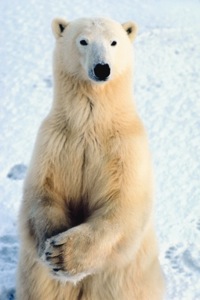
A recent post I wrote to highlight a radio discussion of the current plight of polar bears, drew a challenge from Russell Steele, one of our regular readers. Steele questioned some of the scientific conclusions underlying dire predictions for the bears.
To help sort some of this out, I asked for responses from two highly regarded scientists in the field. Here’s a response to the specific reader challenge from Mark Serreze, Director of the National Snow & Ice Data Center, in Boulder, CO:
It is unclear what Mr. Steele is trying to get at with reference to the seasonal cycles in sea ice extent from the AMSR-E data. The AMSR-E data, while valuable, only go back to 2002. Through combining SSM/I and SMMR satellite data with other information sources for earlier years, we have a decent record of Arctic sea ice extent going back to the early 1950s. The relevant issue is the long-term decline in end-of-summer (September) ice extent evident in this record, with the extreme September minima of recent years (represented in the short AMSR-E record) serving as exclamation points. The observed rate of September ice loss exceeds expectations from nearly all climate models.
I also turned to Waleed Abdalati. Now director of the Earth Sciences Observation Center at the University of Colorado, Abdalati is a veteran of the Cryospheric Sciences and Terrestrial Hydrology programs at NASA, and one of the most articulate people I’ve heard speak on the subject of polar ice. He offers the following:
I am not an expert on polar bears, but I do think it is safe to say that their primary habitat, the Arctic sea ice, is severely threatened. I, and most of my colleagues believe we are well on our way to an ice-free Arctic in summer any time between this decade and the next 40 years.
This is because of two things: 1) it will be decades before the ocean has finished its response to present-day greenhouse forcing, so the impacts of what we’ve done already have not been fully realized; and 2) the loss of sea ice is self-compounding: when it starts to shrink, exposing a darker more (heat) absorbing ocean underneath, the likelihood of its continued shrinking is greater (ice melts, exposes darker ocean, absorbs more heat, melts more ice, exposes darker ocean, and so-on).
Of course the flipside of this is that as ice starts to grow, it is more inclined to grow, but against the backdrop of the increased warming, the former is far more likely than the latter. Finally, as thick multi-year ice disappears, it is replaced with thinner and younger ice that is more vulnerable to surface melt from the atmosphere, bottom melting from sea water, and being carried away to lower, warmer latitudes by ocean current and wind.
So back to the polar bears: If their habitat disappears and they are unable to hunt seals, their main source of food, they seem to stand little or no chance of survival. I am not a wildlife biologist but its hard for me to believe they as a population can sustain themselves on land and with only a seasonally-present ice cover. In some cases, the fact that they face more challenges on sea ice than in the past, has driven them to forage inland, creating the illusion in some people’s minds that their populations are increasing, because there are more sightings on land. Who knows? Maybe they’ll evolve to hibernate in late summer, when there is no ice, and hunt the rest of the year.
There is an added effect that doesn’t get much attention. There was a fascinating study by a Canadian Biologist (Ian Stirling) and a sea ice expert (Claire Parkinson) [Stirling, I., and C.L. Parkinson. 2006. Possible Effects of Climate Warming on Selected Populations of Polar Bears (Ursus maritimus) in the Canadian Arctic. Arctic 59(3): 261-275.], which suggested that the bears are also losing weight, and approaching the weights at which they have historically not been able to bear cubs. So not only is the population threatened by starvation, the ability to replenish the population seems diminished.
I don’t believe we can say anything with absolute certainty, so I, myself would not make the statement that the polar bears are doomed–but I will say that the outlook for them, in my view, looks very, very bad.
Louis Blumberg directs the California climate program for The Nature Conservancy. He’s also been keeping us posted as an official observer to the UN climate conference.
Copenhagen, December 16
Amidst the protests, the deliberations, the 24/7 schedule and battling what has been dubbed the “COP 15 flu,” the collective energy and sense of import in Copenhagen is still motivating us all to keep at it.
The atmosphere at the Bella Center has been a roller coaster this week. One thing I’ve realized is that it’s tricky to keep up with the constant changes that are happening so rapidly. At one point, we heard that negotiators had included in the draft text a global goal to reduce emissions from deforestation by 50 percent by 2020 and to achieve zero emissions by 2030. This would have been unprecedented. Unfortunately, we later learned that this text was only a placeholder but still could come through in a final agreement.
Adopting a global goal to stop deforestation would certainly be one important measure of success for this conference. It is alarming that the destruction of the world’s forests is the second highest source of greenhouse gas emissions — more than the emissions from all planes, trains and automobiles combined — yet a role for reducing emissions from deforestation and degradation (known as REDD) was not included in the 1997 Kyoto Protocol. This left countries with few economic incentives for preserving their forests, while they stood to make a fortune selling the timber, clearing forests for development or converting them to agriculture.
Enter the forest carbon market. Meeting an ambitious global goal on deforestation will take a lot of resources. A global market that gives value to forest carbon can generate the funding required each year to reduce deforestation at the scale needed to address climate change, while providing cash-poor, forest-rich countries the financial incentives they need to protect their forests rather than destroy them. While it is not the only tool to reduce emissions, it is a crucial one.
California has been a leader in this arena by both establishing a credible, prescriptive method for certifying forest carbon projects and including a role for forest offsets [PDF download from Stanford] in the state’s cap-and-trade program. This is a model that COP 15 negotiators can point to while framing the global solution to reducing deforestation. Let’s hope they come to an agreement soon.
Because our charter at Climate Watch is to examine climate change from the California perspective, you don’t see a lot here about melting ice caps and imperiled polar bears. But Michael Krasny’s interview with Richard Ellis on KQED’s Forum program is well worth an hour of your time.
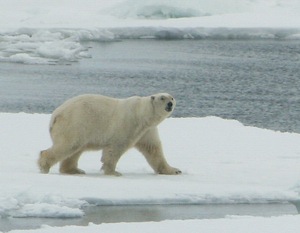
Ellis is the author of On Thin Ice: The Changing World of the Polar Bear (Random House, 2009) and it’s fair to say that he managed to stun Krasny with a declaration that the species is “doomed,” no matter what we might try to do to save it at this point. Ellis says there is already too much warming in the pipeline (what scientists call “committed” warming) to reverse the disintegration of the bears’ arctic habitat.
Polar bear populations have been a topic of persistent confusion, recently amplified in an op-ed piece written by former Alaska governor Sarah Palin for The Washington Post.
According to the advocacy group Polar Bears International, there is little room for doubt about the animal’s decline. The organization’s website breaks down the numbers, which point to a “scientifically documented decline in the best-studied population, Western Hudson Bay, and predictions of decline in the second best-studied population, the Southern Beaufort Sea.”
The PBI analysis goes on to explain that:
The Western Hudson Bay population has dropped by 22% since 1987. The Southern Beaufort Sea bears are showing the same signs of stress the Western Hudson Bay bears did before they crashed, including smaller adults and fewer yearling bears.
At the most recent meeting of the IUCN Polar Bear Specialist Group (Copenhagen, 2009), scientists reported that of the 19 sub-populations of polar bears, eight are declining, three are stable, one is increasing, and seven have insufficient data on which to base a decision. (The number of declining populations has increased from five at the group’s 2005 meeting.)
Regardless of whether you share the conclusions of Ellis and PBI about the future of the “poster child for global warming,” the Forum interview is a fascinating hour.
Despite the addition of 81 million people over the period, Americans were using less water in 2005 than they were in 1975, according to the latest numbers released from the USGS.
The per-capita decrease of 30% since 2000, down to 1383 gallons per person per day, is a level not seen since the 1950s. Of course this doesn’t mean that each person in the United States is using more than a thousand gallons per day at home–that number is somewhere between 54 (if you live in Maine) and 190 (if you live in Nevada). The USGS number is derived from dividing total water withdrawals by total population. In 2005, the total withdrawal was 410 billion gallons per day (5% less than in the peak year, 1980) and the total population was approximately 310 million.
An analysis by the Oakland-based Pacific Institute finds that the changes in national water use are due to improvements in efficiency, particularly in industrial use and irrigation. However, the largest category of water use–that used for producing energy–is growing (by 3% between 2000 and 2005), and the analysis cites this as a worrying trend as the population increases, particularly in dry parts of the country. In 2005, 49% of all water withdrawals were for cooling power plants.
“Far more water is required for nuclear and fossil fuel energy systems than for most renewable energy systems,” said Peter Gleick, president of the Pacific Institute, in a statement about the new numbers. “Water availability will increasingly limit our energy choices as climate change accelerates and population continues to grow.” California’s two commercial nuclear plants are located on the coast and use sea water for cooling.
More efficient farming seems to be one of the bright spots in the report. Irrigation withdrawals in 2005 declined to the 1970 level of 1.28 billion gallons per day, even though the amount of irrigated land in the nation has increased by millions of acres since 1970. It seems that American agriculture is, in fact, doing more with less, thanks to more efficient sprinklers and drip irrigation systems. Even so, agriculture still claims about 77% of “developed” water in California, according to Ellen Hanak, water policy analyst with the Pubic Policy Institute of California.
The Pacific Institute commentary added some sobering notes:
The United States, although relatively water-rich, faces a range of threats to its vital supplies of freshwater. Overuse has turned the Colorado River into little more than a trickle. Overuse and contamination threaten the massive Ogallala aquifer, which runs from Texas to South Dakota and is an important source of irrigation and drinking water. Political and economic conflicts are growing between Alabama, Florida, and Georgia over water use. And other serious threats to our water resources – including climate change, environmental destruction, and population growth – remain unaddressed.
Household water use across the country is growing proportionately to U.S. population growth. While people are becoming more water-efficient at home, these behavioral changes are being balanced out by a shift in population to hotter, drier areas, such as the Southwest.
The Pacific Institute’s Circle of Blue Water News has interactive maps showing which states have decreased their water withdrawals between 2000 and 2005 and total water withdrawals by state for this time period, as well as charts tracking U.S. water withdrawals since 1950.
11/18/09 Update: Listen to audio of Peter Gleick discussing the report’s findings on today’s broadcast of NPR’s Morning Edition.
As Governor Arnold Schwarzenegger wrapped up his three-day Global Climate Summit today, with signatures and ceremony, the U.N.’s top climate official set a sobering tone with his own parting shot.
In a final panel this afternoon, the Governor was joined by former Prime Minister Tony Blair and Rajendra Pachauri, who chairs the U.N.’s Intergovernmental Panel on Climate Change (IPCC). Pachauri said the worst-case scenarios from previous climate modeling appear to be coming true, and warned that the next climate change assessment from the IPCC, due out in 2014, “will alarm the world.”
Then he went on to reiterate a prediction he made before the U.N. earlier this month; that based on the science he’s seen, 12 countries are in danger of becoming failed states due to the impacts of climate change. And while he stopped short of listing the nations, previous statements appear to imply that several of the states on his list are in Africa.
Elsewhere at the summit, 30 delegates from state and local governments around the world signed a final agreement to collaborate on climate change. If they follow through with some muscle on the partnership, they’ll be collaborating on clean transportation and on climate adaptation strategies.
Governors from Brazil, Indonesia and U.S.also called on their national governments to address deforestation at the UN climate treaty talks in Copenhagen. Forest loss accounts for 20% of climate emissions globally. California also signed its agreement with the Jiangsu Province of China.
The three-day summit’s title was “On the Road to Copenhagen” and the international talks have been front and center in the discussions here. The governors attending would like their role in combating climate change formally recognized there. They see themselves on the front lines of climate change, as evidenced by this much cited statistic: 50-80% of the emissions cuts needed to reach the UN’s goals will be implemented by states and cities.
But despite the Copenhagen-mania, Schwarzenegger stuck with his subnational message, saying: “Climate change isn’t all about this one treaty.” Even if the talks at Copenhagen fail, he says states and provinces should keep forging ahead.
Climate change has California’s birds on the move, but not in the usual direction or at the same pace, a new study has found. Research suggests that warming temperatures and changing precipitation patterns will cause bird species distributions to shift independently, resulting in new bird “communities” appearing in up to half the state.
In some cases, these new communities will create combinations of birds that have never existed before, a situation that could disrupt the delicate balance of species interactions with potentially unanticipated consequences for whole ecosystems, the report authors concluded.
One of the co-authors, Stanford biologist Terry Root, told Climate Watch: “This will not be just a few species in a few locations–this tearing apart of communities could be quite extensive across California.”
The study authors, including Terry Root of Stanford and Diana Stralberg and John Wiens of PRBO, write that the emergence of new bird communities in the coming decades present enormous conservation and management challenges. They assert that rapidly changing habitats and ecological communities are going to require new approaches to conservation and management. “As new combinations of species interact, some species will face new competition and/or predation pressures, while others may be released from previous biotic interactions,” they wrote. “Managers and conservationists will be faced with difficult choices about how, where, and on which species to prioritize their efforts and investments.”
Root pointed to experience with wolves, coyotes and foxes, in which wildlife managers tried to control one, only to see unexpected spikes in the population of another: “Here is a community of only 3 canines to which we purposely forced changes, and we had two big surprises. Now we are talking about 70 species of birds shifting without any control of the force or the species being changed. I guarantee there will be a lot of surprises.”
A one-fifth reduction in per capita water use by 2020 is among the goals outlined in a new state report on adapting to climate change.
Released by the California Natural Resources Agency (CNRA) as a “discussion draft,” the 2009 California Climate Adaptation Strategy is being billed as the nation’s first comprehensive game plan for adaptation to climate change.
Photo: Reed Galin
Most of the state’s high-profile climate initiatives (and battles) have been about mitigation; how to reduce greenhouse gas emissions to slow down warming. This report swings the spotlight over to adaptation; what needs to be done to accommodate the climate change effects that are already “in the pipeline.”
While the California’s centerpiece climate law was passed three years ago, this week’s CNRA report concedes that “adaptation is a relatively new concept in California policy.” The 161-page white paper comes in response to an executive order from the Governor last fall, calling for a statewide adaptation strategy.
The draft divides the strategy into seven “sectors:” Public health, biodiversity and habitat, ocean and coastal resources, water, agriculture, and forestry.
Tony Brunello, Deputy Secretary for Climate Change and Energy at CNRA, says “This is the first report that really looks at how climate change is going to impact the state and what we need to do about it.”
But Brunello stopped short of conceding that mitigation is a lost cause. “You only have half a deck if you’re only focused on mitigation,” he said. “You need to focus on both mitigation and adaptation to truly be prepared.”
Some strategies attack both. Brunello points to water conservation measures, which save both water and energy (20% of the energy used in the state is deployed moving water around).
The plan is designed to work in consort with the California Air Resources Board’s implementation plan for AB-32, the state’s multifaceted attack on greenhouse gas emissions. CNRA says one of its goals is to “enhance” existing efforts, rather than create new programs and offices that need funding.
CNRA also promises to use the “best available science in identifying climate change risks and adaptation strategies.” Andrew Revkin has a useful overview of the mounting challenges to climate scientists, published this week in the New York Times.
One planned product from the adaptation plan is an interactive website devoted to climate adaptation, with maps and data to assist local planners. CNRA hopes to have that in place by early next year. The draft plan now enters a 45-day period for public comment.
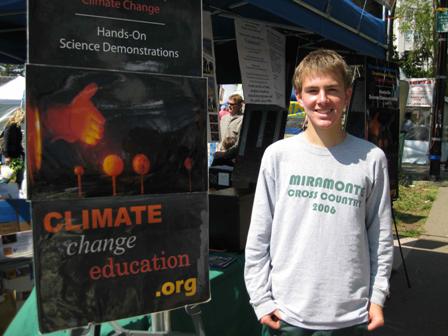
Devin Finzer is a 2008 California Climate Champion from Orinda who graduated from Miramonte High School in June. In this guest post for the Climate Watch blog, he describes how he and fellow Champion Patrick Ouziel were able to start a carpooling program at his school.
Walking to my high school each morning, I trekked past long lines of backed-up traffic. Driver after driver waited anxiously for his or her chance to round the corner into the Miramonte High School lot and hunt for a coveted parking spot. For the most part, each car contained just one person. The passenger seats of large SUVs and mini-vans were often left completely empty. The early-morning situation involved stress, traffic congestion, and unnecessary pollution. Fellow student Patrick Ouziel and I decided we could do something about it.
As California Climate Champions sponsored by the California Air Resources Board and the British Council, Patrick and I are engaged in local and international efforts to take action and spread awareness about climate change. One of the main environmental issues we noticed at our high school was the way students get around. With after-school sports and club activities, juniors and seniors take advantage of their newly earned driver’s license, but by driving only themselves, they often missed out on easy, cost-beneficial, and eco-friendly ways to group together with other students traveling their same route.
Patrick and I are proud to have lobbied for the expansion of our school’s carpool system, which provides carpoolers with designated parking spots each morning. During the school year, we produced several videos promoting eco-friendly transportation and climate awareness, and linked these videos to a web site where students could demonstrate their support for increasing the percentage of carpool spots at our school. We also provided an option where students could sign up as “potential carpoolers” in order to find other ride-sharers who lived close by.
The result? With the support of students and the administration, we transformed our parking lot reserved for high school seniors into a lot exclusively for carpoolers. Now 80 spots, about 30% of our entire lot, are reserved exclusively for carpoolers.
What are the environmental benefits for the new program? While differing gas mileages and travel distances make exact calculations difficult, we do know that carpooling with just one other person already cuts per-person emissions, as well as gas costs, in half, and we can estimate that our carpool system inspired about 40 additional carpool groups.
While deciding to carpool almost seems almost like a no-brainer, Patrick and I did face significant barriers when we emphasized the importance of ridesharing. From the get-go, one of the main obstacles we had to address was the relationship between driving and teenage independence. Every sixteen-year-old remembers the day he earns his license: the fresh feeling of the driver’s seat and the thrill of taking the wheel, free from parental supervision. Americans clearly love to drive, and apparently, many of us love to do it by ourselves — a 2005 U.S. Census Bureau survey says 77 percent of American workers drive to and from work alone.
In our awareness videos, Patrick and I emphasized that carpooling doesn’t have to be a sacrifice of this independence. Rather, it can be an effective symbol of collaboration: sharing a ride is an opportunity to spend time with friends, or to get to know new people. Teenagers are social beings who feel most content when they are connected with their peers. That’s why we emphasized the importance of a collective carpool movement built on the strong sense of community at our school.
Advocating carpooling can be a great way to start a green movement at your own school or workplace. There are a number of web sites that match potential carpoolers and make ridesharing easy. I’ve reviewed a few of the better-known ride-matching sites on my blog.
Patrick and I will both be going to school on the East Coast next year, Patrick at Yale and myself at Brown. We plan to continue our climate change activism. In particular, I’d like to encourage the installation of solar panels on the roofs of high schools and universities. Our continued environmental efforts will be documented on my blog.
Special thanks to Climate Watch intern Kristine Wong for help with this post.
 A
A  Louis Blumberg directs the California