Climate, Corn, and the Coming Market Chaos

Climate change has an outsize effect on corn price volatility

Climate change -- and the ensuing heat waves -- will create more volatility in the corn price market.

By Michael D. Lemonick

Farmers know all too well that the prices they get for what they grow can fluctuate from one year to the next, sometimes wildly. Drought or heat can reduce crop yields; so can frost and floods. For corn producers, the Renewable Fuel Standard, which mandates the addition of ethanol to gasoline, is yet another source of volatility. It puts extra demands on whatever supply there is, making corn more expensive for consumers even as it puts more money in farmers’ pockets. And overlaid on top of it all is climate change, which exerts its on push on the ups and downs of weather.

Scientists have looked at different pieces of this equation, but researchers from Stanford and Purdue have analyzed the entire equation, in a paper just published in Nature Climate Change, and determined which factor causes the most trouble: it’s climate change, and for Stanford’s Noah Diffenbaugh, that came as a surprise. “I genuinely expected that climate would be a minor player relative to these other influences,” he said in a telephone interview.
Continue reading Climate, Corn, and the Coming Market Chaos

Foghorns and the Changing Coastal Soundscape

Technology and politics are changing the tune of the maritime chorus

Read the full text version of this story at KQED’s QUEST site.

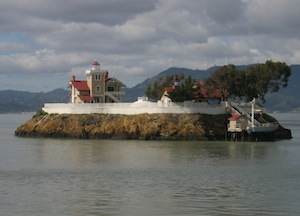
East Brother Island, with the 19th-century lighthouse on the left and fog signal building on the right.

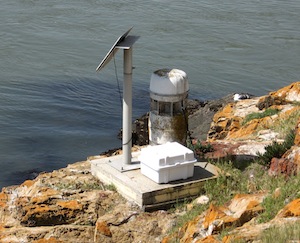
On foggy mornings, I wake up to a faint symphony of foghorns. From my condo on a windy bluff above the Mare Island Strait, the horn on the Carquinez Bridge is the bassoon in the back row, accompanied by the assorted boops and beeps of all the other fog signals within earshot of where the Sacramento River empties into San Pablo Bay.

But the orchestra plays a different tune than it did in decades past. Technology and politics are changing the navigational soundscape of coastal America. Complaints from coastal residents about the repetitive blasts of sound and modern electronic navigation aids have relegated the foghorn to a lesser role in the maritime chorus. Continue reading Foghorns and the Changing Coastal Soundscape

Can Clean-Tech Survive the Coming Funding Drought?

By 2014, federal clean-tech investment may tumble by 75% from its peak in 2009

Government policies and subsidies that support clean-tech are phasing out over the next two years. That could be disastrous for the industry, though it doesn’t have to be, according to a new report from the Brookings Metropolitan Policy Program. In 2009 when federal support was peaking, the industry received $44.3 billion. But the report, entitled Beyond Boom and Bust: Putting Clean Tech On a Path To Subsidy Independence [PDF], projects that by 2014, federal subsidies will have dropped to $11 billion.

“Undeniably, there’s a massive reset before us,” Mark Muro, a senior fellow at Brookings and one of the report’s authors, said this morning on KQED’s Forum radio program. Muro and the other authors examined 92 programs that provide policy or financial support to the clean-tech industry. Of those, 61 have pre-set expiration dates and, unless extended, will no longer be in place by the end of 2014.

Continue reading Can Clean-Tech Survive the Coming Funding Drought?

Thinking Long-Term About Power Plants

A new report warns against the folly of over-investing in natural gas

By Thibault Worth

As the nation's power plants age, a new report warns against relying too much on natural gas.

The nation’s power plants are aging. An increasing number require replacement parts; others can’t keep up with new environmental regulations.

A report released today [PDF] by the Boston-based think tank Ceres estimates that in the next two decades, up to $100 billion will be invested in the electric utility industry every year – twice the amount invested in recent years.

According to the report, that boom in investment will take place in a shifting regulatory environment. Air pollution and greenhouse gas restrictions will increase, and fossil fuel-burning power plants will have to keep up. Governments are setting requirements for energy from renewable sources. (California, for example, is targeting a 33% renewable energy ratio by 2020.) Smart grids and new consumer technologies are changing how people think about energy production and consumption.

Continue reading Thinking Long-Term About Power Plants

What Will Conservation Cost?

Probably billions, as climate change complicates conservation

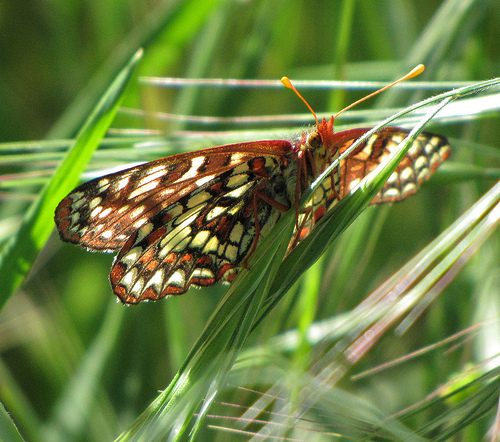
The Bay checkerspot butterfly is one of the species that might need help migrating.

Traditional approaches to preserving biodiversity may not hold up as the climate changes.

One common tool environmental groups use now is to buy land. But that tactic only works if, once the land is protected, the species that live there can stay there. Climate change scrambles that notion. Species won’t necessarily be able to stay where they are in perpetuity. A new study in the journal Conservation Biology (abstract only) examines what it would cost to stick to the current approach and the same conservation goals in one area in California. And that number — again, for just one conservation area — is staggering. By 2100, the study finds, the total price tag will be about $2.5 billion.

“It is a dizzying number,” Rebecca Shaw, the associate vice president of the Environmental Defense Fund and one of the study’s authors, told me. “And it’s dizzying because climate change is dynamic and our conservation strategies are designed for static systems.”

Shaw explains that the current approach — searching out good habitat, buying the land, hands-on management and monitoring — is expensive anyway. But she predicts that climate change will double the cost.

Continue reading What Will Conservation Cost?

How Green is Your EV?

A new study and map reveal that it depends on where your juice is coming from

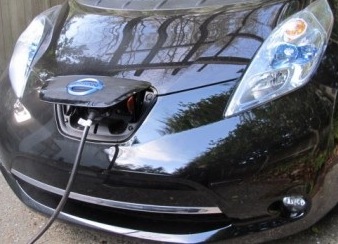
The author's EV gets "tanked up."

Just because an electric vehicle (EV) lacks a tail pipe, it doesn’t mean it’s always cleaner than other fuel efficient cars. According to a new report from the Union of Concerned Scientists, where you live may determine how clean your electric car is.

The new report, called “State of Charge,” looks at the entire life cycle of EV emissions that includes energy inputs from start to finish, not just during drive time. In other words, what kind of emissions do EVs create from charging on an electric grid and how does the cost of that charging compare to filling up a gasoline-powered vehicle? Continue reading How Green is Your EV?

Lightning, Twisters, Snow and Waterspouts (Oh My)

April arrives with a lot more than showers

We saw a little bit of everything around California last week.

Lightning strikes the Bay Bridge last Thursday evening, some of an estimate 740 "ground strikes."

On Friday, a small tornado touched down in Yuba City, sideswiping a car dealership.
A freak April snow shut down a stretch of I-5. That made local papers on the East Coast.
Waterspouts were sighted off Orange County, and a thunderstorm over San Francisco Bay spawned an extraordinary 740 lightning strikes, according to Christine Riley, a forecaster with the National Weather Service in Monterey. Opportunistic photographers caught bolts connecting with iconic bridges and the Transamerica Pyramid.

There was talk on Friday of this being a “record number” but Riley says the Weather Service doesn’t actually track that. It happens that a forecaster in Monterey added up the strikes from this event that showed up on NASA’s Lightning Detection Network. Riley says that figure includes only “ground strikes,” not the bolts that travel cloud-to-cloud. Continue reading Lightning, Twisters, Snow and Waterspouts (Oh My)

Birds and Blades: Are Condors and Wind Turbines Compatible?

Lawsuits pit an endangered species against renewable energy development

This California condor, flying near the coast, is one of about 200 condors living in the wild.

Wind is a growing industry in the Tehachapi Mountains in Southern California. Kern County welcomes new wind projects, and Google has gotten in on the action. But some environmentalists say that developers and officials are ignoring the elephant — or, in this case, the enormous bird — in the room.

California condors are beginning to return to the Tehachapis after nearly going extinct in the 1980’s, and birds and wind turbines don’t mix. No California condors have yet had a run-in with a turbine. But they are still endangered — it’s illegal to kill them — and three environmental groups say that Kern County and the US Bureau of Land Management (BLM) are not properly considering the risks. The Sierra Club, Defenders of Wildlife, and the Center for Biological Diversity filed a lawsuit against the BLM today, regarding one wind development in particular. (They have previously sued Kern County over the same project).

Continue reading Birds and Blades: Are Condors and Wind Turbines Compatible?

How Climate Change Makes Trees Sick

Warmer and wetter weather is good for tree diseases, which is bad news for trees

A patch of tanoak, killed by Sudden Oak Death, in the Los Padres National Forest in Monterey County.

Climate change is likely to wreak havoc on California’s forests. Extreme weather, wildfires and insect outbreaks will all take a toll. Add to those another looming threat: disease. Forest diseases like Sudden Oak Death, which has infected trees in 14 counties in the state, stand to benefit from the effects of climate change, to the detriment, obviously, of the trees.

Trees are big and long-lived. Tree pathogens, mostly fungi and bacteria, are the opposite. They’re mobile, able to blow around on the wind. And they reproduce and evolve rapidly. That’s the crux of the problem, according to Susan Frankel, a plant pathologist with the Forest Service.

“When you look at forest health and the balance between forest trees and the pathogens that attack them, it does seem, given climate change, pathogens get the better end of the deal,” she told me.

Continue reading How Climate Change Makes Trees Sick

California Braces for the Complex World of Carbon Markets

In which Air Board chief Mary Nichols performs a dramatic reading of a vintage Jerry Brown speech

As chair of the California Air Resources Board, Mary Nichols is presiding over the nation’s first comprehensive cap-and-trade program.” credit=”California Air Resources Board

When its nascent cap-and-trade program ramps up later this year, California will be the first state in the nation to reduce greenhouse gases by making a broad spectrum of big polluters buy permits to exceed their allotted emissions.

Other governments, industry and scientists will be watching, but there’s still a lot to sort out. That much has been evident at this week’s carbon market and policy conference in San Francisco, “Navigating the American Carbon World.”

The long and winding road to carbon trading was highlighted by Mary Nichols, chair of the California Air Resources Board, in a little prank she played on the gathering. Obviously reading from a script, she stumbled over words, looked up at the audience, then back down at the page, plodding through her replies to moderator Diane Wittenberg. Continue reading California Braces for the Complex World of Carbon Markets