Category Archives: Water

Potentially the biggest climate impact on life in California

River Diaries, Part 3: Encounters with Civilization

Here are some more journal entries from participants in the Paddle to the Sea project, to raise awareness of river and water supply issues. Two paddlers have pledged to go all the way, from the Sierra to San Francisco Bay. At this point, they’ve descended from the high country and are preparing to traverse California’s Great Valley.
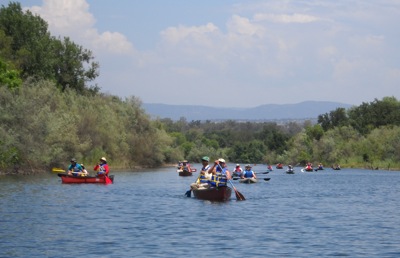
On the tamed lower Tuolumne. Photo: Jesse Raeder

Emilio Martinez: Don Pedro Reservoir & Turlock Lake

After the whitewater thrills of the upper Tuolumne, Don Pedro Reservoir was exciting in the same way that a putting green is exciting: smooth and well-groomed, and so accommodating to the well-mannered sportsman. With the whine of the fishing engine accompanying a distinct lack of visual variety in the blond hills, we boated for two hours towards the Dam, then hiked Bonds Flat Road, then J59 for 2 more hours in the near hundred degree heat, examining road kill for diversion.  Besides the houseboats and odd floating trash, there was not a whole lot to feed the river-bound soul.

So it was with a complete sense that all the excitement that the River Tuolumne had to offer had been expended during the upper portion that I stepped awkwardly into my canoe on the 27th of May. I had already complacently decided that the River was something of a “has been” and would be nothing now but a gentle, rolling presence.

What a complete and arrogant assumption of what the River is, without any knowledge of the true meaning of that word as Nature herself uses it.

The River, in short, thrashed both my thesis–and companion Tim and I like the inconsequential beings that we are before the River’s sublime power and majesty: it slapped us upside the head with willow branches drenched in chilling waters, banged our thighs and knees with the fiberglass canoe we haughtily thought we’d master it with: instead, it made us respect it and fear it: precisely because we are mere visitors to its emerald green kingdom, our canoes so much jetsam and flotsam in its consciousness: in short,  the Tuolumne did everything it needed to do to show us how we must not underestimate Nature, but rather, protect one’s reverence and humility before it so that one can live and be nurtured by it.

Long live the River!
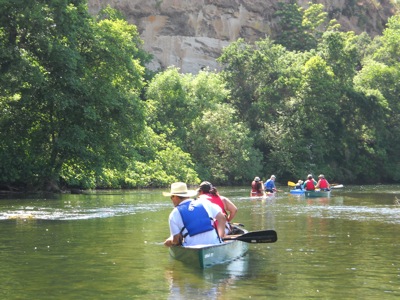
Looking for fish. Photo: Jesse Raeder

Owen Segerstrom: Don Pedro Reservoir

Today’s crossing of Don Pedro was an instructive microcosm of the damage that dams cause. While the former Tuolumne River Canyon rests under hundreds of feet of water, the remaining habitat is a virtual biological desert. Turkey vultures, mallards, and hatchery-raised fish are a far cry from the wildlife of an intact river system. What was once a salmon-bearing, thriving ecosystem sequestering untold millions of metric tons of carbon is now a layer of anaerobic matter at the bottom of the reservoir, the decomposition of which releases methane (a greenhouse gas that is orders of magnitude more potent that carbon dioxide) into the atmosphere.  [Editor’s note: The figure most quoted by scientists is that methane is about 20 times more potent than CO2 as a greenhouse gas. In California, however, livestock and leakage from oil & gas operations are much bigger emitters of methane than natural decomposition from lakebeds].

Upon arrival at the dam, Emilio, Mason (a friend of mine from Kentucky who accompanied us) and I were presented with an interesting conundrum.  Despite indications to the contrary from National Geographic’s mapping database, there is no trail from the dam to the Old La Grange bridge.  After consulting a local ranger, we determined that the only way to walk this leg of our journey was on the side of Bonds Flat road and eventually J59 (approximately 7 miles).  The partially decomposed remains of a fox, whose life was ostensibly claimed by a motorist on the highway, were yet another sobering reminder of the human-caused chasm between a Mt. Lyell-to-the-Pacific river system and the Tuolumne’s current state.  We maintained morale by nicknaming this stretch of our sojourn the “great asphalt eddy of the T,” but the experience was nonetheless jarring.

After the experience at Don Pedro, the first section of the Lower Tuolumne was quite literally a breath of fresh air.  Heritage oaks, the call of an osprey from its nest along the river bank, and the water’s peaceful meander were a feast for the senses.  The integration of community advocacy groups throughout the valley is a hopeful sign for the future of freshwater consciousness, and the results of their efforts are evident.

Though anadromous fish passage beyond the Old La Grange Dam is still impossible, the efforts to address disastrous impacts on salmon populations (an unparalleled gauge of the health of a river ecosystem) between this impasse and the ocean are inspiring.  Salmon have been described as the conscience of a watershed, as they represent the lone upstream vector for ocean nutrients that have historically fertilized inland ecosystems.  The conscientious cooperation of central valley communities along the Tuolumne represents the utterly necessary prevention of local extinction of Chinook salmon.

[Editor’s Note: Here’s the latest biological opinion on California’s Chinook salmon and how it stands to affect water supplies.]

Turlock Lake to Waterford Park

Today’s paddle began with a conversation about the history of California river advocacy. As our group went through individual introductions, many of the participants recalled the (ultimately unsuccessful) efforts to prevent the damming of the Stanislaus River in the late 1970’s, including Mark DuBois chaining himself to a riverside boulder in protest.  While the beauty and avian abundance of yesterday’s journey punctuated the beginning of our day, reminders of the need to rekindle Mark’s passion quickly confronted us.  The soundscape for our lunch break was provided by an industrial gravel pit, the footprint of which has massively diverted the river channel.  As one volunteer pointed out, the beautiful hyacinth blooming in the pond adjacent to the pit were nonetheless a dubious indicator of the river’s ecological health.  The day culminated in a rousing gathering of Waterford’s riverfront restoration community at the local park,  A group of children enjoying a game based on answering questions about salmon presented hope that somewhere there is a young person who will carry Mark’s torch in defense of the Tuolumne’s continuity.

Our posts are running a bit behind the paddlers’ progress. In real time, they are set to cross San Francisco Bay today and conclude their journey tomorrow, with a celebration at Aquatic Park in San Francisco.
More Adventures “Paddling to the Sea”

Here are some more journal entries from participants in the Paddle to the Sea project, to raise awareness of river and water supply issues. For most, it’s a relay event and they’re taking a leg or two of the voyage from the upper Tuolumne to the San Francisco Bay. But two paddlers have pledged to go all the way. Here are some of their observations.

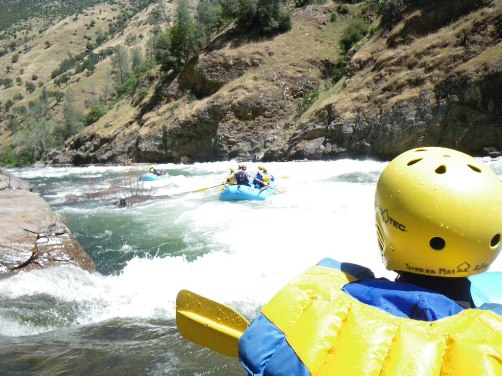
Facing the froth--and mortality--on the Tuolumne.
Facing the froth--and mortality--on the Tuolumne. Photo by Jayne Johnson.

Emilio Martinez: whitewater section, Tuolumne River

Once the green terror subsided and I knew I might not drown, rafting the “T” (river rat lingo) was an absolute blast! Our blue rafts, manned by a crew of four apiece, plus an experienced guide at the helm, put in about ten miles upstream from where the Clavey River and the Tuolumne River meet in a thunderous embrace. And I am not ashamed to tell you that seeing the river run at 7000+ cubic feet per second was exhilarating to the point of terror. Whether due to climate change or pure luck, the Tuolumne was in fine form that weekend: racing down its bed like some aquatic serpentine creature from another dimension, wildly snaking its way through ancient bedrock as it bucked and thrashed, arching into the wind, pummeling its way through narrow confines of rock and tree as only a force of nature unleashed can.

For two days, thirty of us clung to the River, loving it and fearing it, crawling out of our rafts each day, tired and hungry, but somehow spiritually cleansed by the only worldly thing I’ve ever known that I can call sacred.

Unlike my rafting cohorts–who likely must travel some distance to the “T” to pay it homage–as denizens of Modesto’s “Airport District,” we are blessed with the Tuolumne as a constant benevolent feature of our neighborhood (emphasis on hood), which squats on the River’s banks, roughly one square mile of humanity and squalor broiling in the San Joaquin Valley, and whose inhabitants are more known for our deficits than our merits, for our God-fearing ways rather than earth-loving hearts.

My first encounters with the “Tuolumne” were a mix of horror (fear of drowning), awe (Pentecostal baptisms), joy (childhood treasure hunts at the Modesto landfill – now filled up and landscaped into something called the Tuolumne River Regional Park), and food (Mexican fiestas, where beer, barbeque, and corridos mixed nicely).

And, as befits my low-income neighborhood: I am still largely ignorant of the ecology of this gorgeous river.

So, speaking for myself, my trip down the Tuolumne River is something like an awakening to nature in the Garden of Eden, for there is precious little vocabulary in the noisy, backward streets of the Airport District for the marvels of nature that abound on the banks, canyons, and hillside forests that flank the River: though we children of the Airport grow up touching the River almost daily, we are taught almost nothing about its nature or how to address it.

Shame.

Still, I figure (hope) that my vocabulary for its flora and fauna and geology will grow as I flow downstream towards the San Francisco Bay; that I’ll be able to distinguish an oak from alder some day, egret from swallow, poison ivy from blackberry vine, and that my eyes will see “salmon” and not just vague swimming things.

I exaggerate, but not by too much.


Emilio Martinez grew up in the Central Valley and currently lives in Modesto. The rivers are uncharted territory for him and have inspired his poetic side.

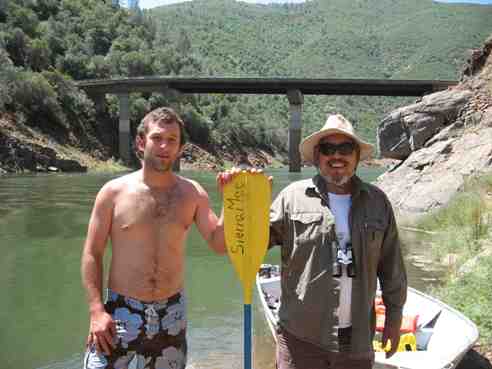
Segerstrom and Martinez on the river.
Segerstrom and Martinez on the river. Photo by Jayne Johnson.

Owen Segerstrom: whitewater section, Tuolumne River:

It is a privilege to be on the “T” (Tuolumne River) during a peak snow melt flow like the one we experienced over the weekend.  My cousin Tom, son of Sierra Mac founder and TRT (Tuolumne River Trust) board member Marty McDonnell, said it was the second highest flow he had ever seen (out of an estimated thirty-five trips).

Our guide, an east coaster working his first season for Sierra Mac, opined that the T would be the national gold standard in whitewater if such flows were a regular occurrence. We took a nasty swim on a 4+ rapid called “Frame Crusher,” a humbling reminder of the river’s power.  The excitement of the water conditions was rivaled only by the magnificence of the river canyon itself.  As if to remind us not to stay away for too long, a bald eagle swooped above us on an up-canyon trajectory less than a mile before the take-out.

Owen Segerstrom grew up in Sonora, near the upper reaches of the Tuolumne River, and spent his childhood and teenage years exploring the Tuolumne and Clavey swimming holes.  He’s also done quite a bit of rafting on the Tuolumne.


Navigating the Urban Water Jungle

Follow Gretchen’s radio journey to cut her own water use by 20%. Her story aired May 29 on The California Report weekly magazine.


Gretchen Weber
Photo: Gretchen Weber
Saving water when you live in an apartment isn’t as hard as it might seem.

I know the motivation might not be there to take shorter showers when you see your neighbors watering their lawns in the middle of the day or local restaurants hosing down the sidewalks, but cutting back on your water use (or at least feeling less guilty about those long showers) can be as simple as swapping out your old shower head for a lower-flow model, screwing some aerators onto your faucets, and, for the sufficiently motivated, talking to your landlord about installing higher-efficiency toilets.

For me, the first and last stop was calling my utility company, San Francisco Public Utilities.  They sent out a water expert armed with free devices for my flat, and in less than an hour we’d outfitted the kitchen and bathroom to be much more water efficient.   Save our H2O, a website sponsored by the California Department of Water Resources, has tons of conservation resources including a rebate finder and a list of the state’s local water agencies.

But since I know not every utility offers free devices to customers, last night I dropped by The Home Depot in Daly City, to see what’s available.  I have been inside one of these orange megabox retailers exactly three times in my life and it’s always a bit of sensory overload.  There must have been close to 100 shower heads to choose from, but it wasn’t easy finding one with a low-flow (1.5 gallons per minute) rating.  No matter the price or the size, every model I picked up was either 2.5 gpm, or I couldn’t find the flow rate on the packaging.

Gretchen Weber

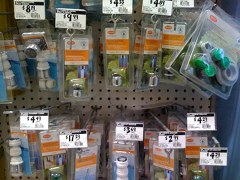
Faucet aerators at The Home Depot

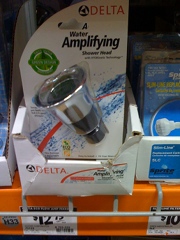
I finally asked a salesman who at first couldn’t find one either.  But eventually, he found one tucked in among the others: the Delta Water Amplifying Shower Head, for $12.75.  It’s actually 1.6 gpm, and it looked kind of  small and cheap,  although it may work fine.  I felt a little disappointed that this was my only option.

Hoping for better luck, I wandered over to the aerator section one aisle over.  There I found aerator aficionado heaven.  Once again, the selection was a little overwhelming.  There were probably 40 aerators to choose from–aerators, no less.  Low-flow, 1.5-gpm models like the kind the SFPU gave me ranged in price from $2.99 to $17.39 for the upscale brushed-nickel variety.

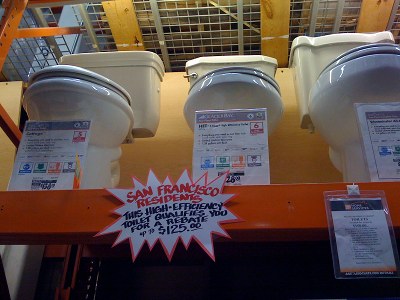
Across from the aerators were the toilets.  I scanned the high shelf and saw several low-flow models (1.6 and 1.28 gallons per flush) that were priced between $90 and $128.  Taped to the toilet shelf was a sign reading that San Francisco residents may be eligible for a $125 rebate on a low-flow model, which could basically mean a free toilet.  Other cities and counties in California have similar rebates.

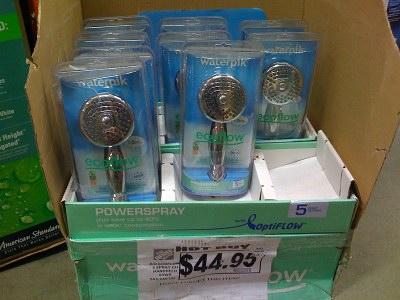
As I turned to leave the toilet/aerator aisle, I bumped into a large box sitting on the floor.  There, far from all the others, was the shower head I’d been looking for:  a 1.5 gallon-per-minute WaterPik EcoFlow with five different pressures, including something called “Powerspray.”  Touting a 40% water savings, these puppies were on sale for $44.95.

Gretchen Weber
Water Pik Eco Flow Shower Head Photo: Gretchen Weber

Rick Soerhen, the Deputy Director of Water Use Efficiency for the California Department of Water Resources told me that people living in apartments most likely already get “gold stars” for water conservation because they probably aren’t watering lawns and gardens.

So, flat-dwellers, be proud. But if you really want to be as water efficient as possible, devices like these can make a big difference on your total usage — without requiring three-minute showers.

Paddling to the Sea

Jessie Raeder is Bay Area Organizer for the Tuolumne River Trust. More than 200 paddlers are expected to take to the river between now and June 7, for this river awareness relay. Raeder offers this dispatch from the starting line, near the headwaters in Yosemite National Park.

By Jessie Raeder

Paddle to the Sea got off to a roaring start over the weekend.  Melting snow caused by an early heat wave in the Sierras had the river pumping at much higher flows than rafters typically face. The Tuolumne is usually rated Class 4–but goes to Class 5 when flows get over 4000 cubic feet per second.   This weekend saw the river flowing at 7000 cfs! For a while it looked like we might have to cancel all the whitewater trips due to safety concerns, but in the end one trip did go on and needless to say it was an epic journey for our Paddle-to-the-Sea team.

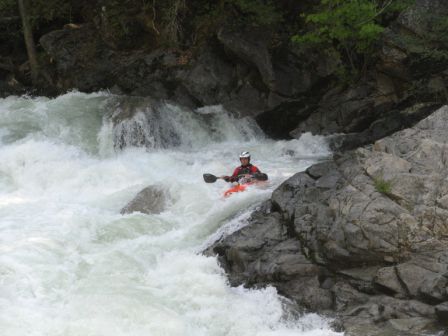
A paddler takes on the Clavey. Photo:
A paddler takes on the Clavey. Photo: Patrick Koepele, Tuolumne River Trust

Meanwhile, an international team of 12 hotshot kayakers ran the Clavey River, a tributary of the Tuolumne and one of only three remaining free-flowing rivers in the Sierra.  The Clavey is a class 5+ river that’s rarely run and only by experts.

Paddle to the Sea is a three-week festival to foster stewardship of the Tuolumne River. Hundreds are joining in this epic journey from the Sierra to the Sea. Kayakers and rafters will begin on the upper stretches of the Clavey and Tuolumne Rivers, travel through the Central Valley where canoers take the lead, pass through the confluence of the Tuolumne and San Joaquin Rivers, and sea kayakers will finish the trip in San Francisco Bay.

A changing and increasingly unpredictable water supply will be the first way that most people in California experience climate change affecting their own lives.  Here in the Bay Area, tap water for 2.5 million people comes from the Tuolumne River, whose headwaters start with melting snow from the Lyell Glacier (picture attached).  That glacier is on the retreat, and more frequent droughts are expected throughout the Sierra.

Paddle to the Sea is meant to demonstrate that issues that affect one section of the river ripple up and down the watershed.   Bay Area water users share this resource with farmers in Modesto, anglers in Yosemite, the commercial salmon industry on the Pacific, and a host of native fish, plant, and wildlife species, many of which are endangered.

As population and demand for water continues to grow, California will be faced with many questions about how we use water, and where it will come from.  The Tuolumne River Trust is working to ensure that we turn to water efficiency and water recycling as much as possible–alternatives which are far more sustainable and renewable than continuing to take additional water from the Tuolumne River, which has been the solution most turned to in the past.


California’s Water Meter Rebellion Withers

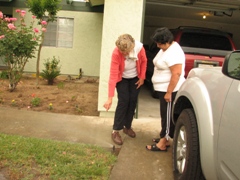
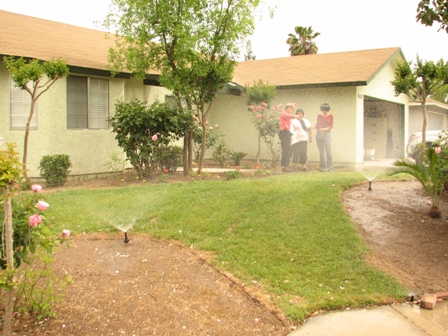
City water conservation specialist Marilyn Creel shows Fresno resident Mary Ann Evans how to adjust her sprinklers to point them away from the sidewalk.

Monday on The California Report, Central Valley Bureau Chief Sasha Khokha tracks one city’s longstanding rebellion against water meters–and says the day of reckoning is nearly at hand. Listen to Sasha’s story here.

I admit it. I wanted to do this story because I saw so many of my neighbors watering their driveways. What I learned is that unmetered cities are a long and slow-dying tradition in the Central Valley.

Martin McIntyre, who used to head Fresno’s water agency, explained how vehement anti-metering forces swayed voters and banned meters in the city charter:

“They were really false arguments. The simple phraseology was ‘meters are taxing machines,’ and they’re going to use meters to fund city hall activities. And, in fact, as is the case for all municipal water supply systems, the funds collected from ratepayers by law can only be used for the operation and improvement of the water supply system. Nonetheless, that resonated with some of the public and it was very easy for a handful of people to get prominent headlines above the fold simply by saying city hall is taxing us to death.”

State lawmakers overrode Fresno’s rule, because they understood that cities with meters use less water.

Ellen Hanak, a water researcher with the Public Policy Institute of California, has found that metered cities use about 15 percent less water than unmetered cities. And cities with a tiered rate system save an additional ten percent on top of that. In addition to usage, her report compares different cities’ water rates. Of course, San Franciscans get away with using less water because–guess what? Many of them don’t have front yards.

Hanak crunched statewide residential water rate numbers and determined that more than half of San Joaquin Valley residents don’t have water meters. (For further details, read the survey disclaimer.)

But meters are coming, one way or another.

There are basically three laws that will eventually require the entire state to install water meters. One says that all homes built after 1992 must have meters. Another dictates that cities that get federal water (like Fresno) have to install meters by 2013. And yet another law says that all California cities (including holdouts like Sacramento) have to be metered by 2025.

Fresno is gearing up to install its first meters this year. They’ve even created a handy Q&A for skittish customers.

And if you thought Central California was the only laggard, this might make you feel better: many Chicago residents don’t have meters, either.

But they probably don’t have the sprinkler ladies–who can fix any leaky, squeaky, spritzy sprinkler, and make sure it’s pointing away from the sidewalk.

KQED’s Sasha Khokha braves sprinkler spray to record Fresno’s city water conservation team at work.

“The Australian Reality”

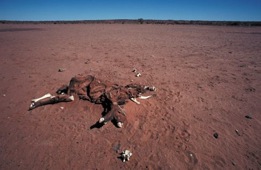
Australia's Simpson Desert. Photo: Mike Gillam

Referring to Australia’s seven-year drought, that’s how the state’s top water manager describes the new paradigm for water planning at the Dept. of Water Resources.

Speaking to a packed house at the annual forum of the Sacramento River Watershed Program yesterday, DWR Director Lester Snow said his staff is assuming that 2010 will be another dry year. Snow warned about “loss of resilience” in the state’s water system, calling it “completely unsustainable” in it’s present form, given predictions for population growth, coupled with anticipated effects of climate change.

All speakers at the forum seemed to agree that a paradigm shift is in order. Thomas Philps, a strategist at SoCal’s Metropolitan Water District, pointed out that in Victoria’s capital city of Melbourne (Australia), per capita water consumption runs about 40 gallons per day, while in California’s capital, it’s 280 gallons. As Sasha Khoka will report Monday morning on The California Report, Sacramento is just one of several cities in the Central Valley that still doesn’t meter its water use. Philps added that the Sacramento region is “on a trajectory” to use the same volume of water as Los Angeles, though he did not say by when.

UC Davis geologist Jeff Mount cautioned against relying on additional surface storage to secure California’s water future. Not only does storing water become “very expensive” year over year, but dams and reservoirs “don’t create any new water,” he said. (If some think Mount is taking a “jaundiced view” of the situation, it might be because he braved a bout of hepatitis to deliver his morning talk)

In a panel discussion on resource planning, moderator Greg Zlotnick of the Santa Clara Valley Water District asked panelists to respond with “true” or “false” to a quote from the Pacific Institute’s Peter Gleick in a story aired on NPR last week. The quote, as given by Zlotnick, was: “Government has built infrastructure and made promises that can’t be kept.” Here are the panelists’ responses:

Tina Swanson, The Bay Institute: “True.”

Philps: “True, but…” (Generally true but MWD doesn’t really expect to get its full contractual allocation of water anymore, anyway)

Don Glaser, US Bureau of Reclamation: “False, but…” (Water allotments from his agency’s Central Valley Project are intended to be “supplemental contracts,” to augment use of groundwater and other sources, but Glaser sees the statement becoming “more and more true in the future.”)

Snow: “Hell, no.”

NPR Spotlights California Water Issues

farm_0799_blog1

NPR’s Morning Edition launched an “occasional series” on California’s water woes this morning. Veteran correspondent John McChesney begins with the impact on agriculture in the Central Valley’s Westlands Water District, the nation’s “biggest irrigated region.”

KQED’s Central Valley Bureau Chief and Climate Watch contributor Sasha Khokha will have three stories in the series, two of which will debut on The California Report in the weeks ahead:

WATER METERS: Many California cities are preparing for or implementing mandatory water rationing this summer. But there are still cities and towns, particularly in California’s Central Valley, where water can’t be rationed because residents don’t even have water meters.  Residents are charged a flat rate for any amount of water they use. Khokha looks at the city of Fresno, where water meters will be phased in, but not until 2013.

MENDOTA PROFILE: The town of Mendota in California’s Central Valley is at the heart of the economic crisis spawned by drought and the loss of farm jobs.  Sam Rubio grew up here, the son of a Mexican farmworker.  He went off to college, and was planning to become a doctor, but instead has returned to this town to teach biology, mentor local kids, and run a café that’s become a haven for the farmworker youth.

AG ADAPTING TO DROUGHT: California farmers are facing an increasingly uncertain water supply, brought about by drought, environmental restrictions on pumping, and climate change. How will farmers adapt? Some of them are yanking out water-intensive crops and replacing them with more drought-tolerant ones. But others are trying to keep growing the same crops with improved technology. We’ll follow a new tech start-up that’s helping farmers use water more efficiently by tracking how much moisture reaches each plant in their fields–and sending a satellite message to their cell phones. We’ll also talk with a researcher who says there are ways California can grow some key crops, like oranges and nuts, using less water.


Decoding California’s Drought History

Abbie Tingstad is a paleoclimatologist at UCLA. She specializes in reconstructing drought records in the western United States, and takes us along on some of her field research in this guest post:

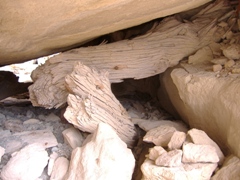
Part of a Piñon pine beam under the collapsed rock shelter. This beam was one of several sampled for tree ring analysis. Photo by Abbie Tingstad.
Part of a Piñon pine beam under a collapsed rock shelter. This beam was one of several sampled for tree ring analysis. Photo by Abbie Tingstad.

By Abbie Tingstad

The site was so remote we needed a team of archaeologists and a couple of heavy-duty 4x4s to get us there.

Deep within the rocky piñon-juniper cliffs of northwestern Colorado was a secret so well hidden I didn’t see it until I was physically inside, face-to-face with a series of hand prints made over a thousand years ago. This rock shelter was occupied during Medieval times by Fremont Indians, contemporaries of the Anasazi whose cultural center was further south in the Four Corners Region. The site had already been excavated, but our interest as dendroclimatologists was not in artifacts. We had come to take samples from the ancient piñon and juniper beams that once supported this structure for the valuable paleoclimate information contained within their annual growth rings.

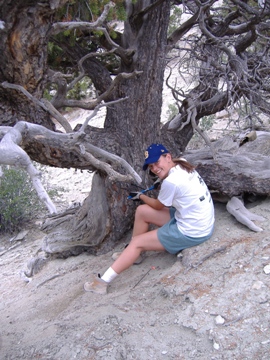
Tingstad sampling a live Piñon pine tree in northeastern Utah. This tree is about 550 years old. Photo by Glen MacDonald.

Gathering Medieval climate information from tree rings, lake sediments, and other natural climate archives in the Western US is critically important for understanding the implications of increasing temperatures in this region, particularly when it comes to future water supply and demand.

Research has confirmed that temperatures rose in the Western U.S. from about A.D. 800-1300, which translated into a series of droughts. The most devastating of these occurred in the mid-11th and 12th Centuries, when dry conditions persisted for several decades and may have contributed to the collapse of the Anasazi and Fremont cultures.

Paleoclimate data from tree rings and other sources also suggest that the mechanism driving drought during the “Medieval Warm Period” was eastern Pacific Ocean cooling. Like a widespread, extended La Niña event, cool sea surface temperatures may have strengthened the persistent moisture-blocking system of high-pressure off the West coast, nudging storm tracks north.

While the Medieval period is an instructive analogue for the warming we are beginning to experience, it is an imperfect one. Two major factors separate the episode the Fremont and Anasazi experienced a thousand years ago from what we are just beginning to undergo today. First, Medieval warming appears to have been fostered by a combination of increased solar irradiance and decreased volcanic activity, rather than anthropogenic greenhouse gas emissions. Secondly, Medieval times were characterized mainly by summer warming, while winter and spring temperatures are expected to increase most dramatically in the future. These differences manifest themselves in many ways, but notable for the water-starved West are the implications for decreased winter snowpack and earlier spring river discharge.

The Medieval Warm Period may not offer a precise preview of our future, but it serves as a valuable warning about the tenuous balance of water supply and demand in California and the Western US, something the occupants of the Fremont rock shelter we visited were likely aware of.

Since the turn of the new Millennium, drought has been the norm rather than the exception in this region and the end is not in sight: As of May 1, 2009 surveys suggest that the Sierra Nevada snowpack is two-thirds of normal. What we can learn from Medieval times is not to expect “normally” moist conditions to return any time soon, and to plan accordingly.

Sierra Snow Season Ends with a Whimper

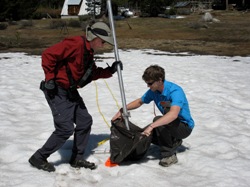
Surveyor Frank Gehrke takes on last poke at the season's shrinking snow pack. Photo by Craig Miller.
Surveyor Frank Gehrke takes one last poke at the season's shrinking snow pack. Photo by Craig Miller.

When veteran snow surveyor Frank Gehrke stuck his aluminum tube into the thinning snow course at Phillips Station this morning, the “Mount Rose” snow gauge stopped dead a few inches in. He then withdrew a sad little cylinder of corn snow, about the size of a flashlight battery. There was barely a foot of snow left at this measuring station, 6,900 feet above sea level. Water content: 35% of normal. Yikes. Of course, that’s just one station among many surveyed on a monthly basis to help handicap the coming summer’s water supply.

The numbers are in for the season’s last snow survey: On average throughout the Sierra Nevada, water content clocks in at 66% of normal for this date. Last year at this time it was 72% of normal. The southern third of the Sierra came in at 61%.

So even with that hope-lifting late-season burst of precipitation that started in mid-February, we ended up even worse than last year–at least in terms of the snowpack. Some local reservoirs filled up nicely with the soggy spring. The trouble, says Gehrke, is that “The big ones didn’t.”

Some municipal water districts have vacillated on rationing plans for the summer. But the big state and federal systems that supply irrigation water to farms have largely stuck with their drastic cuts in allocations this year.

The bottom line, according to state water director Lester Snow:  “When combined with extremely dry years in 2007 and 2008, low storage in the state’s major reservoirs, restrictions on Delta pumping, a growing population and prediction of increasingly unpredictable weather patterns due to climate change, it is clear the problems facing California will persist beyond this year and this drought.”

Official drought proclamations have been a source of some controversy since the rain finally began falling in February. The Department of Water Resources has produced a statewide water plan and put it up for comment until June.

Congressman: Delta Fish a “Worthless Little Worm”

Peter Johnsen, U.S. Fish & Wildlife Service
Photo: Peter Johnsen, U.S. Fish & Wildlife Service

In hearings by the House Energy & Commerce Subcommitee today, Rep. George Radanovich (R-Fresno) called the Delta smelt “a worthless little worm that needs to go the way of the dinosaur.” He made the remark as part of a five-minute attack on “environmental alarmism,” in response to testimony from former vice-president Al Gore, founder of the Alliance for Climate Protection.

The tiny fish, recently listed by the state Fish & Game Commission as “endangered,” came up in remarks by Radanovich about the current drought conditions in the Central Valley. He blamed the lack of water on lawsuits that have restricted water supplies to farms, “for a Delta smelt–a worthless little worm that needs to go the way of the dinosaur. They’ve shut pumps down and restricted water deliveries to California over that thing, when what’s eating it is a striped bass, a non-native species in the Delta.”

Radanovich rejected the possibility that climate change might be a player in the current drought. Instead he took aim at what he described as “collaboration between environmentalists and sport fishermen,” blaming that for slashed water allocations to farms, as many as 60,000 job losses and “a $6 billion-dollar hit to our economy.”

“That is not global warming,” he said. ” “It’s the result of bad policy caused by environmental alarmism.”

Joining Gore among the 21 witnesses before the subcommittee on Day 4 of the climate bill hearings was UC Davis professor Dan Sperling (.pdf link), who had just come from a marathon hearing before the California Air Resources Board. Last evening the Air Board approved the first-ever Low-Carbon Fuel Standard, as part of it’s plan to reduce greenhouse gases.