Category Archives: Water

Potentially the biggest climate impact on life in California

Early Runoff More than Theory

This post has been modified based on clarifications by the study’s lead author, which are outlined in her comment, below.

A recent study seems to confirm what many have already surmised: The spring melt from the Sierra snowpack is happening sooner.

To get a handle on the timing of mountain runoff, a team led by Iris Stewart of Santa Clara University pulled together data from 52 stream gauges up and down California. For her study, Stewart says she chose only water courses unaffected by dams and diversions, with at least 20 years of continuous data.

Stewart’s data shows that over the 60 years spanning 1948-2008; 80% of the gauges show the “stream pulse” that accompanies peak runoff, coming consistently sooner in the season–an average of about 10 days sooner, though at least one location had shifted up by more than a month. In fact, combining all of the metrics in the study, Stewart says only one gauge showed a later trend.

The trend seems remarkably consistent. Stewart says that despite a warming trend over the past ten years, she has not seen any acceleration of the trend within that period.

Stewart cautions that there’s more work to do on this and was reluctant to draw broad inferences from the study. Runoff in a particular stream is affected by many factors, including the elevation, slope, aspect (which direction it’s facing), vegetation cover and soil composition. Stewart says further study of these variables will better help identify the most vulnerable streams. But the latest results seem consistent with an earlier study in which Stewart found “earlier runoff on a continental scale.”

Scientists are concerned that as average temperatures rise, California’s mountains will see more rain, less snow–and what snow there is will melt off sooner. Reservoirs can only retain so much runoff at once, so if more of the “frozen reservoir” dissipates earlier in the season, farms and cities stand to be caught short of water before the rains return.

Stewart, an assistant professor at SCU’s Environmental Studies Institute, presented her findings this morning to researchers at the Pacific Climate Workshop (known as PACLIM, the conference does not have a website), a semi-annual gathering of climate scientists doing front-line research around North America. The conference in Pacific Grove is organized by the USGS office in Menlo Park.

Over the course of four days, about 60 researchers will hear findings on the climatic implications for fire, fog, glaciers, the ocean and wildlife, among other topics.
Survey Says: Drought Still On

It’s still “cause for concern.” That’s how California’s water chief summed up the water outlook for this summer, based on the latest survey. The Sierra snowpack stands at 81% of normal for this date, according to today’s measurements by the state Department of Water Resources.

Chopping up the Sierra Nevada into segments, Northern California fared a little better at 87%. The situation deteriorates as you move southward, with Southern Sierra stations clocking in at 77% of normal.

In most years, the April survey marks the peak of the season’s snow water content.

Ultimately what matters is runoff, or the total amount of water that actually comes off the mountains with the spring melt. And snowpack isn’t necessarily a good predictor of that, as we heard in David Gorn’s story on The California Report and in his blog notes from today.

Just yesterday the Governor’s Climate Action Team released its 2009 assessment of likely climate change effects in California. One  predicted outcome is that ripple effects from water shortages could run up a tab of $3 billion per year. And that’s the rosy scenario, based on being able to quickly move 5 million acre-feet of water to where it’s needed. Eileen Tutt of Cal-EPA cautions that the actual capacity of the current system to quickly redistribute water is closer to 1 million acre-feet. An acre-foot is about the amount of water that a typical household uses in one year.

Fire and (Less) Ice: California’s Climate Future

firesign_blogThere was little “news” in this week’s report from California’s inter-agency Climate Action Team. The distillation of 37 academic studies mostly affirmed what we’ve been hearing from multiple sources lately; that “severe and costly impacts” likely lie ahead as the state’s climate changes.

The report’s findings are aligned with two of the scenarios modeled by the U.N.’s climate panel; the “B1” outlook for moderate emissions of CO2, and the higher-emissions “A2” scenario. While California has ambitious plans to curb carbon emissions, many recent reports agree that the world is presently on a path toward emissions even higher than the worst IPCC scenario.

Under that more severe tableau, says report co-author Dan Cayan of the Scripps Institution of Oceanography in San Diego, the number of wildfires in the state could double by 2085. Cayan said that “by every model,” the state is warming and in some areas, drying. One regional model sees precipitation in Southern California tailing off by 10% in years to come.

There’s more coverage of the report in Jane Kay’s article for the San Francisco Chronicle and Bettina Boxall’s story in the L.A. Times.

The Times article points to some relatively “good” news in the report; a UCLA study that the strength of fire-fanning Santa Ana winds may be subsiding. But there is also research out of Lawrence Berkeley National Laboratory that points to a longer Santa Ana season, so it’s unclear what the net effect might be in the long run.

In a media conference call attended by report authors and state officials, I asked about murmurings that the Western Climate Initiative may be unraveling. Eileen Tutt of Cal-EPA denied that the planned regional cap & trade program for cutting carbon emissions is in trouble. She said that in working with people from California’s six potential partner states, it’s her view that they “aren’t backing off at all.” She admitted that “rumors abound,” however.

Climate Watch has dispatched freelance correspondent Tom Banse to look further into those rumors. He’ll be reporting in from Washington and Oregon in the weeks to come.

Handicapping the Snowpack Derby

shasta_0759

On the eve of the season’s fourth Sierra snow survey, David Gorn files a report that poses the question: “Is it time for Californians to redefine the term “drought?” His report airs on The California Report Thursday morning and some additional thoughts appear here:

Anybody who’s lived in California for a while has been trained to watch the snow. When the monthly snow surveys come around, we handicap them like they’re the Triple Crown. We all know what’s at stake: when it doesn’t snow, our reservoirs don’t get enough runoff, and we dive deeper into drought.

The snowpack gives us a sneak preview of the coming summer, when our other water sources dry up. The last big snow measurement of the season happens on Thursday. State officials are hoping for the best but preparing for something less than a miracle.

We get about a third of our water from snowpack runoff. But the biggest number in water circles is not the number of inches of snow. It’s the amount of runoff that snowmelt produces. And that can be deceiving, which may explain the caution that always seems to pervade official post-survey pronouncements.

Case in point: Last year at this time, the snowpack measurement was 100% of normal and state officials were breathing easier. And yet the amount of runoff that snow produced last year was only 58 percent of normal, and that’s frighteningly low.

What accounts for the difference? Department of Water Resources meteorologist Elissa Lynn says that the wind can disperse snow, which happened last year (maybe Nevada had a “windfall”). Also, a hot spring can melt snow before its time, resulting in too much runoff being released too early, leaving too little for the summer months.

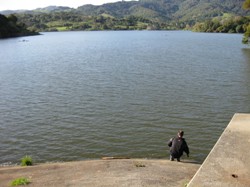
A deceptively full Stafford Lake reservoir in northern Marin County. Photo by David Gorn.

A little rainy weather can be deceiving, too. Even though some local reservoirs around the state topped off–or nearly so–with the late-season storms of February and March, some of the people served by those same reservoirs may still face rationing this summer. That’s because many communities draw their water from multiple sources, which may include mountain runoff.

Projections this year are for snowpack runoff to clock in at about 70% of normal. That beats than the 52% and 58% of the previous two years but is still cause for concern.

Water Allocations Tweaked Slightly Upward

A few drops of good news for farmers and cities this week: a heftier late-spring snowpack means there will be slightly more water headed their way this summer.

Earlier this week, the State Department of Water Resources said it will increase water from state reservoirs from 15% of what cities and farms had hoped for, to 20%.  Today the federal Bureau of Reclamation (Central Valley Project) followed suit and nudged some of its projected allocations up, too.

The five-percentage-point bump is mildly good news for some northern California farmers.  But farmers in the southern San Joaquin Valley are still slated to get zero gallons from federal reservoirs. For that to change would require an April of historically soggy proportions.

The previous nadir for State Water Project deliveries was set in 1991, when urban and industrial customers got 30% of their requested water and farms got zero.

Delta Smelt Listed as Endangered

The California Fish and Game Commission today officially qualified two species of freshwater fish for special protection under the California Endangered Species Act.

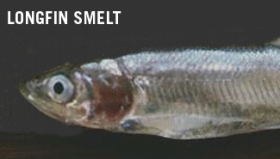
Longfin smelt. Photo: NOAA
Photo: NOAA

The Commission listed the delta smelt as “endangered” and the longfin smelt as “threatened,” a lesser classification. Both are denizens of the Sacramento-San Joaquin Delta and have long been at the center of controversy over water diversions from the Delta. According to the San Francisco-based Center for Biological Diversity:

“The San Francisco Bay-Delta Estuary is home to the largest and southernmost self-sustaining population of longfin smelt. Longfin smelt populations that inhabit the estuaries and lower reaches of Humboldt Bay and the Klamath River have also declined and may now be extinct. Since 2000, the Bay-Delta longfin smelt population has fallen to unprecedented low numbers. Since 2002, the delta smelt has plummeted to its lowest population levels ever recorded.”

CBD was among the environmental groups that petitioned the state for listing of the longfin in 2007. Delta smelt have been protected as a “threatened” species since last year but today that designation was escalated to “endangered.” The Center has also petitioned for–but has yet to attain–federal listing for both species by the U.S. Fish & Wildlife Service.

The listing could have major implications for water supplies this year. Court decisions in favor of the fishes have already forced reductions in water pumped out of the Delta for diversion to the San Joaquin Valley and Southern California. The rulings have prompted some to characterize subsequent reduced water deliveries as a “regulatory drought.”

Snowpack Buildup “Too little, too late”

Frank Gehrke at Tamarck Flat last winter.
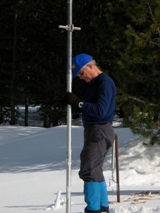
Frank Gehrke at Tamarack Flat last winter.

That’s how Frank Gehrke described the somewhat improved numbers in the latest Sierra snowpack survey. Gehrke has been trekking up to the snow courses for decades to do the seasonal surveys. Today, the statewide average for water content in the snowpack came in at 80% of normal for this date.

Northern Sierra locations clocked in a bit better at 84%, southern locations at 77%. These are an improvement over last month’s tally, when the state averaged only 61% of normal–but reservoirs are not filling fast enough to make up for the long, dry winter that preceded this recent string of storms.

Not that the recent rains haven’t helped. Oakland, Long Beach, Riverside and San Diego are among several spots that have now had at least 90% of their normal precipitation–and some local reservoirs have been catching up. But up in the Sierra, where it really counts for the Big Picture, they’re not catching up fast enough. The main holding “tanks” for the state’s two major water supply systems, Shasta Lake and Lake Oroville, are still at 60% and 55% of normal, respectively.

The recent storms have been relatively warm, too, with precipitation falling as rain all the way up to 7,500 or 8,000 feet. This is precisely the condition that climatologists have been warning about. Snow sticks to the mountain and makes its own reservoir, slowly releasing water well into the spring, as it melts off. But rain at those high elevations is double trouble. It runs off immediately into the rivers and also accelerates the snow melt. That means less water for later in the season, when we really need it.

That may be why the Governor didn’t wait around for today’s numbers. He went ahead and declared a statewide drought emergency on Friday, urging urban water users to cut consumption by 20%.

Can There Be This Much Climate News?

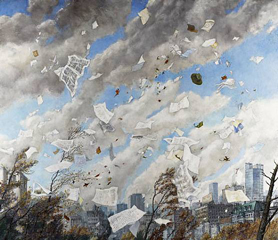
"Reports to the Contrary" by Chester Arnold

Some weeks it seems like KQED could fill up its entire “news hole” with climate-related stories (thank goodness we don’t). Last week was a prime example.

Monday: A keynote speaker at U.C. Berkeley’s annual Energy Symposium said that we need a “Fed” for energy policy. John Hofmeister, a former executive at Shell Oil and founder of Citizens for Affordable Energy, told the lunch crowd that the only way to overcome the current two-year “policy cycle” (the length of a congressional term) is with an autonomous policy group like the Federal Reserve Board, which can take a longer view.

Tuesday: PG&E announced a massive new solar power initiative (it was brought to my attention this week that no news story is complete these days without the word “massive”–at least when there’s no opportunity to use “deadly”). If approved by state regulators, the project will provide 500 megawatts of photovoltaic energy by 2015. Perhaps the most interesting aspect of the plan is that instead of, say, taking over huge tracts of the Mojave, the project will rely heavily on “solar infill;” making use of property already owned by the company, where they can conveniently access the grid.

Wednesday: Senator Barbara Boxer chaired a hearing of the Energy and Public Works Committee to update members on the latest climate science. They heard testimony from four experts, including Christopher Field of Stanford, who essentially said things are worse than you think. Ranking minority member James Inhofe of Oklahoma seized the moment to decry a $6.7 trillion “climate bailout,” a reference to upcoming federal climate legislation and costs associated with an aggressive plan to fight global warming. You can watch the entire two-and-a-half hour webcast for the gory details.

And of course also on Wednesday, the Coen Brothers rolled out their TV ad for The Reality Coalition, assailing the concept of “clean coal.”

Thursday: The California Air Resources Control Board rolled out new regulations to control some of the lesser known (but highly potent) greenhouse gases, including sulfur hexaflouride, used in the manufacture of computer chips. CARB says a pound of it has the same atmospheric warming potential as ten metric tons of CO2. The board also unveiled a new drought page on its website.

Friday: The Governor issued the latest in a series of drought declarations, this one proclaiming a state of emergency and called on cities to reduce their water use by 20%.

And this week wasn’t all that unusual.

Monday, another week begins with the winter’s third survey of the Sierra snowpack. While recent storms will no doubt have raised the water content from last month’s 61% of normal, it should be something of an anticlimax, especially given that the Governor didn’t wait for the numbers to make his drought declaration last week.

Record-Low Water Allocations for Farms

Photo by Sasha Khokha
Deceptively soggy fields in Fresno County. Photo by Sasha Khokha

This morning’s news for Central Valley farmers was bad–but not unexpected: record low allocations of water from state and federal irrigation systems, just as growers make their spring planting decisions.

There are two major plumbing systems that supply water for Valley farms. This morning, the federal Bureau of Reclamation said the best-case scenario will be that ag customers of its Central Valley Project get 10% of their requested water this year. Zero is more likely for most, especially if the current season’s weather patterns persist. The previous low for CVP allocations was 25% in the early 1990s.

Also today, the California Department of Water Resources confirmed its earlier estimate of 15% allocations for farms served by the State Water Project.

The recent string of rainy days has left fields soggy but failed to make a dent in the current drought. Elissa Lynn, Senior Meteorologist for the state Department of Water Resources says we’d need four or five more big storms by April to bring the state’s precipitation levels up to normal.

It’s unlikely it will keep raining hard enough, for long enough, to bring California out of a drought.

And that means more fighting over the state’s water supply. Especially when it comes to the massive state and federal plumbing projects that pipe water from northern California to make arid Central Valley fields bloom.

Not only is there less water in the state’s reservoirs, but there are restrictions on pumping it because of legal decisions to protect the endangered delta smelt.

On The California Report this morning, we visited with a Fresno County tomato farmer, to find out how he’s coping. If you missed it, that radio story will be posted here sometime today.

For more on the drought, explore Climate Watch’s newest resource, California’s Water. Visit this page for access to KQED’s drought coverage, data and reports from the Department of Water Resources and the National Oceanic and Atmospheric Administration, and California water news from across the Web.

The End of Ag? Chu Drops a Climate Bomb

arizona-drought-small.jpgHigher temperatures and drier conditions could destroy California’s vineyards by the end of the century if Americans do not act fast to slow global warming, Secretary of Energy Stephen Chu said Tuesday in his first interview since joining the Obama cabinet.  Chu, a California native, warned that increased water shortages in the West and a loss of up to 90 percent of the Sierra snowpack are likely to have a severe impact on the state’s agricultural industries as well as California’s cities.

“I don’t think the American public has gripped in its gut what could happen,” Chu told the Los Angeles Times.  “We’re looking at a scenario where there’s no more agriculture in California.”

Californians may appreciate this kind of attention in Washington to what is shaping up as potentially the worst drought in the state’s history.  The California Department of Water Resources reports $308.9 million in agricultural losses last year due to drought in the state, and if January was any indication of what’s to come, that number will be even higher for 2009.  The Santa Rosa Press Democrat reports that grape growers in the counties of Sonoma and Mendocino are facing a difficult choice this month as they decide whether to use some of their reduced water allotments for frost protection. With such a rapidly dwindling supply, water used now could mean none for irrigation later in the season.

This morning on KQED’s Forum, California water experts discussed the direness of the situation and the probability of water rationing and other measures to deal with it.

The California Department of Water Resources website has extensive information about drought conditions and mitigation efforts across the state, including this fact sheet updated for January 2009.

Photo by Reed Galin