Category Archives: Water

Potentially the biggest climate impact on life in California

Seeding Clouds for Hydropower

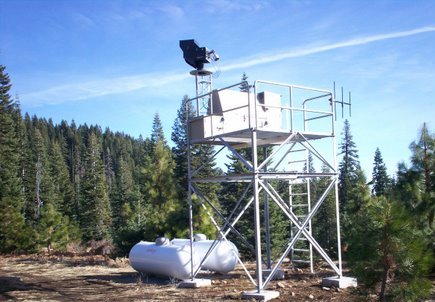
PG&E cloud seeders located near Burney Falls, CA. Photo: PG&E

Christina Aanestad’s radio feature for Climate Watch airs Monday morning on The California Report.

Wringing Hydropower Out of the Clouds

By Christina Aanestad

When cloud seeding began in the 1950’s there were no laws governing weather modification. According to Maurice Roos, Chief Hydrologist with the state Department of Water Resources (DWR), it wasn’t until the late 1970’s when a storm in a seeded area near Los Angeles flooded, that regulations governing weather modification were included in the state’s water code. In the West, “Most of the states have legislation that governs the conduct of weather modification activity,” says Brant Foote, director of the Research Applications Lab at the National Center for Atmospheric Research (NCAR) in Boulder, Colorado.

Government oversight has changed over the years. Today in California, state regulations have slackened. “As for the State’s role, it is mainly informational. There are no permits or licenses,” said Roos. According to Roos, all cloud-seeding projects required permits until the law was reformed. “The old law required licenses and permits but it was repealed in the 1980’s. There was a general move toward deregulation in the government–mainly to reduce costs.” Today, according to Roos, Sponsors of cloud-seeding projects must notify DWR and county governments of the project, “This can be a letter or, for DWR, an e-mail notice,” he said. “They also have to publish a Notice of Intention in the county or counties affected by their proposed operations.”

Most of what this reporter learned was from Roos’ institutional memory, and going directly to sponsors of cloud-seeding operations–about 15 intermittent projects around the state. Data on cloud seeding at the state level is scattered, according to Roos. “We used to have an annual report that was published. Last time I tried to find it, it was in an archived box and nobody knew where it was,” said Roos, who added that budget cuts and deregulation mostly gutted the oversight program.

Despite lax oversight, the State of California wants to use weather modification as part of its 2009 Water Plan, which states:

“Cloud seeding has advantages over many other strategies for providing water. A project can be developed and implemented relatively quickly…it could offset some of the loss in snow pack expected from global warming.”

According to the plan, some regulation remains: weather modification sponsors need to comply with the California Environmental Quality Act [CEQA]. But not all seeding has to comply with environmental regulations. PG&E contends that an environmental impact report is not required for its Pit-McCloud River project because it is privately funded, with equipment on private lands,” said Roos.

That has locals groups near Mount Shasta concerned with PG&E’s proposed project in the Pit and McCloud River watersheds. “It’s a clear unequal treatment between public agencies and private entities,” said Angelina Cook with the Climate Council and the Mount Shasta Community Rights Project. “Private corporations require more government oversight and regulation to ensure accountability for the their practices.” But compiling all cloud-seeding data in California into one reference source today would be “a labor of love,” says Roos. “There’s no funds for it,” he said.

Cook says she is working on a cloud-seeding ban in Mount Shasta City, which may include a chemical trespass for silver iodide, the common chemical used in cloud seeding. “If silver iodide is found in the area, PG&E would be liable,” said Cook.
But Roos, who says cloud seeding is mostly benign, asks where one would draw the line. “There’s all kinds of influences on the air like people driving their cars, diesel trucks running around,” said Roos. Just as California has increased its regulations on air emissions in the state, some like Cook would like to see tougher regulations for weather modification as well.

Meanwhile, the state’s 2009 water plan also urges more research and development into cloud-seeding. Research could include cloud seeding’s impact on global climate change, and it’s effectiveness. The plan also identifies areas that could provide optimal results from cloud seeding, mostly in Northern California, along the Sacramento, Trinity and Russian Rivers.

Cloud Seeding Projects in California

View Cloud Seeding Projects in California in a larger map

To find references to cloud-seeding in the state’s water plan, look under Volume 3, then for “Precipitation Enhancement.”
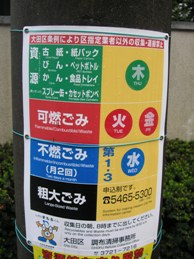
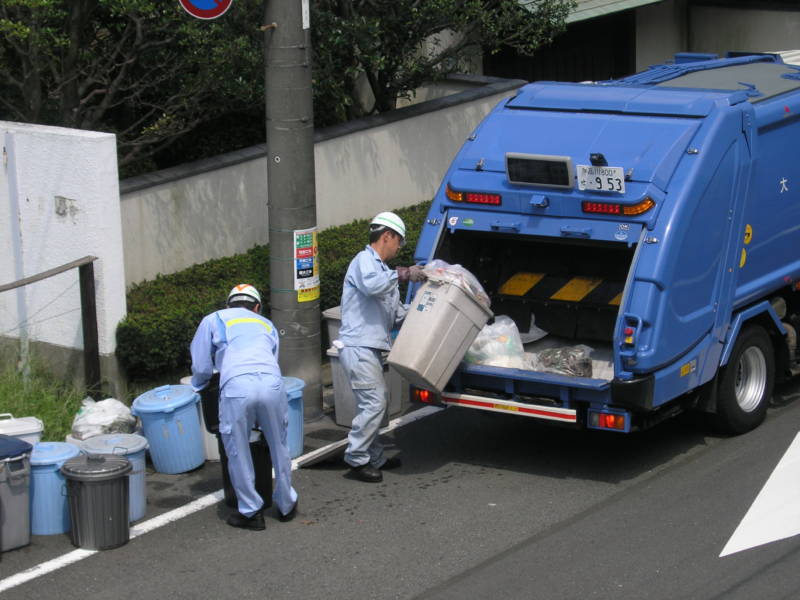
Trash Day in Tokyo: The Learning Curve

KQED’s Los Angeles Bureau Chief and frequent Climate Watch contributor Rob Schmitz is spending six weeks in Japan, as part of  the Abe Fellowship for Journalists. In the weeks to come he’ll file a series of special reports on Japan’s extraordinary strides in energy efficiency–and what we might learn from them.

Today was combustible garbage day in my neighborhood. On Tuesdays and Fridays, residents place all their garbage deemed ‘burnable’ out on the curb. At promptly 8 a.m., it is taken away and, presumably, burned.

Burn after reading? Recycling instructions in Japan.
Burn after reading? Trash day instructions in Japan.

I had a lot of questions about what was considered combustible and the sign on the light post advertising the pick-up days wasn’t very helpful. My wife and I brought our 11-month-old son here. Were diapers considered ‘burnable’? I knocked on the Webers’ door to ask. Terry and Sherry Weber live next door. They’ve been working as teachers in Tokyo for 27 years. They told me that up until recently, plastic products were not considered burnable items, but all of that changed this year, and now it’s apparently fine to deposit plastic items like diapers on the curb on combustible garbage day. Either way, they told me, if the sanitation officials see that I’ve tried to sneak in some non-combustibles on the incorrect day, they’d leave it on the curb with a note, scolding me for screwing it all up.

I put a bag of diapers and another bag of what I thought were burnable items on the curb, nervous that I’d be the laughing stock of my new neighborhood. An hour later, the garbage truck arrived, two men got out, inspected my garbage, and dumped all of it into the back of their truck.

The dreaded Tokyo city sanitation department gives me a passing grade on my burnable/non-burnable garbage sorting skills.

Whew. Now I’ve got to prepare for Thursday, which is recyclables day. I’m supposed to separate all of my recyclables into paper, cardboard, plastic, and cans, and bundle each of them with string. Wish me luck.

Elsewhere on the waste disposal front:

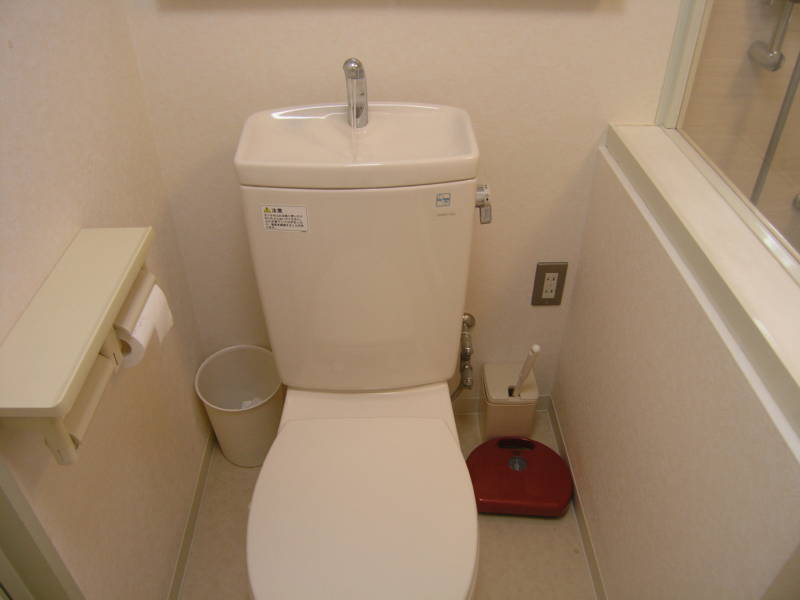
I usually don’t get excited about toilets. But the toilet in my apartment here in Tokyo has inspired me to great heights.

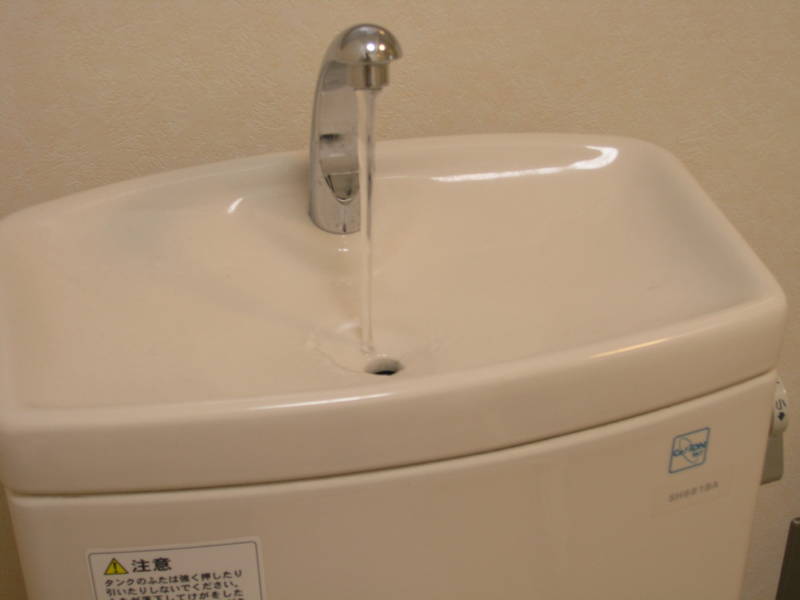
It doesn’t look exciting. But look more closely…

The toilet gives the user two types of flushes: the ‘big’ flush, or the ‘small’ flush, so that you can control how much water you’ll need, thereby conserving this precious resource.

Parched water districts of California: Please start importing these for your customers!

But that’s not what got me excited. What I was really impressed by was when you flush the toilet, water is pumped into the tank at the back of the toilet via a faucet. It runs into a basin on top of the tank where you can wash your hands with the water before it enters the toilet for the next flush. Genius. Pure genius. Why don’t we see more of these in California, where water is an even more precious resource than it is here?

Editor’s Note: Dual-flush toilets are now available in California. But the piggy-back sink–that’s a new one for me. –CM

Delta Dawn

Scientists and policy wonks seem to be in general agreement on this: that it’s time to close out the current management epoch on the Sacramento-San Joaquin Delta and begin anew. There’s less accord on how to proceed.

U.S. Fish & Wildlife Service
Photo: U.S. Fish & Wildlife Service

Policy makers have assembled “blue ribbon” panels to study the options and make recommendations. Volumes of studies and proposals line the shelves in Sacramento and elsewhere.

Last week a new idea surfaced for moving water through the Delta: Instead of channeling around it, tunnel under it.

This week the non-partisan Public Policy Institute of California released its recommendations for a mechanism to fund the enormous fixes that will be required: Those who benefit pay (ecologists use the term “ecosystem services” for all those bennies we get from natural resources and tend to take for granted).

Whatever the outcome, one thing seems inevitable, with or without human intervention. Driven by warming ocean temperatures, rising sea levels will continue to push saltwater farther upstream, changing the Delta’s character and the “services” it provides.

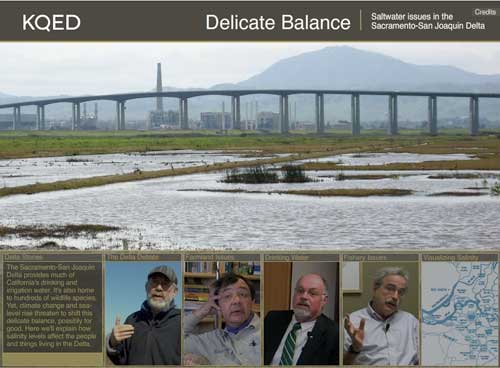
Recently a team of students at U.C. Berkeley’s Graduate School of Journalism produced a Flash presentation on some of the issues raised by advancing salt in the Delta. The multimedia report: Delicate Balance was produced for Climate Watch by Amanda Dyer, Martin Ricard and Jeremy Whitaker. We’re grateful to them for their time and creativity.

delicatebalance

Plan Moves Climate Adaptation to Front Burner

A one-fifth reduction in per capita water use by 2020 is among the goals outlined in a new state report on adapting to climate change.

Released by the California Natural Resources Agency (CNRA) as a “discussion draft,”  the 2009 California Climate Adaptation Strategy is being billed as the nation’s first comprehensive game plan for adaptation to climate change.

Reed Galin
Photo: Reed Galin

Most of the state’s high-profile climate initiatives (and battles) have been about mitigation; how to reduce greenhouse gas emissions to slow down warming. This report swings the spotlight over to adaptation; what needs to be done to accommodate the climate change effects that are already “in the pipeline.”

While the California’s centerpiece climate law was passed three years ago, this week’s CNRA report concedes that “adaptation is a relatively new concept in California policy.” The 161-page white paper comes in response to an executive order from the Governor last fall, calling for a statewide adaptation strategy.

The draft divides the strategy into seven “sectors:” Public health, biodiversity and habitat, ocean and coastal resources, water, agriculture, and forestry.

Tony Brunello, Deputy Secretary for Climate Change and Energy at CNRA, says “This is the first report that really looks at how climate change is going to impact the state and what we need to do about it.”

But Brunello stopped short of conceding that mitigation is a lost cause. “You only have half a deck if you’re only focused on mitigation,” he said. “You need to focus on both mitigation and adaptation to truly be prepared.”

Some strategies attack both. Brunello points to water conservation measures, which save both water and energy (20% of the energy used in the state is deployed moving water around).

The plan is designed to work in consort with the California Air Resources Board’s implementation plan for AB-32, the state’s multifaceted attack on greenhouse gas emissions. CNRA says one of its goals is to “enhance” existing efforts, rather than create new programs and offices that need funding.

CNRA also promises to use the “best available science in identifying climate change risks and adaptation strategies.” Andrew Revkin has a useful overview of the mounting challenges to climate scientists, published this week in the New York Times.

One planned product from the adaptation plan is an interactive website devoted to climate adaptation, with maps and data to assist local planners. CNRA hopes to have that in place by early next year. The draft plan now enters a 45-day period for public comment.

Threats to Colorado River Water Supply

Photo: National Park Service

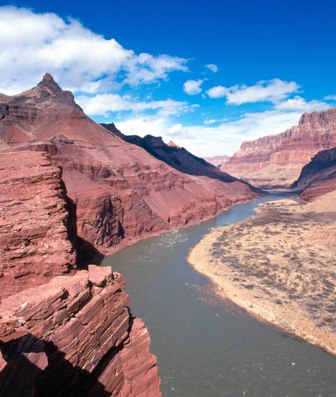
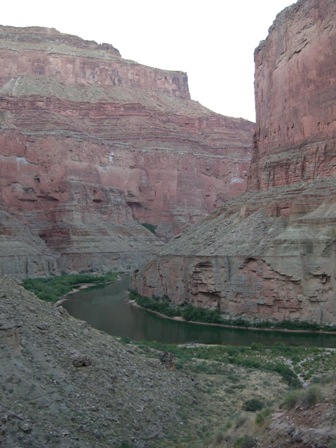
The Colorado River supplies water to approximately 27  million people in seven states and irrigates more than three million acres of farmland. In Southern California alone, it supplies 18 million Metropolitan Water District customers with 40 percent of their water.

So last year, when a study out of Scripps Institution of Oceanography reported that there’s a 50 percent chance that the Colorado River’s largest reservoir (and the largest reservoir in the United States), Lake Mead, will be dry by 2021, the news generated a lot of buzz.

But a new study out from the University of Colorado Boulder finds that despite a 10-year drought in the Colorado River system, the odds of draining the river’s delivery system before 2026 are pretty slim — below 10% in any given year.  Researchers say this is primarily due to the massive reservoir storage capacity along the Colorado — more than 60 million acre feet, which includes Lake Mead.  The reservoir system of the Colorado is currently at 59 percent of capacity, according to the study.

But the scientists predict that by mid-century, the Colorado could become less reliable unless water-management strategies change.

The researchers found that if climate change causes a 10 percent reduction in the Colorado River’s average stream flow as some recent studies predict ([PDF]), the chances of fully depleting the system’s reservoirs will exceed 25 percent by 2057.  If there is a 20 percent reduction in stream flow, the chances of deleption rise to 50 percent.

“On average, drying caused by climate change would increase the risk of fully depleting reservoir storage by nearly ten times more than the risk we expect from population pressures alone,” said lead study author Balaji Rajagopalan in a press release about the study.

The authors of the study conclude that the magnitude of the risk will depend not just on the amount of drying the region experiences, but also the types of water management and conservation strategies that are implemented in the near future.

For the last decade, California’s annual use of Colorado River water has varied from 4.5 to 5.2 million acre feet.

Photo by Adrian Fogg
Photo: Adrian Fogg

Updated: Disaster Status Sought for Valley

Five days after filing it, Governor Arnold Schwarzenegger was still awaiting some response from the White House to his request for a federal disaster declaration, to address drought conditions in Fresno County.

Meanwhile, the Washington bureau of the McClatchy newspaper chain (which includes the Fresno Bee) reports that the request is something of a longshot.

The Governor made the request last Friday, one day after he faced a tense gathering in Fresno, where water issues upstaged even the precarious condition of state finances, and shortly after a meeting with farmers in Mendota.

The governor has had a standing statewide drought emergency in effect since February. Friday he signed an executive order freeing up state resources to help ease drought-related impacts. A federal declaration would allow affected businesses to apply for federal aid. President Obama has since signed several other disaster declarations last week, in response to storms in Missouri, wildfires in Oklahoma and other incidents.

Parsing the White House Climate Report

At least one researcher cited in the 196-page climate impacts report issued this week by the Obama administration is not impressed with the final product. Roger Pielke of the University of Colorado’s Center for Science & Technology Research has written a blog post critical of the report and in particular, the way in which his work was interpreted. If you’d rather not plow through the entire post, John Tierney has an overview of Pielke’s critique on his blog for the New York Times.

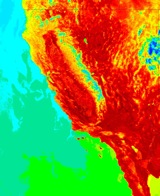
California heat wave, from the Aqua satellite. Image: NASA
2004 California heat wave, from the Aqua satellite. Image: NASA

The report was arguably the first to break down both observed and projected effects of climate change into coherent regional summaries. For the purposes of the report, California was considered part of the Southwest region, which included states as far east as Colorado and New Mexico.

Not surprisingly, many of the points raised in the Southwest section (beginning on p. 129) have to do with water supply. Most have been reported or discussed in our Climate Watch coverage, either here or in our radio reports. Selected “highlights” include:

– Past climate records based on changes in Colorado River flows indicate that drought is a frequent feature of the Southwest, with some of the longest documented “megadroughts” on Earth.

– The prospect of future droughts becoming more severe as a result of global warming is a significant concern, especially because the Southwest continues to lead the nation in population growth.

– Human-induced climate change appears to be well underway in the Southwest. Recent warming is among the most rapid in the nation, significantly more than the global average in some areas.

– Projections suggest continued strong warming, with much larger increases under higher emissions scenarios compared to lower emissions scenarios. Projected summertime temperature increases are greater than the annual average increases in some parts of the region, and are likely to be exacerbated locally by expanding urban
heat island effects.

– Water supplies in some areas of the Southwest are already becoming limited, and this trend toward scarcity is likely to be a harbinger of future water shortages. Groundwater pumping is lowering water tables, while rising temperatures reduce river flows in vital rivers including the Colorado.

– Projected temperature increases, combined with river-flow reductions, will increase the risk of water conflicts between sectors, states, and even nations.

– Increasing temperature, drought, wildfire, and invasive species will accelerate transformation of the landscape.

– Under higher emissions scenarios, high-elevation forests in California, for example, are projected to decline by 60 to 90 percent before the end of the century.

– In California, two-thirds of the more than 5,500 native plant species are projected to experience range reductions up to 80 percent before the end of this century under projected warming.

– Projected changes in the timing and amount of river flow, particularly in winter and spring, is estimated to more than double the risk of Delta flooding events by mid-century, and result in an eight-fold increase before the end of the century.

– A steady reduction in winter chilling could have serious economic impacts on fruit and nut production in the region. California’s losses due to future climate change are estimated between zero and 40 percent for wine and table grapes, almonds, oranges, walnuts, and avocados, varying significantly by location.

By the way, Pielke’s critique does not directly address anything in this list, though his work does involve weather-related disasters, which would include floods. Asked by a commentator on his blog if he thinks the entire report should be dismissed based on the flawed interpretation of his research, Pielke replied: “I wouldn’t think so and would certainly hope not. At the same time the section which covers my research does not give me a lot of confidence in the process that led to the report.”

No Shockers in White House Climate Report

The Obama Administration released a much-vaunted update on climate change today. In its nearly 200 pages, the report contains no new data and few new conclusions on the pace and impact of climate change across the U.S. Rather it affirms the core findings of recent research and sounds the alarm for rapid, definitive action to reduce carbon emissions and prepare for changes already on the way.

In a statement from Lawrence Berkeley National Lab, Evan Mills, one of the report’s 28 co-authors, calls it “the most thorough and up-to-date review ever assembled of climate-change impacts observed to date as well as those anticipated in the future across the United States.” Mills is one of two northern California scientists listed in the report’s credits, along with Ben Santer of Lawrence Livermore National Lab.

One clear signal from the report is that it’s time to move adaptation strategies to the front burner; preparing for climate effects already in the pipeline.

Louis Blumberg directs the California climate change team for The Nature Conservancy, and told me in a telephone interview this morning, “I would say it’s a very clear signal that even if we dramatically reduce emissions immediately, which we need to do as soon as possible, we’ve already put enough CO2 into the atmosphere where we’re going to have have significant changes to our way of life. And we need to begin now and plan to adapt to these unavoidable impacts and I think this report underscores that urgency.”

But neither Blumberg nor Mills have given up on the mitigation side. Mills says “the good news is that the harshest impacts of future climate change can be avoided if the nation takes deliberate action soon.”

Here is a summary of  “key findings,” taken directly from the report:

1. Global warming is unequivocal and primarily human-induced.

Global temperature has increased over the past 50 years. This observed increase is due primarily to human-induced emissions of heat-trapping gases.

2. Climate changes are underway in the United States and are projected to grow.

Climate-related changes are already observed in the United States and its coastal waters. These include increases in heavy downpours, rising temperature and sea level, rapidly retreating glaciers, thawing permafrost, lengthening growing seasons, lengthening ice-free seasons in the ocean and on lakes and rivers, earlier snowmelt, and alterations in river flows. These changes are projected to grow.

3. Widespread climate-related impacts are occurring now and are expected to increase.

Climate changes are already affecting water, energy, transportation, agriculture, ecosystems, and health. These impacts are different from region to region and will grow under projected climate change.

4. Climate change will stress water resources.

Water is an issue in every region, but the nature of the potential impacts varies. Drought, related to reduced precipitation, increased evaporation, and increased water loss from plants, is an important issue in many regions, especially in the West. Floods and water quality problems are likely to be amplified by climate change in most regions. Declines in mountain snowpack are important in the West and Alaska where snowpack provides vital natural water storage.

5. Crop and livestock production will be increasingly challenged.

Agriculture is considered one of the sectors most adaptable to changes in climate. However, increased heat, pests, water stress, diseases, and weather extremes will pose adaptation challenges for crop and livestock production.

6. Coastal areas are at increasing risk from sea-level rise and storm surge.

Sea-level rise and storm surge place many U.S. coastal areas at increasing risk of erosion and flooding, especially along the Atlantic and Gulf Coasts, Pacific Islands, and parts of Alaska. Energy and transportation infrastructure and other property in coastal areas are very likely to be adversely affected.

7. Threats to human health will increase.

Health impacts of climate change are related to heat stress, waterborne diseases, poor air quality, extreme weather events, and diseases transmitted by insects and rodents. Robust public health infrastructure can reduce the potential for negative impacts.

8. Climate change will interact with many social and environmental stresses.

Climate change will combine with pollution, population growth, overuse of resources, urbanization, and other social, economic, and environmental stresses to create larger impacts than from any of these factors alone.

9. Thresholds will be crossed, leading to large changes in climate and ecosystems.

There are a variety of thresholds in the climate system and ecosystems. These thresholds determine, for example, the presence of sea ice and permafrost, and the survival of species, from fish to insect pests, with implications for society. With further climate change, the crossing of additional thresholds is expected.

10. Future climate change and its impacts depend on choices made today.

The amount and rate of future climate change depend primarily on current and future human-caused emissions of heat-trapping gases and airborne particles. Responses involve reducing emissions to limit future warming, and adapting to the changes that are unavoidable.

On KQED Public Radio’s Forum for Wednesday, 6/17

9am Forum with Michael Krasny
White House Climate Report
We discuss the report, as well as federal climate change legislation from Congressmen Henry Waxman and Ed Markey. Guests include Dan Kammen, professor of energy at UC Berkeley and co-director of the Berkeley Institute of the Environment; and Katharine Hayhoe, professor of geophysics at Texas Tech University and a lead author of the climate study.

Ag and Water: Making Do with Less

This story was produced in collaboration with NPR, with help from producer Cindy Carpien. Sasha’s radio story aired on The California Report on June 8, and will also air later this month as part of NPR’s series on water and the West.

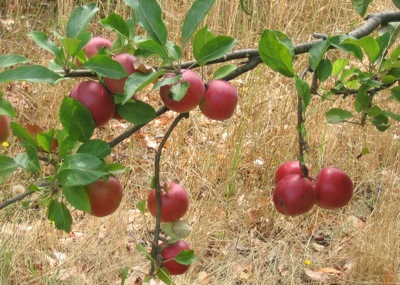
Juicy apples spring from the apparently dry landscape of Sonoma County. Photo: Cindy Carpien
Juicy apples spring from the apparently dry landscape of Sonoma County. Photo: Dan Lehrer, Flatland Flower Farm

Does climate change spell doomsday for California agriculture?

That’s what Nobel-prize winning physicist Steven Chu told the Los Angeles Times in an interview, soon after President Obama appointed him Secretary of Energy.

“I don’t think the American public has gripped in its gut what could happen,” he told the Times in February. “We’re looking at a scenario where there’s no more agriculture in California.”

For another perspective, I called UC Davis ag economist Richard Howitt, who focuses on water and California agriculture, to ask him what he thought.

“That’s a highly inaccurate statement,” Howitt said. “Steven got carried away. Brilliant man, but he doesn’t know anything about California water.”

Howitt’s models show climate change will likely lead to a 25% reduction in the state’s water supply over the next 50 years. He says that will likely mean some rough times ahead for farmers, but certainly not the end of California’s role as an agricultural powerhouse.

In fact, Howitt says if California farmers can continue to grow more drought-tolerant crops and cut back on flood irrigation, they’re likely to thrive in the marketplace over the long term:

“As income increases, people eat more California fruit, nuts, and vegetables,” he says. “They don’t care about cotton; they don’t care about corn. We are on the right side of the agricultural business in terms of future growth.”

Of course, that means if you were to fly over the Central Valley in 50 years, you’d probably see fewer emerald-green islands of crops like rice, alfalfa, and cotton–and more fields of wheat and flexible crops like canning tomatoes, which can be planted seasonally and according to demand.

“This will, of course mean that we have less slack in the system than we do now,”  says Howitt.  “We’re going to have to be much better at applying water, look a little more like Israel and a little less like Northern California.”

Engineers who specialize in irrigation technology have long looked to drought-stricken countries for models. The folks who developed the Pure Sense software I discuss in my radio story have collaborated extensively with farmers in Australia.

Howitt also says no matter how efficiently farmers apply water, they have to figure out how to more efficiently move it around the state. Rather than just fighting over smelt, salmon, and pumping in the Sacramento-San Joaquin Delta, Howitt thinks farmers could be more efficient if we plumb water east to west (currently the two major water systems in California are primarily north-south oriented). Howitt says that would create incentives for farmers in relatively water-rich areas, like the east side of the San Joaquin Valley, to sell water to farms with good soil but less water–like the west side of the San Joaquin Valley, home to the some of the largest and wealthiest farms in the world.

Tricking plants into yielding more with less

Meanwhile, the idea of “dry farming,” like what the folks at Sonoma County’s Flatland Farm are doing with their apples, is getting popular in coastal areas. Dry-farmed tomatoes, like these from Santa Cruz, are increasingly popular at farmer’s markets.

Some researchers are taking this concept to places where it doesn’t rain so much. The idea is to control irrigation to stress the plants to the point where they think they’re starting to die, which triggers the plant’s genetic imperative to produce more fruit. David Goldhamer, who advises Central Valley farmers through the UC Cooperative extension, has demonstrated that farmers who cut back on watering of navel oranges and pistachios, may actually produce higher-quality fruit and generate more income.

A sprinkling of history

I also visited David Zoldoske, at the Center for Irrigation Technology at Fresno State. They have an amazing collection of historical sprinkler systems and a virtual irrigation museum online. Zoldoske has been studying irrigation and water efficiency for decades. Here’s what he told me about how agriculture is going to have to adapt to warming temperatures:

“I think the thing to remember here is there is no silver bullet. There is no reservoir or canal or any other technology or engineering feat that’s going to solve this problem. We’re going to have to use every tool in the toolbox. It’s going  to take multiple feats of engineering elegance so we can solve this problem. And it’s still possible that we’ll fail. And I don’t want to be saying that we will fail. We need to be very focused on this. It’s going to be a long journey. We won’t solve it over night.”

Learn more:

Ag and Climate Change

The entire April-June issue of the University of California’s quarterly journal, California Agriculture, is devoted to research on climate change and how it may fundamentally alter California’s environment and landscape, agriculture and food quality.

Saving Every Drop:

The California Institute for Rural Studies has profiled some of the most efficient California farmers in their January report, California Water Stewards: Innovative On-Farm management Practices (.pdf link).

The institute is also tied into the California Agricultural Water Stewardship Initiative (CAWSI), which has just launched a new website that features farmers using less water.

River Diaries, Part 4: Homecoming

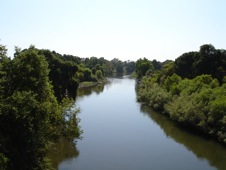
Tuolumne River, near Modesto. Photo: National Weather Service

The Tuolumne River Trust’s Paddle to the Sea project concludes today on the San Francisco waterfront. This is another journal entry from Emilio Martinez, one of two paddlers who traveled the entire route, from Yosemite to the Golden Gate.

Emilio Martinez: Return to the Valley

The surprise for the day was that my old stomps look completely different from the vantage point of a kayak on the River’s surface. Some visuals betokened our peculiar Central Valley “look:” the sudden appearance of palm trees behind the oaks and willows; the five bright yellow shopping carts submerged or waiting on the banks for their shiftless owners; and the three homeless sleeping bag spots.

All told, for the first time in my life, the exposed flanks of the Tuolumne were a genuine joy to behold.

A few more things of note, some nice, some just off-putting: the clarity of the water disappeared as we progressed from Fox Grove (Hughson) toward Modesto, going from a fairly deep green of decent transparency to the opaque silt-colored, pale oil-green that we Modestans are quite used to. Not only that, the counter breezes and slowing current acted like a turgid brake on our once swift progression on the water; and of course the air became redolent with–something–either fermenting processed vegetable matter (from where?) or the fertilizer smells wafting over the River from the nearby farm fields. I don’t know.

Besides, the obvious enjoyment of seeing your familiar haunts appear new, fresh, and full of the variety and appeal that Nature’s fecund imagination can contrive, was just sublime. And the River yielded some surreal grace notes, too, specifically in the form of an exquisitely colored horse, sporting every imaginable shade of black and white, lounging serenely underneath the Mitchell Bridge, a place I usually associate with graffiti, industrial consumer detritus, and shiftless “recreational” types: this image shall always remain in my conscious as almost mystical, an ancient ancestral avatar.

Modesto

If the Tuolumne may be considered an emerald queen in its Sierra manifestations, imprisoned and ghostly nobility during its Don Pedro phase, and a country beauty during its descent from La Grange to Waterford, then perhaps the best description of Her Majesty in Her Legion Park – to – Big Bend garb is that of Cinderella. What I mean is that after the Tuolumne’s creep through the homeless camps, fishing holes, arson-burned river banks, defunct Dennet Dam, past sunken fishing boats (five at least), felled floodplain almond trees, topped with a good dousing of cow muffin-perfumed swamp gases, even a queen emerges covered in the cinders and muck of real life as we know it in these troubled regions.

Nonetheless, the “Paddling to the Sea” company was fine and filled with story, song, and revelation; their faces fair and wise; their hearts still courageous enough to brave possible death by choosing life; and their eyes and ears eager to identify the symphony of wildlife that still calls the Tuolumne its home (today’s additions: dogs, crows, palm trees).

Our crew of Tuolumne River Trust personnel and their Grateful Rowers have been at it at least five-days-straight on the River (not counting at least three months of advance preparation on the part of TRT) and we are battered and bruised but still strong and excited by the new face that the River presents every day with each new bend.

So, perhaps fittingly, we began today’s ten-mile row on the nascent topology of the future “Gateway Park” beneath the 7th St. “Lions’ Bridge,” a place where ornate four-foot-high crucifixes memorialized the tragic death of 14-year-old Jeremy Wilson, a drowning victim of the ancient, defunct, and evil Dennett Dam, and ended it at the current “Big Bend” renovation site, where thousands of newly planted trees no higher than year-old-babies dotted the landscape in their blue and red ribbons–all a product of the indefatigable efforts of the TRT’s committed humanity.

I leave you with one image that marks the end of today’s trip in memory: the pale blue gauze of the Coastal Ranges slowly emerging from the horizon to steadfastly gaze back at us from beyond Westley, the small migrant town of my childhood days, the place where the River first entered my consciousness as something to be feared and revered: to many a theologian these are the two faces of the sacred.

Amen.

I want to end on the positive note here. I want to give credit where credit (and kudos) must be given: every one of the human representatives involved in this venture have displayed nothing but stellar professionalism, humanity, and good cheer: from the Hispanic Leadership Youth Council teens to the TRT (Tuolumne River Trust) people–especially the latter, who’ve had the huge task of dealing with boats, people, hunger, and rallies. I cannot imagine an undertaking of this scope being carried out in a better manner by better people, under more challenging conditions, or for a greater cause.