All posts by Gretchen Weber

Average Sierra Snowpack, More Water Allocated

Photo: Gretchen Weber

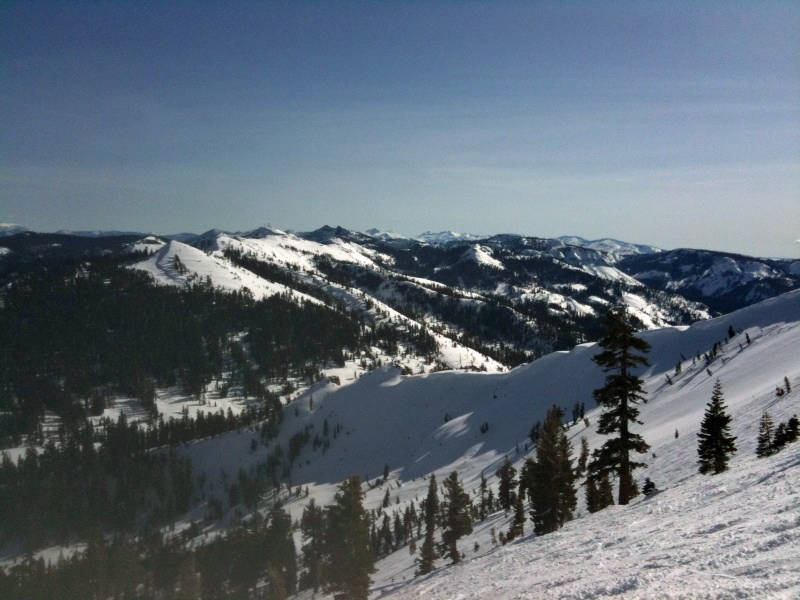
Despite what might feel like an incessant onslaught of storms these past few months, the word from the Department of Water Resources’s fourth snow survey of the season is… average. Manual and electronic survey readings indicate that statewide, the Sierra snowpack water content is 106% of normal for this date. In the northern Sierra it’s higher, at 126% of normal, while the central and southern Sierra are at 92% and 105%, respectively.

The news was good enough for the DWR to increase its State Water Project allocation from 15% to 20%, but agency director Mark Cowin told reporters on a call Thursday that three years of drought and regulatory restrictions on Delta pumping to protect fish species will keep the allocations far below normal.  He said the final allocation, which is announced in May, will likely be between 30% and 40%, depending on April’s precipitation.  (Last year’s final allotment was 40%.)

“We’ve had a hit and miss nature to storms this winter, and that has left the State Water Project in not as good a position as we would like to be and perhaps worse than you would expect based upon those fairly good numbers regarding snowpack and precipitation,” said Cowin. “Remember that we started this winter with very poor carry over storage in most of our key reservoirs.”

While many reservoirs across the state, such as Lake Shasta, are at above average capacity for this time of year, others still have a ways to go.  The State Water Project’s principal reservoir, Lake Oroville, is currently at 47 percent capacity, which is just 60 percent of normal.   Cowin said that the difference between the two lies with where the snow fell this year.

“Clearly we’re going to have water shortages this year,” said Cowin.  “We’re all going to have to conserve water.  Even if we get to 30 or 40% allocation, those are still low numbers. The ethic of using water efficiently in California has got to be the normal course of business and not dependent on the weather forecast.”

Last month, the U.S. Bureau of Reclamation issued an updated allocation for its Central Valley Project customers that ranged from 25% to 75%.

Check recent levels of California’s major reservoirs on the map, below:

View KQED: California Reservoir Watch in a larger map

New Federal Fuel Standards Follow CA’s Lead

California has spent years battling to set its own rules on greenhouse gas emissions, and today, the federal Department of Transportation and the EPA announced the first-ever national greenhouse gas emissions standards, based on California’s rules.  The new federal standards improve the current ones by nearly 10 mpg by the 2016 model year. According to a government statement, drivers could save up to $3,000 per year due to improved fuel efficiency, and nearly 1.8 billion barrels of oil and a billion tons of CO2 will be conserved over the lives of the vehicles covered by the new rules.

NPR has a complete story on the announcement.

The new federal rules, which mandate that the U.S. car and light-truck fleet reach an average fuel efficiency of between 35.5 mpg by 2016, are modeled after the standards outlined in California’s AB 1493, which was signed into law in 2002.  The state was not granted permission from the U.S. EPA to implement the law until June 2009, however.

In a written statement Thursday, state Air Resources Board Chairman Mary Nichols said,  “For eight long years California and the thirteen other states that adopted our tough standards led the way. This action by the White House now means consumers in all fifty states can benefit from cleaner, more efficient cars.”

Geoengineering: Starting the Conversation

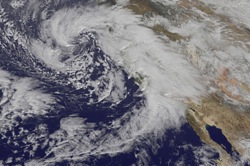
Storms over California. Image: NASA

After five days of talks at Asilomar this week, scientists concluded that more research is needed on climate intervention strategies and their potential risks and rewards, as is a broader discussion involving governments and the public.

The meeting, hosted by The Climate Response Fund (CRF), drew more than 175  people from at least 15 countries, and from  disciplines in the natural sciences as well as social sciences, humanities, engineering, law, and policy, organizers said.

“The purpose of the conference was to figure out what are the processes and procedures that scientists should be thinking about as they undertake this research,”said Mike McCracken, who chaired the event’s Scientific Organizing Committee.  “This was not a conference about comparing geo-engineering ideas to one another, or about bringing new technological ideas to table.”

At the close of the meeting, there seemed to be more questions than answers.  What was clear from meeting discussions and Q&A sessions is that there was no single agenda shared by all participants.  Several voiced grave concerns about the potential risks of climate intervention, on several levels: environmental, social, political, and ethical.

Friday morning provided a glimpse of the tortuous path that awaits this concept, when for more than an hour, participants lined up at a microphone to voice their concerns about the language and intention of a draft news release for the event. The committee then regrouped, drafted a second version of the release, and brought it back to the gathering an hour later.  Objections remained and therefore the release is attributed to the conference Steering Committee, and not the conference as a whole.

From the statement:

“The participants explored a range of issues that need to be addressed to ensure that research into risks, impacts and efficacy of climate intervention methods is responsibly and transparently conducted and that potential consequences are thoroughly understood.  The group recognized that given our limited understanding  of these methods and the potential for significant impacts on people and ecosystems, further discussions must involve government and civil society….  We do not yet have sufficient knowledge of the risks associated with using climate intervention methods, their intended and unintended impacts and their efficacy in reducing the rate of climatic change to assess whether they should or should not be implemented. Thus, further research is indispensible.”

“I think this was the first dialogue, and it was a real dialogue,” said Margaret Leinen of the CRF.  “You have to start somewhere, and this is the beginning of the conversation, definitely not the end of the conversation. I would agree with people who say that many more voices need to come in, and I think it’s not just one additional conference. This is a process, and it’s a process of engagement.”

Those missing voices were among the chief concerns of those protesting the conference.  Diana Bronson of the advocacy organization ETC Group says that conversations about geoengineering need to take place in a UN-like forum, where people who will be most affected by climate change–and potentially by climate intervention strategies–can make themselves heard.  The conference at Asilomar, she said, did not provide that.

“This is the wrong conversation, with the wrong people, at the wrong time,” said Bronson.

Leinen countered that the very purpose of the Asilomar conference was to begin bringing diverse voices together.

“I think that one thing people were concerned about was that this was a conference of the technologists getting together in a closed room, and coming up with the rules that they would use for self-governing,” said Leinen. “That wasn’t at all what this conference was about.”

McCracken said a statement of guiding principles developed at the conference will be released in about four weeks, after it has been reviewed and commented on by meeting participants.

The conference was funded by the State of Victoria, Australia, and by private individuals and foundations.

AB 32 and the Economic Road Ahead

By 2020, California will see two million new jobs whether the state implements its climate law AB 32 or not, according to a revised analysis from the California Air Resources Board.

The report, released Wednesday, predicts modest growth in the state economy over the next 10 years, including growth of 2.4% in both personal income and gross state product with or without the law.

During a Wednesday conference call,  CARB chairman Mary Nichols told reporters that sectors where California is strong, such as renewable energy and informational technology, will benefit from AB 32.

“California is uniquely positioned to benefit because this is the direction in which our economy is going anyway,” she said.

Nichols added that industries heavily dependent on petroleum will also benefit, but that they will have to go through a transition.

“We will see economic benefits overall by 2020,” said Nichols, “but it will be easier for some than for others.”

The report was reviewed by the 16-member Economic and Allocation Advisory Committee (EAAC), an independent panel of policy, business and economic experts appointed by Nichols and California Environmental Protection Agency Secretary Linda Adams.

The report finds that AB 32 provides, “neither a huge boost nor a major negative impact on California,” said Larry Goulder, chair of the EAAC and of Stanford’s Economics Department on a call Wednesday with reporters.  “These findings are not that different from other studies that have been done.”

The Air Board’s original analysis was questioned earlier this month in a report from the non-partisan Legislative Analyst’s Office, which projected a mixed bag of pluses and minuses, with a short-term negative impact on jobs.

CARB’s first economic projections were criticized by others, including UCLA economics professor Matthew Kahn.   Kahn said he is much happier with this new report because of adjustments made to the baseline scenario and because of the independent review made by EAAC panel, which he called a “dream team” of economists.  However, the report still falls short, Kahn says, because its macroeconomic approach doesn’t identify how specific industries and businesses will fare under AB32.

“The report released today is about averages. And where I think we need more research is in how individual firms will be affected,” said Kahn. “When I was in graduate school, I had a professor who used to say ‘if your feet are in the fridge and your head is in the oven, on average, you’re ok’ and I always thought that was a funny joke, but I think it’s apropos about California today.”

Also on Wednesday, Kahn published an opinion piece in the LA Times with co-author James L. Sweeney, director of Stanford’s Precourt Energy Efficiency Center, arguing that a study frequently cited by opponents of AB 32 is seriously flawed.  The study, known as the Varshney/Tootelian analysis, estimates that the law will cost small businesses $50,000 a year and each household $3,857 a year once the new rules kick in.

Opponents of AB 32 are advocating for a ballot initiative that would suspend the law’s regulations until the state economy improves and the state unemployment rate drops to 5.5%. It’s currently pegged at 12.5%, officially.

California Cities Get High Marks for Energy Efficiency

San Francisco

Los Angeles tops a new ranking (PDF) of the 25 U.S. cities with the most energy efficient buildings, released by the Environmental Protection Agency.  With 293 Energy Star-rated buildings encompassing 76 million square feet of space, Los Angeles saves $93.9 million and reduces emissions equal that from electricity use by 34,800 homes, according to the EPA.

Washington, D.C. was ranked second, and San Francisco third.  Two other California cities made the top 25: Sacramento (16th) and San Diego (17th).  According to EPA data, San Francisco has 173 Energy Star buildings (including Hotel Nikko and One Embarcadero Center) that save an estimated $69.4 million in energy costs and reduce emissions equivalent to 24,700 homes. Sacramento and San Diego have 61 and 58, respectively.

As of the end of last year, 9,000 commercial buildings had been awarded Energy Star designation since 1999, representing a combined savings in utility costs of $1.6 billion and a reduction in GHG emissions equal to that of one million homes, according to the EPA.

Buildings that qualify for Energy Star are those that score in the top 25%, based on the EPA’s National Energy Performance Rating System, which compares energy use among facilities of similar types on a scale of 1-100.

Environmental Risks of “Geoegineering”

This week, as scientists meet in Monterey to discuss the potential for large-scale climate intervention strategies, we’re posting short discussions on some of the issues surrounding “geoengineering.”

Aside from the political and economic risks associated with geoengineering, which we explored in Monday’s radio segment on The California Report, critics warn that climate intervention strategies involve some serious potential environmental consequences as well.

In one 2008 study, scientists at the Lawrence Livermore National Lab found that one of the leading geoengineering ideas–blocking solar radiation by pumping sulfur aerosol into the stratosphere–may lead to decreased precipitation across the globe.

Climate scientist Phil Duffy, now of the education organization Climate Central and one of the authors of the 2008 study, says that the decrease in precipitation would follow a slowdown of the overall hydrologic cycle, caused by a decrease in evaporation.  Blocking sunlight reduces evaporation, and since what comes down much first go up, less evaporation means less rain and snow.  As this geoengineering scheme is being proposed as an emergency brake to counter effects of climate change like drought, this is problematic news.

Stratospheric sulfur injection could also seriously damage the Earth’s ozone layer above the Arctic, another 2008 study found.  And opponents fear that it could lead to acid rain, which could exacerbate the growing problem of ocean acidification.

Ken Caldeira of the Carnegie Institute for Science says that computer modeling from his lab indicates that even if the strategy improved living conditions for 90% of the people on the planet, it’s likely that 10% would suffer negative environmental consequences, and, he says, it would be hard to predict where on the planet that 10% would be.

“We’ve come to the conclusion that there are no experiments that will tell you ahead of time what the regional effects will be,” said Caldeira.

Another high-profile strategy involves fertilizing the ocean with iron as a way to  encourage algae blooms for carbon sequestration.  Algae absorb carbon dioxide as they grow, and the theory is that when they die, they’ll sink to the bottom of the ocean and take the CO2 with it.  There is conflicting research about whether this could work as a long-term sequestration strategy, but a recent study suggests that regardless of whether it’s effective at sequestering CO2 or not, fertilizing the oceans with iron could harm marine ecosystems.   The research shows that increases in algae from the genus Pseudonitzschia can promote concentrations of domoic acid, a poison that can kill birds and marine mammals.  Richard Black has more on the new findings at the BBC website.

For more on the potential risks of geoengineering, Alan Robock‘s article “20 Reasons Why Geoengineering May Be a Bad Idea” appears in the May/June issue of the Bulletin of Atomic Scientists.

Concerns Abound as Geoengineering Conference Opens

Photo: Craig Miller

This week in Monterey, an international group of scientists and policymakers are  are gathering to hash out some ground rules for experimenting with climate intervention, or “geoengineering”–what many are calling “Plan B” for dealing with climate change.

There are two main categories of geoengineering strategies: one focuses on blocking solar radiation that reaches the Earth’s surface, the other aims to remove CO2 from the atmosphere.  The goal of both is to pull an emergency brake on global warming, using technology that is, in many cases, experimental.

Ideas for blocking the sun include science-fiction-sounding ideas like spraying sulfur aerosol into the stratosphere (which we explore in a radio feature on The California Report), launching reflectors into orbit, and spraying seawater at clouds to make them brighter and more reflective.

Because much of the technology remains untested, and because, given the complexities of the climate system there’s no real way to test them out in a lab, (not to mention the philosophical issue of interfering in such a direct way with the Earth), the very idea of geoengineering is controversial (watch this space for more about that in the week ahead) But as it turns out, this week’s conference in Monterey is shaping up to be controversial on its own.

The stated goal of the Asilomar International Conference on Climate Intervention Technologies is “to develop norms and guidelines for controlled experimentation on climate engineering or intervention techniques.” Some big names in climate circles are expected to be in attendance, including the Climate Institute‘s Michael McCracken, who is chairing the conference, and former IPCC lead author Richard Somerville, now retired from Scripps Institution of Oceanography in La Jolla.

Other leading scientists, however, have chosen to skip the conference, including Stanford’s Ken Caldeira, Martin Bunzl, who directs the Rutgers Initiative on Climate Change and Social Policy, and Braden Allenby, a professor of Engineering and Ethics at Arizona State University, both of whom participated in a lively panel on geoengineering at the AAAS annual meeting in February. Bunzl told Climate Watch Senior Editor Craig Miller that the five-day event was too much time to devote to the topic, and Allenby called the conference premature.

Many scientists say that more research needs to be done to determine whether these strategies would even work, before we start hashing out how to to deploy them, even if only on a limited, experimental basis.  Others fear a focus on intervention might lead to complacency and distract from the immediate task of reducing CO2 emissions.

The latest controversy surrounding the conference, however, revolves around accusations of a conflict of interest.  The Climate Response Fund (CRF), which is organizing the conference, has ties to a geoengineering firm, San Francisco-based Climos.  Climate blogger Joe Romm (who is admittedly “not a fan of geoengineering”) writes about these connections in-depth at Climate Progress, and details email exchanges he had on the subject with Margaret Leinen of the CRF, David Keith of the University of Calgary and Caldeira of the Carnegie Institute for Science, all of whom reportedly expressed concerns about the potential conflict of interest (one reason Caldeira cites for skipping the conference).

Meanwhile organizers will try to enforce media restrictions almost unheard of in the Internet age, including a ban on daily reporting from the conference, and on quoting presenters without their express consent.  The rationale was laid out in an email from the conference organizers:

“The conference is designed to allow the conferees to consider multiple points of view during the course of the meetings.  Reporting before participants have had the opportunity to consider the full mix of views will necessarily be incomplete and therefore risk being misleading.  This also is  matter of courtesy to your fellow conferees, will help in maintaining the focus of the discussions and efforts to achieve the Conference objectives, and will help reduce the likelihood that Internet exchanges about the Conference will break out before we all have an opportunity to be participating in them, as appropriate, based on our actual experiences here at Asilomar.”

Some form of announcement is scheduled for Friday, when the meeting comes to a close.

Update 3/22/10
The Board of Directors of the Climate Response Fund has issued a statement addressing the concerns raised about a potential conflict of interest.  It states that CRF “will not fund field experiments for any climate intervention technique now or in the future.”  This reportedly has assuaged some scientists’ (and journalists’) concerns about the intentions of the organization and the purpose of the Asilomar conference.

The Air Quality-Carbon Connection

Here’s a news flash: California has an air pollution problem.  According to the American Lung Association’s 2009 State of the Air Report, 38 of California’s 52 counties get failing grades for either high ozone or particle pollution days.  (You can see your own county’s grades for ozone and air particle pollution at the State of the Air website.)
In fact, last month the federal EPA’s new director for San Francisco-based Region 9 made an astonishing claim on KQED’s Forum program. Jared Blumenfeld said that more Californians die from air pollution than from car wrecks. When a caller asked him to back up the claim, Blumenfeld provided the following statistics:

– Traffic-related fatalities: 3,949 deaths per year from 3,535 fatal collisions (average for 1999-2008)
– Deaths associated with PM2.5 exposure above 5 ug/m3 in California : 18,000 deaths per year

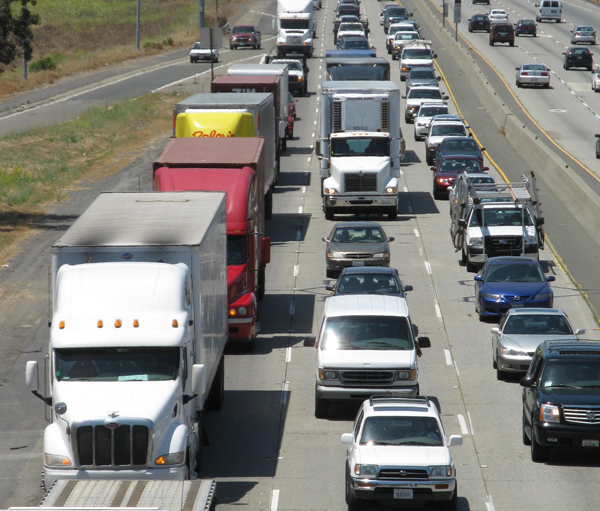
Cars are doing double duty in these statistics, since passenger vehicles are a large source of air pollution. Over the decades the state has addressed this fact with landmark efforts to regulate vehicle emissions, in efforts initially to improve local air quality and more recently, to reduce greenhouse gas emissions.

In a new study released this week by the Public Policy Institute of California (PPIC),  researchers looked at two state priorities: reducing greenhouse gas emissions that cause global warming and improving air quality to benefit public health, and evaluated the effectiveness of four potential transportation strategies to address both.

What they found is something that policymakers have known all along: there are no easy answers.  And everything involves a trade-off.

PPIC research fellow Louise Bedworth compared the cost, public health benefits, and GHG reduction potential for various alternative-fuel vehicles; battery-electrics, fuel cell, ethanol, and for reducing overall vehicle miles.  What she found is that transforming California’s vehicle fleet to battery-electric vehicles provides the greatest public health benefit, but that high costs and technological uncertainty make this option far from ideal.

On the flip side, said Bedsworth, while we have the technology for vehicles to run on corn-based ethanol, research shows that when indirect land-use costs are considered, corn-based biofuels provide no significant public health or climate change benefit.

But while the PPIC looks at local health and global warming effects separately, a new study out of Stanford has found that the two are directly linked. It’s well established that carbon dioxide contributes to global warming and that increased temperatures can exacerbate air pollution, but the new study shows that CO2 “domes” that develop over urban areas are, in fact, causing health problems for city-dwellers.  The study, conducted by civil and environmental engineering professor Mark Jacobsen, looked at models for the contiguous 48 states, for California and for the Los Angeles area. Results showed an increased death rate in all three areas compared to what the rate would be if no local carbon dioxide were being emitted.

Neither current regulations, nor the federal cap-and-trade bill passed by the House address the local effects of CO2 emissions on health.  Jacobsen says that this study provides evidence that they should.  He estimated an increase in premature mortality of 50-to-100 deaths per year from local CO2 emissions in California.

Jacobsen talks about his study in the video, below.

Gallup: A Drop in Concern over Warming

Emily Coven
Photo: Emily Coven

Another day, another poll showing that fewer Americans believe climate change is real.

Results from the latest Gallup Social Series Environment poll show that concern about global warming continues to wane, in some areas dipping to levels as low as when Gallup first started surveying about climate change in 1997.  The poll was conducted last week (between March 4 and March 7) and included responses from telephone interviews (land lines and cell phones) with 1,014 individuals 18 and older.

Key results include:

  • 19 percent say that effects of climate change “will never happen.” That compares with 16 percent last year and a low of 7 percent in 2001.
  • Almost half of Americans say most scientists are either unsure if global warming is happening (36 percent) or that most scientists believe that it is not happening (10 percent). Just 52 percent think most scientists “believe it is occurring,” down from 65 percent last year.
  • The poll showed a near-even split between those who think global temperature increases are due to human activity (50 percent) as opposed to natural causes (46 percent). That’s the lowest percentage to blame warming on human activity since Gallup first asked the question in 2003 and a drop of 8 percent from last year.
  • 48 percent said that news reports about climate change are “generally exaggerated” compared with 40 percent last year and 30 percent in 2006 and 2001.

The Gallup results mirror a recent study by Yale and George Mason universities called “Global Warming’s Six Americas.” The report found that the number of Americans who believe global warming is not happening has risen from 8 percent to 16 percent since 2008.

According to Gallup, the study results over the last two years mark a reversal in American attitudes about climate change.  Their data shows that concerns had increased from 1997 for over a decade, but in 2009 public concern retreated, and this year’s survey results mark an even more pronounced downtown.

As we have reported, this shift in attitudes may reflect recent publicity about mistakes in the 2007 IPCC report and the emails hacked and disseminated from the accounts of East Anglia climate scientists.  The record-breaking cold and snow in some parts of the country this year also could have played a role as well as the increasingly politicized nature of the debate.

California Behind in Weatherizing Homes

Touted as a “shovel-ready” project that would create jobs immediately by leveraging existing infrastructure, the Department of Energy’s Weatherization Assistance Program has so far fallen far short of its goals.  The program received almost $5 billion under the American Recovery and Reinvestment Act of 2009 (ARRA) to improve the energy efficiency of nearly 590,000 residences of low-income citizens — more than a tenfold increase over the $450 million approved in FY 2009.

But a Special Report released last month from the Inspector General of the Office of Audit Services at the DOE found that as of December, just $368 million (8%) of the $4.73 billion allocation had been spent, and 5% of the nearly 600,000 units nationwide slated for weatherization with funding from the Recovery Act were actually completed.

That includes completion of just 12 of 43,400 planned units in California, which has been allotted more than $185.8 million in Recovery Act funding for its Weatherization Assistance Program.

So much for shovel-ready.

The report outlines reasons for the hold-up. Among them was a lengthy delay while the Department of Labor conducted wage surveys to determine appropriate compensation for weatherization work, so that the program would be in compliance with regulations.  Many states did not want to begin work until the wage rates were in place, the report stated, so much weatherization work throughout the country did not begin until late in 2009.

The report also found that, “Ironically, given the anticipated stimulus effect of the program, economic programs in many states adversely impacted their ability to ensure that weatherization activities were performed.”

Effects like hiring freezes, and, in California in particular, furloughs created significant staffing challenges in implementing the Weatherization Program, the report said.

In a a press release responding to the DOE report, the National Association for State Community Services Programs  (state officials implementing the DOE program), said that, “While it is accurate to assert that the ramp-up of expenditures and production has been slower than anticipated, this has been due largely to variables outside of the control of network providers.”

T. Maria Caudill, a spokesperson for the California State Department of Community Services and Development, the “network provider” in that state, said that as of December 2009, state administrators were still waiting for “specificity” from the federal government with regard to wage requirements.  In the last two months, California has aggressively worked to get contracts in place and units weatherized, she said.

According to Caudill, as of the end of February, 849 units had been completed across the state and 1,047 were in the process of being weatherized.

“We are on target to meet our first milestone,” said Caudill, referring to the goal of 12,900 units weatherized with ARRA funds by September 30.

She said that currently, eight service areas including Los Angeles, San Francisco, and El Dorado County are still without contracts for the ARRA weatherization work.

In a speech at Stanford yesterday, Energy Secretary Steven Chu told students and faculty that the number one priority of the DOE is “to get America employed using clean energy as the tool.”  Repeating a favorite metaphor of his, Chu called energy efficiency the “low-hanging fruit” for creating jobs, saving money, and reducing emissions.

As of December 2009, 520 jobs had been created or saved in California by the DOE’s use of recovery funds, according to a recent report from the Pew Center on Global Climate Change. That number will grow as California plays catch up, weatherizing more than 40,000 units between now and March 2012, which is the deadline for spending Recovery Act funds.