All posts by Gretchen Weber

Chu: Time to End “Paralysis”

Photo: Gretchen Weber

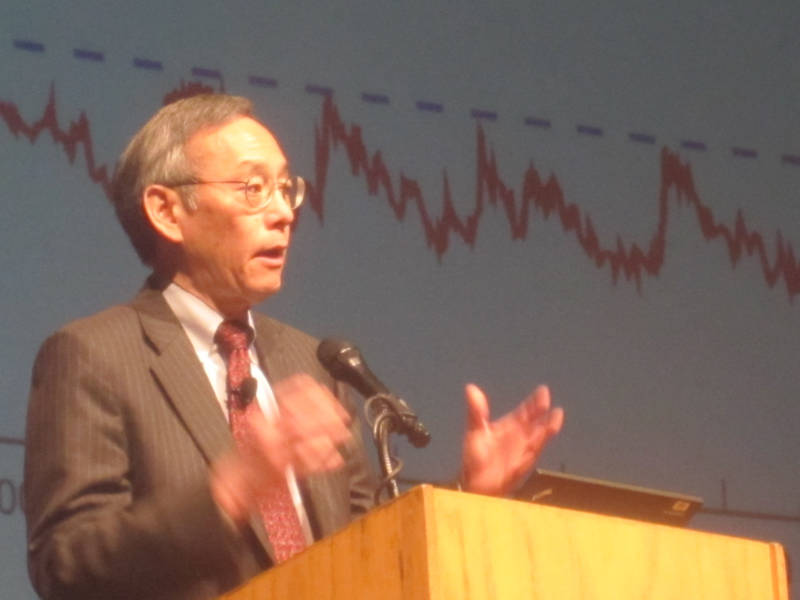
Energy Secretary Steven Chu returned to his old stomping grounds at Stanford University yesterday with a broad outline for jump-starting “a clean energy industrial revolution.”  Speaking to a packed auditorium of students and faculty, Chu advocated the passage of a comprehensive energy bill, saying that increased innovation and investment in “clean tech” is essential for American competitiveness, as well as for reducing dependence on foreign oil and mitigating climate change:

“We are right now in a state of paralysis. There are many businesses who say ‘No, no, we can’t do this, this country was founded on cheap energy, that’s what I want.’  That’s just holding off the inevitable.  So if we hold off the inevitable for another 5 or 10 years, I think we will lose.  Because the other countries are moving.  And then we play catch up.  And then we import their stuff.  That’s what’s at risk.  The future of the prosperity of the US is at risk.  Energy touches everything.”

Chu said the United States is “not doing so well” in terms of clean energy innovation and cited the drop in US market share in photovoltaics  from 44% in 1996 to less than 10% today.

“The US innovation machine is the best in the world,” he said, and then recited a dismal laundry list of fields in which the US is no longer leading the way, including auto fuel efficiency, hybrid car batteries, energy transmission, energy transmission equipment, and nuclear technology.

When asked by an audience member why the US doesn’t commit to a Manhattan Project-style endeavor to solve the energy issue, Chu explained that a project at that scale would have an annual cost in the tens of billions.  In comparison, the current base budget of the DOE is $3 billion per year.

“I agree.  We should do that,” he said. “Tell people in Congress how important it is.”

Key to America’s success, he said is an energy bill that sends signals to the private sector that clean energy is a profitable venture, through incentives and tax breaks.  He said that the federal government plays a role in grants and loan guarantees, but to scale technologies from the idea stage to the factory floor, private investors must play a role.

“America has an opportunity to seize the day and to lead in what has to be a new industrial revolution,” said Chu.  “It’s our choice. Do we want to be leaders or followers?”

As if on cue, it looks like Los Angeles is about to crush one plan that might have helped put southern California at the forefront of clean energy generation and transmission. The Riverside Press-Enterprise reports today that Los Angeles officials will likely announce tomorrow that they’re pulling the plug on the contentious project known as Green Path North.   The project would have installed 80 miles of high-voltage lines and towers to carry geothermal, wind and solar energy from Imperial County to Los Angeles and some Inland cities.  The plans have met with opposition from environmental groups and communities along the proposed corridors.

The project was featured last year in a radio series for Climate Watch by KQED’s Rob Schmitz, on plans to get clean energy from southern California’s deserts to its cities.
Climate Scientists Respond to IPCC Critics

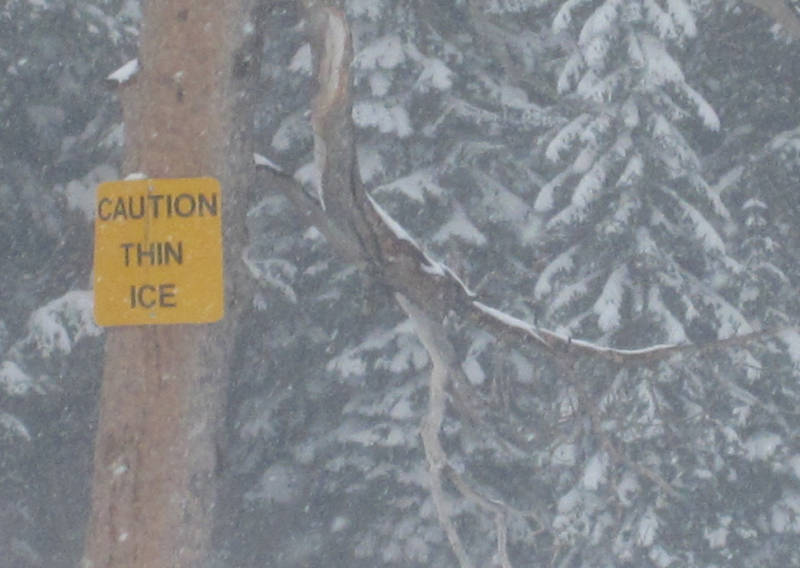
Snowstorm at Donner Pass, January 2010 (Photo: Gretchen Weber)

As we all know, climate scientists have been on the hot seat lately. Among other recent incidents, they’ve drawn fire for the leaked East Anglia emails and for the now-retracted assertion in a 2007 report from the Intergovernmental Panel on Climate Change that Himalayan glaciers might be gone by 2035.  In both cases, researchers admitted missteps and expressed regret. But they say neither incident invalidates the mass of evidence that the Earth is warming and that human activity is a likely cause.

On a call with journalists this week, three leading scientists defended the IPCC, its processes, and climate science in general.  Fielding questions were Penn State glaciologist Richard Alley, Scripps Institute climate scientist Richard Somerville, and Chris Field, director of the Carnegie Institute Department of Global Ecology at Stanford.

“There are errors, and you can find errors on both sides,” said Alley, referring to the fact that previous IPCC reports had underestimated sea-level rise.  “It’s done by humans. It’s not perfect.  But these errors in no way impact our fundamental understanding that we’re adding CO2 to the air, that this is turning up the Earth’s thermostat,” he said.

Somerville made a similar point about the false Himalayan prediction in the 2007 report.

“I liken what’s happened here to the occasional error that happens a bank statement or a phone book,” he said, noting that the 2007 report was 3,000 pages long.

Just because a bank makes a mistake on your statement, he argued, “That’s not a reason to distrust banks.”

The scientists defended the IPCC standards and review process, but supported the IPCC’s recent announcement that it will seek an outside review for future studies in efforts to avoid mistakes in the future.  It’s not clear yet what the independent review process will look like.

“The best thing we can do to push errors to the minimum is to have more eyes looking and to have more expertise and more transparency,” said Field.

There’s no question that errors such as the one about the Himalayan glaciers have provided fodder for critics of climate science and may have contributed to a recent decline in public concern about (and belief in) global warming. During their call this week, the climate researchers bemoaned the fact the urgency of their findings isn’t getting through.

“The fact is that we don’t have forever to decide to reduce emissions of greenhouse gases,” Somerville said. “That’s not something you can procrastinate for ever. Mother Nature imposes a time scale and it’s measured in a few years, not a century.”

Scientists are being forced to defend their work against attacks that are based on policy, not science, Somerville said. The IPCC has a mandate to be policy-neutral, and its goal is to provide information that is policy-relevant but not policy-prescriptive, he said.

“And yet, when you take apart the criticisms that have been made of IPCC and climate science in general, you’ll find, I believe, that in many cases they are motivated by policy concerns rather than scientific concerns,” he said.  “And so I think you’ll find individuals and organizations who have strong views on carbon taxes or government participation in free markets or ceding sovereignty of one country by signing international agreements – all kinds of things like that that are disguised as concerns about the science.”

There’s an interesting conversation happening at Yale Environment 360 about the future of the IPCC.  Robert T. Watson, chair of the IPCC from 1997 to 2002, argues in an essay that while there’s room for improvement in terms of implementation, the IPCC’s procedures are sound.   On the other side, University of Colorado Environmental Studies Professor Roger A. Pielke argues for sweeping reform, citing, among other criteria, a need for a mechanism for resolving allegations of error and a policy pertaining to real and perceived conflicts of interest.

When Green Ain’t Necessarily Green

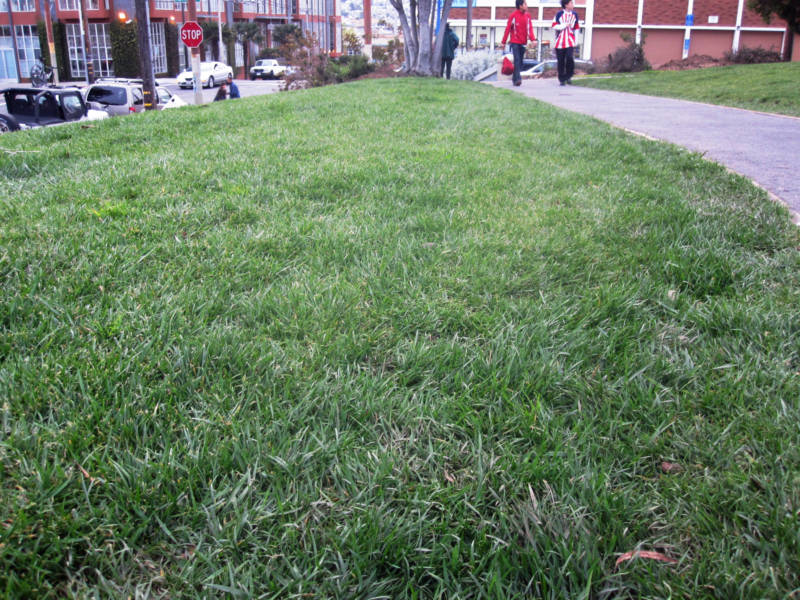
San Francisco’s Franklin Square Park (Photo: Gretchen Weber)

One of my favorite things about living in San Francisco is that springtime starts in February.  A month, which, when I was growing up in New England, was the grayest, worst month of all.

But here, walking down the street outside KQED last week, I could smell the blossoms on the budding trees. Sometimes you can even hear the birds chirping over the sounds of buses pulling in and out of the MUNI yard across the street.

One block away from the station, there’s a public park.  The turf grass there has been pretty green all year (something that was certainly not true of the parks from my childhood.)   Walking by the park and its lush green lawn the other day, I was reminded of an argument I’ve been having with my mother for about 20 years: Just because its green, and it’s grass, that doesn’t mean it’s good, Mom.  Okay, maybe it’s visually good, if you go for a certain aesthetic, but a perfectly manicured lawn, green as it may be, isn’t necessarily good for the planet.  And I’m not just talking about the visits that ChemLawn paid to my childhood home every summer.

Yes, there’s the water issue.  In California, we could still be staring into our fourth year of drought (mostly from cumulative effects of the past three years), and there’s been a lot of talk about how much water traditional lawns eat up.  There are advocates for growing native plants in front of your house instead of turf grass for that very reason.

But a recent report takes the lawn debate beyond water. In the study, researchers from UC Irvine found that ornamental turf grass actually produces more greenhouse gases than it absorbs, once you factor in emissions from irrigation, fertilization, and mowing.  Plants naturally remove CO2 from the air as part of photosynthesis, and so lawns and parks have often been thought of as carbon “sinks,” that is having a net negative effect on atmospheric CO2 levels.  But that may be because most studies haven’t factored “lawn care” into the equation.

Read more about the study in the LA Times.

Mapping California’s Shifting Climate

By Gretchen Weber & Molly Samuel

A companion radio piece to this post aired on The California Report.

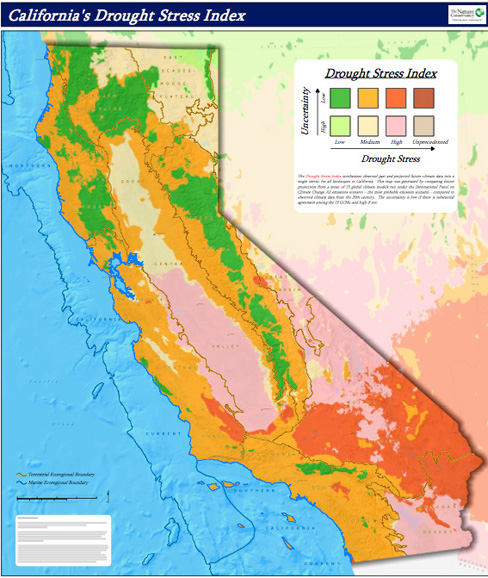
Map from The Nature Conservancy showing projected drought conditions for 2070-2100
Projected drought conditions for 2070-2100 (Map: The Nature Conservancy)

Climate change is causing conservationists to rethink traditional methods of protecting lands and ecosystems. The conventional strategy of setting aside a specific parcel of land (and increasingly, ocean) to protect a particular community of organisms may no longer be sufficient in a rapidly changing climate. While greenhouse gas reduction and climate change mitigation remains a top priority for most conservationists, land managers have begun developing adaptation strategies that take the effects of a warming planet into account.

“We have a fantastic conservation success story in having conserved a huge network of protected areas,” says Healy Hamilton, director of the Center for Applied Biodiversity Informatics at the California Academy of Sciences. “The issue with those protected areas is that they all have static boundaries around them and they work to protect what lies within them,  So the plants and animals that are there are well-protected, as long as they stay there.” Trouble is, the habitat isn’t staying put.

Climate has “Velocity”

The world’s ecosystems will need to move about a quarter of a mile each year to keep up with climate change, according to a recent study published in Nature (link is to the first paragraph of the paper; the full article is only available to subscribers, but you can read a press release about the about the study).

Researchers from the Carnegie Institution, Stanford, the California Academy of Sciences, and UC Berkeley collaborated on the paper, which describes climate belts sweeping north and south from the equator–and also moving uphill–as the world warms.

Hamilton, who co-authored the study, told a packed house at the Center for Biological Diversity in January, that “Climates are on the move. It’s not just a slow unfolding, it’s a radical, abnormal process. Everywhere we look, shifts are already occurring.”

And under these changing conditions, she said, plants and animals have three choices: “They can stay and adapt, they can shift with their climate, or they can go locally extinct if they can’t move fast enough.”

The study’s lead author, Scott Loarie, a fellow at the Carnegie Institution, explains that climate change forecasts are commonly measured in degrees per year, but the authors of this study wanted to know how those temperature changes would affect what can live where. So they used temperature “velocity” (in kilometers per year) to measure how fast regional climate conditions are moving as the planet heats up.

It turns out that the belts move at different rates, depending on the landscape. In the Amazon Basin, velocity is relatively high. It’s a large and homogeneous ecosystem, so as the temperature changes there, plants and animals will have to travel a long way to keep up with the climate in which they’ve evolved to thrive. In a place like California, with its microclimates and variable topography, the velocity is lower. Some species may need merely to migrate to a nearby north-facing–and therefore cooler–slope. Others will have to head north and toward the coast. Climate models forecast that eventually the Bay Area will look more like Southern California, and the Bay Area’s current climate will be located somewhere north of us.

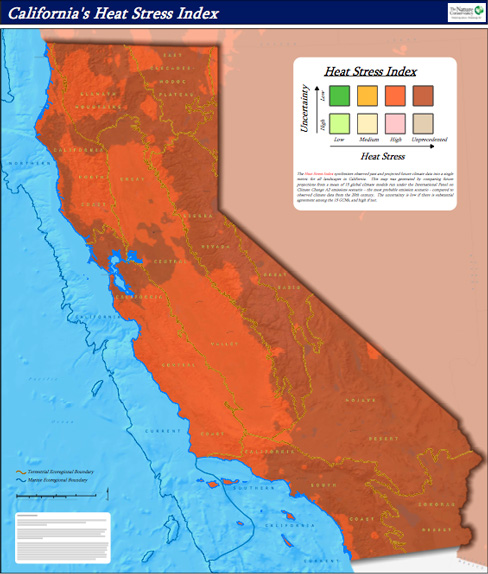
Projected Heat Stress in California for 2070-2100 (Map: The Nature Conservancy)

Mapping a Moving Climate

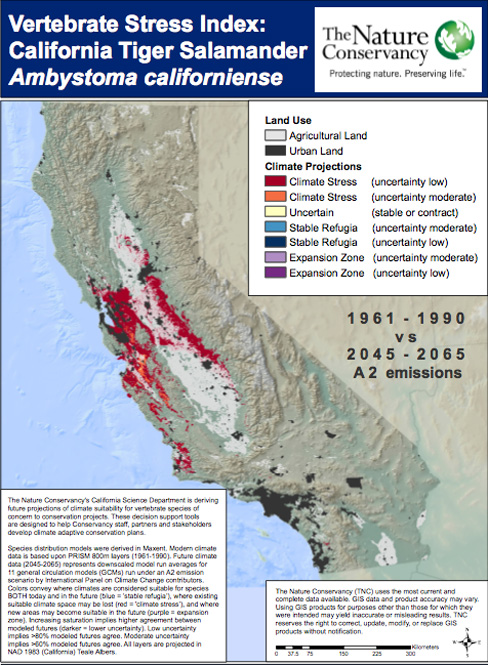
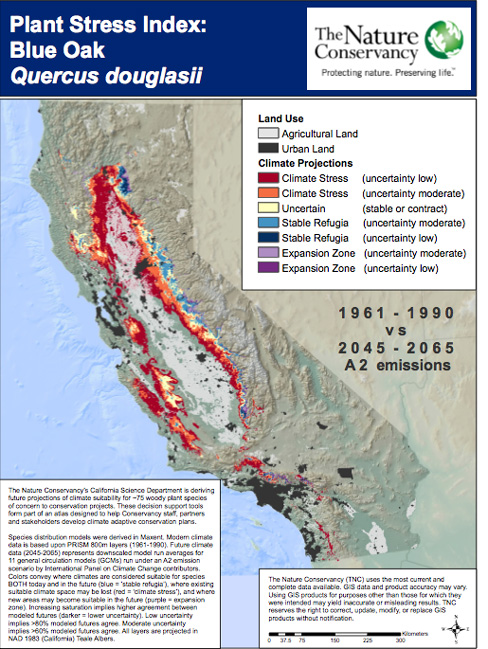
The Nature Conservancy of California has attempted to map some of these trends (see above and below). Scientists averaged together several different climate models to create a picture of California’s future in terms of temperature and precipitation. They then applied that projection to habitats for specific species, to make predictions about how ranges may shift. The maps show both how much areas are likely to change, as well as how certain the predictions are.

“What we’re trying to understand is how does the way we protect species in the future need to change with a changing climate,” says Rebecca Shaw, Director of Conservation for the Nature Conservancy of California. “The kind of strategies you employ and how much you spend is really going to be dependent on how certain you are about change in the future.”

For example, she says some parts of the Sierra are not likely to change very much over the next century, but some places like the Mojave Desert are expected to change a great deal. That kind of information could be useful for land managers trying to plan for the future. For example, in areas that are expected to undergo great change, it might be more important to preserve corridors, or connecting stretches of protected lands, so that populations can move as the climate changes, if they are unable to adapt where they are.

Loarie says “assisted migration”–helping specific species move to new locations–is expensive, unpredictable, and unrealistic. Instead, he, too, corridors for plants and animals to safely follow their climate–if they can keep up. Species like the American pika, already living on mountaintops, can’t go any farther uphill. Their habitats could disappear completely, or, as Loarie says, “they’ll pop off the top.”

There are limitations to the predictions one can make with temperature velocity measurements. What temperature changes will do to fog, for instance, is still unknown, so it’s not clear yet where the redwoods will need to move in the next 100 or so years.

To enable the second option, Hamilton agrees with Loarie. she says the conservation community needs to rethink its traditional strategy of protecting lands. Instead of protecting specific parcels of land and expecting them the stay the same over time, conservationists need to expect change, and to create connectivity in the landscape so that species can move when and if they need to.

Projected changes in California Salamander habitat (Map: The Nature Conservancy)
Projected changes in California Blue Oak habitat (Map: The Nature Conservancy)

On the Road to a National GHG Auto Standard

Photo: Craig Miller

The California Air Resources Board (CARB) announced Thursday that the state has fulfilled its part of the May 2009 agreement set between auto manufacturers and two federal agencies that will establish the nation’s first greenhouse gas emissions standard for cars.

The new regulation adopted Thursday contains what CARB spokesman Stanley Young called “largely technical fixes,” including a change that will allow cars that meet the federal standard in the years 2012 to 2016 to be counted as compliant with the stricter California standard.  (The federal standard goes into effect in 2012.  It differs from the California standard until the two reach the same levels in 2016.)

The California law mandating rules to cut greenhouse gas emissions from cars, AB 1493, was passed in 2002.  Between 2005 and 2009, the state fought for an EPA waiver that would allow it to implement a standard tougher than existing federal rules. Last May, President Obama announced a national standard for tailpipe emissions of greenhouse gases  modeled on California’s rules.  In June, the U.S. EPA  granted the waiver the state had long sought.  See the CARB website for a history of the struggles over the regulations.

CARB says that national implementation of the standard will cut 941 million tons of CO2 by 2020, compared to 793 million tons had the standard been limited to California and the thirteen states that had adopted California’s rules.

AB 1493 would not be affected by a suspension of AB 32, an issue Californians may be voting on soon.

Belief in Global Warming Waning

cw-climate-badge-1
One of six possible profile "badges" from KQED's Matter of Degree Facebook survey

The percentage of Americans who believe that global warming is not happening has doubled since 2008, climbing from eight to 16 percent of the adult population, according to a new report from Yale and George Mason Universities.  (The full report is available as a PDF on the Yale Project on Climate Change website.)

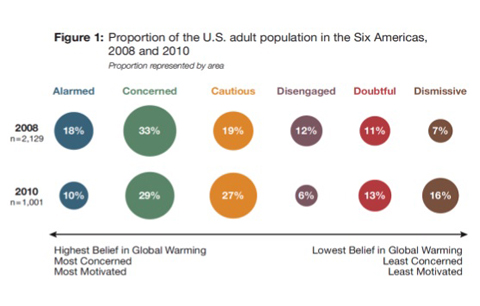
More than 1,000 adults were surveyed in late December and early January, and their responses compared with results from a similar survey in the fall of 2008.  Called “Global Warming’s Six Americas,” the study identifies six “types” of attitudes about climate change ranging from “Alarmed” to “Dismissive” (see diagram, below).

The updated research  finds that while the percentage of “Dismissives” is growing, the proportion of  people at the opposite end of the spectrum, the Alarmed, is shrinking.  The percentage of Americans who believe that climate change is real, is caused by humans, and is an immediate threat, has dropped to 10 percent of the population, down from 18 percent in 2008. The survey group described as “Concerned” has, however grown slightly, and the “Disengaged” portion has halved, which would seem to indicate more people staking out positions on one side or the other.

Study author and director of the Yale Project on Climate Change, Anthony Leiserowitz, cited “gloomy unemployment numbers, public frustration with Washington, attacks on climate science, and mobilized opposition to national climate legislation” as contributing to diminished public concerns about global warming.

As we reported earlier this month, despite a drop in concern about climate change, majorities in all six groups say that developing sources of clean energy should be a priority for the US government.

To see which of the “Six Americas” resonates most with your viewpoint, take our climate survey, A Matter of Degree, which was developed in collaboration with the Yale Project on Climate Change and the Center for Climate Change Communication at George Mason Univeristy.  It’s available on the Climate Watch website and on Facebook.

sixameric
Graph from Global Warming's Six Americas, January 2010

Accounting for Corporate Carbon

Five years ago, the notion of measuring your company’s carbon footprint might have seemed quaint, or foolish, or just plain impossible.  And not too many large companies were interested.  But a recent report from the consulting firm Groom Energy Solutions finds that corporate emissions reporting is fast becoming big business (Groom describes itself as a “provider of renewable and energy efficiency systems to commercial and industrial companies.”)

The Groom analysis focuses on “enterprise carbon accounting” software, or, in plain language, technology that helps companies track their emissions.  According to the report, venture capitalists invested $46 million in enterprise carbon accounting (ECA) software in 2009, and it predicts that purchases of the technology will increase 600% by next year.

According to Paul Baier, VP of consulting services for Groom, 60% of Fortune 500 companies currently report their carbon emissions, and that number is growing rapidly.

“By the end of 2010, if a company is not reporting, it will be seen as a laggard in the industry,” said Baier.  “It’s increasingly mainstream for corporations to be doing this now.

Ninety percent of reporting companies are using “spreadsheets and consultants” to determine their footprints, said Baier, and the rest are using ECA software.  Three years from now he expects that 80% will be using the software, which helps companies track hundreds of different data points related to operational emissions.

“They don’t keep track of their financial information with spreadsheets anymore, and they won’t be using them for carbon reporting much longer,” he said.

In general, corporate carbon accounting is limited to what the Greenhouse Gas Protocol Initiative (which sets the widely accepted standards) refers to as Scope 1 and Scope 2.  These include the direct emissions of company operations such as on-site fuel combustion and electricity use.  Significantly, Scopes 1 and 2 leave out the potentially enormous, yet elusive footprint of a company’s suppliers and the myriad of other associated carbon sources.  In the works are standards for measuring Scope 3, which Baier calls “everything else,” but for now, there is no generally agreed-upon template for measuring this wider footprint.

Which leaves room for debate, such as when The Wall Street Journal raised questions about the 2008 pronouncement by Dell Inc. that it had achieved carbon neutrality. The Journal article reported that Dell was measuring only a small fraction of total emissions associated with the company.  Dell had taken into account employee air travel and building electricity use, but not emissions produced from transporting products or the footprints of the factories around that world that supply it with computer parts.

Given the inconsistencies and uncertainties of corporate carbon accounting, not to mention the cost in employee time and technology investments, why are companies flocking to do it?

According to the Groom Energy report, the three main drivers, in order, are:

  1. Increased pressure from customers and investors for companies to create a “greener” public image
  2. Cost and energy savings
  3. Mandates from buyers, like the Walmart Supplier Sustainability Assessment Program, intended to measure the environmental impact of its 100,000 suppliers.

Reducing CO2 emissions to help mitigate the effects of climate change did not make the list.

The New Streamliners: Big Rigs Save Fuel, CO2

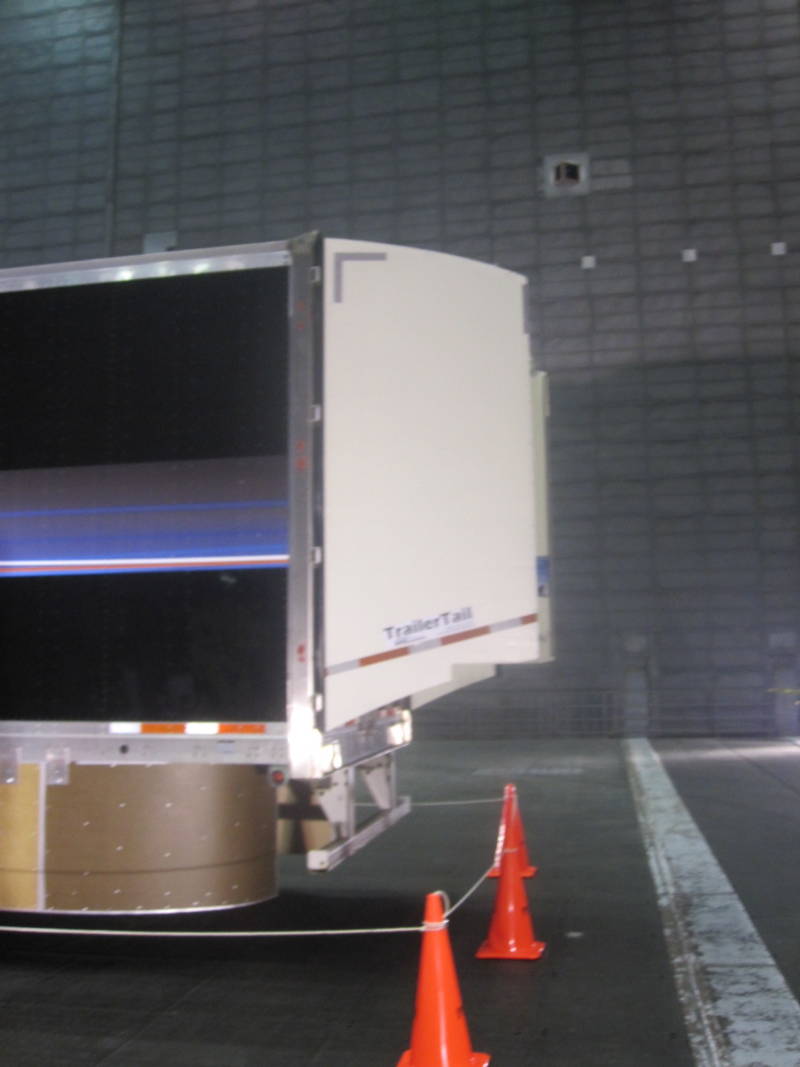
Not exactly the Space Shuttle: A big rig in the wind tunnel at NASA Ames Research Center. Photo: Gretchen Weber

A companion radio piece to this post aired on The California Report.

The wind tunnel at NASA’s Ames Research Center in Mountain View is the largest in the world. According to Ames deputy director Lou Braxton, at various times it has housed a Boeing 747 and an America’s Cup racing yacht. But parked inside this week was a relatively diminutive semi-truck with a 53-foot trailer. The truck is called the ProStar, and according to its manufacturer, Navistar, it’s the most aerodynamic truck on the road.

The wind tunnel was open to the media because Ames, Lawrence Livermore National Lab (LLNL), Navistar, and the Air Force (which manages the tunnel) were showcasing their ongoing project designed to identify, develop, and test devices that reduce the aerodynamic drag of “big rigs.” The wind tunnel wasn’t activated for the press event but the media gathered inside the cavernous space could envision how the tests might work.

At highway speeds, more than 50 percent of the energy produced by a truck’s engine is used to overcome aerodynamic drag. Therefore, reducing that drag can produce significant fuel savings. In fact, testing thus far has determined that existing aerodynamic design adjustments and attachments can increase fuel efficiency by 12 percent, which, when applied to the US trucking fleet, could save more than three billion gallons of diesel fuel per year, a cost savings of more than $10 billion at current prices. This savings in diesel translates to a reduction of 36 million metric tons of CO2 per year.

Inside the wind tunnel, the truck’s trailer was outfitted with various attachments designed to reduce drag at critical points such as the trailer base, the under body, and the gap between the tractor and trailer. Some, such as the TrailerTail, are already commercially available, while others are still in development. For the next three weeks, scientists will test various devices and combinations. The best ones will be track tested and then road tested over the next year.

Currently, semi-trucks make up about 12 percent of US petroleum consumption; about 21 million barrels a day, according to LLNL.

The TrailerTail (Photo: Gretchen Weber)
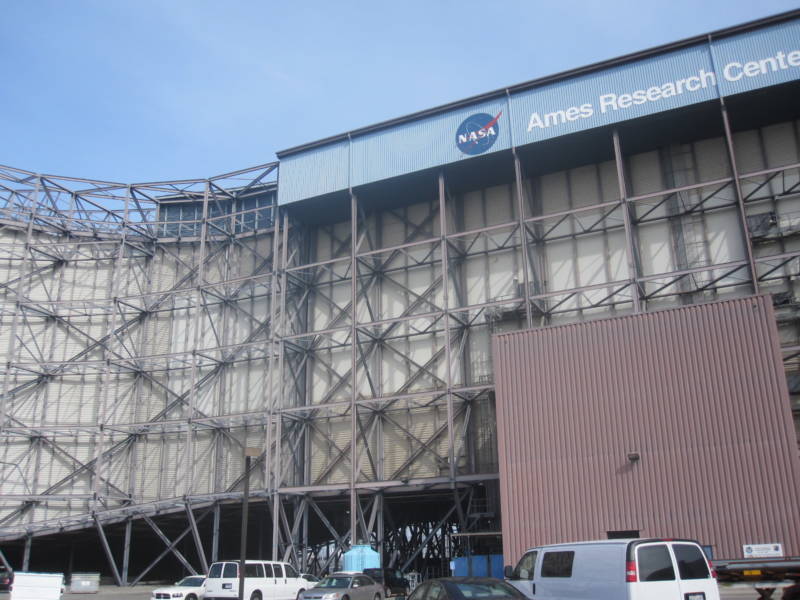
Outside the National Full-Scale Aerodynamics Complex (NFAC) at Ames, where the wind tunnel is located (Photo: Gretchen Weber)

No Protection for American Pika

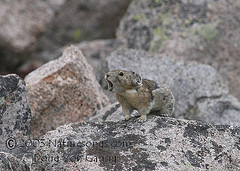
American Pika, Photo: Doug Van Gausig
American Pika, Photo: Doug Von Gausig

The high-alpine rabbit relative, the American pika, does not warrant protection under the Endangered Species Act, according to a ruling Thursday by the U.S. Fish and Wildlife Service. The decision was required by a court order stemming from a lawsuit brought by the San Francisco-based Center for Biological Diversity against the agency, for failing to respond to a petition submitted by the Center in 2007.

The CBD petition cited climate change as the cause for population decline in pika populations in the mountains of Nevada’s Great Basin. Because the creatures can die from overheating at temperatures as low as 78 degrees, and research suggests that a warming climate has led to major losses in lower-elevation populations, pushing pika to migrate to higher elevations. Some biologists are concerned that if temperatures rise high enough, they may reach the mountain-tops and run out of hospitable habitat.

“By not listing the pika, the decision is not respecting the best available science,” said Shaye Wolf, a staff biologist at the CBD. “The science is very clear. Scientists in the Great Basin will tell you that their research is showing that pika are disappearing and that the losses are linked to climate change: heat stress in the summer and loss of snowpack in the winter.”

Wolf said that the federal agency is required to use the “best available science” in making its ruling. She said that the CBD may challenge the decision on this basis.

“The (government’s) interpretation of the studies is that even though pika are disappearing and will continue to disappear, they will be able to cope,” said Wolf. “That’s not consistent with what we’re seeing. It’s a bizarre argument that pika will adapt. There’s no basis for that claim.

Had the federal agency ruled the other way, the pika would have been the first animal to make the endangered list as a direct result of climate change.  Last year, the Obama Administration denied a similar petition for the Alaskan spotted seal, Wolf said.

The scientific community itself is split about whether the pika warrants a federal listing. While research shows that some populations of pika are declining, such as in the Great Basin, not everyone agrees that the entire species is facing extinction.

The CBD also has a pika case still pending at the state level.  The California Fish and Game Commission has twice denied CBD requests for a status review of the American pika. The organization is currently challenging the state’s second denial.

For more background on the CBD’s efforts to list the pika, see Craig Miller’s blog posts from May 2009.

Climate Concern Flags Amid Support for Policies

app_full_proxy
One possible outcome "badge" from KQED's Facebook survey, "A Matter of Degree"

Despite being far less concerned about climate change than they were a year ago, a large majority of Americans supports the the passage of federal climate and energy policies, according to a national survey released last week by researchers at Yale and George Mason Universities.  (The full survey is available as a PDF on the Yale Project on Climate Change website.)

More than 1,000 adults were surveyed in late December and early January, and their responses compared with the results of a similar survey from the fall of 2008.

Key findings include:

  • Only 50% of Americans now say they are “somewhat” or “very worried” about global warming, a 13-point decrease
  • The percentage of Americans who think global warming is happening has dropped 14 points, to 57%
  • The percentage of Americans who think global warming is caused mostly by humans activities dropped 10 points, to 47%.

These results echo a similar survey by the Pew Research Center for People and the Press, which found that between April 2008 and October 2009, the proportion of Americans who believed there was solid evidence for global warming dropped 14 points, from 71% to 57%.

While both reports indicate a flagging of public concern about climate change in general, the Yale/GMU report finds that public support for the passage of federal climate and energy policies is strong, even across party lines. Majorities of Republicans and Democrats surveyed support renewable energy research, tax rebates for people buying fuel-efficient vehicles or solar panels, and regulating CO2 as a pollutant.

“The good news is that even though some Americans are becoming more skeptical that global warming is happening, nevertheless, there is still support for some of the basic climate policies,” said Anthony Leiserowitz, director of the Yale Project on Climate Change and one of the study’s principal investigators.

But the poll also revealed low levels of awareness about the policy debate in general: 60% of Americans surveyed said they’d heard “nothing at all” about cap-and-trade legislation, while just 12% said they’d heard “a lot.”  When the concept of carbon permit trading was explained to survey respondents, 58% supported the policy, but that support dropped to 40% when respondents were told that one hypothetical outcome would be to drive up household energy costs by $15 a month.  Support rebounded to 66% if a yearly household bonus of $180 were supplied to offset higher energy costs.

Bipartisan support for some climate-related policies amid fading concern about climate change, is not as contradictory as it might seem.  While some respondents approve of supporting research funding for renewable energy technologies as efforts to reduce global greenhouse gas emissions, others support this policy on national security and energy-independence grounds.  Leiserowitz noted that while support for renewable energy research has been high for years, the current public support for cap and trade could “go either way” in the near future, depending on how the public debate plays out.

Climate Watch has partnered with the Yale Project on Climate Change and the George Mason Center for Climate Change Communication to create our climate survey A Matter of Degree, which is available on the Climate Watch website and on Facebook.   A Matter of Degree uses data from the Yale and GMU researchers’ Global Warming’s Six Americas survey to help survey respondents determine where they fall on the spectrum of American beliefs about climate change.