
All posts by Gretchen Weber

Geoengineering Field Tests on the Horizon?

Bill Gates may investing in geoengineering projects, but a widely-quoted news story reporting that he contributed $300,000 to a San Francisco company to launch climate-intervention field tests is full of inaccuracies, according to one scientist involved.  The article, which appeared Monday on the Times Online website, asserts that Gates gave the company, Silver Lining Project, the funds to develop machines to spray seawater up to 1,000 meters into the sky in efforts to whiten clouds and increase their reflectivity, thus blocking the sun and ultimately slowing the rate of atmospheric warming.  The article then describes a planned field trial, which would involve 10 ships and 10,000 square km of ocean, leading some readers to assume that Gates is funding the largest-scale geoengineering field test to date.

According to Ken Caldeira of the Carnegie Institute of Global Ecology at Stanford, Silver Lining has received no funds from Gates personally.  Instead, he said, the $300,000 was allotted by Caldeira and David Keith, who have been directing geoengineering project funding for Gates.  Caldeira explained in an email that the scientists dispensed funds not to Silver Lining for field tests, but to engineer Armand Neukermans and his team, “to test the feasibility of fine seawater sprays in the laboratory.”

“There was no funding given for the planning, preparation, or execution of any field tests,” Caldeira wrote.   “I have expressly said that private efforts to conduct field tests should await the development of appropriate governance structures. I am opposed to private entities conducting field tests without appropriate governance and would oppose funding such activities.”

It’s possible, as critics assert, that the technology developed by Neukermans could eventually be used in Silver Lining Project field tests. However, the $300,000 from Caldeira and Keith would most likely be a drop in that bucket.  The Vancouver Sun reports that a scientist collaborating with Silver Lining, Robert Wood, said that it will likely take $25 to $30 million to fund the proposed field experiments.

The Times Online article touched on a particularly hot issue with the statement, “The British and American scientists involved do not intend to wait for international rules on technology that deliberately alters the climate.”

In March, scientists and policymakers gathered in Monterey for a week to discuss this very issue.  The general sentiment at the close of the talks was that more research is needed, as well as more input from governing bodies and the public, before potentially damaging field experiments are undertaken.

“This is a first step down a dangerous road,” said Rutgers scientist Alan Robock about the reported Silver Lining Project field test plans.  “Because, where do you stop?  There is no governance or agreed-upon restrictions determining what’s safe.”
Campus as Climate Microcosm

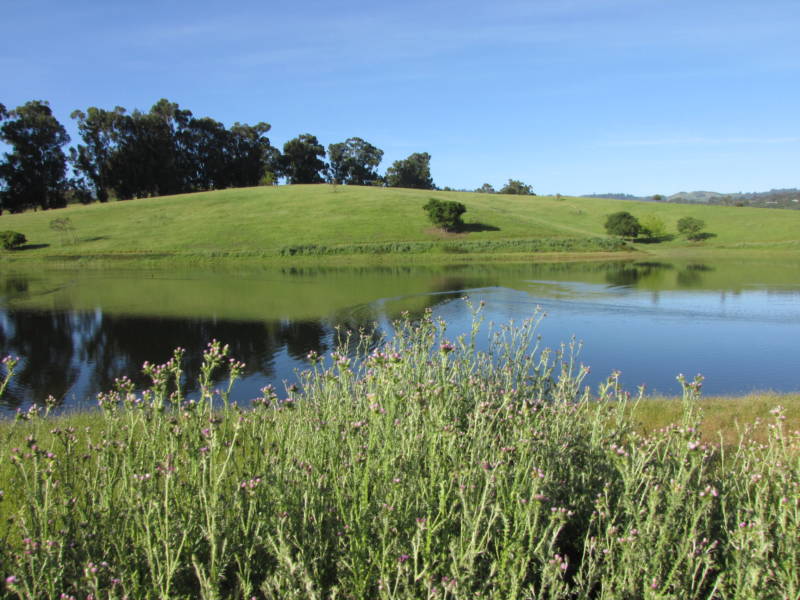
Felt Reservoir, Stanford University (photo: Gretchen Weber)

On a recent weekend, a couple of dozen hearty souls hiked more than 20 miles across the sprawling lands of Stanford University, to learn about global warming and see first-hand how the changing climate is affecting the campus.  It was the fourth annual “Walk the Farm” outing, a trek organized by the Bill Lane Center for the American West and led by its Executive Director, Jon Christensen.  Each year, the hike takes a different route through Stanford’s more than 8,000 acres, and is designed to use the university as a microcosm for a different global theme.  This year’s was climate change.

Throughout the 12-hour day, Stanford researchers joined the hikers to talk about the effects of climate change on the campus and region, as well as the related research taking place at the university.   Biology professor Carol Boggs spoke about her research on the Bay checkerspot butterfly, its extirpation in the region, and plans for a possible future reintroduction of the species on campus.  Other presenters included climate scientists Chris Field and Steven Schneider, and biologist Scott Loarie.

Watch this six-minute video for an overview of this year’s Walk the Farm hike and highlights from some of the talks along the way:

Hear more from Carol Boggs about the Bay checkerspot butterfly:

Scott Loarie explains how a rapidly changing climate is posing challenges for species migration in the video below:

CA Power Plants Must Find New Cooling Methods

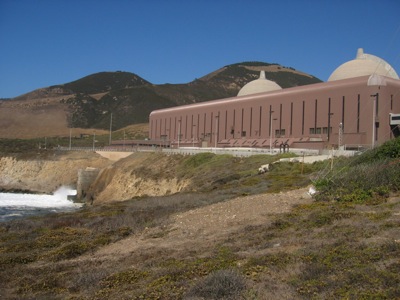
California’s electrical power generators will be scrambling for new ways to cool their turbines, now that state regulators have ordered a phase-out of  “once-through cooling.” The practice, which has been under study by regulators since at least 2005, requires sucking in billions of gallons of cold ocean or river water and then returning it at higher temperatures. Nineteen major power plants across the state, including California’s only two commercial nuclear plants, are currently using once-through cooling.

Sea water used for cooling at Diablo Canyon nuclear power plant. Photo: Craig Miller
Sea water spews from an outlet after being used for cooling at PG&E's Diablo Canyon nuclear power plant. Photo: Craig Miller

Prior to Tuesday’s vote by the Water Resources Control Board, the head of that body’s ocean unit testified that once-through cooling systems kill 2.6 million fish, 19 billion fish larvae and 57 seals, sea lions and sea turtles each year, Dow Jones reported.

According to the Board’s summary:

“The proposed policy establishes technology-based standards to implement federal Clean Water Act section 316(b) and reduce the harmful effects associated with cooling water intake structures on marine and estuarine life.”

The rules require that companies phase out the practice and install equipment that reduces impact on marine ecosystems within the next several years.  Some generators have warned that the high cost of complying with the regulations could force them to shut some plants down.

For more on the practice of “once through cooling” and its effects on marine life, listen to Amy Standen’s Quest radio report from Monday.

Tracking the Changing Glaciers of the West

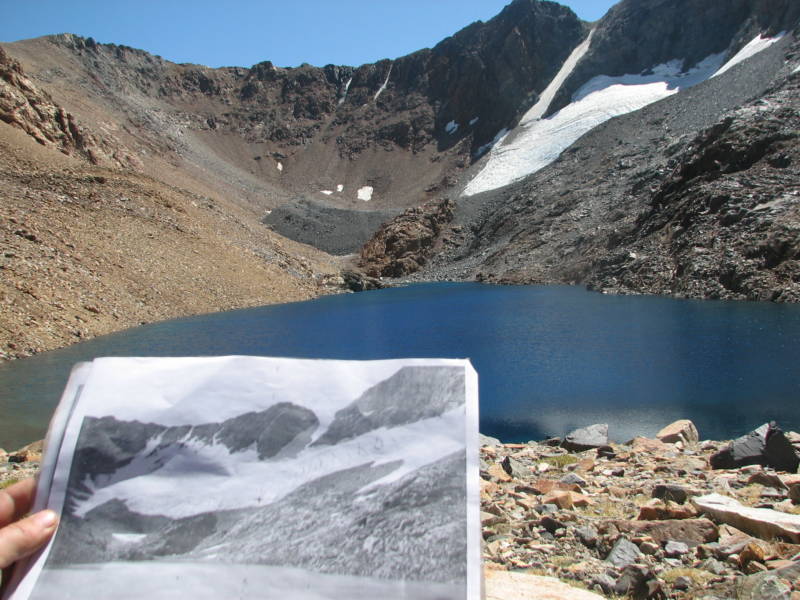
Yosemite’s Dana Glacier, in 2008 and 1883 (photo: Gretchen Weber)

Years of exhaustive (and exhausting) field work out of Portland State University has produced some stunning visual images online.

Not quite two years ago, reporter Sasha Khokha and I joined geologist Hassan Basagic on a long trek to photograph the Dana Glacier, located just inside the eastern edge of Yosemite National Park.  Since 2003, Basagic has been documenting the changes in the glaciers of the Sierra using historic photographs, and we joined him in September of 2008 to see the shrinking glacier for ourselves. We documented the trip with a radio report, an audio slide show, and web videos.

That field work was part of a project called “Glacier Rephotography of the American West” which tracks the retreat of glaciers across the western United States over the last century.

Tom Knudson of the Sacramento Bee, who has closely followed the project, tells us that it has produced a new online resource. It includes a series of interactive time lines that showcase historic photos as well as more recent ones (including Basagic’s) that, when viewed side by side, offer some startling views of how glaciers in various regions have changed.

For more remarkable images of moving glaciers, explore the “Extreme Ice” episode of the PBS series Nova.

New Solar Manufacturing Plant for Silicon Valley

SunPower CEO Tom Werner and Gov. Arnold Schwarzeneggar announcing the creation of a new solar manufacturing plant in Milpitas, CA (photo: Gretchen Weber)
SunPower CEO Tom Werner and Gov. Arnold Schwarzenegger. Photo: Gretchen Weber

Silicon Valley-based solar cell manufacturer SunPower Corp. announced today that it’s decided to site its newest manufacturing plant in California, a move that CEO Tom Werner says will create hundreds of jobs and may prompt an “economic cluster” that will attract similar projects.

SunPower has partnered with contract manufacturer Flextronics, and plans for the Milipitas-based operation to be up and running by the end of the year, producing high-efficiency solar cells.

Werner and Flextronics CEO E.C. Sykes were joined at the announcement in Milipitas by Gov. Arnold Schwarzenegger, who sported a green tie and chastised the assembled crowd for not celebrating Earth Day with similar fashion choices.

“I am so excited about this,” said Schwarzenegger about the new project. “This proves that protecting the economy and protecting the environment can be done simultaneously.”

Werner said locating the manufacturing operation in California makes sense both for economic reasons and because California is home to a large solar market, thanks to  the state’s Renewable Portfolio Standard, requiring 33% renewable energy by 2020, and the Million Solar Roofs Initiative.  Werner added that a record 50 megawatts of rooftop solar power were installed last month in California.

“You want to be close to your customer for logistical reasons, and also because you learn from your customer and you build it back into your product,” Werner told me following the staged media event.  “And by being local you can learn faster than you can if you’re distant.”

Other California selling points were a green manufacturing equipment sales tax exemption, which enabled SunPower to buy equipment for the facility tax-free, and low-interest loans from Recovery Act funds granted through the City of Milpitas, said Werner.

Governor Schwarzenegger used the occasion to warn Californians against taking the state’s environmental laws for granted.

“Right now there are greedy Texas oil companies that want to come in here and spend millions of dollars to roll back AB 32 (the state’s 2006 carbon legislation) and our other environmental laws,” he said. “Why? Because they don’t like that there’s alternative energy being created.  They don’t like what you are doing here.”

An Earth Day “Natural:” San Francisco’s Tree Census


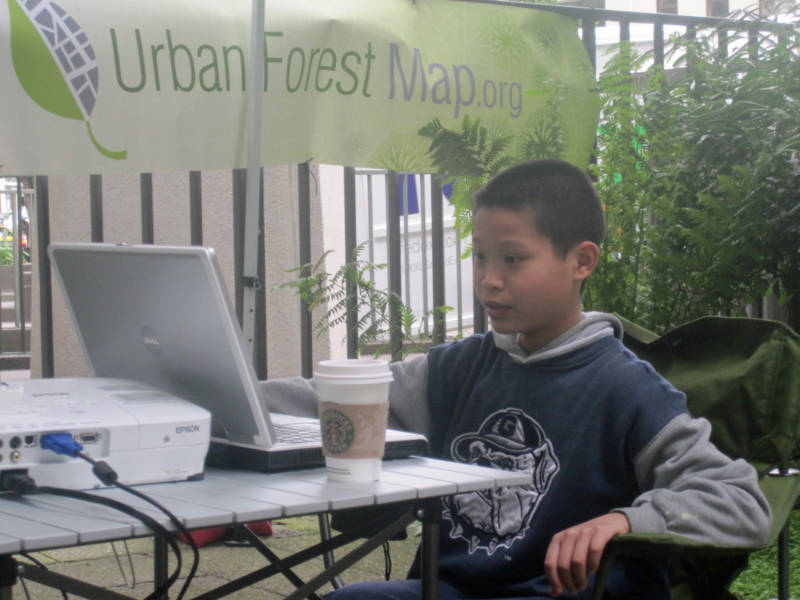
San Francisco 5th-grader Benton Liang demonstrates how to add a tree to the Urban Forest Map (photo: Gretchen Weber)

A new online tool launched this week aims to enlist citizens to help catalog San Francisco’s trees.  The Urban Forest Map relies on the public, or “citizen scientists,” to observe their yards and neighborhoods and to add information to an online database that tracks  tree location, species, size, and health, throughout San Francisco.

The project’s creator, Amber Bieg, said that 17 different organizations and agencies in the city manage and track trees, but until now, they had no organized way to share information. “This map provides the ability to aggregate data in a new way,” said Bieg. “And it’s an affordable way to do an inventory because it uses citizen participation.”

Bieg developed the program with funding from the California Department of Forestry and Fire Prevention (CAL FIRE). Created in cooperation with Friends of the Urban Forest and the City and County of San Francisco, the Urban Forest Map is designed to serve as a publicly accessible, centralized database that will help urban foresters and city planners better manage trees in specific areas, track and combat tree pests and diseases, and plan future tree plantings.

Creators also hope that climatologists will use to the tool to better understand the effects of urban forests on climate, and that students will get involved and use the map to learn about the role trees play in the urban ecosystem. “If you can’t count it, you can’t manage it,” said CAL FIRE urban forester John Melvin. “If the state is going to adapt to climate change, we’re going to have to expand and better manage our urban forests, and that starts with knowing what we have.”

Urban trees can help cities adapt to climate change by providing shade cover and by both mitigating and purifying storm water runoff, Melvin said. Studies have shown that a robust tree canopy can reduce the “urban heat island” effect by several degrees.

To underscore how easy the tool is to use, on Wednesday morning San Francisco 5th-grader Benton Liang demonstrated how to use to the software for a small crowd gathered in a small park at the foot of the Transamerica Building. In addition to providing an inventory, Bieg said, the map is also an educational tool.  The Urban Tree Key is a related interactive tool that helps citizen scientists identify common Northern California urban trees. The map’s software also allows users to calculate the benefits, such as energy savings and air quality, that a specific tree or category of trees provide using data from the Center for Urban Forests Research, said Bieg.

To learn more about the Urban Forest Map, watch a video from 2007 that KQED’s Quest made about the project.

Spring Comes Sooner, Some Species Suffer

Spring in the United States comes ten days sooner than it did just 20 years ago, according to scientists on a media call Tuesday.   This phenomenon, known as “spring creep” (or “season creep“), may be good news for flip-flop fans, but it doesn’t always work out well for native species in certain habitats.  According to Reuters, scientists on the call (which was sponsored by the Union of Concerned Scientists) explained that when spring comes earlier, it doesn’t just bring warm weather sooner — it actually throws off the balance of entire ecosystems by encouraging the spread of invasive species, many of which are better able to adapt to the changing conditions than are native plants and animals.  In the American West, warmer weather is already shrinking the habitat of the American pika, and more of it could make wildfires more frequent and intense.

Geoengineering: A Hot Topic


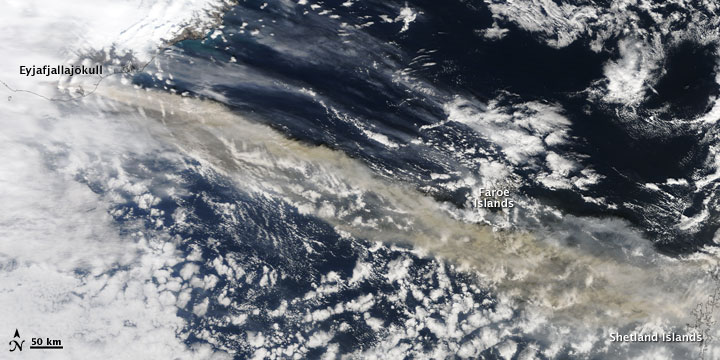
Ash plume across the North Atlantic from Iceland’s Eyjafjallajökull Volcano (Photo: NASA’s Earth Observatory)

As we reported last month for The California Report and on the Climate Watch Blog, the subject of geoengineering, or deliberate climate intervention, is becoming an increasingly hot topic; ideas such as brightening clouds to reflect sunlight away from the Earth or shooting aerosol particles into the stratosphere to block it. They’re just two of the science-fiction-sounding ideas garnering interest from the scientific community and the public as prospects dim for CO2 mitigation efforts across the world.

This morning on KQED’s Forum program, host Dave Iverson was joined by Ken Caldeira, climate scientist at the Carnegie Institution’s Department of Global Ecology at Stanford University, and Martin Bunzl, professor of philosophy at Rutgers University and director of the Rutgers Initiative on Climate and Social Policy.

At the outset, Caldeira explained the distinction between two basic kinds of intervention: one bucket of strategies that focus on removing carbon from the atmosphere, which tend to be expensive, but less controversial, and a second bucket of strategies that are being designed to reflect or block sunlight to cool temperatures, irrespective of CO2 levels.

This second bucket is where the bulk of the controversy lies for various reasons, including environmental and political concerns, as well as a fear by some that the more attention geoengineering gets, the less likely people will be to do the critical work required to reduce greenhouse gas emissions.

“The only real way to solve our climate problem is to reduce greenhouse gas emissions,” said Calderia. “But I’m concerned that we’re not doing that, and I’m thinking, what will we do in the event of an emergency?””

Because climate modeling is not yet sophisticated enough to capture the regional and local effects of geoengineering strategies, and because with current technology, it would likely be impossible to limit the effects to a specific area of the planet, both Caldeira and Bunzl expressed the need for caution when considering deployment.  Caldeira said that more research needs to be done on potential environmental impacts of geoengineering, something Bunzl said might be premature.  Bunzl advocated that research be focused on improving computer modeling before taking any experiments into the field.

“I’m concerned about the limitations of our climate models in predicting regional effects, and especially regional effects due to precipitation. Until and unless those climate models become a lot better with their fine-grained prediction, its a crapshoot,” said Bunzl.

One concern Climate Watch readers and listeners have raised about using sulfur aerosol for solar radiation management is acid rain.  Caldeira said that this strategy could produce a “small acid rain problem,” but that it would not be consequential given the relatively small amount of particles that would be used (a few percent, compared with what we’re already emitting in other ways).  In a separate interview last month, Rutgers geoengineering expert Alan Robock dismissed the acid rain concern by saying that the amount of sulfur that would be used in geoengineering strategies would be close to negligible, compared with the sulfur already spewing into the atmosphere from coal plants.  In fact, Robock said he recently removed acid rain from his list of “20 reasons why geoengineering may be a bad idea” list.

Two new books on the subject will appear on shelves this month: How to Cool the Planet by Jeff Goodell, and Hack the Planet by Eli Kintisch. Both books are reviewed by Mason Inman at Nature Reports Climate Change this week and on Thursday, Goodell discussed his book on NPR’s Fresh Air.  Kintisch has also developed the Earth Emergency Procedures Safety Card which is a clever, quick introduction to the why’s and how’s of geoengineering, available either as a physical card or an online flash interactive animation.

After the Forum broadcast, I asked Caldeira about the volcano erupting in Iceland that is currently grounding flights across Europe.  Could Eyjafjallajokull be another Mt. Pinatubo?  (The massive 1991 eruption of Mt. Pinatubo in The Philippines sent so much ash into the stratosphere, that it was responsible for cooling the Earth’s atmosphere 1/2 degree Celsius.)  Not likely, said Caldeira.  While the Icelandic volcano is wreaking havoc on air travel, he said, the eruption is too small to disrupt global climate.  The only effects Californians might see, he said, are “better sunsets.”

Icelandic Volcano Chills Travel Plans…But What About the Climate?

This post was contributed by Andrew Freedman of our content partners at Climate Central. Find out why scientists are using volcanoes as a possible model for global climate intervention, on the Climate Watch blog and on KQED’s Forum program.

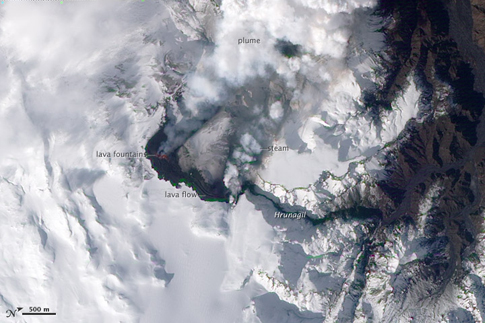
Eruption of Eyjafjallajökull Volcano, Iceland  (Photo: NASA Earth Observatory)
Eruption of Eyjafjallajökull Volcano, Iceland (Photo: NASA Earth Observatory)


The ongoing eruption of Mt. Eyjafjallajokull in Iceland is disrupting flights across Europe, shutting down some of the busiest airports and aviation corridors in the world. But could it also disrupt the climate system, leading to a temporary cooling trend this summer?

Not likely, according to Rutgers University environmental sciences professor Alan Robock, an expert on how volcanoes alter the composition of the Earth’s atmosphere. According to Robock, the Icelandic eruption hasn’t contributed enough sulfur dioxide to the upper atmosphere to significantly alter the climate.

“From what I’ve seen from the observations so far, there hasn’t been enough put into the atmosphere to have a large climate effect,” he said in a telephone interview.

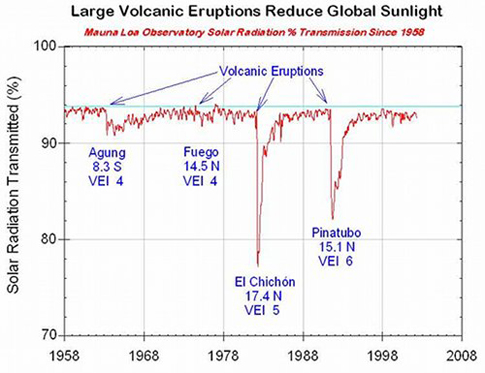
It is well known that volcanic eruptions can affect the climate. Just ask historians, who can tell you about the “year without a summer” that followed the enormous eruption of Mt. Tambora in Indonesia in 1816. More recently, the 1991 eruption of Mt. Pinatubo in the Philippines, which contributed about 20 megatons of volcanic material to the atmosphere, cooled global average surface temperatures by about one degree Fahrenheit in the year following the eruption.

By vaulting particles of sulfur dioxide and other reflective aerosols high into the stratosphere, volcanic eruptions can reduce the amount of solar radiation reaching the planet’s surface. However, this only results in temporary cooling, since chemical processes and air currents remove the particles over time.

NOAA plot showing a decrease in solar radiation reaching the Earth's surface after major volcanic eruptions

In addition to causing short-term cooling, volcanoes also contribute carbon dioxide (CO2) to the atmosphere, which in the very long-term balances slow CO2 losses from other causes. The volcanic contribution of CO2 to the atmosphere is estimated to be well less than the recent human contribution, on average.

Robock noted that the ash cloud that is canceling flights would not alter the climate, since it will fall out of the air in a matter of days. “What’s dangerous for airplanes is not what causes climate to change,” he said.

The volcano’s climate impacts may also be limited by its high-latitude location, since the air circulation in the upper atmosphere in the high latitudes tends to be more efficient at getting rid of volcanic material, compared to lower latitudes where sulfur dioxide particles from volcanoes can linger for years.

Robock noted that Icelandic eruptions have disrupted climate in the past, such as a long duration event in 1783-4 that cooled temperatures in Europe, catching then US ambassador to France Benjamin Franklin’s attention. According to the National Oceanic and Atmospheric Administration, Franklin was a pioneer in linking a volcanic eruption to climate change.

It’s still possible that this volcano, which is continuing to erupt, may yet send more volcanic material into the upper atmosphere, thereby causing a cooler summer in the northern hemisphere.

Climate Change as a Moral Issue

Global warming is not just a scientific or political issue, it’s a moral one, said Reverend Sally Bingham of San Francisco’s Grace Cathedral, at the Commonwealth Club last week.  Bingham, who founded the Interfaith Power and Light campaign, an organization dedicated to “mobilizing a religious response to global warming,” joined Rabbi Stephen Pearce of Congregation Emanu-El in San Francisco at the talk, which was organized by Climate One, to discuss the intersection of religion and climate change.

“I think believe of faith have come to realize that this is a moral issue, how we behave on the planet, ” said Bingham. “God put us here to be the stewards, and over the last few years as more clergy have come to realize that this is a matter of faith. You cannot profess a love of God and destroy creation.”

Pearce talked about how he first entered the arena of environmental activism in the 1990s, when he went to a rally to save redwoods in northern California.  After being moved by the experience he founded the Interfaith Coalition to Save the Headwater Forest, an activist organization dedicated to protect the forest. After a long battle, during which Pearce earned the nickname “The Redwood Rabbi,” the forest was eventually protected.

“I was moved by the plight of all of these people who got into their pick up trucks and came all the way down to make their plight known,” said Pearce.

In this video from the talk, both religious leaders talk about the passages from scriptures have contributed to their beliefs on environmentalism.

The hour-long program airs on KQED at 2:00pm this Saturday, April 3rd, and after that is available online.