Category Archives: Music

Ann Hamilton

Ann Hamilton‘s eight-story tower, built on the grounds of the Oliver Ranch in Geyserville, Calif., is more than just a work of art to be observed. With its cylindrical walls, staggered windows, open ceiling and winding stairways, the space also serves as a unique venue for performance art. Spark visits with Hamilton and Meredith Monk for the unveiling of “The Tower.”

The product of almost nine years of discussion and three years of construction, Hamilton’s tower was inspired by a 16th-century Italian well that led farm animals down to water via one staircase and — because they couldn’t turn around on their own — back to the top via another. Yet unlike a well deep in the ground, Hamilton’s work rises high above the landscape.

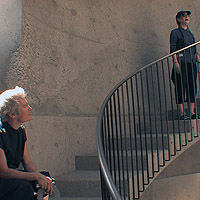
In the structure’s center, a reflecting pool sets the stage for the two spiral staircases, which shaped like a double helix never connect or cross each other in a seemingly M.C. Escher fashion. Adding to the illusion, the 128 steps in each of the staircases get progressively narrower as they ascend.

Poured from more than 2,000 tons of concrete and sandblasted for an instant antiquing effect, “The Tower” features windows in various shapes and sizes that, much like the holes on a woodwind instrument, allow sound to escape. At the same time, these openings provide an unconventional seating schema for audiences.

“What interested me about the form of the double helix in this situation is that it means that one stairway can be a moving performance and one can be a static or moving audience. But you’re wound within each other, in the same space,” Hamilton explains.

Steve and Nancy Oliver’s 100-acre ranch has become one of the most prestigious private art preserves in the country over the last two decades. Hamilton’s tower is the 18th site-specific structure that the Olivers have commissioned on their Sonoma property.

Based in Columbus, Ohio, Ann Hamilton earned an M.F.A. in sculpture from Yale University. She was awarded a MacArthur Fellowship in 1993 and was the 1999 American representative to the Venice Biennale. She is a faculty member at the University of Ohio.

  • Array
  • Array
  • Array

Laurie Antonioli

Bay Area vocalist and lyricist Laurie Antonioli has traveled the world and performed with some legendary jazz artists, including Cedar Walton, Bobby McFerrin, and Joe Henderson. After a four-year stint as a professor in the vocal jazz department at KUG University in Graz, Austria, Antonioli is back in the Bay Area teaching aspiring vocalists at the Jazzschool in Berkeley.

After musical studies at Mt. Hood Community College in Portland, Oregon, Antonioli joined saxophonist and vocalist Pony Poindexter on a European tour. When she returned stateside with considerable experience under her belt, she performed regularly and released such albums as “Soul Eyes” (Catero Records) and “The Duo Sessions” (Nabel Records).

Antonioli also thrives as a lyricist, penning words to such jazz standards as “Blue In Green” (Davis/Evans), as well as works by contemporary composers like Charlie Haden, Richie Beirach, and John Pattitucci. During her time in Austria, she wrote the lyrics to a body of compositions by pianist Fritz Pauer, which was made into “The Pauer-Antonioli Songbook.” Spark gets a front row seat as she debuts of some of these songs along with a quartet consisting of pianist Peter Horvath, bassist John Shifflett, and drummer Jason Lewis.

  • Array
  • Array

Ballet Afsaneh Art and Culture Society

From Uzbekistan to India, Turkey to Afghanistan, the Ballet Afsaneh Art and Culture Society brings to the stage the vibrant sights and sounds of the ancient route through Asia known as the Silk Road. Spark sits in as they rehearse Sharlyn Sawyer’s “Song of Generations,” a multi-generational collaboration with the Nejad World Music Daf Ensemble that celebrates Persian culture and history.

A crossroads of trade in ideas as well as goods, the 7,000-mile-long Silk Road connected the empires of Byzantium, the Ottomans, India, Persia and Mongolia with Western Europe for more than 2,000 years. Combining music, poetry and dance, Ballet Afsaneh’s performances offer a richly textured perspective on cultures that originate in modern-day Iran, Tajikstan, Uzbekhistan and Afghanistan — an alternative to the usual news about political upheaval and war in that region.

Founded in 1986 by California native Sawyer, Ballet Afsaneh’s repertoire spans the traditional as well as the contemporary, with colorful dances created by Sawyer in collaboration with the other members of the troupe. Sawyer’s training includes both Eastern and Western dance styles, and she focuses on preserving and presenting the traditional dances of women from the various countries that make up Central Asia and Asia Minor.

Lyrical, classically influenced dances like Barg e Behesht — with its expressive, twining arms and graceful movements under a canopy of blue silk representing the sky — evoke the elegant storytelling traditions of the Persian courts. In contrast, the company’s Uzbekh repertoire includes dances in the playful Bukhuran style as well as the softer, more emotional Ferghana style, which reenacts celebrations, such as weddings and festivals.

A troupe mainly composed of women, Ballet Afsaneh also showcases its members in the traditional folkloric and ritual dances of Afghanistan, such as the Loghari and Attan, as a response to the religious and political strife that has kept women from dancing or performing in public in Afghanistan during the rule of the Taliban.

The company, whose name comes from a Persian word meaning “fairytale” or “legend,” is composed not only of dancers but also of poets and musicians, most of whom come from a Central Asian background. Each member of the troupe, however, performs in a wide variety of styles, crossing over cultural barriers in the same way that migrating travelers have intermingled along the Silk Road for thousands of years.

  • Array
  • Array

Mike Henderson

As a successful blues man, Mike Henderson has performed widely and released several albums. As a painter, Henderson’s work has been exhibited across the country. And as if that weren’t impressive enough, he’s also an accomplished filmmaker. Spark visits Henderson in his San Leandro home studio as he jams on the guitar and creates a new series of paintings for the Haines Gallery.

As a young artist and musician in the mid-1960s, Henderson entrenched himself in the political rallies of the era. Inspired by these events, his artwork leaned toward the figurative, but after a fire destroyed many of his unsold paintings in 1985, he began to create increasingly more abstract pieces.

His oil work today is characterized by large brush strokes, spread and layered thick, then scraped away, leaving bold panes of color that many times reflect his visual interpretation of music. “I started painting these thoughts I had about music, using this big red, like Ray Charles screaming or an Albert King lick.”

Born in the small farming town of Marshall, Missouri, in 1944, Mike Henderson was supposed to work in the local factory with his father. But his passion for art led him across the country to one of the first integrated art schools in the United States, the San Francisco Art Institute. He earned a B.F.A. in 1969 and an M.F.A. in 1970. Henderson has been teaching art and art history at the University of California at Davis ever since, and he is considered a prominent figure among the second generation of Bay Area abstract painters.

  • Array

KlezCalifornia

For the past 30 years, Martin Schwartz has gathered an impressive collection of rare 78 rpm records, many of them klezmer, a type of instrumental music originating from Eastern European Jews. In the 1970s, Schwartz met some Berkeley musicians who shared his passion for klezmer. They began learning from the old recordings and started a band called Klezmorim, fostering a burgeoning nationwide revival of the genre.

Meaning literally “vessel of song,” klezmer can be played on a variety of instruments – including trombone, clarinet, violin, accordion, tsimbl (a kind of hammered dulcimer), drums, bass viol – but is most commonly associated with the violin and the clarinet. These lead instruments are played in a style that mimics the human voice, common to liturgical singing styles.

Klezmer harkens back to a time when music was an integral part of daily life, supporting weddings, bar mitzvahs, and other sacred and secular celebrations. Today, Schwartz is on the Advisory Council of KlezCalifornia, which was founded in 2003 to celebrate klezmer music and Yiddish culture in the San Francisco Bay Area.

KlezCalifornia offers workshops on music, dance and singing. Participants learn the music by listening and playing back what they hear — no written music is handed out, which is true to the way klezmer has been passed down for hundreds of years. Spark explores this revival at KlezCalifornia shedding light on a tradition that has endured through time and hardships to prove its vitality and relevance to new generations.

Array

  • Array
  • Array
  • Array

Tippy Canoe and the Paddlemen

Michele Kappel aka Tippy Canoe was a drummer in the rock band The Kirby Grips when she picked up the ukulele and fell in love. She then started writing her own songs for the instrument combining jazz, pop, old time, and girl group music mixed with post-punk influences such as Squeeze and Blondie.

After a few years of performing on her own, Kappel formed her own back up band, The Paddlemen with Rick Quisol on drums, Mikie Lee Prasad on guitar and Chris “T.G.” Green on bass. Spark catches one of their gigs at Alameda’s Speisekammer.

  • Array
  • Array
  • Array

Howard Wiley

Bay Area jazz saxophonist Howard Wiley has discovered that great works of art sometimes are born of the direst circumstances. Wiley has put together a program based on music found at Louisiana’s notorious Angola State Penitentiary, where gospel songs dating back to the 1930s have been preserved. Spark checks in as Wiley and his ensemble rehearse for a concert at San Francisco’s Intersection for the Arts.

Angola State Penitentiary is one of the largest prisons in the country, holding about 5,000 prisoners and maintaining a staff of 1,000. The facility sits on an 18,000-acre expanse that was originally four separate slave plantations. In 1880, Samuel Lawrence James joined these plantations to form the Angola plantation and contracted convicts from the state to work on it. Louisiana took full control of the plantation in 1901.

Over the course of the 20th century, Angola developed a reputation for violence and abuse. Still a working farm, the prison became known as a holdover from the days of slavery, where the predominantly black inmates were forced to spend life sentences laboring under dehumanizing conditions. In 1952, 31 inmates, who came to be known as the Heel String Gang, severed their own Achilles tendons in protest of the brutal work routine. In 1972, the federal courts finally interceded and ordered a crackdown on the abuse at Angola.

Daniel Atkinson, an ethnomusicologist who studies African American folk traditions of the South, introduced Wiley to the music of Angola. In part because Angola remained a functioning plantation, inmates retained and handed down some of the spirituals and work songs of the slave era, traditions that became mingled with secular performance practices when populations began migrating north and west in the 1920s. This legacy, which Wiley is featuring in his Angola program, was crucial to the development of American music, eventually giving rise to a number of genres, including blues, gospel and jazz.

For Wiley, uncovering the music of Angola State Penitentiary has opened a window onto the musical origins of the South. He has put together the Angola Project, which he describes as a “soul chamber ensemble.” The ensemble combines two vocalists with violins, bass, saxophone, trombone, trumpet and drums. His interpretations of the songs from Angola are based on the call-and-response interplay between leader and congregation in churches. The style adds a stirring, haunting tone to the compositions.

Array

  • Array
  • Array

Del Sol String Quartet

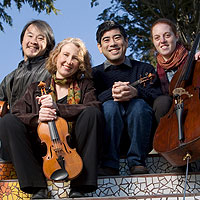
Based in San Francisco, the Del Sol String Quartet is asserting itself as a leader in Bay Area new-music performance. This ensemble commissions new music from composers and showcases those and other new works in relevant, responsive and deeply passionate performances. Spark listens to the Del Sol String Quartet rehearse and is there when the quartet debuts the work of three composers — New Zealand native Jack Body, Iranian-American composer Reza Vali and Los Angeles-based Eric Lindsay.

Body’s piece, entitled “Epicycle,” does exactly that: It cycles through a pattern of pitches that are at times played simultaneously and at other times played as distinctly separate notes. The work was originally performed by the Kronos Quartet. “I loved his piece from the minute we picked it up, despite how difficult it is to play,” says ensemble member Hannah Addario-Berry.

Vali, a professor of music at Carnegie Mellon University, helped the Del Sol String Quartet tackle the Persian scale patterns used in his piece. One of the main principles in Middle Eastern music is its use of quartertones, which Western music does not commonly employ. A quartertone is a note that is between the half-step interval, or halftone, the smallest distance between two pitches in Western music. Also, as Vali states, Persian music is not rhythmically in sync in the same way that Western music is. They play the same music, but with a slight time difference.

“Del Sol is at the point where they’re ready to be discovered. They’ve worked very hard and developed a unity that is sensational. They’re exciting — not only the music they choose, but also their performances are electric,” praises Charles Amirkhanian, the executive director of Other Minds, a new-music festival and community.

The members of the Del Sol String Quartet are Kate Stenberg and Rick Shinozaki, violinists, Charlton Lee, violist, and Hannah Addario-Berry, cellist. The quartet began in 1992 at the renowned Banff Centre for the Arts in Canada, after which it was awarded a residency at San Francisco State University in association with the Alexander String Quartet. They tour internationally and are committed to performing outreach work in schools and at other community sites. In January 2006, the quartet was awarded First Prize for Adventurous Programming (Mixed Repertory) from Chamber Music America/ASCAP.

  • Array
  • Array
  • Array

John Santos

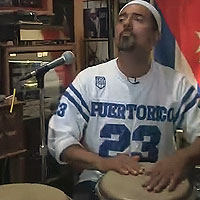
Four-time Latin Grammy nominees John Santos and his Machete Ensemble have been at the forefront of Latin jazz in the Bay Area for more than 20 years. His 11-piece ensemble has explored the boundaries of the genre, incorporating elements of experimental, Afro-Caribbean folk and Latin dance music as well as the blues.

Over the years, the Machete Ensemble has developed a loyal and critical audience appreciative of music that doesn’t fit into simple categories. But economic factors have not been kind to large ensembles, and with reduced bookings, the ensemble has decided to end its two-decade tenure with a farewell concert closing the San Francisco Jazz Festival. Spark follows Santos as he prepares for both the concert and the journey into the next phase of his music career, with the John Santos Quintet.

With family roots in Cape Verde and Puerto Rico, Santos was inspired by his musically talented family and the burgeoning music scene of San Francisco’s Mission District. He started out playing Latin percussion instruments, including the bongos and the conga drums. But it was upon the introduction in the 1960s of the funky Latin fusion music of Carlos Santana that Santos became truly inspired by the possibilities of merging traditional Latin music with modern forms.

After a brief experience as a percussionist in Santana’s band, Santos dedicated himself to a lifetime of study and practice, and today he is one of the foremost authorities on Latin jazz and Latin folk music traditions. After many years as an educator, a historian, a recording artist and a performer, Santos has made it part of his mission to educate the public on Latin music traditions and its strong influence on the development of not just jazz, but all popular American music.

Array

  • Array
  • Array

Amy X Neuburg

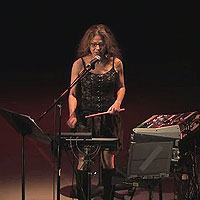
Since the mid-1980s, Amy X Neuburg has been combining her staggering vocal abilities with electronics to create music that defies categorization. Working both as a solo performer and as part of a number of ensembles, Neuburg writes, records and performs a hybrid style of music she calls “avant-cabaret.” Spark pays a visit to this groundbreaking musician as she prepares a new song cycle, entitled “The Secret Language of Subways.”

Neuburg primarily uses electronic instruments in her work — programmable drum pads, mixers and a looper — which allows her to instantaneously record and play back sound. Before she can perform a song, Neuburg must prepare each of these devices, a task that can take weeks of experimenting with an array of configurations and functions. To these tools she adds her voice, which boasts an impressive four-octave range.

In performance, all sounds are executed live: Despite Neuburg’s reliance on electronic instruments, she uses no prerecorded tapes or canned sound. Looping allows her to create a sound live then repeat it to build a dense and dynamic sound texture. In addition, Neuburg leaves little room for improvisation, as each sound is meticulously scripted, every note precisely choreographed.

Subtitled “A Song Cycle About Love and War and New York,” Neuburg’s “The Secret Language of Subways” is composed of 12 songs that were largely conceived while riding New York’s subway system. Using urban metaphors to examine questions of love, loss, deceit, art and social responsibility, “The Secret Language of Subways” is Neuburg’s most ambitious work yet, both in terms of content and musically. Enlisting the help of Bay Area cellists Jess Ivry, Elaine Kreston and Beth Vandervennet, she has put together an unusual and challenging quartet.

Born in Cheltenham, England, Amy X Neuburg began classical training in voice at the age of 13. She earned a B.Mus. from Oberlin Conservatory and a B.A. in linguistics from Oberlin College. Neuburg then went on to pursue a master’s degree at Mills College, where she studied composition under electronic music pioneers Pauline Oliveros and David Rosenboom. In 1987, along with fellow Mills students Joel Davel, Tim Root and Herb Heinz, Neuburg formed the techno-theater ensemble MAP, later performing under the name “Amy X Neuburg and Men.” Neuburg has also performed and toured the world in the operas of veteran minimalist composer Robert Ashley.

Array

  • Array

The Crooked Jades

The Crooked Jades are on a mission to revive some of America’s oldest music. Aficionados of “old-time” music, the members of this Bay Area band perform their own take on rural folk music from the days before radio. Spark catches up with The Crooked Jades as they prepare to leave on their European tour.

Old-time music is a branch of American roots music that originated in the South, mostly around Kentucky and Georgia, and extended north as far as New England. Its base is a mixture of folk songs and instrumentation that go back to the country’s earliest settlers. Old-time music was instrumental to the folk revival of the 1960s, and it’s currently enjoying a renewed interest among young and old audiences alike. The Crooked Jades are amongst a number of old-time bands that have sprung up across the country in recent years in an effort to revitalize this rich heritage.

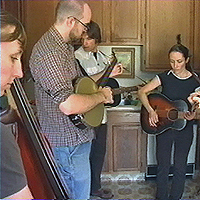
For Crooked Jades bandleader Jeff Kazor, old-time music offers a way to connect today’s world with the country’s earliest days — the songs evoke conjure common feelings of alienation and suffering. As the chief songwriter of the band, Kazor finds his inspiration by listening to old recordings and selecting songs to rediscover and reinterpret. The band then convenes to practice the new tunes in Kazor’s kitchen.

Kazor is fond of the spontaneous nature of old-time music’s instrumentation, which was often determined more by availability than by musical considerations. At a time when instruments were scarce and expensive, an old-time band made do with jugs, washboards, washtubs and spoons.

The Crooked Jades are Jeff Kazor (guitar/ukulele); Jennie Benford (mandolin/guitar), of Jim & Jennie & the Pinetops; Adam Tanner (fiddle/mandolin); Megan Adie (bass); and Seth Folsom (banjo/slide guitar). The band has toured across the United States and Europe and plays regularly in California. The Crooked Jades’ releases can be found on independent label Copper Creek Records and on their own label, Jade Note Music.

Array

  • Array
  • Array
  • Array

Miena Yoo

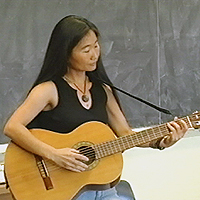
Miena Yoo has been singing and writing her own songs since she was 18 years old, but it was stomach cancer that prompted her to first perform publicly. As a patient at UCSF’s Mt. Zion Cancer Center in San Francisco, Yoo learned about a volunteer musician program that brings local artists to play music for patients and their families.

When she beat cancer after a year-long struggle that included rounds of chemotherapy, Yoo traded in her patient status for that of performer. Today, you’ll find Yoo performing at Mt. Zion Cancer Center, as well as Bay Area nursing homes, the Martinez veterans home, local festivals, cafes and private events. She also has a regular gig at the Cannery at Del Monte Square, where her deep, soulful voice provides a backdrop for the crowds of tourists who frequent the marketplace. Much like the folk greats of yesteryear, she eagerly travels anywhere she can to share her music with others.

A native of South Korea who immigrated to the United States 14 years ago, Yoo creates music that mixes Korean language, phrases and imagery with English. “When I sing in Korean it is my native language. It touches my heart and I see more the experiences of my memories that I had when I was little. It brings … more emotional feelings when I sing,” she explains to Spark.

In 2006, Yoo released the album “At the River Again,” which touches on her childhood in Korea, her family members and natural themes like wildlife, trees and water. Her folk-driven sound carries obvious influence from Korean performers like Hee Eun Yang — famous in the 1960s and 70s — and American songstresses Lucinda Williams and Tracy Chapman.

In the midst of a busy playing schedule and work on her album, Yoo remains focused on giving back to the surrounding community. Along with offering her time and music to ill and elderly Bay Area residents, Yoo plans to donate all proceeds from heralbum to stray animal rescue efforts.

  • Array
  • Array
  • Array
  • Array

Walter Savage

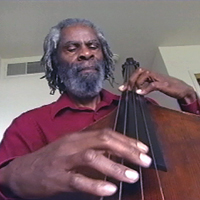
The upright bass is often viewed primarily as a supporting instrument, but local jazz musician Walter Savage has won a reputation for bringing it to the spotlight. Whether he’s playing a gig at a renowned Bay Area jazz institution like Yoshi’s or entertaining the masses at Enrico’s in North Beach, Savage lets the bass shine through as a leading force.

Savage’s love affair with music began early on. “You know my background in music is like a lot of black people in America,” Savage says. “My dad was a preacher. I was forced … to do [music] in the church, you know? I’ve always been interested in music. I can’t remember not singing. Everybody in my family loved to sing.”

Stationed throughout the Pacific during the 1960s, Savage got turned onto the bass after a musician visiting his military base showed him a few jazz chords. At first, he thought the instrument would be easy to master. Now, over forty years later, Savage says he’s still exploring his instrument’s possibilities. “It’s like the more you learn, the more you know you need to learn,” he says.

That thirst for knowledge has led Savage to record two albums featuring his own compositions and vocals. While his music writing and singing talents have garnered praise from jazz fans, Savage’s chief interest these days is showcasing the bass as a solo instrument — as Spark witnesses when Savage headlines at Yoshi’s Jazz House with drummer Eddie Marshall and pianist Alan Steiger.

  • Array
  • Array

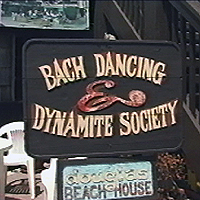
Bach Dancing and Dynamite Society

Founded by Pete Douglas in 1964, the Bach Dancing and Dynamite Society is a non-profit organization presenting live concerts of principally jazz, classical and world music. All performances are held at the Douglas Beach House on Miramar Beach, Half Moon Bay on Friday and Saturday nights in addition to Sunday afternoons. To attend, please note that reservations are only taken for current Bach members, but some seating is almost always available at the door.

  • Array