Tag Archives: Technology

Geoengineering: A Hot Topic


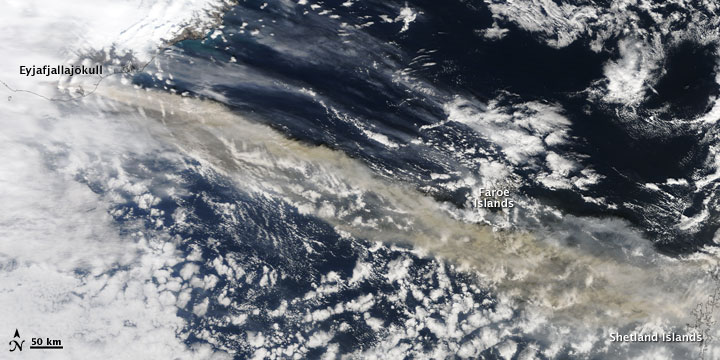
Ash plume across the North Atlantic from Iceland’s Eyjafjallajökull Volcano (Photo: NASA’s Earth Observatory)

As we reported last month for The California Report and on the Climate Watch Blog, the subject of geoengineering, or deliberate climate intervention, is becoming an increasingly hot topic; ideas such as brightening clouds to reflect sunlight away from the Earth or shooting aerosol particles into the stratosphere to block it. They’re just two of the science-fiction-sounding ideas garnering interest from the scientific community and the public as prospects dim for CO2 mitigation efforts across the world.

This morning on KQED’s Forum program, host Dave Iverson was joined by Ken Caldeira, climate scientist at the Carnegie Institution’s Department of Global Ecology at Stanford University, and Martin Bunzl, professor of philosophy at Rutgers University and director of the Rutgers Initiative on Climate and Social Policy.

At the outset, Caldeira explained the distinction between two basic kinds of intervention: one bucket of strategies that focus on removing carbon from the atmosphere, which tend to be expensive, but less controversial, and a second bucket of strategies that are being designed to reflect or block sunlight to cool temperatures, irrespective of CO2 levels.

This second bucket is where the bulk of the controversy lies for various reasons, including environmental and political concerns, as well as a fear by some that the more attention geoengineering gets, the less likely people will be to do the critical work required to reduce greenhouse gas emissions.

“The only real way to solve our climate problem is to reduce greenhouse gas emissions,” said Calderia. “But I’m concerned that we’re not doing that, and I’m thinking, what will we do in the event of an emergency?””

Because climate modeling is not yet sophisticated enough to capture the regional and local effects of geoengineering strategies, and because with current technology, it would likely be impossible to limit the effects to a specific area of the planet, both Caldeira and Bunzl expressed the need for caution when considering deployment.  Caldeira said that more research needs to be done on potential environmental impacts of geoengineering, something Bunzl said might be premature.  Bunzl advocated that research be focused on improving computer modeling before taking any experiments into the field.

“I’m concerned about the limitations of our climate models in predicting regional effects, and especially regional effects due to precipitation. Until and unless those climate models become a lot better with their fine-grained prediction, its a crapshoot,” said Bunzl.

One concern Climate Watch readers and listeners have raised about using sulfur aerosol for solar radiation management is acid rain.  Caldeira said that this strategy could produce a “small acid rain problem,” but that it would not be consequential given the relatively small amount of particles that would be used (a few percent, compared with what we’re already emitting in other ways).  In a separate interview last month, Rutgers geoengineering expert Alan Robock dismissed the acid rain concern by saying that the amount of sulfur that would be used in geoengineering strategies would be close to negligible, compared with the sulfur already spewing into the atmosphere from coal plants.  In fact, Robock said he recently removed acid rain from his list of “20 reasons why geoengineering may be a bad idea” list.

Two new books on the subject will appear on shelves this month: How to Cool the Planet by Jeff Goodell, and Hack the Planet by Eli Kintisch. Both books are reviewed by Mason Inman at Nature Reports Climate Change this week and on Thursday, Goodell discussed his book on NPR’s Fresh Air.  Kintisch has also developed the Earth Emergency Procedures Safety Card which is a clever, quick introduction to the why’s and how’s of geoengineering, available either as a physical card or an online flash interactive animation.

After the Forum broadcast, I asked Caldeira about the volcano erupting in Iceland that is currently grounding flights across Europe.  Could Eyjafjallajokull be another Mt. Pinatubo?  (The massive 1991 eruption of Mt. Pinatubo in The Philippines sent so much ash into the stratosphere, that it was responsible for cooling the Earth’s atmosphere 1/2 degree Celsius.)  Not likely, said Caldeira.  While the Icelandic volcano is wreaking havoc on air travel, he said, the eruption is too small to disrupt global climate.  The only effects Californians might see, he said, are “better sunsets.”
NASA Looking More Earthward

Rachel Cohen is a Bay Area freelance writer, presently serving an internship with Climate Watch.

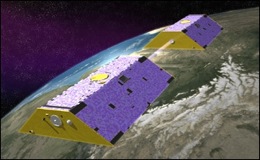
NASA's GRACE satellite is equipped to gather ice and water data on the Earth's surface. Image: NASA

To boldly go–where we already live

By Rachel Cohen

NASA will likely be focusing more attention on the “pale blue dot” in coming years, with a reinvigorated Earth Science Program. California’s freshwater supply and sea level change are among the features that will be studied by replacing an aging satellite.

The proposed White House budget for the National Aeronautics and Space Administration includes billions of dollars for satellites and other tech tools to help scientists investigate Earth-bound problems, especially climate change. Part of the program will be steered from Pasadena’s Jet Propulsion Laboratory, which will manage two key missions connected with the program. JPL spokesman Alan Buis says the White House support may provide stability for gathering the kind of long-term data sets needed to study gradual changes in earth systems.

As Jon Hamilton reports in his  story for NPR’s Morning Edition, the centerpiece of the program will be the GRACE satellite which will collect data critical for a variety of models and applications, including:

· The changing mass of polar ice caps
· Changes in water resources on land
· Shallow and deep ocean current transport mechanisms
· Sea level change resulting from ocean temperature and water mass changes
· Exchanges between the oceans and atmosphere
· Forces that generate Earth’s geomagnetic field, and
· Internal Earth forces that move tectonic plates and result in earthquakes and volcanic eruptions

GRACE has been in orbit since 2002 and is due to be replaced. NASA suffered a severe setback when its Orbiting Carbon Observatory (OCO) satellite crashed after its launch early last year. The White House budget includes funding to rebuild the vehicle and relaunch in February of 2013. The OCO2 satellite is designed to measure carbon dioxide in the atmosphere, specifically comparing sources of CO2 to “sinks,” where it is stored.

Research Vessel Docked for Lack of Funds

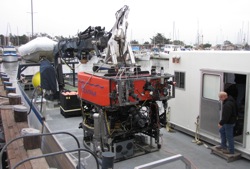
The research vessel Point Lobos, docked at Moss Landing. Photo: Craig Miller

Update: Since this original post, the status of the Point Lobos was updated by Paul Rogers in the San Jose Mercury News. The article also adds detail on the finances of MBARI and its primary funder.

The Monterey Bay Aquarium Research Institute (MBARI) has been forced to dock the workhorse of its research fleet, the R/V Point Lobos.

For years the vessel has ventured out three-to-five times a week, to conduct short-term experiments in the deep canyons of Monterey Bay. The ship serves as a platform for the Institute’s remote-control submarine, ROV Ventana. The Point Lobos and its robo-sub have played critical roles in recent experiments to study the effects of ocean acidification, among other endeavors.

In the late 1980s, MBARI converted the 110-foot vessel from its original duty as an oilfield service boat in the Gulf of Mexico. Since then it’s completed more than 3,500 missions, with its seven-person crew and various teams of scientists.

The remotely operated sub Ventana, perched on the afterdeck of the Point Lobos. Photo: Craig Miller

Institute spokesman Kim Fulton-Bennett says that as of April 1, the Lobos is “mothballed” for the time being, its future uncertain. “It means we won’t have as frequent access to the ocean as we did,” Fulton-Bennett told me, as we stood on the dock at Moss Landing.

“By going out several times a week, we’ve got a database of observations that goes back 20 years.”

But the Wall Street woes of the past couple of years have taken their toll on the investment portfolios of many foundations, including MBARI’s primary funder, the David and Lucile Packard Foundation, which Fulton-Bennett says has reduced it’s funding for MBARI.

H-P co-founder David Packard launched MBARI in 1987 with the goal of applying advanced technology to marine research. The Institute relies on the Packard Foundation for 80% of its funding, typically $30-to-40 million per year, according to the MBARI annual report.

The Institute has two other vessels in its research fleet, a converted pilot boat called the Zephyr and the 117-foot Western Flyer, a twin-hulled, ultra-stable vessel that resembles a catamaran-style ferry. The Flyer is deployed on longer-duration missions in open sea, usually with project-specific funding.

The Point Lobos is featured in Lauren Sommer’s radio report/audio slide show for KQED’s Quest series.

Geoengineering: Starting the Conversation

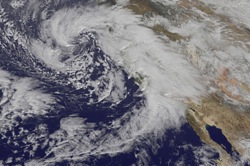
Storms over California. Image: NASA

After five days of talks at Asilomar this week, scientists concluded that more research is needed on climate intervention strategies and their potential risks and rewards, as is a broader discussion involving governments and the public.

The meeting, hosted by The Climate Response Fund (CRF), drew more than 175  people from at least 15 countries, and from  disciplines in the natural sciences as well as social sciences, humanities, engineering, law, and policy, organizers said.

“The purpose of the conference was to figure out what are the processes and procedures that scientists should be thinking about as they undertake this research,”said Mike McCracken, who chaired the event’s Scientific Organizing Committee.  “This was not a conference about comparing geo-engineering ideas to one another, or about bringing new technological ideas to table.”

At the close of the meeting, there seemed to be more questions than answers.  What was clear from meeting discussions and Q&A sessions is that there was no single agenda shared by all participants.  Several voiced grave concerns about the potential risks of climate intervention, on several levels: environmental, social, political, and ethical.

Friday morning provided a glimpse of the tortuous path that awaits this concept, when for more than an hour, participants lined up at a microphone to voice their concerns about the language and intention of a draft news release for the event. The committee then regrouped, drafted a second version of the release, and brought it back to the gathering an hour later.  Objections remained and therefore the release is attributed to the conference Steering Committee, and not the conference as a whole.

From the statement:

“The participants explored a range of issues that need to be addressed to ensure that research into risks, impacts and efficacy of climate intervention methods is responsibly and transparently conducted and that potential consequences are thoroughly understood.  The group recognized that given our limited understanding  of these methods and the potential for significant impacts on people and ecosystems, further discussions must involve government and civil society….  We do not yet have sufficient knowledge of the risks associated with using climate intervention methods, their intended and unintended impacts and their efficacy in reducing the rate of climatic change to assess whether they should or should not be implemented. Thus, further research is indispensible.”

“I think this was the first dialogue, and it was a real dialogue,” said Margaret Leinen of the CRF.  “You have to start somewhere, and this is the beginning of the conversation, definitely not the end of the conversation. I would agree with people who say that many more voices need to come in, and I think it’s not just one additional conference. This is a process, and it’s a process of engagement.”

Those missing voices were among the chief concerns of those protesting the conference.  Diana Bronson of the advocacy organization ETC Group says that conversations about geoengineering need to take place in a UN-like forum, where people who will be most affected by climate change–and potentially by climate intervention strategies–can make themselves heard.  The conference at Asilomar, she said, did not provide that.

“This is the wrong conversation, with the wrong people, at the wrong time,” said Bronson.

Leinen countered that the very purpose of the Asilomar conference was to begin bringing diverse voices together.

“I think that one thing people were concerned about was that this was a conference of the technologists getting together in a closed room, and coming up with the rules that they would use for self-governing,” said Leinen. “That wasn’t at all what this conference was about.”

McCracken said a statement of guiding principles developed at the conference will be released in about four weeks, after it has been reviewed and commented on by meeting participants.

The conference was funded by the State of Victoria, Australia, and by private individuals and foundations.

Hope, Skepticism at Renewables Conference

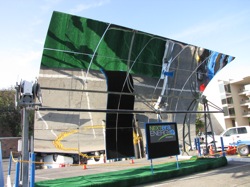
One section of a solar-thermal array on display at UC Riverside. Thousands of these mirrors gather solar radiation to heat a synthetic oil, which drives electrical generation at huge desert facilities. Photo: Craig Miller

Perhaps the most telling moment at the Governor’s Renewable Energy Policy Conference this week, was when the Governor’s own senior advisor on renewables, Michael Picker, asked for a show of hands. How many present, he wondered, actually thought that California would attain its goal of 33% renewable power by 2020. Amid the 370 or so gathered on the campus of UC Riverside, about a dozen hands went up. How many, he asked, thought we’d make it to 33% by 2050? Another dozen or so hands.

Bear in mind that this was a room containing some of the most knowledgeable people on the topic, from government, industry and environmental organizations. These were people invested in getting there, yet most seemed to doubt that we would.

Their pessimism was not entirely shared by the questioner. Picker told me afterward that he expected about 8,000 megawatts of new power to be approved by year-end. That’s approved, not necessarily financed. Solar arrays that generate 250 MW or more are considered large-scale operations.

Meanwhile, developers are pushing to get major projects approved before the year is out. To qualify for federal stimulus dollars, projects have to break ground this year and spend a certain percentage of project costs.

“It’s a hard state to develop in,” said Matt Handel, a vice president with NextEra Energy Resources. The Florida-based company is already a major player in both solar and wind generation in California, and Handel says the stimulus money is essential for two major new projects that NextEra has in mind for the southern California deserts.

“There is hope,” Handel told me. “It is difficult. There are a lot of constituencies out there pulling in different directions.”

Virtually all of those stakeholder groups were present in Riverside, in some form. Local (especially desert) communities, environmentalists, Indian tribes and representatives from federal agencies such as the Bureau of Land Management and National Park Service were there.

Identifying the most appropriate sites for large-scale wind and solar plants has been complicated by more than bureaucracy, said Kim Delfino, California Program Director for Defenders of Wildlife. “The landscape we’re working in is already changing due to the effects of climate change, which presents a challenge as to which areas to protect,” said Delfino in a panel discussion.

Picker says he’s “not so sure” that the state is doing the best possible job of moving projects efficiently through the pipeline (to borrow a metaphor from the fossil fuels era), and he conceded that some developers will be left standing in line as the year-end deadline expires. But he calculated that if, over the next five years, 20% of the biggest projects on the drawing board can get approved, the state should make its 2020 goal.

Environmental Risks of “Geoegineering”

This week, as scientists meet in Monterey to discuss the potential for large-scale climate intervention strategies, we’re posting short discussions on some of the issues surrounding “geoengineering.”

Aside from the political and economic risks associated with geoengineering, which we explored in Monday’s radio segment on The California Report, critics warn that climate intervention strategies involve some serious potential environmental consequences as well.

In one 2008 study, scientists at the Lawrence Livermore National Lab found that one of the leading geoengineering ideas–blocking solar radiation by pumping sulfur aerosol into the stratosphere–may lead to decreased precipitation across the globe.

Climate scientist Phil Duffy, now of the education organization Climate Central and one of the authors of the 2008 study, says that the decrease in precipitation would follow a slowdown of the overall hydrologic cycle, caused by a decrease in evaporation.  Blocking sunlight reduces evaporation, and since what comes down much first go up, less evaporation means less rain and snow.  As this geoengineering scheme is being proposed as an emergency brake to counter effects of climate change like drought, this is problematic news.

Stratospheric sulfur injection could also seriously damage the Earth’s ozone layer above the Arctic, another 2008 study found.  And opponents fear that it could lead to acid rain, which could exacerbate the growing problem of ocean acidification.

Ken Caldeira of the Carnegie Institute for Science says that computer modeling from his lab indicates that even if the strategy improved living conditions for 90% of the people on the planet, it’s likely that 10% would suffer negative environmental consequences, and, he says, it would be hard to predict where on the planet that 10% would be.

“We’ve come to the conclusion that there are no experiments that will tell you ahead of time what the regional effects will be,” said Caldeira.

Another high-profile strategy involves fertilizing the ocean with iron as a way to  encourage algae blooms for carbon sequestration.  Algae absorb carbon dioxide as they grow, and the theory is that when they die, they’ll sink to the bottom of the ocean and take the CO2 with it.  There is conflicting research about whether this could work as a long-term sequestration strategy, but a recent study suggests that regardless of whether it’s effective at sequestering CO2 or not, fertilizing the oceans with iron could harm marine ecosystems.   The research shows that increases in algae from the genus Pseudonitzschia can promote concentrations of domoic acid, a poison that can kill birds and marine mammals.  Richard Black has more on the new findings at the BBC website.

For more on the potential risks of geoengineering, Alan Robock‘s article “20 Reasons Why Geoengineering May Be a Bad Idea” appears in the May/June issue of the Bulletin of Atomic Scientists.

Concerns Abound as Geoengineering Conference Opens

Photo: Craig Miller

This week in Monterey, an international group of scientists and policymakers are  are gathering to hash out some ground rules for experimenting with climate intervention, or “geoengineering”–what many are calling “Plan B” for dealing with climate change.

There are two main categories of geoengineering strategies: one focuses on blocking solar radiation that reaches the Earth’s surface, the other aims to remove CO2 from the atmosphere.  The goal of both is to pull an emergency brake on global warming, using technology that is, in many cases, experimental.

Ideas for blocking the sun include science-fiction-sounding ideas like spraying sulfur aerosol into the stratosphere (which we explore in a radio feature on The California Report), launching reflectors into orbit, and spraying seawater at clouds to make them brighter and more reflective.

Because much of the technology remains untested, and because, given the complexities of the climate system there’s no real way to test them out in a lab, (not to mention the philosophical issue of interfering in such a direct way with the Earth), the very idea of geoengineering is controversial (watch this space for more about that in the week ahead) But as it turns out, this week’s conference in Monterey is shaping up to be controversial on its own.

The stated goal of the Asilomar International Conference on Climate Intervention Technologies is “to develop norms and guidelines for controlled experimentation on climate engineering or intervention techniques.” Some big names in climate circles are expected to be in attendance, including the Climate Institute‘s Michael McCracken, who is chairing the conference, and former IPCC lead author Richard Somerville, now retired from Scripps Institution of Oceanography in La Jolla.

Other leading scientists, however, have chosen to skip the conference, including Stanford’s Ken Caldeira, Martin Bunzl, who directs the Rutgers Initiative on Climate Change and Social Policy, and Braden Allenby, a professor of Engineering and Ethics at Arizona State University, both of whom participated in a lively panel on geoengineering at the AAAS annual meeting in February. Bunzl told Climate Watch Senior Editor Craig Miller that the five-day event was too much time to devote to the topic, and Allenby called the conference premature.

Many scientists say that more research needs to be done to determine whether these strategies would even work, before we start hashing out how to to deploy them, even if only on a limited, experimental basis.  Others fear a focus on intervention might lead to complacency and distract from the immediate task of reducing CO2 emissions.

The latest controversy surrounding the conference, however, revolves around accusations of a conflict of interest.  The Climate Response Fund (CRF), which is organizing the conference, has ties to a geoengineering firm, San Francisco-based Climos.  Climate blogger Joe Romm (who is admittedly “not a fan of geoengineering”) writes about these connections in-depth at Climate Progress, and details email exchanges he had on the subject with Margaret Leinen of the CRF, David Keith of the University of Calgary and Caldeira of the Carnegie Institute for Science, all of whom reportedly expressed concerns about the potential conflict of interest (one reason Caldeira cites for skipping the conference).

Meanwhile organizers will try to enforce media restrictions almost unheard of in the Internet age, including a ban on daily reporting from the conference, and on quoting presenters without their express consent.  The rationale was laid out in an email from the conference organizers:

“The conference is designed to allow the conferees to consider multiple points of view during the course of the meetings.  Reporting before participants have had the opportunity to consider the full mix of views will necessarily be incomplete and therefore risk being misleading.  This also is  matter of courtesy to your fellow conferees, will help in maintaining the focus of the discussions and efforts to achieve the Conference objectives, and will help reduce the likelihood that Internet exchanges about the Conference will break out before we all have an opportunity to be participating in them, as appropriate, based on our actual experiences here at Asilomar.”

Some form of announcement is scheduled for Friday, when the meeting comes to a close.

Update 3/22/10
The Board of Directors of the Climate Response Fund has issued a statement addressing the concerns raised about a potential conflict of interest.  It states that CRF “will not fund field experiments for any climate intervention technique now or in the future.”  This reportedly has assuaged some scientists’ (and journalists’) concerns about the intentions of the organization and the purpose of the Asilomar conference.

The Air Quality-Carbon Connection

Here’s a news flash: California has an air pollution problem.  According to the American Lung Association’s 2009 State of the Air Report, 38 of California’s 52 counties get failing grades for either high ozone or particle pollution days.  (You can see your own county’s grades for ozone and air particle pollution at the State of the Air website.)

In fact, last month the federal EPA’s new director for San Francisco-based Region 9 made an astonishing claim on KQED’s Forum program. Jared Blumenfeld said that more Californians die from air pollution than from car wrecks. When a caller asked him to back up the claim, Blumenfeld provided the following statistics:

– Traffic-related fatalities: 3,949 deaths per year from 3,535 fatal collisions (average for 1999-2008)
– Deaths associated with PM2.5 exposure above 5 ug/m3 in California : 18,000 deaths per year

Cars are doing double duty in these statistics, since passenger vehicles are a large source of air pollution. Over the decades the state has addressed this fact with landmark efforts to regulate vehicle emissions, in efforts initially to improve local air quality and more recently, to reduce greenhouse gas emissions.

In a new study released this week by the Public Policy Institute of California (PPIC),  researchers looked at two state priorities: reducing greenhouse gas emissions that cause global warming and improving air quality to benefit public health, and evaluated the effectiveness of four potential transportation strategies to address both.

What they found is something that policymakers have known all along: there are no easy answers.  And everything involves a trade-off.

PPIC research fellow Louise Bedworth compared the cost, public health benefits, and GHG reduction potential for various alternative-fuel vehicles; battery-electrics, fuel cell, ethanol, and for reducing overall vehicle miles.  What she found is that transforming California’s vehicle fleet to battery-electric vehicles provides the greatest public health benefit, but that high costs and technological uncertainty make this option far from ideal.

On the flip side, said Bedsworth, while we have the technology for vehicles to run on corn-based ethanol, research shows that when indirect land-use costs are considered, corn-based biofuels provide no significant public health or climate change benefit.

But while the PPIC looks at local health and global warming effects separately, a new study out of Stanford has found that the two are directly linked. It’s well established that carbon dioxide contributes to global warming and that increased temperatures can exacerbate air pollution, but the new study shows that CO2 “domes” that develop over urban areas are, in fact, causing health problems for city-dwellers.  The study, conducted by civil and environmental engineering professor Mark Jacobsen, looked at models for the contiguous 48 states, for California and for the Los Angeles area. Results showed an increased death rate in all three areas compared to what the rate would be if no local carbon dioxide were being emitted.

Neither current regulations, nor the federal cap-and-trade bill passed by the House address the local effects of CO2 emissions on health.  Jacobsen says that this study provides evidence that they should.  He estimated an increase in premature mortality of 50-to-100 deaths per year from local CO2 emissions in California.

Jacobsen talks about his study in the video, below.

Curbing Range Anxiety

David Ferry is a freelance writer and former Climate Watch intern, based in the San Francisco Bay Area.

A Saba Roadster on display at a forum on the future of electric vehicles at St. Mary’s College in Moraga, CA. (Photo: David Ferry)

By David Ferry

Electric vehicles can reduce emissions, save money on fuel, and, according to their enthusiastic proponents, are even fun to drive. But are “normal” people ever going to buy one?

Despite the perceived benefits of going electric–and the all-out push from auto companies to roll out EVs as soon as possible–experts predict that American consumers will purchase about a million electric cars in the next five years (by automotive standards, that’s a small number). There are, of course, a number of reasons why the average driver would be hesitant to drop $30,000 on a strange new car, but the one that automakers (and the press) love to fret over is called “range anxiety”.

Range anxiety is the fear that your electric car will run out of juice miles from the nearest charging station. Most electric cars have significantly shorter ranges than their gas-powered cousins, and batteries take hours to recharge. As a result, studies have shown that an EV’s “electric leash” makes drivers nervous and may ultimately keep consumers from switching from unleaded to AC.

This apparent fear of being tethered raises two questions for academics and execs: How can automakers and municipalities reduce range anxiety? And does the condition even  exist?

A hundred years ago, before our vast network of public fueling stations was developed, early automotive adopters installed gas stations in their own homes and carried cans of petrol with them. Nowadays, an EV owner can convert the plugs in their garage but, as one panelist pointed out at a forum on electric cars last week, when your electric car’s meter hits zero, the only way home  is a flatbed truck.

So, how do you ease that anxiety? Nissan and the political leaders of nine Bay Area counties think that installing a public system of quick-charging stations will help. Nissan, which is releasing the electric LEAF this December, is working with the local officials to bulk up the region’s free vehicle-charging infrastructure. The hope is that easily accessible recharging stations will accelerate sales and bring some peace of mind to jittery EV buyers.

“It’s a psychological thing,” says Ron Freund, a board member of Plug In America, who also sat on the panel at St. Mary’s College in Moraga, last week. Freund says that while public charging stations often go unused, EV owners drive farther and worry less in cities with easily accessible charging stations.

(For a take on the strain all these electric cars may place on the grid, see Alison Hawkes’ post and companion radio story: “Invasion of the Electrics.”)

Alas, the meager number of public charging stations already installed won’t rid electric car owners of their fear of hitting “E”, says Andy Frank, a professor of mechanical and aeronautical engineering at UC Davis.

“With EVs, there will always be range anxiety,” he says. Even though most people drive their cars fewer than 35 miles a day and single trips are generally under 11 miles (well within the range of electrics like the Nissan LEAF) recharging takes hours longer than gassing-up does, and consumers are hesitant to be without a car for 5-8 hours.

Which brings us to the contrary view: maybe range anxiety isn’t all that big of a deal. Tom Turrentine, director of the Plug-in Hybrid Electric Vehicle Research Center at UC Davis, says it’s all hogwash.

“It is not as if potential EV drivers will buy a vehicle and head out to go to Lake Tahoe or grandma’s house suddenly to find themselves short on charge. Most of the drivers we have interviewed over the years never encounter such situations,” Turrentine wrote in an email. “They buy the vehicle and use it in a space that is comfortable for the range of the vehicle, seldom running it down below 50%, especially when they first own the vehicle. We all know our laptops are good for about 2-3 hours and don’t take them backpacking for that reason. If they go to Tahoe, they’ll take the hybrid or gas vehicle.”

Turrentine notes that most people in the market for an EV come from multiple-car households. Frank and Turrentine agree that an EV may make a very handy second car, but it’s a pain if it’s your only one.

So, who’s going to buy an electric car? People like Ron Freund, the board member from Plug-in America:

“I think it’s kind of an adventure,” he said, when asked about range anxiety. “I make it a game: I like to see how little energy I can use to go a mile.”

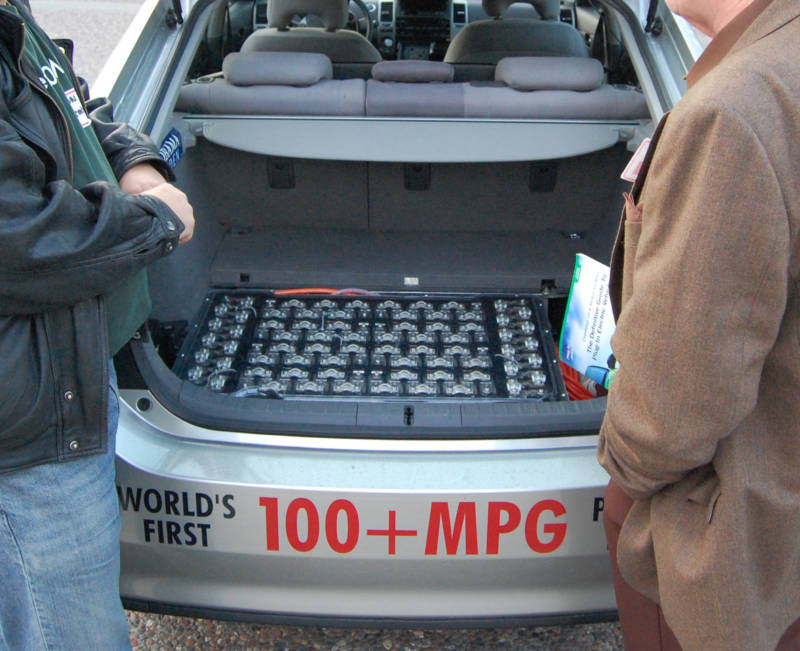
The electric engine of a “Plug-In Prius” (Photo: David Ferry)

The Backlash Against “SmartMeters”

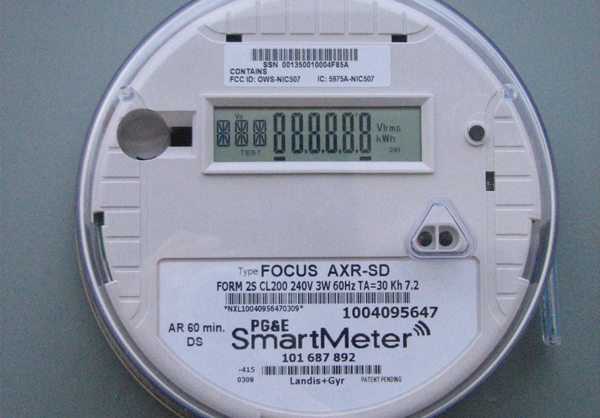
A “SmartMeter” mounted on a Fresno home. (Photo: Sasha Khokha)

The California Public Utilities Commission says it will name a consultant sometime this week to start testing PG&E digital “SmartMeters,” which customers have blamed for spikes in their utility bills.

The announcement came after state Senator Dean Florez (D-Shafter) held a press conference in Bakersfield to question why the CPUC hadn’t taken action. Last October, the Commission agreed to quickly hire an independent contractor to test the meters.
Florez got involved in the flap last year after some of his Central Valley constituents saw their bills triple with the new meters, even if customers bought energy saving appliances, or in some cases, when no one was living at the home. “The biggest savings recognized so far has been to PG&E, who were able to lay off numerous meter readers,” said Florez in a press release.

PG&E has blamed the higher bills on rate increases and hot weather (not a new phenomenon in the Central Valley, where people coddle their air conditioners as if they were household pets).

The Bakersfield Californian reported last month that the backlash here in the Central Valley is catching the attention of industry analysts and utilities nationwide, who want to avoid a spreading backlash against the new technology.

One of the groups sounding a warning is the Division of Ratepayer Advocates, an independent consumer advocacy division of the CPUC. Last week, it advised the Commission to reject a Southern California Gas application to fund its own $1 billion smart meter program. DRA argued not that utility bills would spike with new digital meters, but that money could be better spent on energy efficiency measures and appliances. DRA says SoCalGas is overestimating how much customers will reduce their usage if they can see a digital display of how much energy they’re paying for.

Part of the concept behind smart meters is to help utilities with “demand response” strategies; providing timely feedback to customers, who can use their home computers to see exactly how and when they’re using power, customers might then alter their consumption patterns to avoid peak demand periods, and cut utility bills.

But some of that strategy has already backfired. The San Francisco Chronicle recently reported that a document PG&E filed with the CPUC says the advanced digital smart meters will let the company shut off power to more customers who fall behind on their bills, since they can do so without having to send a crew to a customer’s home. The meters may be smart but consumer advocates say it’s a dumb strategy that will make it easier for the utility giant to leave customers out in the cold.