China, the world’s largest emitter of CO2, is the focus of a new $2 million investment in clean coal technology research by Stanford’s Global Climate and Energy Project (GCEP).
The project will fund research into large-scale carbon sequestration in underground geological formations. China relies heavily on coal for electricity generation and in 2006 was reported to be building the equivalent of one new coal-fired power plant every week.
“China is growing so rapidly, and if they’re going to be able to lower their emissions, they are going to need a whole suite of technologies,” said Sally Benson, director of GCEP. “They are doing a lot with solar technologies and energy efficiency but China is not abandoning coal. So, we’re looking for ways they can reduce their emissions from coal.”
The three-year project is an international collaboration among the University of Southern California (USC), Peking University (PKU) and China University of Geosciences at Wuhan (CUG). It will focus on the technical aspects of stashing carbon in saline aquifers, such as chemical reactions between the rock and carbon and understanding what portions of the aquifers can actually be filled up. The research will involve 39 scientists and students, and will integrate geological modeling, reservoir simulation and laboratory experiments. The results may shed needed light on China’s overall carbon storage potential.
“Saline aquifers have been shown to have the biggest storage capacity across the world,” said Benson, “and China has a tremendous need.”
China’s not the only country with a tremendous need. As the second largest emitter of CO2 (and still bigger than China per capita), the United States has yet to deploy large-scale CCS. Yesterday, the U.S. Department of Energy announced $27.6 million in new funding for 19 projects exploring potential carbon storage technologies.
This is an updated re-post from August 24th, when my radio feature first aired on KQED’s Quest series. That report repeats on this week’s magazine edition of The California Report.
More people appear to be saying “yes” these days, even if grudgingly. The question is: Is it too late?
The Public Policy Institute of California has been tracking public support for expanded nuclear power over the past several years. Survey participants are offered a menu of four potential energy options, one at a time.
The question posed is: “Thinking about the country as a whole, to address the country’s energy needs and reduce dependence on foreign oil sources, do you favor or oppose the following proposals?” Then the four options are offered, including: “How about building more nuclear power plants at this time”
As recently as 2002, adults surveyed in California opposed the idea by a margin of 59% to 33%. But that gap has been closing steadily in the years since and by this July, Californians were split just about down the middle on the question, with 46% in favor and 48% opposed. The poll has a margin of error of about 2%, making it a virtual tie.
When you dig into the numbers a little deeper, some demographic preferences emerge. Support increases with both age and education. Californians 55 and older support more nuclear by a wide margin (58% to 36%) as do college graduates (50%-43%).
Many people use cost as an argument against nuclear but just as the PPIC was phoning around for opinions on the matter, the Palo Alto-based Electric Power Research Institute was finishing up its own report, concluding that trying to reach greenhouse gas reduction goals without baseload technologies like nuclear power, could end up costing much more.
Dan Kammen, who runs an energy lab at U.C. Berkeley, would appear to agree. He said in a recent interview for Climate Watch that “Without knowing exactly where things will come down on nuclear, I think that it absolutely has to be part of the equation in a way that it has not been in the past. Energy costs from fossil fuels are rising at almost 5% a year now, and the damage we are doing and are going to do more of, if we don’t stop our fossil fuel expansion, in terms of greenhouse warming, is so large an issue that these technologies have to be back on the table.
Is the road back to nuclear a dead end? Cooling towers at the decommissioned Rancho Seco nuclear power plant.
But there are serious doubts whether the nation–let alone the state–is in a position to embrace nuclear as it did in the 1960s. Kammen is also a professor of nuclear engineering, and noted with some alarm the rate at which the industry is “graying.” Now in his mid-forties, he told me that when he attends technical meetings for nuclear engineers, he’s often “the youngest guy in the room–by 20 years.” Since the U.S. more or less abandoned its nuclear hopes following the Three Mile Island debacle, the nation has ceded most of its nuclear industrial capacity to other nations, and few young people have chosen to enter the field.
Reports from new projects around the world have not been encouraging of late. Finland is struggling mightily to get its newest reactor up and running. This goes directly to doubts expressed by Kammen and others, that the industry can cowboy up fast enough for nuclear to play a meaningful role in meeting CO2 reduction targets.
The effective ban on new nuclear plants that California has had in place since 1976 could be reconsidered. But ultimately electric utilities will have to want it and I sense a certain “nuclear fatigue” in that arena.
Managers at the Sacramento Municipal Utility District (SMUD) shut down its only reactor in 1989, after a thumbs-down referendum. When I called to ask for an interview on the prospects for a nuclear revival, they declined. They didn’t even want to talk about it. Managers at PG&E, whose twin reactors at Diablo Canyon produce nearly a quarter of the utility’s output, still claim an interest in nuclear. But when I asked CEO Peter Darbee about it recently, he said he had the sense that most people in California would prefer to look elsewhere for energy solutions.
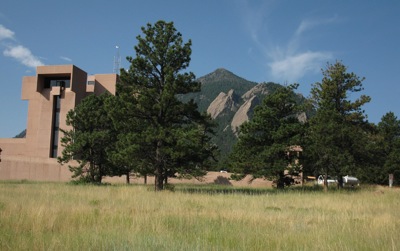
I’m spending the week in Boulder, CO, attending a series of lectures and discussions at the National Center for Atmospheric Research (NCAR). The center is a hub for climate modeling using some of the world’s most advanced computers–but scientists here are working on a dizzying array of projects, from “wind prospecting” models for siting utility-scale wind farms in Colorado, to tracking the ozone drift from California wildfires, to studying the relationship between weather and meningitis in Sub-Saharan Africa.
With the Flatiron Mountains as a backdrop, architect I. M. Pei used the Mesa Verde cliff dwellings as inspiration for the NCAR headquarters building, in Boulder. Photo: Craig Miller
While NCAR works closely with NOAA (which also has a major research center in town), it is not part of it. NCAR is funded by the National Science Foundation and managed by something called the University Corporation for Atmospheric Research (UCAR), a consortium of about 75 North American universities, as well as major institutions abroad.
About 400 scientists work under the NCAR umbrella, including Kevin Trenberth, a leading authority on the link between El Nino and global climate. Right before hopping a plane for Australia this week, Trenberth, head of NCAR’s Climate Analysis Section, reaffirmed what NOAA and others have been saying; that we may be in for a significant El Nino event this fall and winter.
“There are good signs below the surface of the ocean in the tropical Pacific that this is the real deal,” said Trenberth. He echoed some of the optimism expressed by many Californians that the result could be an overdue dousing after three years of accumulating drought conditions. “The odds are, if it’s a good El Nino,” said Trenberth, “that there is more likelihood of a southerly storm track that’ll bring a lot of weather systems into southern California in particular. It’s not always clear what happens in northern California but the odds are that there’s a much more active southern storm track right across the U.S. and in particular in California.”
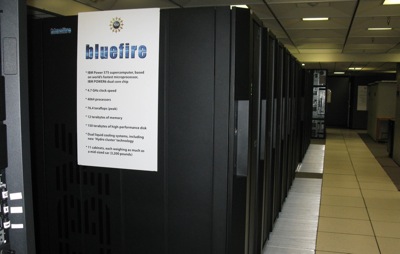
The IBM Bluefire 76-teraflop computer, centerpiece of NCAR's supercomputing center. Photo: Craig Miller
NCAR scientists continue to refine their climate models, which have been downloaded by more than 10,000 scientists around the world. UCAR invests $20-to-$30 million every four years in it’s Computational & Information Systems Lab (CISL), to maintain it’s state-of-the-art status. CISL chief Rich Loft says it’s probably the most advanced supercomputing center devoted largely to climate analysis.
Even so, NCAR is busy building a bigger, faster one–but not here. The new supercomputer, which may be ready by 2012, will be sited near Cheyenne, Wyoming, mostly to take advantage of the cheap, abundant electric power in that area. Loft and NCAR Director Eric Barron both concede the paradox that the most advanced computer assault on global warming is itself a huge gobbler of electricity, much of which comes from coal-fired power plants. The Wyoming facility will suck down 4.5 megawatts of power. Barron says at least there’s a major wind farm “right next door.”
The center’s carbon footprint is probably also swollen slightly by its own air force. NCAR operates two aircraft packed with advanced instrumentation; a hulking C-130 Hercules and a sleek, high-altitude Gulfstream V. Sadly, no rides were offered this week.
Figures released this week by a national wind power trade association would seem to indicate that the expansion of wind capacity proceeds apace. The American Wind Energy Association (AWEA) reported that more than 4,000 megawatts of new capacity has been installed so far this year, a 38% increase over last year’s pace.
Even so, AWEA CEO Denise Bode seems mildly disappointed by the numbers. Citing a slowdown in manufacturing of turbine components, Bode described the industry as “swimming upstream.”
The contrary current may get even stronger if my recent visit to upstate New York is any indication. Arriving for a family visit, I found that I’d landed in the midst of an uproar over wind farms, both built and proposed. Several times a week, articles were appearing in the Watertown Daily Times, about how area residents from around the state are complaining of ill effects from the utility-scale wind farms nearby and bristling at plans for more.
Wind power has hit headwinds in the past over concerns about birds, bats and its effect on people’s views. In upstate New York, the current objection seems to be noise.
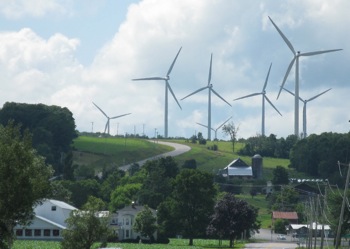
Commercial wind turbines dwarf dairy farms in northern New York. Photo: Craig Miller
At the Maple Ridge wind farm, billed as the biggest east of the Mississippi, I was rendered insignificant by 300-foot turbines, which tower over the farmland in Lewis County. Farther south, in New York’s Finger Lakes region, some turbines top 420 feet. More on this scale are being proposed to stretch out along the St. Lawrence River, which separates New York from Canada. Horizon Wind energy has already erected nearly 200 turbines on Maple Ridge, between the east end of Lake Ontario and the Adirondack Mountains.
Wind companies talk a lot about megawatts and numbers of households served and even tons of greenhouse gases avoided–but not so much about how big these things are. The Cape Vincent-based Wind Power Ethics Group has a graphic on its website that puts some of these numbers in perspective. It shows a 423′ turbine towering over a local lighthouse and the Statue of Liberty.
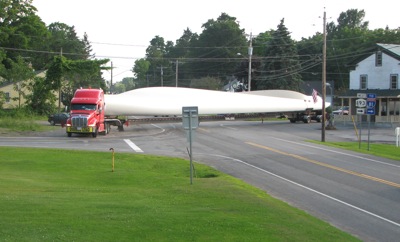
A truck hauling wind turbine blades negotiates a turn onto Route 11 in northern New York. Photo: Chuck Miller
When Californians think about wind farms, they may envision places like Altamont Pass and Tehachapi. California pioneered wind power in the 1970s and 80s and most of the state’s windmills would barely make an impression compared to what’s going up around the country nowadays. California comes in fifth on the AWEA’s latest list of states with the most aggressive wind expansion (Missouri added the most capacity in the last quarter–New York didn’t even make the top 10).
Later this month, in a radio story for Climate Watch, I’ll look at the implications of this scaling-up as companies propose wind farms closer to populated areas in California, such west Marin County (more about that particular situation in our second Quest/Climate Watch television special, which premieres August 25).
Two developments this week would seem to validate concerns that things aren’t quite lining up for the vaunted new age of renewable energy.
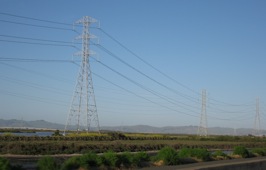
While the Secretaries of Energy and Interior were offering confident assurances to a Senate panel about the future of renewables, a consortium of environmental groups was suing them over a plan for major new transmission lines for the western electrical grid.
The groups, represented by lawyers at Oakland-based EarthJustice, produced their own maps to show that the proposed routes appear to miss many areas with the most potential for solar, wind and geothermal resources. Instead, environmentalists say the West-wide Energy Transmission Corridors approved under the Bush administration would seem to line up just about perfectly with major existing and proposed coal-fired power plants (note that the maps themselves are PDF downloads).
According to EarthJustice:
“The Bush corridors plan ignores the Renewable Portfolio Standards (RPS) adopted by nine of the eleven western states to increase use of the region’s vast wind, solar, and other forms of renewable energy. The approximately 6,000 miles and 3.2 million acres of federal land in eleven western states designated as energy corridors puts imperiled wildlife at risk and slices or brushes against the borders of iconic public lands. Among these are Utah’s Grand Staircase-Escalante National Monument, Arches National Park, and New Mexico’s Sevilleta National Wildlife Refuge.”
I asked Katie Renshaw, a Washington-based lawyer for EarthJustice, if Energy and Interior wouldn’t have updated their plans since the Bush-era maps were approved. “As far as we’ve seen, they haven’t,” said Renshaw. “An analysis was never really completed.”
The lawsuit comes just days after energy entrepreneur T. Boone Pickens revealed that he’s having to reconsider his plans for a major network of wind turbines through Texas. The reason: no transmission lines.
In California and elsewhere, proposed transmission lines have run afoul of environmental interests, as Rob Schmitz reported in his New Gridlock series for Climate Watch.
Update: Scott Streater has more on the controversy over siting renewables in a New York TimesGreenwire post.
Kristine Wong is a student at UC Berkeley’s Graduate School of Journalism. She is currently serving an internship at KQED Climate Watch.
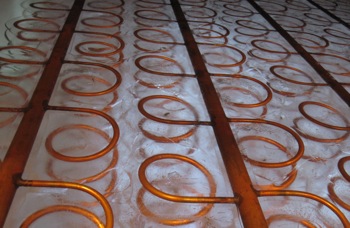
Copper meets ice in the Ice Bear rooftop cooler. Photo: Kristine Wong
Latest technology designed to improve grid performance, decrease peak energy demand
By Kristine Wong
When the hot weather hits town, everyone wants to cool off. Some down a cold drink, others take a dip in the pool. But most just turn on a switch–for the air conditioning or the fan. But when everybody jumps for the switch at the same time, the electrical grid is pushed to the max, which can lead to blackouts, as well as use of peak energy generators. Peak generators are used just a few times during the year but use more fossil fuels than other power plants.
Now, with the realization that climate change is upon us, along with advances in technology, there are new ways to stay cool while conserving energy and cutting carbon emissions at the same time. Several products showcased this week at the Edison Electric Institute conference in San Francisco seem to have the potential to do just that.
Take SmartMeter, for instance. The program from PG&E will monitor and control home energy use by satellite, and adjust energy consumption accordingly by supply and demand via a few palm-sized monitors. Right now, it’s still in demonstration mode. But PG&E will offer voluntary enrollment in 2010, and aims to outfit all households by 2012, according to Peter Chan, a PG&E supervisor in Demand Response Operations (“demand response” is industry-speak for systems that can adjust electrical use at the consumer end). Redistributing energy as needed avoids the need to bring peak generators online. Customers lower their energy bills and can also override the system if, say, that load of laundry really needs to go into the dryer now.
The Ice Bear aims to reduce the energy needed to cool low-rise buildings (under 3 stories), using rooftop energy storage that works in conjunction with the building’s air conditioning system. Developed by Windsor, CO-based Ice Energy, a rectangular unit about the size of a sub-compact car sits on the roof and stores energy at night. It releases the energy during peak daytime periods.
The company claims that using off-peak stored power during peak hours reduces carbon emissions by 40%. And the key technology is–well, ice. Major components include a block of ice threaded with a network of copper coils designed to keep the ice from melting, a condenser that makes the ice, and a controller that achieves the building’s thermostat level most efficiently in conjunction with the building’s air conditioning system. The unit uses R410, a refrigerant which the company says is more efficient than more commonly used refrigerants such as R-22. The system comes with a price tag topping $8000 but utilities are apparently bullish on Ice Bear and have bought thousands of units–13,000-15,000 units can conserve up to 50 megawatts, according to company spokeswoman Therese Wells.
The conference also featured previews of potential “game-changing” technologies. PG&E panelist and Director of Emerging Clean Technologies Hal La Flash told the audience about a solar “nantenna,” a flexible panel that may replace solar panels in the future. And Mike Howard, Senior Vice President of Research & Development at the Electric Power Research Institute, spoke of being 5-to-10 years away from the debut of LED lighting that has the potential to be even more energy efficient than compact fluorescent bulbs.
 China, the world’s largest emitter of CO2, is the focus of a new $2 million investment in clean coal technology research by Stanford’s Global Climate and Energy Project (GCEP).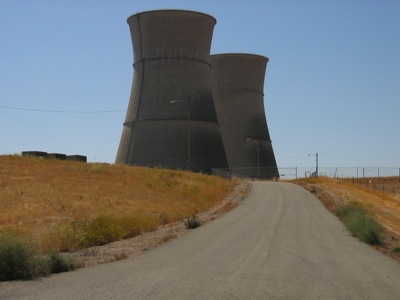
 Two developments this week would seem to validate concerns that things aren’t quite lining up for the vaunted new age of renewable energy.