UPDATE: In late January, 2011, The New York Times published a good overview of how the controversy over smart meters has evolved since this post.
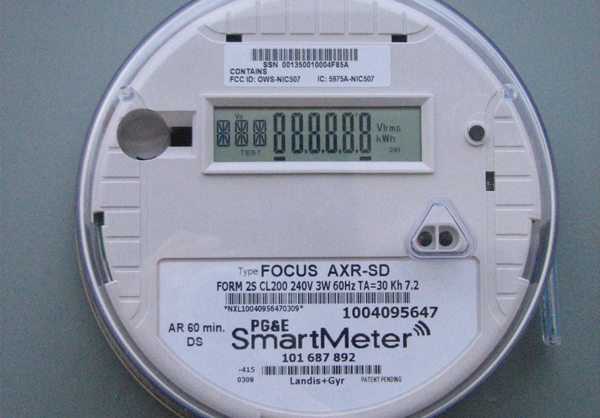
When utilities and the California Public Utilities Commission hatched plans to bolt a “smart meter” onto every household, the premise–and the promise–was that by digitally tracking just how much they were using and spending, customers would be able to make smarter choices about their energy use, ultimately saving money and cutting carbon emissions.
Smart meters are also a critical component of the nascent but much vaunted “smart grid,” in which household appliances and electric cars communicate with the vast power transmission network, and optimize things like when to recharge.
But as I report in my radio story for The California Report, many PG&E customers consider them more bane than boon (PG&E uses the trademark “SmartMeter,” whereas I may refer to them generically as “smart meters”).
Part of what’s riled up customers in Bakersfield and elsewhere in California is that PG&E hasn’t provided the devices to help watch the watts. Customers can go online to track their energy use over the last 24 hours, but that’s about it. And in the meantime, consumers are paying the cost of the new meters, and in some cases, higher bills that they blame on those meters.
Julie Fitch, who heads the energy division of the California Public Utilities Commission, told me she thinks those real-time tracking gadgets won’t actually change consumer habits that much. “There’s a certain percentage of us who are interested in seeing what our energy use is at all times, and are fascinated by it, but I think it’s probably a small percentage in the grand scheme of things,” Fitch said.
Fitch says consumers will see more of an advantage from smart meters when home appliances can communicate with the devices.
“The reality is the grid right now is that it’s actually fairly dumb,” Fitch said. There’s a lot of manual decisions that need to be made in order to get the electricity from a generator to your house. I think what we’re looking at is a much more automatically controlled situation where appliances are automatically linked in with smart devices.”
For example, a fully integrated system could “decide” to run your clothes dryer at off-peak times, to relieve strain on the grid and possibly save money. But the whole idea of charging more for power at different times of day, known as peak pricing, troubles consumer advocates like Mark Toney. He heads The Utility Reform Network (TURN), a consumer advocacy group based in Oakland.
“We want to make sure this doesn’t unduly harm seniors, for instance, who are home bound,” Toney told me, pointing out that folks don’t have a choice sometimes about whether to run their air conditioner in the sweltering Central Valley heat. “We don’t want them to be faced with the choice of being safe in their home or being subject to heat stroke because they shut off their AC because they can’t afford it,” he said.
Toney is also concerned that struggling customers are more likely to see their power shut off, if they can’t keep up with the bills. Smart meters allow utilities to turn off power remotely, without having to send a crew out to someone’s home–and that, he says, gives the company less incentive to negotiate payment plans.
The CPUC’s response? Utilities will still have to follow standard procedures, including advance notice of shut-offs.
Meanwhile an independent lab appointed by the CPUC continues to test PG&E SmartMeters to try to determine why some of them are malfunctioning. Some customers now have “side-by-side” test installations, with both analog and digital meters tracking electricity use in tandem. Strangely enough, the deployment of smart meters by Southern California’s two major utilities has gone relatively smoothly, with just a fraction of the complaints that PG&E has logged.
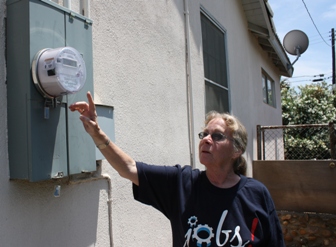
In my radio story, I interviewed Bakersfield Resident Liz Keogh, who saw her electric bill spike after her SmartMeter was installed. Keogh is very energy-conscious; her home is a veritable showcase of energy-saving gadgetry. There could be any number of technical reasons why the new meters led to larger bills. Keogh developed her own personal theory (since disproved by independent tests), which she demonstrates in the video below, using some unlikely props. It’s a good example of the broad spectrum of consumer objections to the technology.