Tag Archives: Technology

An Hour with Amory Lovins

In case you missed it amid the flurry of climate-related news last week: On September 30, Amory Lovins, founder and chief scientist of the Rocky Mountain Institute, and an honest-to-goodness energy guru to many, spent an hour in conversation with Michael Krasny and callers to KQED’s Forum program. You can listen to the entire archived broadcast or scan some of the highlights here, compiled by Climate Watch intern David Ferry.

On China:

“We can count on China to lead the world out of the climate mess…Even though the U.S. has led the world in wind installations the past three years, this year China’s going to pass us so fast we won’t even hear them go by. China’s doubled its wind installation each of the past four years, and there’s a new paper in Science from Harvard and Tsinghua in September saying that China can meet all its electric needs–not the growth but the total–till at least 2030, cost effectively, from its wind resources.”

On Nuclear Power:

“Basically nuclear and coal plants are getting walloped in the global marketplace by efficiency and renewables and cogeneration because they’re a lot cheaper and they have less financial risk so they can attract private investment.”

Grading the Obama Administration on Renewables:

“Greatly improved and I think on the whole doing very well.”

On the Upcoming UN Climate Talks in Copenhagen:

“I’m cautiously optimistic…But remember that governments are usually the last to figure these things out. Most governments still think climate protection is costly. They haven’t figured out yet that economic theorists got the sign wrong and actually climate protection is profitable. Once you change the conversation from cost, burden and sacrifice to profit, jobs and competitive advantage it makes the politics a whole lot easier.”

On Energy Efficiency & Steve Chu’s “Low-Hanging Fruit” metaphor:

“The technologies keep improving faster than we use them, so efficiency is an ever bigger and cheaper source–it’s as if the ‘low hanging fruit’ had fallen on the ground; it’s mushing up around the ankles, it’s spilling in over the tops of our boots and the efficiency tree keeps dumping more fruit on our heads.”

On Large-Scale Solar Farms v. “Distributed” Power Generation:

“The sun is distributed for free. Why gather it in one place and then pay to spread it out again? The National Renewable Energy Lab says if we put solar cells on seven percent of the structures in this country it would run all our electric needs without using any land. And for that matter, the wind potential on available windy land in this country is several times our total electric need and the footprint is actually very small.”

On Whether Climate Change is Irreversible:

“There are a half-dozen known mechanisms of rapid climate change. Several of them show like they may be starting up, so it’s urgent to reverse that…we have plenty of technology already available to stabilize climate to the extent that irreversible changes have not already started. We don’t know what that extent is, so we ought to go full bore on best buys first and hope that we’re in time.”

You can also take a virtual tour of Lovins’ home in Colorado, which doubles as a laboratory for energy innovation.

Diatoms Have Their Day

Everybody’s got a summit nowadays. Last week, while the governors were doing their climate summitry in L.A., scientists and policy wonks convened at U.C. Davis for an ag-and-climate “summit.” The discussions seemed interesting and productive, despite (or perhaps because of) the fact that no world leaders appeared. This week the gods of green goop are gathered in San Diego for an Algae Biomass Summit. Climate Watch contributor and climate scientist Abbie Tingstad explains why algae deserves a summit.

tingstaddiatom2_blogThe Power of Pond Scum

By Abbie Tingstad

The slimy yellowish brown muck known as “pond scum” may soon help fuel your car, make your airplane trips more environmentally friendly, and power your home. Scientists and start-ups around the world are now looking to tap into this unsightly source to produce ethanol, biodiesel and jet fuel, and even more efficient solar cells. This sustainable energy source consumes carbon dioxide and can be developed without competing with food crops for land.

Yellow-brown pond scum is composed of diatoms; single-celled algae with elaborate silica-based cell walls (green films on water are made up of other types of algae and small water plants). These primary producers are ubiquitous: they inhabit a wide range of environments, requiring only sufficient light for photosynthesis and enough moisture to prevent desiccation. Worldwide, there may be 100,000 species living in oceans, lakes, estuaries, rivers, swamps, moist soils, and other damp environments.

Climate and environmental researchers have taken advantage of diatoms’ cosmopolitan living habits to reconstruct past climates and infer recent environmental changes related to pollution and climate warming. Since different locations tend to have unique diatom community compositions, these tiny algae have also helped forensic investigators solve crimes.

Now, diatoms and other types of algae and small aquatic plants like duckweed and watermeal might be used to generate ethanol, biodiesel, and jet fuel. A number of start-ups, such as Aurora Biofuels and SunEco Energy in California, have begun developing technologies to “farm” algae on non-agricultural land, using salt-or lower-quality fresh-water and also just happens to consume carbon dioxide. This research has seen renewed interest at large laboratories such as the National Renewable Energy Laboratory (NREL). Big private-sector players, such as ExxonMobil, Chevron, Dow Chemical, and Honeywell International, have begun investing in research as well.

Diatoms may also be able to make solar cells more powerful, according to recent research out of Oregon State University and Portland State University. Unlike more conventional silicon-based cells, dye-sensitized solar cells, which absorb photons on a dye molecule thin-film joined to a layer of titanium oxide on glass or plastic, are made from environmentally neutral materials and work well in lower light conditions. Using diatoms to coat the dye-sensitized solar cells could triple their efficiency, making them more competitive with silicon cells.

These diatom-based technologies are still in their infancy so it’s difficult to determine whether they’ll make a meaningful contribution to a new wave of renewables. However, California may well benefit if they do become more widespread because these can potentially be operated on dry land and, in the case of fuels, using salt water.

With these technologies still in their infancy, it’s not clear how soon, if ever, they’ll become widespread. However, with its surfeit of sunshine and lots of available desert land and access to saltwater, California stands to benefit from an algae boom, should investors wade in.

Abbie Tingstad is finishing her Ph.D. in the Department of Geography at UCLA, where she specializes in the analysis of tree-rings and diatoms (environmentally-sensitive unicellular algae) to infer information about climate and environmental change.

Behold the power of pond scum in the recent television segment produced by KQED’s Quest.

Keeping Up with the Sakakis

Rob’s companion radio report to this post begins his series: “Rising Sun: Why Japan is Winning the Energy Race.” Part One airs Monday on The California Report.

Meet the Sakakis: Thirty-something mom and dad Yukiko and Hiroshi, and their three-year-old daughter, May. They’re a typical Japanese family: they live in the Tokyo suburb of Musashino, they have one child (and they’re stopping there, they say), and both parents work to afford a middle-class lifestyle.

The modern-day energy-saving Japanese family

I visited the Sakakis to get an idea of how an average Japanese family consumes energy. I left their home with a greater understanding of why Japan is a much more energy-efficient country than ours.

I visited the Sakakis on a Saturday. It was 85 degrees and muggy outside; a typical early September day in Tokyo. Despite the conditions, the Sakakis weren’t running their air conditioner, opting instead to open the windows and close the drapes to their two-bedroom apartment, in order to block out the sun and let a humid breeze flow through. When I asked them why the AC wasn’t on, Sakaki-san went to his desk drawer and pulled out his electricity bill. The Sakakis pay 24 yen per kilowatt-hour. That’s equivalent to about 30 cents in U.S. currency. That’s also roughly twice as much as Californians pay for electricity. Despite their frugal energy habits and diminutive quarters, the Sakakis pay what amounts to a little over $100 a month on electricity. They spend around the same for natural gas each month.

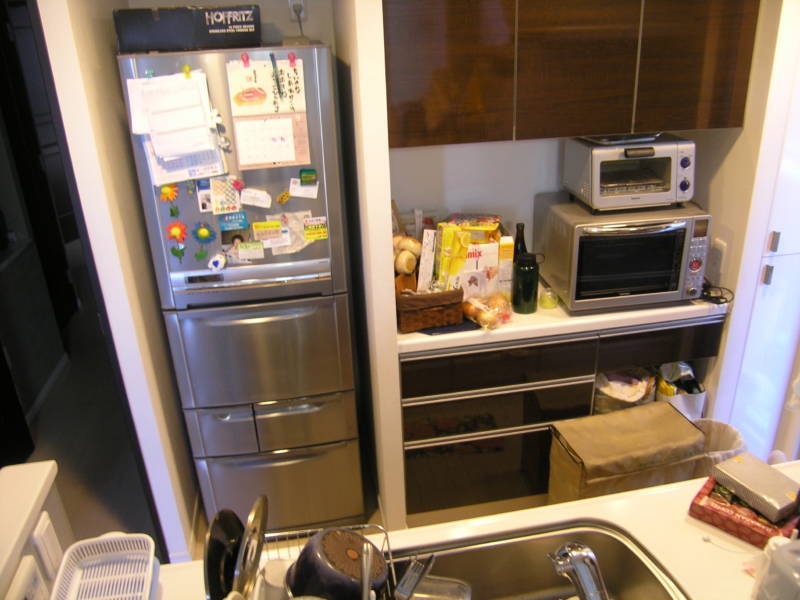
The typical Japanese fridge: several doors to save energy when opening it, and a compact size to accommodate the Japanese habit of shopping every few days (this is a large fridge, by Japanese standards, say the Sakakis).

Energy is expensive in Japan. The country has no domestic fossil fuel resources, so it has to import them. The government taxes its citizens heavily for energy consumption, and then uses the revenue to put Japan at the forefront of renewable energy R&D. This has made Japan a world leader in solar panel sales and it’s put the country years ahead of the rest of the world in the development of other innovative energy-saving technologies like hydrogen fuel cells and batteries for electric vehicles. According to Japan expert Llewelyn Hughes at George Washington University, Japan leads the world in green technology patents. “It’s not even close,” he told me in an interview to prepare me for my trip.

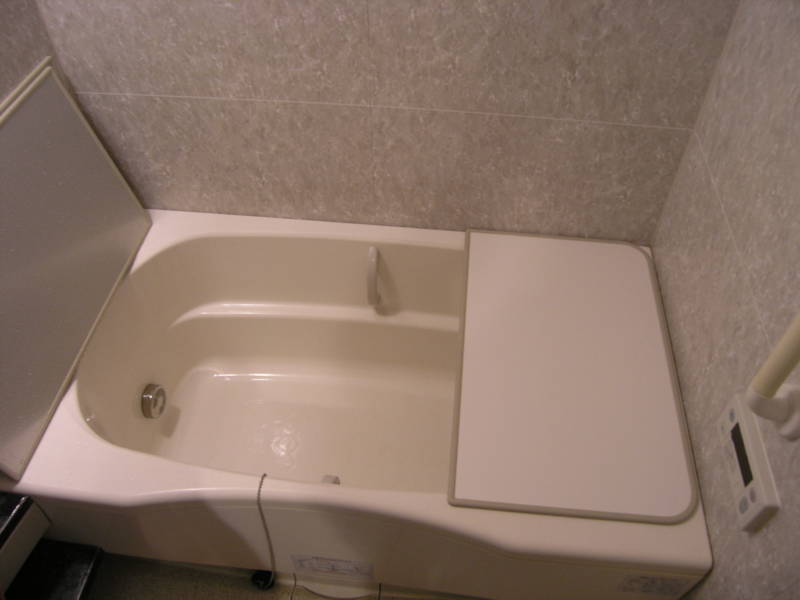
Like many Japanese families, the Sakakis share their bath water each evening. Their high-tech bath includes a temperature control mechanism and panels to trap the heat.

All of these technological innovations mean Japan is poised to emerge from the global recession with great economic potential. It also means that the Sakaki household has some very cool gadgets: a refrigerator with several different drawers in order to separate perishable items and save energy, a floor that heats up in the winter, and a bath that talks to them.

Japan’s Zero Emissions Fever

Sekisui House’s Green First Home-It looks like a normal house, but take a closer look at those roof tiles…yup. PV.

Since arriving in Japan almost a month ago, I’ve visited a “zero-emissions house,” a house that claims to be zero emissions but really isn’t (more on that later), and an “EcoHouse.” It’s fair to say the housing industry in Japan is going ga-ga over reducing carbon emissions. The obsession began a little over a year ago, when Japan’s largest companies (collectively known as “keiretsu“) came together to build the zero-emissions house.

The home, which purportedly produces zero or negative emissions over the course of its lifetime, was built especially for the 2008 G8 Summit in Toyako, on Japan’s northern island of Hokkaido (you can see my video tour of the home at KQED’s YouTube site). Originally nestled on a hillside overlooking a lovely lake during the G8 summit, the home has moved to more modest surroundings: It now sits in a drab parking lot outside Sekisui House‘s noisy prefabricated homes factory in Koga, 40 miles north of Tokyo. The home’s greenhouse gas-reducing technology includes:

– A 14-kilowatt solar array on the roof

– A hydrogen fuel cell which generates energy by taking hydrogen from natural gas and using the byproduct, heat, for the home’s hot water supply and space heating during the winter

– A window with photovoltaic (PV) film inside of it

– A ‘waterless’ washer/dryer, and of course, every energy-efficient appliance you can think of.

Kimikazu Kondo, spokesman for Sekisui House, tells me that nobody’s offered to buy the home yet. Until they do, it’ll be sitting in that parking lot, looking a little lonely.

The interior of the Green First Home. If this is prefab, sign me up.

Kondo also showed me Sekisui’s Green First home, the company’s newest prefab. Sekisui estimates that the average Japanese household spends around the equivalent of  $3,000 on energy per year. Kondo told me that if you buy the Green First home, you’ll spend around five hundred. The home’s roof tiles are made of PV thin film. The house has a hydrogen fuel cell, LED lights, etc. When I first toured the home, Kondo told me it was a zero-emissions home, too. But when I asked specific, pointed questions at how they arrived at that determination, he backed down and told me that over the life of the house, it would reduce 70% of greenhouse gas emissions over an average home in Japan. Not a true zero emitter, but not bad.

But I started to wonder how Sekisui House was marketing this home to Japanese buyers. Were they touting it as a “zero-emissions” house, despite the fact that it isn’t? Hmm. Sekisui’s Kondo did take me on a very interesting tour of his prefabricated home factory. I shot a short video there of a machine that punches holes through steel beams.

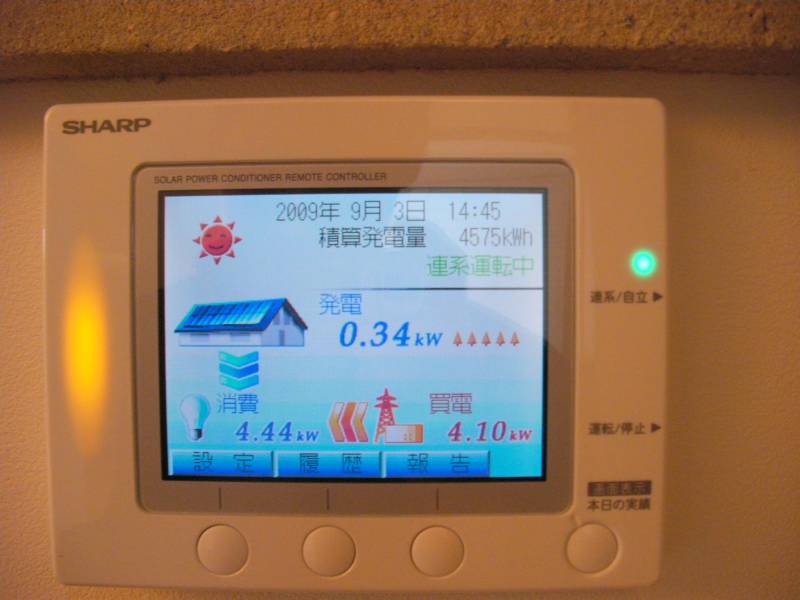
A control panel inside the Green First home which gives the homeowner information on how much electricity is being generated from the solar panels on the roof. On this day, it was only 340 watts. It was cloudy.

Each prefabricated home that Sekisui builds has more than a hundred thousand parts built for it in a factory. They’re actually more durable than your average site-built Japanese home. Prefab homes make up about 15% of the housing stock in Japan. Kondo told me Sekisui has no plans to bring its homes to the American market, but it is now starting to sell them in Australia.

Governor: RPS Order “Stronger than Law”

Gov. Schwarzenegger fields questions from Greg Dalton of the Commonwealth Club's Climate One initiative. Photo: Governor's Office

Governor Arnold Schwarzenegger is defending his planned veto of two renewable power bills, saying the executive order he issued instead is “stronger than the law” because it places fewer limitations on electricity imported from other states.

At the tail end of the legislative session, California’s assembly and senate passed separate bills requiring the state’s utilities to draw a third of their energy from renewable sources by 2020. But during a Q&A session at San Francisco’s Commonwealth Club Thursday, the Governor said that the recently passed bills were “for special interests” and that they “represented protectionism,” the latter a reference to limits on how much energy could be imported from neighboring states. The Governor’s own executive order has the same proportional requirement or “renewable portfolio standard” (RPS) as the bills but sets no limits on imported power. Also unlike the legislature’s bills, the order does not exclude particular sources, such as hydro-electric from the definition of “renewables.”

Critics contend that succeeding governors might simply rescind the order, which Governor Schwarzenegger does not deny. He faces an October 11 deadline to veto the bills.

Governor Schwarzenegger’s appearance was designed to mark the third anniversary of the state’s adoption of AB 32, the Global Warming Solutions Act of 2006, a law which has its own detractors.

Meg Whitman, the former CEO of eBay, who is running for governor said last week that she would issue a moratorium on most AB 32-related rules on her first day as Governor.  When asked about  Whitman’s remarks Schwarzenegger dismissed her comments as “just rhetoric.”

“I think she will probably reconsider what she has said and will see that the greatest thing that can happen for California is to move forward. I’m sure she does not want to be counted as one of those Republicans that want to move us back to the Stone Age,” he said.

Touting the state’s achievements in renewable energy innovation, emissions reductions,  and technology, the Governor painted a rosy picture of an invigorated economy, new jobs, and a cleaner environment throughout the state.

“A wave of green innovation is washing over our state right now,” he said.  “In last three years,  scientists and entrepreneurs have pumped more than $6 billion of venture capital into California.  Since 2005, green jobs in California have grown ten times faster than other jobs. California companies hold more than 40% of the nation’s new patents in solar and wind technology, and solar installations this year alone in California have gone up by 120%.”

Focusing largely on projected economic benefits, he made a case for continuing on the path California started three years ago with AB 32 and is continuing under his executive order from earlier this month, saying that the current path offers far more economic opportunity than economic risk.

“I know that it’s possible to protect the environment and the economy at the same time,” he said. “Technology will save us all. It’s all about technology, technology, technology. ”

Not all of the speech was about legislation, green technologies and the economy, however. The Governor did respond to a question from  group of fourth-graders attending the talk, asking what he says to his children about climate change.

“I’ve had major fights with my kids,” he said.

He said he has imposed a five-minute shower rule in his house and that he sometimes “spies” on his children to make sure they are obeying his order.

“If their showers are more than five minutes, there will be consequences.”

He added that other environmental steps his family has taken at home are to install solar panels nearby to provide energy for the family swimming pool and jacuzzi, and that they have converted the regular engines on their Hummers to hydrogen or bio-fuel engines.

Notebook Lost, Work Ethic Found

Rob Schmitz continues his dispatches from Japan, where he’s reporting on that country’s aggressive approach to energy efficiency–and what lessons we might take from them. Rob returns to KQED’s Los Angeles Bureau in October–with his notebook.

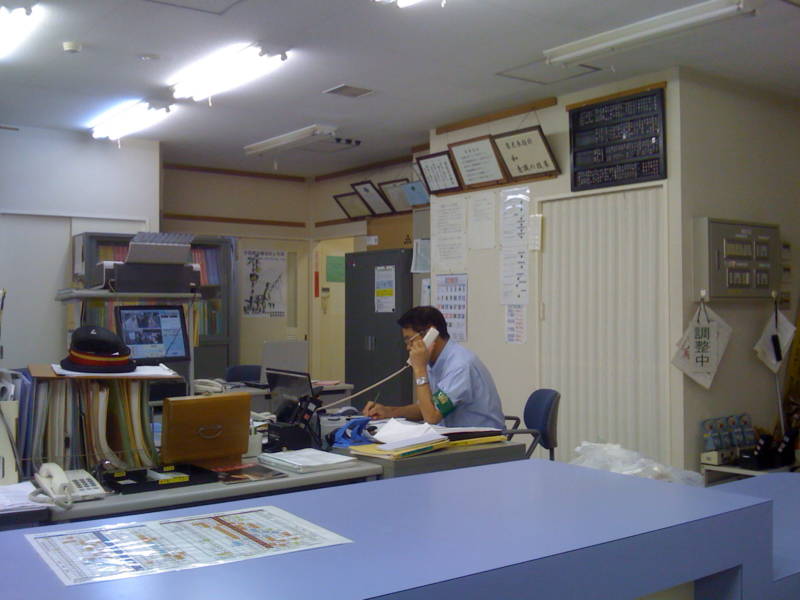
Today I left my notebook on the train to Ota. In it were notes of all the interviews I had conducted since arriving in Japan. Throughout my day of reporting, I repeatedly asked to borrow my interpreter’s notebook, and by the end of the day, I was depressed with the thought of having to listen to hours of tape that I had meticulously transcribed over weeks of interviews. When we returned to the station, my interpreter, Chiaki, took me to the station master’s office. That’s where I met Mr. Aiba.

My Travelling Notebook

Aiba-san was in his 50s, tall, thin, graying hair, glasses, and, like most Japanese in his position, incredibly polite. He wore a blue uniform and a green band around his arm with ‘security’ written on it in Kanji. Aiba-san listened intently to Chiaki’s every word describing the notebook, where I left it, and how important it was to me. He asked follow-up questions: “What are the approximate dimensions of the notebook? Is your name on the notebook?” and so on. As Chiaki answered, he took notes.

When he was finished, he offered us a seat, briskly walked to his desk, and picked up the phone. He called other stations, he called cleaning companies, and he consulted timetables. In between calls, he updated us: “The train you were on has made three round trips from Tokyo to Akagi today. Cleaning crews in many cities have cleaned the train several times.” Aiba-san briefly left the room while he waited to hear from the cleaning crews. He returned with some tea for us. A minute later, he received a call from the cleaning crew in Akagi, a city in the mountains at the end of the line: they found my notebook. Nobody had claimed it, so it had been tossed into a recycling bin. It was waiting for me on the platform there.

Aiba-san, getting the job done.

“But you’ll have to hurry,” said Aiba-san, looking at his watch. “The train to Akagi leaves in less than one minute.” He escorted us, running frantically in the lead, to the platform. We barely made the train. I had a few seconds to reach into my bag to give him a box of See’s chocolates that I had brought as a gift for my interviewees. He sternly declined the gift, but I insisted.

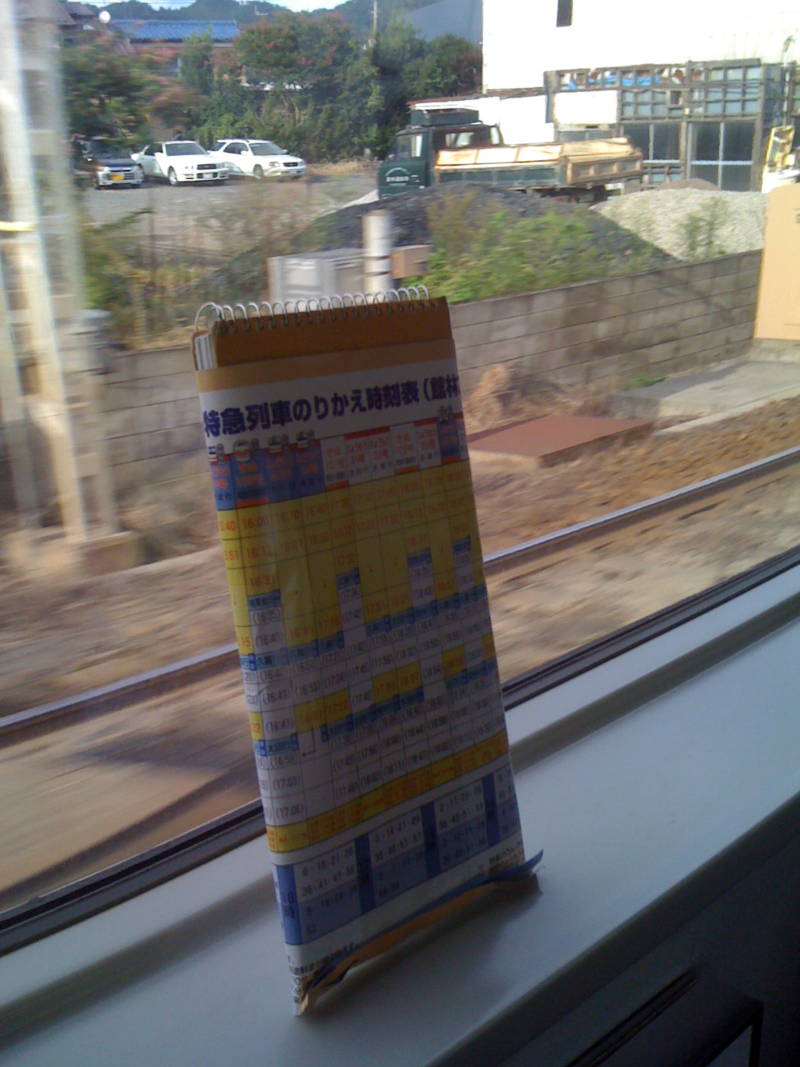
When we arrived to the tiny Akagi station, two elderly custodians with brooms in their hands were waiting for us on the platform. They bowed in unison to me and handed me my notebook. They had neatly wrapped it in a copy of the train’s timetable. This is just one of many examples of the generosity and commitment to service that I’ve experienced in my short time in Japan. Had I lost my notebook on a train or a bus back home, would anyone care? They probably would’ve laughed me out of the station at the thought of tracking it down.

Now, take this behavior to a macro level and you start to see why Japan, an island nation with no fossil fuels and few resources of any kind, has become the second largest economy in the world. When Japan puts its collective mind to something, it not only gets the job done, but it oftentimes excels at it. From my conversations with government officials, business leaders, and those in the non-profit sector here, it’s obvious that Japan is not only committed to reducing greenhouse gases, but perhaps more importantly, it wants to make a lot of money from doing so.

In short, it wants to ensure that its companies own and make as much of the technology that goes towards this global effort as is possible, and it’s got a head start. Japan leads the world by a long shot in registered patents in the green technology sector, according to a report from CERNA, the Centre d’Economie Industrielle. Check out the final pages of that report, which compare countries, and you’ll see Japan leads in every patent category except one. Japan is getting the job done, just like Aiba-san stepped up to do his job when I sought his help. It’s a spirit that’s refreshing to be around. We could use a few more Aiba-sans back home.

Seeding Clouds for Hydropower

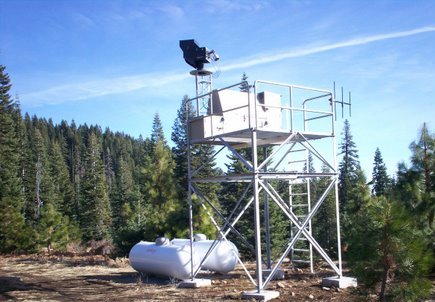
PG&E cloud seeders located near Burney Falls, CA. Photo: PG&E

Christina Aanestad’s radio feature for Climate Watch airs Monday morning on The California Report.

Wringing Hydropower Out of the Clouds

By Christina Aanestad

When cloud seeding began in the 1950’s there were no laws governing weather modification. According to Maurice Roos, Chief Hydrologist with the state Department of Water Resources (DWR), it wasn’t until the late 1970’s when a storm in a seeded area near Los Angeles flooded, that regulations governing weather modification were included in the state’s water code. In the West, “Most of the states have legislation that governs the conduct of weather modification activity,” says Brant Foote, director of the Research Applications Lab at the National Center for Atmospheric Research (NCAR) in Boulder, Colorado.

Government oversight has changed over the years. Today in California, state regulations have slackened. “As for the State’s role, it is mainly informational. There are no permits or licenses,” said Roos. According to Roos, all cloud-seeding projects required permits until the law was reformed. “The old law required licenses and permits but it was repealed in the 1980’s. There was a general move toward deregulation in the government–mainly to reduce costs.” Today, according to Roos, Sponsors of cloud-seeding projects must notify DWR and county governments of the project, “This can be a letter or, for DWR, an e-mail notice,” he said. “They also have to publish a Notice of Intention in the county or counties affected by their proposed operations.”

Most of what this reporter learned was from Roos’ institutional memory, and going directly to sponsors of cloud-seeding operations–about 15 intermittent projects around the state. Data on cloud seeding at the state level is scattered, according to Roos. “We used to have an annual report that was published. Last time I tried to find it, it was in an archived box and nobody knew where it was,” said Roos, who added that budget cuts and deregulation mostly gutted the oversight program.

Despite lax oversight, the State of California wants to use weather modification as part of its 2009 Water Plan, which states:

“Cloud seeding has advantages over many other strategies for providing water. A project can be developed and implemented relatively quickly…it could offset some of the loss in snow pack expected from global warming.”

According to the plan, some regulation remains: weather modification sponsors need to comply with the California Environmental Quality Act [CEQA]. But not all seeding has to comply with environmental regulations. PG&E contends that an environmental impact report is not required for its Pit-McCloud River project because it is privately funded, with equipment on private lands,” said Roos.

That has locals groups near Mount Shasta concerned with PG&E’s proposed project in the Pit and McCloud River watersheds. “It’s a clear unequal treatment between public agencies and private entities,” said Angelina Cook with the Climate Council and the Mount Shasta Community Rights Project. “Private corporations require more government oversight and regulation to ensure accountability for the their practices.” But compiling all cloud-seeding data in California into one reference source today would be “a labor of love,” says Roos. “There’s no funds for it,” he said.

Cook says she is working on a cloud-seeding ban in Mount Shasta City, which may include a chemical trespass for silver iodide, the common chemical used in cloud seeding. “If silver iodide is found in the area, PG&E would be liable,” said Cook.
But Roos, who says cloud seeding is mostly benign, asks where one would draw the line. “There’s all kinds of influences on the air like people driving their cars, diesel trucks running around,” said Roos. Just as California has increased its regulations on air emissions in the state, some like Cook would like to see tougher regulations for weather modification as well.

Meanwhile, the state’s 2009 water plan also urges more research and development into cloud-seeding. Research could include cloud seeding’s impact on global climate change, and it’s effectiveness. The plan also identifies areas that could provide optimal results from cloud seeding, mostly in Northern California, along the Sacramento, Trinity and Russian Rivers.

Cloud Seeding Projects in California

View Cloud Seeding Projects in California in a larger map

To find references to cloud-seeding in the state’s water plan, look under Volume 3, then for “Precipitation Enhancement.”

Trash Day in Tokyo: The Learning Curve

KQED’s Los Angeles Bureau Chief and frequent Climate Watch contributor Rob Schmitz is spending six weeks in Japan, as part of  the Abe Fellowship for Journalists. In the weeks to come he’ll file a series of special reports on Japan’s extraordinary strides in energy efficiency–and what we might learn from them.

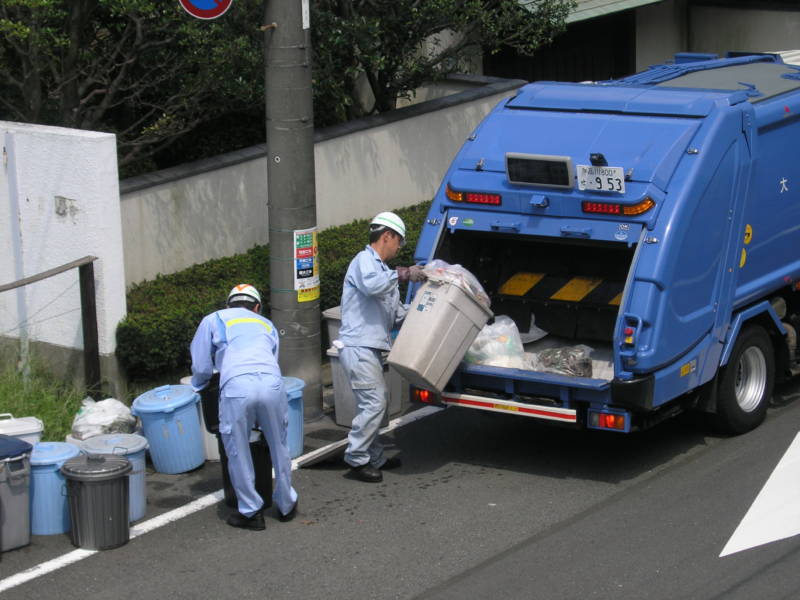
Today was combustible garbage day in my neighborhood. On Tuesdays and Fridays, residents place all their garbage deemed ‘burnable’ out on the curb. At promptly 8 a.m., it is taken away and, presumably, burned.

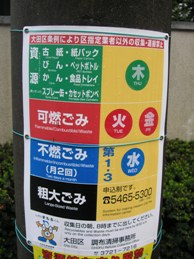
Burn after reading? Recycling instructions in Japan.
Burn after reading? Trash day instructions in Japan.

I had a lot of questions about what was considered combustible and the sign on the light post advertising the pick-up days wasn’t very helpful. My wife and I brought our 11-month-old son here. Were diapers considered ‘burnable’? I knocked on the Webers’ door to ask. Terry and Sherry Weber live next door. They’ve been working as teachers in Tokyo for 27 years. They told me that up until recently, plastic products were not considered burnable items, but all of that changed this year, and now it’s apparently fine to deposit plastic items like diapers on the curb on combustible garbage day. Either way, they told me, if the sanitation officials see that I’ve tried to sneak in some non-combustibles on the incorrect day, they’d leave it on the curb with a note, scolding me for screwing it all up.

I put a bag of diapers and another bag of what I thought were burnable items on the curb, nervous that I’d be the laughing stock of my new neighborhood. An hour later, the garbage truck arrived, two men got out, inspected my garbage, and dumped all of it into the back of their truck.

The dreaded Tokyo city sanitation department gives me a passing grade on my burnable/non-burnable garbage sorting skills.

Whew. Now I’ve got to prepare for Thursday, which is recyclables day. I’m supposed to separate all of my recyclables into paper, cardboard, plastic, and cans, and bundle each of them with string. Wish me luck.

Elsewhere on the waste disposal front:

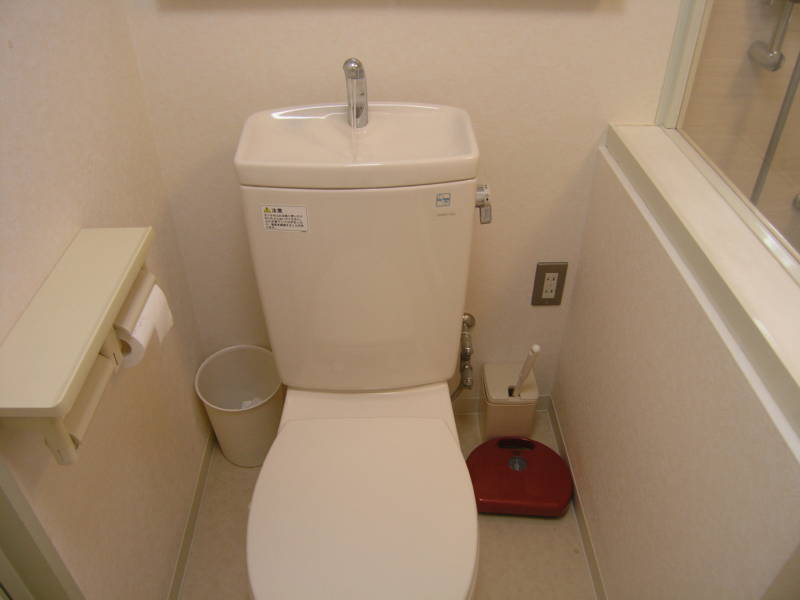
I usually don’t get excited about toilets. But the toilet in my apartment here in Tokyo has inspired me to great heights.

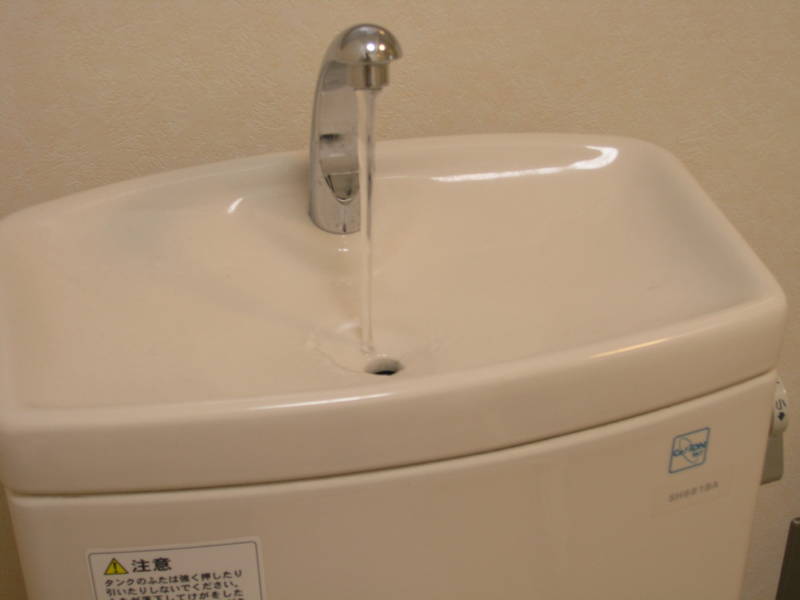
It doesn’t look exciting. But look more closely…

The toilet gives the user two types of flushes: the ‘big’ flush, or the ‘small’ flush, so that you can control how much water you’ll need, thereby conserving this precious resource.

Parched water districts of California: Please start importing these for your customers!

But that’s not what got me excited. What I was really impressed by was when you flush the toilet, water is pumped into the tank at the back of the toilet via a faucet. It runs into a basin on top of the tank where you can wash your hands with the water before it enters the toilet for the next flush. Genius. Pure genius. Why don’t we see more of these in California, where water is an even more precious resource than it is here?

Editor’s Note: Dual-flush toilets are now available in California. But the piggy-back sink–that’s a new one for me. –CM

How a Data-Gathering Ocean Robot was Born

Thayer Walker is a San Francisco-based freelance writer, who first reported on development of the Wave Glider for The New York Times. His radio segment for Climate Watch, was produced by Nathanael Johnson and is scheduled to air Monday, 8/31 on KQED’s The California Report.

Red Flash in the Sunset

By Thayer Walker

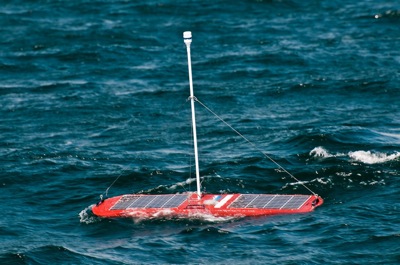
A Silicon Valley engineering firm called Liquid Robotics recently launched a new device called a Wave Glider off the California coast. It’s the latest and perhaps, the most ingenious design in the growing network of “autonomous ocean samplers,” which is to say sea-going science robots. The glider is a sensor-carrying platform powered entirely by wave energy and it has the potential to collect an enormous amount of data about the ocean, which in turn will give scientists a better understanding of climate change.

"Red Flash" at sea. Photo: Liquid Robotics

Jim Bellingham, Chief Technologist at the Monterey Bay Aquarium Research Institute, calls the device a “transformational development” in the field of ocean science and technology, but when the inventors came up with the idea they weren’t trying to revolutionize marine studies, they were trying to eavesdrop on humpback whales.

In 2005, Joe Rizzi, the chairman of Liquid Robotics, wanted to listen to the song of humpback whales off the coast of his home in Puako, Hawaii. He anchored a hydrophone near the shore, but instead of picking up whale song he heard the sound of frying bacon. Snapping shrimp, a small crustacean that uses its powerful claw to generate sound blasts that stuns its prey, had drowned out the call of the whales.

When Rizzi moved the hydrophones into deeper water he captured clear whale sounds, but kept losing the moored devices to rough seas. “The difficulty,” says Rizzi “was holding a hydrophone anchored in 600 feet of water during winter storms.” Rizzi realized that to keep a hydrophone stationary, he would need a powered device. “You’re not going to do that with a battery and a motor and a solar panel,” he explains. “The amount of power to hold station in a 60 mile per hour wind and 10 foot waves is thousands of watts. We recognized that it’s an energy problem.”

Rizzi presented the problem to Liquid Robotics CEO Roger Hine, who quickly came up with a design, and the Wave Glider was born.  “We weren’t sitting around thinking this thing would have a lot of scientific uses,” says Rizzi, “but as it turns out, there are a lot more uses for this device than just listening to whales.”

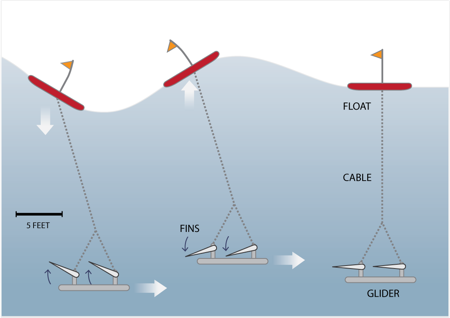
The Wave Glider's passive propulsion system harnesses the up-and-down motion of sea swells for locomotion. Diagram: Liquid Robotics