Tag Archives: Technology

Passionate About Panoche

The “33 x 20” series continues today on Quest Radio, with the second of two parts on the proposed Solargen project in San Benito County. The report will be repeated on The California Report weekly magazine on Friday.

Catch up by listening to the first part and reading the accompanying blog post from last week.
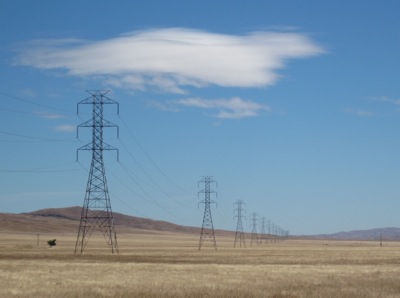
PG and E already has transmission lines running along the Panoche valley floor.

One thing becomes clear when you visit the Panoche Valley and the people that live and work there, everyone is charmed by it. The local ranchers, the environmental advocates, even the biologists hired by the Silicon Valley company that is looking at developing part of the valley for a commercial solar farm.

Thousands of acres of vast cattle land ringed by golden, scrub covered hills make up the Panoche Valley. The area has a vast, open beauty that seems very Californian. But in the springtime locals say it looks like Ireland. The land has also caught the eye of the CEO of Solargen Energy.

The company would like to build a 420 megawatt solar farm that would power about 120 thousand homes. To do so, Solargen would cover much of 4,700 acres of the valley with photo voltaic solar panels. Locals like chicken rancher Kim Williams worry it would change the character of the valley and harm wildlife. A group of local environmental advocates and ranchers have formed a group called Save Panoche Valley.

Kim Williams runs Your Family Farm in the Panoche valley and is opposed to the Solargen project.

Solargen, as required by law, has hired a team of wildlife biologists to do environmental surveys of the area which, it turns out, is home to several endangered species. Michelle Korpos, the leader of the team, has also developed a fondness for Panoche Valley where she has been working for the past year. Everyday she and group of biologists march out to the project site, and surrounding hills, searching out fox dens, canvassing creek beds and geo-tagging lizard scat.
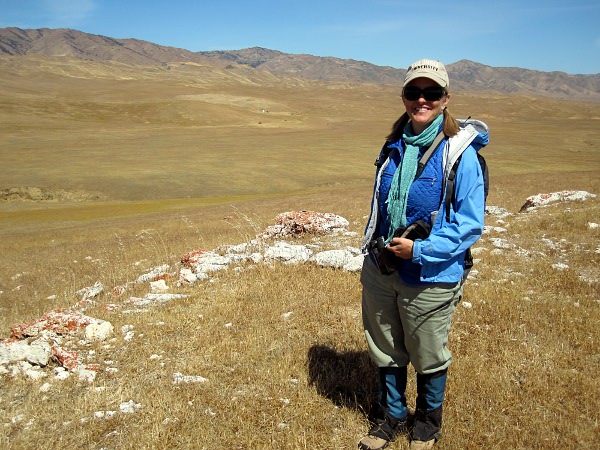
Michelle Korpos, along with other biologists, has been hired by Solargen to run wildlife surveys for an Environmental Impact Report.

Charlie McCullough has owned his cattle ranch, one of the biggest in the area, since the early fifties and was born in San Benito County. He is one of five ranchers who has agreed to sell some of his land to Solargen. But McCullough is feeling remorseful that his decision could lead to such a change in the valley he loves.
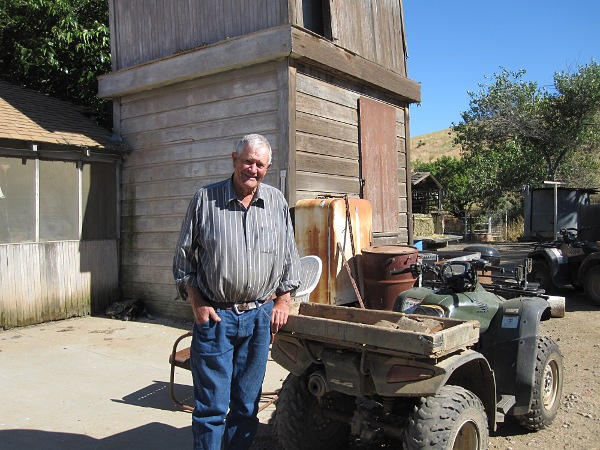
Charlie McCullough has agreed to sell some of his land to Solargen for their big solar project.

The only commercial business in town is the Panoche Valley Inn which is not really an inn at all but a bar that serves as a stop for tired ranchers at the end of the day and birders and bikers on sunny weekends. The owner hopes the project’s contstruction jobs mean more business over the six year build out. But even the number of jobs Solargen promises to create has become contentious.

Larry Lopez, owner of the Panoche Inn, hopes construction of a big solar array would bring in more business.

One thing is for sure, the valley gets lots of sun, 90-percent of the solar intensity of the Mojave desert. But the Mojave, with its protected federal lands and desert tortoises, has turned out to be a nightmare for big solar entrepreneurs. Listen to our stories on the Panoche Valley which now finds itself in the middle of the debate over big solar. It’s all part of our series, “33 by 20,” a look at the obstacles in the way of California’s plan for utilities to generate one third of their electricity from clean energy by 2020. Here’s a map of solar intensity throughout the U.S.
Clock Ticking for Solar Developers

The “33 x 20” series continues Monday on Quest Radio, with the first of two parts on the proposed Solargen project in San Benito County. The reports will be repeated on The California Report weekly magazine.

Well hidden among the coast ranges of San Benito County, there’s a valley where, as one ecologist put it, “the hammer is hitting the anvil.” Mike Westphal of the Bureau of Land Management’s Hollister field office was describing the current tension playing out in Panoche Valley between two environmental goals: the mandate to combat global warming with a transition to renewable energy, and the desire to conserve the habitat of endangered animals, as well as California’s remaining ag land.

Solargen argues that Panoche Valley is a rare combination of great sun, proximity to population centers, and existing transmission lines to get the power there. (Photo: Craig Miller)

As part of our collaborative series: “33 x 20: California’s Clean Power Countdown,” Quest Senior Editor Andrea Kissack and I have been exploring the effort by Solargen Energy to develop Panoche Valley as a utility-scale solar power array (the state defines “utility-scale” as any facility that produces 200 megawatts of electricity or more).

Like many developers, Solargen CEO Mike Peterson is racing to break ground by the end of this year, in order to cash in on up-front stimulus money from the federal government. He says Panoche Valley presents a rare alignment of attributes for solar power: high solar potential (he says 90% of the Mojave), relative proximity to population centers, and existing transmission lines to get the power there. Peterson told me that the lines already in place have enough available capacity to handle his 420 megawatts of solar power, though a spokeswoman for PG&E says that question is still under study.

Meanwhile, some farmers and wildlife advocates have opposed the plan, saying big solar “farms” are better placed on “degraded” land. Ron Garthwaite, who runs Claravale organic dairy, says “This is just not the place to put it. There’s other places which have no ag value and which have less of a natural value where they could put it.”

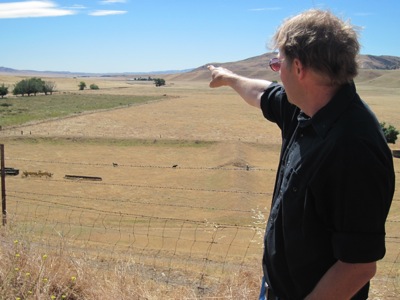
Standing at the valley's north end, BLM ecologist Mike Westphal points to where 2,000 acres might be covered in PV solar panels. (Photo: Craig Miller)

Westphal, whose agency is not directly involved in assessing the project, sees the valley as a rare microcosm for the once unspoiled habitat of the San Joaquin Valley, just over the hill. “What we really need to think hard about is do we want to risk ecosystems to get energy,” he told me, scanning the valley from Shotgun Pass at the north end.  “That’s what’s going on here in Panoche Valley is we’re making this equation: how much do we want to risk the continued endangerment or extinction of this ecosystem in order to get more energy? That’s the crux of this conflict here.”

In this video clip, BLM ecologist Michael Westphal gives Craig Miller an overview of the valley, looking south from Shotgun Pass.

Solargen is shelling out for a $1.3 million-dollar environmental impact report, which Peterson says does not include measures such as the two dozen biologists and a detachment of scat-sniffing dogs, trained to track down the droppings of other critters for DNA analysis. The results help determine what species are there. Peterson says the total tab in “preparing and preparing for the EIR” now tops $7 million.

In Part 2 of our Panoche Valley “case study,” Andrea Kissack will have a closer look at the wildlife issues. That report runs next Monday, June 28, on Quest Radio.

As for the Governor’s ambitious goal to have renewable energy sources account for one third of the state’s electrical generation by 2020, Peterson describes the process as “surprisingly harder than you would expect.” He says he ponders how to “get this done in a way that is able to meet the mandates, but also be a good steward to the environment, and try to make people happy. And we won’t be able to please everybody.”

He’s right about that. Dairyman Garthwaite says of the state’s quest for renewables: “Just because somebody in Sacramento says something, doesn’t mean that it can happen–or should happen. I mean there’s all kinds of political things involved in that, there’s lobbyists involved in that. People want to make money.”

Climate Watch intern Chris Penalosa mapped some of California’s larger solar projects in development, below.


View Utility Scale Solar Projects in California in a larger map

California’s Future Energy Mix

The Quest/Climate Watch series “33×20: California’s Clean Power Countdown” continues on Monday, with the first of two parts on one company’s attempt to build one of the nation’s largest PV solar arrays in San Benito County.

(Image: Solargen Energy)

With its ambitious 33%-by-2020 renewable energy goal, California will be looking for renewable megawatts from all corners of the state. While the state may hit 18-19% by the end of this year, reaching 33% will require approximately a doubling of renewable power, since the state’s energy appetite will continue to grow in the meantime.

So, where will the energy come from? According to the California Public Utilities Commission, wind and solar will have to carry much of the “load.” Check out the CPUC projections in the charts below.

Dumbfounded by “SmartMeters”

UPDATE: In late January, 2011, The New York Times published a good overview of how the controversy over smart meters has evolved since this post.

When utilities and the California Public Utilities Commission hatched plans to bolt a “smart meter” onto every household, the premise–and the promise–was that by digitally tracking just how much they were using and spending, customers would be able to make smarter choices about their energy use, ultimately saving money and cutting carbon emissions.

Smart meters are also a critical component of the nascent but much vaunted “smart grid,” in which household appliances and electric cars communicate with the vast power transmission network, and optimize things like when to recharge.

But as I report in my radio story for The California Report, many PG&E customers consider them more bane than boon (PG&E uses the trademark “SmartMeter,” whereas I may refer to them generically as “smart meters”).

Part of what’s riled up customers in Bakersfield and elsewhere in California is that PG&E hasn’t provided the devices to help watch the watts. Customers can go online to track their energy use over the last 24 hours, but that’s about it. And in the meantime, consumers are paying the cost of the new meters, and in some cases, higher bills that they blame on those meters.

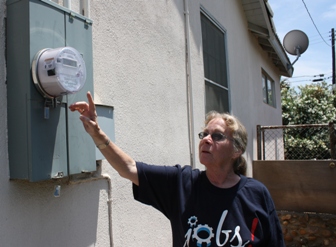
Liz Keogh shows me the "SmartMeter" outside her Bakersfield home. Photo: Sasha Khokha
Liz Keogh shows me the "SmartMeter" outside her Bakersfield home. Her summer 2009 bills went up by half after it was installed. (Photo: Kristin Torres)

Julie Fitch, who heads the energy division of the California Public Utilities Commission, told me she thinks those real-time tracking gadgets won’t actually change consumer habits that much. “There’s a certain percentage of us who are interested in seeing what our energy use is at all times, and are fascinated by it, but I think it’s probably a small percentage in the grand scheme of things,” Fitch said.

Fitch says consumers will see more of an advantage from smart meters when home appliances can communicate with the devices.

“The reality is the grid right now is that it’s actually fairly dumb,” Fitch said. There’s a lot of manual decisions that need to be made in order to get the electricity from a generator to your house. I think what we’re looking at is a much more automatically controlled situation where appliances are automatically linked in with smart devices.”

For example, a fully integrated system could “decide” to run your clothes dryer at off-peak times, to relieve strain on the grid and possibly save money. But the whole idea of charging more for power at different times of day, known as peak pricing, troubles consumer advocates like Mark Toney. He heads The Utility Reform Network (TURN), a consumer advocacy group based in Oakland.

“We want to make sure this doesn’t unduly harm seniors, for instance, who are home bound,” Toney told me, pointing out that folks don’t have a choice sometimes about whether to run their air conditioner in the sweltering Central Valley heat.  “We don’t want them to be faced with the choice of being safe in their home or being subject to heat stroke because they shut off their AC because they can’t afford it,” he said.

Toney is also concerned that struggling customers are more likely to see their power shut off,  if they can’t keep up with the bills.  Smart meters allow utilities to turn off power remotely, without having to send a crew out to someone’s home–and that, he says, gives the company less incentive to negotiate payment plans.

The CPUC’s response? Utilities will still have to follow standard procedures, including advance notice of shut-offs.

Meanwhile an independent lab appointed by the CPUC continues to test PG&E SmartMeters to try to determine why some of them are malfunctioning. Some customers now have “side-by-side” test installations, with both analog and digital meters tracking electricity use in tandem. Strangely enough, the deployment of smart meters by Southern California’s two major utilities has gone relatively smoothly, with just a fraction of the complaints that PG&E has logged.

In my radio story, I interviewed Bakersfield Resident Liz Keogh, who saw her electric bill spike after her SmartMeter was installed.  Keogh is very energy-conscious; her home is a veritable showcase of energy-saving gadgetry. There could be any number of technical reasons why the new meters led to larger bills. Keogh developed her own personal theory (since disproved by independent tests), which she demonstrates in the video below, using some unlikely props. It’s a good example of the broad spectrum of consumer objections to the technology.

The Solar Jobs Solution: Some Perspective

As anyone who got stuck in the traffic knows, President Obama made a call at one of the Bay Area’s new darlings of green tech, Fremont-based Solyndra Inc., which he called a “testament to American ingenuity and dynamism.”

The firm is tapping more than a half-billion dollars in federal loan guarantees to build a manufacturing plant for its photovoltaic (PV) technology. Governor Schwarzenegger and Energy Secretary Steven Chu have also used Solyndra as a backdrop for showcasing California’s burgeoning clean tech sector. The company has developed a new type of PV technology designed for commercial rooftops.

Solyndra's rooftop solar panels use a new type of cylindrical module. Image: Solyndra, Inc.

Today in Silicon Valley, the big, green hype machine was running at full tilt. Solyndra’s CEO, Chris Gronet, talked up the California location. “If our factory was someplace else (outside the US), we probably would not have the supply chain across 29 US states,” he told KQED’s Cy Musiker today.

Mike Mielke of Silicon Valley Leadership Group added to the frenzy: “Clearly California’s leadership in the emerging trillion-dollar clean energy technology market has put us in an ideal investment position,” he said in a statement issued after the Presidential appearance.  “We would not be as competitive without the state’s landmark clean energy policies like AB 32.”

But some temperance was injected into the festivities by Severin Borenstein, co-director of the Energy Institute at UC Berkeley’s Haas School of Business. Asked if investments in solar panel production necessarily translate to permanent job growth, he told Musiker: “The evidence from a longer-run perspective really doesn’t support that.”

Borenstein says what history does demonstrate is that dominance in a given technology lasts just about as long as the government subsidies supporting it. He pointed to both Germany and Spain, both of which have recently lost some of their edge in production of solar components. Much production of solar and wind energy products has already moved to China.

“This idea that you’re going to create a permanent competitive advantage in producing green technology by subsidizing it now is really not very well born out in the data,” said Borenstein, who doesn’t deny that federal stimulus funding has “helped push forward” some key technologies. In the absence of a meaningful price mechanism for carbon emissions, Borenstein says that “pushing forward on some of these alternative technologies is the best thing we can do.”

Regarding California’s landmark climate law, the aforementioned AB 32, Borenstein agrees with the state’s Legislative Analyst that implementation would not have a significant impact on California’s overall economy, in either direction. But Borenstein doesn’t see the point in abandoning the state’s primary comprehensive climate strategy to save jobs, as some have suggested it would. “Climate change is real and it is potentially catastrophic,” said Borenstein. “If every time we have an economic setback, we put the environment second, we’re never going to make any progress.”

Series Explores 33×20 Renewable Energy Goal

California has set some ambitious targets for ramping up renewable energy sources. Some say too ambitious. Utilities won’t make the first milepost of 20% renewable power by this year, and many are skeptical that the longer-term goal of 33% by 2020 is doable, either, the executive order signed by Governor Schwarzenegger in 2008 notwithstanding.

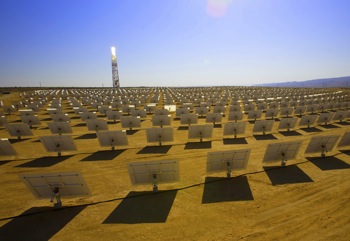
A thermal-solar array of the type planned for southern California. Photo: Brightsource Energy
A thermal solar array of the type planned for southern California. Photo: BrightSource Energy

A major hurdle is the permitting process for large “utility-scale” solar and wind installations, described by the Governor’s own senior advisor as “tortuous.” In the months ahead, we’ll take you through some of the obstacle course in a multimedia series called “33 x 20: California’s Clean Power Countdown.” A collaboration of Climate Watch and Quest, KQED’s science and environmental initiative, the series of radio reports and web features explores the promise and pitfalls of the state’s 33 x 20 plan.

The series begins Monday with Lauren Sommer’s review of California’s clean power legacy and an assessment of the present push. Future reports will look at a solar siting case study in central California, as well as prospects for major development of wind and geothermal sources. California currently leads the nation in solar generation but trails Texas and Iowa in the race for wind power. See Lauren’s interactive map for an overview of how California stacks up against other states in its ambitions toward renewable energy.

Future reports will examine the potential impact of large-scale power generation on deserts and tribal lands and the progress toward what some consider the “holy grail” of energy technology; large-scale storage of electricity. In June, Quest Senior Editor Andrea Kissack and I will team up for a kind of case study in one company’s ambitions; the 4,700-acre photovoltaic array planned by Solargen Energy for Panoche Valley in San Benito County.

Northern California listeners can hear the radio series as part of KQED’s Quest radio service (airs Mondays during NPR’s Morning Edition on KQED and KQEI in Sacramento) or statewide on The California Report. You can follow the entire series and see the related web features as they appear on our “33 x 20” series page.

Geoengineering Field Tests on the Horizon?

Bill Gates may investing in geoengineering projects, but a widely-quoted news story reporting that he contributed $300,000 to a San Francisco company to launch climate-intervention field tests is full of inaccuracies, according to one scientist involved.  The article, which appeared Monday on the Times Online website, asserts that Gates gave the company, Silver Lining Project, the funds to develop machines to spray seawater up to 1,000 meters into the sky in efforts to whiten clouds and increase their reflectivity, thus blocking the sun and ultimately slowing the rate of atmospheric warming.  The article then describes a planned field trial, which would involve 10 ships and 10,000 square km of ocean, leading some readers to assume that Gates is funding the largest-scale geoengineering field test to date.

According to Ken Caldeira of the Carnegie Institute of Global Ecology at Stanford, Silver Lining has received no funds from Gates personally.  Instead, he said, the $300,000 was allotted by Caldeira and David Keith, who have been directing geoengineering project funding for Gates.  Caldeira explained in an email that the scientists dispensed funds not to Silver Lining for field tests, but to engineer Armand Neukermans and his team, “to test the feasibility of fine seawater sprays in the laboratory.”

“There was no funding given for the planning, preparation, or execution of any field tests,” Caldeira wrote.   “I have expressly said that private efforts to conduct field tests should await the development of appropriate governance structures. I am opposed to private entities conducting field tests without appropriate governance and would oppose funding such activities.”

It’s possible, as critics assert, that the technology developed by Neukermans could eventually be used in Silver Lining Project field tests. However, the $300,000 from Caldeira and Keith would most likely be a drop in that bucket.  The Vancouver Sun reports that a scientist collaborating with Silver Lining, Robert Wood, said that it will likely take $25 to $30 million to fund the proposed field experiments.

The Times Online article touched on a particularly hot issue with the statement, “The British and American scientists involved do not intend to wait for international rules on technology that deliberately alters the climate.”

In March, scientists and policymakers gathered in Monterey for a week to discuss this very issue.  The general sentiment at the close of the talks was that more research is needed, as well as more input from governing bodies and the public, before potentially damaging field experiments are undertaken.

“This is a first step down a dangerous road,” said Rutgers scientist Alan Robock about the reported Silver Lining Project field test plans.  “Because, where do you stop?  There is no governance or agreed-upon restrictions determining what’s safe.”

What’s an Albedo? (And Why You Should Care)

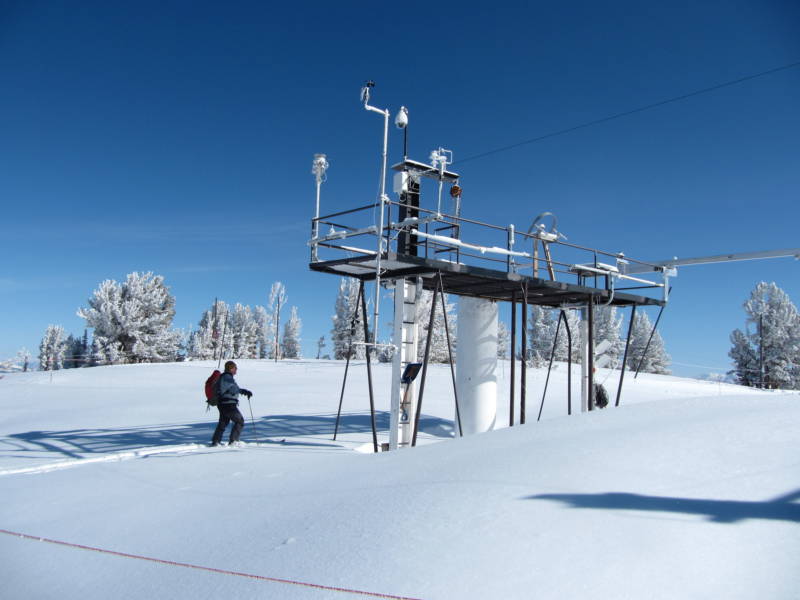
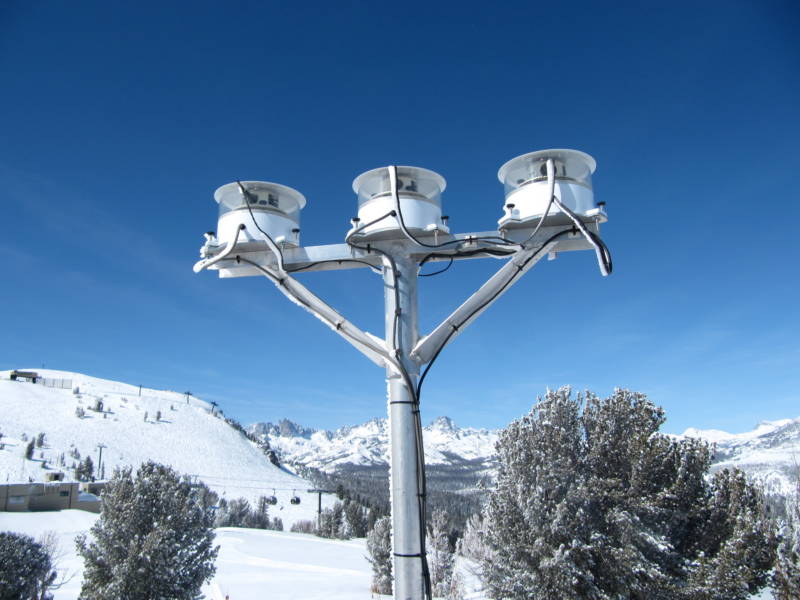
Jeff Dozier approaches the instrument tower on Mammoth Mountain.

When Jeff Dozier, a hydrologist at UC Santa Barbara, goes to work, he gets to enjoy quite a view. His snow lab is perched halfway up Mammoth Mountain in the central Sierra. We took a gondola to get up there; the other passengers were skiers and snowboarders itching to get out on the freshly fallen snow.

But the instrument platform from which we enjoyed views of the White Mountains is really only half the story. Dozier’s computer lab has much less of a view. In fact, it has no view. It’s buried under the snow, accessible only through what he calls a “Santa Claus entrance” (in the picture above, you can see the entrance–it’s the white tubular “chimney” extending down into the snow from the center of the platform).

The snow lab, operated by both UCSB and the U.S. Army Cold Regions Research and Engineering Laboratory (CRREL), uploads information about the snowpack to a website every fifteen minutes. You can see nearly real-time readings on, among other things, snow depth, temperature, humidity, and radiation.

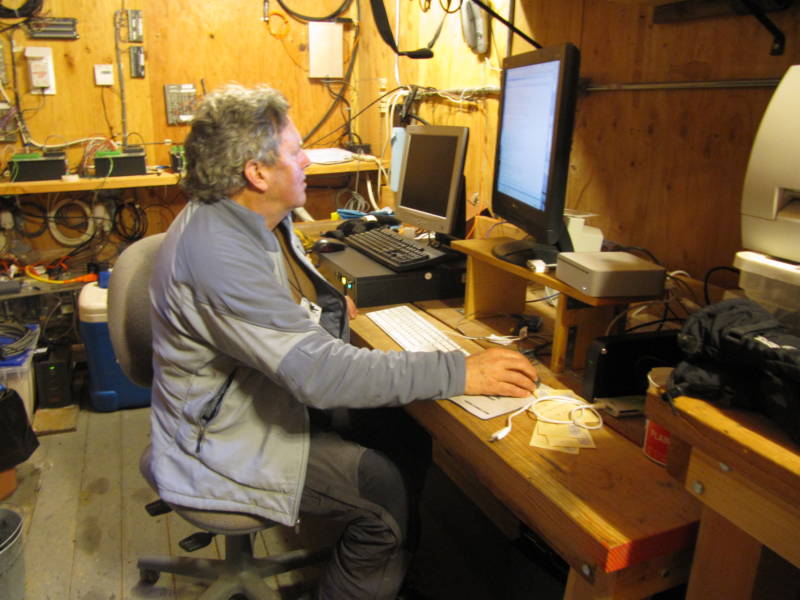
Dozier in the computer lab. Photo: Molly Samuel

Radiation is an important one. Instruments called radiometers are mounted on the tower. Some point up, measuring the radiation coming from the sun; others point down, measuring how much is reflected back to the sky by the snow.

Albedo” is the measurement of how reflective the snow is. Something completely white that reflects all of the sun’s energy has an albedo of one; something black, that absorbs all the energy, is zero. Bright, freshly fallen snow has a high albedo, typically above 0.8.

Even if the term is new to you, albedo is probably a familiar concept. As I reported for KQED’s The California Report this morning, Hans Moosmuller of the University of Nevada’s Desert Research Institute explains it in terms of outfits: on a sunny day, if you wear a black sweater you’ll be warmer than if wear a white one. You may notice it with roofs, too. I grew up in Atlanta, in a house with a black roof. Before my parents got an air conditioner, the upstairs bedrooms were unbearable in the summer. If we’d had a white

These radiometers measure radiation coming from the sun. Photo: Molly Samuel

roof, it would have been a little more bearable (though I can’t say it would have helped with Atlanta’s other charming summer attributes, humidity and mosquitoes).

The color sweater you wear has no bearing on the earth’s climate. Roof color could have an effect on a large enough scale. What really matters are the huge swaths of dark and light that cover the globe: ocean and snow.

When warming causes sea ice near the poles to melt faster, areas that had a high albedo (ice is very reflective) become  areas with a very low albedo (the blue ocean absorbs more radiation than forests or plain dirt). Moosmuller says it creates a feedback loop. The more dark spots there are, the more radiation is absorbed. So melting speeds up, and warming increases, exposing even more dark areas, and so on.

Pollution plays an important role that’s coming under increasing scrutiny. Deposits of soot or dust make the snow darker, so it melts faster, exposes more dark ground, and there’s that feedback loop again. In the Himalayas soot, also known as black carbon, from stoves, tailpipes, factories, and fires is having a measurable impact.

In the Rockies, there’s a similar problem caused by dust kicked up from ranches. Tom Painter of the University of Utah says the snow in the Colorado River Basin melts a full month earlier than normal. The difference the dust makes is so drastic, Painter says, that “We’re in an entirely new regime for snow melt…it would be like if we started measuring climate impacts fifty years from now.”

No one has yet done a long-term study on the effects of dust and soot on the Sierra Nevada snow pack. Moosmuller says he’s beginning to look into it now. In the summer, black carbon drifts into the mountains from California’s cities, ports, highways and farms in the Central Valley. Tony Van Curen, in a research project at UC Davis, has found that soot blows over from Asia, too.

There is good news in all of this: Black carbon, unlike most greenhouse gases, lingers in the atmosphere only for a couple of weeks. So reducing emissions could have a relatively quick impact.

East Coast Leads Offshore Wind Derby

The Nysted wind farm off Denmark. Image: Cape Wind Assoc.

The nation’s first offshore utility-scale wind farm has won federal approval but it was no slam dunk. The Dept. of Interior has approved the 130-turbine Cape Wind project, off Nantucket.

The plan launched such an epic debate that at least one book has been written about it. Today’s nod comes just weeks after a federal advisory panel recommended against approval and doesn’t necessarily mean the project will go forward. Opposition groups have already vowed to go to court.

Cape Wind is just one of numerous offshore wind projects under consideration for the East Coast and Great Lakes region.

Permitting for most wind projects in California comes under local jurisdiction but a spokeswoman at the California Energy Commission told me that to her knowledge, no offshore wind projects are currently under review for California. An obstacle often cited is the extreme ocean depths off California, which make construction difficult. Various wave power projects have been proposed for the coastline.

New Solar Manufacturing Plant for Silicon Valley

SunPower CEO Tom Werner and Gov. Arnold Schwarzeneggar announcing the creation of a new solar manufacturing plant in Milpitas, CA (photo: Gretchen Weber)
SunPower CEO Tom Werner and Gov. Arnold Schwarzenegger. Photo: Gretchen Weber

Silicon Valley-based solar cell manufacturer SunPower Corp. announced today that it’s decided to site its newest manufacturing plant in California, a move that CEO Tom Werner says will create hundreds of jobs and may prompt an “economic cluster” that will attract similar projects.

SunPower has partnered with contract manufacturer Flextronics, and plans for the Milipitas-based operation to be up and running by the end of the year, producing high-efficiency solar cells.

Werner and Flextronics CEO E.C. Sykes were joined at the announcement in Milipitas by Gov. Arnold Schwarzenegger, who sported a green tie and chastised the assembled crowd for not celebrating Earth Day with similar fashion choices.

“I am so excited about this,” said Schwarzenegger about the new project. “This proves that protecting the economy and protecting the environment can be done simultaneously.”

Werner said locating the manufacturing operation in California makes sense both for economic reasons and because California is home to a large solar market, thanks to  the state’s Renewable Portfolio Standard, requiring 33% renewable energy by 2020, and the Million Solar Roofs Initiative.  Werner added that a record 50 megawatts of rooftop solar power were installed last month in California.

“You want to be close to your customer for logistical reasons, and also because you learn from your customer and you build it back into your product,” Werner told me following the staged media event.  “And by being local you can learn faster than you can if you’re distant.”

Other California selling points were a green manufacturing equipment sales tax exemption, which enabled SunPower to buy equipment for the facility tax-free, and low-interest loans from Recovery Act funds granted through the City of Milpitas, said Werner.

Governor Schwarzenegger used the occasion to warn Californians against taking the state’s environmental laws for granted.

“Right now there are greedy Texas oil companies that want to come in here and spend millions of dollars to roll back AB 32 (the state’s 2006 carbon legislation) and our other environmental laws,” he said. “Why? Because they don’t like that there’s alternative energy being created.  They don’t like what you are doing here.”