Environmentalists have registered much consternation over the fact that out-of-state oil companies have been bankrolling a ballot measure to freeze implementation of AB 32, backbone of the state’s climate strategy.
Heavy surf along the Monterey Peninsula. Photo: Craig Miller
Speakers at this week’s sea level planning conference in Oakland cited everybody from H. L. Mencken to Yogi Berra (“You can observe a lot just by watching”). But the primary insight from the event may have been courtesy of Robert Frost: “…miles to go before (we) sleep.”
About 225 representatives from industry, government and academia gathered at the behest of the non-profit Bay Planning Coalition. The effort was to push forward a planning agenda to help prepare the Bay Area and coastal California for rising sea levels due to the changing climate. There is considerable uncertainty surrounding how much sea level rise we should expect in the decades to come. There were indications at the conference that planners were starting to coalesce around predictions of 16 inches by 2050, and 55 inches by 2100, projections embraced by the state’s formal climate adaptation plan.
Greater still is the uncertainty surrounding how governments, businesses and public agencies will respond to the challenge. Estimates are that rising seas threaten $100 billion of “economic assets” statewide, half of which are in the Bay Area. While most speakers seemed to agree on the urgency of mobilizing a coordinated planning effort, few seemed certain where to start.
The palpable frustration in the room was voiced by, among others, Calla Rose Ostrander, Climate Action Coordinator with the City and County of San Francisco. “I think we’ve set ourselves up to need certainty, to make decisions,” she told me, saying that public agencies in charge of roads and development feel paralyzed. “When we apply for funding for these things,” explained Ostrander, they (potential funders) say ‘How are you planning for it?’ And we haven’t been advised yet on how to plan for it.” That dilemma was echoed by Paul Thayer of the California State Lands Commission: “You can’t engineer for a range of sea level rise,” he said. And yet that would appear to be the task.
Oakland Int'l Airport, like much of the Bay Area's critical infrastructure, lies barely above sea level. Photo: Craig Miller
Funding is another area that remains fuzzy, amid all the inter-agency discussions, and one that was not substantively addressed at the conference. It is expected that rising seas will require billions of dollars in infrastructure upgrades. The Port of Oakland, for example, is awaiting the outcome of a study to determine what “perimeter defenses” will be needed to keep runways at Oakland International Airport above water.
Several speakers raised concern about rallying public support to confront a threat that is so diffuse. Will Travis, who heads the San Francisco-based Bay Conservation & Development Commission, predicted that “bringing it home” to households with more immediate worries will be the biggest challenge. And yet we can’t wait, warned Travis. “The longer we wait, the worse the problem becomes.”
Scientists as well as policymakers are pondering how to respond to rising sea levels. Nicole Heller of our content partner Climate Central recently attended a conference aimed at that end of the issue, and wrote about it in the Climate Central blog.
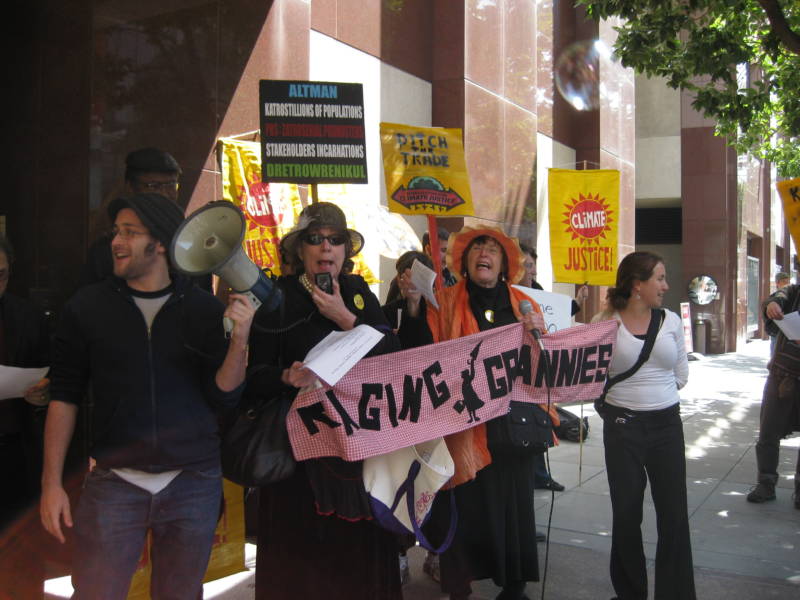
Businesses wary of a cap-and-trade system for carbon regulation are finding some unlikely allies these days. Outside a carbon policy conference in San Francisco today, the concept was assailed by members of the “environmental justice” movement.
About sixty protesters targeted an event called Navigating the American Carbon World, an event that brought together representatives from government and industry, including firms interested in facilitating emerging carbon markets.
“Inside there are thousands of people trying to make big money off-carbon trading,” said rally organizer Brianna Morgan of Rising Tide North America, as demonstrators outside sang songs, led chants, and performed political street theater. “We believe that carbon trading and carbon offsets let corporations off the hook from making real changes to the way they do business,” said Morgan.
Morgan and her fellow protesters were part of Mobilization for Climate Justice West, a network of 15 to 20 community-based groups.
Meanwhile conference attendees inside the Marriott hotel discussed climate change policy topics including carbon trading, a major component of the California climate law passed in 2006, known as AB 32.
The European Community is already using a carbon trading system, in which industrial emitters are allocated “carbon credits” corresponding to a specific quantity of global warming pollution. If facilities emit more CO2 than they have credits, they can buy additional credits in a regulated carbon market. But carbon markets have been slow to get off the ground elsewhere, including the US. California’s cap-and-trade system, scheduled to take effect in 2012, has encountered resistance from business groups and conservative candidates for Governor.
The San Francisco protesters said they object, in part, to carbon offsets, which allow emitters to meet regulatory requirements by funding activities elsewhere in the world, such as re-forestation, the exact impact of which on net carbon emissions may be elusive. Meanwhile, local emissions are allowed to continue.
“We believe that this is rewarding people for doing exactly what they always do,” Morgan said.
She added that carbon emissions coincide with other types of pollution that have public health consequences at home, such as increased rates of asthma near oil refineries and major ports.
California has had a climate change mitigation law on the books for more than three years now–but getting that law’s regulations fully in place is proving to be a tough slog.
Fans and mortal enemies of California’s Global Warming Solutions Act (AB 32) all exude certainty about what the carbon emissions-cutting law will do for–or to–the state’s economy. Lately the debate has escalated into full-scale PR warfare. Major battlefronts include:
– A signature campaign for a ballot initiative to suspend the law
– An online campaign to boycott oil companies funding the above
– Studies & surveys from both sides proclaiming their case
– A gubernatorial candidate who has vowed to suspend AB 32
The measure would suspend most provisions of the climate law until the state’s official unemployment rate improves substantially from its current 12.5% level. NFIB statements say “the measure is headed for the November ballot” but only if proponents gather more than 400,000 required signatures.
John Kabateck, executive director of NFIB/California said in a conference call with reporters today that his organization would help gather signatures to qualify the measure. He called the climate law “one more arrow in the quiver of damage and pain inflicted on small business right now.” In a companion news release, Kabatek ventured that full implementation of AB 32 would cost California more than a million jobs.
California’s non-partisan Legislative Analyst has concluded that while the exact job impact is hard to pin down, AB 32’s overall effect would be relatively minor compared to the state’s total economy.
Meanwhile, pro-AB 32 activists are circulating an online petition calling for a boycott of Valero and Tesoro, two Texas-based oil companies that are helping bankroll the suspension measure in California.
The NFIB announcement followed by one day the unveiling of a new poll showing support for AB-32 among California voters. The survey shows 58% of Californians “favor” the law either “strongly” (34%) or “somewhat.” One in four surveyed said they strongly opposed the measure. Sixty-four percent said they supported charging industry for excess emissions, while 31% opposed that. The poll was conducted in March by Field Research for Next 10, a public policy think tank that strongly supports AB 32. Field polled about 500 voters for the survey, which has a margin of error of 4.5%.
Business is sharply divided over AB 32. The viewpoint of those wary of it is generally represented by the AB 32 Implementation Group. Other business leaders strongly support the law, including it’s cap-and-trade provisions. An outspoken example is Barry Cinnamon, CEO of Akeena Solar, who recently laid out his position for Alison van Diggelin, publisher of the Fresh Dialogues blog site.
In that conversation, Cinnamon skewered the “inane commentary” of gubernatorial candidates calling for the undoing of AB 32. Republican candidate Meg Whitman has pledged to order a one-year “moratorium” on regulations under AB 32, on her “first day as governor,” calling the policy “wrong for these challenging times.”
Despite what might feel like an incessant onslaught of storms these past few months, the word from the Department of Water Resources’s fourth snow survey of the season is… average. Manual and electronic survey readings indicate that statewide, the Sierra snowpack water content is 106% of normal for this date. In the northern Sierra it’s higher, at 126% of normal, while the central and southern Sierra are at 92% and 105%, respectively.
The news was good enough for the DWR to increase its State Water Project allocation from 15% to 20%, but agency director Mark Cowin told reporters on a call Thursday that three years of drought and regulatory restrictions on Delta pumping to protect fish species will keep the allocations far below normal. He said the final allocation, which is announced in May, will likely be between 30% and 40%, depending on April’s precipitation. (Last year’s final allotment was 40%.)
“We’ve had a hit and miss nature to storms this winter, and that has left the State Water Project in not as good a position as we would like to be and perhaps worse than you would expect based upon those fairly good numbers regarding snowpack and precipitation,” said Cowin. “Remember that we started this winter with very poor carry over storage in most of our key reservoirs.”
While many reservoirs across the state, such as Lake Shasta, are at above average capacity for this time of year, others still have a ways to go. The State Water Project’s principal reservoir, Lake Oroville, is currently at 47 percent capacity, which is just 60 percent of normal. Cowin said that the difference between the two lies with where the snow fell this year.
“Clearly we’re going to have water shortages this year,” said Cowin. “We’re all going to have to conserve water. Even if we get to 30 or 40% allocation, those are still low numbers. The ethic of using water efficiently in California has got to be the normal course of business and not dependent on the weather forecast.”
Last month, the U.S. Bureau of Reclamation issued an updated allocation for its Central Valley Project customers that ranged from 25% to 75%.
Check recent levels of California’s major reservoirs on the map, below:
After five days of talks at Asilomar this week, scientists concluded that more research is needed on climate intervention strategies and their potential risks and rewards, as is a broader discussion involving governments and the public.
The meeting, hosted by The Climate Response Fund (CRF), drew more than 175 people from at least 15 countries, and from disciplines in the natural sciences as well as social sciences, humanities, engineering, law, and policy, organizers said.
“The purpose of the conference was to figure out what are the processes and procedures that scientists should be thinking about as they undertake this research,”said Mike McCracken, who chaired the event’s Scientific Organizing Committee. “This was not a conference about comparing geo-engineering ideas to one another, or about bringing new technological ideas to table.”
At the close of the meeting, there seemed to be more questions than answers. What was clear from meeting discussions and Q&A sessions is that there was no single agenda shared by all participants. Several voiced grave concerns about the potential risks of climate intervention, on several levels: environmental, social, political, and ethical.
Friday morning provided a glimpse of the tortuous path that awaits this concept, when for more than an hour, participants lined up at a microphone to voice their concerns about the language and intention of a draft news release for the event. The committee then regrouped, drafted a second version of the release, and brought it back to the gathering an hour later. Objections remained and therefore the release is attributed to the conference Steering Committee, and not the conference as a whole.
From the statement:
“The participants explored a range of issues that need to be addressed to ensure that research into risks, impacts and efficacy of climate intervention methods is responsibly and transparently conducted and that potential consequences are thoroughly understood. The group recognized that given our limited understanding of these methods and the potential for significant impacts on people and ecosystems, further discussions must involve government and civil society…. We do not yet have sufficient knowledge of the risks associated with using climate intervention methods, their intended and unintended impacts and their efficacy in reducing the rate of climatic change to assess whether they should or should not be implemented. Thus, further research is indispensible.”
“I think this was the first dialogue, and it was a real dialogue,” said Margaret Leinen of the CRF. “You have to start somewhere, and this is the beginning of the conversation, definitely not the end of the conversation. I would agree with people who say that many more voices need to come in, and I think it’s not just one additional conference. This is a process, and it’s a process of engagement.”
Those missing voices were among the chief concerns of those protesting the conference. Diana Bronson of the advocacy organization ETC Group says that conversations about geoengineering need to take place in a UN-like forum, where people who will be most affected by climate change–and potentially by climate intervention strategies–can make themselves heard. The conference at Asilomar, she said, did not provide that.
“This is the wrong conversation, with the wrong people, at the wrong time,” said Bronson.
Leinen countered that the very purpose of the Asilomar conference was to begin bringing diverse voices together.
“I think that one thing people were concerned about was that this was a conference of the technologists getting together in a closed room, and coming up with the rules that they would use for self-governing,” said Leinen. “That wasn’t at all what this conference was about.”
McCracken said a statement of guiding principles developed at the conference will be released in about four weeks, after it has been reviewed and commented on by meeting participants.
The conference was funded by the State of Victoria, Australia, and by private individuals and foundations.
One section of a solar-thermal array on display at UC Riverside. Thousands of these mirrors gather solar radiation to heat a synthetic oil, which drives electrical generation at huge desert facilities. Photo: Craig Miller
Perhaps the most telling moment at the Governor’s Renewable Energy Policy Conference this week, was when the Governor’s own senior advisor on renewables, Michael Picker, asked for a show of hands. How many present, he wondered, actually thought that California would attain its goal of 33% renewable power by 2020. Amid the 370 or so gathered on the campus of UC Riverside, about a dozen hands went up. How many, he asked, thought we’d make it to 33% by 2050? Another dozen or so hands.
Bear in mind that this was a room containing some of the most knowledgeable people on the topic, from government, industry and environmental organizations. These were people invested in getting there, yet most seemed to doubt that we would.
Their pessimism was not entirely shared by the questioner. Picker told me afterward that he expected about 8,000 megawatts of new power to be approved by year-end. That’s approved, not necessarily financed. Solar arrays that generate 250 MW or more are considered large-scale operations.
Meanwhile, developers are pushing to get major projects approved before the year is out. To qualify for federal stimulus dollars, projects have to break ground this year and spend a certain percentage of project costs.
“It’s a hard state to develop in,” said Matt Handel, a vice president with NextEra Energy Resources. The Florida-based company is already a major player in both solar and wind generation in California, and Handel says the stimulus money is essential for two major new projects that NextEra has in mind for the southern California deserts.
“There is hope,” Handel told me. “It is difficult. There are a lot of constituencies out there pulling in different directions.”
Virtually all of those stakeholder groups were present in Riverside, in some form. Local (especially desert) communities, environmentalists, Indian tribes and representatives from federal agencies such as the Bureau of Land Management and National Park Service were there.
Identifying the most appropriate sites for large-scale wind and solar plants has been complicated by more than bureaucracy, said Kim Delfino, California Program Director for Defenders of Wildlife. “The landscape we’re working in is already changing due to the effects of climate change, which presents a challenge as to which areas to protect,” said Delfino in a panel discussion.
Picker says he’s “not so sure” that the state is doing the best possible job of moving projects efficiently through the pipeline (to borrow a metaphor from the fossil fuels era), and he conceded that some developers will be left standing in line as the year-end deadline expires. But he calculated that if, over the next five years, 20% of the biggest projects on the drawing board can get approved, the state should make its 2020 goal.
By 2020, California will see two million new jobs whether the state implements its climate law AB 32 or not, according to a revised analysis from the California Air Resources Board.
The report, released Wednesday, predicts modest growth in the state economy over the next 10 years, including growth of 2.4% in both personal income and gross state product with or without the law.
During a Wednesday conference call, CARB chairman Mary Nichols told reporters that sectors where California is strong, such as renewable energy and informational technology, will benefit from AB 32.
“California is uniquely positioned to benefit because this is the direction in which our economy is going anyway,” she said.
Nichols added that industries heavily dependent on petroleum will also benefit, but that they will have to go through a transition.
“We will see economic benefits overall by 2020,” said Nichols, “but it will be easier for some than for others.”
The report was reviewed by the 16-member Economic and Allocation Advisory Committee (EAAC), an independent panel of policy, business and economic experts appointed by Nichols and California Environmental Protection Agency Secretary Linda Adams.
The report finds that AB 32 provides, “neither a huge boost nor a major negative impact on California,” said Larry Goulder, chair of the EAAC and of Stanford’s Economics Department on a call Wednesday with reporters. “These findings are not that different from other studies that have been done.”
The Air Board’s original analysis was questioned earlier this month in a report from the non-partisan Legislative Analyst’s Office, which projected a mixed bag of pluses and minuses, with a short-term negative impact on jobs.
CARB’s first economic projections were criticized by others, including UCLA economics professor Matthew Kahn. Kahn said he is much happier with this new report because of adjustments made to the baseline scenario and because of the independent review made by EAAC panel, which he called a “dream team” of economists. However, the report still falls short, Kahn says, because its macroeconomic approach doesn’t identify how specific industries and businesses will fare under AB32.
“The report released today is about averages. And where I think we need more research is in how individual firms will be affected,” said Kahn. “When I was in graduate school, I had a professor who used to say ‘if your feet are in the fridge and your head is in the oven, on average, you’re ok’ and I always thought that was a funny joke, but I think it’s apropos about California today.”
Also on Wednesday, Kahn published an opinion piece in the LA Times with co-author James L. Sweeney, director of Stanford’s Precourt Energy Efficiency Center, arguing that a study frequently cited by opponents of AB 32 is seriously flawed. The study, known as the Varshney/Tootelian analysis, estimates that the law will cost small businesses $50,000 a year and each household $3,857 a year once the new rules kick in.
Opponents of AB 32 are advocating for a ballot initiative that would suspend the law’s regulations until the state economy improves and the state unemployment rate drops to 5.5%. It’s currently pegged at 12.5%, officially.
This week in Monterey, an international group of scientists and policymakers are are gathering to hash out some ground rules for experimenting with climate intervention, or “geoengineering”–what many are calling “Plan B” for dealing with climate change.
There are two main categories of geoengineering strategies: one focuses on blocking solar radiation that reaches the Earth’s surface, the other aims to remove CO2 from the atmosphere. The goal of both is to pull an emergency brake on global warming, using technology that is, in many cases, experimental.
Ideas for blocking the sun include science-fiction-sounding ideas like spraying sulfur aerosol into the stratosphere (which we explore in a radio feature on The California Report), launching reflectors into orbit, and spraying seawater at clouds to make them brighter and more reflective.
Because much of the technology remains untested, and because, given the complexities of the climate system there’s no real way to test them out in a lab, (not to mention the philosophical issue of interfering in such a direct way with the Earth), the very idea of geoengineering is controversial (watch this space for more about that in the week ahead) But as it turns out, this week’s conference in Monterey is shaping up to be controversial on its own.
Other leading scientists, however, have chosen to skip the conference, including Stanford’s Ken Caldeira, Martin Bunzl, who directs the Rutgers Initiative on Climate Change and Social Policy, and Braden Allenby, a professor of Engineering and Ethics at Arizona State University, both of whom participated in a lively panel on geoengineering at the AAAS annual meeting in February. Bunzl told Climate Watch Senior Editor Craig Miller that the five-day event was too much time to devote to the topic, and Allenby called the conference premature.
Many scientists say that more research needs to be done to determine whether these strategies would even work, before we start hashing out how to to deploy them, even if only on a limited, experimental basis. Others fear a focus on intervention might lead to complacency and distract from the immediate task of reducing CO2 emissions.
The latest controversy surrounding the conference, however, revolves around accusations of a conflict of interest. The Climate Response Fund (CRF), which is organizing the conference, has ties to a geoengineering firm, San Francisco-based Climos. Climate blogger Joe Romm (who is admittedly “not a fan of geoengineering”) writes about these connections in-depth at Climate Progress, and details email exchanges he had on the subject with Margaret Leinen of the CRF, David Keith of the University of Calgary and Caldeira of the Carnegie Institute for Science, all of whom reportedly expressed concerns about the potential conflict of interest (one reason Caldeira cites for skipping the conference).
Meanwhile organizers will try to enforce media restrictions almost unheard of in the Internet age, including a ban on daily reporting from the conference, and on quoting presenters without their express consent. The rationale was laid out in an email from the conference organizers:
“The conference is designed to allow the conferees to consider multiple points of view during the course of the meetings. Reporting before participants have had the opportunity to consider the full mix of views will necessarily be incomplete and therefore risk being misleading. This also is matter of courtesy to your fellow conferees, will help in maintaining the focus of the discussions and efforts to achieve the Conference objectives, and will help reduce the likelihood that Internet exchanges about the Conference will break out before we all have an opportunity to be participating in them, as appropriate, based on our actual experiences here at Asilomar.”
Some form of announcement is scheduled for Friday, when the meeting comes to a close.
Update 3/22/10
The Board of Directors of the Climate Response Fund has issued a statement addressing the concerns raised about a potential conflict of interest. It states that CRF “will not fund field experiments for any climate intervention technique now or in the future.” This reportedly has assuaged some scientists’ (and journalists’) concerns about the intentions of the organization and the purpose of the Asilomar conference.
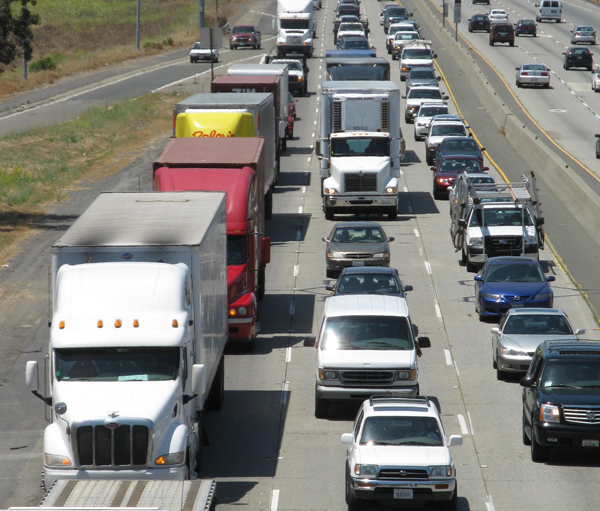
Here’s a news flash: California has an air pollution problem. According to the American Lung Association’s 2009 State of the Air Report, 38 of California’s 52 counties get failing grades for either high ozone or particle pollution days. (You can see your own county’s grades for ozone and air particle pollution at the State of the Air website.)
In fact, last month the federal EPA’s new director for San Francisco-based Region 9 made an astonishing claim on KQED’s Forum program. Jared Blumenfeld said that more Californians die from air pollution than from car wrecks. When a caller asked him to back up the claim, Blumenfeld provided the following statistics:
– Traffic-related fatalities: 3,949 deaths per year from 3,535 fatal collisions (average for 1999-2008)
– Deaths associated with PM2.5 exposure above 5 ug/m3 in California : 18,000 deaths per year
Cars are doing double duty in these statistics, since passenger vehicles are a large source of air pollution. Over the decades the state has addressed this fact with landmark efforts to regulate vehicle emissions, in efforts initially to improve local air quality and more recently, to reduce greenhouse gas emissions.
In a new study released this week by the Public Policy Institute of California (PPIC), researchers looked at two state priorities: reducing greenhouse gas emissions that cause global warming and improving air quality to benefit public health, and evaluated the effectiveness of four potential transportation strategies to address both.
What they found is something that policymakers have known all along: there are no easy answers. And everything involves a trade-off.
PPIC research fellow Louise Bedworth compared the cost, public health benefits, and GHG reduction potential for various alternative-fuel vehicles; battery-electrics, fuel cell, ethanol, and for reducing overall vehicle miles. What she found is that transforming California’s vehicle fleet to battery-electric vehicles provides the greatest public health benefit, but that high costs and technological uncertainty make this option far from ideal.
On the flip side, said Bedsworth, while we have the technology for vehicles to run on corn-based ethanol, research shows that when indirect land-use costs are considered, corn-based biofuels provide no significant public health or climate change benefit.
But while the PPIC looks at local health and global warming effects separately, a new study out of Stanford has found that the two are directly linked. It’s well established that carbon dioxide contributes to global warming and that increased temperatures can exacerbate air pollution, but the new study shows that CO2 “domes” that develop over urban areas are, in fact, causing health problems for city-dwellers. The study, conducted by civil and environmental engineering professor Mark Jacobsen, looked at models for the contiguous 48 states, for California and for the Los Angeles area. Results showed an increased death rate in all three areas compared to what the rate would be if no local carbon dioxide were being emitted.
Neither current regulations, nor the federal cap-and-trade bill passed by the House address the local effects of CO2 emissions on health. Jacobsen says that this study provides evidence that they should. He estimated an increase in premature mortality of 50-to-100 deaths per year from local CO2 emissions in California.
Jacobsen talks about his study in the video, below.

 Environmentalists have registered much consternation over the fact that out-of-state oil companies have been bankrolling a ballot measure to freeze implementation of AB 32, backbone of the state’s climate strategy.

 California has had a climate change mitigation law on the books for more than three years now–but getting that law’s regulations fully in place is proving to be a tough slog.
 By 2020, California will see two million new jobs whether the state implements its climate law AB 32 or not, according to a
 Here’s a news flash: California has an air pollution problem. According to the American Lung Association’s