
Tag Archives: International

Not With a Bang, But…

This is the way the world ends. Not with a bang but with a whimper. –T.S. Eliot

With the President headed for Mexico for a two-day summit, I was struck last week by the juxtaposition of two headlines that jumped out of a daily environmental news digest.

One headline read: “MEXICO AIMS TO BRING CO2 CUT PLAN TO CLIMATE TALKS.” The other, just above it, referring to similar efforts in this country, read: “CLIMATE BILL MAY FALL BY THE WAYSIDE.”

“With the fight over health care reform absorbing all the bandwidth on Capitol Hill,” Lisa Lerer wrote for Politico, “Democrats fear a major climate change bill may be left on the cutting-room floor this year.”

Granted, Mexico’s contribution to global greenhouse gas emissions is reportedly about 2%, or a tenth of the U.S. contribution, so one might argue that there’s a lesser job to do there. But with less than four months remaining before the next major U.N. climate conference, it raises the grim prospect that while other nations press on, the U.S. could arrive in Copenhagen empty-handed, which is to say without meaningful carbon legislation to show.

At the same time last week, the 16-nation Pacific Islands Forum called for a 50/50 commitment from developed nations; a 50% reduction in greenhouse gas emissions by 2050. Many of those island nations are on the hot seat as rising seas levels could make them among the first to lose substantial real estate before the end of this century.

At his first climate summit for governors last fall, Governor Arnold Schwarzenegger introduced a video from then President-elect Obama, in which he promised that his presidency would “mark a new chapter in America’s leadership on climate change.”

Praising the governors in attendance for their own climate initiatives, the newly elected President declared that “Too often Washington has failed to show the same kind of leadership. That will change when I take office.”

Of course “Washington” includes Congress, which is still dithering over the major carbon emissions bill championed by the new President. It squeaked through the House by nine votes and now looms as a 1,400-page pig that the Senate python will attempt to digest or regurgitate. Either way, what comes out is unlikely to closely resemble what went in.

Meanwhile the whole cap-and-trade concept has been coming under increasing scrutiny and skepticism. Last month, when the non-partisan Public Policy Institute of California polled Californians on the subject, more respondents favored an out-and-out carbon tax than cap-and-trade (56% to 49%). The Western Climate Initiative, a regional cap-and-trade pact that is a keystone of California’s climate strategy, AB 32, remains in limbo while western legislatures wait on Congress.

So when the Governor convenes his second climate summit in L.A. next month, billed optimistically as “The Road to Copenhagen,” he and his fellow “subnational leaders” (Wisconsin, Michigan & Connecticut governors are currently signed up) may find that the ball is still in their court. According to a news release from the Governor’s office, “climate leaders from around the world will come together and collaborate on efforts to further the global fight against climate change.”

They’ll do it with the same question on the table as last year: Can they count on Washington to take up the reins?


NOAA Confirms El Nino

Image from NASA
Warm water patterns in the Pacific during normal (upper) and El Nino (lower) years. The lower image is from 1995-96. Image from NASA

Scientists with the National Oceanic and Atmospheric Administration today confirmed what many had pretty much surmised: El Nino is back.

Officially the El Nino Southern Oscillation (ENSO), the cyclical pattern of ocean conditions has broad implications for weather and the Pacific food chain.

According to the NOAA news release:

“NOAA expects this El Niño to continue developing during the next several months, with further strengthening possible. The event is expected to last through winter 2009-10.”

NOAA’s Climate Prediction Center suggested about a month ago that conditions were right for the return of El Nino.

More recently, the high incidence of underweight sea lion pups turning up along the California coast was taken by some as a harbinger of ENSO. During El Nino cycles, normal upwelling of deep, cold water slows down, essentially shutting down the “food elevator” for many species.

Of course, there can be an upside. According to NOAA:

“El Niño’s impacts depend on a variety of factors, such as intensity and extent of ocean warming, and the time of year. Contrary to popular belief, not all effects are negative. On the positive side, El Niño can help to suppress Atlantic hurricane activity. In the United States, it typically brings beneficial winter precipitation to the arid Southwest, less wintry weather across the North, and a reduced risk of Florida wildfires.”

Links to climate change are less clear. Some scientists have suggested that warming air and sea temperatures might bring about more and longer El Nino events.

Global Call for Climate Change Stories

Want a trip to Copenhagen to cover this year’s UN climate talks, but not sure how to pay for it?

earthshine_nasa
Photo: NASA

Internews, an international media development organization, today launched The Earth Journalism Awards, a competition for the world’s best climate change reporting.  Applicants can register and submit stories on the EJA website until September 7, 2009, when 14 winners will be selected to be flown to Copenhagen in December to cover the UN talks for their home countries and local media outlets.

“The media has a hugely important role to play in helping to raise awareness about climate change, and environmental issues,” said James Fahn, the director of Internews’  Earth Journalism Network.

Winners will be selected for seven regions: Eurasia, South Asia, East Asia, Sub-Saharan Africa, Europe, and Australia. EJA will make awards for reporting in categories such as Human Voices, Energy, Forests, Nature and Climate Change. Then the non-profit will invite the public to vote online for the best story out of 14 finalists, which will be awarded the Global Public Award.

The competition is open to both professional “citizen” journalists from all over the world, and Fahn says there’s a special emphasis on engaging reporters from developing nations.

“The people and communities most vulnerable to climate change often have the least information about it.  It’s the marginalized, poor communities that have the most exposure to the impacts of climate change.  They can generally see that climate change is happening but they don’t always know why, or what’s in store for the future.  It’s important for us to fill this information gap,” said Fahn.

Fahn says more than 300 journalists from eleven countries have already entered. EJA will fly the winners to Denmark for the next major round of UN climate talks in December.

Climate Watch will feature EJA selected entries on this website.

The Battle Over Biomass

This week, the California Air Resources Board is expected to pass a controversial new standard that measures the carbon footprint of transportation fuels. Reporter Marjorie Sun filed a story for Climate Watch on the measure and why the ethanol industry is fighting it. She provides some additional insights here:

The proposed low carbon fuel standard is part of a broad effort by the California regulators to roll greenhouse gas emissions back to 1990 levels by 2020.

biofuel pumpSlashing carbon emissions from cars and trucks is a big part of the state’s game plan. That’s because transportation accounts for 40 percent of the state’s greenhouse gas emissions. A whopping 96 percent of the fuel sources that power our cars and trucks is petroleum-based. Right now, the bulk of ethanol sold in California–and the rest of the United States for that matter—is corn-based. (Brazil makes its ethanol fuel from sugar cane, which has a smaller carbon footprint.) U.S. producers argue that the proposed Low-Carbon Fuel Standard (LCFS) would make corn-based ethanol less competitive in the marketplace because of the way it calculates emissions. Pacific Ethanol was the biggest ethanol producer and marketer in California– until recently. With the drop in gasoline prices over the past year, demand for ethanol has plummeted. Over the past several months the company suspended operations at its two production plants in California and stopped construction of a third facility. In March, it filed for loan extensions with its creditors. So the new fuel standard could deliver yet another blow to the company. Hence, ethanol interests have been putting up a fight. But the Air Resources Board is counting on the proposed standard to spur innovation in the alternative fuels market, to reduce carbon emissions. The state says it’s hoping to “expand the size of the current renewable fuels market in California (already the largest in the nation) by three-to-five times. Instead of today’s corn, over half of the ethanol is likely to be made from extremely low-carbon, cellulosic feedstocks such as agricultural waste and switchgrass. There are numerous startups in California working on cellulosic ethanol. They’re experimenting with a wide range of plants, from switchgrass to algae, as potential sources of ethanol. Getting a new fuel to market, however, requires enormous capital costs. The state is projecting that by 2020, Californians will have bought more than 7 million alternative-fuel and hybrid vehicles. That’s about 20 times greater than today. But in these tight economic times, folks are hanging onto their old cars. So it’s not clear how fast Priuses and plug-ins will replace the carbon-spewing cars on the road today.

Sun’s radio story aired Wednesday on The California Report.

China: Have a Carb and a Smile

carb_stockWhat does coal power have to do with popping a can of soda? This morning, NPR’s Anthony Kuhn reported on a power plant in China that is successfully capturing some of the carbon dioxide it releases. They extract it, liquefy it, and send it off to companies that use it in dry ice, fire extinguishers, and even carbonated beverages. A handful of power plants in U.S. are already doing the same.
Of course, when it comes to reducing carbon emissions, capture is only half the battle. The carbon snared from these plants is only temporarily stored – it gets released eventually–like when someone pops the top of the soda can.  It’s more like carbon recycling. The greater hurdle is in “sequestering” part of it.  In order to make a lasting difference in cutting emissions, that carbon has to be stored permanently.

President Obama has signaled that developing carbon sequestration technology is a key part of his energy plan, and is handing out billions in stimulus dollars.  But the U.S. is already behind the curve.  While there are several ways to store carbon, the main focus has been on storing carbon underground in geologic formations. There are several power plants in Europe that are already capturing and sequestering carbon emissions underground.  The Bush Administration backed off its first attempt at carbon capture and sequestration (CCS), the FutureGen project, in 2008 after the costs became too high. The name of game now is to simply get a demonstration plant working. Anywhere.

Here in California, CCS is an option, thanks to the underground geologic formations throughout the Central Valley that could be ideal sites. A western consortium known as WESTCARB is leading the charge with backing from the California Energy Commission and the Department of Energy.  They’ve announced a pilot project in Bakersfield where carbon will be captured from a 50-megawatt power plant. But construction is described as still “months away.”

As with any new technology, cost is the make-or-break issue.  Capturing and stashing carbon is prohibitively expensive–at least until there’s a price on carbon or the technology improves. This week, Energy Secretary Steven Chu said he doesn’t expect to see cost-effective technology for at least eight years. And he raised another point. “Even if the United States or Europe turns its back on coal, India and China will not,” Chu said.  At last fall’s climate summit in Los Angeles, members of the Chinese delegation told Climate Watch that they were looking to the U.S. to provide key technology. But as Anthony Kuhn reported, the Chinese went to Australia to get technical advice.

It’s commonly forecast that coal will remain a central power source in the U.S. for decades to come. But as critics of carbon sequestration have stated, it’s really a question of whether cost-effective technology will arrive in time to slow down climate change.

Lauren Sommer is an associate producer with Quest at KQED, and a self-described “carbon geek.” Her story on plans for a “smart” electrical grid is Monday’s Quest Radio feature.

California’s Climate Partners Get Cold Feet

On Wednesday’s edition of The California Report, correspondent Tom Banse takes the pulse of a vital organ in California’s climate strategy; the regional carbon trading market. The upshot: Reports of its well-being may be greatly exaggerated.

Are they with us?  It’s hard to tell looking at some of California’s supposed partners in the Western Climate Initiative.

WCI includes six states besides California and four Canadian provinces.  Last year the group agreed on a regional “cap-and-trade” plan to reduce greenhouse gas emissions (and not coincidentally to show the federal government how it’s done).  Governors and environmental agencies in the participating states continue to voice support for moving ahead with a regional initiative.  The rub is that the executive branch cannot just snap its fingers and will the plan into being.  A major policy change like this requires state legislatures to adopt the cap-and-trade rules.  And some of those lawmakers definitely have other ideas.

Utah offers the most dramatic example.  Before adjourning for the year, the state House of Representatives voted 52-19 in favor of a non-binding resolution directed at Utah Governor Jon Huntsman:

    “…WHEREAS, experts, including the Congressional Budget Office, warn against cap and trade policies, especially regional programs like the seven-member WCI;WHEREAS, experts also point out that the costs of such programming will be borne by consumers, placing a disproportionately high burden on poorer households; andWHEREAS, no state or nation has enhanced economic opportunities for its citizens or increased real GDP through cap and trade or other carbon reduction policies:NOW, THEREFORE, BE IT RESOLVED that the House of Representatives urges the Governor to withdraw Utah from the Western Climate Initiative.”

Huntsman, a Republican, is apparently ignoring the legislative shot across his bow.

Skepticism is also alive and well in the Arizona Legislature, where this preemptive strike skips the whereases and gets right to the job of handcuffing the executive branch.

    “The [Arizona Department of Environmental Quality] shall not participate in the Western climate initiative that is organized and operated by an affiliation of state governors and one or more provinces of Canada.”

The succinct bill has passed out of state House committee and awaits a floor vote.

Meanwhile in New Mexico, the legislature is done for the year.  Legislation to authorize a greenhouse gas emissions cap was not even broached.  Montana’s legislature is still in session, but all lawmakers in Helena have the stomach to tackle is preparatory measures.  They would set up the regulatory framework for underground carbon storage (aka, sequestration) and require large companies to track and report their carbon emissions.

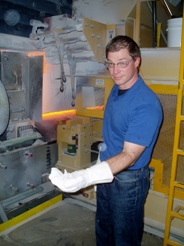
At his glassmaking plant in southwestern Washington, Steve Smith worries that a regional cap on carbon emissions will render his business unable to compete with suppliers outside the region. Photo by Tom Banse.
At his glass making plant in southwestern Washington, Steve Smith worries that a regional cap on carbon emissions will render his business unable to compete with suppliers outside the region. Photo by Tom Banse.

The governors of Oregon and Washington State served up the full climate enchilada to their legislatures this January only to see it picked apart.

That leaves California as the sole state in the Western Climate Initiative that has so far adopted cap-and-trade as the law of the land.  California’s partners have consistently told us that a national program is the preferable way to regulate greenhouse gases.  Now the “preferable” way is starting to look like the only way.

A Billion People in the Dark?

Where will you be when the hour arrives? Wherever it is, you might want to take a flashlight–LED, of course. In it’s third year, the organizers of Earth Hour are shooting for one billion people to turn out the lights in this global demonstration in support of decarbonization.

It’s being promoted as a kind of switchplate referendum. Begun in Sydney, Australia, in 2007, it’s a simple concept, which may be part of its appeal: Wherever you are, at 8:30 local time tomorrow (Saturday) evening, turn off the lights for one hour.

Last year organizers estimated that 50 million people complied. California icons like the Golden Gate Bridge went dark. This year, about two dozen California cities and counties have signed up to participate, as well as the State of California.

They’re not telling you to turn off your computer or iPhone, however. Electrons we save at the light switch might be made up for on the Internet, which will likely be abuzz with a worldwide conversation documenting the event on blogs and social networks like Twitter (tag your updates with #earthour and #location). Photo sites will be bombarded with picture uploads.

Personally, I’ll be in the high desert of New Mexico, beyond the sight of any town or even neighbors, so the event won’t make for much of a snaphot.

It might also be a bit anticlimactic for the folks who run California’s power grid. I asked Gregg Fishman at the California ISO (Independent System Operator) if they’d be able to see a dip in the load at 8:30 p.m. tomorrow. He’s not counting on it: “It will probably have some impact but it’s really hard to measure,” he told me.

This time of year, the state is usually pulling about 27-28,000 megawatts at that hour on a Saturday evening. In fact, if you look at the ISO’s grid status graph, you can see a little spike around 8 p.m., as people normally start turning lights on. But Fishman says that even though “most of the load is lighting” at that hour, it may be hard, even for grid technicians, to measure the actual effect of Earth Hour.

But of course, that’s kind of beside the point. The event isn’t designed to achieve palpable energy savings for one hour. It’s supposed to be a visual show of support for policies designed to reduce energy consumption and the global carbon footprint. Recent surveys have shown that economic woes have pushed concerns about global warming and the environment to their predictable recessionary lows, at least in this country. Tomorrow night we’ll find out how the rest of the world feels about it.

Letter from Paris: Confessions of a Generalist

eb_blog21Eleanor Beardsley, whose  South Carolina drawl is often heard emanating from Paris on NPR, agreed to take on her first climate policy symposium for us. She’s covered presidential elections, civil riots and the Tour de France. But climate policy wonks–whoa. Now that’s scary. From her notebook:

When I walked into the rather run-down conference room at Paris’ Universite Dauphine at the edge of the city, about 20 people were sitting around a huge circular table discussing climate issues. I have to say that I almost gave up the idea of doing a report at first, because I couldn’t get my head around what they were talking about. They were discussing the minute points of such things as paying for carbon emission reduction schemes, and the fairness of the CMD, or clean development mechanism! It seemed like a lot of blah, blah techno-speak. I jotted down several beyond-me phrases in my notebook, like “sectoral baselines without additionality.”

But I decided to stick it out. I had schlepped out there early in the morning, making two changes on the Paris metro. I might as well stay a while. That’s often the hardest part about being a reporter. You’re not really an expert at anything, and sometimes you have to find a way to quickly understand a complex story. But you just have to keep focused on what you think your general audience would want to hear about. They always tell you, “pretend as if you’re explaining it to your grandmother.”

In the end, all of the officials — both French and Californian — were more than happy to explain the main issues to me and what the stakes were.

I got the feeling these climate experts from the US and Europe have been working together and learning from each other for years, despite America’s seeming non-interest in the topic under the second Bush administration. Everyone seemed to know each other and be familiar with each other’s work. Someone described the advances that had been made over the years as “leap-frog progress.”

Now here was a concept I could grasp. You can see an example with the cap-and-trade policy on emissions the Obama administration wants to put in place. Apparently they are studying the already-existent European scheme to limit carbon emissions. But that European system, in turn, is based on the US’s successful reduction of sulfur dioxide, or acid rain, in the 1990s.

So even though everyone said global warming was already well under way, I came away from the conference with a comforting sense that at least there are some very smart people working passionately on the issue. I think they will find a way for the world to work together on this, rich and poor nations alike. There was also a lot of talk about fairness; making sure the richer, industrialized nations helped the developing countries get their act together.

They might even achieve those sectoral baselines without additionality…whatever that is.

Leveraging Disaster: Australia’s Fires and Climate Policy

Environmentalists in Australia are seizing on the recent catastrophic fires there to press for more aggressive action on climate change.

Reuters news service reports that the drought-driven fires, which killed at least 130 people in the nation’s Victoria province, have become a fulcrum in arguments to intensify Australia’s relatively modest targets for reducing greenhouse gas emissions.

Here in California, we can only hope that the Australia fires aren’t a preview of the summer ahead. Last year’s fire season set records, with more than 2,000 fires burning at one point. This year, conditions will likely be even drier.