
Tag Archives: International

Japan’s Zero Emissions Fever

Sekisui House’s Green First Home-It looks like a normal house, but take a closer look at those roof tiles…yup. PV.

Since arriving in Japan almost a month ago, I’ve visited a “zero-emissions house,” a house that claims to be zero emissions but really isn’t (more on that later), and an “EcoHouse.” It’s fair to say the housing industry in Japan is going ga-ga over reducing carbon emissions. The obsession began a little over a year ago, when Japan’s largest companies (collectively known as “keiretsu“) came together to build the zero-emissions house.

The home, which purportedly produces zero or negative emissions over the course of its lifetime, was built especially for the 2008 G8 Summit in Toyako, on Japan’s northern island of Hokkaido (you can see my video tour of the home at KQED’s YouTube site). Originally nestled on a hillside overlooking a lovely lake during the G8 summit, the home has moved to more modest surroundings: It now sits in a drab parking lot outside Sekisui House‘s noisy prefabricated homes factory in Koga, 40 miles north of Tokyo. The home’s greenhouse gas-reducing technology includes:

– A 14-kilowatt solar array on the roof

– A hydrogen fuel cell which generates energy by taking hydrogen from natural gas and using the byproduct, heat, for the home’s hot water supply and space heating during the winter

– A window with photovoltaic (PV) film inside of it

– A ‘waterless’ washer/dryer, and of course, every energy-efficient appliance you can think of.

Kimikazu Kondo, spokesman for Sekisui House, tells me that nobody’s offered to buy the home yet. Until they do, it’ll be sitting in that parking lot, looking a little lonely.

The interior of the Green First Home. If this is prefab, sign me up.

Kondo also showed me Sekisui’s Green First home, the company’s newest prefab. Sekisui estimates that the average Japanese household spends around the equivalent of  $3,000 on energy per year. Kondo told me that if you buy the Green First home, you’ll spend around five hundred. The home’s roof tiles are made of PV thin film. The house has a hydrogen fuel cell, LED lights, etc. When I first toured the home, Kondo told me it was a zero-emissions home, too. But when I asked specific, pointed questions at how they arrived at that determination, he backed down and told me that over the life of the house, it would reduce 70% of greenhouse gas emissions over an average home in Japan. Not a true zero emitter, but not bad.

But I started to wonder how Sekisui House was marketing this home to Japanese buyers. Were they touting it as a “zero-emissions” house, despite the fact that it isn’t? Hmm. Sekisui’s Kondo did take me on a very interesting tour of his prefabricated home factory. I shot a short video there of a machine that punches holes through steel beams.
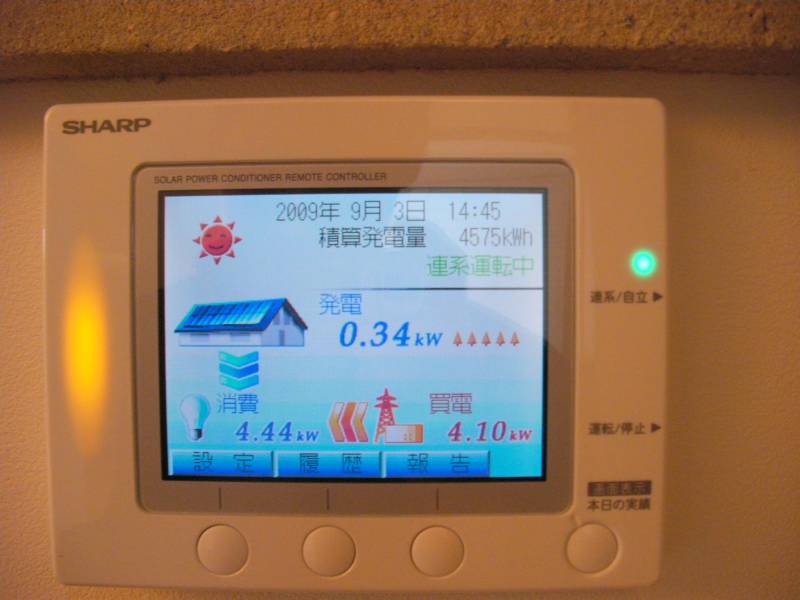
A control panel inside the Green First home which gives the homeowner information on how much electricity is being generated from the solar panels on the roof. On this day, it was only 340 watts. It was cloudy.

Each prefabricated home that Sekisui builds has more than a hundred thousand parts built for it in a factory. They’re actually more durable than your average site-built Japanese home. Prefab homes make up about 15% of the housing stock in Japan. Kondo told me Sekisui has no plans to bring its homes to the American market, but it is now starting to sell them in Australia.

Notebook Lost, Work Ethic Found

Rob Schmitz continues his dispatches from Japan, where he’s reporting on that country’s aggressive approach to energy efficiency–and what lessons we might take from them. Rob returns to KQED’s Los Angeles Bureau in October–with his notebook.

Today I left my notebook on the train to Ota. In it were notes of all the interviews I had conducted since arriving in Japan. Throughout my day of reporting, I repeatedly asked to borrow my interpreter’s notebook, and by the end of the day, I was depressed with the thought of having to listen to hours of tape that I had meticulously transcribed over weeks of interviews. When we returned to the station, my interpreter, Chiaki, took me to the station master’s office. That’s where I met Mr. Aiba.

My Travelling Notebook

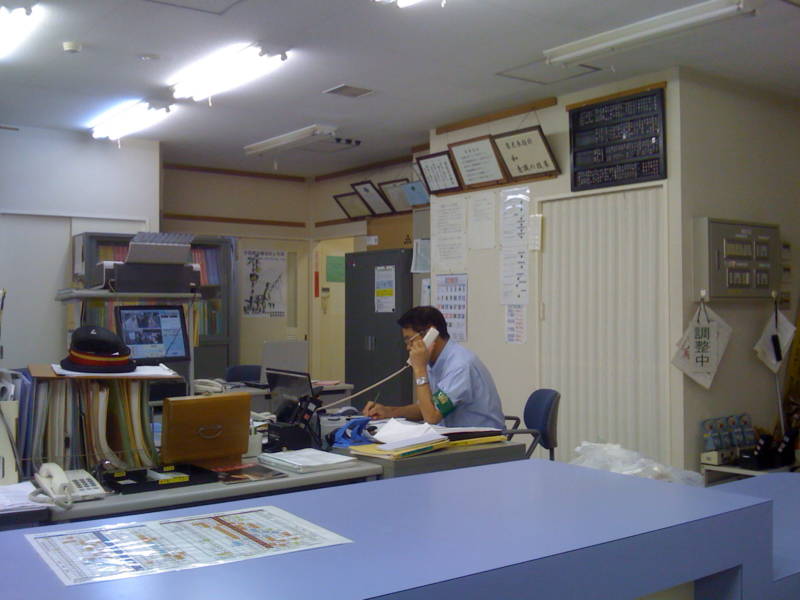
Aiba-san was in his 50s, tall, thin, graying hair, glasses, and, like most Japanese in his position, incredibly polite. He wore a blue uniform and a green band around his arm with ‘security’ written on it in Kanji. Aiba-san listened intently to Chiaki’s every word describing the notebook, where I left it, and how important it was to me. He asked follow-up questions: “What are the approximate dimensions of the notebook? Is your name on the notebook?” and so on. As Chiaki answered, he took notes.

When he was finished, he offered us a seat, briskly walked to his desk, and picked up the phone. He called other stations, he called cleaning companies, and he consulted timetables. In between calls, he updated us: “The train you were on has made three round trips from Tokyo to Akagi today. Cleaning crews in many cities have cleaned the train several times.” Aiba-san briefly left the room while he waited to hear from the cleaning crews. He returned with some tea for us. A minute later, he received a call from the cleaning crew in Akagi, a city in the mountains at the end of the line: they found my notebook. Nobody had claimed it, so it had been tossed into a recycling bin. It was waiting for me on the platform there.

Aiba-san, getting the job done.

“But you’ll have to hurry,” said Aiba-san, looking at his watch. “The train to Akagi leaves in less than one minute.” He escorted us, running frantically in the lead, to the platform. We barely made the train. I had a few seconds to reach into my bag to give him a box of See’s chocolates that I had brought as a gift for my interviewees. He sternly declined the gift, but I insisted.

When we arrived to the tiny Akagi station, two elderly custodians with brooms in their hands were waiting for us on the platform. They bowed in unison to me and handed me my notebook. They had neatly wrapped it in a copy of the train’s timetable. This is just one of many examples of the generosity and commitment to service that I’ve experienced in my short time in Japan. Had I lost my notebook on a train or a bus back home, would anyone care? They probably would’ve laughed me out of the station at the thought of tracking it down.

Now, take this behavior to a macro level and you start to see why Japan, an island nation with no fossil fuels and few resources of any kind, has become the second largest economy in the world. When Japan puts its collective mind to something, it not only gets the job done, but it oftentimes excels at it. From my conversations with government officials, business leaders, and those in the non-profit sector here, it’s obvious that Japan is not only committed to reducing greenhouse gases, but perhaps more importantly, it wants to make a lot of money from doing so.

In short, it wants to ensure that its companies own and make as much of the technology that goes towards this global effort as is possible, and it’s got a head start. Japan leads the world by a long shot in registered patents in the green technology sector, according to a report from CERNA, the Centre d’Economie Industrielle. Check out the final pages of that report, which compare countries, and you’ll see Japan leads in every patent category except one. Japan is getting the job done, just like Aiba-san stepped up to do his job when I sought his help. It’s a spirit that’s refreshing to be around. We could use a few more Aiba-sans back home.

Copenhagen Sans Congress

KQED’s Los Angeles Bureau Chief and frequent Climate Watch contributor Rob Schmitz is spending six weeks in Japan, as part of  the Abe Fellowship Program. He’s filing a series of blog posts and radio reports on Japan’s extraordinary strides in energy efficiency–and what we might learn from them.

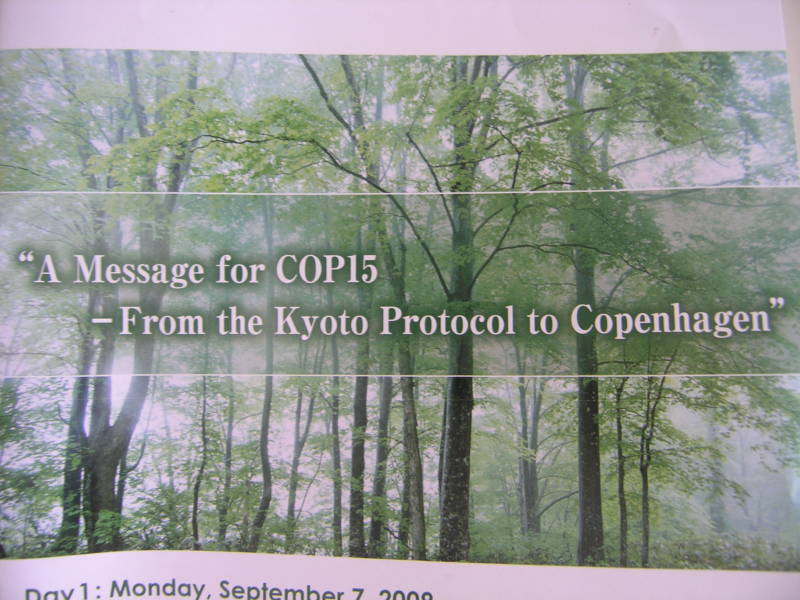
…And a message for the US from Yvo de Boer–An official program from last week’s Asahi World Environment Forum in Tokyo.

With the United Nations Climate Change Conference in Copenhagen two and a half months away, it’s becoming increasingly likely that lawmakers on Capitol Hill will not pass legislation on greenhouse gas reductions in time. A commonly accepted premise seems to be that without domestic climate legislation enacted at home, the U.S. won’t be able to sign a global deal on climate change in Copenhagen, either.

Not true, said UN Climate chief Yvo de Boer last week at the Asahi World Environment Forum here in Tokyo. de Boer told a packed house that in recent conversations he’s had with Senator John Kerry (chairman of the Senate Foreign Relations Committee) and senior advisors to President Obama, it was clear to him that the United States doesn’t need Congress to act in order to sign a deal in Copenhagen. (Listen to an audio clip of his remarks using the player below.)

[audio:http://kqed03.streamguys.us/anon.kqed/climatewatch/YvodeBoer.mp3]

This isn’t the first time de Boer has said this, nor is it the first time this notion has been floated. Last year, Marc Ambiner, political editor for The Atlantic, wrote in his blog about how the administration could bypass Congress for comprehensive energy reform by using the Clean Air Act as a platform. It seems that some of Obama’s environmental advisors believe that the act not only gives the Environmental Protection Agency the power to regulate greenhouse gases but also to institute a cap-and-trade regime on its own. Going around Congress for such an important policy shift would no doubt be a controversial step, but if such powerful and influential figures are hinting at it to de Boer, maybe we’ll see a little Copenhagen surprise on the part of the American delegation.

Scotland Rising to Carbon Challenge

This dispatch came in from Alison van Diggelen after a recent visit to her home country. Van Diggelen is a freelance writer and interviewer and founder of the Fresh Dialogues website and podcast. Originally from Glasgow, she now makes her home in Silicon Valley.

Scotland Aims to Beat California on Climate Change Action

By Alison van Diggelen

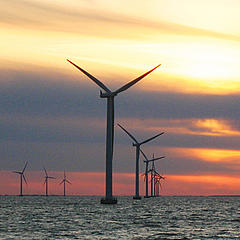
Wind turbines off Scottish coast. Photo: World Wildlife Fund

It’s not often that Scotland is ahead of the game compared to California, but on the issue of climate change, this small northern country has taken a legislative lead that has put it on the green map of the world.

As the California Legislature this week grapples with new laws* requiring utilities to get 33% of their energy from renewable sources by 2020, Scotland is sitting pretty. It is already close to its 31% target of energy from renewables by 2011 and has an even bolder target of 50% by 2020.

On a trip to Scotland this summer, I met with Lena Wilson, CEO of Scottish Enterprise, a government-funded organization that promotes Scottish interests both at home and abroad. She told me that the fight against global warming is a crucial part of the government’s strategy because ultimately a low carbon future is an economic stimulus and job creator for the country.

But how did Scotland muster the political will to set such ambitious targets? Scotland’s First Minister, Alex Salmond is passionate about renewable energy, Wilson told me; and establishing Scotland as a hub of green energy and green-tech is key to his strategy. Part of the plan is to harness its natural resources – powerful wind and wave power, estimated to account for a quarter of Europe’s potential. Salmond recently opened the largest wind farm in Europe to drive home that point. It’s on the outskirts of my home town of Glasgow and makes me rather proud.

Yet, making bold targets isn’t the end of the story. Scotland must create a whole ecosystem to make green growth attractive in Scotland. It launched the Saltire Prize last year to stimulate innovation in wave and tidal power; but still has ground to cover. As well as the financial, administrative and logistical challenges, there’s the issue of NIMBY-ism. Although Wilson insisted they’re pursing a popular green agenda, some of the locals I talked to in Scotland were less enthusiastic about the aesthetics of wind turbines.
And then there’s the “nuclear option.” Just as in California, the issue is red hot. Salmond is publically against it, but if he wants to keep shining his low carbon credentials, he may be forced to rethink his position.

One final note: When I asked Wilson, is your boss, Alex Salmond the Al Gore of Scotland? Her response was enlightening. She almost choked. Being a staunch nationalist, union man and former socialist, she doubted he’d enjoy the comparison. On my next trip, I hope to discuss this with the man himself and find out exactly how his passion for green took root. Stay tuned.

*State legislators passed two bills during their overnight session on Friday. Here’s a summary provided by the advocacy group Environment California:

AB 64 (Krekorian) & SB 14 (Simitian): AB 64 and SB 14 are companion bills that together set California on the path toward producing 33% of its electricity from renewable resources like solar and wind power. While there was much controversy over amendments to the bill that add in language for PG&E to potentially build large hydroelectric dams in British Columbia and call it renewable energy as well as amendments pushed by British Petroleum and Chevron that put 7,000 MW of fossil fuel burning combined heat and power plants ahead of renewable energy, the two bills still stand to become the biggest renewable energy mandate in the country”

Japan’s Climate Plan: Too Ambitious?

KQED’s Los Angeles Bureau Chief and frequent Climate Watch contributor Rob Schmitz is spending six weeks in Japan, as part of  the Abe Fellowship for Journalists. In the weeks to come he’ll file a series of special reports on Japan’s extraordinary strides in energy efficiency–and what we might learn from them.

Saturday night, on my way home from an interview, I witnessed one of the more interesting orchestrated movements of humanity the world has to offer. I shot this video when I was changing trains at Shibuya station, one of Tokyo’s busiest. The intersection shows how well Japan engineers pedestrian movement–but how well will it engineer its residents’ greenhouse gas emissions?

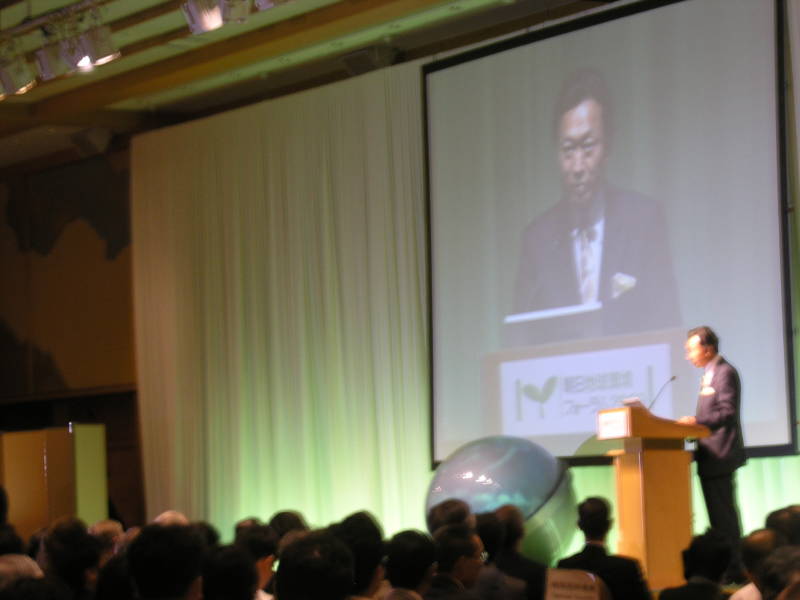
On Monday, I attended the Asahi World Environment Forum, where all the bigwigs on climate change were in attendance (including Yvo de Boer and Rajendra Pachauri, among others). The surprise visitor was Japan’s Prime Minister-elect Yukio Hatoyama.

Hatoyama makes his climate change pledge.

He told a packed house that Japan will aim to reduce its greenhouse gases by 25% from 1990 levels by 2020.

“In my personal opinion, that’s impossible,” Hidetoshi Nakagami told me last week. Nakagami is President of the Jyukankyo Research Institute and holds a coveted seat on the advisory committee to Japan’s powerful Ministry of Economy, Trade, and Industry, or METI. “Hatoyama’s pledge is pure politics,” he said. “It’s not practical, it’s not possible, and there’s not enough time.”

Nakagami is not a pessimist. He played a large role in creating Japan’s very successful Top Runner program, a 1997 policy that searches for the most efficient model of any given electrical appliance and then makes that model the industry standard, requiring other companies to adhere to it when making new models of the same appliance. The program was one of Japan’s most ambitious energy efficiency measures, and Nakagami had to fight against Japan’s largest companies in order to help craft the policy into law.

While Nakagami would like to see a one-quarter reduction in greenhouse gases from 1990 levels in the next decade, he says it’ll cost the average Japanese dearly. When former Prime Minister Taro Aso pledged to cut Japan’s greenhouse gases by 15% of 2005 levels, Nakagami’s institute estimated that the effort would cost each Japanese household, on average, 70,000 yen–a little over USD $700–a year. Even that, says Nakagami, would be a tall order in this economy.

In the end, Hatoyama may not fill this order. His historic pledge, which during his campaign, seemed to have no strings attached to it, now has an important caveat. At Monday’s forum, he told the audience that Japan will embark on this journey as long as other major countries also set similar ambitious targets.

Japan’s future hanging in the balance.

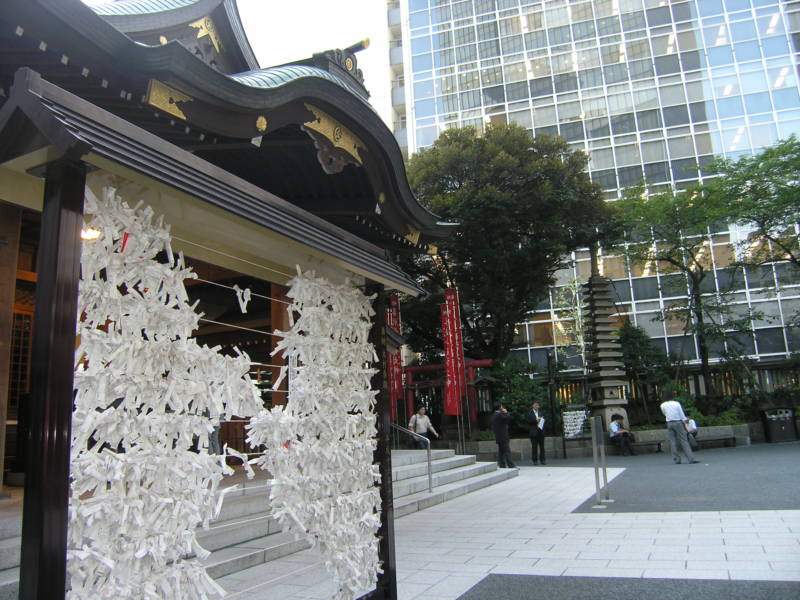
After the forum concluded, I walked outside into Tokyo’s rush hour: pedestrians everywhere, taxis speeding by me. I stopped at a Shinto shrine built among enormous glass skyscrapers. In front stood an Omikuji shrine, where believers tie a paper copy of their fortune, with hopes that it’ll come true. Hundreds of paper fortunes rattled in the hot, summer wind. I wondered if one of them was Hatoyama’s.

Trash Day in Tokyo: The Learning Curve

KQED’s Los Angeles Bureau Chief and frequent Climate Watch contributor Rob Schmitz is spending six weeks in Japan, as part of  the Abe Fellowship for Journalists. In the weeks to come he’ll file a series of special reports on Japan’s extraordinary strides in energy efficiency–and what we might learn from them.

Today was combustible garbage day in my neighborhood. On Tuesdays and Fridays, residents place all their garbage deemed ‘burnable’ out on the curb. At promptly 8 a.m., it is taken away and, presumably, burned.

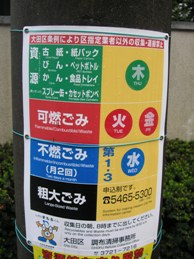
Burn after reading? Recycling instructions in Japan.
Burn after reading? Trash day instructions in Japan.

I had a lot of questions about what was considered combustible and the sign on the light post advertising the pick-up days wasn’t very helpful. My wife and I brought our 11-month-old son here. Were diapers considered ‘burnable’? I knocked on the Webers’ door to ask. Terry and Sherry Weber live next door. They’ve been working as teachers in Tokyo for 27 years. They told me that up until recently, plastic products were not considered burnable items, but all of that changed this year, and now it’s apparently fine to deposit plastic items like diapers on the curb on combustible garbage day. Either way, they told me, if the sanitation officials see that I’ve tried to sneak in some non-combustibles on the incorrect day, they’d leave it on the curb with a note, scolding me for screwing it all up.

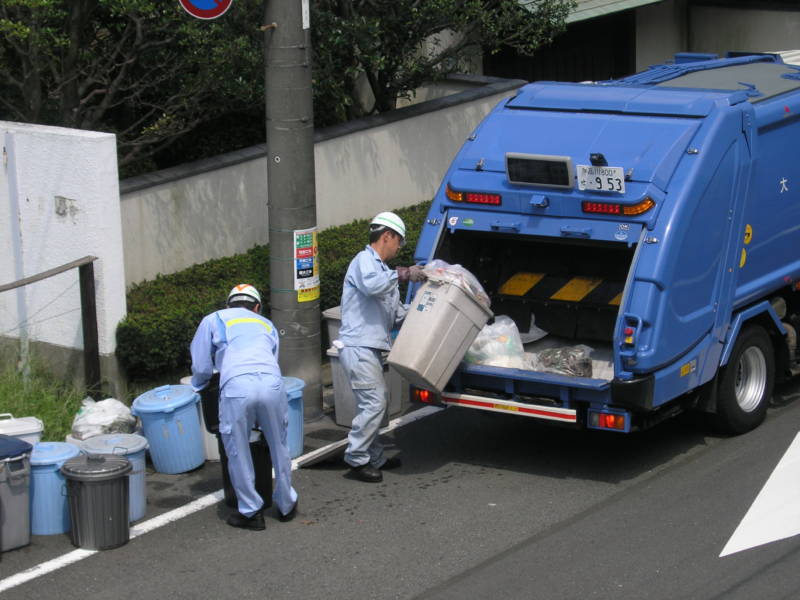
I put a bag of diapers and another bag of what I thought were burnable items on the curb, nervous that I’d be the laughing stock of my new neighborhood. An hour later, the garbage truck arrived, two men got out, inspected my garbage, and dumped all of it into the back of their truck.

The dreaded Tokyo city sanitation department gives me a passing grade on my burnable/non-burnable garbage sorting skills.

Whew. Now I’ve got to prepare for Thursday, which is recyclables day. I’m supposed to separate all of my recyclables into paper, cardboard, plastic, and cans, and bundle each of them with string. Wish me luck.

Elsewhere on the waste disposal front:

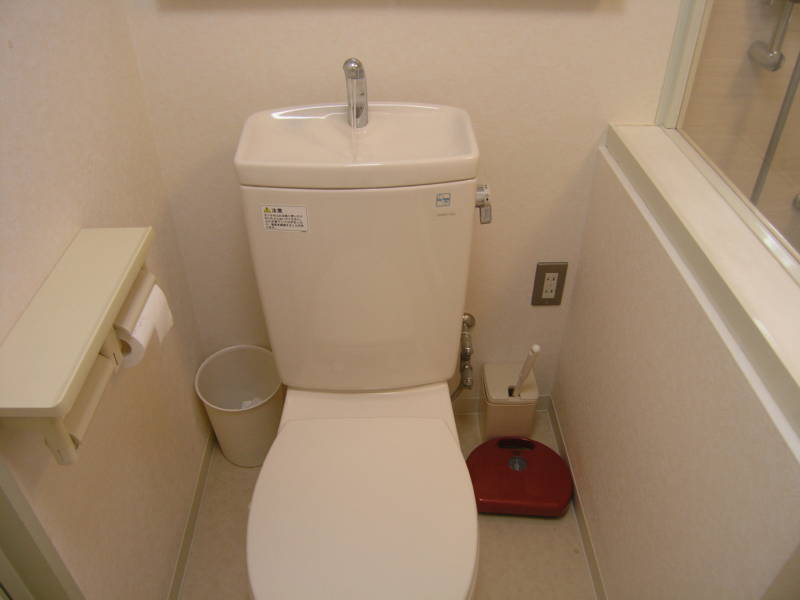
I usually don’t get excited about toilets. But the toilet in my apartment here in Tokyo has inspired me to great heights.

It doesn’t look exciting. But look more closely…

The toilet gives the user two types of flushes: the ‘big’ flush, or the ‘small’ flush, so that you can control how much water you’ll need, thereby conserving this precious resource.

Parched water districts of California: Please start importing these for your customers!

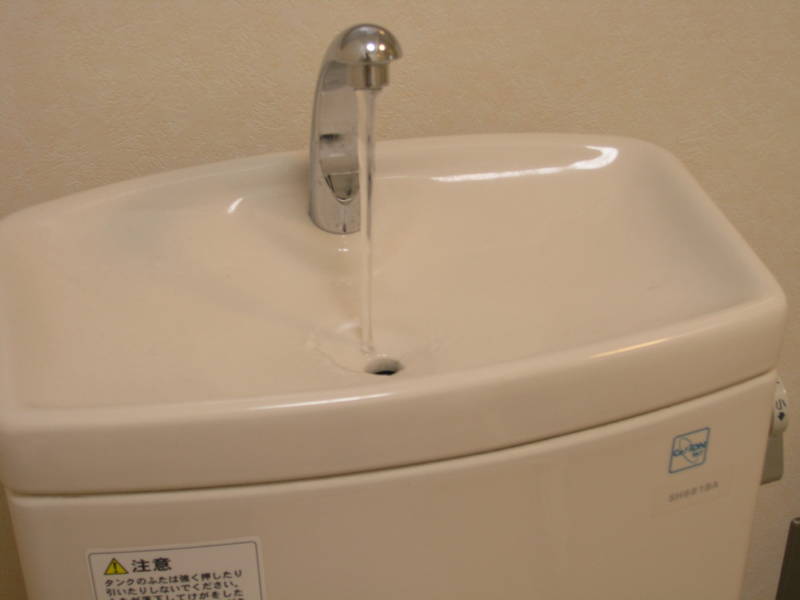
But that’s not what got me excited. What I was really impressed by was when you flush the toilet, water is pumped into the tank at the back of the toilet via a faucet. It runs into a basin on top of the tank where you can wash your hands with the water before it enters the toilet for the next flush. Genius. Pure genius. Why don’t we see more of these in California, where water is an even more precious resource than it is here?

Editor’s Note: Dual-flush toilets are now available in California. But the piggy-back sink–that’s a new one for me. –CM

Mister Hatoyama’s Neighborhood

KQED’s Los Angeles Bureau Chief and frequent Climate Watch contributor Rob Schmitz is spending six weeks in Japan, as part of  the Abe Fellowship for Journalists. In the weeks to come he’ll file a series of special reports on Japan’s extraordinary strides in energy efficiency–and what we might learn from them.

Yesterday Japan held a national election. My neighbor won it. Well, technically, his party won it, but it’s assumed that my neighbor, who heads the Democratic Party of Japan, will become Prime Minister within a couple of weeks when the party formally elects him.

A peek outside my door yesterday revealed media vans and limos outside the house of my new neighbor and Japan’s new prime minister-elect, Yukio Hatoyama.

My neighbor is Yukio Hatoyama. He lives in a large house across the street from the apartment I’m renting here in the tony Tokyo suburb of Denenchofu. Yesterday morning an elderly police officer knocked on my door clutching a map, explaining to me in slow, metered Japanese that his men would be establishing a perimeter around our neighborhood to keep out protesters, non-credentialed journalists, and anyone interested in engaging in general tomfoolery near the Hatoyama residence (an English-speaking neighbor helped translate). I mustered the only Japanese response I knew (“Arigato!”), not having sufficient language skills to explain that I, in fact, was one of those “non-credentialed journalists.” He smiled, bowed, and moved on to the next residence.

As early results on the afternoon television news began to confirm that Hatoyama’s party was on the path to victory, my neighborhood, which was virtually silent for my first few days here, started buzzing with activity. Police officers on foot patrol, random passers-by who somehow got past the perimeter stopping in front of Hatoyama’s house to stand and stare before being ushered away, and members of the “credentialed” Japanese press sitting on the curb in the rain, quietly watched over by the around-the-clock security presence in front of Hatoyama’s home. My wife and I are thinking of baking our neighbor a cake as a congratulations gift–if we could just get by security.

Apart from the amazing coincidence that the apartment I rented happened to be located across the street from the incoming prime minister, my new neighbor has a lot of work ahead of him. Japan is suffering its worst unemployment ever, and many here are fed up with the Liberal Democratic Party, which, despite its name, is the conservative party that has ruled Japan for 50 years.

View of Hatoyama’s house from my living room. “May I borrow some sugar, Hatoyama-san? …and perhaps an interview?”

Hatoyama has promised the Japanese more social welfare programs and fewer incentives to big Japanese business but some experts wonder if it’s a good idea to tinker with a system that’s helped Japan become one of the world’s biggest success stories.

Hatoyama has a strong California connection: His doctorate in engineering is from Stanford University, where he met his wife. He speaks English well–well enough to have written a provocative Op-Ed in the New York Times this past weekend; a timely critique of U.S.-led globalism and unbridled capitalism, and a call for Japan to retreat from this system, to a more regional and sustainable economic framework.

More to the purpose of my reporting here, Hatoyama has pledged to make Japan a more prominent world leader in battling climate change. He’s pledged to cut the country’s greenhouse gas emissions by 25% from 1990 levels by 2020, and has promised to generate more jobs for Japanese workers by helping develop the clean-tech industry here.

He also heavily favors on a bigger reliance on nuclear power for Japan; a stance that is not as controversial as you may think in this country. In recent polls, the majority of Japanese respondents say they’re open to a larger reliance on nuclear power. In a country that imports all of its fossil fuels, nuclear power means more energy security and fewer greenhouse gas emissions. On the other hand, it heightens the thorny debate of what to do with radioactive waste–a debate that, despite poll numbers, is of big concern to many Japanese. With all these issues to tackle, it’s likely that my neighbor won’t be spending too much time at home in the coming weeks. Maybe I should offer to house-sit.

Stanford Studies Clean Coal Tech for China

coal_blogChina, the world’s largest emitter of CO2, is the focus of a new $2 million investment in clean coal technology research by  Stanford’s Global Climate and Energy Project (GCEP).

The project will fund research into large-scale carbon sequestration in underground geological formations. China relies heavily on coal for electricity generation and in 2006 was reported to be building the equivalent of one new coal-fired power plant every week.

“China is growing so rapidly, and if they’re going to be able to lower their emissions, they are going to need a whole suite of technologies,” said Sally Benson, director of GCEP.  “They are doing a lot with solar technologies and energy efficiency but China is not abandoning coal.  So, we’re looking for ways they can reduce their emissions from coal.”

The three-year project is an international collaboration among the University of Southern California (USC), Peking University (PKU) and China University of Geosciences at Wuhan (CUG). It will focus on the technical aspects of stashing carbon in saline aquifers, such as chemical reactions between the rock and carbon and understanding what portions of the aquifers can actually be filled up.  The research will involve 39 scientists and students, and will integrate geological modeling, reservoir simulation and laboratory experiments.   The results may shed needed light on China’s overall carbon storage potential.

“Saline aquifers have been shown to have the biggest storage capacity across the world,” said Benson, “and China has a tremendous need.”

China’s not the only country with a tremendous need.  As the second largest emitter of CO2 (and still bigger than China per capita), the United States has yet to deploy large-scale CCS. Yesterday, the U.S. Department of Energy announced $27.6 million in new funding for 19 projects exploring potential carbon storage technologies.

A Climate Reporter’s Candy Store

I’m spending the week in Boulder, CO, attending a series of lectures and discussions at the National Center for Atmospheric Research (NCAR). The center is a hub for climate modeling using some of the world’s most advanced computers–but scientists here are working on a dizzying array of projects, from “wind prospecting” models for siting utility-scale wind farms in Colorado, to tracking the ozone drift from California wildfires, to studying the relationship between weather and meningitis in Sub-Saharan Africa.

With the Flatiron Mountains as a backdrop, architect I. M. Pei used the Mesa Verde cliff dwellings as inspiration for the NCAR headquarters building, in Boulder. Photo: Craig Miller

While NCAR works closely with NOAA (which also has a major research center in town), it is not part of it. NCAR is funded by the National Science Foundation and managed by something called the University Corporation for Atmospheric Research (UCAR), a consortium of about 75 North American universities, as well as major institutions abroad.

About 400 scientists work under the NCAR umbrella, including Kevin Trenberth, a leading authority on the link between El Nino and global climate. Right before hopping a plane for Australia this week, Trenberth, head of NCAR’s Climate Analysis Section, reaffirmed what NOAA and others have been saying; that we may be in for a significant El Nino event this fall and winter.

“There are good signs below the surface of the ocean in the tropical Pacific that this is the real deal,” said Trenberth. He echoed some of the optimism expressed by many Californians that the result could be an overdue dousing after three years of accumulating drought conditions. “The odds are, if it’s a good El Nino,” said Trenberth, “that there is more likelihood of a southerly storm track that’ll bring a lot of weather systems into southern California in particular. It’s not always clear what happens in northern California but the odds are that there’s a much more active southern storm track right across the U.S. and in particular in California.”

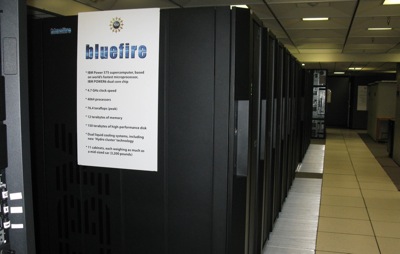
The IBM Bluefire 76-teraflop computer, centerpiece of NCAR's supercomputing center. Photo: Craig Miller

NCAR scientists continue to refine their climate models, which have been downloaded by more than 10,000 scientists around the world. UCAR invests $20-to-$30 million every four years in it’s Computational & Information Systems Lab (CISL), to maintain it’s state-of-the-art status. CISL chief Rich Loft says it’s probably the most advanced supercomputing center devoted largely to climate analysis.

Even so, NCAR is busy building a bigger, faster one–but not here. The new supercomputer, which may be ready by 2012, will be sited near Cheyenne, Wyoming, mostly to take advantage of the cheap, abundant electric power in that area. Loft and NCAR Director Eric Barron both concede the paradox that the most advanced computer assault on global warming is itself a huge gobbler of electricity, much of which comes from coal-fired power plants. The Wyoming facility will suck down 4.5 megawatts of power. Barron says at least there’s a major wind farm “right next door.”

The center’s carbon footprint is probably also swollen slightly by its own air force. NCAR operates two aircraft packed with advanced instrumentation; a hulking C-130 Hercules and a sleek, high-altitude Gulfstream V. Sadly, no rides were offered this week.