Tag Archives: Economics

Do We Need Nuclear?

This is an updated re-post from August 24th, when my radio feature first aired on KQED’s Quest series. That report repeats on this week’s magazine edition of The California Report.

More people appear to be saying “yes” these days, even if grudgingly. The question is: Is it too late?

The Public Policy Institute of California has been tracking public support for expanded nuclear power over the past several years. Survey participants are offered a menu of four potential energy options, one at a time.

The question posed is: “Thinking about the country as a whole, to address the country’s energy needs and reduce dependence on foreign oil sources, do you favor or oppose the following proposals?” Then the four options are offered, including: “How about building more nuclear power plants at this time”

As recently as 2002, adults surveyed in California opposed the idea by a margin of 59% to 33%. But that gap has been closing steadily in the years since and by this July, Californians were split just about down the middle on the question, with 46% in favor and 48% opposed. The poll has a margin of error of about 2%, making it a virtual tie.

When you dig into the numbers a little deeper, some demographic preferences emerge. Support increases with both age and education. Californians 55 and older support more nuclear by a wide margin (58% to 36%) as do college graduates (50%-43%).

Many people use cost as an argument against nuclear but just as the PPIC was phoning around for opinions on the matter, the Palo Alto-based Electric Power Research Institute was finishing up its own report, concluding that trying to reach greenhouse gas reduction goals without baseload technologies like nuclear power, could end up costing much more.

Dan Kammen, who runs an energy lab at U.C. Berkeley, would appear to agree. He said in a recent interview for Climate Watch that “Without knowing exactly where things will come down on nuclear, I think that it absolutely has to be part of the equation in a way that it has not been in the past. Energy costs from fossil fuels are rising at almost 5% a year now, and the damage we are doing and are going to do more of, if we don’t stop our fossil fuel expansion, in terms of greenhouse warming, is so large an issue that these technologies have to be back on the table.
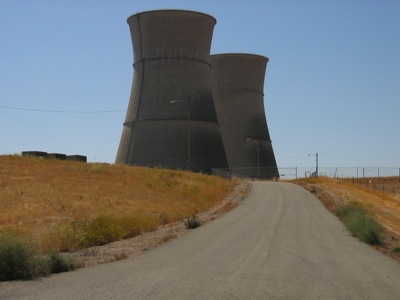
Is the road back to nuclear a dead end? Cooling towers at the decommissioned Rancho Seco nuclear power plant.

But there are serious doubts whether the nation–let alone the state–is in a position to embrace nuclear as it did in the 1960s. Kammen is also a professor of nuclear engineering, and noted with some alarm the rate at which the industry is “graying.” Now in his mid-forties, he told me that when he attends technical meetings for nuclear engineers, he’s often “the youngest guy in the room–by 20 years.” Since the U.S. more or less abandoned its nuclear hopes following the Three Mile Island debacle, the nation has ceded most of its nuclear industrial capacity to other nations, and few young people have chosen to enter the field.

Reports from new projects around the world have not been encouraging of late. Finland is struggling mightily to get its newest reactor up and running. This goes directly to doubts expressed by Kammen and others, that the industry can cowboy up fast enough for nuclear to play a meaningful role in meeting CO2 reduction targets.

The effective ban on new nuclear plants that California has had in place since 1976 could be reconsidered. But ultimately electric utilities will have to want it and I sense a certain “nuclear fatigue” in that arena.

Managers at the Sacramento Municipal Utility District (SMUD) shut down its only reactor in 1989, after a thumbs-down referendum. When I called to ask for an interview on the prospects for a nuclear revival, they declined. They didn’t even want to talk about it. Managers at PG&E, whose twin reactors at Diablo Canyon produce nearly a quarter of the utility’s output, still claim an interest in nuclear. But when I asked CEO Peter Darbee about it recently, he said he had the sense that most people in California would prefer to look elsewhere for energy solutions.

Of course, that was before the latest PPIC poll.
Delta Dawn

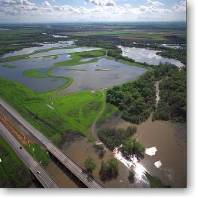
Scientists and policy wonks seem to be in general agreement on this: that it’s time to close out the current management epoch on the Sacramento-San Joaquin Delta and begin anew. There’s less accord on how to proceed.

U.S. Fish & Wildlife Service
Photo: U.S. Fish & Wildlife Service

Policy makers have assembled “blue ribbon” panels to study the options and make recommendations. Volumes of studies and proposals line the shelves in Sacramento and elsewhere.

Last week a new idea surfaced for moving water through the Delta: Instead of channeling around it, tunnel under it.

This week the non-partisan Public Policy Institute of California released its recommendations for a mechanism to fund the enormous fixes that will be required: Those who benefit pay (ecologists use the term “ecosystem services” for all those bennies we get from natural resources and tend to take for granted).

Whatever the outcome, one thing seems inevitable, with or without human intervention. Driven by warming ocean temperatures, rising sea levels will continue to push saltwater farther upstream, changing the Delta’s character and the “services” it provides.

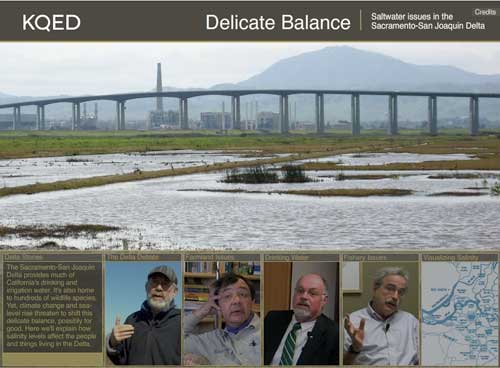
Recently a team of students at U.C. Berkeley’s Graduate School of Journalism produced a Flash presentation on some of the issues raised by advancing salt in the Delta. The multimedia report: Delicate Balance was produced for Climate Watch by Amanda Dyer, Martin Ricard and Jeremy Whitaker. We’re grateful to them for their time and creativity.

delicatebalance

Not Connecting the Dots

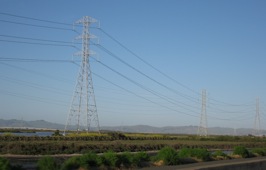
grid_0295Two developments this week would seem to validate concerns that things aren’t quite lining up for the vaunted new age of renewable energy.

While the Secretaries of Energy and Interior were offering confident assurances to a Senate panel about the future of renewables, a consortium of environmental groups was suing them over a plan for major new transmission lines for the western electrical grid.

The groups, represented by lawyers at Oakland-based EarthJustice, produced their own maps to show that the proposed routes appear to miss many areas with the most potential for solar, wind and geothermal resources. Instead, environmentalists say the West-wide Energy Transmission Corridors approved under the Bush administration would seem to line up just about perfectly with major existing and proposed coal-fired power plants (note that the maps themselves are PDF downloads).

According to EarthJustice:

“The Bush corridors plan ignores the Renewable Portfolio Standards (RPS) adopted by nine of the eleven western states to increase use of the region’s vast wind, solar, and other forms of renewable energy. The approximately 6,000 miles and 3.2 million acres of federal land in eleven western states designated as energy corridors puts imperiled wildlife at risk and slices or brushes against the borders of iconic public lands. Among these are Utah’s Grand Staircase-Escalante National Monument, Arches National Park, and New Mexico’s Sevilleta National Wildlife Refuge.”

I asked Katie Renshaw, a Washington-based lawyer for EarthJustice, if Energy and Interior wouldn’t have updated their plans since the Bush-era maps were approved. “As far as we’ve seen, they haven’t,” said Renshaw.  “An analysis was never really completed.”

The lawsuit comes just days after energy entrepreneur T. Boone Pickens revealed that he’s having to reconsider his plans for a major network of wind turbines through Texas. The reason: no transmission lines.

In California and elsewhere, proposed transmission lines have run afoul of environmental interests, as Rob Schmitz reported in his New Gridlock series for Climate Watch.

Update: Scott Streater has more on the controversy over siting renewables in a New York Times Greenwire post.

Long, Hot Summer for Climate Bill

capitoldome_hr_blogAs California’s Barbara Boxer opened Senate hearings on the Waxman-Markey climate bill today, her committee was urged by Republicans not to “rush through this thing.” At this point there seems to be little danger of that.

Having squeaked through the House by the thinnest of margins, the American Clean Energy and Security Act is facing a gantlet of Senate committees that will likely spend most of the summer dissecting the 1400-page beast.

Boxer’s Environmental and Public Woks Committee heard testimony today, with Finance and Foreign Relations scheduled to have their whack at it tomorrow. During the latter, expect to hear gruesome details about Europe’s experiment with cap & trade, which has been fraught with problems. Peter Fairley recently provided an excellent overview of those pitfalls in MIT’s Technology Review. Fairley writes that in its current form, the Waxman bill is destined to hit many of the same potholes.

During today’s morning session, members of the Energy committee heard from several cabinet-level officials, including Department of Energy Secretary Steve Chu, who fielded numerous questions on the role of nuclear power in the nation’s energy future. While California still has in place a legislated moratorium on new nuclear plants, Chu assured committee members that restarting the nuclear industry is a “very important factor” in the low-carbon future and that faces “no reluctance” from him.
Chu said his department is “pushing as hard as we can” to provide loan guarantees for new plant construction (most of which is planned for the southeastern U.S.). The former head of Lawrence Berkeley National Lab said that the U.S. has lost the lead on nuclear technology and “should get it back.”

(We’ll look at the prospects for that in a Climate Watch radio feature, scheduled to air on the August 24th broadcast of KQED’s Quest radio series.)

Committee Republicans repeated concerns about potential job losses and the danger of “carbon leakage,” wonk-speak for when production moves overseas to countries where it creates more greenhouse gas emissions than it would here.

As in the House floor debate, Republicans recalled a comment made by then-candidate Barack Obama to the San Francisco Chronicle in January of last year, that electricity rates would “necessarily skyrocket” under cap-and-trade. David Hawkins of the Natural Resources Defense Council countered that the act would also offer some savings; that households could see “up to $14 per month” in savings from transportation efficiencies.

California’s EPA Waiver: Does it Still Matter?

Deja vu all over again. Photo: Craig Miller

Today the federal Environmental Protection Agency formally granted the waiver that California has sought since 2002, allowing the state to set its own standards for greenhouse gas emissions from cars.

But wait–didn’t this already happen for practical purposes, last month? That’s when the Obama administration announced its intent to essentially put California’s proposed standards in place nationwide.

Well, yes–and no. Bernadette Del Chiaro, who represents the group Environment California, says that having the waiver is more than a legal technicality. She says it means that the state can get started sooner, cleaning up tailpipe emissions. Del Chiaro explains that: “California’s standards kick in now, through 2016. The federal program that President Obama has extended throughout the entire country, starts in 2013 (also through 2016).”

That gives the states, in effect, a three-year jump-start. In 2013, everybody should be on the same page.

California’s chief air regulator,  Mary Nichols said, in a written statement:
“The waiver affirms California’s authority to set the standards for the cleanest cars in the nation and recognizes the ability of forward-thinking states to continue to adopt them. Now we can begin to work with the manufacturers to make a new generation of cars that deliver all the comfort and power we have come to expect but with improved efficiency and far fewer greenhouse gas emissions. ”

Thirteen other states had also pursued the waiver and can now proceed with their own programs.

While automakers have long argued that the tighter regs will make cars more expensive, Environment California calculates that they’ll “save consumers $36 billion at the pump by 2020.” That projection assumed that gasoline would would average about $2 per gallon over that period. Higher pump prices (which seem a lot more likely) would in turn, increase expected savings, as the underlying premise is that we’ll be driving cars that get better gas mileage.

But of course those cars will cost more than the clunkers we’re wheeling around in now. The state Air Resources Board estimates that the clean car regulations will tack an average of $1,000 onto the price of a new car by 2016. Obviously that would offset some of the pump savings.

Renewables Meet NIMBY…Everywhere

Suddenly, everywhere you look nowadays, prospects for clean, green energy are being muddied by NIMBY* syndrome.

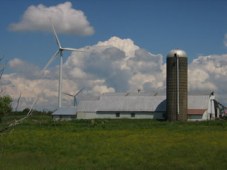
Windmills dwarf a dairy farm in upstate New York. Photo: Craig Miller
Wind farm: Windmills dwarf a dairy barn in upstate New York. Photo: Craig Miller

We saw it first-hand in Rob Schmitz’s series on “green gridlock” in California’s southeastern deserts. Trepidation there turns more on the transmission lines that would have to go up, to connect solar, wind and geothermal fields to population centers where the power is needed.

We’ve seen it at work in efforts to license wave power projects along the West Coast.

In Marin County, it took the McEvoy Ranch nine years from concept to completion, to get one 150-foot windmill up and running, to power the olive operation. Objections from the neighbors forced them to move the site more than a half-mile, and downsize the turbine to three quarters the proposed height and one third the power output (more about this in the next Quest/Climate Watch special, to premiere on August 25).

Now, as James Glanz reports in the New York Times, seismic fears are causing tremors in geothermal fields north of San Francisco.

Glanz writes that with venture funding from Kleiner Perkins Caufield & Byers and Google, Sausalito-based AltaRock Energy is deploying “enhanced” geothermal technology to wrest more steam from the earth. But fears over the potential for unleashing earthquakes in the process are not enhancing their prospects.

*For the truly uninitiated: “Not in My Back Yard”

Updated: Disaster Status Sought for Valley

Five days after filing it, Governor Arnold Schwarzenegger was still awaiting some response from the White House to his request for a federal disaster declaration, to address drought conditions in Fresno County.

Meanwhile, the Washington bureau of the McClatchy newspaper chain (which includes the Fresno Bee) reports that the request is something of a longshot.

The Governor made the request last Friday, one day after he faced a tense gathering in Fresno, where water issues upstaged even the precarious condition of state finances, and shortly after a meeting with farmers in Mendota.

The governor has had a standing statewide drought emergency in effect since February. Friday he signed an executive order freeing up state resources to help ease drought-related impacts. A federal declaration would allow affected businesses to apply for federal aid. President Obama has since signed several other disaster declarations last week, in response to storms in Missouri, wildfires in Oklahoma and other incidents.

Parsing the White House Climate Report

At least one researcher cited in the 196-page climate impacts report issued this week by the Obama administration is not impressed with the final product. Roger Pielke of the University of Colorado’s Center for Science & Technology Research has written a blog post critical of the report and in particular, the way in which his work was interpreted. If you’d rather not plow through the entire post, John Tierney has an overview of Pielke’s critique on his blog for the New York Times.

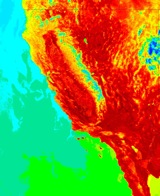
California heat wave, from the Aqua satellite. Image: NASA
2004 California heat wave, from the Aqua satellite. Image: NASA

The report was arguably the first to break down both observed and projected effects of climate change into coherent regional summaries. For the purposes of the report, California was considered part of the Southwest region, which included states as far east as Colorado and New Mexico.

Not surprisingly, many of the points raised in the Southwest section (beginning on p. 129) have to do with water supply. Most have been reported or discussed in our Climate Watch coverage, either here or in our radio reports. Selected “highlights” include:

– Past climate records based on changes in Colorado River flows indicate that drought is a frequent feature of the Southwest, with some of the longest documented “megadroughts” on Earth.

– The prospect of future droughts becoming more severe as a result of global warming is a significant concern, especially because the Southwest continues to lead the nation in population growth.

– Human-induced climate change appears to be well underway in the Southwest. Recent warming is among the most rapid in the nation, significantly more than the global average in some areas.

– Projections suggest continued strong warming, with much larger increases under higher emissions scenarios compared to lower emissions scenarios. Projected summertime temperature increases are greater than the annual average increases in some parts of the region, and are likely to be exacerbated locally by expanding urban
heat island effects.

– Water supplies in some areas of the Southwest are already becoming limited, and this trend toward scarcity is likely to be a harbinger of future water shortages. Groundwater pumping is lowering water tables, while rising temperatures reduce river flows in vital rivers including the Colorado.

– Projected temperature increases, combined with river-flow reductions, will increase the risk of water conflicts between sectors, states, and even nations.

– Increasing temperature, drought, wildfire, and invasive species will accelerate transformation of the landscape.

– Under higher emissions scenarios, high-elevation forests in California, for example, are projected to decline by 60 to 90 percent before the end of the century.

– In California, two-thirds of the more than 5,500 native plant species are projected to experience range reductions up to 80 percent before the end of this century under projected warming.

– Projected changes in the timing and amount of river flow, particularly in winter and spring, is estimated to more than double the risk of Delta flooding events by mid-century, and result in an eight-fold increase before the end of the century.

– A steady reduction in winter chilling could have serious economic impacts on fruit and nut production in the region. California’s losses due to future climate change are estimated between zero and 40 percent for wine and table grapes, almonds, oranges, walnuts, and avocados, varying significantly by location.

By the way, Pielke’s critique does not directly address anything in this list, though his work does involve weather-related disasters, which would include floods. Asked by a commentator on his blog if he thinks the entire report should be dismissed based on the flawed interpretation of his research, Pielke replied: “I wouldn’t think so and would certainly hope not. At the same time the section which covers my research does not give me a lot of confidence in the process that led to the report.”

Head-to-Head: Chevron and The Sierra Club

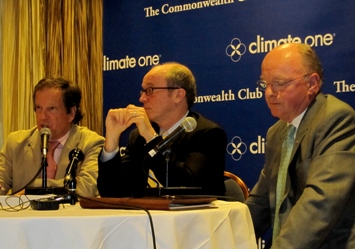
Two giants of California’s energy debate squared off at a Commonwealth Club forum in San Francisco last night.

Chevron CEO Dave O’Reilly and Sierra Club Executive Director Carl Pope fielded questions from moderator Alan Murray of The Wall Street Journal and a sometimes impassioned audience, about renewable energy opportunities, reducing greenhouse gas emissions, and predictions for the future of the United States’ energy economy. Several questions also concerned Chevron’s high profile court battle in Ecuador and the oil company’s presence in Richmond, the Bay Area city where a major Chevron refinery dominates the skyline–and some say, local governance

Carl Pope, ED of Sierra Club Alan Murray, Executive Editor of WSJ Online Dave O'Reilly, CEO of Chevron. Photo: Gretchen Weber
From left to right: Sierra Club chief Carl Pope; WSJ Online Executive Editor Alan Murray; Dave O'Reilly, CEO of Chevron. Photo: Gretchen Weber

In what was less of a debate than a discussion, Pope and O’Reilly agreed that the United States needs to make major changes towards greater energy efficiency and that the country must begin to rely more on renewable energy sources.

Their views diverged significantly, however, on the timeline for such changes. While Pope supports a 90% reduction of greenhouse gas emissions from today’s levels by 2050 and says he believes this goal possible, O’Reilly projected that by 2050, the United States will have reduced its GHG emissions by no more than 20-25% from today’s levels.

O’Reilly said that even if the U.S. replaced the entire transportation system with a zero-emissions system, the country would reduce GHG emissions by just 34%–and that doing likewise with the nation’s power generation would reduce GHGs by another 40%.

“So we have to ask ourselves, can we replace our entire energy system–transportation and power–in just a few short decades?” said O’Reilly. “I think the transition is going to take some time.”

According to O’Reilly, his company is already the largest provider of geothermal energy in the world and yet only 2% of Chevron’s income currently comes from renewable energy.

“The challenge of scale demands that we acknowledge that conventional energy sources will remain indispensable for decades,” said O’Reilly. “We must be realistic. For the foreseeable future we need to develop it all: conventional as well as non-conventional energy, as well as renewables and alternatives.”

When asked what his prediction was for how much of Chevron’s income would come from renewable energy sources by 2050, O’Reilly said he thought the number would be about 10-15%.

Pope responded, “The world will have room in 2050 for a very small company, 90% of whose energy comes from fossils [fuels]. The world will not have room, or tolerance, in 2050 for a big energy company [that does], so if Chevron wants to be successful, I think Chevron’s going to need to change those numbers.

Pope also called on Chevron to “come to the table” with local communities in which Chevron operates, such as Richmond, CA, and he proposed that all oil companies donate 10% of their profits to a global fund to clean up areas of the world damaged by the petroleum industry.

Not surprisingly, Pope and O’Reilly agreed that the highest priority for reducing GHG emissions is to replace coal with natural gas or another less carbon-intensive energy source, and while on stage, the men shook hands on an agreement to lobby the issue together in Washington.

KQED will broadcast the entire Commonwealth Club event at 8 p.m. on Friday, June 19, with a rebroadcast at 2 a.m. the following morning.

Ag and Water: Making Do with Less

This story was produced in collaboration with NPR, with help from producer Cindy Carpien. Sasha’s radio story aired on The California Report on June 8, and will also air later this month as part of NPR’s series on water and the West.

Juicy apples spring from the apparently dry landscape of Sonoma County. Photo: Cindy Carpien
Juicy apples spring from the apparently dry landscape of Sonoma County. Photo: Dan Lehrer, Flatland Flower Farm

Does climate change spell doomsday for California agriculture?

That’s what Nobel-prize winning physicist Steven Chu told the Los Angeles Times in an interview, soon after President Obama appointed him Secretary of Energy.

“I don’t think the American public has gripped in its gut what could happen,” he told the Times in February. “We’re looking at a scenario where there’s no more agriculture in California.”

For another perspective, I called UC Davis ag economist Richard Howitt, who focuses on water and California agriculture, to ask him what he thought.

“That’s a highly inaccurate statement,” Howitt said. “Steven got carried away. Brilliant man, but he doesn’t know anything about California water.”

Howitt’s models show climate change will likely lead to a 25% reduction in the state’s water supply over the next 50 years. He says that will likely mean some rough times ahead for farmers, but certainly not the end of California’s role as an agricultural powerhouse.

In fact, Howitt says if California farmers can continue to grow more drought-tolerant crops and cut back on flood irrigation, they’re likely to thrive in the marketplace over the long term:

“As income increases, people eat more California fruit, nuts, and vegetables,” he says. “They don’t care about cotton; they don’t care about corn. We are on the right side of the agricultural business in terms of future growth.”

Of course, that means if you were to fly over the Central Valley in 50 years, you’d probably see fewer emerald-green islands of crops like rice, alfalfa, and cotton–and more fields of wheat and flexible crops like canning tomatoes, which can be planted seasonally and according to demand.

“This will, of course mean that we have less slack in the system than we do now,”  says Howitt.  “We’re going to have to be much better at applying water, look a little more like Israel and a little less like Northern California.”

Engineers who specialize in irrigation technology have long looked to drought-stricken countries for models. The folks who developed the Pure Sense software I discuss in my radio story have collaborated extensively with farmers in Australia.

Howitt also says no matter how efficiently farmers apply water, they have to figure out how to more efficiently move it around the state. Rather than just fighting over smelt, salmon, and pumping in the Sacramento-San Joaquin Delta, Howitt thinks farmers could be more efficient if we plumb water east to west (currently the two major water systems in California are primarily north-south oriented). Howitt says that would create incentives for farmers in relatively water-rich areas, like the east side of the San Joaquin Valley, to sell water to farms with good soil but less water–like the west side of the San Joaquin Valley, home to the some of the largest and wealthiest farms in the world.

Tricking plants into yielding more with less

Meanwhile, the idea of “dry farming,” like what the folks at Sonoma County’s Flatland Farm are doing with their apples, is getting popular in coastal areas. Dry-farmed tomatoes, like these from Santa Cruz, are increasingly popular at farmer’s markets.

Some researchers are taking this concept to places where it doesn’t rain so much. The idea is to control irrigation to stress the plants to the point where they think they’re starting to die, which triggers the plant’s genetic imperative to produce more fruit. David Goldhamer, who advises Central Valley farmers through the UC Cooperative extension, has demonstrated that farmers who cut back on watering of navel oranges and pistachios, may actually produce higher-quality fruit and generate more income.

A sprinkling of history

I also visited David Zoldoske, at the Center for Irrigation Technology at Fresno State. They have an amazing collection of historical sprinkler systems and a virtual irrigation museum online. Zoldoske has been studying irrigation and water efficiency for decades. Here’s what he told me about how agriculture is going to have to adapt to warming temperatures:

“I think the thing to remember here is there is no silver bullet. There is no reservoir or canal or any other technology or engineering feat that’s going to solve this problem. We’re going to have to use every tool in the toolbox. It’s going  to take multiple feats of engineering elegance so we can solve this problem. And it’s still possible that we’ll fail. And I don’t want to be saying that we will fail. We need to be very focused on this. It’s going to be a long journey. We won’t solve it over night.”

Learn more:

Ag and Climate Change

The entire April-June issue of the University of California’s quarterly journal, California Agriculture, is devoted to research on climate change and how it may fundamentally alter California’s environment and landscape, agriculture and food quality.

Saving Every Drop:

The California Institute for Rural Studies has profiled some of the most efficient California farmers in their January report, California Water Stewards: Innovative On-Farm management Practices (.pdf link).

The institute is also tied into the California Agricultural Water Stewardship Initiative (CAWSI), which has just launched a new website that features farmers using less water.