
Tag Archives: Economics

No Crystal Ball for Fusion Power

Lawrence Livermore Nat'l Lab
Photo: Lawrence Livermore Nat'l Lab

Now here’s a guy with some historical perspective: For something north of a half-century, David Perlman has been covering science for the San Francisco Chronicle. On KQED’s Forum program this morning, he noted that “40 years ago, they said ‘in 20 years, we’ll have unlimited energy from fusion’.”

The record will show that we didn’t quite get there–but that hasn’t stopped them from trying. The long quest for bottled fusion will pass another milestone this week, when the US Dept. of Energy formally cuts the ribbon on the National Ignition Facility (NIF) at Lawrence Livermore National Lab.

Comparing the hardware with other titanic undertakings, like the CERN particle accelerator in Switzerland, Perlman called the 192-laser assembly “one of the most amazing machines–if it succeeds–and one probably won’t know for the next two, three years.”

That’s the hopeful time frame for creating fusion in a fuel pellet the size of a BB (artistically rendered in the image, above) Will they? Perlman says: “I would not dream of putting a bet on it.”

Nor would sparking some mini-fusion at NIF quickly translate to a national solution for clean, safe energy. Scaling that ignition up to practical size for reactors would likely require decades more.

A NIF technician appears to be gazing into a "crystal ball," which is actually used to amplify laser beams--but not much good for predicting the future. Photo: Lawrence Livermore National Lab
A NIF technician appears to be gazing into a "crystal ball." Precision-ground crystals are used to amplify laser beams--but not much good for seeing into the future. Photo: Lawrence Livermore National Lab

Earlier this week, in an interview with NASA scientist James Hansen, I asked him about the potential for nuclear power to make a comeback with new technology. Rather than waiting for fusion, Hansen favors the technology known as “fourth-generation nuclear,” which he says could “burn nearly all of the fuel, where at present, the nuclear technology that we’re using burns only one percent of the energy in the uranium.” From one percent to “nearly all” would represent a drastic reduction in the current radioactive waste problem.

There may be some wishful thinking in that. An early report published in the magazine 21st Century Science & Technology describes these “Generation IV” reactors as “about 50% more efficient than conventional nuclear reactors.”

Other nations have moved ahead with Gen-IV reactors. The French expect to have one under construction by 2020.

Meanwhile, as the US pursues a parallel Gen-IV research program, it will press on toward the Holy Grail of fusion with its Livermore megalaser, described by Perlman as “already a mini-Manhattan Project.” Costs so far have run to nearly triple the original budget of more than a billion dollars. DOE expects to spend $140 million per year to run the NIF. So, it would be–you know–nice if something comes of it.

Carbon Offsets in the Air

Friday on The California Report’s weekly magazine, Rori Gallagher reports on ways to assuage your carbon guilt with a quick stop at an airport kiosk.

By Rori Gallagher

Reed Galin
Photo: Reed Galin

I first got the idea to do a story on carbon offsets back in December, when San Francisco International Airport announced it was partnering with a private company called 3Degrees to install carbon offset kiosks.

Originally, the kiosks were supposed to be installed sometime “in the spring.” But there seems to be a delay with the contract negotiations. I kept checking in with 3Degrees about a launch date. At first they were saying Earth Day–then it was pushed to May, and now “by the end of June.”

But there are already other options out there. I found that Virgin America, the only major airline based in California, was the first to offer carbon offsets in the sky. Other airlines do offer customers the chance to purchase offsets but Virgin allows you to do it during the flight through the in-flight entertainment system.

Carbon offsets are supposed to stop carbon emissions that would have otherwise taken place. That’s really difficult to substantiate. Projects like wind farms for example, certainly seem good for the environment but likely most of them would be built anyway and produce power without this type of third-party incentive.

Virgin’s program managers say they stringently vetted carbon offset programs, and that theirs are among the most credible out there. But as I point out in my radio story, there is very little regulation of the voluntary carbon offset industry and it’s difficult to know if they’ll do what they say they will.

There are some independent efforts to separate the sheep from the goats, for example the Natural Resources Defense Council has produced a buyer’s guide for carbon offsets.

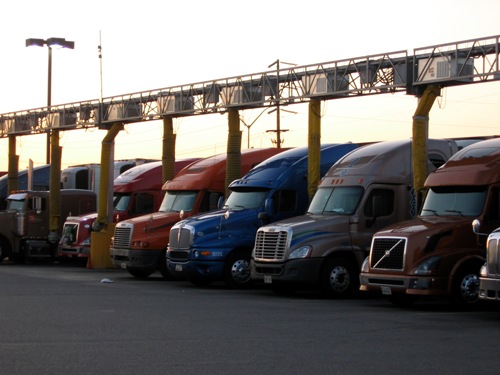
Trucks line up at an IdleAire terminal, which provides "carbon offsets" for airlines. Photo: Rori Gallagher

“The Australian Reality”

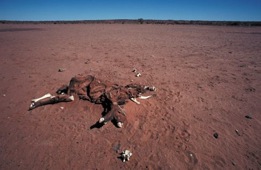
Australia's Simpson Desert. Photo: Mike Gillam

Referring to Australia’s seven-year drought, that’s how the state’s top water manager describes the new paradigm for water planning at the Dept. of Water Resources.

Speaking to a packed house at the annual forum of the Sacramento River Watershed Program yesterday, DWR Director Lester Snow said his staff is assuming that 2010 will be another dry year. Snow warned about “loss of resilience” in the state’s water system, calling it “completely unsustainable” in it’s present form, given predictions for population growth, coupled with anticipated effects of climate change.

All speakers at the forum seemed to agree that a paradigm shift is in order. Thomas Philps, a strategist at SoCal’s Metropolitan Water District, pointed out that in Victoria’s capital city of Melbourne (Australia), per capita water consumption runs about 40 gallons per day, while in California’s capital, it’s 280 gallons. As Sasha Khoka will report Monday morning on The California Report, Sacramento is just one of several cities in the Central Valley that still doesn’t meter its water use. Philps added that the Sacramento region is “on a trajectory” to use the same volume of water as Los Angeles, though he did not say by when.

UC Davis geologist Jeff Mount cautioned against relying on additional surface storage to secure California’s water future. Not only does storing water become “very expensive” year over year, but dams and reservoirs “don’t create any new water,” he said. (If some think Mount is taking a “jaundiced view” of the situation, it might be because he braved a bout of hepatitis to deliver his morning talk)

In a panel discussion on resource planning, moderator Greg Zlotnick of the Santa Clara Valley Water District asked panelists to respond with “true” or “false” to a quote from the Pacific Institute’s Peter Gleick in a story aired on NPR last week. The quote, as given by Zlotnick, was: “Government has built infrastructure and made promises that can’t be kept.” Here are the panelists’ responses:

Tina Swanson, The Bay Institute: “True.”

Philps: “True, but…” (Generally true but MWD doesn’t really expect to get its full contractual allocation of water anymore, anyway)

Don Glaser, US Bureau of Reclamation: “False, but…” (Water allotments from his agency’s Central Valley Project are intended to be “supplemental contracts,” to augment use of groundwater and other sources, but Glaser sees the statement becoming “more and more true in the future.”)

Snow: “Hell, no.”

NPR Spotlights California Water Issues

farm_0799_blog1

NPR’s Morning Edition launched an “occasional series” on California’s water woes this morning. Veteran correspondent John McChesney begins with the impact on agriculture in the Central Valley’s Westlands Water District, the nation’s “biggest irrigated region.”

KQED’s Central Valley Bureau Chief and Climate Watch contributor Sasha Khokha will have three stories in the series, two of which will debut on The California Report in the weeks ahead:

WATER METERS: Many California cities are preparing for or implementing mandatory water rationing this summer. But there are still cities and towns, particularly in California’s Central Valley, where water can’t be rationed because residents don’t even have water meters.  Residents are charged a flat rate for any amount of water they use. Khokha looks at the city of Fresno, where water meters will be phased in, but not until 2013.

MENDOTA PROFILE: The town of Mendota in California’s Central Valley is at the heart of the economic crisis spawned by drought and the loss of farm jobs.  Sam Rubio grew up here, the son of a Mexican farmworker.  He went off to college, and was planning to become a doctor, but instead has returned to this town to teach biology, mentor local kids, and run a café that’s become a haven for the farmworker youth.

AG ADAPTING TO DROUGHT: California farmers are facing an increasingly uncertain water supply, brought about by drought, environmental restrictions on pumping, and climate change. How will farmers adapt? Some of them are yanking out water-intensive crops and replacing them with more drought-tolerant ones. But others are trying to keep growing the same crops with improved technology. We’ll follow a new tech start-up that’s helping farmers use water more efficiently by tracking how much moisture reaches each plant in their fields–and sending a satellite message to their cell phones. We’ll also talk with a researcher who says there are ways California can grow some key crops, like oranges and nuts, using less water.


Change Your Diet, Change the Climate?

salinas-007_blog

Climate Watch contributor David Gorn has been looking at the link between climate and the food we eat. His latest report aired recently on NPR’s All Things Considered.

So I have to admit, when I first got this story assignment from National Public Radio, my reaction was mixed. You want to reduce global carbon emissions by changing your personal DIET? Oh, come on. I mean, how much of an impact could diet change have on climate change?

Quite a bit, apparently.

A United Nations report says livestock accounts for 18 percent of the world’s greenhouse gasses, much of it from the methane produced by cows, as well as goats and sheep.

Shipping beef and dairy products across the country and around the globe also contributes heavily to that carbon footprint, in the form of emissions from trains, planes and trucks.

So the idea is that by cutting out beef and cheese from your personal diet, you can significantly reduce your personal carbon footprint. Chris Jones, a staff researcher at UC Berkeley’s Institute of the Environment, says the production and distribution of beef, pork, lamb and cheese are particularly high offenders on the greenhouse gas emissions chart.

In my story for All Things Considered, I focused on an Earth Day event where the University of San Francisco cafeteria and about 400 other food service outlets across the country, managed by Palo Alto-based Bon Appetit, were cutting all beef and cheese out of the menu for one day. Yes, no cheeseburgers in a university cafeteria. Scary thought, eh? The students didn’t seem to flinch, though.

It looks like this approach to the low-carbon diet it may be catching on among Bay Area hospital cafeterias, as well.

It’s unclear what effect the current efforts might have on climate patterns but it’s a familiar pattern to Americans; using personal buying power to influence public policy decisions.

“Smart Grid” Getting Some Juice

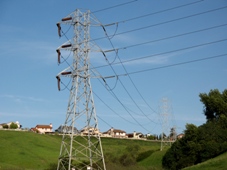
img_3197_blogThe mainstream media’s beginning to catch up to the “smart grid” story; the grand plan to remake the nation’s electrical distribution system.

On Friday, NPR began a ten-part series; “Power Hungry: Reinventing the U.S. Electric Grid.” The reports will air on both of the network’s flagship programs, Morning Edition and All Things Considered.

KQED’s Lauren Sommer set up the series earlier this month, with her backgrounder on emerging smart-grid technologies for Quest. Her report also includes a narrated slideshow, that includes a look inside PG&E’s version of “Mission Control.”

In March, Rob Schmitz previewed some of the challenges in his two-part series for Climate Watch, “Green Gridlock.”

And if you’re still “power hungry” after all that, Scott Pelley’s piece on the coal power industry is well worth a twelve-minute investment at the 60 Minutes website.

Congressman: Delta Fish a “Worthless Little Worm”

Peter Johnsen, U.S. Fish & Wildlife Service
Photo: Peter Johnsen, U.S. Fish & Wildlife Service

In hearings by the House Energy & Commerce Subcommitee today, Rep. George Radanovich (R-Fresno) called the Delta smelt “a worthless little worm that needs to go the way of the dinosaur.” He made the remark as part of a five-minute attack on “environmental alarmism,” in response to testimony from former vice-president Al Gore, founder of the Alliance for Climate Protection.

The tiny fish, recently listed by the state Fish & Game Commission as “endangered,” came up in remarks by Radanovich about the current drought conditions in the Central Valley. He blamed the lack of water on lawsuits that have restricted water supplies to farms, “for a Delta smelt–a worthless little worm that needs to go the way of the dinosaur. They’ve shut pumps down and restricted water deliveries to California over that thing, when what’s eating it is a striped bass, a non-native species in the Delta.”

Radanovich rejected the possibility that climate change might be a player in the current drought. Instead he took aim at what he described as “collaboration between environmentalists and sport fishermen,” blaming that for slashed water allocations to farms, as many as 60,000 job losses and “a $6 billion-dollar hit to our economy.”

“That is not global warming,” he said. ” “It’s the result of bad policy caused by environmental alarmism.”

Joining Gore among the 21 witnesses before the subcommittee on Day 4 of the climate bill hearings was UC Davis professor Dan Sperling (.pdf link), who had just come from a marathon hearing before the California Air Resources Board. Last evening the Air Board approved the first-ever Low-Carbon Fuel Standard, as part of it’s plan to reduce greenhouse gases.

Low-Carbon Fuels in Your Future

After years of study and a day of marathon testimony in Sacramento, state regulators have adopted the world’s first low-carbon standard (LCFS) for transportation fuels. Only one member of the California Air Resources Board, John Telles, voted against adoption.

During nearly six hours of testimony by almost 100 speakers, businesses lined up both for and against the new rules. As Marjorie Sun reported for us this week, some claimed that calculations for the carbon footprints of different fuels–especially ethanol–were not even-handed. Speaker after speaker assailed the LCFS as being the product of “incomplete analysis” or just bad math (public testimony begins about an hour into the webcast).

But Daniel Sperling, a UC Davis professor and member of the Air Board, calls it “government at its best.”

“There’s been a huge amount of effort,” he said, ” in working with the oil companies, working with the electricity companies, working with the environmental community, working with the biofuels companies, to try to get this really done right.”

Though numerous speakers challenged the view that it was done right, both Sperling and Air Board head Mary Nichols seemed to leave the door open to additional tweakage of the regulations. “In the end, it’s a science-based policy,” said Sterling. “There are a lot of pieces of this that we’re not certain exactly the best way to do it but we’ve got the framework of a really outstanding policy and an important policy. And we’ve made the commitment to work with all the different stakeholders in refining it, to make sure that it really works best.”

Small-business and environmental justice groups locked arms to decry the cost of the new rules. Some cited a report from Sacramento-based Sierra Research estimating $3.8 billion in increased fuel costs by 2020, if the LCFS takes effect.

An “expert working group” is due to report back on January 1, with possible suggestions for fine-tuning the plan.

Board member Ron Roberts summed up the proposed regulation by paraphrasing Winston Churchill: “It may not be the end or even the beginning of the end, but it’s the end of the start,” said Roberts (falling somewhat short of Churchillian eloquence but point taken).

The new rules are designed to cut greenhouse gas emissions from transportation 10 percent by 20-20.  Sperling is now headed to Capitol Hill, to testify before Congress on national legislation. California’s process is being closely watched in Washington, where pending federal carbon legislation is widely seen to be modeled after California’s plan.

The Battle Over Biomass

This week, the California Air Resources Board is expected to pass a controversial new standard that measures the carbon footprint of transportation fuels. Reporter Marjorie Sun filed a story for Climate Watch on the measure and why the ethanol industry is fighting it. She provides some additional insights here:

The proposed low carbon fuel standard is part of a broad effort by the California regulators to roll greenhouse gas emissions back to 1990 levels by 2020.

biofuel pumpSlashing carbon emissions from cars and trucks is a big part of the state’s game plan. That’s because transportation accounts for 40 percent of the state’s greenhouse gas emissions. A whopping 96 percent of the fuel sources that power our cars and trucks is petroleum-based. Right now, the bulk of ethanol sold in California–and the rest of the United States for that matter—is corn-based. (Brazil makes its ethanol fuel from sugar cane, which has a smaller carbon footprint.) U.S. producers argue that the proposed Low-Carbon Fuel Standard (LCFS) would make corn-based ethanol less competitive in the marketplace because of the way it calculates emissions. Pacific Ethanol was the biggest ethanol producer and marketer in California– until recently. With the drop in gasoline prices over the past year, demand for ethanol has plummeted. Over the past several months the company suspended operations at its two production plants in California and stopped construction of a third facility. In March, it filed for loan extensions with its creditors. So the new fuel standard could deliver yet another blow to the company. Hence, ethanol interests have been putting up a fight. But the Air Resources Board is counting on the proposed standard to spur innovation in the alternative fuels market, to reduce carbon emissions. The state says it’s hoping to “expand the size of the current renewable fuels market in California (already the largest in the nation) by three-to-five times. Instead of today’s corn, over half of the ethanol is likely to be made from extremely low-carbon, cellulosic feedstocks such as agricultural waste and switchgrass. There are numerous startups in California working on cellulosic ethanol. They’re experimenting with a wide range of plants, from switchgrass to algae, as potential sources of ethanol. Getting a new fuel to market, however, requires enormous capital costs. The state is projecting that by 2020, Californians will have bought more than 7 million alternative-fuel and hybrid vehicles. That’s about 20 times greater than today. But in these tight economic times, folks are hanging onto their old cars. So it’s not clear how fast Priuses and plug-ins will replace the carbon-spewing cars on the road today.
Sun’s radio story aired Wednesday on The California Report.

California’s Climate Partners Get Cold Feet

On Wednesday’s edition of The California Report, correspondent Tom Banse takes the pulse of a vital organ in California’s climate strategy; the regional carbon trading market. The upshot: Reports of its well-being may be greatly exaggerated.

Are they with us?  It’s hard to tell looking at some of California’s supposed partners in the Western Climate Initiative.

WCI includes six states besides California and four Canadian provinces.  Last year the group agreed on a regional “cap-and-trade” plan to reduce greenhouse gas emissions (and not coincidentally to show the federal government how it’s done).  Governors and environmental agencies in the participating states continue to voice support for moving ahead with a regional initiative.  The rub is that the executive branch cannot just snap its fingers and will the plan into being.  A major policy change like this requires state legislatures to adopt the cap-and-trade rules.  And some of those lawmakers definitely have other ideas.

Utah offers the most dramatic example.  Before adjourning for the year, the state House of Representatives voted 52-19 in favor of a non-binding resolution directed at Utah Governor Jon Huntsman:

    “…WHEREAS, experts, including the Congressional Budget Office, warn against cap and trade policies, especially regional programs like the seven-member WCI;WHEREAS, experts also point out that the costs of such programming will be borne by consumers, placing a disproportionately high burden on poorer households; andWHEREAS, no state or nation has enhanced economic opportunities for its citizens or increased real GDP through cap and trade or other carbon reduction policies:NOW, THEREFORE, BE IT RESOLVED that the House of Representatives urges the Governor to withdraw Utah from the Western Climate Initiative.”

Huntsman, a Republican, is apparently ignoring the legislative shot across his bow.

Skepticism is also alive and well in the Arizona Legislature, where this preemptive strike skips the whereases and gets right to the job of handcuffing the executive branch.

    “The [Arizona Department of Environmental Quality] shall not participate in the Western climate initiative that is organized and operated by an affiliation of state governors and one or more provinces of Canada.”

The succinct bill has passed out of state House committee and awaits a floor vote.

Meanwhile in New Mexico, the legislature is done for the year.  Legislation to authorize a greenhouse gas emissions cap was not even broached.  Montana’s legislature is still in session, but all lawmakers in Helena have the stomach to tackle is preparatory measures.  They would set up the regulatory framework for underground carbon storage (aka, sequestration) and require large companies to track and report their carbon emissions.

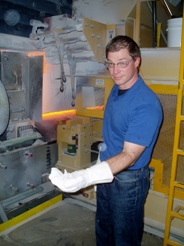
At his glassmaking plant in southwestern Washington, Steve Smith worries that a regional cap on carbon emissions will render his business unable to compete with suppliers outside the region. Photo by Tom Banse.
At his glass making plant in southwestern Washington, Steve Smith worries that a regional cap on carbon emissions will render his business unable to compete with suppliers outside the region. Photo by Tom Banse.

The governors of Oregon and Washington State served up the full climate enchilada to their legislatures this January only to see it picked apart.

That leaves California as the sole state in the Western Climate Initiative that has so far adopted cap-and-trade as the law of the land.  California’s partners have consistently told us that a national program is the preferable way to regulate greenhouse gases.  Now the “preferable” way is starting to look like the only way.