Tag Archives: Economics

Water Allocations Tweaked Slightly Upward

A few drops of good news for farmers and cities this week: a heftier late-spring snowpack means there will be slightly more water headed their way this summer.

Earlier this week, the State Department of Water Resources said it will increase water from state reservoirs from 15% of what cities and farms had hoped for, to 20%.  Today the federal Bureau of Reclamation (Central Valley Project) followed suit and nudged some of its projected allocations up, too.

The five-percentage-point bump is mildly good news for some northern California farmers.  But farmers in the southern San Joaquin Valley are still slated to get zero gallons from federal reservoirs. For that to change would require an April of historically soggy proportions.

The previous nadir for State Water Project deliveries was set in 1991, when urban and industrial customers got 30% of their requested water and farms got zero.

A Rising Tide Raises All Costs

Pacific Institute. Complete maps at link, below.
Photo: Pacific Institute. Complete maps at link, below.

This has been a week of dire predictions about the rising sea level and its eventual consequences.

On Tuesday, scientists preparing for the Copenhagen climate talks this year said that the current IPCC working model for sea level is out of date and overly cheerful.  German climate researcher Stefan Rahmstorf told the International Scientific Congress on Climate Change that even the most optimistic outlook for carbon emissions now portends at least a one-meter rise, or 3.28 feet by the end of this century. The U.N.’s 2007 report had anticipated a rise of up to two feet over the same time period.

Then today, analysts at Oakland’s Pacific Institute chimed in with a projection of California impacts from rising seas, based on a rise of 1.4 meters by 2100.

The report, which includes maps of projected inundation, projects nearly a half-million people at risk of a “100-year” flood event and loss of 41 square miles of coastal land, due to erosion.

“Critical infrastructure” in harm’s way includes highways, hospitals, schools, power and sewage treatment plants, as well as residential neighborhoods. It also includes several of the state’s busiest airports.

The report estimates that the tab for protecting that infrastructure could easily run to $14 billion. According to co-author Matt Heberger, “Communities really have to decide what it is that they value about the coast, whether that’s habitat, recreation, aesthetics, boating, shipping, all sort of things. We won’t necessarily be able to preserve all of those things at the same time. ”

The Governor has already issued an executive order requiring sea level rise to be factored into urban planning in all vulnerable regions of California. There remains an enormous planning task ahead.

Heberger sums it up thusly: “The evidence is in and we know what the impacts to the state are going to be. Now, what are we going to do about it?”

We’ll get some answers to that question on Monday’s Forum program on KQED and Sirius satellite. Listen to the archived program here.

Oceans Rising
Guests joining our discussion include Will Travis, executive director of the San Francisco Bay Conservation and Development Commission; Peter Gleick, president of the Pacific Institute, a non-partisan research institute on the environment and social equity; and Craig Miller, senior editor of KQED’s Climate Watch.

EPA Waiver Still Not “In the Can”

Now the waiting begins–or resumes. After nearly seven hours watching opposing sides duke it out in a Beltway hearing room this week, the EPA will settle down to deciding (again) if California should be allowed to set its own standards for auto emissions.

During the hearing, one group was using Twitter to pass around an online petition supporting the required EPA waiver. They weren’t too late. EPA will continue accepting public comment until April 6. EPA spokesman Cathy Milbourn says “We will review all of the comments, with a decision to follow.” No further timeline for that decision has been made public, however.

Meanwhile, the Detroit News is reporting today that California’s top air regulator may be ready to compromise on a new national standard that would obviate the need for a special waiver.

In case you need a quick review, the issue is whether the tailpipe emissions standards passed into law by California several years ago–the so-called Pavley regulations–can actually be enforced. The Pavley standards are more stringent than the current federal standard and the state is leaning heavily on them to attain its greenhouse gas targets under the Global Warming Solutions Act of 2006 (AB 32). But the waiver was denied under the Bush administration.

Thirteen other states are lined up to enact the California standard if they get a green light from EPA. The auto industry has long argued that this will create a “patchwork” of regulations across the nation, and the ensuing complications of compliance would place an onerous burden on the industry and push up prices for car buyers.

Supporters of the California standard, like Jim Kliesch of the Union of Concerned Scientists, say that automakers already have the technology and can easily comply. Kliesch conceded that consolidating the most efficient technology into one car would add–he figures–about $700 to the cost. But he says the same technology would recoup $1,800 in fuel savings over the life of the car.

Mark Cooper of the Consumer Federation of America pointed to an apparent disconnect in the car maket. He referred to a survey in which half the respondents said they wanted their next car to get at least 30 MPG–but Cooper said only 2% of models currently on the market deliver that.

And so, the argument goes, that if car makers would just follow the market toward cleaner, more fuel-efficient cars, it would actually help them recover from a financial abyss that threatens to topple them.

At the end of the day, the EPA has to make its decision based on three criteria, says David Doniger of the NRDC. To be valid, the California standard must be:

1. Equally strict or more stringent than the federal standard,

2. Needed to meet “compelling and extraordinary conditions,” and

3. Technologically and economically feasible.

Hmm. It seems like you could make a solid case for checking off numbers 1 and 2 but what’s “economically feasible” is a potential tripwire, especially with General Motors teetering on the brink of bankruptcy. Much of it will come down to whether the Obama administration buys into the “patchwork” argument. It’ll be at least another month before we know.


Cow Power Takes to the Highway

biogas1If the program for the World Ag Expo in Tulare had a centerfold, it might well be a gleaming red and silver tank truck, powered by pure Holstein hydrocarbons.

A Tulare County dairyman is using cow “emissions” to fuel two delivery trucks. Instead of a sleeper compartment, the cab of the truck holds six lightweight tanks for compressed bio-methane.

Western United Dairymen have produced a video about the project and its benefits to the environment. That’s an interesting twist because the dairy lobbying group and air quality regulators haven’t always seen eye to eye on the question of bovine gas.

Emissions from livestock have their own load of air quality issues, especially in Tulare County, where there are more cows than people. When cows burp or emit gas, it produces ozone, a key component of smog. Dairy owners have also wrangled with air regulators over emissions from some methane digesters that convert manure to electricity on dairies. For a refresher (poor word choice, perhaps), check out our recent radio/web series on methane.

But the California Air Resources Board stands behind the cow-power project (though perhaps not the manure spreaders–okay, old joke). In fact, CARB staked the dairy to a $600,000 grant, under legislation passed in June 2006 to encourage the introduction of alternative fuels into the California market. Hilarides Dairy and Cheese company used the money to help build a methane digester and figure out how to convert the diesel trucks.

How exactly does cow poop become something that can power a vehicle? It isn’t pretty, according to the group Sustainable Conservation, which put out a report on the subject. It goes something like this:

Manure is flushed from the cows’ stalls into a covered lagoon where bacteria convert the manure to biogas. The trapped gas is sent from the lagoon to a biogas upgrading system which removes impurities. Pressurized bio-methane is put into the truck’s fuel tank. The truck is then ready for the road.

The report estimates that cows could eventually power a million cars nationwide. But unless you live near a dairy farm or have your own personal cow to hook up to your fuel tank, don’t expect this will save you a trip to the gas station anytime soon.

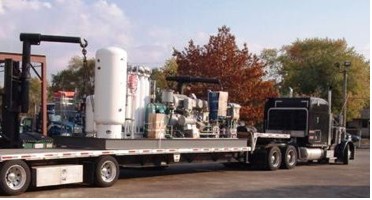
Photo courtesy of Hilarides Dairy: The biogas upgrading system arrives by truck from Michigan (but transported with conventional diesel).

GHG Targets: Compared to What?

cooling-tower-small.jpgSetting targets for greenhouse gas reductions has turned into a house of mirrors. It’s hard to know what anyone means when they talk about an “80% reduction” in emissions. Reader Steve Bloom raised this point in response to my January 15 post. It’s an important one.

Most of California’s targets are based on 1990 levels (also 80% by 2050). On the other hand, The USCAP plan announced last month by a national coalition of business & environmental groups, also aims for an 80% reduction by 2050–but from 2005 levels. That 15 years between 1990 and 2005 is hardly trivial. Much of the explosive development in China and India occurred during this time, as U.S. emissions were also rising.

The number that will matter the most is the one that comes out in the federal legislation, which is still being drafted. In his video address to the Governor’s Climate Summit in November, President (then-elect) Obama appeared to be using California’s aggressive goal as a benchmark when he promised to “set us on a course to reduce emissions to their 1990 levels by 2020, and reduce them an additional 80% by 2050.”

We’re hearing more voices saying that California’s 2020 target (about 15% from today’s level) is unobtainable, Stanford researcher Steve Schneider being a recent example (see Gretchen Weber’s post from 1/30). As a practical matter, this would mean cutting California’s per capita carbon footprint from 14 tons per year, down to about ten.

Lately more people seem to be looking toward the 2050 target of an 80% reduction. But for national policy, the question is still sort of hanging out there: 80% of what? It’s one that will have to be answered soon, as congressional leaders press to have a climate bill ready by Memorial Day.

Photo by Reed Galin

Methane Epilogue: Power from Cows and Castoffs

dig_3944-web.jpgWe have updates from some of the places we visited in our methane series, heard on The California Report. For Part 1 of the series, click here. For Part 2 of the series, click here.

At Fiscalini Farms near Modesto, John Fiscalini says he finally worked out a deal with air regulators that allows him to convert his manure into methane for electric power. His permit from the San Joaquin Valley Air Pollution Control District allows him to run the engine while he makes adjustments to minimize particulate and nitrous oxide pollutants.

He hopes to be making power by the middle of this month–more than 13 months behind schedule. Capturing the methane, of course, will make a significant dent in the carbon footprint of the farm, which has 3,000 cows (1,500 producing and 1,500 “replacements”).

He also has a grant from the U.S. Dept. of Energy, under which university researchers will install equipment to monitor the methane operation. Fiscalini says they’ll “monitor everything we can possibly monitor” and gather data to make better judgments about the efficiency and economic feasibility of methane digesters. He’s having some doubts about the economic feasibility of his own. Now, he says, water quality regulators want him to do $40,000 worth of environmental assessments, including a hydro-geologic survey and a study of his waste stream (he uses leftovers from the methane digester for fertilizer).

You may recall that we started Part One at an unidentified landfill, to explain how methane is produced and captured, and why flaring it off is better than letting the methane escape into the atmosphere. I later heard from Jessica Jones, district manager for Waste Management, which runs the Redwood Landfill and Recycling Center in Marin County, the location where I did the recording. While the landfill currently flares off its collected methane, Jones wanted us to know about some of the company’s efforts to harness that gas–potentially enough to power 4,000-5,000 homes. In an email to KQED, she wrote:

“Redwood Landfill is currently working to permit a landfill gas to energy facility which will become Marin County’s largest source of green power.  Altamont Landfill in Alameda County currently has landfill gas to energy production through the use of internal combustion engines and turbines, and is beginning construction of a liquefied natural gas facility which will convert landfill gas into a clean burning fuel which can be used to power Waste Management’s refuse collection fleet.  This type of fuel is estimated to be potentially the closest to carbon neutral of any fuel being developed today.”

There’s more about Redwood’s landfill-gas-to-energy (LFGTE) project at the company’s website. In echoes from our conversations with John Fiscalini, Jones writes on the site that there are “regulatory hurdles” to be cleared before this can happen. Sound familiar?

Photo: Stinky silage; Methane digester tanks will soon power the Fiscalini dairy farm.

Green Index a Green Light for California Economy?

ggheadlands.jpgA new study from the privately funded think tank Next 10 will be released today, making the case for an economic revival based on giving the state and the nation a “green” overhaul. The study includes the latest reading in Next 10’s California Green Innovation Index, begun a year ago.

Next 10 is essentially using California as a case study, showing that you can have it both ways; growing and greening at the same time (the same argument advanced by President Obama and Al Gore, among others), and that other states can choose to follow California’s lead. According to the report, California’s “energy productivity” is 68% higher than the nation as a whole. Next 10 defines energy productivity as the total economic growth produced per unit of energy.

Much of the story is told in one especially interesting graph (p. 14 of the report), which shows diverging trend lines for greenhouse gas (GHG) emissions and GDP (gross domestic product, by which they really mean gross state product). The graph shows that since 1990, GHG emissions, measured per capita, have dropped, despite a fairly steady rise in GDP.

Next 10 interprets that divergence to mean that emissions need not be linked to prosperity. By extension, they’re also saying that prosperity and energy efficiency do go hand-in-hand. Next 10’s economists argue that a good chunk of those economic gains came from energy savings, as the state became more efficient.

There are some flashing yellow lights in the report. For instance, while Calfornians have been able to reduce the number of vehicle miles traveled (VMT) per capita, total miles keep rising with the growing population. Reducing vehicle miles is one of the most effective (and challenging) ways of reducing GHG emissions. The newly passed anti-sprawl legislation (SB-375) aims to reverse–or at least slow–this trend.

Loaded to the gunwales with  wonky goodies, the report is more a rear-view mirror than a predictive tool. When I reminded Next 10’s lead economist Doug Henton of the old investment caveat, “Past performance is not an indicator of future returns,” he said he sees no reason to think that California’s energy productivity curve is topping out, i.e. reaching that “point of diminishing returns” that they teach you in Econ 101. He cites a record $3.3 billion in venture capital for related technologies last year.

National Cap-and-Trade Program Unveiled

California’s largest electric utility joined with a coalition of about 30 other companies and environmental groups today, in taking the wraps off a proposed national climate strategy. After two years of talks, the U.S. Climate Action Partnership, which includes PG&E, is ready to put its muscle behind it’s Blueprint for Legislative Action, just in time for Inauguration Day.

The program uses a trading program for carbon credits, much like the Western Climate Initiative, a collaboration of several western states and Canadian provinces. The goal is to roll back greenhouse gas emissions to:

> 97%‐102% of 2005 levels by 2012
> 80%‐86% of 2005 levels by 2020
> 58% of 2005 levels by 2030
> 20% of 2005 levels by 2050

While stated a little differently here, the targets reflect what has become the broadly accepted goal of cutting GHGs 80% by 2050.

A thorny question surrounding carbon trading programs is always whether pollution credits will be auctioned off or given away free to major emitters. According to the group’s “blueprint:”

“USCAP recommends that a significant portion of allowances should be initially distributed free to
capped entities and economic sectors particularly disadvantaged by the secondary price effects of a
cap and that free distribution of allowances be phased out over time.”

This would appear to conflict with the stated goals of the Western Climate Initiative, whose representatives have committed (at least verbally) to making companies pay for most credits up front. And yet the USCAP plan carries the endorsement of major environmental organizations, such as The Nature Conservancy and the NRDC, both of which are members.

As one corporate executive put it at the plan’s unveiling, “We simply think you have to give away a significant portion…and then phase them out over time.”

The USCAP plan also offers emitters the chance to buy approved carbon offsets and gives special allowances to companies that have already achieved verifiable reductions in GHG emissions–or plan to do so.

Air Board Responds to LAO Critique

The California Air Resources Board has formulated a written response to the very unflattering report by the state Legislative Analyst (LAO) described here last week. The Air Resources Board is the lead agency in implementation of the state’s attack on climate change, known by its legislative shorthand, AB-32.

The Board admits that most (70%) of the savings in AB-32 flow from one measure, the so-called Pavley regulations on vehicle emissions. But it insists that even without those, the overall plan still pencils, economically.

The Air Board also concedes that its economic analysis was not complete when it issued its “scoping plan” for implementation, but counters that it has since done some more number-crunching and that the bottom line is still a net benefit of about $300 million per year, as the first phase of the plan is unfolding. After 2012, the Board says, annual savings to Californians ramp up to nearly $3 billion.