
Tag Archives: Economics

An Hour with Stewart Brand

Photo by Ryan Phelan

Climate Watch sat down with ecologist and futurist Stewart Brand to talk about the rethinking of “traditional green pieties” that he says environmentalists will have to confront, in order to address climate change. In his new book, Whole Earth Discipline, he argues for a major change in the way “greens” have traditionally thought about stewarding the planet — one that calls for managing the earth’s natural infrastructure “with as light a touch as possible and with as much intervention as necessary.”

What do you think the world is facing in terms of climate change?

“I pretty much buy James Lovelock‘s approach that we’re warming toward an equilibrium of maybe five degrees warmer than now, which doesn’t sound like much, but the last time we were that was 55 million years ago and crocodiles were swimming around in the polar oceans. [Lovelock] thinks the carrying capacity for humans in a world that’s five degrees warmer would be about a billion to a billion-and-a-half people. And it could happen fairly quickly because there are various positive feedbacks that are self-reinforcing, amplification of change going on. A four-or-five-billion person die-back is horrible to contemplate. Nothing like it has ever happened in human history, and it does get your attention.

“I am persuaded by a number of data points he looks at and climatologists he listens to and the system dynamics of climate, which is tremendously non-linear. It has lots of these positive feedbacks in it and various thresholds. Sometimes we know where the threshold is, and sometimes we find out after we’ve passed it. Abrupt climate change, it turns out, is pretty common in the historical record and that’s what we could be looking at this century, maybe even in the first half of this century.”

You write in your book: “Accustomed to saving natural systems from civilization, Greens now have the unfamiliar task of saving civilization from a natural system: climate change.” Can you talk more about this?

“I wonder if there will be people turning up soon saying, “Let the climate do what it wants. Gaia’s just having her usual carryings-on and we must not stand in her way.” [Ed. Note: There are people already saying this] I think when it cuts this close to home, environmentalists do realize that when humans are an endangered species we’ve got to rise to the occasion and be green to protect this species and its habitat as well.

“There’s a shift that goes on because the standard, deep, ideological, emotional stance of environmentalists is that nature is always right and humans are always wrong, and this is a case when actually, nature is up to something we really, really don’t like and we have to do, as humans, something that’s right to head that off. That’s a switch. And it’s my point of leverage in the book which is to say, okay, bear that switch in mind, now think through all the things you’ve had opinions about for 20 or 30 years and revisit them.

“The climate crunch gives us permission, indeed encouragement, to rethink nuclear power, to rethink genetically-engineered food crops, to rethink how we feel about cities, and to start thinking in a serious way and an encouraging way about geo-engineering, which is direct intervention in the climate.”

The idea of “playing God” with nature can raise a lot of emotion and controversy…

“The thing is, we’ve been having god-like power in nature for a very long time, probably at least 10,000 years, maybe 55,000 years when we started doing massive burning to change the landscape in a way that we liked. In ecology, the current term is “niche construction” or “ecological engineering.” We don’t have a choice not to do it because it’s what we are doing. One of the terms for our era geologically is the ‘Anthropocene;’ the human-dominated era of geology. And so we’re already terraforming the Earth, and we’re doing it badly. So, is the choice to stop terraforming the Earth? No. Actually that’s no longer an option. The only choice is to stop doing it badly and start doing it well.”

It’s a large laboratory that we’re talking about in terms of learning from our mistakes, because we’ll be conducting our experiments (geo-engineering, bio-engineering, etc) in the world.

“We’re running an experiment in the world anyway by raising the greenhouse gas percentage in the atmosphere, and we’re starting to get results from that experiment, and we don’t like them, so we’re already doing interventionist science outside the lab in the laboratory of the world. If we don’t like what’s happening so far, we have no choice but to do better experimentation and better science and start getting the results that are better.”

How do you respond to Amory Lovins’ recent article on Grist, criticizing your position on nuclear power?

“I think it’s great that Amory Lovins, who is an old friend, has put up a rebuttal to my chapter on nuclear in the book. I think that’s absolutely fair and right since my whole chapter is basically a rebuttal of his anti-nuclear arguments.* I respect him enormously for most of the things I think he’s right about. I think he’s wrong about nuclear. He thinks I’m right about most things, and that I’m wrong about nuclear, so that’s the debate.”

*Last week we posted highlights from a conversation with Amory Lovins, aired originally on KQED’s Forum program. Brand’s name was not evoked in those excerpts but Lovins was critical of the idea of a nuclear power revival, dismissing it as financially unsupportable.


Mottainai! Saving Energy as Cultural Value

Follow Rob’s quest for understanding of Japan’s energy efficiency on this interactive map.

While reporting my series on Japan’s energy efficiency, I’ve come across a list of explanations from economists, government officials, industry insiders, and Japan experts about how Japan became the most energy-efficient country in the world (measured by greenhouse gas emissions per unit of GDP). Most of the reasons revolve around Japan’s lack of fossil fuels; a market-based supply-and-demand answer.

A few weeks ago, when I met with Ikutoshi Matsumura, he gave me the same answer. I let him finish, and then pushed harder: “But Matsumura-san, there are many countries, like Japan, that are equally resource-poor, and they are very poor and struggling. Why is Japan different?” Matsumura, an executive at Nippon Oil, Japan’s largest oil company, started chuckling [Ed: Matsumura also appears in Part 2 of Rob’s radio series as head of Japan’s Fuel Cell Association. He’s that, too]. He admitted that he, too, had thought this over during his lifetime, and that the conclusion he always reached was that there were more than market forces at work here. The deeper reason was cultural.

The 750 year-old Great Buddha of Kamakura. How much of Japan’s energy-saving path is cultural?

“Japanese culture has always emphasized education and hard work,” he told me. “The reason we succeed is because of our human resources, not our lack of natural resources.”

One last Mochi + Nobody to eat it = a Mottainai moment.

Mottainai is a term in Japanese that roughly translates to “What a waste.” The concept is an ancient one based on Buddhist philosophy. The meaning of Mottainai is that one should never waste anything. Buddhists traditionally used the term to show regret for wasting something sacred, such as religious lessons. In modern colloquial Japanese, Mottainai is often heard. If a child doesn’t finish his rice, his parents will spit out “Mottainai!” If you forget to put the newspaper in the recycling bin, a neighbor will see this and whisper “Mottainai” under her breath. You get the idea.

In 2005, Nobel Peace Prize winner Wangari Maathai visited Kyoto from her native Kenya, and learned about the word. A world-famous environmentalist, Maathai quickly applied the word to climate change. She’s reportedly used the word on her lecture tours, and while addressing the U.N. Commission on the Status of Women, she led the audience in a ‘Mottainai’ chant. Maathai’s publicizing of Mottainai prompted the Japanese government and non-profits to start using the word as a call to protect the environment, too.

“Things like this often happen in Japan,” says Japanese Sociologist Yuko Kawanishi, ” Although we are the world’s second largest economy, there is something in the Japanese mind that unless something is recognized and valued by non-Japanese, there will not come the realization that ‘Oh, we have such a wonderful thing.'”

I spoke to Kawanishi about Mottainai prior to my trip in August. She’s finishing up as a visiting scholar in New York. I asked her if the concept has helped Japan become so energy efficient. “It might have helped us to exercise the spirit more easily,” she told me, but she added other important cultural traits. “It’s something about Japanese people’s collective social psychology….the Japanese people follow instructions easily. There’s also a lot of peer pressure, sort of watching each other. And also there’s this disposition among Japanese to be meticulous and thorough to whatever task is assigned to them, so if the task is to save as much energy as possible, they’re more likely to really put a lot of effort toward it, and they’ll watch each other to make sure the others are doing it as thoroughly as they are.”

Kawanishi added that this dynamic combination of internal values is not comfortable for the Japanese, but when applied to protecting the environment, it works.

An Hour with Amory Lovins

In case you missed it amid the flurry of climate-related news last week: On September 30, Amory Lovins, founder and chief scientist of the Rocky Mountain Institute, and an honest-to-goodness energy guru to many, spent an hour in conversation with Michael Krasny and callers to KQED’s Forum program. You can listen to the entire archived broadcast or scan some of the highlights here, compiled by Climate Watch intern David Ferry.

On China:

“We can count on China to lead the world out of the climate mess…Even though the U.S. has led the world in wind installations the past three years, this year China’s going to pass us so fast we won’t even hear them go by. China’s doubled its wind installation each of the past four years, and there’s a new paper in Science from Harvard and Tsinghua in September saying that China can meet all its electric needs–not the growth but the total–till at least 2030, cost effectively, from its wind resources.”

On Nuclear Power:

“Basically nuclear and coal plants are getting walloped in the global marketplace by efficiency and renewables and cogeneration because they’re a lot cheaper and they have less financial risk so they can attract private investment.”

Grading the Obama Administration on Renewables:

“Greatly improved and I think on the whole doing very well.”

On the Upcoming UN Climate Talks in Copenhagen:

“I’m cautiously optimistic…But remember that governments are usually the last to figure these things out. Most governments still think climate protection is costly. They haven’t figured out yet that economic theorists got the sign wrong and actually climate protection is profitable. Once you change the conversation from cost, burden and sacrifice to profit, jobs and competitive advantage it makes the politics a whole lot easier.”

On Energy Efficiency & Steve Chu’s “Low-Hanging Fruit” metaphor:

“The technologies keep improving faster than we use them, so efficiency is an ever bigger and cheaper source–it’s as if the ‘low hanging fruit’ had fallen on the ground; it’s mushing up around the ankles, it’s spilling in over the tops of our boots and the efficiency tree keeps dumping more fruit on our heads.”

On Large-Scale Solar Farms v. “Distributed” Power Generation:

“The sun is distributed for free. Why gather it in one place and then pay to spread it out again? The National Renewable Energy Lab says if we put solar cells on seven percent of the structures in this country it would run all our electric needs without using any land. And for that matter, the wind potential on available windy land in this country is several times our total electric need and the footprint is actually very small.”

On Whether Climate Change is Irreversible:

“There are a half-dozen known mechanisms of rapid climate change. Several of them show like they may be starting up, so it’s urgent to reverse that…we have plenty of technology already available to stabilize climate to the extent that irreversible changes have not already started. We don’t know what that extent is, so we ought to go full bore on best buys first and hope that we’re in time.”

You can also take a virtual tour of Lovins’ home in Colorado, which doubles as a laboratory for energy innovation.

Keeping Up with the Sakakis

Rob’s companion radio report to this post begins his series: “Rising Sun: Why Japan is Winning the Energy Race.” Part One airs Monday on The California Report.

Meet the Sakakis: Thirty-something mom and dad Yukiko and Hiroshi, and their three-year-old daughter, May. They’re a typical Japanese family: they live in the Tokyo suburb of Musashino, they have one child (and they’re stopping there, they say), and both parents work to afford a middle-class lifestyle.

The modern-day energy-saving Japanese family

I visited the Sakakis to get an idea of how an average Japanese family consumes energy. I left their home with a greater understanding of why Japan is a much more energy-efficient country than ours.

I visited the Sakakis on a Saturday. It was 85 degrees and muggy outside; a typical early September day in Tokyo. Despite the conditions, the Sakakis weren’t running their air conditioner, opting instead to open the windows and close the drapes to their two-bedroom apartment, in order to block out the sun and let a humid breeze flow through. When I asked them why the AC wasn’t on, Sakaki-san went to his desk drawer and pulled out his electricity bill. The Sakakis pay 24 yen per kilowatt-hour. That’s equivalent to about 30 cents in U.S. currency. That’s also roughly twice as much as Californians pay for electricity. Despite their frugal energy habits and diminutive quarters, the Sakakis pay what amounts to a little over $100 a month on electricity. They spend around the same for natural gas each month.

The typical Japanese fridge: several doors to save energy when opening it, and a compact size to accommodate the Japanese habit of shopping every few days (this is a large fridge, by Japanese standards, say the Sakakis).

Energy is expensive in Japan. The country has no domestic fossil fuel resources, so it has to import them. The government taxes its citizens heavily for energy consumption, and then uses the revenue to put Japan at the forefront of renewable energy R&D. This has made Japan a world leader in solar panel sales and it’s put the country years ahead of the rest of the world in the development of other innovative energy-saving technologies like hydrogen fuel cells and batteries for electric vehicles. According to Japan expert Llewelyn Hughes at George Washington University, Japan leads the world in green technology patents. “It’s not even close,” he told me in an interview to prepare me for my trip.

Like many Japanese families, the Sakakis share their bath water each evening. Their high-tech bath includes a temperature control mechanism and panels to trap the heat.

All of these technological innovations mean Japan is poised to emerge from the global recession with great economic potential. It also means that the Sakaki household has some very cool gadgets: a refrigerator with several different drawers in order to separate perishable items and save energy, a floor that heats up in the winter, and a bath that talks to them.

And Now, the Senate Show Begins

Senators Barbara Boxer (D-CA) and John Kerry (D-MA) have released their climate bill into the maw of Senate committees. Their Clean Energy Jobs and American Power Act is designed to cut greenhouse gas emissions by 20% from 2005 levels by 2020, with a long-range goal of 80% by 2050.

Sen. Boxer told me in an interview today that five committees have jurisdiction over various pieces of the legislation, which runs about 800 pages at this point (versus 1,400 for the version that narrowly passed the House). She conceded that it’s unlikely to clear the committee gantlet and get to the Senate floor in time for the next major round of U.N. climate talks, set for December 7 in Copenhagen.

Given multiple major distractions such as economic recovery, health care reform, and two ongoing wars, Boxer predicted that it would likely be late December before a version of the climate bill could come to the floor. She said “I have a hunch we’re going to be in until Christmas Eve, frankly.”

Box says she and her colleagues have “broadened the coalition” since a House version of national carbon legislation squeaked through by nine votes over the summer. “We think at the end of the day, they (skeptics) will realize that this is the most flexible way to stand up and fight this challenge called global warming.”

Boxer counterposed this “flexibility” with what some consider the likely alternative; non-legislated regulation of greenhouse gases by the Environmental Protection Agency, under the decades-old Clean Air Act. Coincidentally or not, EPA took a step in that direction today by announcing proposed new requirements for large industrial emitters of carbon dioxide.

EPA’s proposed “tailoring rule” covers six known greenhouse gases produced by power plants, oil & chemical refineries and other large-scale operations. Boxer says she doesn’t see the announcement as competing with Congress. “I think this is a very important signal to my colleagues that the EPA wants to work with us. They’re just going after the biggest polluters and that’s following our lead.”

As for “subnational” initiatives like the Governors’ Climate Summit, going on this week in L.A. (and where EPA chief Lisa Jackson chose to announce the new rules), Boxer said her bill “should encourage the Governors to keep on going. Keep on keepin’ on because the more we all do, the easier it will be in the end.”

Boxer said “We have to step up here or we’re going to see the terrible results of unchecked global warming. This is the moment,” she said. “We’re losing the window.”

Lauren Sommer is covering the L.A. summit for Climate Watch. Watch for her daily posts.

Governor: RPS Order “Stronger than Law”

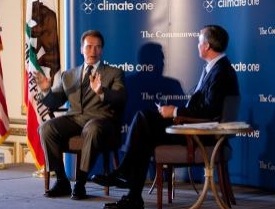
Gov. Schwarzenegger fields questions from Greg Dalton of the Commonwealth Club's Climate One initiative. Photo: Governor's Office

Governor Arnold Schwarzenegger is defending his planned veto of two renewable power bills, saying the executive order he issued instead is “stronger than the law” because it places fewer limitations on electricity imported from other states.

At the tail end of the legislative session, California’s assembly and senate passed separate bills requiring the state’s utilities to draw a third of their energy from renewable sources by 2020. But during a Q&A session at San Francisco’s Commonwealth Club Thursday, the Governor said that the recently passed bills were “for special interests” and that they “represented protectionism,” the latter a reference to limits on how much energy could be imported from neighboring states. The Governor’s own executive order has the same proportional requirement or “renewable portfolio standard” (RPS) as the bills but sets no limits on imported power. Also unlike the legislature’s bills, the order does not exclude particular sources, such as hydro-electric from the definition of “renewables.”

Critics contend that succeeding governors might simply rescind the order, which Governor Schwarzenegger does not deny. He faces an October 11 deadline to veto the bills.

Governor Schwarzenegger’s appearance was designed to mark the third anniversary of the state’s adoption of AB 32, the Global Warming Solutions Act of 2006, a law which has its own detractors.

Meg Whitman, the former CEO of eBay, who is running for governor said last week that she would issue a moratorium on most AB 32-related rules on her first day as Governor.  When asked about  Whitman’s remarks Schwarzenegger dismissed her comments as “just rhetoric.”

“I think she will probably reconsider what she has said and will see that the greatest thing that can happen for California is to move forward. I’m sure she does not want to be counted as one of those Republicans that want to move us back to the Stone Age,” he said.

Touting the state’s achievements in renewable energy innovation, emissions reductions,  and technology, the Governor painted a rosy picture of an invigorated economy, new jobs, and a cleaner environment throughout the state.

“A wave of green innovation is washing over our state right now,” he said.  “In last three years,  scientists and entrepreneurs have pumped more than $6 billion of venture capital into California.  Since 2005, green jobs in California have grown ten times faster than other jobs. California companies hold more than 40% of the nation’s new patents in solar and wind technology, and solar installations this year alone in California have gone up by 120%.”

Focusing largely on projected economic benefits, he made a case for continuing on the path California started three years ago with AB 32 and is continuing under his executive order from earlier this month, saying that the current path offers far more economic opportunity than economic risk.

“I know that it’s possible to protect the environment and the economy at the same time,” he said. “Technology will save us all. It’s all about technology, technology, technology. ”

Not all of the speech was about legislation, green technologies and the economy, however. The Governor did respond to a question from  group of fourth-graders attending the talk, asking what he says to his children about climate change.

“I’ve had major fights with my kids,” he said.

He said he has imposed a five-minute shower rule in his house and that he sometimes “spies” on his children to make sure they are obeying his order.

“If their showers are more than five minutes, there will be consequences.”

He added that other environmental steps his family has taken at home are to install solar panels nearby to provide energy for the family swimming pool and jacuzzi, and that they have converted the regular engines on their Hummers to hydrogen or bio-fuel engines.

Notebook Lost, Work Ethic Found

Rob Schmitz continues his dispatches from Japan, where he’s reporting on that country’s aggressive approach to energy efficiency–and what lessons we might take from them. Rob returns to KQED’s Los Angeles Bureau in October–with his notebook.

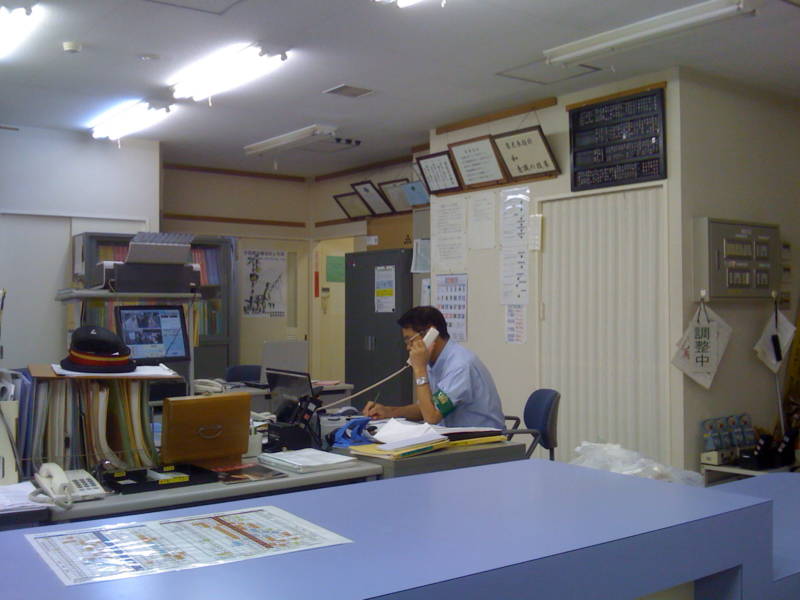
Today I left my notebook on the train to Ota. In it were notes of all the interviews I had conducted since arriving in Japan. Throughout my day of reporting, I repeatedly asked to borrow my interpreter’s notebook, and by the end of the day, I was depressed with the thought of having to listen to hours of tape that I had meticulously transcribed over weeks of interviews. When we returned to the station, my interpreter, Chiaki, took me to the station master’s office. That’s where I met Mr. Aiba.

My Travelling Notebook

Aiba-san was in his 50s, tall, thin, graying hair, glasses, and, like most Japanese in his position, incredibly polite. He wore a blue uniform and a green band around his arm with ‘security’ written on it in Kanji. Aiba-san listened intently to Chiaki’s every word describing the notebook, where I left it, and how important it was to me. He asked follow-up questions: “What are the approximate dimensions of the notebook? Is your name on the notebook?” and so on. As Chiaki answered, he took notes.

When he was finished, he offered us a seat, briskly walked to his desk, and picked up the phone. He called other stations, he called cleaning companies, and he consulted timetables. In between calls, he updated us: “The train you were on has made three round trips from Tokyo to Akagi today. Cleaning crews in many cities have cleaned the train several times.” Aiba-san briefly left the room while he waited to hear from the cleaning crews. He returned with some tea for us. A minute later, he received a call from the cleaning crew in Akagi, a city in the mountains at the end of the line: they found my notebook. Nobody had claimed it, so it had been tossed into a recycling bin. It was waiting for me on the platform there.

Aiba-san, getting the job done.

“But you’ll have to hurry,” said Aiba-san, looking at his watch. “The train to Akagi leaves in less than one minute.” He escorted us, running frantically in the lead, to the platform. We barely made the train. I had a few seconds to reach into my bag to give him a box of See’s chocolates that I had brought as a gift for my interviewees. He sternly declined the gift, but I insisted.

When we arrived to the tiny Akagi station, two elderly custodians with brooms in their hands were waiting for us on the platform. They bowed in unison to me and handed me my notebook. They had neatly wrapped it in a copy of the train’s timetable. This is just one of many examples of the generosity and commitment to service that I’ve experienced in my short time in Japan. Had I lost my notebook on a train or a bus back home, would anyone care? They probably would’ve laughed me out of the station at the thought of tracking it down.

Now, take this behavior to a macro level and you start to see why Japan, an island nation with no fossil fuels and few resources of any kind, has become the second largest economy in the world. When Japan puts its collective mind to something, it not only gets the job done, but it oftentimes excels at it. From my conversations with government officials, business leaders, and those in the non-profit sector here, it’s obvious that Japan is not only committed to reducing greenhouse gases, but perhaps more importantly, it wants to make a lot of money from doing so.

In short, it wants to ensure that its companies own and make as much of the technology that goes towards this global effort as is possible, and it’s got a head start. Japan leads the world by a long shot in registered patents in the green technology sector, according to a report from CERNA, the Centre d’Economie Industrielle. Check out the final pages of that report, which compare countries, and you’ll see Japan leads in every patent category except one. Japan is getting the job done, just like Aiba-san stepped up to do his job when I sought his help. It’s a spirit that’s refreshing to be around. We could use a few more Aiba-sans back home.

Scotland Rising to Carbon Challenge

This dispatch came in from Alison van Diggelen after a recent visit to her home country. Van Diggelen is a freelance writer and interviewer and founder of the Fresh Dialogues website and podcast. Originally from Glasgow, she now makes her home in Silicon Valley.

Scotland Aims to Beat California on Climate Change Action

By Alison van Diggelen

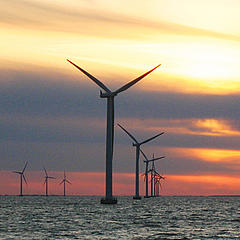
Wind turbines off Scottish coast. Photo: World Wildlife Fund

It’s not often that Scotland is ahead of the game compared to California, but on the issue of climate change, this small northern country has taken a legislative lead that has put it on the green map of the world.

As the California Legislature this week grapples with new laws* requiring utilities to get 33% of their energy from renewable sources by 2020, Scotland is sitting pretty. It is already close to its 31% target of energy from renewables by 2011 and has an even bolder target of 50% by 2020.

On a trip to Scotland this summer, I met with Lena Wilson, CEO of Scottish Enterprise, a government-funded organization that promotes Scottish interests both at home and abroad. She told me that the fight against global warming is a crucial part of the government’s strategy because ultimately a low carbon future is an economic stimulus and job creator for the country.

But how did Scotland muster the political will to set such ambitious targets? Scotland’s First Minister, Alex Salmond is passionate about renewable energy, Wilson told me; and establishing Scotland as a hub of green energy and green-tech is key to his strategy. Part of the plan is to harness its natural resources – powerful wind and wave power, estimated to account for a quarter of Europe’s potential. Salmond recently opened the largest wind farm in Europe to drive home that point. It’s on the outskirts of my home town of Glasgow and makes me rather proud.

Yet, making bold targets isn’t the end of the story. Scotland must create a whole ecosystem to make green growth attractive in Scotland. It launched the Saltire Prize last year to stimulate innovation in wave and tidal power; but still has ground to cover. As well as the financial, administrative and logistical challenges, there’s the issue of NIMBY-ism. Although Wilson insisted they’re pursing a popular green agenda, some of the locals I talked to in Scotland were less enthusiastic about the aesthetics of wind turbines.
And then there’s the “nuclear option.” Just as in California, the issue is red hot. Salmond is publically against it, but if he wants to keep shining his low carbon credentials, he may be forced to rethink his position.

One final note: When I asked Wilson, is your boss, Alex Salmond the Al Gore of Scotland? Her response was enlightening. She almost choked. Being a staunch nationalist, union man and former socialist, she doubted he’d enjoy the comparison. On my next trip, I hope to discuss this with the man himself and find out exactly how his passion for green took root. Stay tuned.

*State legislators passed two bills during their overnight session on Friday. Here’s a summary provided by the advocacy group Environment California:

AB 64 (Krekorian) & SB 14 (Simitian): AB 64 and SB 14 are companion bills that together set California on the path toward producing 33% of its electricity from renewable resources like solar and wind power. While there was much controversy over amendments to the bill that add in language for PG&E to potentially build large hydroelectric dams in British Columbia and call it renewable energy as well as amendments pushed by British Petroleum and Chevron that put 7,000 MW of fossil fuel burning combined heat and power plants ahead of renewable energy, the two bills still stand to become the biggest renewable energy mandate in the country”

Japan’s Climate Plan: Too Ambitious?

KQED’s Los Angeles Bureau Chief and frequent Climate Watch contributor Rob Schmitz is spending six weeks in Japan, as part of  the Abe Fellowship for Journalists. In the weeks to come he’ll file a series of special reports on Japan’s extraordinary strides in energy efficiency–and what we might learn from them.

Saturday night, on my way home from an interview, I witnessed one of the more interesting orchestrated movements of humanity the world has to offer. I shot this video when I was changing trains at Shibuya station, one of Tokyo’s busiest. The intersection shows how well Japan engineers pedestrian movement–but how well will it engineer its residents’ greenhouse gas emissions?

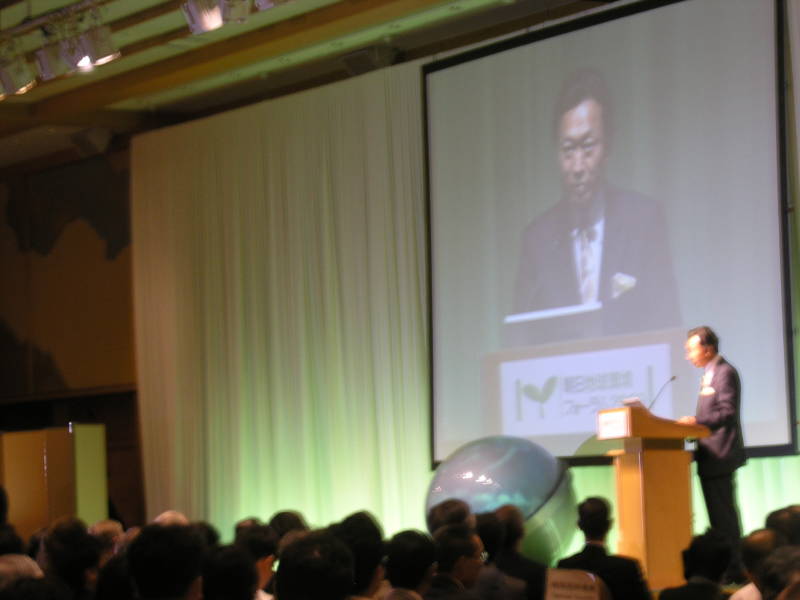
On Monday, I attended the Asahi World Environment Forum, where all the bigwigs on climate change were in attendance (including Yvo de Boer and Rajendra Pachauri, among others). The surprise visitor was Japan’s Prime Minister-elect Yukio Hatoyama.

Hatoyama makes his climate change pledge.

He told a packed house that Japan will aim to reduce its greenhouse gases by 25% from 1990 levels by 2020.

“In my personal opinion, that’s impossible,” Hidetoshi Nakagami told me last week. Nakagami is President of the Jyukankyo Research Institute and holds a coveted seat on the advisory committee to Japan’s powerful Ministry of Economy, Trade, and Industry, or METI. “Hatoyama’s pledge is pure politics,” he said. “It’s not practical, it’s not possible, and there’s not enough time.”

Nakagami is not a pessimist. He played a large role in creating Japan’s very successful Top Runner program, a 1997 policy that searches for the most efficient model of any given electrical appliance and then makes that model the industry standard, requiring other companies to adhere to it when making new models of the same appliance. The program was one of Japan’s most ambitious energy efficiency measures, and Nakagami had to fight against Japan’s largest companies in order to help craft the policy into law.

While Nakagami would like to see a one-quarter reduction in greenhouse gases from 1990 levels in the next decade, he says it’ll cost the average Japanese dearly. When former Prime Minister Taro Aso pledged to cut Japan’s greenhouse gases by 15% of 2005 levels, Nakagami’s institute estimated that the effort would cost each Japanese household, on average, 70,000 yen–a little over USD $700–a year. Even that, says Nakagami, would be a tall order in this economy.

In the end, Hatoyama may not fill this order. His historic pledge, which during his campaign, seemed to have no strings attached to it, now has an important caveat. At Monday’s forum, he told the audience that Japan will embark on this journey as long as other major countries also set similar ambitious targets.

Japan’s future hanging in the balance.

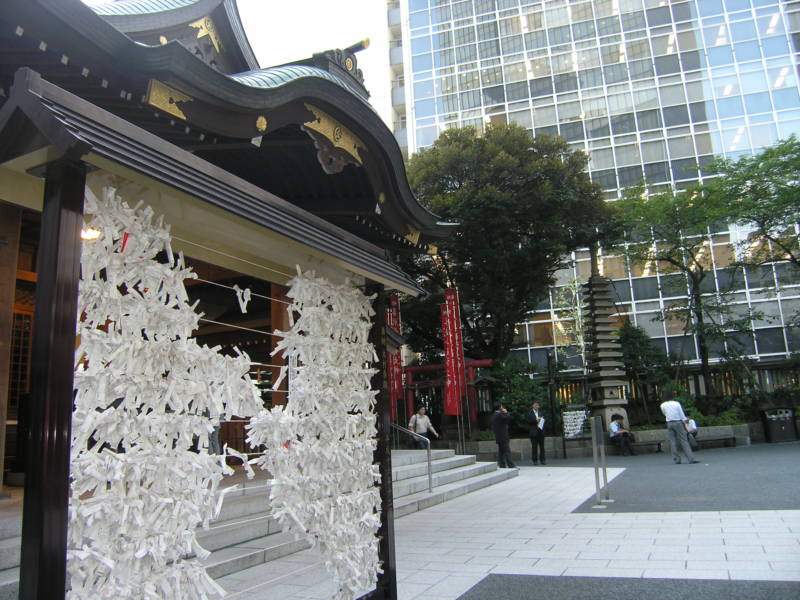
After the forum concluded, I walked outside into Tokyo’s rush hour: pedestrians everywhere, taxis speeding by me. I stopped at a Shinto shrine built among enormous glass skyscrapers. In front stood an Omikuji shrine, where believers tie a paper copy of their fortune, with hopes that it’ll come true. Hundreds of paper fortunes rattled in the hot, summer wind. I wondered if one of them was Hatoyama’s.