Tag Archives: Economics

Everything You Know (About Water) is Wrong

If Dan Brekke isn’t editing newscasts at KQED Radio, chances are that he’s poring over charts full of arcane statistics from the state Department of Water Resources. Call it a hobby. Okay, call it an obsession. Either way, we frequently turn to Dan for his insights into California’s water conundrum.
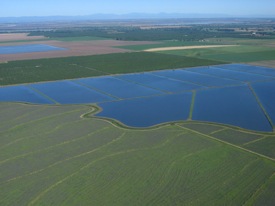
Flooded rice fields in the Sacramento Valley. Photo: Craig Miller

Everything You Know is Wrong

By Dan Brekke

California is home to 37 million people—and to 37 million water experts. If no one’s ever said that, someone should have.

There’s nothing more central to life here and no subject that excites stronger opinions. Recent events have shown that those opinions can easily harden into certainty about what needs to be done to solve all of California’s water problems—the needs of those 37 million people, the needs of the state’s incomparably rich agricultural industry, the needs of native fish and ecosystems.

We’ve long since learned that one person’s “solution”—to build dams and divert water for farms and cities, say—can be another’s nightmare—for instance, the communities that depend on healthy fisheries for their well-being. The conflicts over water are so deep and longstanding that they can make rational discussion difficult or impossible.

This week, though, the Public Policy Institute of California published a report that aims to inject some understanding into the water debate by challenging opinions and misconceptions. The report tests eight widely-held beliefs about water against the complex realities that underlie them. The first myth is fundamental to how we see water issues: “California is running out of water.” The reality the PPIC and its all-star panel of water experts propose is a sobering one: “California has run out of abundant water (our italics) and will need to adapt to increasing water scarcity.”

There’s something in the list of myths to rankle just about everyone. One myth goes like this: “[Insert villain here] is responsible for California’s water problems.” The report goes on to assess several villain-candidates, including:

– Wasteful Southern California homeowners with their lush lawns and luxurious swimming pools,

– Farmers who get federally subsidized (read “cheap”) water, and

– Protections for endangered species (as in “Why are we giving water to that Delta smelt?”).

In reality, the report says, coastal Southern California does an excellent job of limiting residential water use; farmers getting cheap water are in fact paying a price for the subsidy and are becoming more efficient water users; and actions taken to protect the smelt has had a comparatively small impact on water shipments through the Delta.

The PPIC says in the introduction to “California Water Myths” that a “policy based on facts and science is essential if California is to meet the multiple, sometimes competing goals for sustainable management” of water for the rest of the century. No one can argue with that, though it’s certain that squabbles over water will persist. Maybe the best we as Californians can hope for is an honest effort to try to understand the needs of all other water users, and to give each of them the benefit of the doubt when considering solutions to our water problems.

The PPIC report: “California Water Myths,” is available on the institute website or in an excellent interactive version put together by the UC Davis Center for Watershed Sciences.

Meanwhile, how are we doing this winter? Not great. Below is an interactive map of California’s major reservoirs, comparing their current levels to average or “normal” levels for this time of year.

View KQED: California Reservoir Watch in a larger map

Delegate’s Dispatch No. 2

Louis Blumberg directs the California climate programs for The Nature Conservancy. He’s also been keeping us posted as an official observer to the UN climate conference. And yes, views expressed in his guest posts are his and not necessarily those of KQED or the Climate Watch staff.

Things Heat Up Copenhagen
By Louis Blumberg

Emotions erupted at the Bella Center today during the United Nations climate change conference in Copenhagen, Denmark. Demonstrations, street theater, leaked documents, heated words, threats of walkouts and huge crowds all collided to increase the energy level throughout the massive hall. Frustration was driven in part, according to one of the key treaty negotiators, by the fact that little progress has been made.

At this point in the process, the open meetings have stopped and negotiators are meeting in private to work out their differences. This loss of transparency was exacerbated when demonstrators disrupted one of the last public plenary sessions of the week and the organizers threw out representatives from all non-governmental organizations–including me.*

As discouraging as this emerging gridlock is, my optimism remains because I see that three key pieces, which are falling into place, can produce a real deal:

– First, for the first time ever, key countries, including the U.S., China, India, Brazil and Korea, have all put numerical proposals on the table to reduce emissions.

– Second, as I reported before, the U.S. is providing real leadership, in part by proposing a $10 billion annual fund to help developing countries reduce emissions and adapt to climate change while continuing to grow their economies.

– Third, President Obama and 110 other heads of state will arrive next week for the final negotiation.

In the meantime, the process of creating a new international treaty amps up…

Yesterday I joined 200 activists in a standing ovation for EPA Director Lisa Jackson as she confirmed U.S. leadership by listing the administration’s actions to fight climate change, including this week’s official finding that greenhouse gas endangers human health. [Ed. Note: This creates authority for the EPA to regulate greenhouse gases on its own, with or without enabling legislation].

African countries called for more forest protection. Delegates from one island nation faced with imminent destruction by flooding due to sea-level rise, threatened to walk out on the talks unless the developed countries exhort to cut emissions by 95 percent.

I, alongside a coalition of forest activists, struggled (in what may be a futile attempt) to close a new loophole in emissions reporting rules proposed by some European countries.

And finally, the energy, passion and idealism of demonstrators in costume–walking trees, polluters dressed in red, vegans for climate, and Mr. Green (you can figure that one out on your own)–were both captivating and inspiring.

The frenetic pace is both tiring and energizing and will only increase as we move toward the conference closing on December 18. But there is much more to come before then. Stay tuned.

*Ed. Note: We’re using the term “delegate” somewhat loosely here. Blumberg is a member of The Nature Conservancy “delegation” in Copenhagen but technically he’s an official observer, as are all NGO reps. That’s why he can be tossed out of sessions.

Hopenhagen II: A Delegate’s View

Louis Blumberg is a COP 15 delegate and Director of Climate and Forest Policy for the Nature
Conservancy in California.

Update from Hopenhagen

By Louis Blumberg

The sense of possibility pervaded the halls Monday, infusing energy and 
optimism into the delegates at the UN climate change conference in
 Copenhagen, Denmark. As in prior years, the sheer magnitude of the event 
was inspiring. More than 10,000 participants attended today, thousands 
of whom (including this participant) waited patiently in line for hours
 to get inside.

In one room, representatives from 192 nations sat shoulder-to-shoulder
 in the discussions, and each country was given an equal voice. Two seats
 were allocated to Gabon and two for the U.S., two for China and two for
 Monaco, and so on.

At home in San Francisco, much of my work is focused on addressing
 climate change in California, and we have made great progress as a
 state. Now, seeing the whole world gathered in one room (figuratively
 speaking), it is a powerful reminder that the work we are doing in 
California can be applied anywhere, whether in Australia, Peru or China.
 We are all in this together and can learn so much from one another.

This is the 15th meeting for the “Conference of Parties” (hence “COP 15”), a follow-up to 
the 1992 UN Framework Convention on Climate Change, which resulted in the first global climate agreement ratified by 192 nations, including the U.S. Each year preceding that conference, global delegations have 
met to discuss how to address climate change. The most notable agreement
 happened in 1997 in Kyoto, Japan. Dubbed the Kyoto Protocol, it 
ordered 37 industrialized nations to cut greenhouse gas emissions. The
 U.S. rejected that pact, and since then our federal government has shown little-to-no leadership on the issue.

But what a difference a year makes. In its first public statement at the 
conference, the United States addressed two key issues head-on with commitments for action: First, a pledge to reduce emissions of
 greenhouse gases by 17% by 2020; and second, a $10 billion pledge with
 other nations intended to help developing countries grow their economies
 while cutting emissions. U.S. envoy Jonathan Pershing spoke forcefully,
 signaling that a new regime in Washington meant real leadership on
 climate change for the world.

Despite public skepticism, it has become clear that something is going
 to happen here. People from all over the world have come together to solve the most serious problem of our lifetime. Nothing less than the 
future of nature and humanity is at stake. I just hope the agreement is
 sufficiently strong and that action happens quickly.

Climate Watch in Copenhagen

Earthshine_NASAClimate Watch begins it’s coverage of the UN’s COP 15 climate talks in Copenhagen this evening, when KQED’s This Week in Northern California airs my recently taped interview with former Vice President and Nobel Laureate Al Gore. The original 20-minute interview has been “edited for TV,” down to about nine minutes. The full interview is to be posted on This Week’s website.
The interview begins with Gore’s assessment of the upcoming climate conference and then moves on to California’s role, the hype surrounding “green jobs,” controversy over climate science, his new book, and other topics. Regrettably, the interview was recorded before the eruption of the email scandal now known as “Climategate,” so I wasn’t able to get his take on that.

It’s pretty hard to spring anything on Gore. He’s heard every question there is to be asked about a thousand times and has carefully crafted, well-rehearsed answers to all of them. He did seem slightly off-balance when I asked him about FactCheck.org’s conclusions about some of the green job creation hype.

On Monday, our radio and online coverage begins in earnest when the first of Rob Schmitz’ reports from Copenhagen airs on The California Report. Schmitz, KQED’s Los Angeles Bureau Chief, arrives there on Saturday and will be there for the entire two weeks of events and negotiations. He’ll provide radio reports and frequent blog posts, covering–among other things–the appearance of California Governor Arnold Schwarzenegger on “Subnational Day.” In a climate-related media event on Treasure Island this week, Schwarzenegger said his mission in Copenhagen would be to rally governors, mayors, provincial leaders and other subnational players, to continue their own progress toward greenhouse gas emissions and not wait for national governments and international bodies to take action.

Also on Monday, Rob and I will join host Michael Krasny and NASA climatologist James Hansen on KQED’s Forum program. Hansen was the original climate whistle-blower, complaining that the Bush administration was muzzling climate scientists. Hansen has since taken a hard line against the upcoming efforts in Copenhagen, saying that cap & trade is the wrong path to climate intervention (both Gore and Hansen are promoting new books of theirs).

Invasion of the Electrics

If the electric car was indeed “killed,” as a popular documentary suggested not long ago, the floor at the Los Angeles Auto Show this week would suggest a mass resurrection not seen since Night of the Living Dead. Climate Watch contributor Alison Hawkes reports on some implications for the power grid. Her radio report airs Friday on The California Report.

By Alison Hawkes

Electric vehicles may be few in number over the next few years, despite the hype around the release of off-the-assembly line EV models in 2010. It takes several decades to flip the American vehicle fleet.

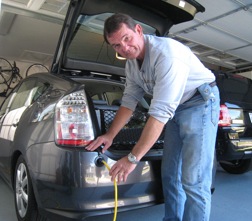
Robert Susich offsets his charging with rooftop solar.  "This is the way of the future," he says. Photo: Alison Hawkes
Robert Susich offsets his charging with rooftop solar. "This is the way of the future," he says. Photo: Alison Hawkes

But there’s little doubt that EVs are coming, pushed on by anxiety over foreign oil and unexpected spikes in gas prices, growing environmental awareness, and government incentives. Starting at the end of December, EV buyers get a federal tax credit of between $2,500-to-$7,500 per vehicle, depending on the battery size. There are other tax credits for plug-in conversions and even electric motorcycles and electric three-wheelers. Now who doesn’t like a tax credit?

All this may sound promising but energy planners have some serious head-scratching to do as Americans begin switching their transportation fuel from gasoline to electricity.

For starters, how do you avoid building extra power plants? Who pays for infrastructure upgrades to electrical substations and transformers? How do you get EV drivers to charge during off-peak hours when the energy supply is now wasted?

Pacific Gas & Electric’s smart grid director Andrew Tang says utilities have faced similar problems before with the advent of air conditioners in the 1970s and plasma screen TVs in the 1990s. New technologies add to the demand on an already tight energy market. “It’s a form of load growth and we’ve managed to deal with it without having sudden power outages,” says Tang.

But, Tang admits, EVs could bring a heavier strain on the grid than any seen before. One EV can draw as much energy as a house. Put another way, that’s doubling a household’s demand for power. Fortunately, it sounds like the utilities have some time, and capacity, to see how the EV market develops.

PG&E is expecting to support some 250,000 vehicles by 2020, which may not seem like much for a 70,000 square-mile service territory. But they won’t be spread out evenly. The northern California utility is expecting EV drivers to congregate in certain neighborhoods, potentially sending substations and transformers into overload (read: blackouts) if not properly managed. Tang said PG&E did a study of hybrid electric vehicle registration over the last four years and found that Fresno’s portion of hybrids was 2.4 percent, while Berkeley’s was 18 percent. “That’s much more concentration,” says Tang. “We think that’s a fair proxy of what we could have with electric vehicles.”

So the California Public Utilities Commission is now exploring ways to regulate EV’s. The basic question is how to influence consumer behavior so EVs do not add to peak energy demand. No one wants blackouts, and no one wants to build more power plants. One idea bandied about is a differentiated rate system that encourages EV drivers to charge during off-peak hours at deeply discounted prices, called a “time of use rate.” Another idea promoted by the PUC’s independent Division of Ratepayer Advocates is a five-dollar monthly fee on EV drivers that would go into upgrading grid infrastructure, like adding or upgrading local transformers, as needed.

“If electric vehicles need (additional) infrastructure, they should pay for it and not spread the cost across all ratepayers,” says DRA’s deputy director Dave Ashuckian.

EV drivers may bristle at being treated differently than other power users, especially when they feel they’re doing society a favor by switching to a cleaner fuel source. Early adopters may be happy to help optimize the grid. But if EVs go mainstream, energy planners know the public is going to want a more convenient system.

Automated smart metering (you’re not in charge of your charging) may help. The hybrid plug-in Chevy Volt coming next year is supposed to come with a smart meter.  But planners eventually foresee public charging stations that will allow EV drivers to juice up quickly (through high-wattage charging equipment) and when they need to, during daytime peak hours. Already some California companies that want in on the emerging charging station business are fighting the idea of PUC regulation of their potential market.

A California PUC staff white paper reported that the benefits of lowered greenhouse gas emissions with an electrified transportation system are realized only when some 76 percent of EV drivers charge off-peak. And only if any extra power demand is met by renewable energy sources – not coal or oil. That’s a tall order.

Ed. Note: One thing EV’s already have going for them: a lobby. This week it was announced that after 16 years, deputy director Eileen Tutt is leaving CalEPA to become executive director of the California Electric Transportation Coalition.

Sketchy First Look at California Cap & Trade

On Tuesday the California Air Resources Board put out a sneak preview of the carbon cap & trade system mandated by the Global Warming Solutions Act of 2006 (AB 32). Couched as a “preliminary draft,” the 132-page plan is intended as a broad outline for a final Cap-and-Trade regulation scheduled to go before the board late next year.

As such, the draft lacks a few key components, such as how many allowances the state plans to auction off to industry, versus give away. Air Board chief Mary Nichols says her agency is still waiting on recommendations from an expert committee on how to best handle allowances.

Environmentalists have been pushing for polluters to pay for allowances up front. In an email to me on Tuesday, in anticipation of the draft, Bernadette del Chiaro of Environment California wrote that her group is “slightly disappointed that ARB staff are punting on the issue of auctions. ARB in the scoping plan said they are committed to getting to 100% auctions. I hope the draft rules at least repeat this commitment.”

The draft appears to stop short of an outright commitment, reiterating that “transition to a 100 percent auction was a worthwhile goal.” In a conference call with reporters, Nichols said she anticipates at least a partial auction. Also undetermined is how to deploy the funds that emitters may pay for allowances. Nichols said a $10 per ton price for carbon could produce a two-to-four-billion-dollar pool of money, which could be used for such things as “buying down” utility costs for low-income families or creating incentives for development of renewable energy technology. Nichols declined to project what a cap & trade system would end up costing households in California.

You can download a PDF file of the complete report at the CARB website (under “What’s New). A public meeting is scheduled for December 14 in Sacramento, to get feedback on the Preliminary Draft Regulation released this week.

Also on Tuesday, the Governor’s Office announced that Quebec, one of California’s partners in the Western Climate Initiative for regional carbon trading, has set a target “to reduce its greenhouse gas emissions 20 percent below 1990 levels by 2020 and the introduction of a clean-car emissions standard equivalent to California’s Vehicle Tailpipe Emissions Standards.”

The WCI includes seven western states and four Canadian provinces. Any progress from the state’s WCI partners is welcome at this point, as most have been reluctant to set their intentions into law.

Check out our interactive map of California’s largest industrial emitters of greenhouse gases.

Attitudes about Climate Change are Shifting. Is Yours?

app_full_proxy
One possible Facebook results "badge" from KQED's "Matter of Degree" survey

Coinciding with the release of a Climate Watch Facebook survey that explores attitudes toward climate change, a new national poll by the Pew Research Center for People and the Press shows that the percentage of people who believe that climate change is a reality has decreased significantly in the past year.  Last year, 71%  nationwide believed the Earth was warming, regardless of the cause. This year the number is 57%.

Yesterday, Andrew Kohut, who directs the Pew Research Center for People and the Press, and Dr. Anthony Leiserowitz of the Yale Project on Climate Change joined Neal Conan on Talk of the Nation to discuss changing attitudes about climate change. (You can listen to the 30-minute segment or read the transcript here.)

Kohut said that the economy most likely plays a large role in the drop.  The number of respondents who assigned a top priority to protecting the environment dropped from 56% to 41% in this year’s study, while the proportion who chose dealing with the economy rose to 85%.  That squares with another part of the survey, in which fewer people said they were willing to protect the environment if it meant slowing economic growth or higher energy prices.

“I think what happens,” said Kohut on yesterday’s program, “is if you’re giving [the environment] a low priority, people will sometimes develop a rationale for that low priority. So you have more people saying, ‘Well, maybe it’s not all that serious’…”

Kohut also pointed out that the cool summer experienced by much of the country this year could have played a role in the apparent flagging acceptance of climate change.

The Pew report, released last week, shows a dramatic partisan split in attitudes toward climate change.  Just thirty-two percent of conservative Republicans believe there is solid evidence for global warming, compared with 83% of liberal Democrats, according to Pew.

Leiserowitz discussed his research into attitudes about climate change, which was done in collaboration with the George Mason University Center for Climate Change Communication.

“This research really came from the recognition that Americans don’t speak with a single voice about climate change,” said Leiserowitz. “And what we found, in fact, is that there are six different Americas within America on this particular issue.” National surveys of attitudes toward climate change often yield very different results from polls in California, where there has been greater acceptance of the warming concept in general, as well as the role of human activity in it.

The original Yale-George Mason study, called “Global Warming’s Six Americas,” divides survey-takers into six psychographic groups: Alarmed (18%), Concerned (33%), Cautious (19%), Disengaged (12%), Doubtful (11%), and Dismissive (7%).

Climate Watch teamed up with Leiserowitz and his colleague Ed Maibach from GMU, to create an online version of this survey, called “A Matter of Degree.”  You can take the survey on KQED’s website or on Facebook.  Both versions allow you to compare your results to those of the original study as well as all online survey-takers.  With the Facebook version you can also compare your results with your Facebook “friends” who have already taken the survey and can invite new friends to take the survey.  The Facebook application also features a discussion area where respondents can share thoughts about the climate change and the survey itself, and there are links to learn more about each profile “type”.

What’s your climate profile?  Take the survey and find out.

Wind Picks Up While Solar Costs Drop

Solar Gain

In green building circles, the term “solar gain” refers to how much a place heats up during the day, from sun exposure. This week marked “gains” for both solar and wind energy development in California. For years, the buzz around solar power has centered on how rapidly the cost of photovoltaic systems would drop enough to make it truly competitive.

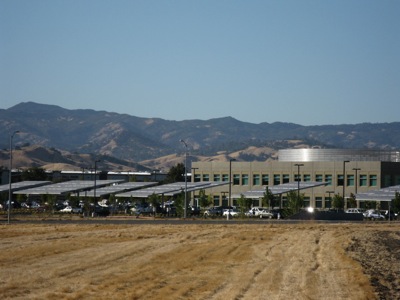
Solar panels shade the parking lot at Genentech in Vacaville.
Solar panels shade a corporate parking lot in Vacaville, CA.

Lawrence Berkeley National Lab released its second annual “Tracking the Sun” report this week, which actually tracks the cost of harnessing the sun’s energy in the U.S. It finds that the last decade (1998 to 2008) has seen the cost of installed photovoltaic power drop by 30%, averaged nationwide, although there were some short-term quirks. Among the “key findings:”

Preliminary cost data indicates that the average cost of projects installed through the California Solar Initiative program during the first 8½ months of 2009 rose by $0.4/W (per watt) relative to 2008, while average costs in New Jersey declined by $0.2/W over the same period.

That’s an interesting quirk at a time of generally low inflation and would seem to resonate with our recent report from Rob Schmitz, comparing the “red tape” cost factors between California and Japan (sorry, we didn’t get to New Jersey). Of course in markets, as in climate science, short-term fluctuations aren’t necessarily meaningful.

While the authors surveyed data from 16 states, they note that the results are “heavily skewed towards systems in California and New Jersey, where the vast majority of PV systems in the U.S. have been installed.” So clearly, California is participating in the longer-term trend of declining costs.

Average installed costs vary widely across states; among ≤10 kW systems completed in 2008, average costs range from a low of $7.3/W in Arizona (followed by California, which had average installed costs of $8.2/W) to a high of $9.9/W in Pennsylvania and Ohio. This variation in average installed cost across states, as well as comparisons with Japan and Germany, suggest that markets with large PV deployment programs tend to have lower average installed costs for residential PV, though exceptions exist.

The report noted three incentive programs in California that are encouraging solar installations in new construction: the Emerging Renewables Program, the New Home Solar Partnership Program, and the California Solar Initiative, and confirms that solar has gone mainstream, with 88% of systems connected to the grid. The LBNL report finds that overall, the main driver in recent cost declines has been the cost of PV panels themselves, as opposed to other components that solar systems require.

The report contains a wealth of charts and graphs to fascinate the solar wonk. You can download the 50-page report as a PDF file.

Wind picking up

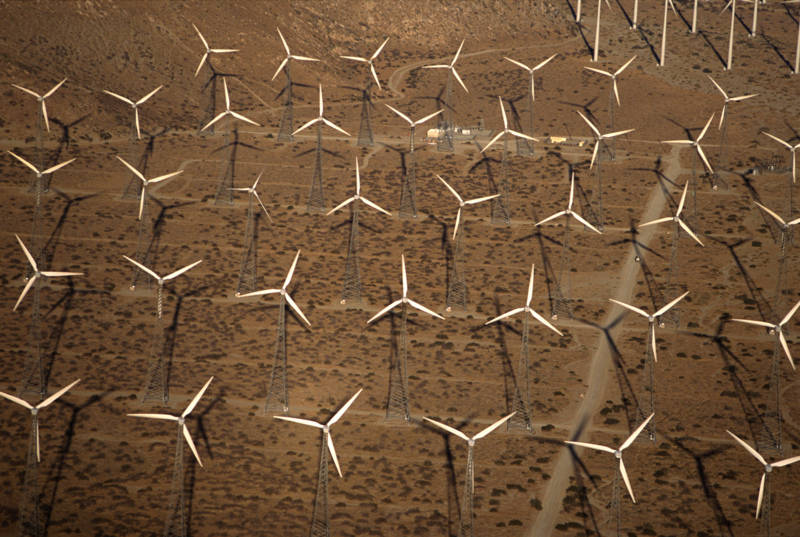
Also this week, the American Wind Energy Association (AWEA) released third-quarter figures (PDF download) for large-scale wind energy  installations, logging 1,649 megawatts (MW) of new power generating capacity. The figure shows growth from the previous quarter and a running total of 5,800 MW of new capacity for the year, so far.

California clocks in at third among states with the most installed wind capacity, behind Texas and Iowa–but the Golden State does not place in the top five, in recent growth.

AWEA continues to voice consternation over a longer-term tailing off in wind turbine construction and manufacturing, especially in the U.S:

…the 5,000 MW now under construction is nearly 38% lower than the over 8,000 MW under construction at this time last year. A firm, long-term national commitment to renewable energy is still needed for the U.S. to become a wind turbine manufacturing powerhouse and create hundreds of thousands of jobs.

AWEA calculates the total operating wind power capacity in the U.S. to be about 31,000 MW, enough to power “the equivalent of nearly 9 million homes, avoiding the emissions of 57 million tons of carbon annually and reducing expected carbon emissions from the electricity sector by 2.5%.” Average power consumption per household varies considerably from state to state.

Brower Youth Award

For the past three years, Adarsha Shivakumar has worked nights and weekends to run a non-profit dedicated to helping impoverished Indian farmers produce biofuels. He has formed an alliance with an NGO and a biotech company to ensure that growers get a good price for their product. And he has used personal funds to purchase seedlings for villagers willing to try a sustainable crop.

Not a bad resume for a 16-year-old.

Earth Island Institute
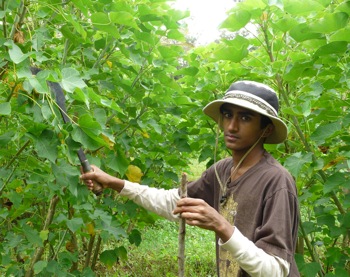
Brower winner Adarsha Shivakumar. Photo: Earth Island Institute

This week the Pleasant Hill native received the prestigious Brower Youth Award for “environmental leadership,” at a ceremony in San Francisco. He is being honored for mixing economics and environmentalism, in his efforts to aid tobacco farmers in India’s Karnataka region.

Shivakumar, who acts as though founding a non-profit is something most high school juniors do in their spare time, grew up visiting the region annually with his family. While there, he was taken aback by the hard life of the local tobacco farmers. His Indian relatives told him that the workers were at the mercy of the crop’s unstable price.

By the time he was twelve he had another realization: the farmers’ over-reliance on tobacco was leading to the slow-motion demolition of a nearby national forest.

“When we went there each year, what we noticed was that more and more sections of forest were just disappearing on the outskirts,” the Oakland College Preparatory High School student said. “This was due to tobacco growing, because what happens is the farmers have to cure the tobacco that they grow, and that requires firewood–a lot of firewood: two kilograms plus of firewood for one kilogram of tobacco.”

“It’s having a huge impact on the wildlife there. Each year…the forest is just steadily being destroyed,” he said.

So the American pre-teen decided to do something. Biofuels were big news in the United States at the time, but corn-based ethanol was getting a bad rap for causing food shortages. So he hunted around for a crop that could produce biofuel, but didn’t double as dinner for families in the developing world. Eventually he settled on Jotrapha curcas, a semi-poisonous plant that is hearty enough to survive the occasional drought and produces seeds that contain about 35% oil.

By encouraging villagers to plant Jotrapha, as well as the tobacco they traditionally grow, Shivakumar would aim to increase the farmers’ income and protect the ecologically sensitive forests nearby (Shivakumar took mild offense at a recent report on NPR about the harsh realities of Jatropha growing in Kenya. He says it’s important not to rely solely on Jatropha as a cash crop, and has learned from his time in Karnataka that, like any plant, Jatropha must be watered and cared for.)

At 13 he teamed up with his younger sister, Apoorva Rangan, and the two of them scrounged together what money they had to buy seedlings and get “Project Jatropha” off the ground. “When I was in the seventh grade I’d won the California State Spelling Bee and I got around $600 from that as a cash prize and I used that money to jumpstart the project,” Shivakumar said. “Apoorva and I had some funds that we had from baby sitting and all, and we used that as well,” he added.

The two worked with the farmers for weeks, trying to gain their trust and convince them to mix a little Jatropha in with their tobacco. In a culture where respect comes with age, Shivakumar said, this was no easy task.

But with the help of a local NGO called Parivarthana (Sanskrit for “change”) and the biotech company Labland Biotechs, he secured a deal that he hoped would make Jatropha planting profitable. Parivarthana would help teach the farmers sustainable agriculture, and Labland–which converts Jatropha into biofuel–would pay the growers for every kilogram of the crop they produced.

Shivakumar said that two years on, Project Jatropha is expanding and going strong. He still devotes hours of his days to communicating with workers in India, but said that lately much of his time has been swallowed up by media requests. He takes on these interviews, he said, to remind others that they can make a difference.

“We have to take action now–that’s the main thing,” he said. “And I hope Project Jatropha will show that it’s possible to take action and affect people in greater ways, and we hope to motivate and inspire others to take action as well.”

The Brower Youth award comes with a $3,000 prize, and it’s not hard to guess how Shivakumar will spend his winnings. “When I found out that we won, I was shocked yet very happy to say the least, because the $3000 cash prize we got is being reinvested into the project,” he said.

California is also home to two other Brower Youth Award winners. Ventura resident Alec Loorz, the youngest recipient this year, won for spreading the word about climate change. Inspired by Al Gore’s “An Inconvenient Truth,” the 15 year old has given at least 75 presentations on global warming to more than 10,000 people.

In his spare time, Loorz founded an organization dedicated to educating young people about climate change (Kids vs. Global Warming, penned a Declaration of Independence from Fossil Fuels, and is set to launch the California Climate Council of Youth, or C3Y, an effort to bring precocious kids together to brainstorm and learn how to combat global warming.

Hai Vo, a 22 year old University of California, Irvine graduate, was honored for a project to bring more sustainable food to his college campus. He worked to bring “real” food, i.e. “ethically produced, with fair treatment of workers, equitable relationships with farmers (locally and abroad), and humanely treated animals” to Irvine, and eventually convinced the entire UC system to offer 20% sustainable food at its campus dining facilities by 2020.

This post was reported and written by Climate Watch intern David Ferry.

New Plan: 100% Renewables by 2030

Wind, water and solar energy can provide more than enough energy to power the world, according to a new plan proposed by two California scientists in the November issue of Scientific American.

Stanford civil and environmental engineering professor Mark Z. Jacobson and UC Davis researcher Mark Delucchi crunched the numbers and have concluded that if the world used existing technology to convert entirely to electricity (and hydrogen powered by these renewables) by 2030, the world’s power demand would be reduced by 30%, from the expected 16.9 terawatts to 11.5 terawatts.  They base this expected reduction on the premise that fossil fuel and biomass combustion are inefficient, losing up to 80% of the produced energy to heat. With energy produced by electricity, only 20% is lost as heat.

Even without this reduction in world energy needs, the two researchers assert that there is more than enough renewable energy available to meet the world’s needs (their data pegs the potential worldwide energy from wind at 1,700 TW and solar at 6,500 TW).  When difficult-to-reach areas and protected lands are excluded from their calculations, the scientists find at least 40 TW available from wind and 580 from solar.   Currently, they find, we generate only .02 TW of wind and .008 of solar.

The ambitious plan calls for 3.8 million large wind turbines, which, when spaced appropriately would occupy 1% of the Earth’s land, and 89,000 300-megawatt photovoltaic and concentrated solar power plants, which would occupy .33% of the Earth’s land surface.  The plan also requires 490,000 tidal turbines; 5,350 geothermal plants; 720,000 wave converters; and 1.7 billion rooftop photovoltaic systems.  Less than 2% of these energy producing installations current exist.  The plan also requires 900 hydroelectric plants, of which 70% are currently operational.

“I know it’s possible,” said Jacobson. It’s just a question of whether people want to do it.”

Of course, overhauling the entire world energy economy in 20 years is a Herculean task to say the least, and the researchers are upfront about the obstacles their plan faces.   They concede that not only would there need to be significant political support in the form of feed-in-tariff (FIT) programs, taxes on fossil fuels, and significant investment in long-distance transmission systems, but materials availability could also be a barrier in the long term.

“It’s all a question of politcal will,” said Jacobson. “It’s not a technical problem. If we shifted subsidies to things that are clean, that’s being smart. Why invest in something that puts out more carbon and air pollution rather than something that doesn’t?”

The idea of shutting off all of the world’s coal and nuclear plants and building hundreds of miles of wind farms and solar arrays  is controversial to say the least.  Aside from (not exactly minor) political, social, and economic obstacles, there is the issue of baseload power–what’s available around the clock, rain or shine, to keep the lights on–which we currently draw primarily from nuclear and fossil fuel plants.   Proponents of nuclear power like Stewart Brand argue that until there’s a massive storage system for wind and solar energy, renewables will remain supplemental sources of energy.

Jacobson and Delucchi do address this issue in their article. “Intermittency problems can be mitigated,” they write, “by a smart balance of sources, such as generating a base supply from steady geothermal or tidal power, relying on wind at night when it is often plentiful, using solar by day and turning to a reliable source such as hydroelectric that can be turned on and off quickly to smooth out supply or meet peak demand.”