Tag Archives: Economics

Accounting for Corporate Carbon

Five years ago, the notion of measuring your company’s carbon footprint might have seemed quaint, or foolish, or just plain impossible.  And not too many large companies were interested.  But a recent report from the consulting firm Groom Energy Solutions finds that corporate emissions reporting is fast becoming big business (Groom describes itself as a “provider of renewable and energy efficiency systems to commercial and industrial companies.”)

The Groom analysis focuses on “enterprise carbon accounting” software, or, in plain language, technology that helps companies track their emissions.  According to the report, venture capitalists invested $46 million in enterprise carbon accounting (ECA) software in 2009, and it predicts that purchases of the technology will increase 600% by next year.

According to Paul Baier, VP of consulting services for Groom, 60% of Fortune 500 companies currently report their carbon emissions, and that number is growing rapidly.

“By the end of 2010, if a company is not reporting, it will be seen as a laggard in the industry,” said Baier.  “It’s increasingly mainstream for corporations to be doing this now.

Ninety percent of reporting companies are using “spreadsheets and consultants” to determine their footprints, said Baier, and the rest are using ECA software.  Three years from now he expects that 80% will be using the software, which helps companies track hundreds of different data points related to operational emissions.

“They don’t keep track of their financial information with spreadsheets anymore, and they won’t be using them for carbon reporting much longer,” he said.

In general, corporate carbon accounting is limited to what the Greenhouse Gas Protocol Initiative (which sets the widely accepted standards) refers to as Scope 1 and Scope 2.  These include the direct emissions of company operations such as on-site fuel combustion and electricity use.  Significantly, Scopes 1 and 2 leave out the potentially enormous, yet elusive footprint of a company’s suppliers and the myriad of other associated carbon sources.  In the works are standards for measuring Scope 3, which Baier calls “everything else,” but for now, there is no generally agreed-upon template for measuring this wider footprint.

Which leaves room for debate, such as when The Wall Street Journal raised questions about the 2008 pronouncement by Dell Inc. that it had achieved carbon neutrality. The Journal article reported that Dell was measuring only a small fraction of total emissions associated with the company.  Dell had taken into account employee air travel and building electricity use, but not emissions produced from transporting products or the footprints of the factories around that world that supply it with computer parts.

Given the inconsistencies and uncertainties of corporate carbon accounting, not to mention the cost in employee time and technology investments, why are companies flocking to do it?

According to the Groom Energy report, the three main drivers, in order, are:

  1. Increased pressure from customers and investors for companies to create a “greener” public image
  2. Cost and energy savings
  3. Mandates from buyers, like the Walmart Supplier Sustainability Assessment Program, intended to measure the environmental impact of its 100,000 suppliers.

Reducing CO2 emissions to help mitigate the effects of climate change did not make the list.

The New Streamliners: Big Rigs Save Fuel, CO2

Not exactly the Space Shuttle: A big rig in the wind tunnel at NASA Ames Research Center. Photo: Gretchen Weber

A companion radio piece to this post aired on The California Report.

The wind tunnel at NASA’s Ames Research Center in Mountain View is the largest in the world. According to Ames deputy director Lou Braxton, at various times it has housed a Boeing 747 and an America’s Cup racing yacht. But parked inside this week was a relatively diminutive semi-truck with a 53-foot trailer. The truck is called the ProStar, and according to its manufacturer, Navistar, it’s the most aerodynamic truck on the road.

The wind tunnel was open to the media because Ames, Lawrence Livermore National Lab (LLNL), Navistar, and the Air Force (which manages the tunnel) were showcasing their ongoing project designed to identify, develop, and test devices that reduce the aerodynamic drag of “big rigs.” The wind tunnel wasn’t activated for the press event but the media gathered inside the cavernous space could envision how the tests might work.

At highway speeds, more than 50 percent of the energy produced by a truck’s engine is used to overcome aerodynamic drag. Therefore, reducing that drag can produce significant fuel savings. In fact, testing thus far has determined that existing aerodynamic design adjustments and attachments can increase fuel efficiency by 12 percent, which, when applied to the US trucking fleet, could save more than three billion gallons of diesel fuel per year, a cost savings of more than $10 billion at current prices. This savings in diesel translates to a reduction of 36 million metric tons of CO2 per year.

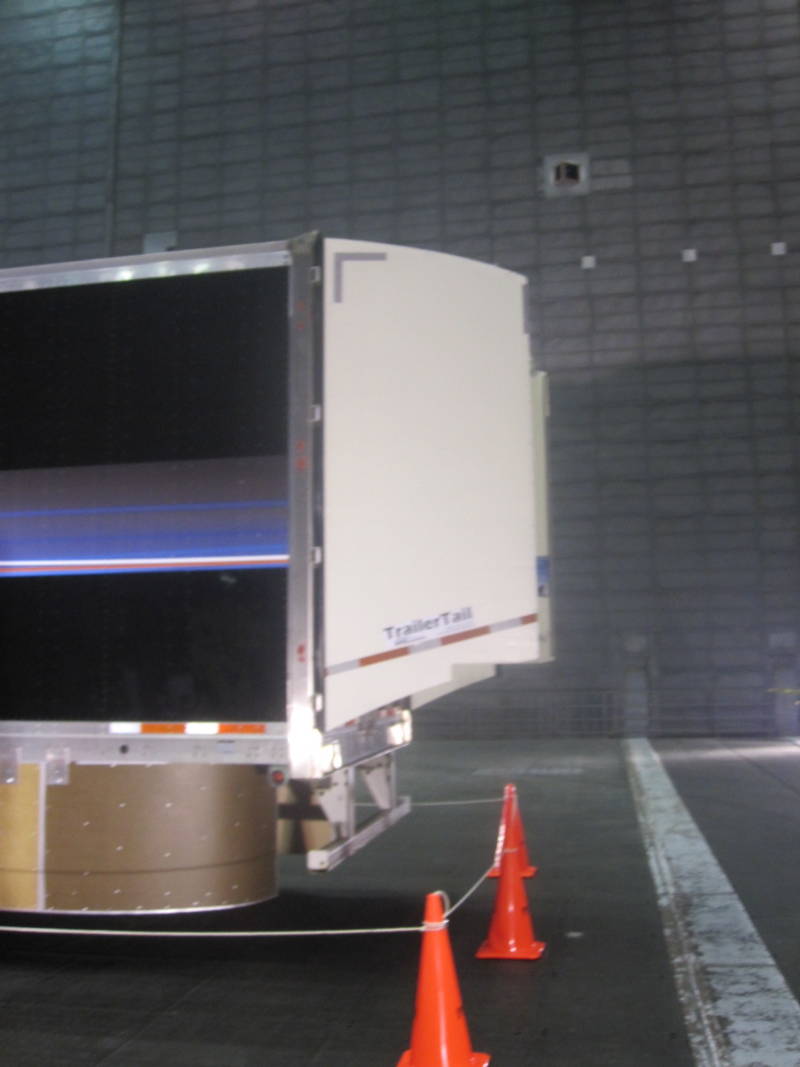
Inside the wind tunnel, the truck’s trailer was outfitted with various attachments designed to reduce drag at critical points such as the trailer base, the under body, and the gap between the tractor and trailer. Some, such as the TrailerTail, are already commercially available, while others are still in development. For the next three weeks, scientists will test various devices and combinations. The best ones will be track tested and then road tested over the next year.

Currently, semi-trucks make up about 12 percent of US petroleum consumption; about 21 million barrels a day, according to LLNL.

The TrailerTail (Photo: Gretchen Weber)
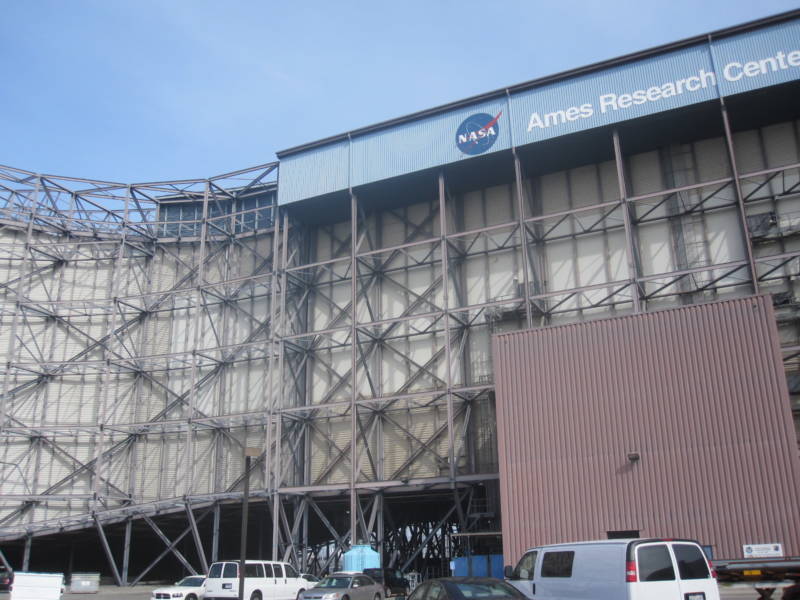
Outside the National Full-Scale Aerodynamics Complex (NFAC) at Ames, where the wind tunnel is located (Photo: Gretchen Weber)

UC Scientist: Don’t Blame the Cows

Cody Sheehy is a rangeland ecologist and independent documentary producer.

87736822By Cody Sheehy

A couple of months ago, nearly lost amid the “Hopenhagen” hype,  the University of California, Davis (UCD) put out a press release with an admonition: “Don’t Blame Cows for Climate Change.” The release was a first look at some work conducted by UCD Associate Professor and Air Quality Specialist Frank Mitloehner. His study examines the greenhouse gases, or GHGs, emitted by the livestock sector.  As California’s air regulators turn more attention toward methane in particular, the report remains timely.

Mitloehner’s paper is entitled: “Clearing the Air: Livestock’s Contributions to Climate Change,” and was published in the peer-reviewed journal Advances in Agronomy. The paper is a synthesis of current science on the cattle-climate connection. Mitloehner has been updating some of that science in recent years.

In 2008, I stopped by his cluster of “bio bubbles;” airtight domes that serve as high-tech stables for cows. Inside, Mitloehner had set up simulated dairy operations, measuring GHGs emitted by the cows’ digestive process and decomposition of the manure. The numbers then in common use had been generated in the 1930s.

Research "bio-bubbles" at UC Davis. Photo: Cody Sheehy

Mitloehner says cattle gets a bum rap in the media, and points to some examples, including a 2007 story in Time magazine, which included assertions like: “Which is responsible for more global warming: your BMW or your Big Mac? Believe it or not, it’s your Big Mac,” and “A 16-oz T-bone is like a hummer on a plate . . ”

In many cases, Mitloehner says the statements are crafted from an influnencial 2006 United Nations report entitled: “Livestock’s Long Shadow.”  According to the executive summary, “The livestock sector is a major player, responsible for 18 percent of greenhouse gas emissions measured in CO2 equivalent. This is a higher share than transport.”

But Mitloehner points to a quote deeper in the report:

“The respiration of livestock makes up only a very small part of the net release of carbon that can be attributed to the livestock sector. Much more is released indirectly by other channels, including: the burning of fossil fuel to produce mineral fertilizers used in feed production, methane release from the breakdown of fertilizers and from animal manure, land-use changes for feed production and for grazing, land degradation, fossil fuel use during feed and animal production and fossil fuel use in production and transport of processed and refrigerated animal products.”

Mitloehner cautions that the transportation number they use only accounts for tailpipe emissions. To be even-handed, he says, the authors should’ve incorporated emissions from the entire oil industry, including refinement of the oil and production of cars. In the UCD release, Mitloehner calls it a “lopsided ‘analysis” and “a classical apples-and-oranges analogy that truly confused the issue.”

Meanwhile, the Bio-bubbles have been generating some interesting numbers. Mitloehner found that the amount of methane the cows respire (belch) and how much is released in the breakdown of animal manure is quite different from what previous research had calculated. In combination, these two sources represent the most direct GHGs from the livestock industry, even if they’re not the largest GHG emitter associated with the industry. They’re also the most out of date.

Emission factors used in “Livestock’s Long Shadow” provide an estimate of methane respiration of about 86 million tonnes (metric tons) of methane (CH4) and 17.5 million tonnes of CH4 annually from manure decomposition. In the annex of the UN report, the authors write: “Obviously, great improvements to the estimates of emission factors could be made if more data on nutrition and production were available.” And so it is that inside his bio-bubbles, Mitloehner has come up with numbers much lower than those that represented the conventional wisdom since 1938.

All in all, we’ve got a discussion about comparing apples and oranges (more appealing than manure, granted) and some updated numbers that lower the emissions of livestock in one category. As with any scientific paper, there will probably be debate on both of these points and new ones, but let’s look at the broader consequences. Will industry look at this study and see an incentive to update and revise carbon emission numbers all across the board?

According to Emilo Laca, an agricultural ecologist at U. C. Davis, some of these questions will be fodder for policy debates that lie outside the realm of science. He says “The real question is, ‘How are we going to split this up?'” Laca used a hypothetical problem to explain: Let’s say that a certain livestock industry consumed 30% of soybean production as a food source. Livestock producers might concede that they should be accountable for 30% of carbon emissions related to soybeans. It makes sense. It’s what the numbers say. Others might counter that without this certain livestock industry, the soybean market would behave differently and some amount–lets guess 70%–wouldn’t need to be planted. Therefore, the livestock industry in this example is responsible for 70% of the emissions, not 30%. Science can support both interpretations. As Laca says, the decision is how to “split” things up. And ultimately, those decisions may fall to policy wonks.

Committee: No Free Lunch for Carbon Emitters

California’s cap-and-trade program took another baby step toward fruition on Monday, with the release of the state-appointed Economic and Allocation Advisory Committee’s final report on implementing carbon regulation.

Stopping just short of recommending a 100% auction of emission credits, the report, which is non-binding and was written to help the California Air Resources Board develop an economically sound cap-and-trade program, advises the state to sell off the majority of its carbon permits to emitters — with a few exceptions. Industries that “rely heavily” on carbon-based energy or compete directly with firms that do not face carbon regulation, the report says, should be “provided with assistance” or given funds earned from the auction.

The report pointedly advises against handing out free permits to utilities. Although the state’s utilities will almost certainly pass increased costs onto customers, the committee predicts that the price spike will provide an incentive for Californians to start saving energy. The committee’s press release says the report takes a “household friendly” approach to cap-and-trade, recommending that at least 75% of the proceeds from selling carbon permits be returned to households through either tax cuts or direct financial transfers.

Even before the report was released on Monday, the looming possibility of a carbon permit auction was causing anxiety in industrial circles. The AB-32 Implementation Group, an organization that aims to protect California business interests, claimed last week that if the price of carbon is set to $60 per ton, “large employers could be subject to an ‘Auction Tax’ of up to $143 billion by 2020.” Environmental groups have been urging the Air Board to auction off all the carbon permits initially offered.

In a written statement, Governor Arnold Schwarzenegger responded to the committee’s report, saying “the best program will be one that returns value to the people through tax cuts, rebates or dividends, and I applaud the Committee for recognizing those options.”

Here’s a quick run down of the rest of the report’s key recommendations:

Protect Low Income Households

The report recommends returning some of the auction’s profits to low income households, since such households tend to spend a greater percentage of their income on energy.

Invest in a Low Carbon Economy

The committee recommends that the state create an independent Investment Advisory Board to help make it reach its low carbon targets.

Simple Auctions

The state’s carbon permit auctions should simple and allow the public to sell permits in the auctions along with the state.

State Senators Hear Cap-and-Trade Caveats

Craig Miller
Photo: Craig Miller

The dark underbelly of cap-and-trade was somewhat exposed in a four-hour hearing today before the Senate’s Select Committee on Climate Change and AB-32 Implementation. AB-32, of course, is shorthand for California’s Global Warming Solutions Act of 2006, which mandates a carbon trading program be in place by 2012.

Here’s my “highlights reel” from the panel of experts who testified, in order of appearance:

Mary Nichols, Chair, California Air Resources Board

– On carbon pricing: “There is no approach that does not involve administrative costs & headaches” but cap-and-trade “seems like a pretty good mix” of certainty provided by an enforced cap and market flexibility (versus an outright carbon tax of some sort).

– On California going “solo” with carbon trading (i.e. without the other states and provinces currently signed to the Western Carbon Initiative): The larger the territory, the more potential for “bad actors” but the greater the potential for meaningful savings & benefits to the economy.

Michael Wara, Stanford Law Professor

– On carbon offsets: “…difficult to administer;” to ensure real reductions, changes in behavior, has proven to be “a significant and ongoing challenge, in practice.”

– California appears to be “opting for prudent limits” on allowable offsets, at an anticipated 4%, versus more than 30% in the Waxman-Markey bill that has cleared the US House of Representatives.

– “Very few [offset] programs have been run without controversy.”

Ken Alex, California Attorney General’s Office

– On enforcement: “Every system has cheaters, especially where billions of dollars are involved.”

– Cap-and-trade provides “a permanent incentive for cheaters.” Unassailable data is essential for regulators.

– Regulators “must have sufficient authority” to assess meaningful penalties. Alex, who was involved in sorting out the state’s energy crisis of 2000-2001, recalled that “million-dollar penalties were irrelevant.”

Dallas Butraw, Economist, Resources for the Future

– Warned against a “phone book-sized” regulation.

– Cost of carbon emissions permits will be passed along to consumers but could be offset by tax breaks or a dividend system similar to what oil & gas companies pay to residents of Alaska.

David Harrison, Economist, NERA Economic Consulting

– On lessons from Europe: Despite a rocky start for the EU’s “pilot” program, the system for carbon trading in 27 countries has “evolved over time” to become “very successful.”

– The EU experience “really does show that cap & trade works. Emissions have been reduced.”

– There is “no silver bullet” for determining allocations; that in Europe has been a “messy” and “contentious” process.

– In spite of it all, the EU experience demonstrates that cap-and-trade is “not perfect but it really is better than the alternatives,” and provides a good laboratory for California.

The committee, chaired by Fran Pavley (D-L.A.), also heard from several business and environmental groups. At one point a speaker from the Natural Resources Defense Council (NRDC) argued briefly with a utility representative about whether electric rates are actually higher or lower in California, compared to the nation as a whole (apparent compromise: rates may be higher but average bills are lower).

Utilities complained that the system, as proposed, forces power companies to bear the brunt of the burden. Business interests warned that unbridled implementation of AB-32 “could add to an already alarming increase in job losses,” claimed that the state has no authority to hold carbon permit auctions under AB-32, and asked for initial permits to be given away to industry. Environmentalists asked for the opposite, urging that 100% of initial permits be auctioned off, i.e. that emitters be made to pay for them.

Numerous speakers expressed nervousness over validity of carbon offset programs. Regarding the various schemes for carbon storage in forests or soil, Assemblyman Jared Huffman (D-San Rafael) said “This one makes my head hurt.” There’ll be a lot of Excedrin passed around before this is through.

Not Giving Up on Central Valley Nuke

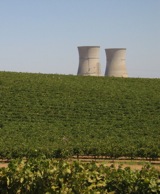
Cooling towers from the defunct Rancho Seco nuclear power plant rise above vineyards near Lodi. Photo: Craig Miller

According to a report in the Fresno Bee, the notion of building a nuclear power plant near Fresno is still alive, if on life supports. California still has an effective ban on new nuclear plants. That hasn’t stopped some from pushing the plan, as Amy Standen reported for Quest last spring.

And apparently some French investors haven’t given up, either.

Maybe they were inspired by the juxtaposition of vineyards and cooling towers at the site of the Sacramento Municipal Utility District’s (SMUD) decommissioned Rancho Seco nuclear plant, near Lodi.

Last summer I reported on the prospects for expanded nuclear power as part of California’s low-carbon energy push. Then in November, the advocacy group Environment America issued a report down-playing the potential role of nuclear. The report, bluntly entitled “Generating Failure,” made the claim that: “Even if the nuclear industry somehow managed to build 100 new nuclear reactors by 2030, nuclear power could reduce total U.S. emissions of global warming pollution over the next 20 years by only 12 percent.”

Proponents of nuclear point to its mportance as a steady source of “base load” power, generated 24/7, as opposed to the intermittent or cyclical nature of many renewable sources.

Climate Lobby Bulks Up

Some California corporations figure prominently in a new tally of climate-related lobbying activity.

A continuing study from the non-partisan Center for Public Integrity (CPI) shows that climate-relating lobbying reached a fever pitch in the third quarter of this year, with 140 new organizations showing up in government-required registrations. That brings the total number of registered climate lobbyists to 1,160, with most activity centered on two climate bills–one passed by the House and another pending in the Senate.

The Center’s latest report is called “The Climate Lobby from Soup to Nuts”–and they mean it literally. CPI reports that registered climate lobbyists now include such diverse interests as the makers of Campbell Soup and Blue Diamond Growers (“a can a week” may not be all they ask, after all).

Not surprisingly, “Big Oil” is a big spender. San Ramon-based Chevron Corp. clocks in at more than $36 million since 2003. And PG&E, one of California’s largest utilities, is shown spending more than $34 million just in the last two years ($19 million in the third quarter of 2008 alone).

Silicon Valley is well represented on the list, including some firms whose stake in climate policy is less obvious; eBay, Google, Hewlett-Packard and Intel are all in the half-million-plus club. Government records show Intel declaring more than $12 million on climate lobbying since 2003.

Marianne Lavelle, a staff writer who helped compile the figures for CPI, says that companies with a stake in green energy technologies are seeking more of a voice in the process, to counter fossil fuel interests, and that technology-oriented venture capital firms are becoming more of a visible presence on the lobbying radar.

The CPI data also includes major environmental lobbies such as the San Francisco-based Sierra Club, which logs $1 million over the past two years. Lavelle says what it doesn’t capture is lobbying at the state level, nor does it reflect spending on “grassroots” organizing or money spent on advertising campaigns designed to steer public opinion on climate issues.

The CPI study site includes a searchable database of all federally registered climate lobbyists.

Schwarzenegger’s Speech in Copenhagen

Here is a transcript of Governor Schwarzenegger’s speech to the UN climate conference in Copenhagen. It’s provided by his media relations staff, as insertion of the “laugh track” and applause notations may suggest.

Thank you so much for this great introduction, Governor Campbell, or Premier Campbell. It’s exactly the way I wrote it. That’s right. (Laughter) Just joking. He has been a terrific partner and a great, great friend and of course we will see each other up there at the Olympics, which is going to be probably the best-organized Olympics, knowing you. So thank you very much also for your invitation.

I also want to thank Governor Jose Serra for the wonderful speech and the very profound things that he said. And you have been also an extraordinary leader, so thank you very much. Let’s give him also again another big hand for the great work. (Applause)

And then Ivo de Bóer from the U.N., we want to thank him for organizing this and being a great leader and believing in the subnational governments.

And also we have from California here some people like Linda Adams, who is in charge of the EPA. Where’s Linda Adams? Stand up, Linda. Let’s give her a big hand. (Applause) Then Senator Fran Pavley, who is a great, great leader. Where is she? Can you get up? OK, right there. (Applause) Extraordinary leader in California. Without her we wouldn’t have been able to go as far as we did with the reduction of greenhouse gases and so on. And then we have Assemblywoman Nancy Skinner. Where is she? She is also here. Let’s give her also a big hand.

I love giving this speech here just simply because I’m not the only one that has an accent. It’s a good place to come. (Laughter)

But anyway, it is wonderful to be back here again. So before I say anything and do anything, let me just thank the U.N. and the people who have worked very hard on this to make this whole meeting happen. Let’s give them a big hand for their great, great organization. (Applause)

I especially want to thank Secretary General Ban Ki-moon for his early attention to the threat of global climate change and I want to congratulate him on his great, great leadership on the issue that has brought us all together.

I am delighted and honored to be with you in Copenhagen. This is not the first time I’ve been here; I’ve been here many, many times before, if it is for my movie promotions or for coming here for bodybuilding and weightlifting seminars, or just on vacation and so on. But I never thought then that one day I will get here as the governor of the great state and talk about climate change, so this is really terrific. So it’s great.

And this city, of course, distinguishes itself by being so clean you can actually swim in its harbor, even though I wouldn’t recommend it right now because it’s a little cold, of course. But how happy we would be if all the world’s harbors would be as clean.

As everyone knows, also in the harbor there is the “Little Mermaid,” the statue based on the Hans Christian Andersen fairy tale. When I was a boy in Austria, the Andersen fairy tale that I always liked best was “The Ugly Duckling.” And looking back, I think the reason that I liked it was because it was a tale of transformation and that spoke to me inside. I have always believed in the tremendous power of personal transformation.

The desire, the hope, the desperate need for planetary transformation is what brought us together here. And the question is: is this also a fairy tale? Is it a dream? Is it a false hope? And if it is not, how do we make it real? Is that something that we ought to discuss? And this is something that I do want to discuss here while I’m here with you. Look around this carbon-conscious city and you should feel hope. Copenhagen is often voted as one of the most livable cities in the world.

So the question really is, how do we make the world itself livable and sustainable? Certainly, it would be terrific if the world’s governments reached an agreement and put hard caps on greenhouse gases while generously helping poor nations, who are least responsible for and least able to respond to climate change. Attempting to reach such an agreement is good and is actually very, very important.

But why do we put so many hopes and eggs into the big international agreement basket when, according to the UN itself, up to 80 percent of greenhouse gas mitigation will be done at the subnational level?

In recent weeks, the prospects for this gathering here have gone up and down, up and own, like a roller-coaster ride. And everyone was in fear, of like what will the U.S. do? What will China do, or not do? Is it going to be 20 percent reductions or a 17 percent reductions? Is the base 1990 or 2005? Should it be 350 parts per million or 450 parts per million?

But what if I said that international agreements, as critical as they are, will never do enough? What if we took that as a given? Wouldn’t that expand the possibilities and approaches for progress we would consider?

I mean, my late mother-in-law, Eunice Kennedy Shriver, the remarkable woman who started Special Olympics, an organization that dedicates itself to people with intellectual disabilities, gave me an insight on this. She was the sister of John F. Kennedy and Robert Kennedy and Teddy Kennedy and she knew everyone in American power and politics.

But she once told me that while the federal government was important for policies related to Special Olympics — such as health care, equal rights, job creation, dental care and so on — but she never would have relied on the federal government to build Special Olympics. She said you need all kinds of different elements and entities like local government, state government, volunteers, corporate sponsors, coaches, celebrities and, of course, the families.

She said that no one from government is going to be there at the sports events and hug those kids when they come through the finish line, or organize the competition so there is a finish line in the first place. No one from government trains those kids so they don’t hurt themselves or so they know how to perform those sports. She said, no, that is up to many of us, many different entities. And she built a movement, a worldwide movement that has spread to 180-plus countries.

So history tells us that movements began with the people, not with government and then, when they became powerful enough, government responds. In the U.S. the labor movement, the women’s suffrage movement, the civil rights movement, the Vietnam anti-war movement — they did not begin in the corridors of power in Washington.

So there’s a lesson in this for our cause. While national governments have been fighting over emission targets, subnational governments have been adopting their own targets and laws and policies. While national governments have been trying for years to define what Kyoto means, businesses are pursuing cutting-edge technologies to solve energy and environmental problems. While national governments debate how carbon caps will affect their economies compared to others, many of their citizens are seeking greener lifestyles on their own.

Government clearly has a major role, there are no two ways about that. But I also believe in the power of the iconoclast and the entrepreneur and the individualist. I believe in the power of the scientists, the capitalists and the activists. I believe in the power of the cities and the states and the provinces to be laboratories for new ideas, which the national governments then can go and study and adopt.

I mean, too often, I think, we fail to see the potential and the progress that is being made on all those different levels. By putting all of our eggs in one basket, we fail to see the eggs in the other baskets.

Let me give you a few quick examples.

Dr. Rajendra Pachuari, who came to our environmental summit in California just recently, he has his own target. He is replacing kerosene and paraffin lanterns with solar light for 400 million rural people in India — 400 million people in India. Think about that. So if the nations of the world do not sign a carbon agreement, does that mean the doctor’s transformative work in India doesn’t count?

In the U.S., in the small town of Roscoe, Texas, a German company has completed the world’s largest wind farm. If we don’t reach a major carbon agreement, does that mean the Texas wind farm doesn’t really count?

With the assistance of Greenpeace, four of the world’s largest meat producers agreed not to buy cattle from newly deforested areas of the Amazon. That doesn’t count?

The head of an energy company in China recently said of renewable and efficient energy, “We think that this is a new business for us, not a burden.” And China now is becoming the leader in developing and manufacturing renewable energy equipment. That doesn’t count?

Yes, sure, they all count. And they reveal that something is happening, something that is happening below the national level.

California, for instance, is working with cities and with states and provinces and regions and nations, including Mexican states, Canadian and Chinese provinces and European nations. We’re even working with the U.N. to assist developing countries, especially in Africa. We are trying to foment change and collaboration and movement. We’re doing everything we can to change the balance of power on the environment.

And of course when I talk about California, I realize that while we may lead America and many other countries environmentally, Denmark here is already one-third more energy efficient. Isn’t that fantastic? And Europe is a great leader in this whole thing.

But the reason for discussing my adopted home state of California is because, first of all, I’m the governor of the great state of California and I have a little right to brag about our state, right? And also, California is the seventh largest economy in the world and also America’s trendsetter, so what we do has consequences. Now, maybe when you look at the globe it is just a little dot, or maybe you cannot even find California. But the power of influence we have is equivalent to a continent. And we in California do not believe and we do not behave, as if progress has to wait for Washington or Beijing or Kyoto.

In California, we are proceeding on renewable energy requirements and a cap and trade system for greenhouse gases. We are moving forward. As a matter of fact, we are making great progress. If hydro is included, we will get 45 percent of our energy from renewables in ten years from now and we are already at 27 percent.

We are proceeding on the world’s first low carbon fuel standards and limiting greenhouse gas emissions from cars which, by the way, the Obama Administration has now just adopted. We are proceeding in a major way on green tech, no matter what happens in Washington or in Copenhagen. Billions of dollars, nearly 60 percent of all venture capital in America, flows to California and this is creating the critical mass of money and intellect to develop new green technologies.

Leaders from around the world are coming to California to see what we’re doing. I took the French Foreign Trade Minister to a business in San Francisco called Solazyme, which was just recently named the most innovative bio-energy company. They have come up with a way to convert algae into a fuel that is 90 percent cleaner than petroleum-based fuels. The U.S. Navy has just signed an agreement with them and is going to use that fuel to power some of its ships.

So from what I see in the research labs and venture capital start-ups around the globe, I believe that the world’s businesses will move to solar and to wind and alternatives much faster than the people expect.

Kenya, for instance. Kenya already gets nearly three-quarters of its power from hydroelectric and from geothermal — three-quarters. And next month it will begin work on a $760 million wind farm that by 2012 will increase Kenya’s power supply by about 30 percent.

Now, the uplifting thing is that the developing nations will be able to leapfrog into the green economy and skip the fossil-fueled industrial revolution. Isn’t that wonderful?

I believe that we have economics on our side. Since the supply of wind and sun and algae is unlimited, their prices will not jump. That cannot be said of oil, the supply of which is limited and declining. That cannot be said of coal, whose costs of extraction and labor and transportation are bound to rise.

So I believe technological and economic forces will overtake the political and the regulatory efforts of national governments. We are beginning one of history’s great transitions – the transition to a new economic foundation for the 21st century and beyond.

Shouldn’t we organize to encourage this transition even as we continue to work toward international compacts? Of course we should. Now, if this conference does not get a strong agreement, some will say that Copenhagen has failed, that we talk grandly but we are fooling ourselves, much like the fairy tale, “The Emperor Has No Clothes.”

And others will say that any agreement that is being reached isn’t enough because the world is going to melt and we’re going to die anyway.

Others will say, “Look at those crazy people trying to wreck the global economy.”

No, ladies and gentlemen, this conference is automatically and already a success.

Kyoto brought the world’s focus to what must be done. It brought the focus to that whole subject. We didn’t know then what we know now. We didn’t have as much experience with the science that we would research or the hurdles we would face. But Kyoto made us think differently about the world.

And perhaps the real success of Copenhagen is to give us the opportunity to think differently again. Perhaps the success comes in realizing that something different needs to be done and in fact is already being done. It’s being done at the sub-national level.

And I would ask the U.N. to convene a climate summit like Copenhagen but for cities, for states, for provinces and for regions. And I will be more than happy to host such a summit in California or anywhere else the U.N. wants to hold it but I recommend strongly in California. (Applause) People like coming to California. They love our state.

So ladies and gentlemen, the world’s governments alone cannot make progress, the kind of progress that is needed on global climate change. They alone cannot do it. They need everyone coming together, everyone working together. They need the cities, they need the states, they need the provinces and the regions. They need the corporations, the activists, the scientists and the universities. They need the individuals whose vision and determination create movements. They need everybody out there.

So ladies and gentlemen, let us regain our momentum, let us regain our purpose, let us regain our hope by liberating the transformative power beneath the national level.
That can be the great contribution of Copenhagen — that could be the great contribution of Copenhagen.

So thank you for inviting me. Thank you for your kind attention and warm hospitality. And thank you for the great passion and for the hard work that you all do. And it is very important that we continue with this work.

So thank you very much and I’ll be back. Thank you.

Schwarzenegger to Rally Subnationals

Meanwhile Rob Schmitz, our reporter in Copenhagen, sets the scene with a look at how the state’s anchor climate legislation is playing here at home, three years after its passage. That report airs Monday morning on The California Report.

Governor Arnold Schwarzenegger is expected to arrive in Copenhagen on Monday, ready to rally the world’s “subnationals” in the fight against global warming. This is the first time that UN climate talks have created a formal role for states, provinces, cities and the like, and California’s governor will be loaded for bear.

In the weeks leading up to Copenhagen, the Governor turned up the heat on climate rhetoric, with a series of related media events. On Treasure Island, a low-lying man-made rectangle on San Francisco Bay that he said “could be under water” by the end of the century, Schwarzenegger unveiled the state’s climate adaptation strategy with a video tour of California’s climate vulnerabilities, powered by graphics from Google Earth (if you just want the gist, there’s a shorter version available).

The Governor also seized the occasion to preview his trip to Copenhagen, saying we “can’t wait” for national and multi-national efforts to save us from the potentially catastrophic effects of climate change; that “subnational” actors like California–perhaps led by California–should stay focused on their own efforts to both reduce greenhouse gas emissions and prepare for the changes already on the way. The Governor’s speech to COP 15 delegates on Tuesday will be a chance to do some crowing about California’s climate leadership, on an international stage, before a media gallery that’s been estimated at somewhere between 3,500 and 5,000 members.

Nothing Ill About This Wind

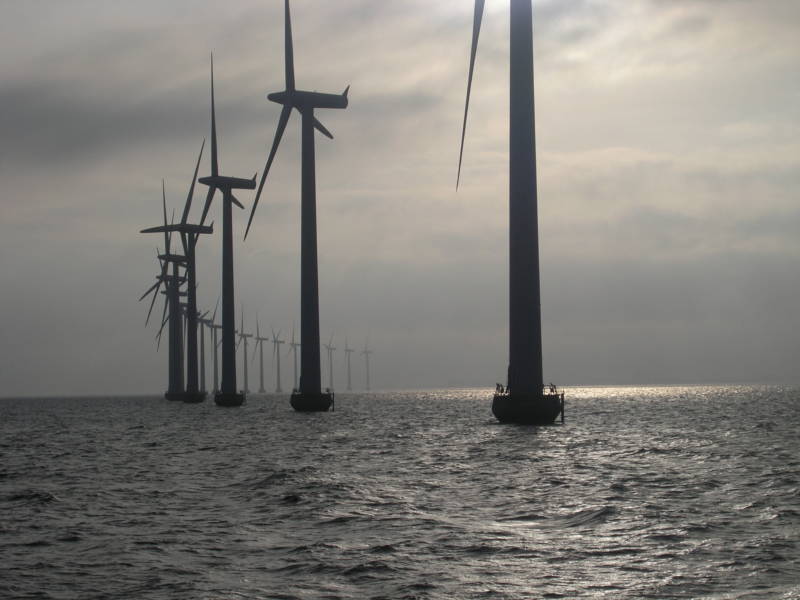
Harnessing nordic winds — The Middelgrunden offshore windfarm off the coast of Copenhagen

Friday on The California Report, Rob Schmitz looks at what we can learn from the world leaders in leveraging wind power.

See the photo on the left? You’re looking at three percent of Denmark’s wind power generation. This is the Middelgrunden wind farm, located in the North Sea, not far from Copenhagen. There, twenty 120-foot wind turbines produce 40 megawatts of wind energy.

I visited Middelgrunden this week in a small boat. Luckily for me, the winds, normally furious at this time of year, were moderate. I went there for a story on how Denmark was able to develop a wind power infrastructure that now produces a fifth of the country’s electric power. This is a larger proportion than any other country on Earth. For the Danes, wind power is big business.

Up until thirty years ago, Denmark was largely an agricultural country. Now, wind power-related exports are on par with agricultural exports. They make up almost 10% of the country’s total exports.

How did Denmark get to this point? The same way Japan became the most energy-efficient country on Earth: the 1970s oil shocks. In the mid ’70s, Denmark relied on oil for more than 90% of its energy. Oil embargoes brought the country to its economic knees. The government quickly instituted “Car-free Sundays,” when Danes were forbidden from driving. Shop owners were asked to turn off their lights outside of business hours. In 1979, the Denmark created its first Ministry of Energy, and it got to work on harnessing what was then considered an alternative energy: wind.

Jutting out into the treacherous North Sea, Denmark has lots of it. By 2020, Denmark plans to rely on wind for half of its electrical supply. And by 2050, the Danish government wants renewables to supply all of the country’s electricity. These are ambitious goals, but Jakob Lau Holst, COO of Denmark’s Wind Industry Association, believes it can be done.

“If you just stick to long-term government investment, you can develop a market for this,”Lau Holst told me today. He told me that much of Denmark’s industry has a hard time doing business in the US because incentives for renewables like wind “are there one year and gone the next. It’s a mixed message to the industry.” It makes one wonder what could be accomplished with more long-term goals–like California’s commitment to 33% renewables by 2020.