
Tag Archives: Economics

Rallying Against Carbon Trading

Photo: Rachel Cohen

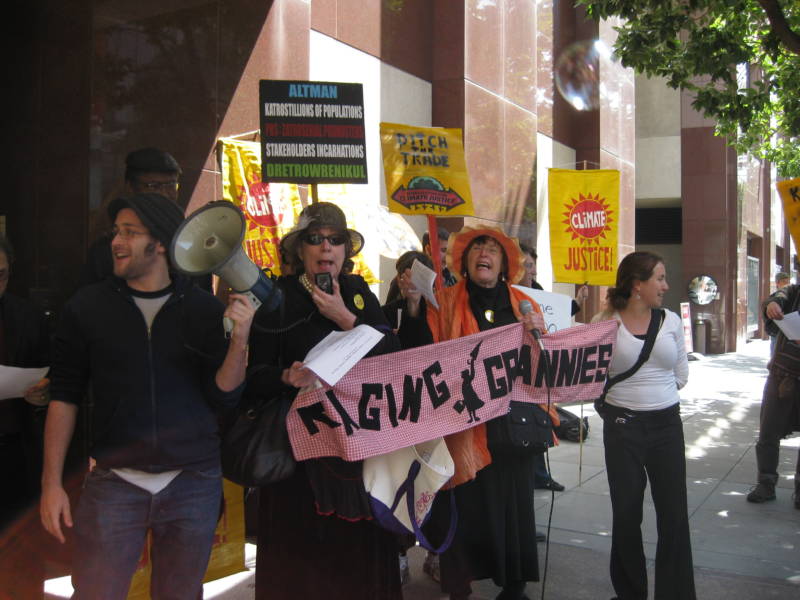
Businesses wary of a cap-and-trade system for carbon regulation are finding some unlikely allies these days. Outside a carbon policy conference in San Francisco today, the concept was assailed by members of the “environmental justice” movement.

About sixty protesters  targeted an event called Navigating the American Carbon World, an event that brought together representatives from government and  industry, including firms interested in facilitating emerging carbon markets.

“Inside there are thousands of people trying to make big money off-carbon trading,” said rally organizer Brianna Morgan of Rising Tide North America, as demonstrators outside sang songs, led chants, and performed political street theater. “We believe that carbon trading and carbon offsets let corporations off the hook from making real changes to the way they do business,” said Morgan.

Morgan and her fellow protesters were part of Mobilization for Climate Justice West, a network of 15 to 20 community-based groups.

Meanwhile conference attendees inside the Marriott hotel discussed climate change policy topics including carbon trading, a major component of the California climate law passed in 2006, known as AB 32.

The European Community is already using a carbon trading system, in which industrial emitters are allocated “carbon credits” corresponding to a specific quantity of global warming pollution. If facilities emit more CO2 than they have credits, they can buy additional credits in a regulated carbon market. But carbon markets have been slow to get off the ground elsewhere, including the US. California’s cap-and-trade system, scheduled to take effect in 2012, has encountered resistance from business groups and conservative candidates for Governor.

The San Francisco protesters said they object, in part, to carbon offsets, which allow emitters to meet regulatory requirements by funding activities elsewhere in the world, such as re-forestation, the exact impact of which on net carbon emissions may be elusive. Meanwhile, local emissions are allowed to continue.

“We believe that this is rewarding people for doing exactly what they always do,” Morgan said.

She added that carbon emissions coincide with other types of pollution that have public health consequences at home, such as increased rates of asthma near oil refineries and major ports.

The Escalating Conflict Over AB 32

Bearfight_blogCalifornia has had a climate change mitigation law on the books for more than three years now–but getting that law’s regulations fully in place is proving to be a tough slog.


Fans and mortal enemies of California’s Global Warming Solutions Act (AB 32) all exude certainty about what the carbon emissions-cutting law will do for–or to–the state’s economy. Lately the debate has escalated into full-scale PR warfare. Major battlefronts include:

– A signature campaign for a ballot initiative to suspend the law

– An online campaign to boycott oil companies funding the above

– Studies & surveys from both sides proclaiming their case

– A gubernatorial candidate who has vowed to suspend AB 32

This week both sides weighed in afresh.

The California branch of the National Federation of Independent Business today announced support of what proponents still call the “California Jobs Initiative,” even though the measure has been renamed by Attorney General Jerry Brown, who supports AB 32.

The measure would suspend most provisions of the climate law until the state’s official unemployment rate improves substantially from its current 12.5% level. NFIB statements say “the measure is headed for the November ballot” but only if proponents gather more than 400,000 required signatures.

John Kabateck, executive director of  NFIB/California said in a conference call with reporters today that his organization would help gather signatures to qualify the measure. He called the climate law “one more arrow in the quiver of damage and pain inflicted on small business right now.” In a companion news release, Kabatek ventured that full implementation of AB 32 would cost California more than a million jobs.

California’s non-partisan Legislative Analyst has concluded that while the exact job impact is hard to pin down, AB 32’s overall effect would be relatively minor compared to the state’s total economy.

Meanwhile, pro-AB 32 activists are circulating an online petition calling for a boycott of Valero and Tesoro, two Texas-based oil companies that are helping bankroll the suspension measure in California.

The NFIB announcement followed by one day the unveiling of a new poll showing support for AB-32 among California voters. The survey shows 58% of Californians “favor” the law either “strongly” (34%) or “somewhat.” One in four surveyed said they strongly opposed the measure. Sixty-four percent said they supported charging industry for excess emissions, while 31% opposed that. The poll was conducted in March by Field Research for Next 10, a public policy think tank that strongly supports AB 32.  Field polled about 500 voters for the survey, which has a margin of error of 4.5%.

Business is sharply divided over AB 32. The viewpoint of those wary of it is generally represented by the AB 32 Implementation Group. Other business leaders strongly support the law, including it’s cap-and-trade provisions. An outspoken example is Barry Cinnamon, CEO of Akeena Solar, who recently laid out his position for Alison van Diggelin, publisher of the Fresh Dialogues blog site.

In that conversation, Cinnamon skewered the “inane commentary” of  gubernatorial candidates calling for the undoing of AB 32. Republican candidate Meg Whitman has pledged to order a one-year “moratorium” on regulations under AB 32, on her “first day as governor,” calling the policy “wrong for these challenging times.”

Research Vessel Docked for Lack of Funds

The research vessel Point Lobos, docked at Moss Landing. Photo: Craig Miller

Update: Since this original post, the status of the Point Lobos was updated by Paul Rogers in the San Jose Mercury News. The article also adds detail on the finances of MBARI and its primary funder.

The Monterey Bay Aquarium Research Institute (MBARI) has been forced to dock the workhorse of its research fleet, the R/V Point Lobos.

For years the vessel has ventured out three-to-five times a week, to conduct short-term experiments in the deep canyons of Monterey Bay. The ship serves as a platform for the Institute’s remote-control submarine, ROV Ventana. The Point Lobos and its robo-sub have played critical roles in recent experiments to study the effects of ocean acidification, among other endeavors.

In the late 1980s, MBARI converted the 110-foot vessel from its original duty as an oilfield service boat in the Gulf of Mexico. Since then it’s completed more than 3,500 missions, with its seven-person crew and various teams of scientists.

The remotely operated sub Ventana, perched on the afterdeck of the Point Lobos. Photo: Craig Miller

Institute spokesman Kim Fulton-Bennett says that as of April 1, the Lobos is “mothballed” for the time being, its future uncertain. “It means we won’t have as frequent access to the ocean as we did,” Fulton-Bennett told me, as we stood on the dock at Moss Landing.

“By going out several times a week, we’ve got a database of observations that goes back 20 years.”

But the Wall Street woes of the past couple of years have taken their toll on the investment portfolios of many foundations, including MBARI’s primary funder, the David and Lucile Packard Foundation, which Fulton-Bennett says has reduced it’s funding for MBARI.

H-P co-founder David Packard launched MBARI in 1987 with the goal of applying advanced technology to marine research. The Institute relies on the Packard Foundation for 80% of its funding, typically $30-to-40 million per year, according to the MBARI annual report.

The Institute has two other vessels in its research fleet, a converted pilot boat called the Zephyr and the 117-foot Western Flyer, a twin-hulled, ultra-stable vessel that resembles a catamaran-style ferry. The Flyer is deployed on longer-duration missions in open sea, usually with project-specific funding.

The Point Lobos is featured in Lauren Sommer’s radio report/audio slide show for KQED’s Quest series.

Hope, Skepticism at Renewables Conference

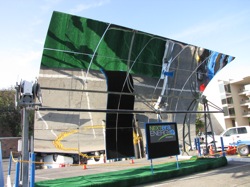
One section of a solar-thermal array on display at UC Riverside. Thousands of these mirrors gather solar radiation to heat a synthetic oil, which drives electrical generation at huge desert facilities. Photo: Craig Miller

Perhaps the most telling moment at the Governor’s Renewable Energy Policy Conference this week, was when the Governor’s own senior advisor on renewables, Michael Picker, asked for a show of hands. How many present, he wondered, actually thought that California would attain its goal of 33% renewable power by 2020. Amid the 370 or so gathered on the campus of UC Riverside, about a dozen hands went up. How many, he asked, thought we’d make it to 33% by 2050? Another dozen or so hands.

Bear in mind that this was a room containing some of the most knowledgeable people on the topic, from government, industry and environmental organizations. These were people invested in getting there, yet most seemed to doubt that we would.

Their pessimism was not entirely shared by the questioner. Picker told me afterward that he expected about 8,000 megawatts of new power to be approved by year-end. That’s approved, not necessarily financed. Solar arrays that generate 250 MW or more are considered large-scale operations.

Meanwhile, developers are pushing to get major projects approved before the year is out. To qualify for federal stimulus dollars, projects have to break ground this year and spend a certain percentage of project costs.

“It’s a hard state to develop in,” said Matt Handel, a vice president with NextEra Energy Resources. The Florida-based company is already a major player in both solar and wind generation in California, and Handel says the stimulus money is essential for two major new projects that NextEra has in mind for the southern California deserts.

“There is hope,” Handel told me. “It is difficult. There are a lot of constituencies out there pulling in different directions.”

Virtually all of those stakeholder groups were present in Riverside, in some form. Local (especially desert) communities, environmentalists, Indian tribes and representatives from federal agencies such as the Bureau of Land Management and National Park Service were there.

Identifying the most appropriate sites for large-scale wind and solar plants has been complicated by more than bureaucracy, said Kim Delfino, California Program Director for Defenders of Wildlife. “The landscape we’re working in is already changing due to the effects of climate change, which presents a challenge as to which areas to protect,” said Delfino in a panel discussion.

Picker says he’s “not so sure” that the state is doing the best possible job of moving projects efficiently through the pipeline (to borrow a metaphor from the fossil fuels era), and he conceded that some developers will be left standing in line as the year-end deadline expires. But he calculated that if, over the next five years, 20% of the biggest projects on the drawing board can get approved, the state should make its 2020 goal.

AB 32 and the Economic Road Ahead

By 2020, California will see two million new jobs whether the state implements its climate law AB 32 or not, according to a revised analysis from the California Air Resources Board.

The report, released Wednesday, predicts modest growth in the state economy over the next 10 years, including growth of 2.4% in both personal income and gross state product with or without the law.

During a Wednesday conference call,  CARB chairman Mary Nichols told reporters that sectors where California is strong, such as renewable energy and informational technology, will benefit from AB 32.

“California is uniquely positioned to benefit because this is the direction in which our economy is going anyway,” she said.

Nichols added that industries heavily dependent on petroleum will also benefit, but that they will have to go through a transition.

“We will see economic benefits overall by 2020,” said Nichols, “but it will be easier for some than for others.”

The report was reviewed by the 16-member Economic and Allocation Advisory Committee (EAAC), an independent panel of policy, business and economic experts appointed by Nichols and California Environmental Protection Agency Secretary Linda Adams.

The report finds that AB 32 provides, “neither a huge boost nor a major negative impact on California,” said Larry Goulder, chair of the EAAC and of Stanford’s Economics Department on a call Wednesday with reporters.  “These findings are not that different from other studies that have been done.”

The Air Board’s original analysis was questioned earlier this month in a report from the non-partisan Legislative Analyst’s Office, which projected a mixed bag of pluses and minuses, with a short-term negative impact on jobs.

CARB’s first economic projections were criticized by others, including UCLA economics professor Matthew Kahn.   Kahn said he is much happier with this new report because of adjustments made to the baseline scenario and because of the independent review made by EAAC panel, which he called a “dream team” of economists.  However, the report still falls short, Kahn says, because its macroeconomic approach doesn’t identify how specific industries and businesses will fare under AB32.

“The report released today is about averages. And where I think we need more research is in how individual firms will be affected,” said Kahn. “When I was in graduate school, I had a professor who used to say ‘if your feet are in the fridge and your head is in the oven, on average, you’re ok’ and I always thought that was a funny joke, but I think it’s apropos about California today.”

Also on Wednesday, Kahn published an opinion piece in the LA Times with co-author James L. Sweeney, director of Stanford’s Precourt Energy Efficiency Center, arguing that a study frequently cited by opponents of AB 32 is seriously flawed.  The study, known as the Varshney/Tootelian analysis, estimates that the law will cost small businesses $50,000 a year and each household $3,857 a year once the new rules kick in.

Opponents of AB 32 are advocating for a ballot initiative that would suspend the law’s regulations until the state economy improves and the state unemployment rate drops to 5.5%. It’s currently pegged at 12.5%, officially.

California Cities Get High Marks for Energy Efficiency

San Francisco

Los Angeles tops a new ranking (PDF) of the 25 U.S. cities with the most energy efficient buildings, released by the Environmental Protection Agency.  With 293 Energy Star-rated buildings encompassing 76 million square feet of space, Los Angeles saves $93.9 million and reduces emissions equal that from electricity use by 34,800 homes, according to the EPA.

Washington, D.C. was ranked second, and San Francisco third.  Two other California cities made the top 25: Sacramento (16th) and San Diego (17th).  According to EPA data, San Francisco has 173 Energy Star buildings (including Hotel Nikko and One Embarcadero Center) that save an estimated $69.4 million in energy costs and reduce emissions equivalent to 24,700 homes. Sacramento and San Diego have 61 and 58, respectively.

As of the end of last year, 9,000 commercial buildings had been awarded Energy Star designation since 1999, representing a combined savings in utility costs of $1.6 billion and a reduction in GHG emissions equal to that of one million homes, according to the EPA.

Buildings that qualify for Energy Star are those that score in the top 25%, based on the EPA’s National Energy Performance Rating System, which compares energy use among facilities of similar types on a scale of 1-100.

California Behind in Weatherizing Homes

Touted as a “shovel-ready” project that would create jobs immediately by leveraging existing infrastructure, the Department of Energy’s Weatherization Assistance Program has so far fallen far short of its goals.  The program received almost $5 billion under the American Recovery and Reinvestment Act of 2009 (ARRA) to improve the energy efficiency of nearly 590,000 residences of low-income citizens — more than a tenfold increase over the $450 million approved in FY 2009.
But a Special Report released last month from the Inspector General of the Office of Audit Services at the DOE found that as of December, just $368 million (8%) of the $4.73 billion allocation had been spent, and 5% of the nearly 600,000 units nationwide slated for weatherization with funding from the Recovery Act were actually completed.

That includes completion of just 12 of 43,400 planned units in California, which has been allotted more than $185.8 million in Recovery Act funding for its Weatherization Assistance Program.

So much for shovel-ready.

The report outlines reasons for the hold-up. Among them was a lengthy delay while the Department of Labor conducted wage surveys to determine appropriate compensation for weatherization work, so that the program would be in compliance with regulations.  Many states did not want to begin work until the wage rates were in place, the report stated, so much weatherization work throughout the country did not begin until late in 2009.

The report also found that, “Ironically, given the anticipated stimulus effect of the program, economic programs in many states adversely impacted their ability to ensure that weatherization activities were performed.”

Effects like hiring freezes, and, in California in particular, furloughs created significant staffing challenges in implementing the Weatherization Program, the report said.

In a a press release responding to the DOE report, the National Association for State Community Services Programs  (state officials implementing the DOE program), said that, “While it is accurate to assert that the ramp-up of expenditures and production has been slower than anticipated, this has been due largely to variables outside of the control of network providers.”

T. Maria Caudill, a spokesperson for the California State Department of Community Services and Development, the “network provider” in that state, said that as of December 2009, state administrators were still waiting for “specificity” from the federal government with regard to wage requirements.  In the last two months, California has aggressively worked to get contracts in place and units weatherized, she said.

According to Caudill, as of the end of February, 849 units had been completed across the state and 1,047 were in the process of being weatherized.

“We are on target to meet our first milestone,” said Caudill, referring to the goal of 12,900 units weatherized with ARRA funds by September 30.

She said that currently, eight service areas including Los Angeles, San Francisco, and El Dorado County are still without contracts for the ARRA weatherization work.

In a speech at Stanford yesterday, Energy Secretary Steven Chu told students and faculty that the number one priority of the DOE is “to get America employed using clean energy as the tool.”  Repeating a favorite metaphor of his, Chu called energy efficiency the “low-hanging fruit” for creating jobs, saving money, and reducing emissions.

As of December 2009, 520 jobs had been created or saved in California by the DOE’s use of recovery funds, according to a recent report from the Pew Center on Global Climate Change. That number will grow as California plays catch up, weatherizing more than 40,000 units between now and March 2012, which is the deadline for spending Recovery Act funds.

The Backlash Against “SmartMeters”

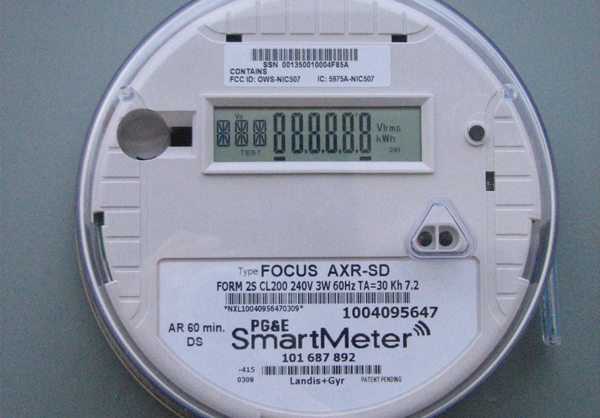
A “SmartMeter” mounted on a Fresno home. (Photo: Sasha Khokha)

The California Public Utilities Commission says it will name a consultant sometime this week to start testing PG&E digital “SmartMeters,” which customers have blamed for spikes in their utility bills.

The announcement came after state Senator Dean Florez (D-Shafter) held a press conference in Bakersfield to question why the CPUC hadn’t taken action. Last October, the Commission agreed to quickly hire an independent contractor to test the meters.
Florez got involved in the flap last year after some of his Central Valley constituents saw their bills triple with the new meters, even if customers bought energy saving appliances, or in some cases, when no one was living at the home. “The biggest savings recognized so far has been to PG&E, who were able to lay off numerous meter readers,” said Florez in a press release.

PG&E has blamed the higher bills on rate increases and hot weather (not a new phenomenon in the Central Valley, where people coddle their air conditioners as if they were household pets).

The Bakersfield Californian reported last month that the backlash here in the Central Valley is catching the attention of industry analysts and utilities nationwide, who want to avoid a spreading backlash against the new technology.

One of the groups sounding a warning is the Division of Ratepayer Advocates, an independent consumer advocacy division of the CPUC. Last week, it advised the Commission to reject a Southern California Gas application to fund its own $1 billion smart meter program. DRA argued not that utility bills would spike with new digital meters, but that money could be better spent on energy efficiency measures and appliances. DRA says SoCalGas is overestimating how much customers will reduce their usage if they can see a digital display of how much energy they’re paying for.

Part of the concept behind smart meters is to help utilities with “demand response” strategies; providing timely feedback to customers, who can use their home computers to see exactly how and when they’re using power, customers might then alter their consumption patterns to avoid peak demand periods, and cut utility bills.

But some of that strategy has already backfired. The San Francisco Chronicle recently reported that a document PG&E filed with the CPUC says the advanced digital smart meters will let the company shut off power to more customers who fall behind on their bills, since they can do so without having to send a crew to a customer’s home. The meters may be smart but consumer advocates say it’s a dumb strategy that will make it easier for the utility giant to leave customers out in the cold.

Governor Rejects LAO Jobs Report on AB-32

Governor Arnold Schwarzenegger said today that he’s “absolutely convinced” that California’s climate law “will create jobs more than kill jobs.”

“Unlike others that only have theoretical opinions,” he said, “I travel up and down the state and see first-hand.”  By “theoretical opinions,” the Governor appeared to be dismissing last week’s analysis by the non-partisan Legislative Analyst’s Office of the likely economic impact of the climate mitigation law, usually known by it’s legislative shorthand, AB-32.

But the report was hardly an unqualified downer. While the LAO concedes that “certain individual businesses and households…would be seriously affected,” the ten-page analysis presents a mixed bag of pluses and minuses, costing jobs in the near term but with potential long-term benefits. According to the report:

“The effects of the SP (Air Board Scoping Plan) on California jobs are difficult to accurately predict but would be mixed, with gains in some occupations and industries (including so-called” green” jobs) and losses in others (primarily involving fossil fuel-related energy production). On balance, however, we believe that the aggregate net jobs impact in the near term is likely to be negative, even after recognizing that many of the SP’s programs phase in over time.”

The report, issued in response to a request from state Senator Dave Cogdill (R-Fresno), is an assessment of California’s Global Warming Solutions Act, passed in 2006 to reduce greenhouse gas emissions, and set for full implementation in 2012. The law is under attack as a potent job killer, by a gubernatorial hopeful and a nascent ballot measure. Business groups are divided on AB-32’s overall effects.

The LAO report concludes that the law’s cap-and-trade program of carbon pricing “would almost certainly raise the near-term prices of electricity, gasoline, and certain other energy sources,” but at the same time, tighter energy efficiency standards for buildings would lower utility bills. Another measure, the low-carbon fuel standard, would raise the price of new cards but also reduce their operating costs.

Netting out the opposing effects of all these components is tricky business, involving a “complex model with hundreds of equations,” as described in the report. The LAO concludes that farther out on the time horizon, economic effects of AB-32 become fuzzier:

“In the longer term, its net effect on jobs-potentially either positive or negative-is unknown and will depend on a variety of factors. In a relative sense, however, its effect on jobs in both the near term and longer term will probably be modest in comparison to the overall size of the state’s economy.”

The Air Resources Board, California’s lead agency in implementing AB-32, initially projected the law would produce a net gain of 120,000 jobs in California by 2020. “They could be exactly correct,” LAO staff economist James Nachbauer told me, though his office isn’t putting its own number on the jobs effect. In it’s report, the LAO “questions the reliability” of the estimate in the scoping plan and concludes that the Air Board’s models “are not able to provide reliable estimates of the jobs impacts” in 2020. To meet it’s goals, AB-32 requires cutting emissions by about 15% from current levels, by 202o.

The Air Board has promised to provide a revised analysis, which LAO staffers say they expect to receive later this month. But as Nachbauer sums it up, “These weren’t created as jobs programs.”

More Water Likely for Farms and Cities–With a Catch

Craig Miller
What is now looking like a "normal" wet winter may mean bigger water allocations for crops. Photo: Craig Miller

We’d like to think that weather and water supply is a straightforward proposition. If rain falls in the lowlands and snow blankets the Sierra Nevada the way we expect it to, then we ought to have enough water to get us through the dry months ahead. But of course, California water is never that simple. The latest example: today’s state and federal announcements of projected  deliveries from two massive Central Valley water systems.

From the state: The Department of Water Resources said it’s increasing promised State Water Project deliveries from five percent–the amount projected last December 1–to 15%.

In a conference call with reporters, newly-appointed DWR Director Mark Cowin called the 15% figure “very conservative.” He said that if the wet season continues on its current “average” path, the department could deliver between 35-and-45% of the contracted amount.  Cowin said where final allocations would land in that range depends on pumping restrictions currently in place to protect endangered salmon and smelt.  “That spread between 35 and 45 percent is based on how the fisheries agencies ultimately apply the existing rules to protect fish–and how much resulting flexibility we have to pump water from the Delta,” Cowin said.

The bottom line from the DWR announcement: Three years of drought have taken a toll on water supplies that will take more than one good year of rain and snow to reverse. Cowin says runoff from the healthy Sierra snowpack will be lower than normal, as more water is absorbed by relatively dry soil.

At the same time, the State Water Project’s biggest reservoir, Lake Oroville, stands at 54% of its normal level for this time of year. The other linchpin for SWP supply, San Luis Reservoir, is at 80 percent of normal overall. But most of that water is already spoken for and is unavailable for meeting this year’s state water contract commitments.

As the state was adjusting its projections, officials also weighed in on 2010 deliveries from the federal Central Valley Project.

Secretary of the Interior Ken Salazar announced that the initial allocation from the CVP to San Joaquin Valley farmers and other users is 5%. That’s better than nothing–which was the early allocation last year. But it was only part of the news.

Salazar disclosed that negotiations involving Senator Dianne Feinstein, other members of the California congressional delegation, water contractors, and environmental groups have hammered out a plan that could deliver nearly 40% of contracted supplies to CVP customers. But there’s a big “if” in the picture: Those expanded deliveries only happen if the wet season continues to be wet.

Weeks of controversy preceded Salazar’s announcement. Areas of the San Joaquin Valley that have gone thirsty during the three-year drought–notably the Westlands Water District–have been agitating for more federal water even if it means overriding Endangered Species Act protections for fish.

Feinstein went to bat for Westlands and other federal water customers, proposing an amendment to a jobs bill that would set aside Delta pumping limits in order to guarantee deliveries to Valley water users. That sparked outrage from those working to save the Delta fisheries and a sharply critical letter from a dozen House members. But it also apparently prompted the talks that led to Salazar’s announcement. In a statement, Feinstein said she was pleased with the projected allocations announced today and praised the “creative thinking” that went into it. But she added that she’s watching how water shipments play out. Although she has shelved her water amendment for now, she said, “I reserve the right to bring it back should it become necessary.”

Here’s our updated KQED California Reservoir Watch, which gives a pretty good picture of the state’s water storage:

<
View KQED: California Reservoir Watch in a larger map