
Tag Archives: Air

EPA Waiver Still Not “In the Can”

Now the waiting begins–or resumes. After nearly seven hours watching opposing sides duke it out in a Beltway hearing room this week, the EPA will settle down to deciding (again) if California should be allowed to set its own standards for auto emissions.

During the hearing, one group was using Twitter to pass around an online petition supporting the required EPA waiver. They weren’t too late. EPA will continue accepting public comment until April 6. EPA spokesman Cathy Milbourn says “We will review all of the comments, with a decision to follow.” No further timeline for that decision has been made public, however.

Meanwhile, the Detroit News is reporting today that California’s top air regulator may be ready to compromise on a new national standard that would obviate the need for a special waiver.

In case you need a quick review, the issue is whether the tailpipe emissions standards passed into law by California several years ago–the so-called Pavley regulations–can actually be enforced. The Pavley standards are more stringent than the current federal standard and the state is leaning heavily on them to attain its greenhouse gas targets under the Global Warming Solutions Act of 2006 (AB 32). But the waiver was denied under the Bush administration.

Thirteen other states are lined up to enact the California standard if they get a green light from EPA. The auto industry has long argued that this will create a “patchwork” of regulations across the nation, and the ensuing complications of compliance would place an onerous burden on the industry and push up prices for car buyers.

Supporters of the California standard, like Jim Kliesch of the Union of Concerned Scientists, say that automakers already have the technology and can easily comply. Kliesch conceded that consolidating the most efficient technology into one car would add–he figures–about $700 to the cost. But he says the same technology would recoup $1,800 in fuel savings over the life of the car.

Mark Cooper of the Consumer Federation of America pointed to an apparent disconnect in the car maket. He referred to a survey in which half the respondents said they wanted their next car to get at least 30 MPG–but Cooper said only 2% of models currently on the market deliver that.

And so, the argument goes, that if car makers would just follow the market toward cleaner, more fuel-efficient cars, it would actually help them recover from a financial abyss that threatens to topple them.

At the end of the day, the EPA has to make its decision based on three criteria, says David Doniger of the NRDC. To be valid, the California standard must be:

1. Equally strict or more stringent than the federal standard,

2. Needed to meet “compelling and extraordinary conditions,” and

3. Technologically and economically feasible.

Hmm. It seems like you could make a solid case for checking off numbers 1 and 2 but what’s “economically feasible” is a potential tripwire, especially with General Motors teetering on the brink of bankruptcy. Much of it will come down to whether the Obama administration buys into the “patchwork” argument. It’ll be at least another month before we know.
The Cost of Ignoring Climate Change

sunheat_smMuch of the debate over addressing climate change hinges on the cost of proposed mitigation efforts.  Some say we can’t afford the extraordinary measures required to cut greenhouses gases, particularly in the current economic train wreck.  What gets less attention is the cost of doing nothing.
This has been a controversial idea since the Stern Review called attention to the issue in 2006. That report concluded that unless one percent of global GDP was diverted to mitigate the worst effects of climate change, the world could lose up to 5% of  global GDP each year and the total damage could claim as much as 20%.

A set of new reports out of the University of Oregon inserts fresh numbers into the debate. According to researchers, three western states are each likely to lose more than $3 billion a year in climate change-related costs by 2020, if nothing is done to reduce greenhouse gas emissions.  By 2080, the projected annual costs range from $9-to-$18 billion for each state.

The reports, which focus on Washington, Oregon, and New Mexico, assume a business-as-usual scenario where both carbon emissions and temperature continue to rise at rates similar to those seen in recent years. Under these conditions, these states (and California, according to the prevalent research) can expect more severe droughts and floods, less snowfall,  more wildfires and habitat loss, and a higher incidence of climate-associated health problems and deaths.

In New Mexico, the study’s authors expect summer temperatures to climb 12.6 degrees above current averages by 2080,  spiking air-conditioning costs, health-care complications, and the state’s death rate.  By 2020, annual climate-related health care costs in New Mexico alone are expected to top $1.3 billion.

California’s temperatures, under business-as-usual scenarios, are widely expected rise between six and ten degrees by the end of century.  Even in a relatively cool state like Washington, health care impacts would make up $421 million, or 32%, of total annual climate-related costs, under this pr0jection.

The study attributed the largest costs (more than $1 billion annually in each state) to inefficient consumption of energy, a projection that might not pan out, given the Obama Adminstration’s focus on green technology and clean energy efforts.

Other costs cited by the study include reduced salmon populations and food production, lost recreational opportunities (sell your snowboard now), and more intense and frequent wildfires and storms.

Cow Power Takes to the Highway

biogas1If the program for the World Ag Expo in Tulare had a centerfold, it might well be a gleaming red and silver tank truck, powered by pure Holstein hydrocarbons.

A Tulare County dairyman is using cow “emissions” to fuel two delivery trucks. Instead of a sleeper compartment, the cab of the truck holds six lightweight tanks for compressed bio-methane.

Western United Dairymen have produced a video about the project and its benefits to the environment. That’s an interesting twist because the dairy lobbying group and air quality regulators haven’t always seen eye to eye on the question of bovine gas.

Emissions from livestock have their own load of air quality issues, especially in Tulare County, where there are more cows than people. When cows burp or emit gas, it produces ozone, a key component of smog. Dairy owners have also wrangled with air regulators over emissions from some methane digesters that convert manure to electricity on dairies. For a refresher (poor word choice, perhaps), check out our recent radio/web series on methane.

But the California Air Resources Board stands behind the cow-power project (though perhaps not the manure spreaders–okay, old joke). In fact, CARB staked the dairy to a $600,000 grant, under legislation passed in June 2006 to encourage the introduction of alternative fuels into the California market. Hilarides Dairy and Cheese company used the money to help build a methane digester and figure out how to convert the diesel trucks.

How exactly does cow poop become something that can power a vehicle? It isn’t pretty, according to the group Sustainable Conservation, which put out a report on the subject. It goes something like this:

Manure is flushed from the cows’ stalls into a covered lagoon where bacteria convert the manure to biogas. The trapped gas is sent from the lagoon to a biogas upgrading system which removes impurities. Pressurized bio-methane is put into the truck’s fuel tank. The truck is then ready for the road.

The report estimates that cows could eventually power a million cars nationwide. But unless you live near a dairy farm or have your own personal cow to hook up to your fuel tank, don’t expect this will save you a trip to the gas station anytime soon.

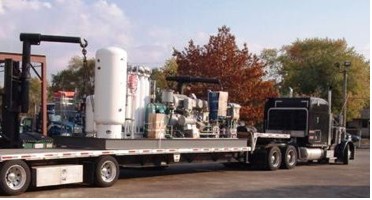
Photo courtesy of Hilarides Dairy: The biogas upgrading system arrives by truck from Michigan (but transported with conventional diesel).

Methane Epilogue: Power from Cows and Castoffs

dig_3944-web.jpgWe have updates from some of the places we visited in our methane series, heard on The California Report. For Part 1 of the series, click here. For Part 2 of the series, click here.

At Fiscalini Farms near Modesto, John Fiscalini says he finally worked out a deal with air regulators that allows him to convert his manure into methane for electric power. His permit from the San Joaquin Valley Air Pollution Control District allows him to run the engine while he makes adjustments to minimize particulate and nitrous oxide pollutants.

He hopes to be making power by the middle of this month–more than 13 months behind schedule. Capturing the methane, of course, will make a significant dent in the carbon footprint of the farm, which has 3,000 cows (1,500 producing and 1,500 “replacements”).

He also has a grant from the U.S. Dept. of Energy, under which university researchers will install equipment to monitor the methane operation. Fiscalini says they’ll “monitor everything we can possibly monitor” and gather data to make better judgments about the efficiency and economic feasibility of methane digesters. He’s having some doubts about the economic feasibility of his own. Now, he says, water quality regulators want him to do $40,000 worth of environmental assessments, including a hydro-geologic survey and a study of his waste stream (he uses leftovers from the methane digester for fertilizer).

You may recall that we started Part One at an unidentified landfill, to explain how methane is produced and captured, and why flaring it off is better than letting the methane escape into the atmosphere. I later heard from Jessica Jones, district manager for Waste Management, which runs the Redwood Landfill and Recycling Center in Marin County, the location where I did the recording. While the landfill currently flares off its collected methane, Jones wanted us to know about some of the company’s efforts to harness that gas–potentially enough to power 4,000-5,000 homes. In an email to KQED, she wrote:

“Redwood Landfill is currently working to permit a landfill gas to energy facility which will become Marin County’s largest source of green power.  Altamont Landfill in Alameda County currently has landfill gas to energy production through the use of internal combustion engines and turbines, and is beginning construction of a liquefied natural gas facility which will convert landfill gas into a clean burning fuel which can be used to power Waste Management’s refuse collection fleet.  This type of fuel is estimated to be potentially the closest to carbon neutral of any fuel being developed today.”

There’s more about Redwood’s landfill-gas-to-energy (LFGTE) project at the company’s website. In echoes from our conversations with John Fiscalini, Jones writes on the site that there are “regulatory hurdles” to be cleared before this can happen. Sound familiar?

Photo: Stinky silage; Methane digester tanks will soon power the Fiscalini dairy farm.

A Few Miles Closer to that EPA Waiver

img_1777.JPGContinuing his methodical repudiation of Bush administration policies, President Obama today took California’s long-delayed request to regulate tailpipe emissions off the shelf. The President ordered an immediate review of the state’s request for a waiver to supersede federal requirements with its own, stricter ones.

We should be just as clear about what didn’t happen, however. He did not throw a thunderbolt at the EPA and reverse the previous administration’s denial of said waiver. He essentially told new EPA Administrator Lisa Jackson to put it back on top of the stack in her in-box. Jackson had already promised a “speedy review” of California’s request, during questioning at her Senate confirmation hearing. “Speedy” is a relative term, however and the reality is that it will likely be months before we get a final decision.

Though there is little doubt what that decision will be, the President did leave room for the EPA to soften the blow to the destitute auto industry. Automakers claim that the waiver will cost them billions in new investments and add an average of $5,000 to the price of new cars.

There’s a lot on the line for California, which had taken the EPA to court over the waiver. The state’s proposed tailpipe emission standards (known as the Pavley regulations) account for nearly 20% of the hoped-for CO2 reductions in the Global Warming Solutions Act (AB-32) and 70% of the attendant economic gains (estimated to be $11 billion).

Some reactions to the White House executive order today…

From the Governor:

“With this announcement from President Obama less than a week into his administration, it is clear that California and the environment now have a strong ally in the White House. Allowing California and other states to aggressively reduce their own harmful vehicle tailpipe emissions would be a historic win for clean air and for millions of Americans who want more fuel-efficient, environmentally-friendly cars.”

From Bernadette del Chiaro, Environment California:

“After being stuck in reverse for eight years when it comes to clean energy and global warming policy, President Obama has taken America from 0 to 60 in six days. From here on, science and not special interests will be in the driver’s seat in America.”

 You get the idea. It was high fives all around and a cavalcade of automotive metaphors in Sacramento today.


Two Billion Cars

We already have one billion, worldwide. Transportation researcher Dan Sperling says that stands to double within about a generation, with unthinkable consequences for air quality and climate change.

But it’s his job to think about the unthinkable. Sperling is a founder of the UC Davis Institute of Transportation Studies and a member of the California Air Resources Board. He talks about his new book, Two Billion Cars, on today’s podcast of NPR’s Fresh Air.

Methane Sources and the “Dark Side” of Solar

plants.jpgPlants don’t produce methane after all, a new study out of the UK contends.  The results refute a 2006 report that suggested plants could account for almost half the world’s production of this potent greenhouse gas. But according to authors of the latest study, plants are more like little methane pipelines; they convey methane from the soil to the air, but they don’t actually produce it.

No one said that climate change was simple.

Neither are the solutions, apparently.  An article in the LA Times reports on the “dark side” of solar, outlining the toxic materials used in cells, the difficulty of recycling some components, and the fossil fuels burned in the production and transportation process of cells and panels.

And don’t let this weird weather confuse you either.  As the Thin Green Line reports, this week’s freezing temperatures in the Midwest don’t mean climate change isn’t happening.

Bay Area Greenhouse Gases on the Rise

trafficjam_sm.jpgThe Bay Area Air Quality Management District has issued a new inventory of greenhouse gas sources, updating a report issued last year, for “base year 2002.” (Yes, the 2006 report was for 2002–let me know if that’s not confusing enough).

If you thought the heavy hitters were those half-dozen or so big, smelly oil refineries strung out between Richmond and Antioch, guess again. If you’re going for your climate geek merit badge, you’ll know that here in California, at least, the transportation sector is the reigning CO2 champ.

According to the updated report, transportation accounts for about 40% of emissions. Non-farm industrial & commercial emissions (from stationary sources) weigh in at 34%. Amaze your friends! If you take that transportation sector and break it down further, it turns out that cars and light-duty trucks account for almost 64% of those mobile emissions.

Okay, so you know all that. But what jumps out of the report are the projections of emissions through 2029, which the Air District arrived at by blending current levels with projected population and economic growth. The trend is not only upward but steeply upward, from 104 million metric tons (CO2 equivalent) to 128 million by 2020 and 150 million by 2029, an increase of 44% in two decades.

But good gravy, how can that be? Isn’t California “leading the way” in greenhouse gas reductions? Well, yes and no. Henry Hilken, Director of Planning and Research for the district, explained that because most of the state’s aggressive mitigation programs are not yet in place, his number crunchers did not take them into account in their calculations. In other words AB-32, cap-and-trade, the so-called Pavley regulations on tailpipe emissions, the low-carbon fuel standard–none of it is actually happening yet. The projections represent a future based on “business-as-usual.”

That’s likely to change, however. State regulators have been virtually assured that they’ll get the required EPA waiver to put stricter tailpipe regulations in place, shortly after President-elect Obama takes office, to use just one example. For more on this issue, listen to Sasha Khokha’s feature from The California Report, earlier this week. On the other side of the ledger, full implementation of AB-32 remains in question, as the funding mechanism is not fully in place.

How much would the picture change with all those–or even some of those measures in place? Hilken says he hasn’t attempted those calculations. It’s also likely that a long, deep recession could put a kink in the emissions trend. So while you can argue that the numbers in the inventory are a weak predictor of things to come, they are a useful snapshot of where we are–and a sobering assessment of where we’ll end up without an aggressive climate policy.

The Air District report tracks two types of carbon dioxide (CO2), along with methane (CH4), nitrous oxide (N2O) and a handful of lesser-known gases. The non-CO2 emissions are converted mathematically to “CO2-equivalent” values.

“Is the Planet Just Doomed?”

3117211300_7c2dceccac_m.jpgThe world needs to completely phase out coal emissions over the next 20 years to avoid climate disaster, James Hansen, the head of NASA’s Goddard Institute of Space Studies (GISS) told a room packed with several hundred people at the AGU conference in San Francisco on Wednesday.

An immediate moratorium on new coal use that does not capture CO2 and phasing out of all other coal emissions by 2030 is the path to reach a target for CO2 emissions of 350 parts per million (ppm) identified in a new study led by Hansen. Previously, Hansen has said that the dangerous level for CO2 was likely to be 450 ppm or higher, but in light of new observations and analysis of ‘slow’ feedback processes like ice melt and greenhouse gas release from the ocean and soil, the study team revised that projection.

Unfortunately for the world, current atmospheric CO2 levels are already at 385 ppm.

(Hansen, a well-known climatologist, received a lot of publicity in 2005 and 2006 over his assertions that NASA administrators tried to censor his public statements about the causes of climate change.)

“We’ve got to get politicians to understand that it is more serious, and we’re at a more critical stage, than they seem to understand,” said the scientist. “No one is doing anything even close to what’s needed, even those countries who appear to be the most serious.”

Hansen’s colleague Pushker Kharecha acknowledged in an earlier lecture that phasing out coal over the next 20 years would be a “Herculean” task, but that it is possible, and necessary. Even if the world comes together to meet this goal, atmospheric CO2 would peak at 400-425ppm before gradually declining with the help of reforestation and other efforts.

Hansen warned that because of certain feedback loops, there will be no escape from “The Venus Syndrome” – runaway global warming – once the climate reaches certain tipping points. We may have already reached the tipping point with the Arctic sea ice which has decreased dramatically, he said. Other indicators he cited are a quadrupling of wildfires in American West over the last 30 years and the rapid retreat of glaciers, which he predicted will have disappeared within 50 years under a “business as usual” scenario.

All of this led one member of the audience to ask the question in everyone’s mind:

“Is the planet just doomed?”

To that Hansen replied that some human causes actually have slowed, such as CFCs and methane, and that there are technologies worth exploring like burning nuclear waste. Then he added, “I think we’ll solve the problem, but we need to tell the truth that it does require a carbon price. Politicians are not willing to do this.”

I can’t say I found his answer especially reassuring.

When Mitigation Falls Short, Adapt

3042486968_0a474edd83_m.jpgWhile California has plans in place to reduce greenhouse gases, to mitigate the effects of climate change, it is only recently that the local governments have begun thinking about adaptation strategies, according to two reports released today by the PPIC.Preparing California for a Changing Climate” and “Climate Policy at the Local Level: A Survey of California’s Cities and Counties.” Both focus on what is being done currently to confront climate change and where the state and municipalities need to focus adaptation efforts, in order to prepare for future environmental changes.

According to Ellen Hanak, who co-authored both studies, while three out of  four California’s communities are “doing something” related to climate change, only half of that group is looking into adaptation strategies and developing plans for protecting community assets.

“The focus has been on bringing greenhouse gases down,” said Hanak. “Only recently have folks been looking into climate impacts.”

Adaptation is a critical element because even if the world does reduce emissions significantly, Californians still may face problems like sea level rise, increased wildfires and flooding, public health issues related to air quality and increased temperatures because of change that has already been set in motion.  The extent of these problems, of course, will depend on how successful we are with mitigation strategies.  The less successful we are at reducing greenhouse gases, the better we need to be at adapting to change.

Hanak sees the executive order issued by the Governor on Friday requiring state agencies to assess and plan for sea level rise due to climate change, which we blogged last week, as one positive step in this direction.  Because the order mandates an assessment of projected sea level rise, local governments will soon have a benchmark to use for planning their adaptation strategies.