Forget this Winter: Western Snowpack Shrinking

By Alyson Kenward

A new study finds large losses of springtime snow cover in the West in recent years, raising concerns about water supplies.
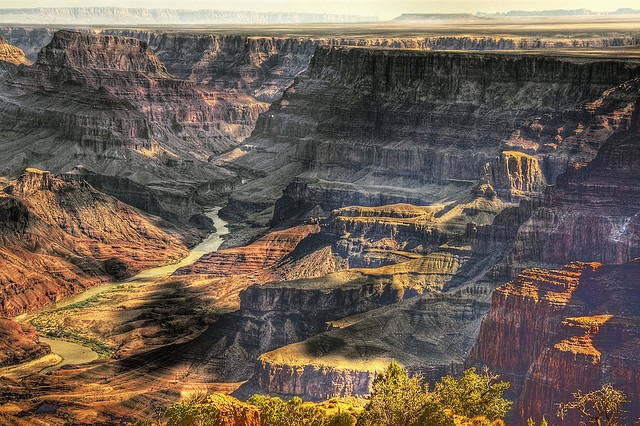
Spring snowpack in the West is an essential water resource, particularly in Southwestern states that are prone to summer drought, like California, Nevada, Arizona and New Mexico. (Credit: Wolfgang Staudt on Flickr)

This spring, from the Pacific Northwest and Sierra Nevada, to the Northern Rockies, western mountain ranges were more than just snow-capped – they were buried in the white stuff. In fact, many locations still have more spring snowpack than has been seen in decades.

Head south across the 40th parallel, however, and things are dramatically different. While there is still above average snow throughout the Sierra, a relatively snow-less winter and spring has left much of the Southwest in a drought that has fostered record wildfires. Already local officials are worried there won’t be enough water to get through the summer months ahead. Continue reading Forget this Winter: Western Snowpack Shrinking
Visualizing California Climate Change

An engrossing one-stop shop for California’s climate future goes online

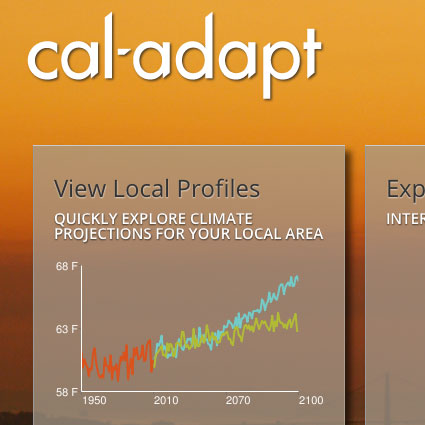
If you’re like me, and you spend a good part of every day thinking about climate change and California, you may have already lost yourself in the treasure trove of climate data and mapping fun that is Cal-Adapt, a comprehensive series of online tools just released by  the California Natural Resources Agency and the California Energy Commission.

And if you’re not like me, it’s still worth checking out.

Built by UC Berkeley’s Geospatial Innovation Facility, Cal-Adapt is designed to aid local and regional planners in preparing to adapt to climate change by providing scientific data from institutions like Scripps Institute of Oceanography, U.S. Geological Survey, UC Merced, and the Pacific Institute, and integrating it with mapping and charting capabilities from Google. The result is an attractive, interactive experience that enables you to view potential future climate-related scenarios for any location in California, and to sort by topics such as sea level rise, wildfire, and snowpack.  Importantly, data sources are prominently displayed. Continue reading Visualizing California Climate Change

The Long, Hot Summer: Longer & Hotter

Stanford study predicts the point of no return for hotter summers

By Katrina Schwartz

Just as many Californians are puzzling over winter-like weather in June, climate scientists are saying hotter days are ahead for most of the West. According to a new Stanford study (available soon at this link), we may be in for permanently hotter summers sooner than expected. Of course, for climatologists, “sooner” is a relative term.

Photo: Craig Miller

Plenty of climate scientists have studied the relationship between climate change and extreme temperature shifts, but until now no one has tried to pinpoint a moment when summer temperatures will permanently shift into a new “heat regime”, in which the coolest summer temperatures will be hotter than the hottest summer temperatures of the previous regime. Findings by the Stanford team suggest that the shift will likely happen sooner and be more widespread than expected. Continue reading The Long, Hot Summer: Longer & Hotter

Running Drier: The Colorado 50 Years Out

A new federal study says the Colorado River may carry 9% less water by 2060.

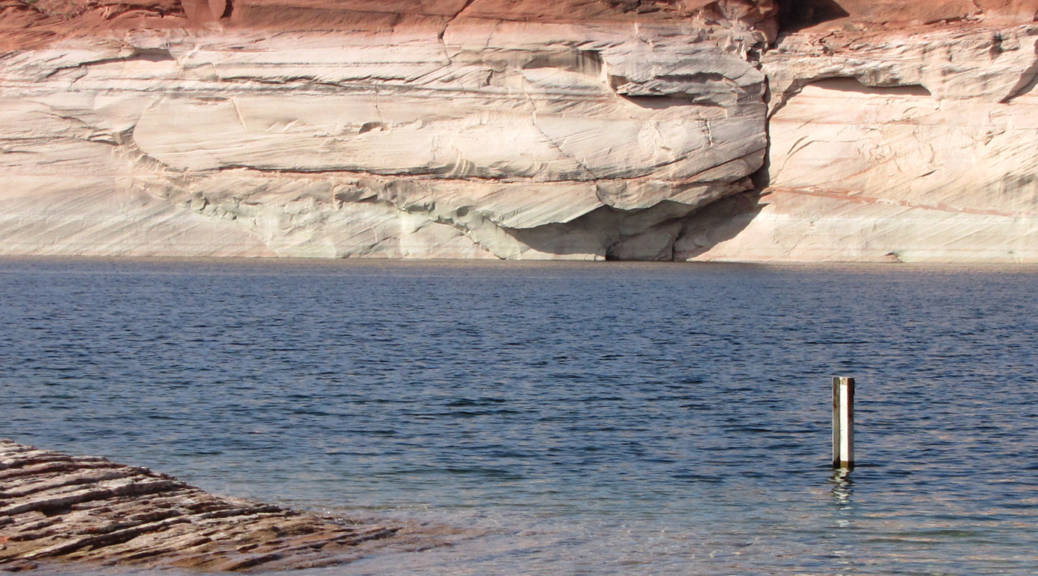
The Colorado River is a critical source of water for more than 30 million people throughout the western United States. California alone gets more than a trillion gallons of water each year from the Colorado. But over the years, recurring droughts and the growing demands of urban populations have stressed the river system, which the Bureau of Reclamation now characterizes as “over-allocated.”  In efforts to plan for the region’s future water needs, the agency, in collaboration with Western states, has undertaken a two-year study to look at what lies ahead for the river and the cities, farms, and families that rely on it.

On Monday, the agency released the first interim report of the “Colorado River Basin Water Supply & Demand Study,” which projects changes in the river’s flow under four different scenarios. A model that incorporates predicted impacts of climate change shows a nine percent reduction in the Colorado’s flow within 50 years.  The study also projects more frequent and more severe droughts throughout the system. Continue reading Running Drier: The Colorado 50 Years Out

California Likely to “Suffer Most,” Says Study

Photo: Craig Miller

California is likely to suffer more than any other state from worsening air pollution due to climate change by the end of the decade, according to a new study from the Union of Concerned Scientists (UCS).

The report finds that in 2020, “climate change-induced ozone increases” could result in nearly half a million additional cases of “serious respiratory illnesses” and add more than $729 million to the state’s health care costs. Continue reading California Likely to “Suffer Most,” Says Study

New Battlefront Over California Water

Garamendi warns of a “serious water war” if Nunes bill passes

Lawmakers traded punches on Capitol Hill this morning over the future of California’s water.

(Photo: University of California)

In a contentious hearing before the House Subcommittee on Water & Power, Delta Democrat John Garamendi warned that a Republican-sponsored bill to ensure farm water in the Central Valley would start a “serious water war.”

“Are you guys kidding?”, Garamendi asked his congressional colleagues. “You really want to start a serious water war in California? And you think that’s going to solve your problems and get you more water? This is really, really terrible public policy.”

The proposed policy at issue is the San Joaquin Valley Water Reliability Act (HR 1837), sponsored by Republican Devin Nunes of Fresno.

Environmentalists say the bill (HR 1837) would gut efforts to restore the Sacramento and San Joaquin Rivers. Nunes says it’s essential to save farms and jobs. Continue reading New Battlefront Over California Water

Planting Seeds for a New CA Nuclear Plant

Could California’s next nuke be on the horizon?

Backers of a new Fresno “clean energy park” aim to use nuclear power to clean up salty irrigation water in California’s Central Valley.

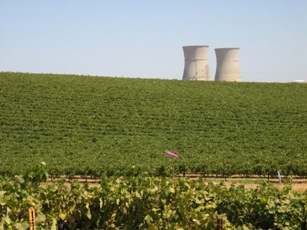
The twin cooling towers of the decommissioned Rancho Seco nuclear power plant. Could the Central Valley see another nuke constructed near Fresno? (Photo: Craig Miller)

They see the state’s 35-year-old moratorium on expansion of nuclear power as a mere speed bump in the road. They wouldn’t be the first. There have been several attempts to challenge the ban over the years – in the courts, in the legislature, and even a couple false starts through the initiative process.

But the idea of simply drawing up plans for a plant and gearing up to build it – without getting permission from the state – that’s a new approach, which I explain in my Wednesday radio feature for The California Report.

Fresno Nuclear CEO John Hutson told me he thinks it would be much more profitable to sell precious clean water to farmers than to generate electricity for the grid. Continue reading Planting Seeds for a New CA Nuclear Plant

What Shade of Green is Your Ride?

New Car Labels Emphasize Emissions and Savings

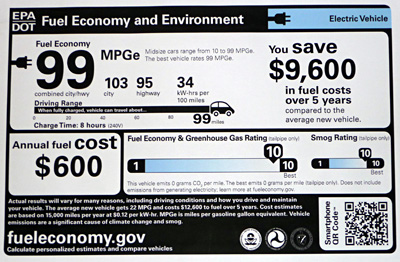
Coming to a showroom near you: a new fuel economy sticker for an electric vehicle. (Photo: Lauren Sommer)

Buy a gas guzzler and you might discover a new form of “sticker shock.”

Cars and trucks sitting on dealership lots will soon have a new fuel economy sticker in the window. Today, the Environmental Protection Agency released newly-designed labels that emphasize environmental performance for conventional and electric cars.

The label might seem familiar to California drivers. In 2008, the state released its own environmental impact sticker for new cars. It rates a car’s smog and greenhouse gas emissions on a scale of one to ten.

The new national label follows California’s lead and incorporates the same rating system. But for the first time, it will also display the annual fuel cost for a vehicle, comparing it to an average vehicle over five years. Continue reading What Shade of Green is Your Ride?

Google Writing More Checks for Renewable Energy

Another major renewable energy project is getting a cash infusion from Google.

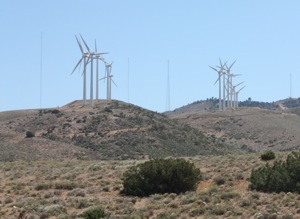
Wind turbines clustered on hilltops near Tehachapi. (Photo: Sasha Khokha)

This time it’s Terra-Gen’s multi-phase wind project in Kern County, known as the Alta Wind Energy Center.

Google’s clean-tech investment arm will reportedly invest $55 million in the project, being built near Tehachapi.

Bill Weihl, Google’s green energy “czar,” told me in an interview last year that the company would support clean energy technologies with two main attributes; global scalability and the potential to become cost-competitive with coal power. In a 2010 interview with the New York Times, Weihl said he thought Google’s “culture of innovation” made it a good fit with renewable energy development.

Google has now made substantial investments in wind, solar and geothermal projects, in and around California, as well as bankrolling an ambitious scheme to build a connective spine connecting offshore wind projects along the Atlantic coast.

Terror, Panic & Redemption in Six Minutes

Hunkered down in a Joplin convenience store when all Hell broke loose

Most of the nearly 800,000 people who had “watched” his video on YouTube by Monday afternoon, know him only as “izelsg.” But in the space of less than six minutes on Sunday night, he managed to capture nearly the full range of human response to crisis.

The Joplin tornado claimed at least 116 lives. (Photo: /Getty Images)

Izelsg, who, according to his YouTube profile, is a 23-year-old college student, was among 12 – 20 people huddled together in a gas station convenience store, when the Joplin tornado bore down and engulfed the building.

Though shot as video, there is little we can see. By this time, the power had gone out and the store’s occupants were huddled in darkness. The minutes that follow are made more compelling by the dearth of images. Only the occasional flashlight beam or lightning strike punctuate the sound of desperation and survival. Continue reading Terror, Panic & Redemption in Six Minutes