It’s just outside Phoenix. No, it’s in the Mojave. Wait, no, it’s in San Benito County.
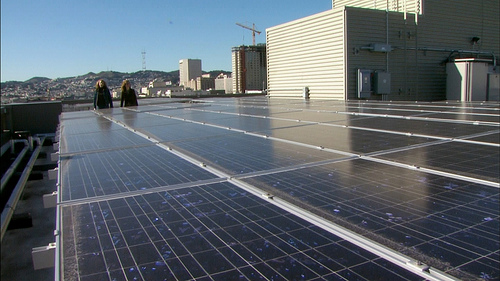
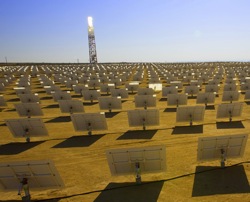
A solar-thermal array uses mirrors to concentrate sunlight. (Image: BrightSource Energy)
On a media call this week in which executives and investors from the solar industry stumped for extensions to key federal incentives, I heard Fred Morse of Abengoa Solar say that the company’s Solana project in Gila Bend, Arizona, will be, as described on the project website, “the world’s largest solar plant.” Later that same day, an email came in from Oakland-based BrightSource Energy, (not in response) touting its Ivanpah project as “the largest solar project in the world.” Similar terms have been used to describe Solargen’s proposed 4,700-acre photovoltaic array in San Benito County. Continue reading The Biggest Solar Project in the World→
The ultimate model for clean fuels? (Photo: KQED QUEST)
Amidst all the fretting over the development of solar and wind technology, it hasn’t been lost on some scientists that there are organisms on the planet that have already cracked the renewable energy code: plants.
Photosynthesis is a highly efficient way of converting sunlight to fuel. So why not try to copy them?
Despite frequent pronouncements by the outgoing governor of the Golden State, the chair of the giant solar industry expo that winds up in San Francisco today says “California and the US are losing badly in the global race” for solar energy deployment.
Weber said that California will represent a tiny fraction of the world’s growth in photovoltaics this year; just 200 of the 10,000 megawatts that he projects will be installed globally. California remains ahead of all other states in the deployment of solar panels. Weber’s forecast for California still represents two thirds of his projected total for the US. That’s “far below what could be expected from a country that’s as rich and sunshine-filled as the United States,” added Weber.
Chinese suppliers had a high profile at this week's solar expo in San Francisco (Photo: Craig Miller)
The global face of solar was impossible to miss at the Intersolar conference at San Francisco’s Moscone Center. Three levels of exhibition space were crammed with industry exhibits. To get there, attendees had to jostle for space on the escalators. Though this was billed as the “North American” conference (following an even bigger one in Europe), the halls included major product exhibits from China, Germany, Spain, South Korea, and other nations. Organizers told the trade publication Solar Industry that they booked 30% more exhibitors than last year for the expo.
While speakers at the conference were calling for more government support for solar and other renewable energy sources, state officials in California were going to the mat to save what’s already in place here. On Wednesday attorney general/gubernatorial candidate Jerry Brown said he is suing key players in the mortgage markets, in an effort to save the vaunted PACE program, which finances residential solar projects through property tax assessments. The announcement came even as the California Public Utilities Commission said it was suspending some solar incentive programs for schools and community organizations, after being overwhelmed with applications.
During the Forum discussion, Weber was sometimes at loggerheads with a former colleague from UC Berkeley, where Weber taught for more than 20 years. Weber predicted that rooftop solar could be cost-competitive with fossil fuels within seven years. But Severin Borenstein, who co-directs the Energy Institute at Berkeley, said he considered that forecast to be “at the very optimistic end of the range.”
Borenstein said he was not surprised that the PACE program is in trouble. He said that from the outset, mortgage lenders had been queasy about the program because when properties end up in foreclosure, the banks could find themselves second or third in line for their money, behind counties that finance the PACE energy upgrades.
California’s commercial buildings suck up more than a third of all the electricity used in the state–and that’s too much.
That’s among the conclusions of a new report from the San Francisco-based think tank Next 10. The 12-page report points out that on average, such buildings could cut energy use by 30% just by upgrading insulation, and another 18-to-20% with more efficient lighting.
Though California leads the nation in its stingy use of electricity overall, the report notes that efficiency standards for new construction are “well below what is possible” and what standards are in place are not met by 40% of new buildings. Study co-author Tracey Grose says that’s partly because even if state-of-the-art equipment is installed, it isn’t always used as intended. There are no energy efficiency standards at all for existing buildings. In general, the study finds that energy use in most buildings could be cut by 80% with some basic upgrades.
The report, compiled by the consulting firm Collaborative Economics in Mountain View, and largely a compilation of existing work, also implies that there’s a built-in way to pay for some of these improvements. The authors cite studies showing that commercial tenants are willing to pay higher rents for “greener” space. The report also cites figures from the Building Owners & Managers Association, that some basic improvements in energy efficiency offer a three-to-one return on investment.
Power consumption varies widely within the commercial sector. Next 10 notes that restaurants are the biggest kilowatt hogs per square foot, followed by supermarkets and hospitals (when’s the last time you had to wear a sweater while grocery shopping because the frozen food section was chilling the whole store?).
According to the report, while raw consumption has continued to rise, efficiency in these buildings has leveled off in recent years. Overall, the nearly 6.8 million square feet of commercial space accounts for 37% of California’s electricity use, compared with 40% for commercial buildings nationwide. The latter accounts for more than a quarter of the nation’s carbon dioxide emissions, according to the report.
Next 10, which describes itself as an “independent, non-partisan organization” has been a vocal promoter of the economic benefits from greening the state’s economy.
The solar industry has descended on the Moscone Center in downtown San Francisco this week. Organizers of the third annual Intersolar North America Conference and Expo expect more than 20,000 attendees.
After a period of explosive growth, the current economic downturn has tested the mettle of solar businesses. Demand for products has declined and panels are sitting on shelves in Europe.
It’s expected that the industry will pick back up as individual states, such as California, and some countries, continue working toward renewable energy goals. As Climate Watch and KQED’s Quest science unit have highlighted in recent reports, California has set a goal for utilities to get a third of their electricity from clean sources by 2020.
But to put that in perspective, Germany, a world leader in solar production, hopes to reach 100% by 2050. And the recent move to cut subsidies notwithstanding, Germany might be on track to reach that goal. At the opening session of Intersolar today, Hans Josef Fell, who helped start a photovoltaic revolution in Germany and is a member of the German parliament, says it is that national commitment that has made the difference. Rooftop solar in Germany, for example, covers nearly 20% of single-family homes and, according to Fell, nearly 60% of multi-family homes and businesses have solar on the roof. During the current economic crisis, Fell says, renewable energy has been the biggest job driver in Germany.
Discussion of large-scale solar opportunities took up a big chunk of the first day at Intersolar. Market analysts, utilities and developers gathered on the dais to discuss ways to help “big solar” grow bigger, especially in California. The take-away: the biggest obstacle is not finding land or overcoming a slow permitting process, but updating transmission lines. A representative from SunPower Corporation said interconnection with the grid and more capacity are among the biggest obstacles to moving forward with medium and large-scale solar projects.
Later this week, attendees at Intersolar take up urban renewable projects and the ins and outs of doing solar business in California. The conference continues through Thursday.
We know there’s a lot happening out there. In case you missed them, here are a few recent climate stories that have been on our radar this week.
1. Charges against “Climategate” scientists dismissed for the third time
Another independent review of British researchers in the “Climategate” scandal came to the same conclusion of previous investigations: The researchers did not manipulate their data. However, the review does fault the researchers for being less-than-forthcoming with their data at times, and for being lax in response to critics.
(Read more at the Los Angeles Times, Newsweek, and BBC.com)
2. Utility giant PG&E opposes AB 32 blocker
CEO Peter Darbee released a statement in opposition of Proposition 23 saying that “…unchecked climate change could cost California’s economy alone tens of billions of dollars a year in losses to agriculture, tourism, and other sectors.” Prop 23, which qualified for the Nov. 2 ballot last month, would suspend AB 32 until unemployment falls to 5.5 percent for four straight quarters.
(Read more at the The Sacramento Bee and CleanTechnica.com)
3. Federal funding for carbon capture and storage research
This week the Department of Energy announced approximately $67 million for ten projects designed to develop technology for CO2 capture and storage from coal power plants, a strategy considered central to reducing global CO2 emissions. Menlo Park-based Membrane Technology and Research, Inc. is slated to receive almost $15 million of the funds.
(Read more at The New York Times Green blog.)
5. Cloud seeding could make things wetter
Spraying seawater into clouds to combat global warming could yield wetter seasons, a Stanford study found. The analysis used computer simulations of the global climate system with increased CO2 levels and more reflective clouds over all of the world’s oceans. Researchers said they were surprised by the findings because previous computer simulations have found that using geoengineering to whiten clouds and decrease solar radiation could make the Earth drier, not wetter.
A plan to help homeowners afford solar panels and other energy-efficient appliances is in limbo. In 2008 California was the first state to pass legislation enabling PACE (Property Assessed Clean Energy) programs, which provide loans for property owners to buy expensive energy-saving devices. The Obama Administration has supported the plan, granting millions of dollars in stimulus funds for the programs. Cities and counties, once their states have given them the go-ahead, set up programs that issue bonds for the appliances. The homeowners then repay the loans through add-ons to their property taxes.
That’s the heart of the problem, according to letters sent by Fannie Mae and Freddie Mac to lenders in May. When homeowners default, usually tax assessments take priority over the mortgage when the debts are repaid. But the federal mortgage backers warn in their letters that “an energy-related lien may not be senior to any mortgage.” (from the Freddie Mac letter (PDF); the Fannie Mae letter (PDF) has slightly different wording). The news has thrown lenders into a state of confusion.
According to articles in Grist and a blog post in the New York Times, now cities (including San Francisco) are suspending their PACE programs, and solar installation companies are losing work–and laying off workers.
The first PACE bond in the country was issued in Berkeley, in January 2009. Since then San Francisco, Sonoma County, and Yucaipa, among other cities and counties in the state have begun PACE programs. San Diego and LA have plans in the works. But without more clarity from Fannie Mae and Freddie Mac on if they will back mortgages given to homeowners who have taken advantage of PACE, it’s unclear if the programs will continue.
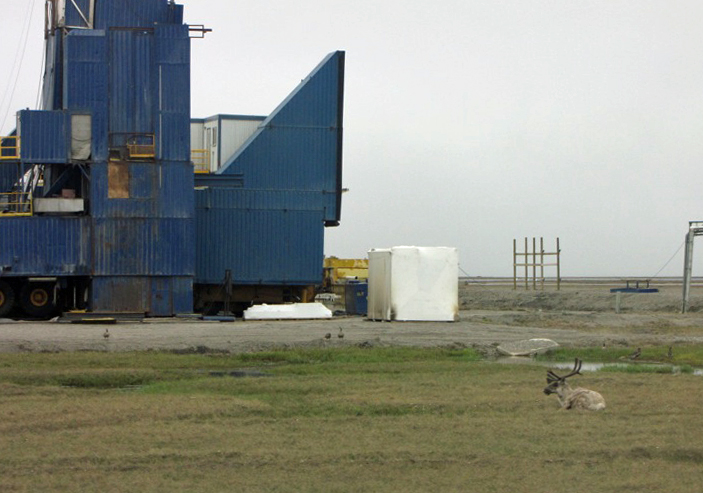
Caribou in a field at Prudhoe Bay (Photo: Gretchen Weber)
The only way to drive to the Arctic Ocean from Toolik Station, or really, any place else in Alaska, is to take the Dalton Highway north until it ends in Prudhoe Bay. I thought the Haul Road was bumpy from Fairbanks to Toolik, but taking it the additional 140 miles from Toolik Field Station to Prudhoe Bay took things to a whole new level. It’s the kind of drive where you have to be careful not to touch your face, because the van is bumping along so wildly, you’ll likely poke your eyeball out. Which is particularly challenging when you also need to be vigilantly swatting mosquitoes the size of hummingbirds.
Very few people actually live in Prudhoe Bay, but at any given moment it is home to thousands of workers working 12 hours shifts, two weeks on, two weeks off, at the country’s largest oil field. It’s basically a gigantic work site, operated by BP. The airport and general store are down the road a bit in the settlement of Deadhorse. And there’s no other way to say it — Prudhoe Bay comes across as one depressing place.
Equipment at the edge of the Arctic Ocean in Prudhoe Bay (Photo: Gretchen Weber)
We made the four-hour journey there last Tuesday, arriving just after 4pm. The temperature was in the 30’s, but the wind made it feel much colder. Gray clouds hung low and close to the ground. Massive oil rigs and processing facilities dominate the landscape in Prudhoe, along with modular unit-type buildings used as living quarters, and parking lots full of trucks. Everything was covered in gray mud. The sky was gray, the icy water was gray, the mud-coated buildings were gray, and even the ocean sand dunes and the marshy landscape around the facilities were a muted, grayish brown. Someone in our group described the scene as “post-apocalyptic,” and another mentioned the movie Blade Runner. Looking around at the trash-strewn landscape, the huge trucks caked with dirt, and, in one spot, the massive pipes belching flames, I was reminded of Cormac McCarthy’s novel, The Road.
Muskoxen at Prudhoe Bay (Photo: Gretchen Weber)
To actually access the Arctic Ocean, which was our group’s true mission, we had to pass through a BP checkpoint. And to be able to do that, we had to be on a company-sanctioned tour, which consisted mainly of driving around looking at buildings and equipment, with a nice but not-very-chatty security guard. But a true highlight was just a few minutes into the bus ride when we encountered a group of wild muskoxen. (Another highlight was the BP promotional video we were forced to watch before we boarded the bus.) Then we headed to a rocky beach, where three brave souls took a full-body plunge into the 29 degree waters of the Arctic Ocean. The chunks of ice floating on the surface were enough to deter me from even wading in at all.
In addition to all the headlines about the Gulf disaster, BP has also been drawing attention over developments here in Prudhoe Bay. According to a recent article in The New York Times, the company plans to start drilling this fall at a new site about three miles off the shore at Prudhoe Bay, despite Obama’s moratorium on new offshore drilling projects. By building an artificial island in the shallow waters, BP has acquired an “onshore” designation for the controversial project, the article explains. This graphic from the Times illustrates how the proposed drilling would work.
Our tour guide didn’t discuss the Liberty project, and when we called ahead about our visit, a BP spokesperson said that no one would be available to talk with us. So, after our tour, we warmed up with some hot chocolate, and then we took our cold selves back to Toolik Field Station with lots of new questions and not many answers.
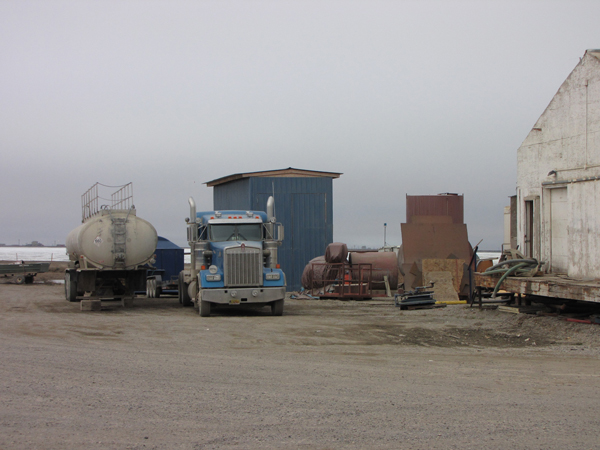
A typical truck in Prudhoe Bay (Photo: Gretchen Weber)
The “33 x 20” series continues today on Quest Radio, with the second of two parts on the proposed Solargen project in San Benito County. The report will be repeated on The California Report weekly magazine on Friday.
Catch up by listening to the first part and reading the accompanying blog post from last week.
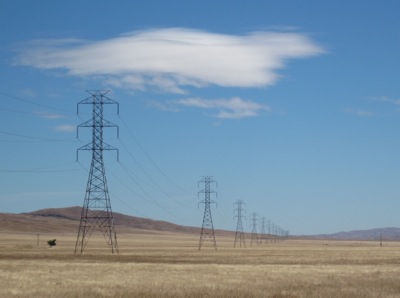
PG and E already has transmission lines running along the Panoche valley floor.
One thing becomes clear when you visit the Panoche Valley and the people that live and work there, everyone is charmed by it. The local ranchers, the environmental advocates, even the biologists hired by the Silicon Valley company that is looking at developing part of the valley for a commercial solar farm.
Thousands of acres of vast cattle land ringed by golden, scrub covered hills make up the Panoche Valley. The area has a vast, open beauty that seems very Californian. But in the springtime locals say it looks like Ireland. The land has also caught the eye of the CEO of Solargen Energy.
The company would like to build a 420 megawatt solar farm that would power about 120 thousand homes. To do so, Solargen would cover much of 4,700 acres of the valley with photo voltaic solar panels. Locals like chicken rancher Kim Williams worry it would change the character of the valley and harm wildlife. A group of local environmental advocates and ranchers have formed a group called Save Panoche Valley.
Kim Williams runs Your Family Farm in the Panoche valley and is opposed to the Solargen project.
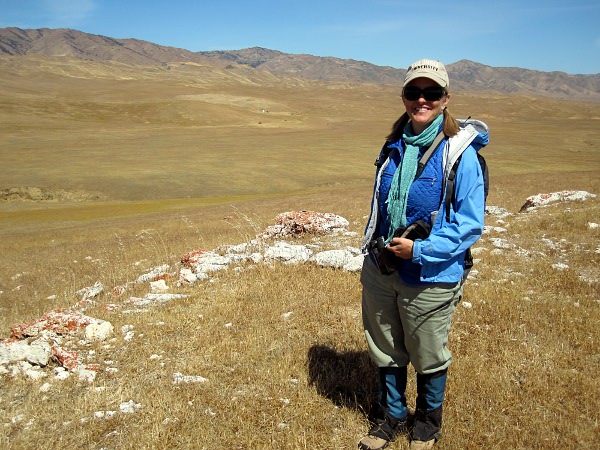
Solargen, as required by law, has hired a team of wildlife biologists to do environmental surveys of the area which, it turns out, is home to several endangered species. Michelle Korpos, the leader of the team, has also developed a fondness for Panoche Valley where she has been working for the past year. Everyday she and group of biologists march out to the project site, and surrounding hills, searching out fox dens, canvassing creek beds and geo-tagging lizard scat.
Michelle Korpos, along with other biologists, has been hired by Solargen to run wildlife surveys for an Environmental Impact Report.
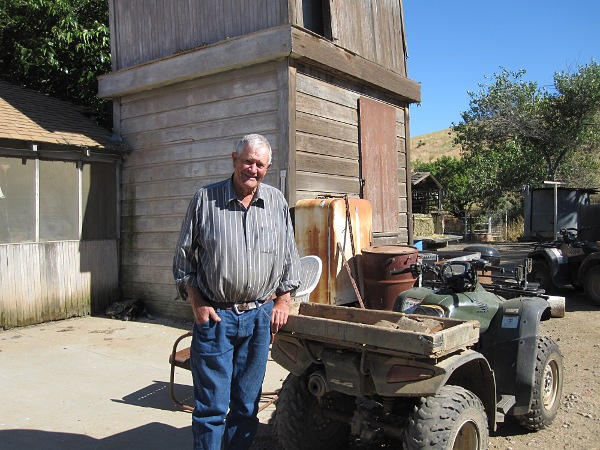
Charlie McCullough has owned his cattle ranch, one of the biggest in the area, since the early fifties and was born in San Benito County. He is one of five ranchers who has agreed to sell some of his land to Solargen. But McCullough is feeling remorseful that his decision could lead to such a change in the valley he loves.
Charlie McCullough has agreed to sell some of his land to Solargen for their big solar project.
The only commercial business in town is the Panoche Valley Inn which is not really an inn at all but a bar that serves as a stop for tired ranchers at the end of the day and birders and bikers on sunny weekends. The owner hopes the project’s contstruction jobs mean more business over the six year build out. But even the number of jobs Solargen promises to create has become contentious.
Larry Lopez, owner of the Panoche Inn, hopes construction of a big solar array would bring in more business.
One thing is for sure, the valley gets lots of sun, 90-percent of the solar intensity of the Mojave desert. But the Mojave, with its protected federal lands and desert tortoises, has turned out to be a nightmare for big solar entrepreneurs. Listen to our stories on the Panoche Valley which now finds itself in the middle of the debate over big solar. It’s all part of our series, “33 by 20,” a look at the obstacles in the way of California’s plan for utilities to generate one third of their electricity from clean energy by 2020. Here’s a map of solar intensity throughout the U.S.
The “33 x 20” series continues Monday on Quest Radio, with the first of two parts on the proposed Solargen project in San Benito County. The reports will be repeated on The California Report weekly magazine.
Well hidden among the coast ranges of San Benito County, there’s a valley where, as one ecologist put it, “the hammer is hitting the anvil.” Mike Westphal of the Bureau of Land Management’s Hollister field office was describing the current tension playing out in Panoche Valley between two environmental goals: the mandate to combat global warming with a transition to renewable energy, and the desire to conserve the habitat of endangered animals, as well as California’s remaining ag land.
Solargen argues that Panoche Valley is a rare combination of great sun, proximity to population centers, and existing transmission lines to get the power there. (Photo: Craig Miller)
As part of our collaborative series: “33 x 20: California’s Clean Power Countdown,” Quest Senior Editor Andrea Kissack and I have been exploring the effort by Solargen Energy to develop Panoche Valley as a utility-scale solar power array (the state defines “utility-scale” as any facility that produces 200 megawatts of electricity or more).
Like many developers, Solargen CEO Mike Peterson is racing to break ground by the end of this year, in order to cash in on up-front stimulus money from the federal government. He says Panoche Valley presents a rare alignment of attributes for solar power: high solar potential (he says 90% of the Mojave), relative proximity to population centers, and existing transmission lines to get the power there. Peterson told me that the lines already in place have enough available capacity to handle his 420 megawatts of solar power, though a spokeswoman for PG&E says that question is still under study.
Meanwhile, some farmers and wildlife advocates have opposed the plan, saying big solar “farms” are better placed on “degraded” land. Ron Garthwaite, who runs Claravale organic dairy, says “This is just not the place to put it. There’s other places which have no ag value and which have less of a natural value where they could put it.”
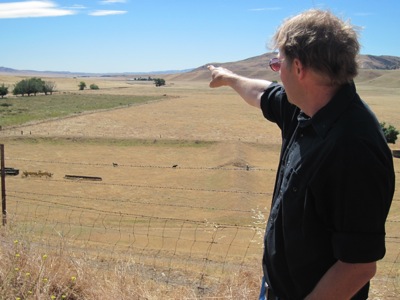
Standing at the valley's north end, BLM ecologist Mike Westphal points to where 2,000 acres might be covered in PV solar panels. (Photo: Craig Miller)
Westphal, whose agency is not directly involved in assessing the project, sees the valley as a rare microcosm for the once unspoiled habitat of the San Joaquin Valley, just over the hill. “What we really need to think hard about is do we want to risk ecosystems to get energy,” he told me, scanning the valley from Shotgun Pass at the north end. “That’s what’s going on here in Panoche Valley is we’re making this equation: how much do we want to risk the continued endangerment or extinction of this ecosystem in order to get more energy? That’s the crux of this conflict here.”
In this video clip, BLM ecologist Michael Westphal gives Craig Miller an overview of the valley, looking south from Shotgun Pass.
Solargen is shelling out for a $1.3 million-dollar environmental impact report, which Peterson says does not include measures such as the two dozen biologists and a detachment of scat-sniffing dogs, trained to track down the droppings of other critters for DNA analysis. The results help determine what species are there. Peterson says the total tab in “preparing and preparing for the EIR” now tops $7 million.
In Part 2 of our Panoche Valley “case study,” Andrea Kissack will have a closer look at the wildlife issues. That report runs next Monday, June 28, on Quest Radio.
As for the Governor’s ambitious goal to have renewable energy sources account for one third of the state’s electrical generation by 2020, Peterson describes the process as “surprisingly harder than you would expect.” He says he ponders how to “get this done in a way that is able to meet the mandates, but also be a good steward to the environment, and try to make people happy. And we won’t be able to please everybody.”
He’s right about that. Dairyman Garthwaite says of the state’s quest for renewables: “Just because somebody in Sacramento says something, doesn’t mean that it can happen–or should happen. I mean there’s all kinds of political things involved in that, there’s lobbyists involved in that. People want to make money.”





 bal warming could yield wetter seasons, a