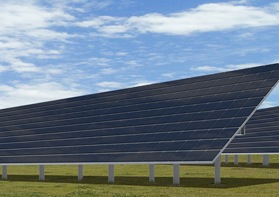
The Quest/Climate Watch series “33×20: California’s Clean Power Countdown” continues on Monday, with the first of two parts on one company’s attempt to build one of the nation’s largest PV solar arrays in San Benito County.
(Image: Solargen Energy)
With its ambitious 33%-by-2020 renewable energy goal, California will be looking for renewable megawatts from all corners of the state. While the state may hit 18-19% by the end of this year, reaching 33% will require approximately a doubling of renewable power, since the state’s energy appetite will continue to grow in the meantime.
So, where will the energy come from? According to the California Public Utilities Commission, wind and solar will have to carry much of the “load.” Check out the CPUC projections in the charts below.
UPDATE: In late January, 2011, The New York Times published a good overview of how the controversy over smart meters has evolved since this post.
When utilities and the California Public Utilities Commission hatched plans to bolt a “smart meter” onto every household, the premise–and the promise–was that by digitally tracking just how much they were using and spending, customers would be able to make smarter choices about their energy use, ultimately saving money and cutting carbon emissions.
Smart meters are also a critical component of the nascent but much vaunted “smart grid,” in which household appliances and electric cars communicate with the vast power transmission network, and optimize things like when to recharge.
But as I report in my radio story for The California Report, many PG&E customers consider them more bane than boon (PG&E uses the trademark “SmartMeter,” whereas I may refer to them generically as “smart meters”).
Part of what’s riled up customers in Bakersfield and elsewhere in California is that PG&E hasn’t provided the devices to help watch the watts. Customers can go online to track their energy use over the last 24 hours, but that’s about it. And in the meantime, consumers are paying the cost of the new meters, and in some cases, higher bills that they blame on those meters.
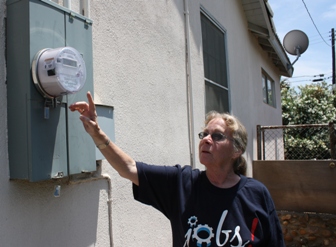
Liz Keogh shows me the "SmartMeter" outside her Bakersfield home. Her summer 2009 bills went up by half after it was installed. (Photo: Kristin Torres)
Julie Fitch, who heads the energy division of the California Public Utilities Commission, told me she thinks those real-time tracking gadgets won’t actually change consumer habits that much. “There’s a certain percentage of us who are interested in seeing what our energy use is at all times, and are fascinated by it, but I think it’s probably a small percentage in the grand scheme of things,” Fitch said.
Fitch says consumers will see more of an advantage from smart meters when home appliances can communicate with the devices.
“The reality is the grid right now is that it’s actually fairly dumb,” Fitch said. There’s a lot of manual decisions that need to be made in order to get the electricity from a generator to your house. I think what we’re looking at is a much more automatically controlled situation where appliances are automatically linked in with smart devices.”
For example, a fully integrated system could “decide” to run your clothes dryer at off-peak times, to relieve strain on the grid and possibly save money. But the whole idea of charging more for power at different times of day, known as peak pricing, troubles consumer advocates like Mark Toney. He heads The Utility Reform Network (TURN), a consumer advocacy group based in Oakland.
“We want to make sure this doesn’t unduly harm seniors, for instance, who are home bound,” Toney told me, pointing out that folks don’t have a choice sometimes about whether to run their air conditioner in the sweltering Central Valley heat. “We don’t want them to be faced with the choice of being safe in their home or being subject to heat stroke because they shut off their AC because they can’t afford it,” he said.
Toney is also concerned that struggling customers are more likely to see their power shut off, if they can’t keep up with the bills. Smart meters allow utilities to turn off power remotely, without having to send a crew out to someone’s home–and that, he says, gives the company less incentive to negotiate payment plans.
The CPUC’s response? Utilities will still have to follow standard procedures, including advance notice of shut-offs.
Meanwhile an independent lab appointed by the CPUC continues to test PG&E SmartMeters to try to determine why some of them are malfunctioning. Some customers now have “side-by-side” test installations, with both analog and digital meters tracking electricity use in tandem. Strangely enough, the deployment of smart meters by Southern California’s two major utilities has gone relatively smoothly, with just a fraction of the complaints that PG&E has logged.
In my radio story, I interviewed Bakersfield Resident Liz Keogh, who saw her electric bill spike after her SmartMeter was installed. Keogh is very energy-conscious; her home is a veritable showcase of energy-saving gadgetry. There could be any number of technical reasons why the new meters led to larger bills. Keogh developed her own personal theory (since disproved by independent tests), which she demonstrates in the video below, using some unlikely props. It’s a good example of the broad spectrum of consumer objections to the technology.
As anyone who got stuck in the traffic knows, President Obama made a call at one of the Bay Area’s new darlings of green tech, Fremont-based Solyndra Inc., which he called a “testament to American ingenuity and dynamism.”
The firm is tapping more than a half-billion dollars in federal loan guarantees to build a manufacturing plant for its photovoltaic (PV) technology. Governor Schwarzenegger and Energy Secretary Steven Chu have also used Solyndra as a backdrop for showcasing California’s burgeoning clean tech sector. The company has developed a new type of PV technology designed for commercial rooftops.
Solyndra's rooftop solar panels use a new type of cylindrical module. Image: Solyndra, Inc.
Today in Silicon Valley, the big, green hype machine was running at full tilt. Solyndra’s CEO, Chris Gronet, talked up the California location. “If our factory was someplace else (outside the US), we probably would not have the supply chain across 29 US states,” he told KQED’s Cy Musiker today.
Mike Mielke of Silicon Valley Leadership Group added to the frenzy: “Clearly California’s leadership in the emerging trillion-dollar clean energy technology market has put us in an ideal investment position,” he said in a statement issued after the Presidential appearance. “We would not be as competitive without the state’s landmark clean energy policies like AB 32.”
But some temperance was injected into the festivities by Severin Borenstein, co-director of the Energy Institute at UC Berkeley’s Haas School of Business. Asked if investments in solar panel production necessarily translate to permanent job growth, he told Musiker: “The evidence from a longer-run perspective really doesn’t support that.”
Borenstein says what history does demonstrate is that dominance in a given technology lasts just about as long as the government subsidies supporting it. He pointed to both Germany and Spain, both of which have recently lost some of their edge in production of solar components. Much production of solar and wind energy products has already moved to China.
“This idea that you’re going to create a permanent competitive advantage in producing green technology by subsidizing it now is really not very well born out in the data,” said Borenstein, who doesn’t deny that federal stimulus funding has “helped push forward” some key technologies. In the absence of a meaningful price mechanism for carbon emissions, Borenstein says that “pushing forward on some of these alternative technologies is the best thing we can do.”
Regarding California’s landmark climate law, the aforementioned AB 32, Borenstein agrees with the state’s Legislative Analyst that implementation would not have a significant impact on California’s overall economy, in either direction. But Borenstein doesn’t see the point in abandoning the state’s primary comprehensive climate strategy to save jobs, as some have suggested it would. “Climate change is real and it is potentially catastrophic,” said Borenstein. “If every time we have an economic setback, we put the environment second, we’re never going to make any progress.”
California has set some ambitious targets for ramping up renewable energy sources. Some say too ambitious. Utilities won’t make the first milepost of 20% renewable power by this year, and many are skeptical that the longer-term goal of 33% by 2020 is doable, either, the executive order signed by Governor Schwarzenegger in 2008 notwithstanding.
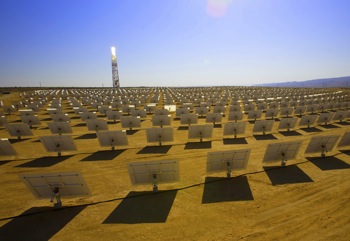
A thermal solar array of the type planned for southern California. Photo: BrightSource Energy
A major hurdle is the permitting process for large “utility-scale” solar and wind installations, described by the Governor’s own senior advisor as “tortuous.” In the months ahead, we’ll take you through some of the obstacle course in a multimedia series called “33 x 20: California’s Clean Power Countdown.” A collaboration of Climate Watch and Quest, KQED’s science and environmental initiative, the series of radio reports and web features explores the promise and pitfalls of the state’s 33 x 20 plan.
The series begins Monday with Lauren Sommer’s review of California’s clean power legacy and an assessment of the present push. Future reports will look at a solar siting case study in central California, as well as prospects for major development of wind and geothermal sources. California currently leads the nation in solar generation but trails Texas and Iowa in the race for wind power. See Lauren’s interactive map for an overview of how California stacks up against other states in its ambitions toward renewable energy.
Future reports will examine the potential impact of large-scale power generation on deserts and tribal lands and the progress toward what some consider the “holy grail” of energy technology; large-scale storage of electricity. In June, Quest Senior Editor Andrea Kissack and I will team up for a kind of case study in one company’s ambitions; the 4,700-acre photovoltaic array planned by Solargen Energy for Panoche Valley in San Benito County.
Northern California listeners can hear the radio series as part of KQED’s Quest radio service (airs Mondays during NPR’s Morning Edition on KQED and KQEI in Sacramento) or statewide onThe California Report. You can follow the entire series and see the related web features as they appear on our “33 x 20” series page.
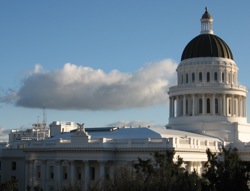
Clouds linger over California's cap-and-trade future. Photo: Craig Miller
The notion may be losing momentum in Washington but in Sacramento, California’s Air Resources Board continues the trudge toward a carbon trading program mandated under the state’s 2006 climate law, AB 32. This week its staff held the latest in a series of public meetings to discuss “program development” and “allowance allocation.” The topic may be a certified snore for most people but the CalEPA auditorium in Sacramento was nearly packed with representatives from utilities, environmental groups, public health advocates and an assortment of other interested parties, many with diametrically opposed views of how carbon allowances should be meted out for trading.
One of them was Chris Busch of the Center for Resource Solutions, who gave voice to a contingent disillusioned with what they read as momentum toward giving away allowances to industry. Busch coined what was probably the phrase of the day, accusing the Air Board of some “creative re-framing” of how carbon allowances might be distributed. Environmentalists have been pushing for something close to a “100% auction” of permits, while many business interests are hoping to get them free of charge, at least in the early stages of the program.
To many in the room, the update from the Air Board staff appeared to indicate a drift toward free permits. The Board’s Kevin Kennedy stressed that the staff had never come out officially for a 100% auction and said they’re “taking a close look” at how best to distribute them. His colleague, Matt Zaragoza put it more bluntly, saying “We’re strongly considering the need for free allocations.”
Regarding the state’s plan to join in a regional carbon market with several other states and some Canadian provinces known as the Western Climate Initiative, Kennedy insisted that “reports of it’s death have been greatly exaggerated.” But when pressed on how many US states are actually prepared to move forward, he confirmed that only New Mexico is in lockstep with California. Arizona’s governor recently signed an executive order pulling that state out of the proposed regional carbon market.
Here in the Golden State, industry is still angling for anything it can get to keep emissions fees to a minimum. Some complain that valid considerations are being left out of the plan.
“A lot of us are producing products today that are very focused on energy savings.,” said Phil Newell, who heads energy and environmental affairs for Guardian Industries, a maker of “low-E” glass products which promote energy efficiency. Newell says that a system of traded carbon permits and offsets should account for the energy savings achieved by his company’s products. “Every time we use a unit of energy in producing a coated product, we’re reducing 500 units of pollution elsewhere,” Newell claimed in a hallway interview. “We need some recognition of that.” Newell said that without that recognition, the high cost of carbon allowances might force his company to shut down manufacturing in California. Guardian operates a plate glass manufacturing plant near Fresno.
The Air Board’s staff says it is pushing for a “design document” describing a plausible allowance system by mid-summer.
The latest version of a federal climate bill sets a series of national targets for greenhouse gas emissions and would halt California’s plans for state and regional carbon trading.
Unveiled by Senators John Kerry and Joe Lieberman today, the American Power Act aims to push GHG emissions down to slightly below 2005 levels by 2013, then sets a longer-term reduction timetable of 83% (of 2005 levels) by 2020, 58% by 2030, 17% by 2050 (or to flip it around, an 83% reduction from 2005 levels by 2050), in line with the promise that President Obama made following the “Copenhagen Accord.”
The 987-page bill regulates seven greenhouse gases, with room for the Environmental Protection Agency to add others under the Clean Air Act. The cap-and-trade provisions focus on “7,500 factories and power plants,” which is to say those that put out more than 25,000 metric tons of carbon per year. That’s the same benchmark used by the federal EPA in its proposed regulations.
Like previous drafts, this one nullifies state and regional carbon regulation, setting up “one clear set of rules” for industry and providing “compensation for the revenues lost as a result of the termination of their cap-and-trade programs,” such as California’s AB 32, and regional efforts, such as the Western Climate Initiative. California’s Legislative Analyst has estimated that the state has committed about $120 million so far, to the implementation of its 2006 climate law. California regulators have already weighed in on the concept of “federal preemption,” warning against leaving the job of carbon reduction to the federal government alone. The Kerry-Lieberman bill requires “consultation” with states that currently have their own emissions plans.
Significantly, the first several sections of the Senate bill address development of energy sources. The reduction goals for greenhouse gas emissions aren’t even spelled out completely until page 265. Energy provisions that may come to bear on California policy include:
Agribusiness:
– All farms appear to be exempt from cap & trade but benefit from offset programs
Oil Industry:
– According to a summary of the bill from Kerry’s office: “Producers and importers of refined products” will get a fixed price for their carbon allowances.
– Offshore drilling is included as part of the energy strategy but states can prohibit leasing within 75 miles of the coast
Nuclear Power:
– Provides several incentives, including an “expedited procedure for issuing combined construction & operating licenses for qualified new nuclear reactors.”
– Increases loan guarantees to $54 billion
Missing from the bill is a comprehensive national strategy for storage of spent nuclear fuel, an unresolved issue that prevents California utilities from any expansion of nuclear power.
Governor Schwarzenegger issued a statement that barely acknowledged federal preemption, saying only that “California has been an unparalleled leader in clean energy, pioneering policies that have benefited the entire nation, and we must be able to continue our important, groundbreaking work that will both improve the environment and help our economy.”
Some environmentalists have already responded with raspberries. In a statement based on draft summaries of the bill, the group Friends of the Earth called it “dangerous,” claiming that the bill would “scrap crucial tools for solving the climate crisis” and provide “billions in giveaways to corporate polluters.” In a statement from the Environmental Defense Fund, on the other hand, its western regional vice president said that the bill’s announcement “marks real progress in the fight against climate change.”
California’s electrical power generators will be scrambling for new ways to cool their turbines, now that state regulators have ordered a phase-out of “once-through cooling.” The practice, which has been under study by regulators since at least 2005, requires sucking in billions of gallons of cold ocean or river water and then returning it at higher temperatures. Nineteen major power plants across the state, including California’s only two commercial nuclear plants, are currently using once-through cooling.
Sea water spews from an outlet after being used for cooling at PG&E's Diablo Canyon nuclear power plant. Photo: Craig Miller
Prior to Tuesday’s vote by the Water Resources Control Board, the head of that body’s ocean unit testified that once-through cooling systems kill 2.6 million fish, 19 billion fish larvae and 57 seals, sea lions and sea turtles each year, Dow Jones reported.
“The proposed policy establishes technology-based standards to implement federal Clean Water Act section 316(b) and reduce the harmful effects associated with cooling water intake structures on marine and estuarine life.”
The rules require that companies phase out the practice and install equipment that reduces impact on marine ecosystems within the next several years. Some generators have warned that the high cost of complying with the regulations could force them to shut some plants down.
For more on the practice of “once through cooling” and its effects on marine life, listen to Amy Standen’sQuestradio report from Monday.
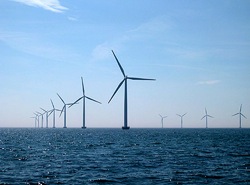
The Nysted wind farm off Denmark. Image: Cape Wind Assoc.
The nation’s first offshore utility-scale wind farm has won federal approval but it was no slam dunk. The Dept. of Interior has approved the 130-turbine Cape Wind project, off Nantucket.
The plan launched such an epic debate that at least one book has been written about it. Today’s nod comes just weeks after a federal advisory panel recommended against approval and doesn’t necessarily mean the project will go forward. Opposition groups have already vowed to go to court.
Permitting for most wind projects in California comes under local jurisdiction but a spokeswoman at the California Energy Commission told me that to her knowledge, no offshore wind projects are currently under review for California. An obstacle often cited is the extreme ocean depths off California, which make construction difficult. Various wave power projects have been proposed for the coastline.
SunPower CEO Tom Werner and Gov. Arnold Schwarzenegger. Photo: Gretchen Weber
Silicon Valley-based solar cell manufacturer SunPower Corp. announced today that it’s decided to site its newest manufacturing plant in California, a move that CEO Tom Werner says will create hundreds of jobs and may prompt an “economic cluster” that will attract similar projects.
SunPower has partnered with contract manufacturer Flextronics, and plans for the Milipitas-based operation to be up and running by the end of the year, producing high-efficiency solar cells.
Werner and Flextronics CEO E.C. Sykes were joined at the announcement in Milipitas by Gov. Arnold Schwarzenegger, who sported a green tie and chastised the assembled crowd for not celebrating Earth Day with similar fashion choices.
“I am so excited about this,” said Schwarzenegger about the new project. “This proves that protecting the economy and protecting the environment can be done simultaneously.”
Werner said locating the manufacturing operation in California makes sense both for economic reasons and because California is home to a large solar market, thanks to the state’s Renewable Portfolio Standard, requiring 33% renewable energy by 2020, and the Million Solar Roofs Initiative. Werner added that a record 50 megawatts of rooftop solar power were installed last month in California.
“You want to be close to your customer for logistical reasons, and also because you learn from your customer and you build it back into your product,” Werner told me following the staged media event. “And by being local you can learn faster than you can if you’re distant.”
Other California selling points were a green manufacturing equipment sales tax exemption, which enabled SunPower to buy equipment for the facility tax-free, and low-interest loans from Recovery Act funds granted through the City of Milpitas, said Werner.
Governor Schwarzenegger used the occasion to warn Californians against taking the state’s environmental laws for granted.
“Right now there are greedy Texas oil companies that want to come in here and spend millions of dollars to roll back AB 32 (the state’s 2006 carbon legislation) and our other environmental laws,” he said. “Why? Because they don’t like that there’s alternative energy being created. They don’t like what you are doing here.”
California has had a climate change mitigation law on the books for more than three years now–but getting that law’s regulations fully in place is proving to be a tough slog.
Fans and mortal enemies of California’s Global Warming Solutions Act (AB 32) all exude certainty about what the carbon emissions-cutting law will do for–or to–the state’s economy. Lately the debate has escalated into full-scale PR warfare. Major battlefronts include:
– A signature campaign for a ballot initiative to suspend the law
– An online campaign to boycott oil companies funding the above
– Studies & surveys from both sides proclaiming their case
– A gubernatorial candidate who has vowed to suspend AB 32
The measure would suspend most provisions of the climate law until the state’s official unemployment rate improves substantially from its current 12.5% level. NFIB statements say “the measure is headed for the November ballot” but only if proponents gather more than 400,000 required signatures.
John Kabateck, executive director of NFIB/California said in a conference call with reporters today that his organization would help gather signatures to qualify the measure. He called the climate law “one more arrow in the quiver of damage and pain inflicted on small business right now.” In a companion news release, Kabatek ventured that full implementation of AB 32 would cost California more than a million jobs.
California’s non-partisan Legislative Analyst has concluded that while the exact job impact is hard to pin down, AB 32’s overall effect would be relatively minor compared to the state’s total economy.
Meanwhile, pro-AB 32 activists are circulating an online petition calling for a boycott of Valero and Tesoro, two Texas-based oil companies that are helping bankroll the suspension measure in California.
The NFIB announcement followed by one day the unveiling of a new poll showing support for AB-32 among California voters. The survey shows 58% of Californians “favor” the law either “strongly” (34%) or “somewhat.” One in four surveyed said they strongly opposed the measure. Sixty-four percent said they supported charging industry for excess emissions, while 31% opposed that. The poll was conducted in March by Field Research for Next 10, a public policy think tank that strongly supports AB 32. Field polled about 500 voters for the survey, which has a margin of error of 4.5%.
Business is sharply divided over AB 32. The viewpoint of those wary of it is generally represented by the AB 32 Implementation Group. Other business leaders strongly support the law, including it’s cap-and-trade provisions. An outspoken example is Barry Cinnamon, CEO of Akeena Solar, who recently laid out his position for Alison van Diggelin, publisher of the Fresh Dialogues blog site.
In that conversation, Cinnamon skewered the “inane commentary” of gubernatorial candidates calling for the undoing of AB 32. Republican candidate Meg Whitman has pledged to order a one-year “moratorium” on regulations under AB 32, on her “first day as governor,” calling the policy “wrong for these challenging times.”


 The latest version of a federal climate bill sets a series of national targets for greenhouse gas emissions and would halt California’s plans for state and regional carbon trading.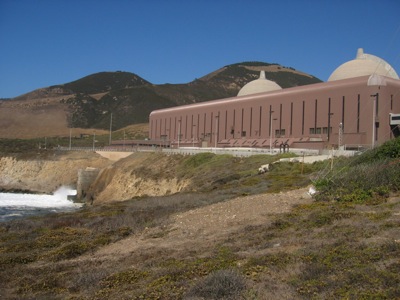

 California has had a climate change mitigation law on the books for more than three years now–but getting that law’s regulations fully in place is proving to be a tough slog.