Category Archives: Power

Progress and pitfalls in California’s clean energy quest

Clean Energy from Below

UPDATED with interactive map

Hear my radio feature on geothermal energy and the rest of a five-part collaboration on renewable energy between NPR and KQED, on NPR’s Morning Edition.

It may be a distant second to California now, but Nevada is making a run to become the nation’s largest producer of geothermal energy.
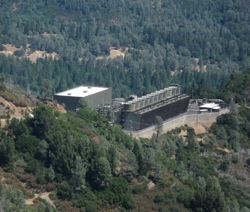
A conventional geothermal power plant at The Geysers complex in Lake County. (Photo: Craig Miller)

California still produces an estimated 80% of the nation’s geothermal power (used to produce electricity*), with more than 40 plants online. But according to a summary from the Geothermal Energy Association (GEA) this summer:

“Nevada could become the leading geothermal energy producer in the coming years if growth and production trends continue on their current trajectories. Nevada’s 86 planned or developing geothermal power plants have the potential add up to 3,686.4 Megawatts of geothermal power to Nevada’s energy portfolio, power for 2.6 million homes – enough to meet the electricity needs of 100% of the homes in the Las Vegas metropolitan area.”

GEA describes 14 Nevada projects as being “in latter stages of development.” Meanwhile, says the group’s executive director, Karl Gawell, development in California is slowing down. “Everything’s relative,” Gawell told me in a phone interview. “Projects are moving forward in California, they just take longer.” Continue reading Clean Energy from Below

The Overspray from Prop 23

On Monday, US energy secretary Steven Chu became the latest high-profile voice against California’s Proposition 23, the statewide initiative to suspend AB 32, the state’s four-year-old climate strategy.

“AB 32 was a good bill and continues to have California in a leadership role in developing clean energy and the efficient use of energy,” Chu told reporters at a dedication in Menlo Park. “From the middle 1970s California played that role and it would just be a terrible setback.”

Last week the trend was given full voice by Mary Nichols, who, as chair of the California Air Resources Board (CARB), is charged with getting AB 32 fully implemented in the next two years, called Prop 23 a “very serious threat,” not just to the core programs of AB 32, but to an array of regulatory programs that support the state’s attack on greenhouse gases. Continue reading The Overspray from Prop 23

Nichols: No Solo Cap-and-Trade

Cap-and-Trade is a lonely business these days. But according to the state’s top regulator in charge of implementing it, California won’t go it alone.

Air Board Chair Mary Nichols, flanked by Google Green Energy Czar Bill Weihl (left) and PG&E Sr. VP Tom Bottorff, at a panel sponsored by the Silicon Valley Leadership Group. (Photo: Craig Miller)

Mary Nichols, who chairs the state’s Air Resources Board, made the remark in a Silicon Valley panel discussion today. The ostensible topic of the event was renewable energy but it turned into a pep rally against Proposition 23, the statewide ballot measure designed to halt California’s comprehensive climate law, AB 32. Nichols was joined on the panel by executives from Google, PG&E and venture capitalist Vinod Khosla, all of whom voiced strong opposition to Prop 23.

When asked about the cap-and-trade provisions of AB 32, Nichols said: “We won’t launch this program without partners to trade with. It doesn’t make sense for an economy even as big as California, to try to do this all by ourselves.” The comment came days after congressional leaders threw in the towel for the summer, on a federal bill to address climate change and energy security. “To get the kind of leverage that you really need to make this program succeed, the US has got to step in,” said Nichols.

California is part of a nascent regional trading pact known as the Western Climate Initiative. But among the seven US states and four Canadian provinces signed on to the WCI, only California, New Mexico and Quebec are prepared to move forward with a working carbon trading market. Others still lack enabling legislation, and Arizona has overtly pulled out of the carbon trading plan, raising the question of how many “partners” California will have, even with WCI in the mix.

“I don’t expect to be faced with this dilemma,” Nichols told me after today’s event, “but if the worst were to happen and none of these states were able to move forward with their own programs, I think we would think long and hard about whether we would actually start enforcing the program, unless and until we were really confident that our  state had the ability to do it in a way that would not put us at a competitive disadvantage.”

Proponents of Prop 23 contend that full implementation of AB 32 will give other states and nations a competitive edge over California, resulting in “leakage” of jobs and businesses to regions with fewer regulations.

The panel, entitled “Electric Bills and Oil Spills: Will California Continue To Be a Clean Energy Leader?” was held on the Google corporate campus in Mountain View.

Whitman Commits on Prop 23 — Sort of

The mystery of whether Republican gubernatorial candidate Meg Whitman does or does not support Proposition 23 would appear to be solved. After weeks of steadfastly refusing to take a stand one way or the other on the ballot measure to freeze the state’s climate law known as AB 32, Whitman conceded on a radio broadcast that “In all likelihood I will vote ‘No’ on Prop 23.” Continue reading Whitman Commits on Prop 23 — Sort of

Wind Picks Up Nationally, California Lags

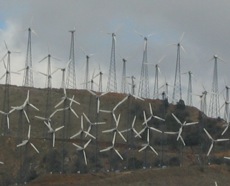
A cluster of wind turbines in Tehachapi Pass marks California's early commitment to wind energy. (Photo: Craig Miller)

Wind power generators added nearly 40% to their total capacity in the US last year, as several states blew past California, according to a new report from the Department of Energy’s Lawrence Berkeley National Lab. According to the tally, four states now generate more than 10% of their total electricity (excluding exports) from wind.

Texas is the undisputed leader in the wind race, installing nearly 2,300 megawatts of capacity last year alone. Other Midwestern states such as Indiana, Iowa, the Dakotas and Minnesota have also been aggressive installers of wind farms. Continue reading Wind Picks Up Nationally, California Lags

Energy Storage: The Holy Grail

New solar panel technology being tested at Stanford University. (Courtesy of Nick Melosh)

Energy storage is something we’ve come to take for granted in everyday life. Our cell phones, iPods, cars and computers all depend on batteries. But storing large amounts of energy for the electric grid is another matter entirely. It’s a technical challenge that has yet to be met–but will need to be for the coming age of renewable energy.

California’s grid is designed to deliver electricity on a real-time basis. Every four seconds, the grid operators at the California Independent System Operator (ISO) have to ensure that the energy supply meets the demand in the state, something that’s known as “balancing” the grid (you can see today’s electricity forecast on the ISO site). As a result, they coordinate the one piece of the system that they have control over: the power plants. Continue reading Energy Storage: The Holy Grail

Creating Power from Both Light and Heat

A key component of new solar panel technology being tested at Stanford. (Photo: Nick Melosh)

In a kind of cruel paradox, heat has always been the enemy of solar panels.  At higher temperatures, photovoltaic cells become less efficient, which is problematic in an industry where efficiency is the name of the game. That heat also represents wasted energy.

Today, researchers at Stanford University announced that they may have helped solve that problem. Nick Melosh of Stanford’s Materials Science & Engineering department set out to make use of the wasted heat. He and his colleagues created a solar cell technology that uses both light and heat to generate electricity. It’s called “photon-enhanced thermionic emission” (or PETE for short). “This is the first time that a process has been reported that can use the heat and the photons together harmoniously,” says Melosh. Continue reading Creating Power from Both Light and Heat

Coal, Soot and A Mighty Wind

This week in climate news: coal dollars in California, soot in the air, and wind in the desert.

1. Big Coal Donates to Fiorina Campaign

Republican Senate candidate Carly Fiorina received $63,000 in donations  from out-of-state coal mining interests. About a third of that money is from Murray Energy Corporation in Ohio, the largest privately owned coal producer in the U.S. Continue reading Coal, Soot and A Mighty Wind