Category Archives: Government & Business

What’s brewing in Sacramento, Silicon Valley, and beyond

New Bill Would Make Confidential Groundwater Info Public

Documents include details on depth and location of wells in California

A well on a farm in the Central Valley. Groundwater accounts for 30-to-40 percent of all water used in California.

[POST UPDATED, 4/3, 5:04pm]

It’s no secret that with several recent years of drought, California’s groundwater supplies have come under increasing strain. But Dennis O’Connor, a water consultant with the State Senate Natural Resources and Water committee, wants to rewrite an arcane piece of California water law that, for decades, has kept documents containing information on the state’s groundwater resources under wraps.

The documents O’Connor wants released to the public are called well completion reports, or “well logs” – technical documents filed by well drillers with the state. Under California water law, well logs are confidential, accessible only by individuals in state agencies or those who meet special criteria.

“These logs are rich sources of information. The data can help you connect the dots and create a three-dimensional picture of what’s going on underground,” O’Connor told me. Logs contain data on the depth, location and geology of the sites as well as engineering details such as the kind of casing used and the angle of drilling.

Continue reading New Bill Would Make Confidential Groundwater Info Public

California Delays First Cap & Trade Permit Auction

State will start with a dry run while questions remain about how to spend the money

Starting next year, industries will have to track their greenhouse gas emissions and some will have to pay for carbon pollution rights.

Mary Nichols, chairwoman of the California Air Resources Board (ARB) announced at a state senate hearing that the first carbon permit auction will be pushed back to November 14th.

The surprise announcement came at a hearing called to discuss what to do with proceeds from the sale of permits to emit greenhouse gases, the first of which is expected to flow into state coffers late this year.

Nichols’ announcement stole the headlines, though she said that the new auction date will not affect the overall timeline for implementation and that August will now be a “practice auction.”

“We’ll give everybody a free round in August where the auction won’t really count,” Nichol told me. “So that gives all the stakeholders, including of course, all the companies that are going to have to be purchasing allowances at the beginning an opportunity to see how the system will actually work.” Continue reading California Delays First Cap & Trade Permit Auction

EPA’s New Carbon Rule Doesn’t Do Much in CA

California enacted similar limits to pollution from power plants in 2006

The EPA's new rule limits carbon emissions from new power plants nationwide.

The US Environmental Protection Agency will, for the first time, begin restricting greenhouse gas emissions from fossil fuel-fired power plants. The EPA’s new standard limits how many pounds of carbon can be emitted per megawatt-hour of electricity generated. It doesn’t apply to existing power plants or to new plants that have already been permitted, and natural gas-powered plants should be able to meet the standard without changes. But coal-powered plants will no longer make the cut without adding carbon capture and sequestration technology.

This won’t have much of an effect on California’s energy industry, Dave Clegern from the California Air Resources Board told me, though he’s not complaining. “It’s always good to see a national standard, and we’re glad the EPA is doing it.”

Former governor Arnold Schwarzenegger signed a similar standard for power plants in California back in 2006. The state gets very little electricity from coal-powered plants, and the coal-fired power California residents do use comes from outside of California.

Continue reading EPA’s New Carbon Rule Doesn’t Do Much in CA

Coastal Erosion in SF Prompts Planning and Debate

City planners are looking at ways to reconfigure the city’s western edge

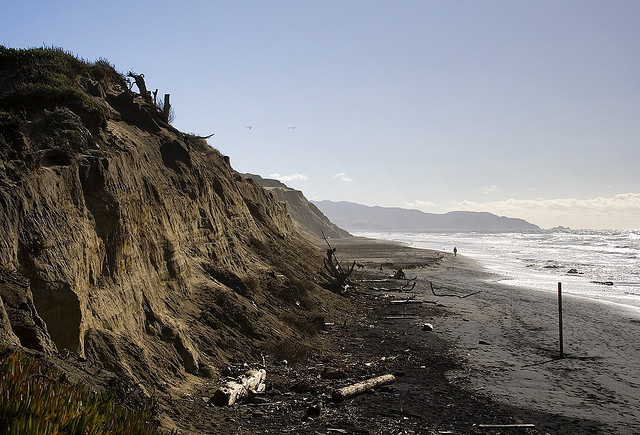
One of the challenges for the Ocean Beach Master Plan is how to slow the erosion of Ocean Beach's sandy cliffs.

San Francisco’s Ocean Beach is eroding; that’s not up for debate. But planners are still figuring out the best way to handle the erosion that’s already happening, and how to prepare for sea level rise. And that’s going to take a lot of planning: Ocean Beach itself is part of the Golden Gate National Recreation Area, managed by the National Park Service, but there are also the nearby residential neighborhoods to consider; plus the Great Highway, a wastewater treatment plant, the parking lot at the beach, endangered species, surfers, dog walkers and the occasional hopeful sun bather.

The Ocean Beach Bulletin, a local news site and one of KQED’s News Associates, has been covering the development of the new plan for San Francisco’s coastline, called the Ocean Beach Master Plan, which will attempt to address erosion and rising sea levels, while balancing the myriad social and environmental needs.

Over the weekend, the New York Times weighed in, too:

Continue reading Coastal Erosion in SF Prompts Planning and Debate

Why Shell Oil Supports California’s Climate Change Legislation

Shell CEO is pro-AB 32, but stands by taking legal action against environmentalists in Alaska

Shell has partnered with MIT to explore carbon sequestration.

Royal Dutch Shell CEO, Peter Voser affirmed his company’s commitment to AB 32, California’s climate change legislation, and also explained why a carbon trading system is crucial to the development of alternative energy sources.

“We are clearly in favor of cap and trade systems,” he said to an audience of Silicon Valley business people and climate experts Wednesday in Burlingame. “We’d like to have it globally, to level the playing field.”

This statement from Shell, the global oil and gas company headquartered in the Netherlands and one of the world’s largest companies, is notable when you consider the strong opposition to AB 32 from the oil industry at large. In 2010, Proposition 23 attempted to derail the imposition of AB 32 provisions and was largely bankrolled by Tesoro and Valero, two Texas oil companies.

Continue reading Why Shell Oil Supports California’s Climate Change Legislation

Will California be a Game-Changer for the Chevy Volt?

GM is hoping new carpool incentives and a green focus will boost Volt sales in the Golden State

The Volt now qualifies for California’s HOV lane status and a $1500 state rebate.

When General Motors CEO Dan Akerson was in San Francisco last week, I spoke to him about the five-week long suspension of the Chevy Volt production — and why he thinks the re-launch of the new-generation Volt could be a winner in California.

The Golden State accounts for one-in-four sales of the Volt, the plug-in hybrid made by General Motors. The car offers a potential solution to the “range anxiety” hurdle many would-be EV buyers face; but to gain traction against rivals like the Toyota Prius hybrid and the all-electric Nissan Leaf, it still has to surmount its red-hot price and fiery reputation.

Akerson says the new Volt qualifies for California’s HOV lane status and a $1,500 state rebate, thanks to changes in the combustion configuration of the engine. The new Volt will have an additional emissions system fan to reduce tailpipe emissions and Akerson anticipates that the average 36 minutes a day that commuters save by using the carpool lane will deliver an effective “California twist” to the vehicle’s marketability here.

Continue reading Will California be a Game-Changer for the Chevy Volt?

Should NOAA Focus on Climate or Weather Research?

House Republicans question NOAA chief on her agency’s priorities

Satellite imagery shows the storm that spawned tornadoes across the Midwest earlier this month.

Jane Lubchenco, director of the National Oceanic and Atmospheric Administration, answered questions about the agency’s budget today in a hearing held by the House Subcommittee on Energy and the Environment.

Lubchenco began by sending her condolences to people who lost loved ones to the tornadoes that tore across the Midwest in the past week. This year, she said, now ranks in the top five for the number of tornadoes occurring in the first two months of the year. She said making the nation “weather-ready” is a top priority in her budget request for Fiscal Year 2013, which comes to $5.1 billion, an increase of $153 million over last year’s.

Not all programs get more money in the budget request. NOAA is asking for nearly $20 million less than last year for the National Weather Service (NWS), a point with which Andy Harris, Maryland Republican and chair of the subcommittee, took issue.

Continue reading Should NOAA Focus on Climate or Weather Research?

Hospital, Heal Thy High-Carbon Self

Kaiser, UCSF and Stanford University Medical Center are all looking for ways to get greener

By Kamal Menghrajani

Solar panels on the roof of Kaiser's hospital in Modesto will help the Oakland-based health care provider reduce its greenhouse gas emissions.

All across California, people are looking for ways to be more eco-friendly: composting, recycling, driving less, and turning out the lights. Now it looks like hospitals in the area are following suit, as Kaiser Permanente announced new ‘green’ initiatives this week.

The Oakland-based health care provider is installing fuel cells and solar panels at its hospitals and clinics throughout the state. The huge non-profit is also turning to green building techniques for new construction projects and to save energy where possible in existing facilities.

The goal is to reduce greenhouse gas emissions by 30%, or a total of 264,000 metric tons, by the year 2020. Continue reading Hospital, Heal Thy High-Carbon Self

Fish vs. Farms Conflict Escalates in Central Valley

Proposed law would stop salmon restoration, deliver more water to Central Valley farms

The San Joaquin River flows from the Sierra Nevada to the Central Valley, where much of its water is diverted to aqueducts.

UPDATE: The House has passed the bill, with a vote of 246-175. It now goes to the Senate.

Meandering through the halls of Capitol Hill is a bill that would dramatically change California’s water picture. Sponsored by Tulare County Congressman Devin Nunes, the sweeping proposal would pipe more water to farms, and challenge the largest river restoration project in U.S. history.

Environmentalists and farmers tangoed for 18 years in federal court over the fate of the San Joaquin River, finally agreeing to restore water to some 60 miles of dry riverbed, and bring back the salmon that died off when the river was dammed just above Fresno.

“Most people associate the San Joaquin as a dry toxic river,” says Chris Acree, director of Revive the River, a Fresno-based non-profit. “Now that this water is back in that river, it allows us to identify ourselves with this river as a living river. This restoration program really is the broadest collaboration between agencies, landowners, stakeholders, and water users, where everybody has a voice.”

But Congressmen Devin Nunes says many Central Valley farmers have been left out of water decisions that put fish before farmers. His bill would not only reverse plans to restore salmon to this river, it would relax pumping restrictions in the Delta designed to protect other endangered fish.

Continue reading Fish vs. Farms Conflict Escalates in Central Valley

Ski-nomics: The Business of Ski Resorts in a Future with Less Snow

While some resorts are struggling, Vail group is expanding and insulating itself

On a recent winter weekend, Kirkwood's slopes had bare patches.

What a difference a season makes at one laid-back California ski area known for deep powder, sweeping bowls and short lift lines.

Kirkwood Mountain Resort, located 35 miles southwest of the glittering mega resorts of Lake Tahoe, is well off its average of 500 inches of snow per year (and a far cry from last year’s record-setting 748 inches). This weekend’s North Face Masters big mountain snowboard competition has been postponed because of lack of snow on the area’s high cirques. And last Wednesday, the resort was bought for $18 million by Colorado-based Vail Resorts.

Kirkwood’s purchase by Vail, a company whose aggressive expansion and intensive development at its other ski areas (including Tahoe resorts Heavenly and Northstar) may portend multi-million dollar ski chalets, luxury boutiques and high-speed gondolas — all things the remote Kirkwood has eschewed in its 40 years of operation.

But according to some industry watchers, Vail’s business model may offer economic insulation from a changing climate, as California’s mountain snowpack is projected to decline by as much as 25% by mid-century.

Continue reading Ski-nomics: The Business of Ski Resorts in a Future with Less Snow