Category Archives: Government & Business

What’s brewing in Sacramento, Silicon Valley, and beyond

Delta Dawn

Scientists and policy wonks seem to be in general agreement on this: that it’s time to close out the current management epoch on the Sacramento-San Joaquin Delta and begin anew. There’s less accord on how to proceed.

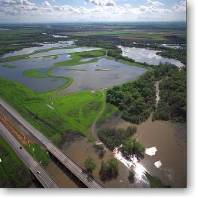
U.S. Fish & Wildlife Service
Photo: U.S. Fish & Wildlife Service

Policy makers have assembled “blue ribbon” panels to study the options and make recommendations. Volumes of studies and proposals line the shelves in Sacramento and elsewhere.

Last week a new idea surfaced for moving water through the Delta: Instead of channeling around it, tunnel under it.

This week the non-partisan Public Policy Institute of California released its recommendations for a mechanism to fund the enormous fixes that will be required: Those who benefit pay (ecologists use the term “ecosystem services” for all those bennies we get from natural resources and tend to take for granted).

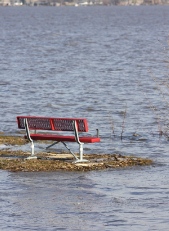
Whatever the outcome, one thing seems inevitable, with or without human intervention. Driven by warming ocean temperatures, rising sea levels will continue to push saltwater farther upstream, changing the Delta’s character and the “services” it provides.

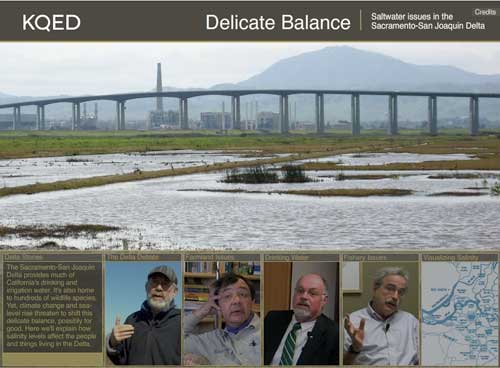
Recently a team of students at U.C. Berkeley’s Graduate School of Journalism produced a Flash presentation on some of the issues raised by advancing salt in the Delta. The multimedia report: Delicate Balance was produced for Climate Watch by Amanda Dyer, Martin Ricard and Jeremy Whitaker. We’re grateful to them for their time and creativity.

delicatebalance

Not With a Bang, But…

This is the way the world ends. Not with a bang but with a whimper. –T.S. Eliot

With the President headed for Mexico for a two-day summit, I was struck last week by the juxtaposition of two headlines that jumped out of a daily environmental news digest.

One headline read: “MEXICO AIMS TO BRING CO2 CUT PLAN TO CLIMATE TALKS.” The other, just above it, referring to similar efforts in this country, read: “CLIMATE BILL MAY FALL BY THE WAYSIDE.”

“With the fight over health care reform absorbing all the bandwidth on Capitol Hill,” Lisa Lerer wrote for Politico, “Democrats fear a major climate change bill may be left on the cutting-room floor this year.”

Granted, Mexico’s contribution to global greenhouse gas emissions is reportedly about 2%, or a tenth of the U.S. contribution, so one might argue that there’s a lesser job to do there. But with less than four months remaining before the next major U.N. climate conference, it raises the grim prospect that while other nations press on, the U.S. could arrive in Copenhagen empty-handed, which is to say without meaningful carbon legislation to show.

At the same time last week, the 16-nation Pacific Islands Forum called for a 50/50 commitment from developed nations; a 50% reduction in greenhouse gas emissions by 2050. Many of those island nations are on the hot seat as rising seas levels could make them among the first to lose substantial real estate before the end of this century.

At his first climate summit for governors last fall, Governor Arnold Schwarzenegger introduced a video from then President-elect Obama, in which he promised that his presidency would “mark a new chapter in America’s leadership on climate change.”

Praising the governors in attendance for their own climate initiatives, the newly elected President declared that “Too often Washington has failed to show the same kind of leadership. That will change when I take office.”

Of course “Washington” includes Congress, which is still dithering over the major carbon emissions bill championed by the new President. It squeaked through the House by nine votes and now looms as a 1,400-page pig that the Senate python will attempt to digest or regurgitate. Either way, what comes out is unlikely to closely resemble what went in.

Meanwhile the whole cap-and-trade concept has been coming under increasing scrutiny and skepticism. Last month, when the non-partisan Public Policy Institute of California polled Californians on the subject, more respondents favored an out-and-out carbon tax than cap-and-trade (56% to 49%). The Western Climate Initiative, a regional cap-and-trade pact that is a keystone of California’s climate strategy, AB 32, remains in limbo while western legislatures wait on Congress.

So when the Governor convenes his second climate summit in L.A. next month, billed optimistically as “The Road to Copenhagen,” he and his fellow “subnational leaders” (Wisconsin, Michigan & Connecticut governors are currently signed up) may find that the ball is still in their court. According to a news release from the Governor’s office, “climate leaders from around the world will come together and collaborate on efforts to further the global fight against climate change.”

They’ll do it with the same question on the table as last year: Can they count on Washington to take up the reins?

Plan Moves Climate Adaptation to Front Burner

A one-fifth reduction in per capita water use by 2020 is among the goals outlined in a new state report on adapting to climate change.

Released by the California Natural Resources Agency (CNRA) as a “discussion draft,”  the 2009 California Climate Adaptation Strategy is being billed as the nation’s first comprehensive game plan for adaptation to climate change.

Reed Galin
Photo: Reed Galin

Most of the state’s high-profile climate initiatives (and battles) have been about mitigation; how to reduce greenhouse gas emissions to slow down warming. This report swings the spotlight over to adaptation; what needs to be done to accommodate the climate change effects that are already “in the pipeline.”

While the California’s centerpiece climate law was passed three years ago, this week’s CNRA report concedes that “adaptation is a relatively new concept in California policy.” The 161-page white paper comes in response to an executive order from the Governor last fall, calling for a statewide adaptation strategy.

The draft divides the strategy into seven “sectors:” Public health, biodiversity and habitat, ocean and coastal resources, water, agriculture, and forestry.

Tony Brunello, Deputy Secretary for Climate Change and Energy at CNRA, says “This is the first report that really looks at how climate change is going to impact the state and what we need to do about it.”

But Brunello stopped short of conceding that mitigation is a lost cause. “You only have half a deck if you’re only focused on mitigation,” he said. “You need to focus on both mitigation and adaptation to truly be prepared.”

Some strategies attack both. Brunello points to water conservation measures, which save both water and energy (20% of the energy used in the state is deployed moving water around).

The plan is designed to work in consort with the California Air Resources Board’s implementation plan for AB-32, the state’s multifaceted attack on greenhouse gas emissions. CNRA says one of its goals is to “enhance” existing efforts, rather than create new programs and offices that need funding.

CNRA also promises to use the “best available science in identifying climate change risks and adaptation strategies.” Andrew Revkin has a useful overview of the mounting challenges to climate scientists, published this week in the New York Times.

One planned product from the adaptation plan is an interactive website devoted to climate adaptation, with maps and data to assist local planners. CNRA hopes to have that in place by early next year. The draft plan now enters a 45-day period for public comment.

Making Noise Over Wind

Figures released this week by a national wind power trade association would seem to indicate that the expansion of wind capacity proceeds apace. The American Wind Energy Association (AWEA) reported that more than 4,000 megawatts of new capacity has been installed so far this year, a 38% increase over last year’s pace.

Even so, AWEA CEO Denise Bode seems mildly disappointed by the numbers. Citing a slowdown in manufacturing of turbine components, Bode described the industry as “swimming upstream.”

The contrary current may get even stronger if my recent visit to upstate New York is any indication. Arriving for a family visit, I found that I’d landed in the midst of an uproar over wind farms, both built and proposed. Several times a week, articles were appearing in the Watertown Daily Times, about how area residents from around the state are complaining of ill effects from the utility-scale wind farms nearby and bristling at plans for more.

Wind power has hit headwinds in the past over concerns about birds, bats and its effect on people’s views. In upstate New York, the current objection seems to be noise.

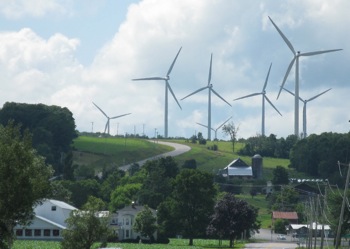
Giant wind turbines dwarf dairy farms in northern New York. Photo: Craig Miller
Commercial wind turbines dwarf dairy farms in northern New York. Photo: Craig Miller

At the Maple Ridge wind farm, billed as the biggest east of the Mississippi, I was rendered insignificant by 300-foot turbines, which tower over the farmland in Lewis County. Farther south, in New York’s Finger Lakes region, some turbines top 420 feet. More on this scale are being proposed to stretch out along the St. Lawrence River, which separates New York from Canada. Horizon Wind energy has already erected nearly 200 turbines on Maple Ridge, between the east end of Lake Ontario and the Adirondack Mountains.

Wind companies talk a lot about megawatts and numbers of households served and even tons of greenhouse gases avoided–but not so much about how big these things are. The Cape Vincent-based Wind Power Ethics Group has a graphic on its website that puts some of these numbers in perspective. It shows a 423′ turbine towering over a local lighthouse and the Statue of Liberty.

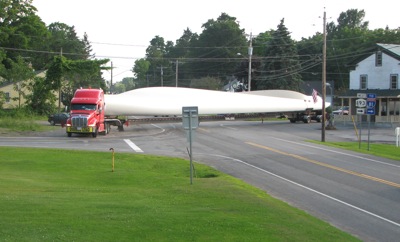
A truck hauling wind turbine blades navigates a turn onto Route 11 in northern New York. Photo: Chuck Miller
A truck hauling wind turbine blades negotiates a turn onto Route 11 in northern New York. Photo: Chuck Miller

When Californians think about wind farms, they may envision places like Altamont Pass and Tehachapi.  California pioneered wind power in the 1970s and 80s and most of the state’s windmills would barely make an impression compared to what’s going up around the country nowadays. California comes in fifth on the AWEA’s latest list of states with the most aggressive wind expansion (Missouri added the most capacity in the last quarter–New York didn’t even make the top 10).

Later this month, in a radio story for Climate Watch, I’ll look at the implications of this scaling-up as companies propose wind farms closer to populated areas in California, such west Marin County (more about that particular situation in our second Quest/Climate Watch television special, which premieres August 25).

Poll: Support for Climate Action More Contentious

New polling suggests that Californians may be wavering slightly in their support of climate response policies. The survey, just released by the non-partisan Public Policy Institute of California (PPIC), also shows a growing rift along party lines, when it comes to climate policy.

Nearly nine in ten Democrats surveyed (86%) said the government should regulate greenhouse gas emissions, while just 54% of Republicans agreed. Among all adults, including “independent” voters, 76% of Californians favored regulation of emissions, similar to a nationwide poll conducted in June by ABC News and the Washington Post.

PPIC chief Mark Baldassare says he thinks that the high-profile debate over national carbon legislation is “splitting Democrats and Republicans in California in a way that they weren’t a couple of years ago, when they saw a Republican governor and a Democratic legislature finding common ground on climate issues.”

Baldassare also observed that the relentless recession and state budget crisis have distracted both voters and their political leaders from environmental concerns.

There was a spike in water concerns compared to last year’s poll, with 18% naming water supply and drought as the state’s most important environmental issue, up 13 points from a year ago, virtually tying air pollution and vehicle emissions (20%) as the top concern. The poll’s margin of error is 2%. The telephone survey was conducted in mid-July.

The PPIC poll also appeared to pick up a groundswell among climate action naysayers. The percentage of respondents saying there’s no need for immediate action was up six points from a year ago, to 23%. Baldassare chalks this up partly to the complex nature of climate science. “People become skeptical when they don’t understand things,” he said.

Overall respondents showed the most concern (59%) over the likelihood of more wildfires, followed by more severe droughts (55%). People seemed less concerned about flooding and coastal erosion brought about by rising sea levels, possibly because they see that as a longer-term threat. Concern over wildfire was strongest in the Inland Empire and L.A. Basin. Interestingly, Angelinos also expressed more intense drought fears (61%) than respondents in the ag-intensive Central Valley, where just 21% described themselves as “very concerned” about the drought threat from climate change. Note that this is not an expression of drought fears in general, just those driven by climate change.

When it came down to the question of what to do about global warming, more Californians favored a “carbon tax” than a cap-and-trade system, by 56% to 49%. California and the nation are currently on a path toward cap-and-trade, at least partly (and paradoxically) because it’s considered more politically palatable than a straightforward carbon tax.

California Climate Champions Abroad

Jason Bade

Jason Bade is a 2009 California Climate Champion from Foster City, who graduated from Aragon High School in June.  In this post, Bade reports on his trip to Germany earlier this month, where he met with other young activists from across the globe, to discuss strategies for combating climate change.

World Youth Coalesce Around Climate Goals

By Jason Bade

Greetings from Stuttgart, Deutschland! I’m here attending the UNESCO World Youth Festival. Essentially the festival is a chance for youth from all over the world to exchange ideas and culture as well as to be educated on particular issues affecting the world.

For two of the days, there was a World Youth Congress, which focused on energy and climate change. I was one of fourteen International Climate Champions from six countries who came to help lead the climate change workshops, speak at the opening ceremony, and formulate the Stuttgart Declaration [PDF], the ultimate goal of the conference.

On Wednesday evening, several ICCs and I spent time with staff from the festival to formulate all the ideas born in the workshops into that single, cohesive document. In it, we detail a call to action from the youth of the world to the business community, the science community, our elected leaders, and ourselves, in which we expound on what we feel must be done by each respective group, in order to effectively combat and adapt to climate change. The Declaration was then presented on Friday to a local representative from each of those communities in Stuttgart.

While the document itself may contain no groundbreaking concepts, the fact that such a diverse crowd of youth assembled to discuss solutions to these problems–without attention to national pride, patriotism, or selfishness–is significant. Regardless of the actual substance produced on paper, the real benefits of this festival are the connections and friendships made among youth of such myriad cultures. It is when people have these experiences early in their lifetimes that they grow up to treat and respect others’ cultures with zeal unseen in those who have only been confined to their own people. It was an experience I wish others could only be so lucky to enjoy!

Not Connecting the Dots

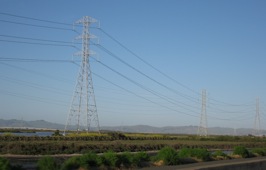
grid_0295Two developments this week would seem to validate concerns that things aren’t quite lining up for the vaunted new age of renewable energy.
While the Secretaries of Energy and Interior were offering confident assurances to a Senate panel about the future of renewables, a consortium of environmental groups was suing them over a plan for major new transmission lines for the western electrical grid.

The groups, represented by lawyers at Oakland-based EarthJustice, produced their own maps to show that the proposed routes appear to miss many areas with the most potential for solar, wind and geothermal resources. Instead, environmentalists say the West-wide Energy Transmission Corridors approved under the Bush administration would seem to line up just about perfectly with major existing and proposed coal-fired power plants (note that the maps themselves are PDF downloads).

According to EarthJustice:

“The Bush corridors plan ignores the Renewable Portfolio Standards (RPS) adopted by nine of the eleven western states to increase use of the region’s vast wind, solar, and other forms of renewable energy. The approximately 6,000 miles and 3.2 million acres of federal land in eleven western states designated as energy corridors puts imperiled wildlife at risk and slices or brushes against the borders of iconic public lands. Among these are Utah’s Grand Staircase-Escalante National Monument, Arches National Park, and New Mexico’s Sevilleta National Wildlife Refuge.”

I asked Katie Renshaw, a Washington-based lawyer for EarthJustice, if Energy and Interior wouldn’t have updated their plans since the Bush-era maps were approved. “As far as we’ve seen, they haven’t,” said Renshaw.  “An analysis was never really completed.”

The lawsuit comes just days after energy entrepreneur T. Boone Pickens revealed that he’s having to reconsider his plans for a major network of wind turbines through Texas. The reason: no transmission lines.

In California and elsewhere, proposed transmission lines have run afoul of environmental interests, as Rob Schmitz reported in his New Gridlock series for Climate Watch.

Update: Scott Streater has more on the controversy over siting renewables in a New York Times Greenwire post.

Long, Hot Summer for Climate Bill

capitoldome_hr_blogAs California’s Barbara Boxer opened Senate hearings on the Waxman-Markey climate bill today, her committee was urged by Republicans not to “rush through this thing.” At this point there seems to be little danger of that.

Having squeaked through the House by the thinnest of margins, the American Clean Energy and Security Act is facing a gantlet of Senate committees that will likely spend most of the summer dissecting the 1400-page beast.

Boxer’s Environmental and Public Woks Committee heard testimony today, with Finance and Foreign Relations scheduled to have their whack at it tomorrow. During the latter, expect to hear gruesome details about Europe’s experiment with cap & trade, which has been fraught with problems. Peter Fairley recently provided an excellent overview of those pitfalls in MIT’s Technology Review. Fairley writes that in its current form, the Waxman bill is destined to hit many of the same potholes.

During today’s morning session, members of the Energy committee heard from several cabinet-level officials, including Department of Energy Secretary Steve Chu, who fielded numerous questions on the role of nuclear power in the nation’s energy future. While California still has in place a legislated moratorium on new nuclear plants, Chu assured committee members that restarting the nuclear industry is a “very important factor” in the low-carbon future and that faces “no reluctance” from him.
Chu said his department is “pushing as hard as we can” to provide loan guarantees for new plant construction (most of which is planned for the southeastern U.S.). The former head of Lawrence Berkeley National Lab said that the U.S. has lost the lead on nuclear technology and “should get it back.”

(We’ll look at the prospects for that in a Climate Watch radio feature, scheduled to air on the August 24th broadcast of KQED’s Quest radio series.)

Committee Republicans repeated concerns about potential job losses and the danger of “carbon leakage,” wonk-speak for when production moves overseas to countries where it creates more greenhouse gas emissions than it would here.

As in the House floor debate, Republicans recalled a comment made by then-candidate Barack Obama to the San Francisco Chronicle in January of last year, that electricity rates would “necessarily skyrocket” under cap-and-trade. David Hawkins of the Natural Resources Defense Council countered that the act would also offer some savings; that households could see “up to $14 per month” in savings from transportation efficiencies.

Mapping Out Solar Power Hotspots

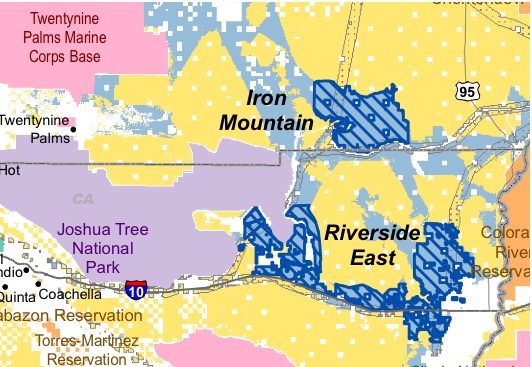
Somewhat overtaken by the other headlines of the week, dominated by celebrity obits and California’s financial meltdown, was the release by federal agencies of some new solar maps. They pinpoint federal lands in seven western states that present–in the government’s view–some of the best potential for building out utility-scale solar power production.

The four California locations (.pdf link) combine more than 350,000 acres in San Bernardino, Riverside and Imperial Counties. They supposedly represent the best combination of production potential, least conflict with other land uses and environmental concerns, and proximity to existing transmission lines or power plants. Areas were also mapped in neighboring Nevada and Arizona.

Update: Scott Streater has more on the controversy over planned renewable power sites, including California’s Iron Mountain site (see map, below),  in a New York Times Greenwire post.

All California locations are on BLM property in the state’s southeastern deserts. Image: DOE/BLM

The maps appeared just as California’s main regulator of power companies issued an update on solar projects in the state. The California Public Utilities Commission reported that the rate of new solar installations nearly doubled last year, from 2007 levels.

The CPUC tally shows California with over 500 MW of solar photovoltaic (PV) connected to the electric grid at almost 50,000 customer sites. The report notes that all those electrons combined are equivalent to one large power plant. About half of the current total went in under the California Solar Initiative, which has reached 13% of it’s 10-year goal, with another 8% in pending applications.

Also this week, more than $300 million fell from the federal money tree for a hydrogen power project in southern California. Cash from the American Recovery and Reinvestment Act (better known as the federal stimulus plan) will flow to the Hydrogen Energy California (HECA) project in Bakersfield. The project is designed to provide power for 150,000 homes in the area, by converting oil to hydrogen.

A statement from the California Recovery Task Force (CRTF), a conduit for federal stimulus funds, describes the HECA project as “an Integrated Gasification Combined Cycle power plant that will take petroleum coke, biomas, coal or blends of each, combined with non-potable water to convert them into hydrogen and carbon dioxide (CO2). The hydrogen gas will be used to fuel a net 250-megawatt power station.”

Perhaps more significant are the plans for the carbon dioxide generated in burning the oil. The CRTF statement says that “The CO2 will be transported by pipeline to nearby oil reservoirs and injected for permanent storage which will enhance U.S. energy security and enable additional production from existing California oilfields.”

CRTF says the project will “avoid” emissions of more than two million tons of greenhouse gases per year.

California’s EPA Waiver: Does it Still Matter?

Deja vu all over again. Photo: Craig Miller

Today the federal Environmental Protection Agency formally granted the waiver that California has sought since 2002, allowing the state to set its own standards for greenhouse gas emissions from cars.

But wait–didn’t this already happen for practical purposes, last month? That’s when the Obama administration announced its intent to essentially put California’s proposed standards in place nationwide.

Well, yes–and no. Bernadette Del Chiaro, who represents the group Environment California, says that having the waiver is more than a legal technicality. She says it means that the state can get started sooner, cleaning up tailpipe emissions. Del Chiaro explains that: “California’s standards kick in now, through 2016. The federal program that President Obama has extended throughout the entire country, starts in 2013 (also through 2016).”

That gives the states, in effect, a three-year jump-start. In 2013, everybody should be on the same page.

California’s chief air regulator,  Mary Nichols said, in a written statement:
“The waiver affirms California’s authority to set the standards for the cleanest cars in the nation and recognizes the ability of forward-thinking states to continue to adopt them. Now we can begin to work with the manufacturers to make a new generation of cars that deliver all the comfort and power we have come to expect but with improved efficiency and far fewer greenhouse gas emissions. ”

Thirteen other states had also pursued the waiver and can now proceed with their own programs.

While automakers have long argued that the tighter regs will make cars more expensive, Environment California calculates that they’ll “save consumers $36 billion at the pump by 2020.” That projection assumed that gasoline would would average about $2 per gallon over that period. Higher pump prices (which seem a lot more likely) would in turn, increase expected savings, as the underlying premise is that we’ll be driving cars that get better gas mileage.

But of course those cars will cost more than the clunkers we’re wheeling around in now. The state Air Resources Board estimates that the clean car regulations will tack an average of $1,000 onto the price of a new car by 2016. Obviously that would offset some of the pump savings.