Category Archives: Government & Business

What’s brewing in Sacramento, Silicon Valley, and beyond

Keeping the Sizzle in California Solar

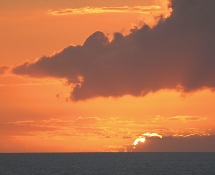
Pacific sunset by Reed Galin
Photo: Pacific sunset by Reed Galin

California, as I noted last fall as part of the series “Solar Realities,” has more solar self-generation than any other state in the nation by far. Now, if you ask the folks in the solar division of the California Public Utilities Commission, this state of affairs has a lot to do with three policies:

  1. The California Solar Initiative (CSI) provides rebates to cover about a fifth of the cost of installing solar systems.
  2. Simplified Interconnection exempts solar customers from interconnection fees and the cost of the studies required to connect their equipment to the electricity grid.
  3. Net Energy Metering allows solar power generators, who run the meter backwards as well as forwards, a credit on their power bills at “full retail electricity rates”–as opposed to the wholesale power price.

The policies were designed to encourage civilians to install solar for their own use; not necessarily to create an incentive for thousands of home power plants to serve the grid (depending on the size and location of your home, you may not be able to meet all your own electricity needs, let alone deliver surplus to the grid).

But if you can generate more solar power than you need, why not?

Adam Browning of the Vote Solar initiative, put it this way to the San Jose Mercury News: “Why are we talking about stamping on the brakes when we should be talking about pushing on the accelerator?”

Enter Assembly Bill 560. Net metering is currently capped at 2.5 % of the system’s peak energy demand or “load.” Once the stream of solar electrons coming onto the grid reaches that level,  the utility is not obligated to sign more net-metering contracts. AB 560, courtesy of Assemblywoman Nancy Skinner (D-Oakland), would provide some more headroom for that program by raising the cap to 10%.

AB 560 has passed the Assembly. Tomorrow, it comes up before the state Senate Energy, Utilities, and Communications Committee.  No doubt, a staff report due out the same day from the CPUC on the status of the California Solar Initiative will give the discussion some extra “juice.”

Meanwhile another bill, AB 920, from Assemblyman Jared Huffman (D-San Rafael), would change the way customers with solar installations are paid for surplus power. As I noted, they now get credited on their monthly bill at the full retail rate. Some of that credit is offset by “regular” power the solar customer uses at night or on cloudy days. Then, at the end of the year, leftover credits are zeroed out. AB 920 would require utilities to pay for credits left over at year-end, albeit at a lower rate–or allow the extra to be rolled over to the next year.

The CPUC, by the way, has come out in support of AB 560, but not AB 920.

The state’s three investor owned utilities dislike both bills; especially Pacific Gas & Electric, which is closest to approaching that 2.5% cap. About 30,000 of PG&E’s 6 million customers have solar systems.

PG&E contends that expanding its home solar program would burden the rest of its customers, who bankroll the state rebates for solar installations. And because solar customers buy less electricity from the utility, PG&E argues they don’t contribute as much as others to cover the costs of transmission and generation.

PG&E has said it would support raising the net-metering cap to 3%–but wants to see a cost-benefit analysis from the CPUC before supporting any further home solar expansion. That report’s due out in January.

There are those outside the industry who share PG&E’s concerns. Framing it as a class issue, the non-profit Utility Reform Network opposes raising the cap unless changes are made to allow non-solar ratepayers to share in the benefits.  Even with the current subsidies, going solar requires an often daunting up-front investment. As green becomes the color du jour for businesses and politicians, an increasing number of projects pair solar with low-income housing. But more often than not, your typical solar-powered household in California is likely to be well heeled.

As utilities enthusiastically pursue their own large scale solar projects, some solar advocates suspect that the companies are really worried that wide-scale residential solar would cut into their income. PG&E counters that state regulations eliminate the financial incentive for investor-owned utilities to simply sell more power to make more money.

All this raises a key question: Without lifting the cap on net metering, can California achieve its goal of 3,000 solar megawatts by 2016?

Rachael Myrow is host of The California Report, produced by KQED and heard on public radio stations throughout the state.

Editor’s Update: The CPUC’s latest report shows a near doubling in the rate of  installed capacity, from 2007 to 2008, and so far, data would seem to indicate a continuing trend this year. Installed  capacity to date puts the CSI at 13 percent of the total program goal, with another eight percent pending.
Down to the Wire: House Passes Climate Bill

After a long day of debate, the U.S. House of Representatives approved the Waxman-Markey climate bill, by a narrow vote of 219-212. The bill now goes to the Senate.

President Obama reportedly changed the topic of his weekly address, in order to respond to the landmark bill’s passage.

Toward the end of the day-long floor debate, Ohio Republican John Boehner railed against a “manager’s amendment” that was “dropped at 3:09 a.m.,” as he reminded members numerous times. The 309-page amendment spelled out some of the regulatory architecture of the proposed law, and Boehner spent more than an hour going through it nearly page-by-page, detailing how the law would reach into local governments, private homes, homeowners’ associations and mortgage markets.

In urging her Democratic colleagues to vote in favor of the measure, House Speaker Nancy Pelosi promised that passage would mean “four things: jobs, jobs, jobs and jobs.” But Republicans repeatedly warned that the law would cost “2.5 million jobs” every year, for the next decade and highlighted conflicting estimates of the cost per household (Projections by the EPA and Congressional Budget Office put the number at between $140 and $175 per year, while House Republicans insisted that the real price would be many times that).

At times the House floor sounded more like the British Parliament in decorum. A Republican amendment known as the “New Manhattan Project” alternative to the bill was defeated 256-172. That proposal would have largely substituted the Waxman bill’s web of regulation with incentives for development of new energy sources.

One thing that both parties seemed to agree on was that the American Clean Energy and Security Act of 2009 is one of the most sweeping pieces of legislation ever to come before Congress. The Waxman bill ballooned to more than 1200 pages by the final vote.

Updated: Disaster Status Sought for Valley

Five days after filing it, Governor Arnold Schwarzenegger was still awaiting some response from the White House to his request for a federal disaster declaration, to address drought conditions in Fresno County.

Meanwhile, the Washington bureau of the McClatchy newspaper chain (which includes the Fresno Bee) reports that the request is something of a longshot.

The Governor made the request last Friday, one day after he faced a tense gathering in Fresno, where water issues upstaged even the precarious condition of state finances, and shortly after a meeting with farmers in Mendota.

The governor has had a standing statewide drought emergency in effect since February. Friday he signed an executive order freeing up state resources to help ease drought-related impacts. A federal declaration would allow affected businesses to apply for federal aid. President Obama has since signed several other disaster declarations last week, in response to storms in Missouri, wildfires in Oklahoma and other incidents.

No Shockers in White House Climate Report

The Obama Administration released a much-vaunted update on climate change today. In its nearly 200 pages, the report contains no new data and few new conclusions on the pace and impact of climate change across the U.S. Rather it affirms the core findings of recent research and sounds the alarm for rapid, definitive action to reduce carbon emissions and prepare for changes already on the way.

In a statement from Lawrence Berkeley National Lab, Evan Mills, one of the report’s 28 co-authors, calls it “the most thorough and up-to-date review ever assembled of climate-change impacts observed to date as well as those anticipated in the future across the United States.” Mills is one of two northern California scientists listed in the report’s credits, along with Ben Santer of Lawrence Livermore National Lab.

One clear signal from the report is that it’s time to move adaptation strategies to the front burner; preparing for climate effects already in the pipeline.

Louis Blumberg directs the California climate change team for The Nature Conservancy, and told me in a telephone interview this morning, “I would say it’s a very clear signal that even if we dramatically reduce emissions immediately, which we need to do as soon as possible, we’ve already put enough CO2 into the atmosphere where we’re going to have have significant changes to our way of life. And we need to begin now and plan to adapt to these unavoidable impacts and I think this report underscores that urgency.”

But neither Blumberg nor Mills have given up on the mitigation side. Mills says “the good news is that the harshest impacts of future climate change can be avoided if the nation takes deliberate action soon.”

Here is a summary of  “key findings,” taken directly from the report:

1. Global warming is unequivocal and primarily human-induced.

Global temperature has increased over the past 50 years. This observed increase is due primarily to human-induced emissions of heat-trapping gases.

2. Climate changes are underway in the United States and are projected to grow.

Climate-related changes are already observed in the United States and its coastal waters. These include increases in heavy downpours, rising temperature and sea level, rapidly retreating glaciers, thawing permafrost, lengthening growing seasons, lengthening ice-free seasons in the ocean and on lakes and rivers, earlier snowmelt, and alterations in river flows. These changes are projected to grow.

3. Widespread climate-related impacts are occurring now and are expected to increase.

Climate changes are already affecting water, energy, transportation, agriculture, ecosystems, and health. These impacts are different from region to region and will grow under projected climate change.

4. Climate change will stress water resources.

Water is an issue in every region, but the nature of the potential impacts varies. Drought, related to reduced precipitation, increased evaporation, and increased water loss from plants, is an important issue in many regions, especially in the West. Floods and water quality problems are likely to be amplified by climate change in most regions. Declines in mountain snowpack are important in the West and Alaska where snowpack provides vital natural water storage.

5. Crop and livestock production will be increasingly challenged.

Agriculture is considered one of the sectors most adaptable to changes in climate. However, increased heat, pests, water stress, diseases, and weather extremes will pose adaptation challenges for crop and livestock production.

6. Coastal areas are at increasing risk from sea-level rise and storm surge.

Sea-level rise and storm surge place many U.S. coastal areas at increasing risk of erosion and flooding, especially along the Atlantic and Gulf Coasts, Pacific Islands, and parts of Alaska. Energy and transportation infrastructure and other property in coastal areas are very likely to be adversely affected.

7. Threats to human health will increase.

Health impacts of climate change are related to heat stress, waterborne diseases, poor air quality, extreme weather events, and diseases transmitted by insects and rodents. Robust public health infrastructure can reduce the potential for negative impacts.

8. Climate change will interact with many social and environmental stresses.

Climate change will combine with pollution, population growth, overuse of resources, urbanization, and other social, economic, and environmental stresses to create larger impacts than from any of these factors alone.

9. Thresholds will be crossed, leading to large changes in climate and ecosystems.

There are a variety of thresholds in the climate system and ecosystems. These thresholds determine, for example, the presence of sea ice and permafrost, and the survival of species, from fish to insect pests, with implications for society. With further climate change, the crossing of additional thresholds is expected.

10. Future climate change and its impacts depend on choices made today.

The amount and rate of future climate change depend primarily on current and future human-caused emissions of heat-trapping gases and airborne particles. Responses involve reducing emissions to limit future warming, and adapting to the changes that are unavoidable.

On KQED Public Radio’s Forum for Wednesday, 6/17

9am Forum with Michael Krasny
White House Climate Report
We discuss the report, as well as federal climate change legislation from Congressmen Henry Waxman and Ed Markey. Guests include Dan Kammen, professor of energy at UC Berkeley and co-director of the Berkeley Institute of the Environment; and Katharine Hayhoe, professor of geophysics at Texas Tech University and a lead author of the climate study.

Speed Bumps on the “Hydrogen Highway”

Seems like the Governor is spending a lot of time looking at cars lately. If the rest of us spent as much time cruising Auto Row, the recession might already be fading in the rear-view mirror.

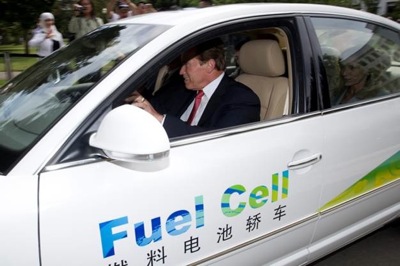
Governor Schwarzenegger tries out the Volkswagen Passat Lingyu. Photo: Governor's Office
Governor Schwarzenegger at the wheel of a Volkswagen Passat Lingyu. Photo: Governor's Office

But California’s chief executive isn’t interested in run-of-the-mill rolling stock (he will, of course, happily take credit for inventing the Hummer). He’s into exotics: the alternative-fuel cars of the future–and in some cases, present.

At least five times in the last three weeks, the Governor’s Office has created photo ops with alt-fuel autos, prototypes or refueling stations; from a fuel-cell Volkswagen (June 3) to the Mutt-&-Jeff of electrics, Hummer and Peapod (May 28 & June 10, respectively), he’s kicked the tires on a whole generation of not-widely-available wheels–not to mention the home ethanol refinery (June 4) or the hydrogen refueling station in Santa Monica (May 27).

All of which got us to wondering: “Dude, where’s our Hydrogen Highway?” You may recall the Governor’s promise five years ago, that California would by now be coming down the home stretch on a whole new infrastructure for the coming swarm of cars powered by hydrogen fuel cells.

Monday morning on KQED’s weekly Quest radio feature, David Gorn reports that we’ve apparently hit a few speed bumps:

“The technology clearly has promise, but it’s behind schedule. Schwarzenegger’s original plan called for 100 to 150 hydrogen fuel stations by next year, and so far there are only about two dozen. He also wanted 2,000 hydrogen-powered cars on the road, yet fewer than 200 are being road-tested today. The lack of progress has prompted California’s non-partisan state legislative analyst to recommend scrapping state funding for the hydrogen program. And on the federal level, Energy Secretary Steven Chu has asked Congress to cut about half of the national hydrogen-research budget. Chu said hydrogen technology is too far from fruition.”

None of these details stopped Governor  Schwarzenegger from hyping the 2009 Hydrogen Road Tour, a recently concluded San Diego-to-Vancouver rally, designed to highlight fuel-cell technology:

“We will keep pushing, and thanks to our public-private partnerships and the commitment of these automakers and energy companies, the era of pollution-free transportation is dawning.”

The Governor’s statement went on to say that “Auto manufacturers expect the number of hydrogen vehicles to increase to 4,300 by 2014 and more than 40,000 vehicles by 2017.” Of course, that was before Energy Secretary Steve Chu announced that R&D funding for hydrogen fuel cells on the road didn’t quite make the cut for the next DOE budget. Plug-in hydrid, anyone?

Head-to-Head: Chevron and The Sierra Club

Two giants of California’s energy debate squared off at a Commonwealth Club forum in San Francisco last night.

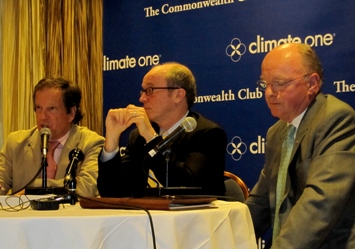
Chevron CEO Dave O’Reilly and Sierra Club Executive Director Carl Pope fielded questions from moderator Alan Murray of The Wall Street Journal and a sometimes impassioned audience, about renewable energy opportunities, reducing greenhouse gas emissions, and predictions for the future of the United States’ energy economy. Several questions also concerned Chevron’s high profile court battle in Ecuador and the oil company’s presence in Richmond, the Bay Area city where a major Chevron refinery dominates the skyline–and some say, local governance

Carl Pope, ED of Sierra Club Alan Murray, Executive Editor of WSJ Online Dave O'Reilly, CEO of Chevron. Photo: Gretchen Weber
From left to right: Sierra Club chief Carl Pope; WSJ Online Executive Editor Alan Murray; Dave O'Reilly, CEO of Chevron. Photo: Gretchen Weber

In what was less of a debate than a discussion, Pope and O’Reilly agreed that the United States needs to make major changes towards greater energy efficiency and that the country must begin to rely more on renewable energy sources.

Their views diverged significantly, however, on the timeline for such changes. While Pope supports a 90% reduction of greenhouse gas emissions from today’s levels by 2050 and says he believes this goal possible, O’Reilly projected that by 2050, the United States will have reduced its GHG emissions by no more than 20-25% from today’s levels.

O’Reilly said that even if the U.S. replaced the entire transportation system with a zero-emissions system, the country would reduce GHG emissions by just 34%–and that doing likewise with the nation’s power generation would reduce GHGs by another 40%.

“So we have to ask ourselves, can we replace our entire energy system–transportation and power–in just a few short decades?” said O’Reilly. “I think the transition is going to take some time.”

According to O’Reilly, his company is already the largest provider of geothermal energy in the world and yet only 2% of Chevron’s income currently comes from renewable energy.

“The challenge of scale demands that we acknowledge that conventional energy sources will remain indispensable for decades,” said O’Reilly. “We must be realistic. For the foreseeable future we need to develop it all: conventional as well as non-conventional energy, as well as renewables and alternatives.”

When asked what his prediction was for how much of Chevron’s income would come from renewable energy sources by 2050, O’Reilly said he thought the number would be about 10-15%.

Pope responded, “The world will have room in 2050 for a very small company, 90% of whose energy comes from fossils [fuels]. The world will not have room, or tolerance, in 2050 for a big energy company [that does], so if Chevron wants to be successful, I think Chevron’s going to need to change those numbers.

Pope also called on Chevron to “come to the table” with local communities in which Chevron operates, such as Richmond, CA, and he proposed that all oil companies donate 10% of their profits to a global fund to clean up areas of the world damaged by the petroleum industry.

Not surprisingly, Pope and O’Reilly agreed that the highest priority for reducing GHG emissions is to replace coal with natural gas or another less carbon-intensive energy source, and while on stage, the men shook hands on an agreement to lobby the issue together in Washington.

KQED will broadcast the entire Commonwealth Club event at 8 p.m. on Friday, June 19, with a rebroadcast at 2 a.m. the following morning.

BK Franchise Serves Up Some “Baloney”

I know: This didn’t happen in California, so why mention it? Well, sometimes stories come in that just seem to crystallize the persistent (some polling would suggest growing) public division over climate change and this is a good example.

When signs on Burger King outlets started opining that “Global warming is baloney,” a Memphis reporter decided to check it out. His exchanges with the local burgermeister and the parent company make for pretty amusing reading.

Interesting that while polls taken within the last year have indicated flagging faith in the prevailing view of climate scientists that the world is warming, a spring poll by the Pew Research Center showed 59% of Americans supporting some kind of cap on carbon emissions. Though still sharply divided along party lines, that could indicate that some kind of reluctant consensus is forming around the issue.

No Crystal Ball for Fusion Power

Lawrence Livermore Nat'l Lab
Photo: Lawrence Livermore Nat'l Lab

Now here’s a guy with some historical perspective: For something north of a half-century, David Perlman has been covering science for the San Francisco Chronicle. On KQED’s Forum program this morning, he noted that “40 years ago, they said ‘in 20 years, we’ll have unlimited energy from fusion’.”

The record will show that we didn’t quite get there–but that hasn’t stopped them from trying. The long quest for bottled fusion will pass another milestone this week, when the US Dept. of Energy formally cuts the ribbon on the National Ignition Facility (NIF) at Lawrence Livermore National Lab.

Comparing the hardware with other titanic undertakings, like the CERN particle accelerator in Switzerland, Perlman called the 192-laser assembly “one of the most amazing machines–if it succeeds–and one probably won’t know for the next two, three years.”

That’s the hopeful time frame for creating fusion in a fuel pellet the size of a BB (artistically rendered in the image, above) Will they? Perlman says: “I would not dream of putting a bet on it.”

Nor would sparking some mini-fusion at NIF quickly translate to a national solution for clean, safe energy. Scaling that ignition up to practical size for reactors would likely require decades more.

A NIF technician appears to be gazing into a "crystal ball," which is actually used to amplify laser beams--but not much good for predicting the future. Photo: Lawrence Livermore National Lab
A NIF technician appears to be gazing into a "crystal ball." Precision-ground crystals are used to amplify laser beams--but not much good for seeing into the future. Photo: Lawrence Livermore National Lab

Earlier this week, in an interview with NASA scientist James Hansen, I asked him about the potential for nuclear power to make a comeback with new technology. Rather than waiting for fusion, Hansen favors the technology known as “fourth-generation nuclear,” which he says could “burn nearly all of the fuel, where at present, the nuclear technology that we’re using burns only one percent of the energy in the uranium.” From one percent to “nearly all” would represent a drastic reduction in the current radioactive waste problem.

There may be some wishful thinking in that. An early report published in the magazine 21st Century Science & Technology describes these “Generation IV” reactors as “about 50% more efficient than conventional nuclear reactors.”

Other nations have moved ahead with Gen-IV reactors. The French expect to have one under construction by 2020.

Meanwhile, as the US pursues a parallel Gen-IV research program, it will press on toward the Holy Grail of fusion with its Livermore megalaser, described by Perlman as “already a mini-Manhattan Project.” Costs so far have run to nearly triple the original budget of more than a billion dollars. DOE expects to spend $140 million per year to run the NIF. So, it would be–you know–nice if something comes of it.

New Tailpipe Regs are an “Alternate Reality”

Amy Standen specializes in science and environmental reporting for Quest. She’s among the guests today on KQED’s Forum program. Listen to the archived program here.

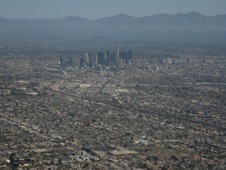
Hazy day in L.A. Photo: Craig Miller

Yesterday afternoon, as I started working on my news spot about the new federal standard for tailpipe emissions, I dug up my notes from over a year ago, the last time I covered this story in any depth.

The contrast in tone between then and now amazed me. Back then, I was describing accusations of outright lying, government actions that California enviros called “completely illegal,” and California officials “sharpening their knives” as they marched into battle with EPA former Administrator Stephen Johnson. It was September, 2007, and Democratic lawmakers, led by Henry Waxman (D-CA), were accusing the White House of strong-arming the EPA into denying California its “waiver,” or permission to regulate auto tailpipe emissions. The mood between California environmentalists, many of the state’s elected officials, and the Bush administration couldn’t have been more hostile.

Today, it’s as if we’ve landed in an alternate reality.  Not only has California been given its more fuel-efficient cars, but those same laws are taking effect nationwide. The new rules actually exceed anything that California–traditionally the most ambitious state in the union, when it comes to greenhouse gas regulation–could have asked for.

Instead of knives being sharpened, California enviros are singing the praises of “an historic blueprint to carry out rigorous greenhouse gas emission standards,” to quote one email I received today. Another group told the New York Times: “This is the single biggest step the American government has ever taken to cut greenhouse gas emissions.” Compared to the fall of ’07–actually make that since ’05, when California first asked for the waiver and the EPA first started stalling–it’s like night and day.

Still, listening in to the White House background press briefing on Monday afternoon, you could hear the seeds of criticism taking root in a few reporters’ questions.

Sure, American automakers will be making more fuel-efficient cars, one reporter asked, but what is the White House doing to encourage consumers to buy them? (in addition to restricting tailpipe emissions, the new rules also substantially increase fuel efficiency standards for manufacturers’ fleets–SUVs and trucks will still be available; they’ll be more fuel efficient than before, but less efficient than smaller cars.) The question takes on new relevance as the federal government finds itself a major stockholder in auto companies.

President Obama says the new regs will have the equivalent impact of taking 177 million cars off the road.

California’s Water Meter Rebellion Withers

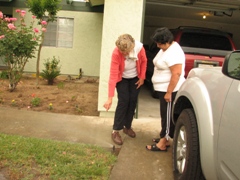
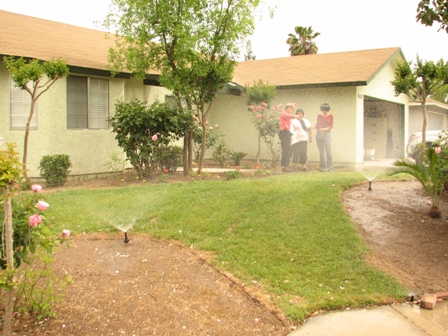
City water conservation specialist Marilyn Creel shows Fresno resident Mary Ann Evans how to adjust her sprinklers to point them away from the sidewalk.

Monday on The California Report, Central Valley Bureau Chief Sasha Khokha tracks one city’s longstanding rebellion against water meters–and says the day of reckoning is nearly at hand. Listen to Sasha’s story here.

I admit it. I wanted to do this story because I saw so many of my neighbors watering their driveways. What I learned is that unmetered cities are a long and slow-dying tradition in the Central Valley.

Martin McIntyre, who used to head Fresno’s water agency, explained how vehement anti-metering forces swayed voters and banned meters in the city charter:

“They were really false arguments. The simple phraseology was ‘meters are taxing machines,’ and they’re going to use meters to fund city hall activities. And, in fact, as is the case for all municipal water supply systems, the funds collected from ratepayers by law can only be used for the operation and improvement of the water supply system. Nonetheless, that resonated with some of the public and it was very easy for a handful of people to get prominent headlines above the fold simply by saying city hall is taxing us to death.”

State lawmakers overrode Fresno’s rule, because they understood that cities with meters use less water.

Ellen Hanak, a water researcher with the Public Policy Institute of California, has found that metered cities use about 15 percent less water than unmetered cities. And cities with a tiered rate system save an additional ten percent on top of that. In addition to usage, her report compares different cities’ water rates. Of course, San Franciscans get away with using less water because–guess what? Many of them don’t have front yards.

Hanak crunched statewide residential water rate numbers and determined that more than half of San Joaquin Valley residents don’t have water meters. (For further details, read the survey disclaimer.)

But meters are coming, one way or another.

There are basically three laws that will eventually require the entire state to install water meters. One says that all homes built after 1992 must have meters. Another dictates that cities that get federal water (like Fresno) have to install meters by 2013. And yet another law says that all California cities (including holdouts like Sacramento) have to be metered by 2025.

Fresno is gearing up to install its first meters this year. They’ve even created a handy Q&A for skittish customers.

And if you thought Central California was the only laggard, this might make you feel better: many Chicago residents don’t have meters, either.

But they probably don’t have the sprinkler ladies–who can fix any leaky, squeaky, spritzy sprinkler, and make sure it’s pointing away from the sidewalk.

KQED’s Sasha Khokha braves sprinkler spray to record Fresno’s city water conservation team at work.