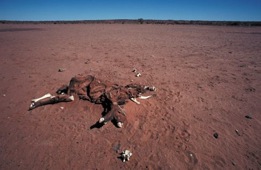
Referring to Australia’s seven-year drought, that’s how the state’s top water manager describes the new paradigm for water planning at the Dept. of Water Resources.
Speaking to a packed house at the annual forum of the Sacramento River Watershed Program yesterday, DWR Director Lester Snow said his staff is assuming that 2010 will be another dry year. Snow warned about “loss of resilience” in the state’s water system, calling it “completely unsustainable” in it’s present form, given predictions for population growth, coupled with anticipated effects of climate change.
All speakers at the forum seemed to agree that a paradigm shift is in order. Thomas Philps, a strategist at SoCal’s Metropolitan Water District, pointed out that in Victoria’s capital city of Melbourne (Australia), per capita water consumption runs about 40 gallons per day, while in California’s capital, it’s 280 gallons. As Sasha Khoka will report Monday morning on The California Report, Sacramento is just one of several cities in the Central Valley that still doesn’t meter its water use. Philps added that the Sacramento region is “on a trajectory” to use the same volume of water as Los Angeles, though he did not say by when.
UC Davis geologist Jeff Mount cautioned against relying on additional surface storage to secure California’s water future. Not only does storing water become “very expensive” year over year, but dams and reservoirs “don’t create any new water,” he said. (If some think Mount is taking a “jaundiced view” of the situation, it might be because he braved a bout of hepatitis to deliver his morning talk)
In a panel discussion on resource planning, moderator Greg Zlotnick of the Santa Clara Valley Water District asked panelists to respond with “true” or “false” to a quote from the Pacific Institute’s Peter Gleick in a story aired on NPR last week. The quote, as given by Zlotnick, was: “Government has built infrastructure and made promises that can’t be kept.” Here are the panelists’ responses:
Philps: “True, but…” (Generally true but MWD doesn’t really expect to get its full contractual allocation of water anymore, anyway)
Don Glaser, US Bureau of Reclamation: “False, but…” (Water allotments from his agency’s Central Valley Project are intended to be “supplemental contracts,” to augment use of groundwater and other sources, but Glaser sees the statement becoming “more and more true in the future.”)
Tom Banse’s radio report on West Coast wave energy aired Thursday morning on The California Report. It’s also posted to the Climate Watch Radio section on this site.
A Crib Sheet for West Coast Ocean Energy
Every now and then when the government gets something right, it’s only fair to give credit. So today we give props to the Federal Energy Regulatory Commission for making public records easily accessible. Combined with our handy-dandy crib sheet, you can be the reporter and dig up all sorts of newsworthy nuggets. We’ll get to some examples, but first the overview:
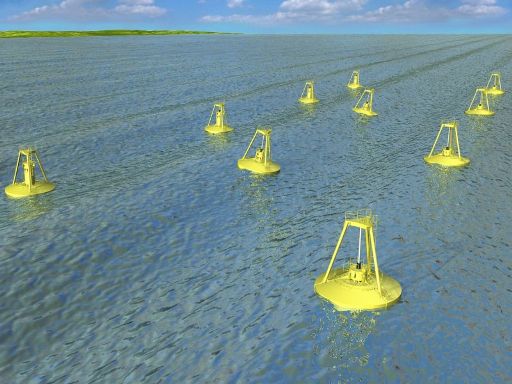
Wave energy buoys proposed for Reedsport, OR (artist's conception). Image provided by: Ocean Power Technologies
Starting in 2006, there was a “gold rush” on the ocean to stake claims for wave energy sites. Now the spray is settling and an industry shakeout is occurring. Energy developers have given up on about a third of the wave power projects they proposed along the West Coast. Some tidal power proposals are ebbing away as well. When things go sideways, we rarely get a press release about it. Often the news pops up first in a filing to FERC.
FERC is the agency that oversees wave and tidal power projects in state waters (up to 3 miles offshore). The agency’s webmasters set up an “eLibrary” to archive project applications and correspondence.
You can see on the crib sheet that FERC dismissed three ocean energy projects in California waters last month. The simple explanation is that the three projects ended up on the wrong side of a bureaucratic turf battle. The Department of Interior’s Minerals Management Service (MMS) won jurisdiction over all energy development on the outer continental shelf, defined in this case as more than three miles offshore. Grays Harbor Ocean Energy Company president Burt Hamner explained in an e-mail:
FERC has cancelled its entire preliminary permit process for projects located on Federal ocean waters, and thus dismissed our seven pending applications for preliminary permits (as well as those of a few others). The new MMS framework says that applicants for wave projects must first get a MMS lease for space, then apply to FERC for a commercial hydropower license. But, MMS is prohibited from issuing leases in national marine sanctuaries. Two of our projects, San Francisco and Hawaii, are in sanctuaries. Therefore these are terminated because there is no way to get a lease or permits there.
At the City of San Francisco, utility specialist Randall Smith said the FERC dismissal of the city’s preliminary permit for the Oceanside project “doesn’t put us back to square one, but does force a step back.” Smith elaborated, “The difference with MMS is getting a lease. That’s a little more protracted.”
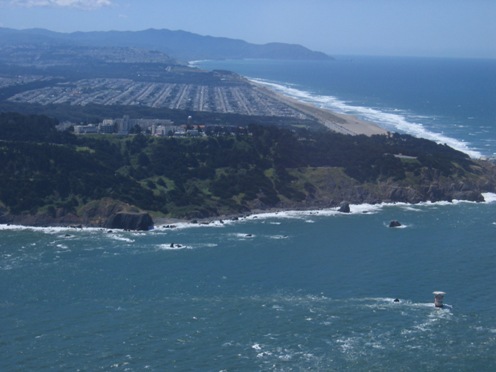
A wave power project proposed for waters off San Francisco's Ocean Beach (upper right) is in limbo.
The voluminous dockets for PG&E’s WaveConnect projects off Humboldt and Mendocino Counties, and the Green Wave Mendocino Wave Park suggest those are the ones moving ahead the fastest. PG&E recently secured $6 million to pay for environmental studies, design work, and permitting. The utility started its community outreach by scheduling two town meetings–in Eureka on May 19 and Ft. Bragg on May 21–both scheduled for 6 pm.
And now, the secret code: An easy way to keep tabs on a marine energy project is to make note of the applicant’s docket number (the one that starts with P-xxxxx) and then periodically plug that number into a “Docket search.” (Click on “Submit” rather than the more prominent “Search Consolidated Dockets” button.)Here are all of the West Coast wave energy projects proposed to FERC, listed from north to south, as of this week:
P-12751 Makah Bay (Finavera) license surrendered 4/09
P-13058 Grays Harbor Ocean Energy (Grays Harbor Ocean Energy Company) 11/2007
P-13047 Oregon Coastal Wave Energy (Tillamook Intergovernmental Dev. Entity) 10/2007
P-12750 Newport OPT Wave Park (Ocean Power Technologies) permit surrendered 3/09
The hamster-sized, high-elevation haymaker known as the American Pika has had its “day” in court–and then some. Now it may be making inroads toward listing as a threatened species, while questions persist over whether that would be premature.
Friday was the deadline for officials at the U.S. Fish & Wildlife Service to decide whether to further consider the pika for listing under the federal Endangered Species Act.
The San Francisco-based Center for Biological Diversity (CBD) has been pursuing listing for the pika under both the state and federal Endangered Species Acts. On April 16, a Superior Court judge in San Francisco ruled that the California Fish and Game Commission applied too stringent a standard, when it voted last year to reject the CBD’s petition to list the pika under the California law. The CBD says it expects the court to formally order the state to go back and take a second look at whether the critter deserves protection.
Meanwhile federal wildlife officials had until May 1 to decide whether to formally review the pika’s plight and consider listing it under federal law. A response is expected to be published in the Federal Register this week.
Complicating the case is an apparent difference between the fate of pika populations in the Great Basin, where field research clearly shows pika colonies in trouble, and colonies in the Sierra Nevada range, which may be faring better.
Pika thrive only at high elevations, in the rocky conditions known as talus. Their band of tolerance for temperature is very narrow, so some biologists see them as an indicator species for global warming. Temperatures that humans may consider merely balmy, can be fatal for pika.
Chris Ray, an ecologist at the University of Colorado, has studied pika in the mountain ranges of the Great Basin. She’s identified and ranked several stress factors that pose threats to the animals, including habitat shrinkage and exposure to both heat and cold.
Ray, who presented her latest research at the USGS-sponsored Pacific Climate Workshop last month, is cautious about endorsing an ESA listing just yet, saying: “I do not think there are data indicating that the species as a whole is in danger of extinction, however the loss of isolated populations from the Great Basin has me concerned.”
“I think it’s very reasonable to consider potentially listing some sub-populations of pika.” Ray says that in order to do that, a case would have to be made that there are genetically distinct sub-species of pika. In its petition, CBD claims that five sub-species have been identified in California. But scientists at UC Berkeley and the U.S. Forest Service who have done field research in the Sierra, have said it’s less clear that those colonies are in trouble.
CBD staff biologist Shaye Wolf says a 1995 study found “evidence for four genetic units across the pika range, roughly grouped as Sierra Nevada, Cascades, Southern Rockies, and Northern Rockies. However, better genetic analyses using more sensitive genetic markers (like microsatellites) are necessary to understand pika population structure.”
Wolf says that for its ESA petition, the CBD drew on a 1981 study that used population distribution to break out 36 “subspecies” of pika.
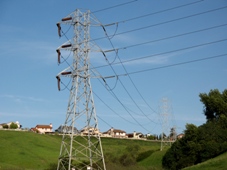
The mainstream media’s beginning to catch up to the “smart grid” story; the grand plan to remake the nation’s electrical distribution system.
On Friday, NPR began a ten-part series; “Power Hungry: Reinventing the U.S. Electric Grid.” The reports will air on both of the network’s flagship programs, Morning Edition and All Things Considered.
And if you’re still “power hungry” after all that, Scott Pelley’s piece on the coal power industry is well worth a twelve-minute investment at the 60 Minutes website.
Photo: Peter Johnsen, U.S. Fish & Wildlife Service
In hearings by the House Energy & Commerce Subcommitee today, Rep. George Radanovich (R-Fresno) called the Delta smelt “a worthless little worm that needs to go the way of the dinosaur.” He made the remark as part of a five-minute attack on “environmental alarmism,” in response to testimony from former vice-president Al Gore, founder of the Alliance for Climate Protection.
The tiny fish, recently listed by the state Fish & Game Commission as “endangered,” came up in remarks by Radanovich about the current drought conditions in the Central Valley. He blamed the lack of water on lawsuits that have restricted water supplies to farms, “for a Delta smelt–a worthless little worm that needs to go the way of the dinosaur. They’ve shut pumps down and restricted water deliveries to California over that thing, when what’s eating it is a striped bass, a non-native species in the Delta.”
Radanovich rejected the possibility that climate change might be a player in the current drought. Instead he took aim at what he described as “collaboration between environmentalists and sport fishermen,” blaming that for slashed water allocations to farms, as many as 60,000 job losses and “a $6 billion-dollar hit to our economy.”
“That is not global warming,” he said. ” “It’s the result of bad policy caused by environmental alarmism.”
Joining Gore among the 21 witnesses before the subcommittee on Day 4 of the climate bill hearings was UC Davis professor Dan Sperling (.pdf link), who had just come from a marathon hearing before the California Air Resources Board. Last evening the Air Board approved the first-ever Low-Carbon Fuel Standard, as part of it’s plan to reduce greenhouse gases.
After years of study and a day of marathon testimony in Sacramento, state regulators have adopted the world’s first low-carbon standard (LCFS) for transportation fuels. Only one member of the California Air Resources Board, John Telles, voted against adoption.
During nearly six hours of testimony by almost 100 speakers, businesses lined up both for and against the new rules. As Marjorie Sun reported for us this week, some claimed that calculations for the carbon footprints of different fuels–especially ethanol–were not even-handed. Speaker after speaker assailed the LCFS as being the product of “incomplete analysis” or just bad math (public testimony begins about an hour into the webcast).
But Daniel Sperling, a UC Davis professor and member of the Air Board, calls it “government at its best.”
“There’s been a huge amount of effort,” he said, ” in working with the oil companies, working with the electricity companies, working with the environmental community, working with the biofuels companies, to try to get this really done right.”
Though numerous speakers challenged the view that it was done right, both Sperling and Air Board head Mary Nichols seemed to leave the door open to additional tweakage of the regulations. “In the end, it’s a science-based policy,” said Sterling. “There are a lot of pieces of this that we’re not certain exactly the best way to do it but we’ve got the framework of a really outstanding policy and an important policy. And we’ve made the commitment to work with all the different stakeholders in refining it, to make sure that it really works best.”
Small-business and environmental justice groups locked arms to decry the cost of the new rules. Some cited a report from Sacramento-based Sierra Research estimating $3.8 billion in increased fuel costs by 2020, if the LCFS takes effect.
An “expert working group” is due to report back on January 1, with possible suggestions for fine-tuning the plan.
Board member Ron Roberts summed up the proposed regulation by paraphrasing Winston Churchill: “It may not be the end or even the beginning of the end, but it’s the end of the start,” said Roberts (falling somewhat short of Churchillian eloquence but point taken).
The new rules are designed to cut greenhouse gas emissions from transportation 10 percent by 20-20. Sperling is now headed to Capitol Hill, to testify before Congress on national legislation. California’s process is being closely watched in Washington, where pending federal carbon legislation is widely seen to be modeled after California’s plan.
This week, the California Air Resources Board is expected to pass a controversial new standard that measures the carbon footprint of transportation fuels. Reporter Marjorie Sun filed a story for Climate Watch on the measure and why the ethanol industry is fighting it. She provides some additional insights here:
The proposed low carbon fuel standard is part of a broad effort by the California regulators to roll greenhouse gas emissions back to 1990 levels by 2020.
Slashing carbon emissions from cars and trucks is a big part of the state’s game plan. That’s because transportation accounts for 40 percent of the state’s greenhouse gas emissions. A whopping 96 percent of the fuel sources that power our cars and trucks is petroleum-based. Right now, the bulk of ethanol sold in California–and the rest of the United States for that matter—is corn-based. (Brazil makes its ethanol fuel from sugar cane, which has a smaller carbon footprint.) U.S. producers argue that the proposed Low-Carbon Fuel Standard (LCFS) would make corn-based ethanol less competitive in the marketplace because of the way it calculates emissions. Pacific Ethanol was the biggest ethanol producer and marketer in California– until recently. With the drop in gasoline prices over the past year, demand for ethanol has plummeted. Over the past several months the company suspended operations at its two production plants in California and stopped construction of a third facility. In March, it filed for loan extensions with its creditors. So the new fuel standard could deliver yet another blow to the company. Hence, ethanol interests have been putting up a fight. But the Air Resources Board is counting on the proposed standard to spur innovation in the alternative fuels market, to reduce carbon emissions. The state says it’s hoping to “expand the size of the current renewable fuels market in California (already the largest in the nation) by three-to-five times. Instead of today’s corn, over half of the ethanol is likely to be made from extremely low-carbon, cellulosic feedstocks such as agricultural waste and switchgrass. There are numerous startups in California working on cellulosic ethanol. They’re experimenting with a wide range of plants, from switchgrass to algae, as potential sources of ethanol. Getting a new fuel to market, however, requires enormous capital costs. The state is projecting that by 2020, Californians will have bought more than 7 million alternative-fuel and hybrid vehicles. That’s about 20 times greater than today. But in these tight economic times, folks are hanging onto their old cars. So it’s not clear how fast Priuses and plug-ins will replace the carbon-spewing cars on the road today.
Reactions are coming in to The EPA’s long-awaited finding today that carbon dioxide and five other greenhouse gases pose a threat to “the public health and welfare.” One California environmental group actually used the word “Duh” in its official response.
After two years of study, prodded by a Supreme Court decision, the federal agency finds that CO2, methane, oxides of nitrogen and two other industrial gases should be regulated as pollutants under the Clean Air Act. A sampling of reactions:
“‘Duh’ may not be a scientific term, but it applies here. Today, common sense prevailed over pressure from Big Oil and other big polluters to deny the obvious in order to maintain the status quo on energy. EPA has embraced the basic facts on global warming that scientists around the world have acknowledged for years.”
Governor Schwarzenegger:
“While the federal government was asleep at the wheel for years, we in California have known greenhouse gases are a threat to our health and to our environment – that’s why we have taken such aggressive action to reduce harmful emissions and move toward a greener economy. Two years after the Supreme Court declared greenhouse gas emissions a pollutant, it’s promising to see the new administration in Washington showing signs that it will take an aggressive leadership role in fighting climate change that will lead to reduced emissions, thousands of new green jobs and a healthier future for our children and our planet.”
“Today’s action by the EPA is the beginning of a regulatory barrage that will destroy jobs, raise energy prices for consumers, and undermine America’s global competitiveness,” Senator Inhofe said. “It now appears EPA’s regulatory reach will find its way into schools, hospitals, assisted living facilities, and just about any activity that meets minimum thresholds in the Clean Air Act. Rep. John Dingell was right: the endangerment finding will produce a ‘glorious mess.’
“This finding was expected, but long overdue because the previous administration respected neither the science nor the law. The consequence of this finding is that EPA will now begin the task of reducing these emissions through the permitting process provided by the Clean Air Act. One way or the other, the clear and present danger of endlessly dumping pollutants into the atmosphere must be confronted. We will either find a way to build a future for our children based on clean energy and sustainable jobs, or we will face a very unsentimental foe unarmed – a climate that makes life unsustainable. The choice is clear, and the new Administration is following the wisest path forward.”
California moved to regulate carbon emissions three years ago, when state lawmakers passed the Global Warming Solutions Act of 2006, also known as AB 32. But many specific regulations required by that law have yet to take effect.
Many believe that climate change presents us with opportunities to tackle multiple problems with a single well-designed response. The authors of this guest post suggest that public health presents one of those opportunities.
Public Health and Climate Change: A Shared Agenda
by Marice Ashe and Richard Jackson
Climate change may be the greatest threat to human health in this century. More intense heat waves will make bad air even worse. More severe droughts and floods will further imperil the water supply California is already struggling to protect. The world is going to see a rise in the number of water-, food-, insect- and animal-borne diseases we have to fight.
Who will suffer most? The elderly, children and the poor—populations that are least able to and can least afford to adapt to such extreme conditions. Although public health leaders have a responsibility to protect and enhance the well-being of the entire population—and especially those most at risk—we have lagged behind in considering climate change as one of the threats that we must confront.
In March, we released An Action Plan for Public Health: Initial Recommendations for Involving Public Health in Climate Change Policy, assembled after talking to more than 150 experts in public health, climate science and environmental law. We hope it helps the public health community think in new terms about their mission.
We must work faster, because making communities healthier can prevent climate change. For example, we work with communities all around California to create safe walking paths and bike routes throughout cities. We encourage these changes to prevent obesity and increase community safety. But when people get out of their cars, they also put less carbon emissions in the air. We call this a “co-benefit:” by taking one action to improve physical health, we gain other benefits to improve planetary health.
Other co-benefits happen when we encourage the development of new housing and retail centers close to public transit. This increases exercise while keeping people out of their cars. But why stop there? Transit-oriented development also preserves agricultural lands for food production and protects our food security. With anticipated changes in rainfall, agricultural pest and disease patterns will shift, too. Safeguarding a regionally based and resilient food system should be a primary public health goal in addressing climate change.
We are working with communities to make it easier to hold farmer’s markets, get more healthy foods in corner markets, and increase fresh fruits and vegetables in schools. This is particularly critical in poor and under-served areas where it’s harder to find healthy and affordable food. The public health goal is to lower rates of diabetes, heart disease, and obesity, which are epidemic in those communities. As a co-benefit, it expands opportunities for local and regional growers who bring the food a much shorter distance on the way to market, thus dropping transportation-related greenhouse gas emissions.
Improving public health will mitigate climate change, and fighting global warming will make people healthier. By approaching this impending public health disaster from many directions, we stand a better chance of making a real difference.
Marice Ashe, JD, MPH directs Public Health Law & Policy, which partners with advocates, health departments, and policy-makers to create healthier communities. PHLP provides in-depth research and analysis on legal and policy questions, and translates complex information into practical tools and model policies for community action.
Richard Jackson, MD, MPH is the Chair of the Environmental Health Sciences division of the UCLA School of Public Health. He is the former director of CDC’s National Center for Environmental Health and California State Public Health officer. Dr. Jackson is a member of the PHLP Board of Directors.
On Wednesday’s edition of The California Report, correspondent Tom Banse takes the pulse of a vital organ in California’s climate strategy; the regional carbon trading market. The upshot: Reports of its well-being may be greatly exaggerated.
Are they with us? It’s hard to tell looking at some of California’s supposed partners in the Western Climate Initiative.
WCI includes six states besides California and four Canadian provinces. Last year the group agreed on a regional “cap-and-trade” plan to reduce greenhouse gas emissions (and not coincidentally to show the federal government how it’s done). Governors and environmental agencies in the participating states continue to voice support for moving ahead with a regional initiative. The rub is that the executive branch cannot just snap its fingers and will the plan into being. A major policy change like this requires state legislatures to adopt the cap-and-trade rules. And some of those lawmakers definitely have other ideas.
Utah offers the most dramatic example. Before adjourning for the year, the state House of Representatives voted 52-19 in favor of a non-binding resolution directed at Utah Governor Jon Huntsman:
“…WHEREAS, experts, including the Congressional Budget Office, warn against cap and trade policies, especially regional programs like the seven-member WCI;WHEREAS, experts also point out that the costs of such programming will be borne by consumers, placing a disproportionately high burden on poorer households; andWHEREAS, no state or nation has enhanced economic opportunities for its citizens or increased real GDP through cap and trade or other carbon reduction policies:NOW, THEREFORE, BE IT RESOLVED that the House of Representatives urges the Governor to withdraw Utah from the Western Climate Initiative.”
Huntsman, a Republican, is apparently ignoring the legislative shot across his bow.
Skepticism is also alive and well in the Arizona Legislature, where this preemptive strike skips the whereases and gets right to the job of handcuffing the executive branch.
“The [Arizona Department of Environmental Quality] shall not participate in the Western climate initiative that is organized and operated by an affiliation of state governors and one or more provinces of Canada.”
The succinct bill has passed out of state House committee and awaits a floor vote.
Meanwhile in New Mexico, the legislature is done for the year. Legislation to authorize a greenhouse gas emissions cap was not even broached. Montana’s legislature is still in session, but all lawmakers in Helena have the stomach to tackle is preparatory measures. They would set up the regulatory framework for underground carbon storage (aka, sequestration) and require large companies to track and report their carbon emissions.
At his glass making plant in southwestern Washington, Steve Smith worries that a regional cap on carbon emissions will render his business unable to compete with suppliers outside the region. Photo by Tom Banse.
The governors of Oregon and Washington State served up the full climate enchilada to their legislatures this January only to see it picked apart.
That leaves California as the sole state in the Western Climate Initiative that has so far adopted cap-and-trade as the law of the land. California’s partners have consistently told us that a national program is the preferable way to regulate greenhouse gases. Now the “preferable” way is starting to look like the only way.


 The mainstream media’s beginning to catch up to the “smart grid” story; the grand plan to remake the nation’s electrical distribution system.
 Slashing carbon emissions from cars and trucks is a big part of the state’s game plan. That’s because transportation accounts for 40 percent of the state’s greenhouse gas emissions. A whopping 96 percent of the fuel sources that power our cars and trucks is petroleum-based. Right now, the bulk of ethanol sold in California–and the rest of the United States for that matter—is corn-based. (Brazil makes its ethanol fuel from sugar cane, which has a smaller carbon footprint.) U.S. producers argue that the proposed Low-Carbon Fuel Standard (LCFS) would make corn-based ethanol less competitive in the marketplace because of the way it calculates emissions.